EBS
(Elastic Block Store)
Presented by Arya TM
AWS Cloud Storage Products
1. Amazon Elastic Block Store(Amazon EBS)
2. Amazon Simple Storage Service(Amazon S3)
3. Amazon Elastic File System (Amazon EFS)
4. Amazon Glacier
5. AWS Storage Gateway
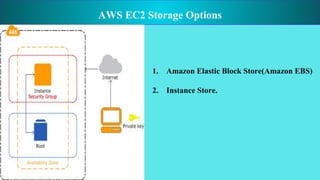
AWS EC2 Storage Options
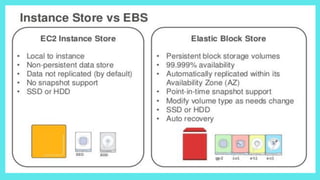
1. Amazon Elastic Block Store(Amazon EBS)
2. Instance Store.
● Block-level storage volumes for use with EC2 instances.
● Use them like any block device (like a hard drive).
● EBS volumes are network-attached, and persist independently from the life of an
instance
● Once mounted, the instance can interact with the volume as it would with a local drive,
formatting it with a file system or installing applications on it directly.
● Storage volume sizes range from 1GB-1TB
● A volume can only be attached to one instance at a time, but many volumes can be
attached to a single instance
● Suitable for apps that require a database, file system, or access to raw block level storage.
Amazon Elastic Block Store(Amazon EBS)
● EBS volumes are placed in a specific Availability Zone, and can then be attached to
instances also in that same Availability Zone.
● Each storage volume is automatically replicated within the same Availability Zone.
● EBS provides the ability to create point-in-time snapshots of volumes, which are
persisted to Amazon S3.
● These snapshots can be used as the starting point for new Amazon EBS volumes, and
protect data for long-term durability.
● The same snapshot can be used to instantiate as many volumes as you wish.
● These snapshots can be copied across AWS regions.
Amazon Elastic Block Store(Amazon EBS)
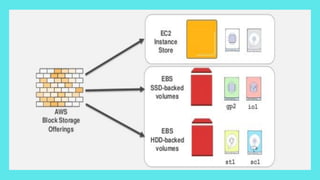
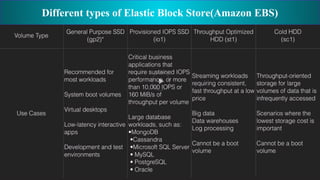
Different types of Elastic Block Store(Amazon EBS)
● Data availability
- When you create an EBS volume in an Availability Zone, it is automatically replicated within that
zone to prevent data loss due to failure of any single hardware component.
● Data persistence
- An EBS volume is off-instance storage that can persist independently from the life of an instance.
You continue to pay for the volume usage as long as the data persists.
● Data encryption
● Snapshots
- Amazon EBS provides the ability to create snapshots (backups) of any EBS volume and write a
copy of the data in the volume to Amazon S3, where it is stored redundantly in multiple Availability
Zones.
● Flexibility
- EBS volumes support live configuration changes while in production. You can modify volume
type, volume size, and IOPS capacity without service interruptions.
Benefits of Using EBS Volumes
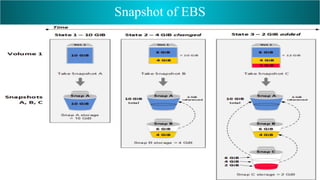
● EBS provides the ability to back up point-in-time snapshots of your data to S3.
● Snapshots are incremental backups: only the blocks on the device that have changed since your last
snapshot will be saved.
● For Example: If you have a device with 100GBs of data, but only 5GBs of data has changed since
your last snapshot, only the 5 additional GBs of snapshot data will be stored back to S3
Snapshot of EBS
Snapshot of EBS
1. Open the Amazon EC2 console at https://console.aws.amazon.com/ec2/.
2. Choose Snapshots in the navigation pane.
3. Choose Create Snapshot.
4. On the Create Snapshot page, select the volume to create a snapshot for.
5. (Optional) Choose Add tags to your snapshot. For each tag, provide a tag key and a tag
value.
Snapshot of EBS
1. OpenAWS Console.
2. Click the Volume section within AWS console under the EC2 dashboard.
3. Click on Create Volume button
● The first thing that you will have to specify is the volume type.
● The next piece of information that you must provide is the size of the volume that you want to create. The volume
size can be between 1GB and 16TB.
● You will also have to specify the availability zone for the volume that you are creating. This setting essentially
determines where in the world the volume will physically reside.
● Then the snapshot ID. You won't have to worry about providing a snapshot ID unless you want to create the
volume based on an existing snapshot.
● The last setting on this dialog box is the Encryption setting. this setting allows you to use a simple checkbox to
encrypt the volume.
● Click the Create button and the volume will be created.
4. To link the volume to an instance
● right-click on the volume and choose the Attach Volume command from the shortcut menu.
● provide an instance ID for the instance. You can only attach a volume to an instance that exists in the same
availability zone as the volume
● provide a device ID for the volume.
● Click the Attach button to attach the volume to the instance,
Creating and attaching additional EBS volume.
● Log in to an instance through ssh and list the disk attached to the instance by using the command:
# fdisk -l
● List the block device by using the command:
# lsblk
● Check the file system on the attached volume:
# file -s /dev/xvdf
● create a file system for them before we can mount them. We can do this by using:
# mkfs.ext4 /dev/xvdf
● Create a mount directory where you want to mount the device:
# mkdir /mountdir
● Open the /etc/fstab file and add a new line at the end of file
/dev/xvdf /mountdir ext4 defaults 0 0
● Run below-mentioned mount command to mount all of the filesystems in /etc/fstab file.
# mount -a
● Check the disk’s free space by using the command below
# df -h
Mount EBS Volume
Presented by Arya TM

EBS elastic block store

  • 1.
  • 2.
    AWS Cloud StorageProducts 1. Amazon Elastic Block Store(Amazon EBS) 2. Amazon Simple Storage Service(Amazon S3) 3. Amazon Elastic File System (Amazon EFS) 4. Amazon Glacier 5. AWS Storage Gateway
  • 3.
    AWS EC2 StorageOptions 1. Amazon Elastic Block Store(Amazon EBS) 2. Instance Store.
  • 6.
    ● Block-level storagevolumes for use with EC2 instances. ● Use them like any block device (like a hard drive). ● EBS volumes are network-attached, and persist independently from the life of an instance ● Once mounted, the instance can interact with the volume as it would with a local drive, formatting it with a file system or installing applications on it directly. ● Storage volume sizes range from 1GB-1TB ● A volume can only be attached to one instance at a time, but many volumes can be attached to a single instance ● Suitable for apps that require a database, file system, or access to raw block level storage. Amazon Elastic Block Store(Amazon EBS)
  • 7.
    ● EBS volumesare placed in a specific Availability Zone, and can then be attached to instances also in that same Availability Zone. ● Each storage volume is automatically replicated within the same Availability Zone. ● EBS provides the ability to create point-in-time snapshots of volumes, which are persisted to Amazon S3. ● These snapshots can be used as the starting point for new Amazon EBS volumes, and protect data for long-term durability. ● The same snapshot can be used to instantiate as many volumes as you wish. ● These snapshots can be copied across AWS regions. Amazon Elastic Block Store(Amazon EBS)
  • 8.
    Different types ofElastic Block Store(Amazon EBS)
  • 9.
    ● Data availability -When you create an EBS volume in an Availability Zone, it is automatically replicated within that zone to prevent data loss due to failure of any single hardware component. ● Data persistence - An EBS volume is off-instance storage that can persist independently from the life of an instance. You continue to pay for the volume usage as long as the data persists. ● Data encryption ● Snapshots - Amazon EBS provides the ability to create snapshots (backups) of any EBS volume and write a copy of the data in the volume to Amazon S3, where it is stored redundantly in multiple Availability Zones. ● Flexibility - EBS volumes support live configuration changes while in production. You can modify volume type, volume size, and IOPS capacity without service interruptions. Benefits of Using EBS Volumes
  • 10.
    ● EBS providesthe ability to back up point-in-time snapshots of your data to S3. ● Snapshots are incremental backups: only the blocks on the device that have changed since your last snapshot will be saved. ● For Example: If you have a device with 100GBs of data, but only 5GBs of data has changed since your last snapshot, only the 5 additional GBs of snapshot data will be stored back to S3 Snapshot of EBS
  • 11.
  • 12.
    1. Open theAmazon EC2 console at https://console.aws.amazon.com/ec2/. 2. Choose Snapshots in the navigation pane. 3. Choose Create Snapshot. 4. On the Create Snapshot page, select the volume to create a snapshot for. 5. (Optional) Choose Add tags to your snapshot. For each tag, provide a tag key and a tag value. Snapshot of EBS
  • 13.
    1. OpenAWS Console. 2.Click the Volume section within AWS console under the EC2 dashboard. 3. Click on Create Volume button ● The first thing that you will have to specify is the volume type. ● The next piece of information that you must provide is the size of the volume that you want to create. The volume size can be between 1GB and 16TB. ● You will also have to specify the availability zone for the volume that you are creating. This setting essentially determines where in the world the volume will physically reside. ● Then the snapshot ID. You won't have to worry about providing a snapshot ID unless you want to create the volume based on an existing snapshot. ● The last setting on this dialog box is the Encryption setting. this setting allows you to use a simple checkbox to encrypt the volume. ● Click the Create button and the volume will be created. 4. To link the volume to an instance ● right-click on the volume and choose the Attach Volume command from the shortcut menu. ● provide an instance ID for the instance. You can only attach a volume to an instance that exists in the same availability zone as the volume ● provide a device ID for the volume. ● Click the Attach button to attach the volume to the instance, Creating and attaching additional EBS volume.
  • 14.
    ● Log into an instance through ssh and list the disk attached to the instance by using the command: # fdisk -l ● List the block device by using the command: # lsblk ● Check the file system on the attached volume: # file -s /dev/xvdf ● create a file system for them before we can mount them. We can do this by using: # mkfs.ext4 /dev/xvdf ● Create a mount directory where you want to mount the device: # mkdir /mountdir ● Open the /etc/fstab file and add a new line at the end of file /dev/xvdf /mountdir ext4 defaults 0 0 ● Run below-mentioned mount command to mount all of the filesystems in /etc/fstab file. # mount -a ● Check the disk’s free space by using the command below # df -h Mount EBS Volume Presented by Arya TM