



Getting Started
• Setup your workshop platform:
• https://bit.ly/2ZohsS1
• Token: 4YSH
• Background slides: https://bit.ly/2Ww980G
• Code repo: https://github.com/michael-
kehoe/bpf-workshop/
• Please let me know ASAP if you’re having
problems
(c|e)BPF Workshop
Michael Kehoe
Sr Staff Site Reliability Engineer
Agenda
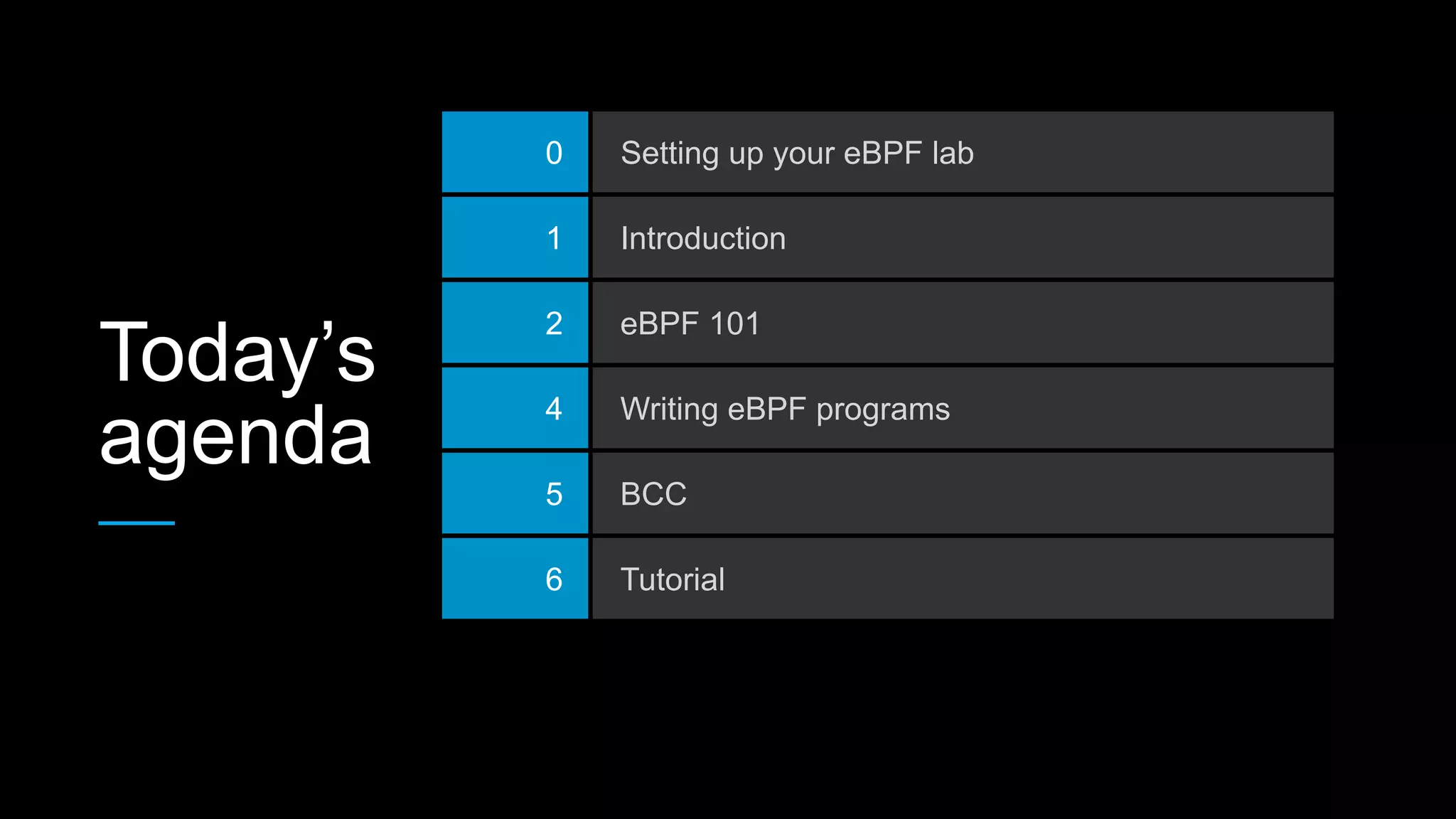
Today’s
agenda
0 Setting up your eBPF lab
1 Introduction
2 eBPF 101
4 Writing eBPF programs
5 BCC
6 Tutorial
Getting Started
• Setup your workshop platform:
• https://bit.ly/2ZohsS1
• Token: 4YSH
• Background slides: https://bit.ly/2Ww980G
• Code repo: https://github.com/michael-
kehoe/bpf-workshop/
• Please let me know ASAP if you’re having
problems
Introduction
Michael Kehoe
$ WHOAMI
• Sr Staff Site Reliability Engineer @
LinkedIn
• Production-SRE Team
• What I do:
• Disaster Recovery
• (Organizational) Visibility Engineering
• Incident Management
• Reliability Research
eBPF 101
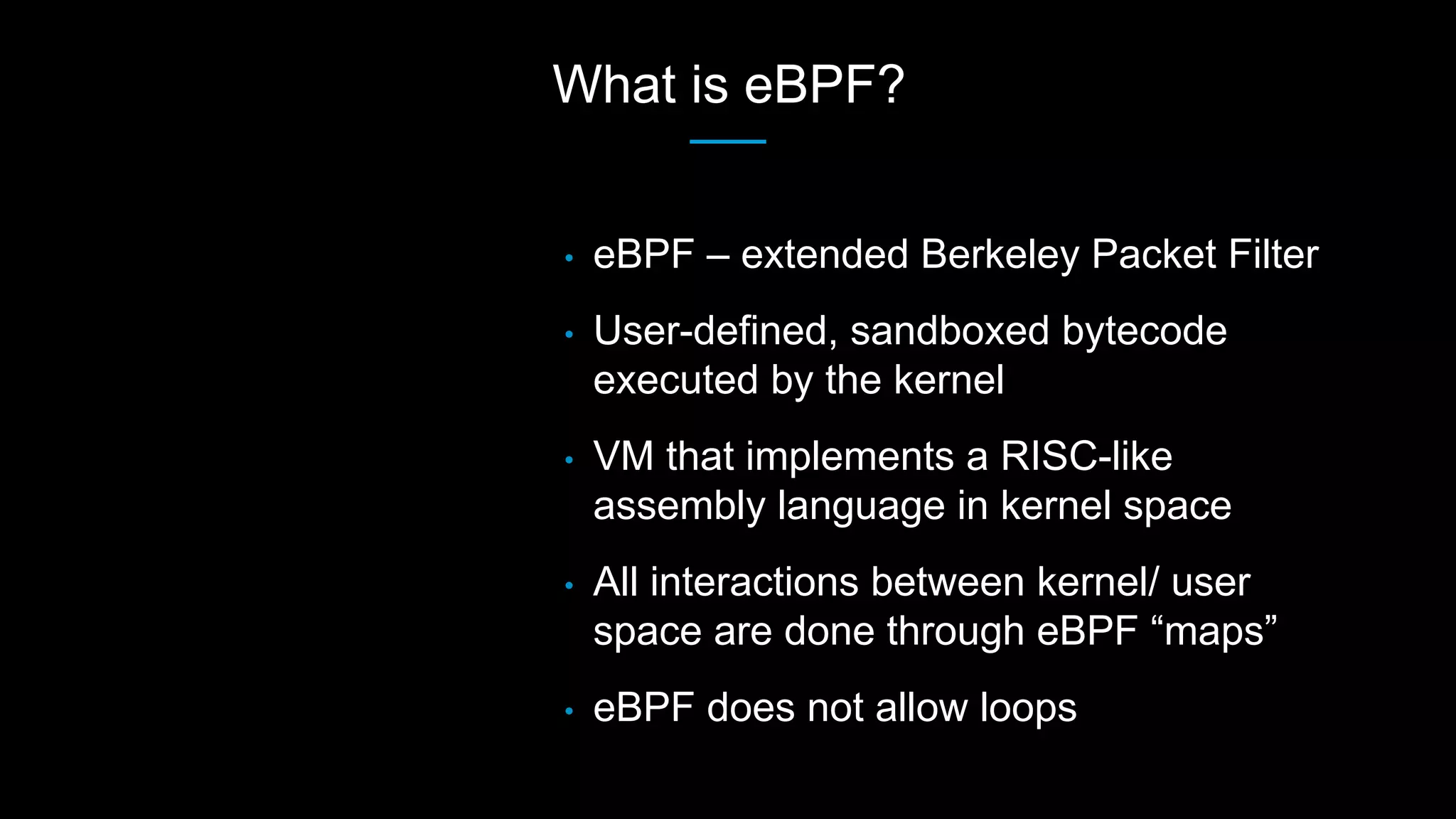
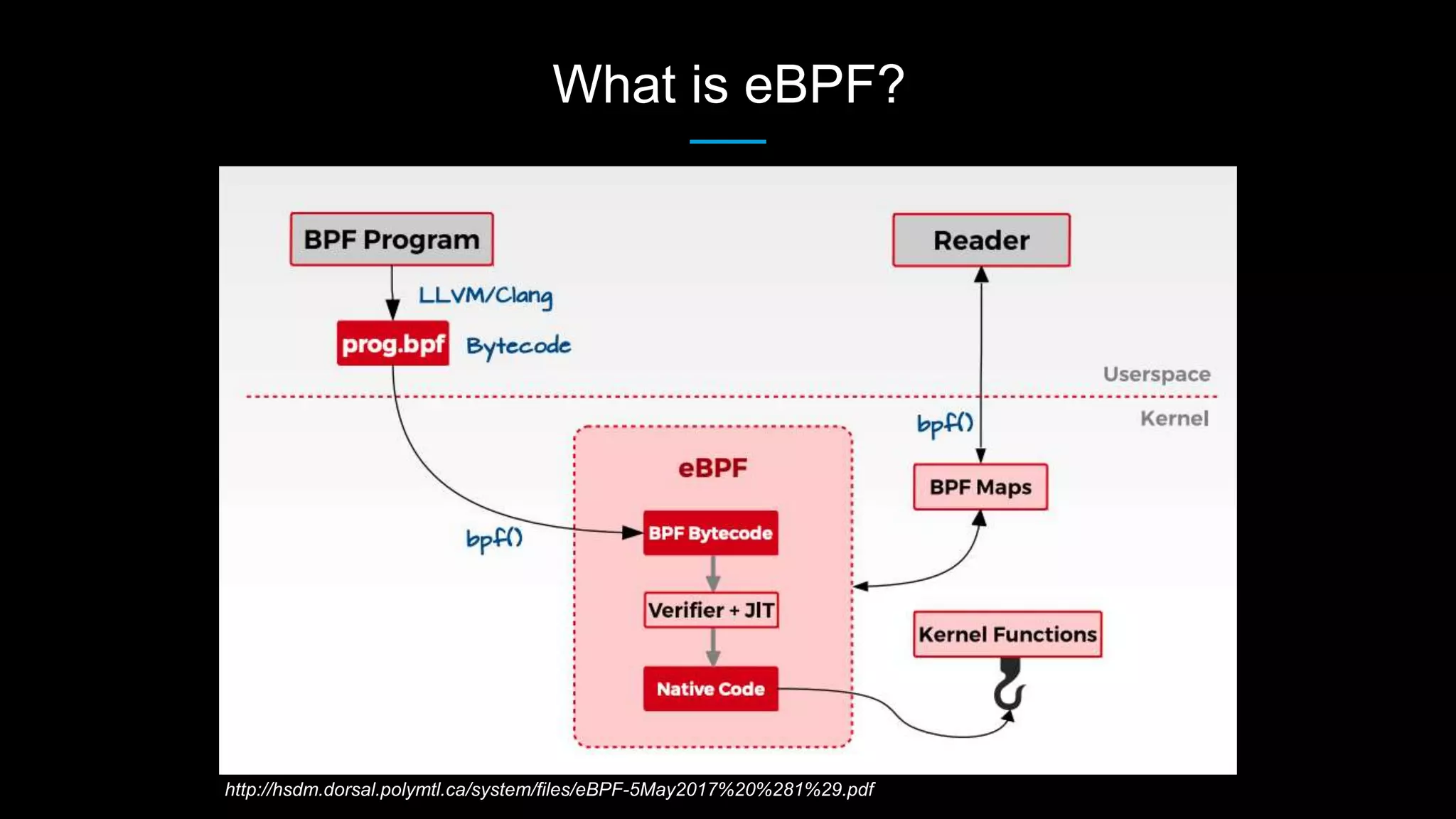
What is eBPF?
• eBPF – extended Berkeley Packet Filter
• User-defined, sandboxed bytecode
executed by the kernel
• VM that implements a RISC-like
assembly language in kernel space
• All interactions between kernel/ user
space are done through eBPF “maps”
• eBPF does not allow loops
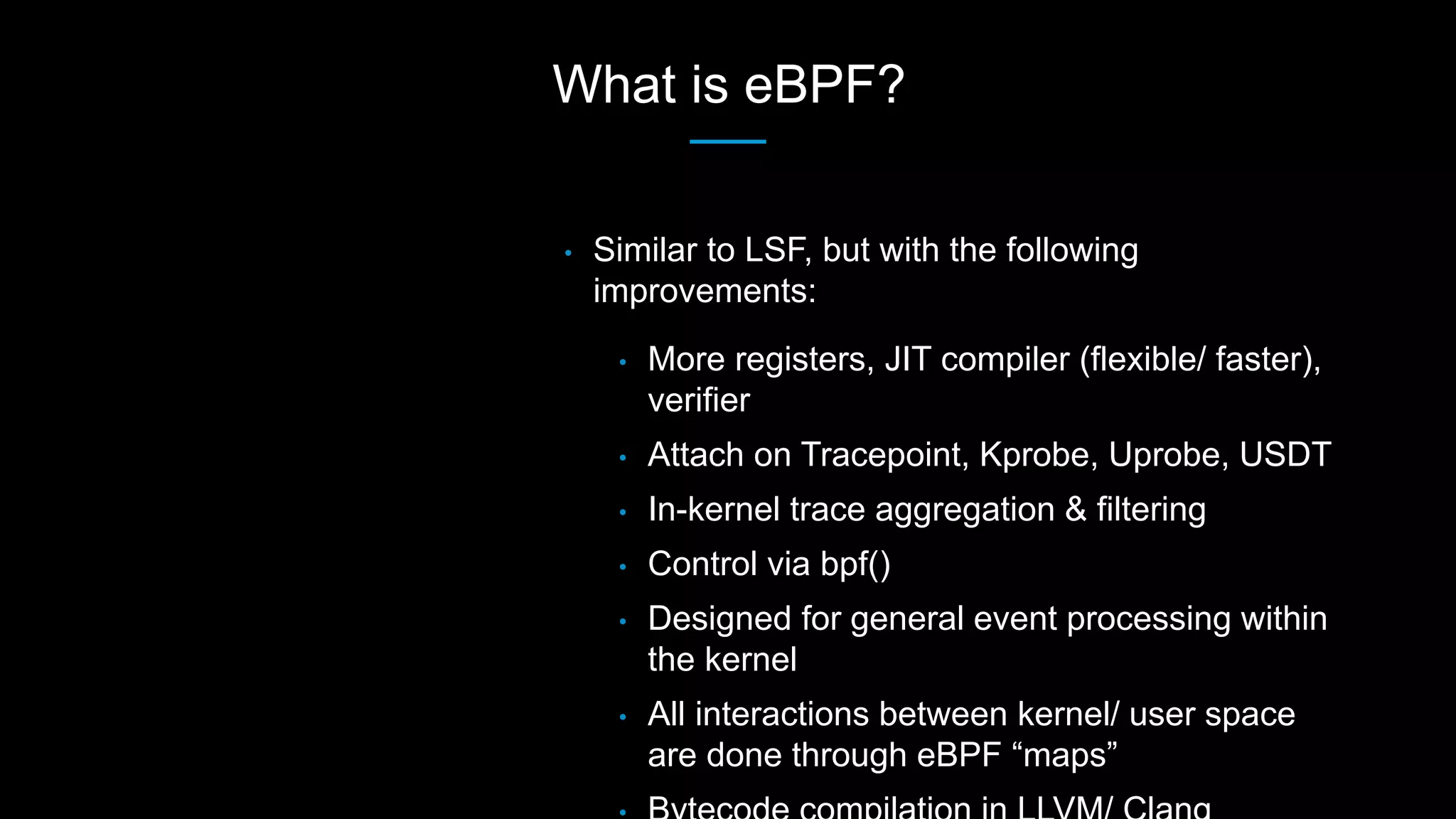
What is eBPF?
• Similar to LSF, but with the following
improvements:
• More registers, JIT compiler (flexible/ faster),
verifier
• Attach on Tracepoint, Kprobe, Uprobe, USDT
• In-kernel trace aggregation & filtering
• Control via bpf()
• Designed for general event processing within
the kernel
• All interactions between kernel/ user space
are done through eBPF “maps”
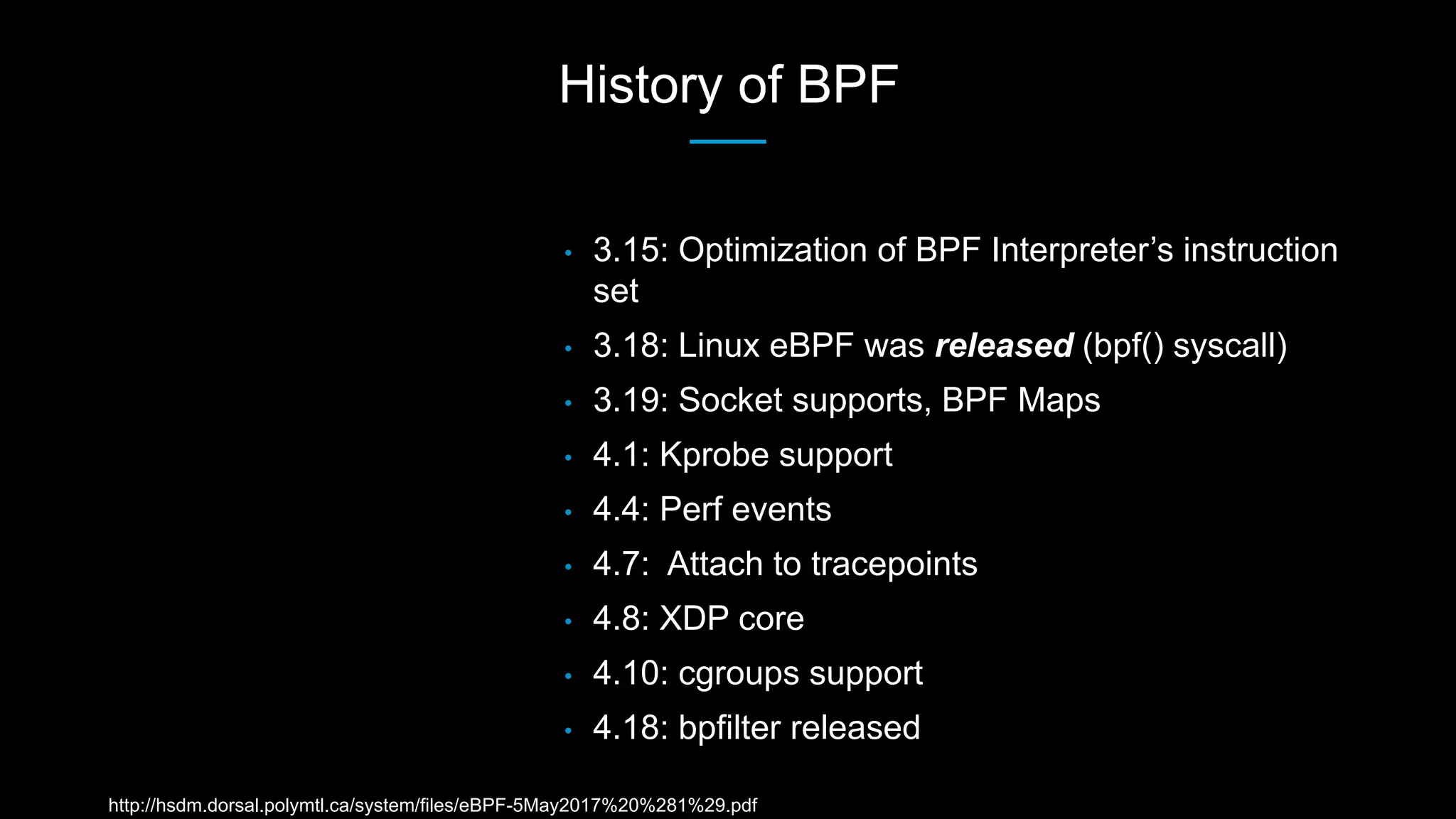
History of BPF
• 3.15: Optimization of BPF Interpreter’s instruction
set
• 3.18: Linux eBPF was released (bpf() syscall)
• 3.19: Socket supports, BPF Maps
• 4.1: Kprobe support
• 4.4: Perf events
• 4.7: Attach to tracepoints
• 4.8: XDP core
• 4.10: cgroups support
• 4.18: bpfilter released
http://hsdm.dorsal.polymtl.ca/system/files/eBPF-5May2017%20%281%29.pdf
What is eBPF?
http://hsdm.dorsal.polymtl.ca/system/files/eBPF-5May2017%20%281%29.pdf
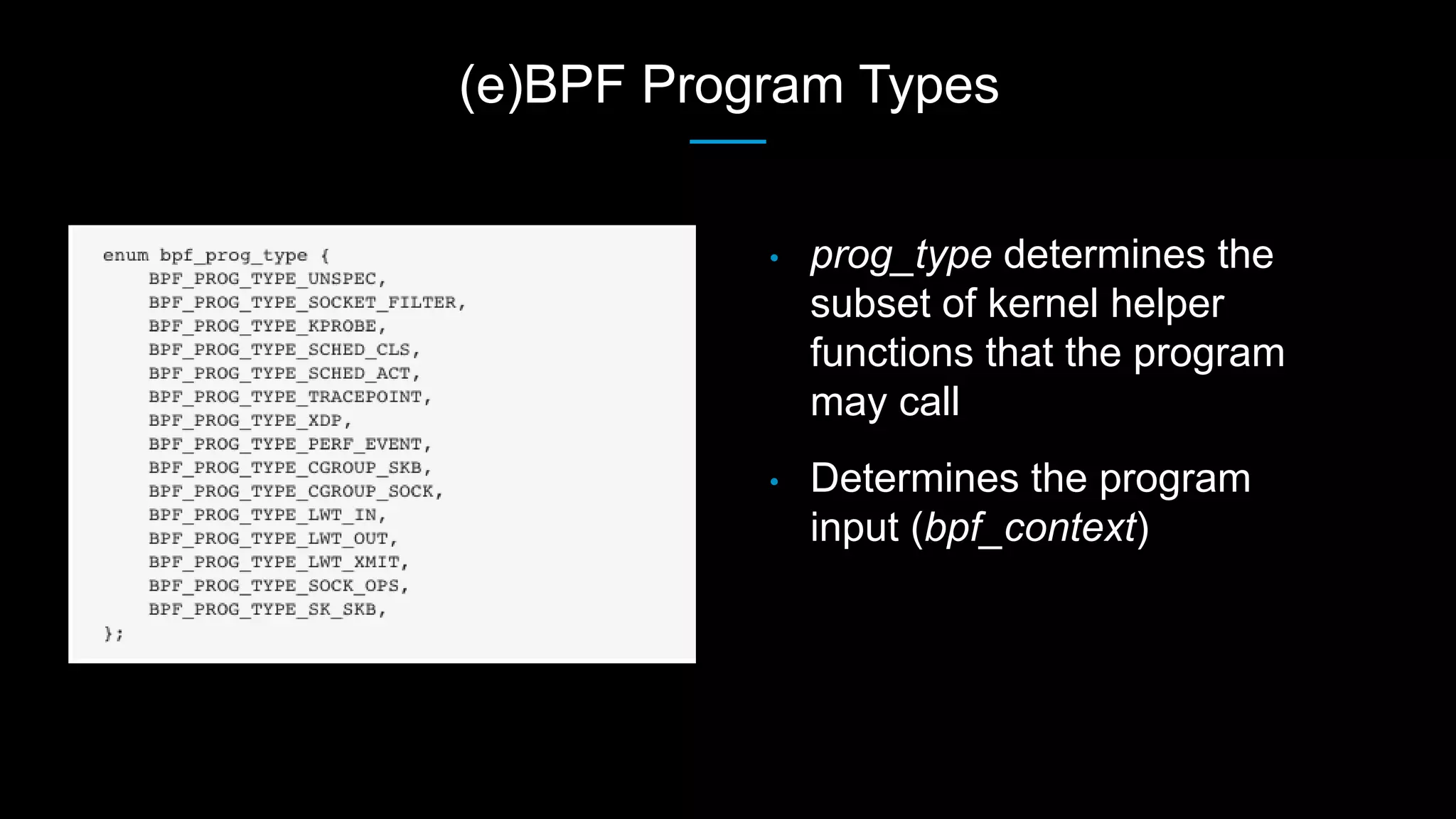
(e)BPF Program Types
• prog_type determines the
subset of kernel helper
functions that the program
may call
• Determines the program
input (bpf_context)
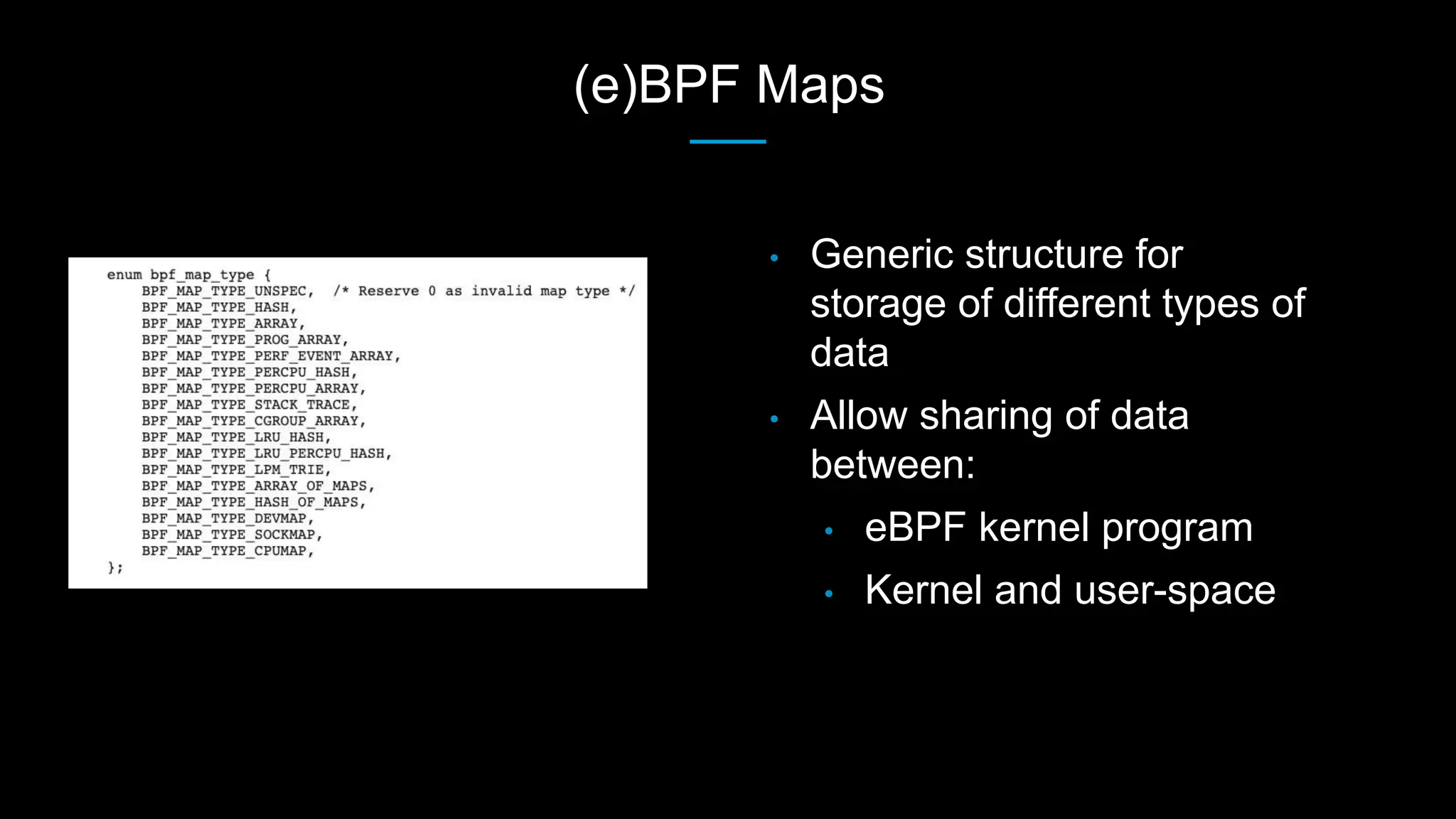
(e)BPF Maps
• Generic structure for
storage of different types of
data
• Allow sharing of data
between:
• eBPF kernel program
• Kernel and user-space
Writing eBPF programs
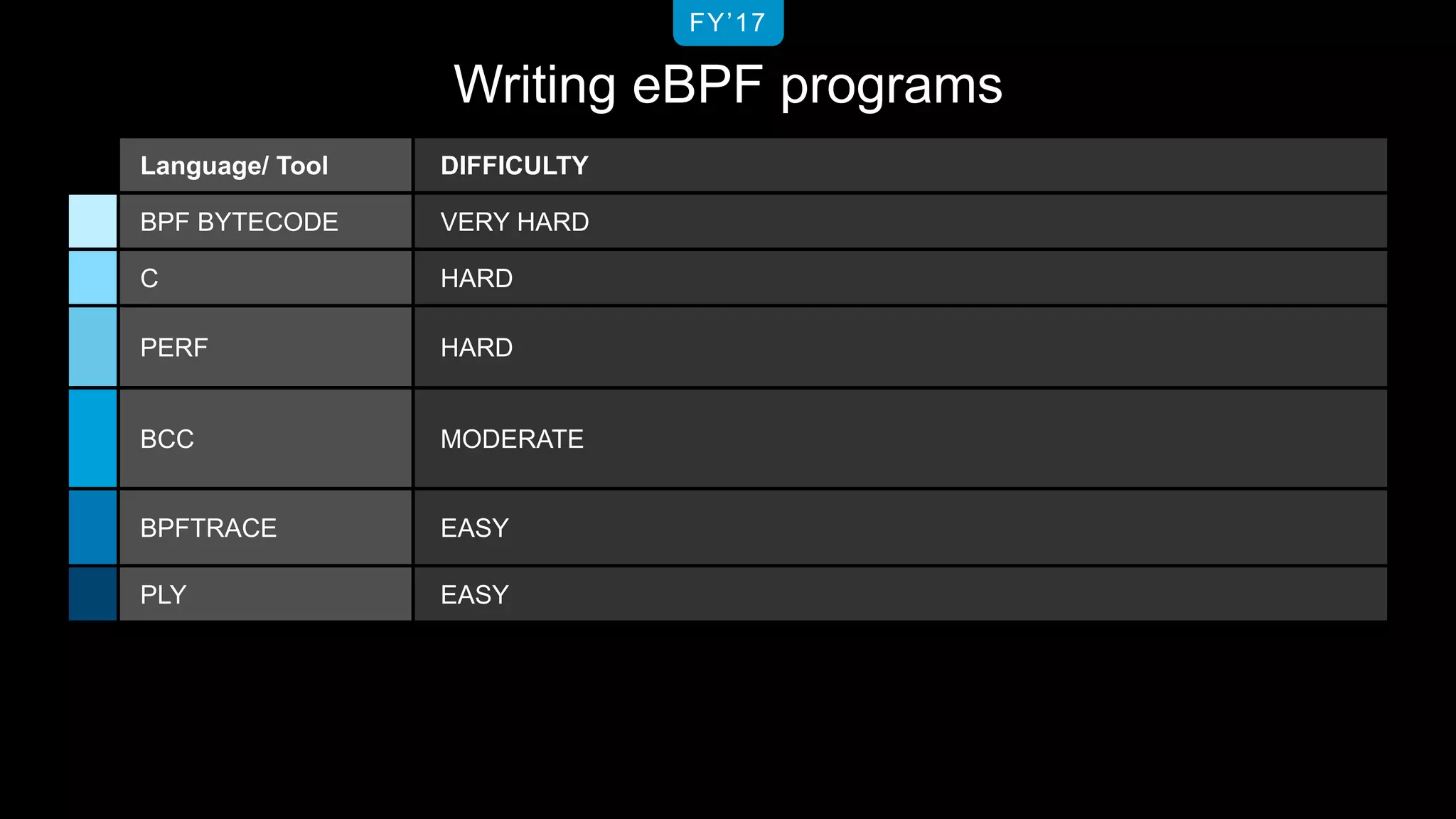
FY’17
Language/ Tool DIFFICULTY
BPF BYTECODE VERY HARD
C HARD
PERF HARD
BCC MODERATE
BPFTRACE EASY
PLY EASY
BCC
BPF Compiler Collection
BCC is a toolkit for creating efficient kernel
tracing and manipulation programs, and
includes several useful tools and examples. It
makes use of extended BPF (Berkeley Packet
Filters), formally known as eBPF,
https://github.com/iovisor/bcc
BCC makes BPF programs easier to write, with
kernel instrumentation in C (and includes a C
wrapper around LLVM), and front-ends in
Python and lua. It is suited for many tasks,
including performance analysis and network
traffic control.
https://github.com/iovisor/bcc
BCC
https://github.com/iovisor/bcc
BCC
Installation
BCC
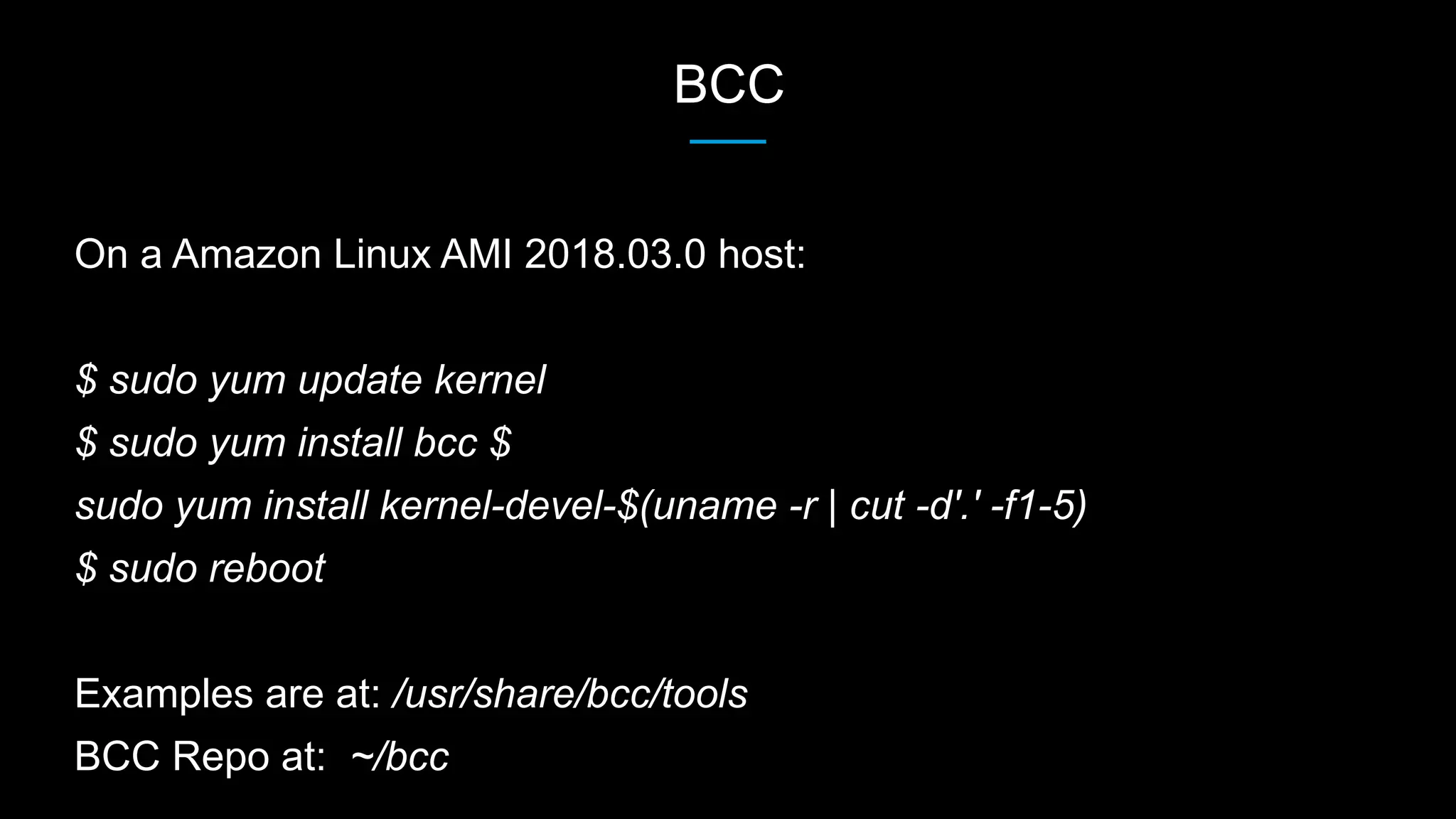
On a Amazon Linux AMI 2018.03.0 host:
$ sudo yum update kernel
$ sudo yum install bcc $
sudo yum install kernel-devel-$(uname -r | cut -d'.' -f1-5)
$ sudo reboot
Examples are at: /usr/share/bcc/tools
BCC Repo at: ~/bcc
BCC
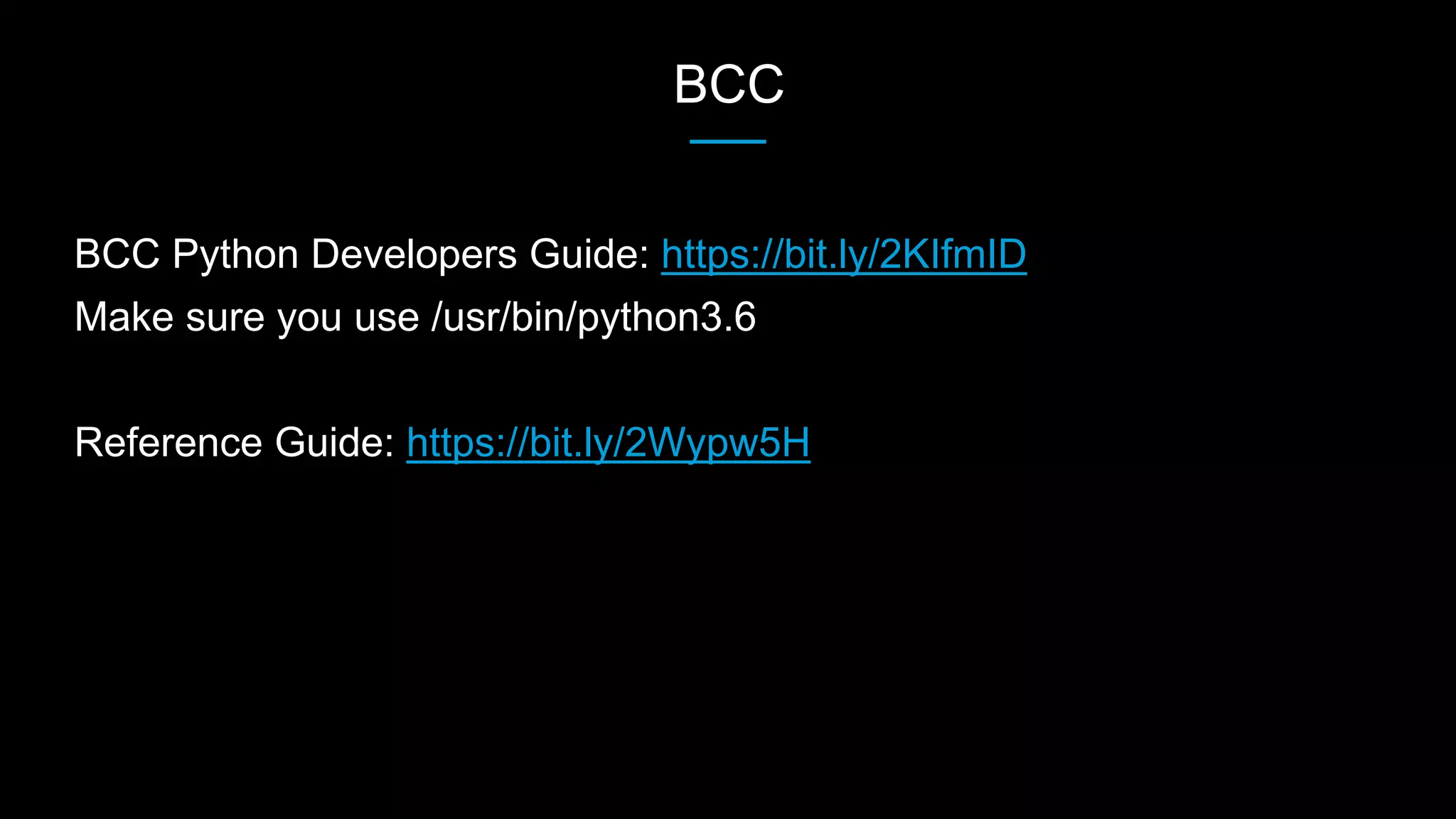
BCC Python Developers Guide: https://bit.ly/2KIfmID
Make sure you use /usr/bin/python3.6
Reference Guide: https://bit.ly/2Wypw5H
Tutorial
Look at `tutorial.md` in the Github repo
eBPF Workshop

eBPF Workshop

  • 1.
    Getting Started • Setupyour workshop platform: • https://bit.ly/2ZohsS1 • Token: 4YSH • Background slides: https://bit.ly/2Ww980G • Code repo: https://github.com/michael- kehoe/bpf-workshop/ • Please let me know ASAP if you’re having problems
  • 2.
    (c|e)BPF Workshop Michael Kehoe SrStaff Site Reliability Engineer
  • 3.
  • 4.
    Today’s agenda 0 Setting upyour eBPF lab 1 Introduction 2 eBPF 101 4 Writing eBPF programs 5 BCC 6 Tutorial
  • 5.
    Getting Started • Setupyour workshop platform: • https://bit.ly/2ZohsS1 • Token: 4YSH • Background slides: https://bit.ly/2Ww980G • Code repo: https://github.com/michael- kehoe/bpf-workshop/ • Please let me know ASAP if you’re having problems
  • 6.
  • 7.
    Michael Kehoe $ WHOAMI •Sr Staff Site Reliability Engineer @ LinkedIn • Production-SRE Team • What I do: • Disaster Recovery • (Organizational) Visibility Engineering • Incident Management • Reliability Research
  • 8.
  • 9.
    What is eBPF? •eBPF – extended Berkeley Packet Filter • User-defined, sandboxed bytecode executed by the kernel • VM that implements a RISC-like assembly language in kernel space • All interactions between kernel/ user space are done through eBPF “maps” • eBPF does not allow loops
  • 10.
    What is eBPF? •Similar to LSF, but with the following improvements: • More registers, JIT compiler (flexible/ faster), verifier • Attach on Tracepoint, Kprobe, Uprobe, USDT • In-kernel trace aggregation & filtering • Control via bpf() • Designed for general event processing within the kernel • All interactions between kernel/ user space are done through eBPF “maps”
  • 11.
    History of BPF •3.15: Optimization of BPF Interpreter’s instruction set • 3.18: Linux eBPF was released (bpf() syscall) • 3.19: Socket supports, BPF Maps • 4.1: Kprobe support • 4.4: Perf events • 4.7: Attach to tracepoints • 4.8: XDP core • 4.10: cgroups support • 4.18: bpfilter released http://hsdm.dorsal.polymtl.ca/system/files/eBPF-5May2017%20%281%29.pdf
  • 12.
  • 13.
    (e)BPF Program Types •prog_type determines the subset of kernel helper functions that the program may call • Determines the program input (bpf_context)
  • 14.
    (e)BPF Maps • Genericstructure for storage of different types of data • Allow sharing of data between: • eBPF kernel program • Kernel and user-space
  • 15.
  • 16.
    Writing eBPF programs FY’17 Language/Tool DIFFICULTY BPF BYTECODE VERY HARD C HARD PERF HARD BCC MODERATE BPFTRACE EASY PLY EASY
  • 17.
  • 18.
    BCC is atoolkit for creating efficient kernel tracing and manipulation programs, and includes several useful tools and examples. It makes use of extended BPF (Berkeley Packet Filters), formally known as eBPF, https://github.com/iovisor/bcc
  • 19.
    BCC makes BPFprograms easier to write, with kernel instrumentation in C (and includes a C wrapper around LLVM), and front-ends in Python and lua. It is suited for many tasks, including performance analysis and network traffic control. https://github.com/iovisor/bcc
  • 20.
  • 21.
  • 22.
    BCC On a AmazonLinux AMI 2018.03.0 host: $ sudo yum update kernel $ sudo yum install bcc $ sudo yum install kernel-devel-$(uname -r | cut -d'.' -f1-5) $ sudo reboot Examples are at: /usr/share/bcc/tools BCC Repo at: ~/bcc
  • 23.
    BCC BCC Python DevelopersGuide: https://bit.ly/2KIfmID Make sure you use /usr/bin/python3.6 Reference Guide: https://bit.ly/2Wypw5H
  • 24.
  • 25.
    Look at `tutorial.md`in the Github repo

Editor's Notes

  • #17 There’s various ways to write eBPF programs. Starting with C which as you can imagine is fun Bcc & bpftrace are reasonably common at the larger companies that use eBPF