Introduction to eBPF
Network Applications
Roger Coll - 3/12/2020
Universitat Politècnica de Catalunya
Linux Kernel
◉ Free and open-source
◉ Modular
◉ Multitasking
◉ Monolithic
◉ Written in C
About 33% of web servers use Linux as OS !
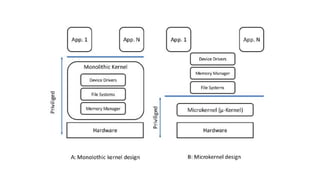
Monolithic Kernel
- The entire OS is working in the Kernel space
- All OS code runs in privileged mode
- High performance, but higher risk for system
crash
What is BPF?
Berkeley Packet Filter is a small virtual machine that can run
programs injected from the user space in the kernel space
without changing/recompiling the kernel code.
- First implementation (BPF) => Linux Kernel 3.15 (1992)
- Better known as the packet filter language for tcpdump
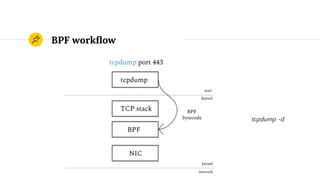
BPF workflow
tcpdump -d
Any benefit?
- Avoids copying unwanted packets from the OS to the
process/user space.
Huge impact on performance
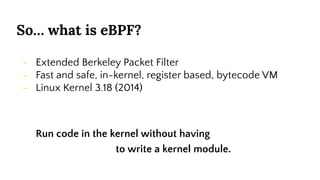
So… what is eBPF?
- Extended Berkeley Packet Filter
- Fast and safe, in-kernel, register based, bytecode VM
- Linux Kernel 3.18 (2014)
Run code in the kernel without having
to write a kernel module.
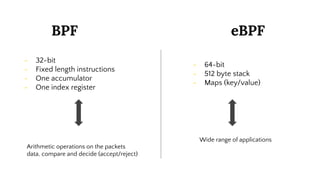
BPF eBPF
- 32-bit
- Fixed length instructions
- One accumulator
- One index register
Arithmetic operations on the packets
data, compare and decide (accept/reject)
- 64-bit
- 512 byte stack
- Maps (key/value)
Wide range of applications
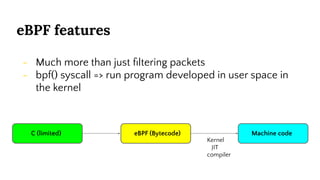
eBPF features
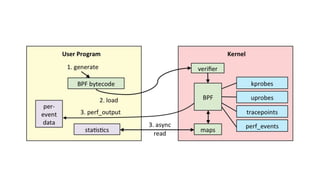
- Much more than just filtering packets
- bpf() syscall => run program developed in user space in
the kernel
C (limited) eBPF (Bytecode) Machine code
Kernel
JIT
compiler
Hello World
+ Kprobes example
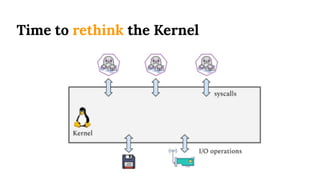
Time to rethink the Kernel
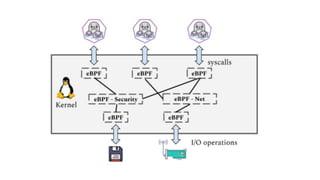
From monolithic to microkernel or kernel with microservices
Network use cases
- SDN configuration
- DDos mitigation (cloudflare)
- Intrusion detection
- Network security at application layer => Cilium k8s
- Load balancing (facebook data centers)
- Servers performance
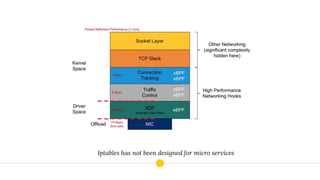
Iptables has not been designed for micro services
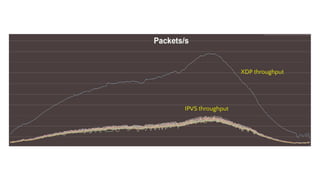
XDP throughput
IPVS throughput
Any questions ?
Thanks!

Introduction to eBPF

  • 1.
    Introduction to eBPF NetworkApplications Roger Coll - 3/12/2020 Universitat Politècnica de Catalunya
  • 2.
    Linux Kernel ◉ Freeand open-source ◉ Modular ◉ Multitasking ◉ Monolithic ◉ Written in C About 33% of web servers use Linux as OS !
  • 3.
    Monolithic Kernel - Theentire OS is working in the Kernel space - All OS code runs in privileged mode - High performance, but higher risk for system crash
  • 5.
    What is BPF? BerkeleyPacket Filter is a small virtual machine that can run programs injected from the user space in the kernel space without changing/recompiling the kernel code. - First implementation (BPF) => Linux Kernel 3.15 (1992) - Better known as the packet filter language for tcpdump
  • 6.
  • 7.
    Any benefit? - Avoidscopying unwanted packets from the OS to the process/user space. Huge impact on performance
  • 8.
    So… what iseBPF? - Extended Berkeley Packet Filter - Fast and safe, in-kernel, register based, bytecode VM - Linux Kernel 3.18 (2014) Run code in the kernel without having to write a kernel module.
  • 9.
    BPF eBPF - 32-bit -Fixed length instructions - One accumulator - One index register Arithmetic operations on the packets data, compare and decide (accept/reject) - 64-bit - 512 byte stack - Maps (key/value) Wide range of applications
  • 10.
    eBPF features - Muchmore than just filtering packets - bpf() syscall => run program developed in user space in the kernel C (limited) eBPF (Bytecode) Machine code Kernel JIT compiler
  • 12.
  • 13.
    Time to rethinkthe Kernel
  • 14.
    From monolithic tomicrokernel or kernel with microservices
  • 16.
    Network use cases -SDN configuration - DDos mitigation (cloudflare) - Intrusion detection - Network security at application layer => Cilium k8s - Load balancing (facebook data centers) - Servers performance
  • 17.
    Iptables has notbeen designed for micro services
  • 18.
  • 19.