EARTHQUAKE   AWARENESS http://disaster-risk-management.blogspot.com
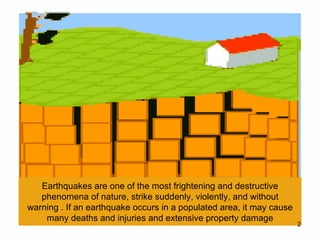
Earthquakes are one of the most frightening and destructive phenomena of nature, strike suddenly, violently, and without warning . If an earthquake occurs in a populated area, it may cause many deaths and injuries and extensive property damage
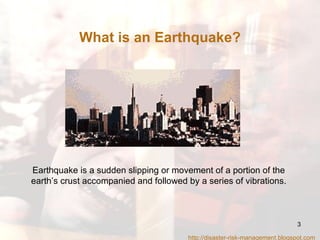
Earthquake is a sudden slipping or movement of a portion of the earth’s crust accompanied and followed by a series of vibrations. What is an Earthquake? http://disaster-risk-management.blogspot.com
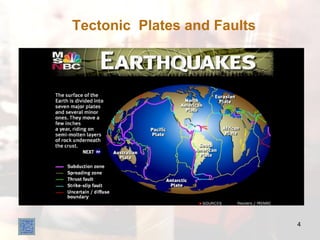
Tectonic  Plates and Faults
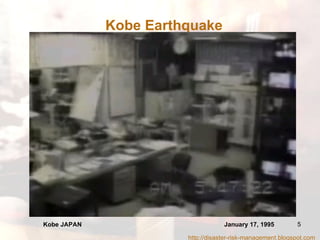
Kobe JAPAN January 17, 1995 Kobe Earthquake http://disaster-risk-management.blogspot.com
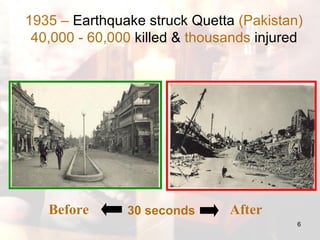
Before After 1935 –  Earthquake struck Quetta  (Pakistan) 40,000 - 60,000  killed &  thousands  injured 30 seconds
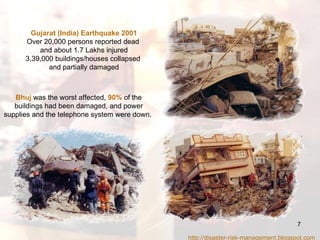
Bhuj  was the worst affected,  90%   of the buildings had been damaged, and power supplies and the telephone system were down.  Gujarat (India) Earthquake 2001 Over 20,000 persons reported dead  and about 1.7 Lakhs injured 3,39,000 buildings/houses collapsed  and partially damaged http://disaster-risk-management.blogspot.com
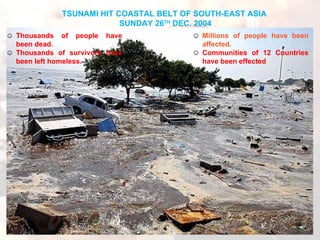
Millions of people have been affected.  Communities of 12 Countries have been effected . TSUNAMI HIT COASTAL BELT OF SOUTH-EAST ASIA  SUNDAY 26 TH  DEC. 2004 Thousands of people have been dead.   Thousands of survivors have been left homeless.
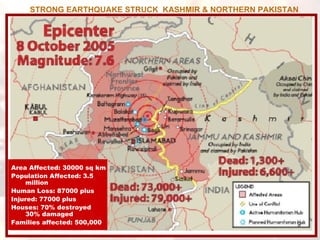
Area Affected: 30000 sq km Population Affected: 3.5 million Human Loss: 87000 plus Injured: 77000 plus Houses: 70% destroyed 30% damaged Families affected: 500,000 STRONG EARTHQUAKE STRUCK  KASHMIR & NORTHERN PAKISTAN
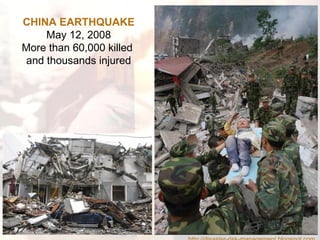
CHINA EARTHQUAKE May 12, 2008 More than 60,000 killed  and thousands injured http://disaster-risk-management.blogspot.com
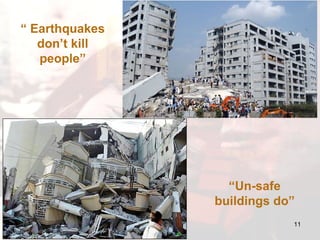
“  Earthquakes don’t kill people” “ Un-safe buildings do”
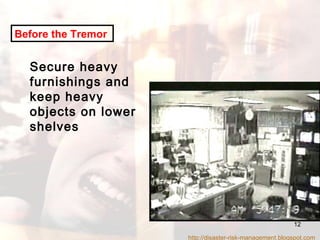
Before the Tremor   Secure heavy furnishings and keep heavy objects on lower shelves http://disaster-risk-management.blogspot.com
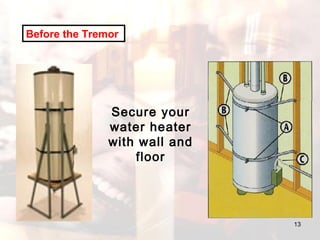
Before the Tremor   Secure your water heater with wall and floor
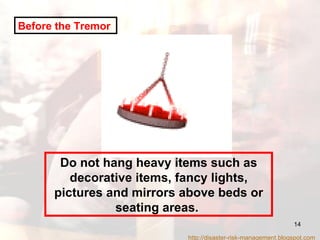
Do not hang heavy items such as decorative items, fancy lights, pictures and mirrors above beds or seating areas.  Before the Tremor   http://disaster-risk-management.blogspot.com
Store weed killers, pesticides, and flammable products securely in closed cabinets with latches and on bottom shelves.  Before the Tremor
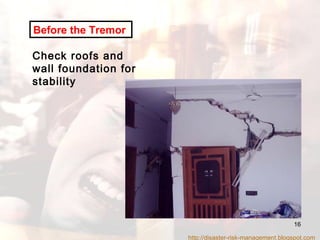
Check roofs and wall foundation for stability Before the Tremor   http://disaster-risk-management.blogspot.com
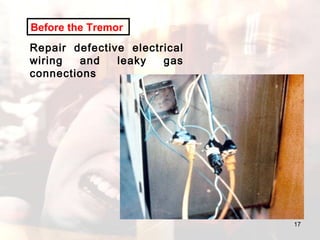
Before the Tremor   Repair defective electrical wiring and leaky gas connections
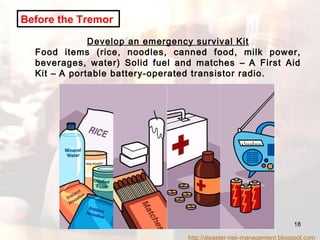
Develop an emergency survival Kit Food items (rice, noodles, canned food, milk power, beverages, water) Solid fuel and matches  –  A First Aid Kit  –  A portable battery-operated transistor radio. Before the Tremor   http://disaster-risk-management.blogspot.com
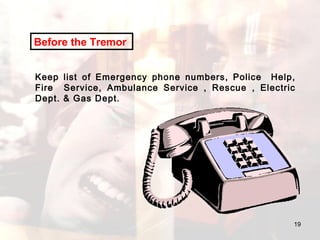
Keep list of Emergency phone numbers, Police  Help, Fire  Service, Ambulance Service , Rescue , Electric Dept. & Gas Dept.  Before the Tremor
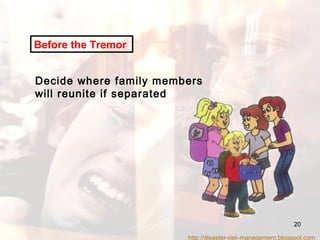
Before the Tremor   Decide where family members will reunite if separated http://disaster-risk-management.blogspot.com
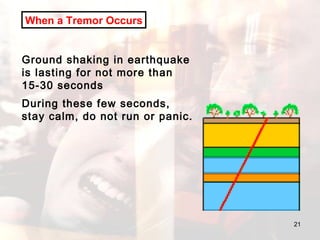
Ground shaking in earthquake is lasting for not more than 15-30 seconds  During these few seconds, stay calm, do not run or panic. When a Tremor Occurs
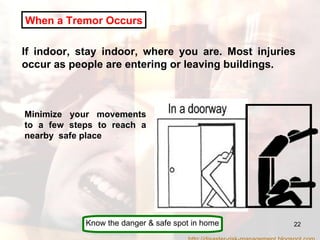
When a Tremor Occurs If indoor, stay indoor, where you are. Most injuries occur as people are entering or leaving buildings. Minimize your movements to a few steps to reach a nearby  safe place Know the danger & safe spot in home http://disaster-risk-management.blogspot.com
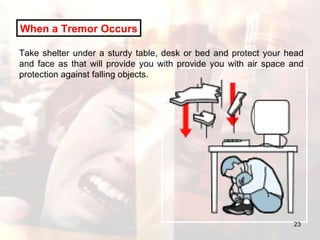
When a Tremor Occurs Take shelter under a sturdy table, desk or bed and protect your head and face as that will provide you with provide you with air space and protection against falling objects.
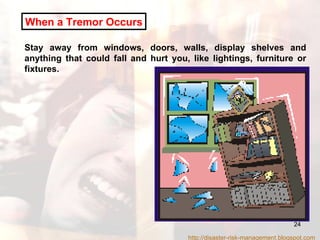
Stay away from windows, doors, walls, display shelves and anything that could fall and hurt you, like lightings, furniture or fixtures. When a Tremor Occurs http://disaster-risk-management.blogspot.com
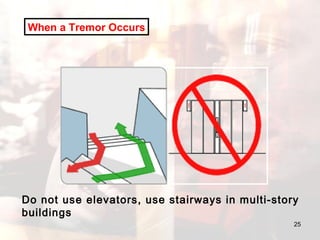
When a Tremor Occurs Do not use elevators, use stairways in multi-story buildings
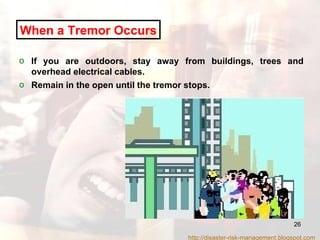
If you are outdoors, stay away from buildings, trees and overhead electrical cables.  Remain in the open until the tremor stops. When a Tremor Occurs http://disaster-risk-management.blogspot.com
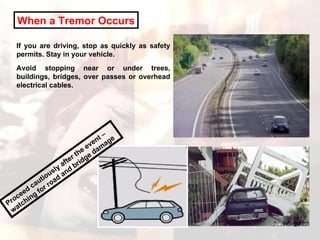
When a Tremor Occurs If you are driving, stop as quickly as safety permits. Stay in your vehicle.  Avoid stopping near or under trees, buildings, bridges, over passes or overhead electrical cables. Proceed cautiously after the event – watching for road and bridge damage
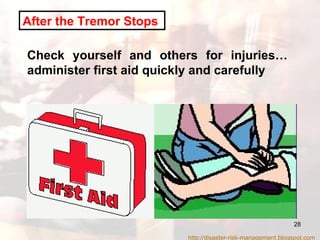
After the Tremor Stops   Check yourself and others for injuries… administer first aid quickly and carefully http://disaster-risk-management.blogspot.com
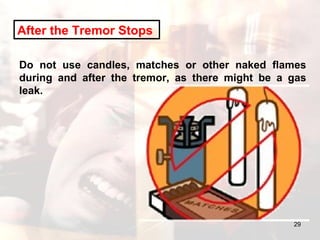
After the Tremor Stops   Do not use candles, matches or other naked flames during and after the tremor, as there might be a gas leak.
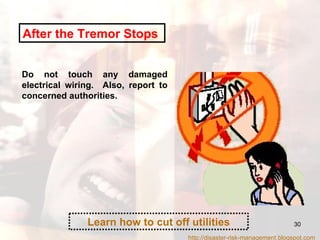
After the Tremor Stops   Do not touch any damaged electrical wiring.  Also, report to concerned authorities.  Learn how to cut off utilities http://disaster-risk-management.blogspot.com
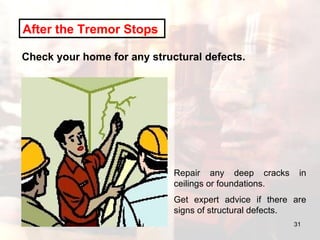
After the Tremor Stops   Check your home for any structural defects.  Repair any deep cracks in ceilings or foundations.  Get expert advice if there are signs of structural defects.
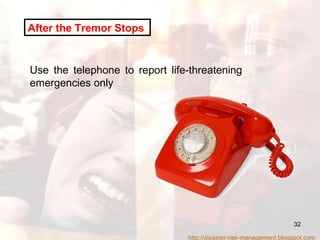
After the Tremor Stops   Use the telephone to report life-threatening emergencies only http://disaster-risk-management.blogspot.com
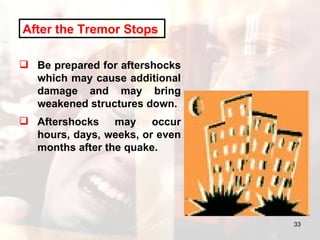
After the Tremor Stops   Be prepared for aftershocks which may cause additional damage and may bring weakened structures down.  Aftershocks may occur hours, days, weeks, or even months after the quake.
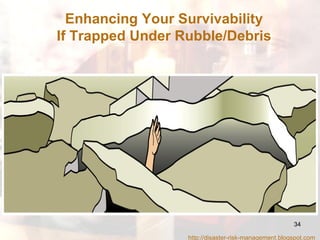
Enhancing Your Survivability If Trapped Under Rubble/Debris http://disaster-risk-management.blogspot.com
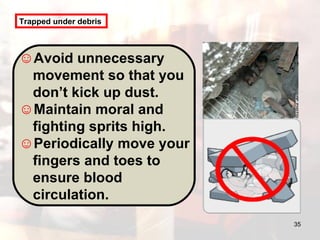
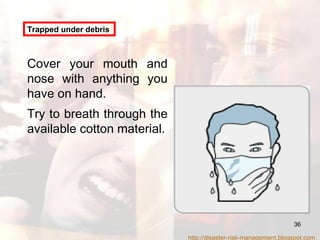
Avoid unnecessary movement so that you don’t kick up dust.  Maintain moral and fighting sprits high. Periodically move your fingers and toes to ensure blood circulation.  Trapped under debris
Trapped under debris Cover your mouth and nose with anything you have on hand.  Try to breath through the available cotton material. http://disaster-risk-management.blogspot.com
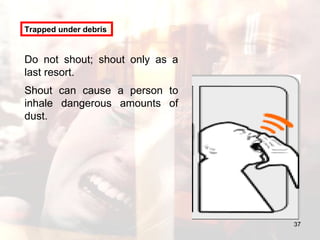
Trapped under debris Do not shout; shout only as a last resort.  Shout can cause a person to inhale dangerous amounts of dust.
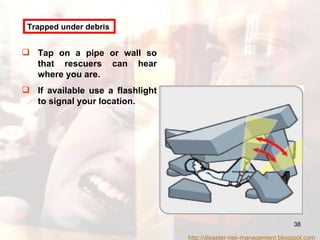
Tap on a pipe or wall so that rescuers can hear where you are. If available use a flashlight to signal your location. Trapped under debris http://disaster-risk-management.blogspot.com
EARTHQUAKE  AFFECTS
Classes of Earthquake There are three classes of earthquake that are known &  recognized as, tectonic, volcanic and artificially produced  Tectonic:  Tectonic quake are by far the most common, devastating and most difficult to predict. They are caused by stresses set up by movements of a dozen or so huge plates that form the earth’s crusts. Most earthquakes occur at the boundaries of these plates. Where two plates slides over and collides against each other; some earthquakes do occur in the middle of plates. Volcanic:  Volcanic quakes are seldom very large or destructive; they often precede or accompany volcanic eruption. Artificial:   Artificially produced earthquake are EQ induced by activities such as the filling of new reservoir or the pumping of fluid deep into the earth through wells. This type of EQ can be noticeable but are hardly destructive. http://disaster-risk-management.blogspot.com
Earthquakes are one of the most destructive of natural hazards. They may occur at any time of year, day or night, with sudden impact and little warning. Destroy buildings and or damage structure of the building, bridges, communications Loss of human lives Dense casualties/injuries Extensive property damages Disruption/Disturbance to normal human life activities Destabilize the government, economy and social structure of a country. Affects of Earthquake
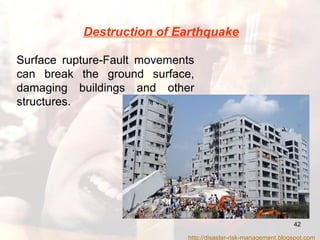
Surface rupture-Fault movements can break the ground surface, damaging buildings and other structures.  Destruction of Earthquake http://disaster-risk-management.blogspot.com
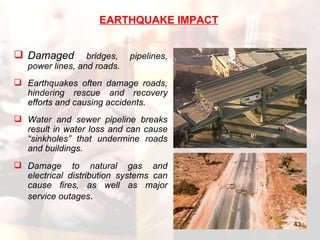
Damaged  bridges, pipelines, power lines, and roads.  Earthquakes often damage roads, hindering rescue and recovery efforts and causing accidents.  Water and sewer pipeline breaks result in water loss and can cause “sinkholes” that undermine roads and buildings.  Damage to natural gas and electrical distribution systems can cause fires, as well as major service outages .   EARTHQUAKE IMPACT
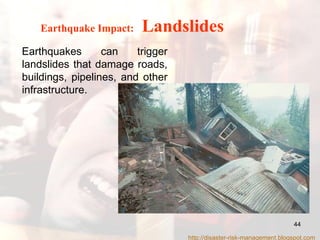
Earthquakes can trigger landslides that damage roads, buildings, pipelines, and other infrastructure.  Earthquake Impact:   Landslides http://disaster-risk-management.blogspot.com
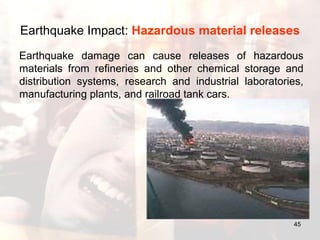
Earthquake Impact:  Hazardous material releases   Earthquake damage can cause releases of hazardous materials from refineries and other chemical storage and distribution systems, research and industrial laboratories, manufacturing plants, and railroad tank cars.
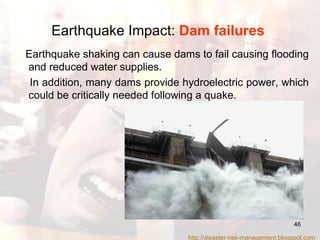
Earthquake Impact:  Dam failures   Earthquake shaking can cause dams to fail causing flooding and reduced water supplies.  In addition, many dams provide hydroelectric power, which could be critically needed following a quake.  http://disaster-risk-management.blogspot.com
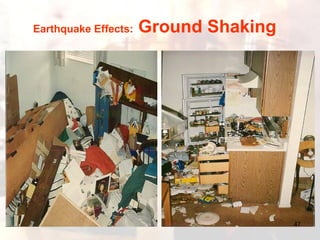
Earthquake Effects:   Ground Shaking
Tsunamis  Land faulting Fire Liquefaction Epidemic  Secondary Affects of Earthquake http://disaster-risk-management.blogspot.com
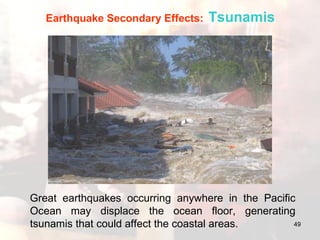
Great earthquakes occurring anywhere in the Pacific Ocean may displace the ocean floor, generating tsunamis that could affect the coastal areas. Earthquake Secondary Effects:   Tsunamis
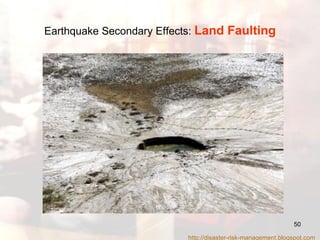
Earthquake Secondary Effects:  Land Faulting http://disaster-risk-management.blogspot.com
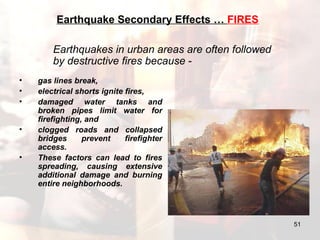
gas lines break,  electrical shorts ignite fires,  damaged water tanks and broken pipes limit water for firefighting, and  clogged roads and collapsed bridges prevent firefighter access.  These factors can lead to fires spreading, causing extensive additional damage and burning entire neighborhoods.   Earthquakes in urban areas are often followed by destructive fires because  - Earthquake Secondary Effects …  FIRES
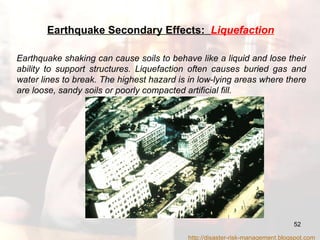
Earthquake shaking can cause soils to behave like a liquid and lose their ability to support structures. Liquefaction often causes buried gas and water lines to break. The highest hazard is in low-lying areas where there are loose, sandy soils or poorly compacted artificial fill.   Earthquake Secondary Effects:  Liquefaction http://disaster-risk-management.blogspot.com
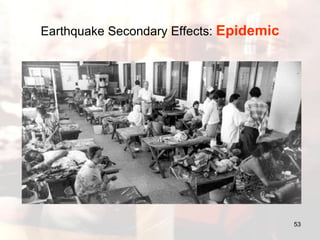
Earthquake Secondary Effects:  Epidemic
For more topics: Please visit: http://disaster-risk-management.blogspot.com Thank you for your time

Earthquake Awareness

  • 1.
    EARTHQUAKE AWARENESS http://disaster-risk-management.blogspot.com
  • 2.
    Earthquakes are oneof the most frightening and destructive phenomena of nature, strike suddenly, violently, and without warning . If an earthquake occurs in a populated area, it may cause many deaths and injuries and extensive property damage
  • 3.
    Earthquake is asudden slipping or movement of a portion of the earth’s crust accompanied and followed by a series of vibrations. What is an Earthquake? http://disaster-risk-management.blogspot.com
  • 4.
    Tectonic Platesand Faults
  • 5.
    Kobe JAPAN January17, 1995 Kobe Earthquake http://disaster-risk-management.blogspot.com
  • 6.
    Before After 1935– Earthquake struck Quetta (Pakistan) 40,000 - 60,000 killed & thousands injured 30 seconds
  • 7.
    Bhuj wasthe worst affected, 90% of the buildings had been damaged, and power supplies and the telephone system were down. Gujarat (India) Earthquake 2001 Over 20,000 persons reported dead and about 1.7 Lakhs injured 3,39,000 buildings/houses collapsed and partially damaged http://disaster-risk-management.blogspot.com
  • 8.
    Millions of peoplehave been affected. Communities of 12 Countries have been effected . TSUNAMI HIT COASTAL BELT OF SOUTH-EAST ASIA SUNDAY 26 TH DEC. 2004 Thousands of people have been dead. Thousands of survivors have been left homeless.
  • 9.
    Area Affected: 30000sq km Population Affected: 3.5 million Human Loss: 87000 plus Injured: 77000 plus Houses: 70% destroyed 30% damaged Families affected: 500,000 STRONG EARTHQUAKE STRUCK KASHMIR & NORTHERN PAKISTAN
  • 10.
    CHINA EARTHQUAKE May12, 2008 More than 60,000 killed and thousands injured http://disaster-risk-management.blogspot.com
  • 11.
    “ Earthquakesdon’t kill people” “ Un-safe buildings do”
  • 12.
    Before the Tremor Secure heavy furnishings and keep heavy objects on lower shelves http://disaster-risk-management.blogspot.com
  • 13.
    Before the Tremor Secure your water heater with wall and floor
  • 14.
    Do not hangheavy items such as decorative items, fancy lights, pictures and mirrors above beds or seating areas. Before the Tremor http://disaster-risk-management.blogspot.com
  • 15.
    Store weed killers,pesticides, and flammable products securely in closed cabinets with latches and on bottom shelves. Before the Tremor
  • 16.
    Check roofs andwall foundation for stability Before the Tremor http://disaster-risk-management.blogspot.com
  • 17.
    Before the Tremor Repair defective electrical wiring and leaky gas connections
  • 18.
    Develop an emergencysurvival Kit Food items (rice, noodles, canned food, milk power, beverages, water) Solid fuel and matches – A First Aid Kit – A portable battery-operated transistor radio. Before the Tremor http://disaster-risk-management.blogspot.com
  • 19.
    Keep list ofEmergency phone numbers, Police Help, Fire Service, Ambulance Service , Rescue , Electric Dept. & Gas Dept. Before the Tremor
  • 20.
    Before the Tremor Decide where family members will reunite if separated http://disaster-risk-management.blogspot.com
  • 21.
    Ground shaking inearthquake is lasting for not more than 15-30 seconds During these few seconds, stay calm, do not run or panic. When a Tremor Occurs
  • 22.
    When a TremorOccurs If indoor, stay indoor, where you are. Most injuries occur as people are entering or leaving buildings. Minimize your movements to a few steps to reach a nearby safe place Know the danger & safe spot in home http://disaster-risk-management.blogspot.com
  • 23.
    When a TremorOccurs Take shelter under a sturdy table, desk or bed and protect your head and face as that will provide you with provide you with air space and protection against falling objects.
  • 24.
    Stay away fromwindows, doors, walls, display shelves and anything that could fall and hurt you, like lightings, furniture or fixtures. When a Tremor Occurs http://disaster-risk-management.blogspot.com
  • 25.
    When a TremorOccurs Do not use elevators, use stairways in multi-story buildings
  • 26.
    If you areoutdoors, stay away from buildings, trees and overhead electrical cables. Remain in the open until the tremor stops. When a Tremor Occurs http://disaster-risk-management.blogspot.com
  • 27.
    When a TremorOccurs If you are driving, stop as quickly as safety permits. Stay in your vehicle. Avoid stopping near or under trees, buildings, bridges, over passes or overhead electrical cables. Proceed cautiously after the event – watching for road and bridge damage
  • 28.
    After the TremorStops Check yourself and others for injuries… administer first aid quickly and carefully http://disaster-risk-management.blogspot.com
  • 29.
    After the TremorStops Do not use candles, matches or other naked flames during and after the tremor, as there might be a gas leak.
  • 30.
    After the TremorStops Do not touch any damaged electrical wiring. Also, report to concerned authorities. Learn how to cut off utilities http://disaster-risk-management.blogspot.com
  • 31.
    After the TremorStops Check your home for any structural defects. Repair any deep cracks in ceilings or foundations. Get expert advice if there are signs of structural defects.
  • 32.
    After the TremorStops Use the telephone to report life-threatening emergencies only http://disaster-risk-management.blogspot.com
  • 33.
    After the TremorStops Be prepared for aftershocks which may cause additional damage and may bring weakened structures down. Aftershocks may occur hours, days, weeks, or even months after the quake.
  • 34.
    Enhancing Your SurvivabilityIf Trapped Under Rubble/Debris http://disaster-risk-management.blogspot.com
  • 35.
    Avoid unnecessary movementso that you don’t kick up dust. Maintain moral and fighting sprits high. Periodically move your fingers and toes to ensure blood circulation. Trapped under debris
  • 36.
    Trapped under debrisCover your mouth and nose with anything you have on hand. Try to breath through the available cotton material. http://disaster-risk-management.blogspot.com
  • 37.
    Trapped under debrisDo not shout; shout only as a last resort. Shout can cause a person to inhale dangerous amounts of dust.
  • 38.
    Tap on apipe or wall so that rescuers can hear where you are. If available use a flashlight to signal your location. Trapped under debris http://disaster-risk-management.blogspot.com
  • 39.
  • 40.
    Classes of EarthquakeThere are three classes of earthquake that are known & recognized as, tectonic, volcanic and artificially produced Tectonic: Tectonic quake are by far the most common, devastating and most difficult to predict. They are caused by stresses set up by movements of a dozen or so huge plates that form the earth’s crusts. Most earthquakes occur at the boundaries of these plates. Where two plates slides over and collides against each other; some earthquakes do occur in the middle of plates. Volcanic: Volcanic quakes are seldom very large or destructive; they often precede or accompany volcanic eruption. Artificial: Artificially produced earthquake are EQ induced by activities such as the filling of new reservoir or the pumping of fluid deep into the earth through wells. This type of EQ can be noticeable but are hardly destructive. http://disaster-risk-management.blogspot.com
  • 41.
    Earthquakes are oneof the most destructive of natural hazards. They may occur at any time of year, day or night, with sudden impact and little warning. Destroy buildings and or damage structure of the building, bridges, communications Loss of human lives Dense casualties/injuries Extensive property damages Disruption/Disturbance to normal human life activities Destabilize the government, economy and social structure of a country. Affects of Earthquake
  • 42.
    Surface rupture-Fault movementscan break the ground surface, damaging buildings and other structures. Destruction of Earthquake http://disaster-risk-management.blogspot.com
  • 43.
    Damaged bridges,pipelines, power lines, and roads. Earthquakes often damage roads, hindering rescue and recovery efforts and causing accidents. Water and sewer pipeline breaks result in water loss and can cause “sinkholes” that undermine roads and buildings. Damage to natural gas and electrical distribution systems can cause fires, as well as major service outages . EARTHQUAKE IMPACT
  • 44.
    Earthquakes can triggerlandslides that damage roads, buildings, pipelines, and other infrastructure. Earthquake Impact: Landslides http://disaster-risk-management.blogspot.com
  • 45.
    Earthquake Impact: Hazardous material releases Earthquake damage can cause releases of hazardous materials from refineries and other chemical storage and distribution systems, research and industrial laboratories, manufacturing plants, and railroad tank cars.
  • 46.
    Earthquake Impact: Dam failures Earthquake shaking can cause dams to fail causing flooding and reduced water supplies. In addition, many dams provide hydroelectric power, which could be critically needed following a quake. http://disaster-risk-management.blogspot.com
  • 47.
    Earthquake Effects: Ground Shaking
  • 48.
    Tsunamis Landfaulting Fire Liquefaction Epidemic Secondary Affects of Earthquake http://disaster-risk-management.blogspot.com
  • 49.
    Great earthquakes occurringanywhere in the Pacific Ocean may displace the ocean floor, generating tsunamis that could affect the coastal areas. Earthquake Secondary Effects: Tsunamis
  • 50.
    Earthquake Secondary Effects: Land Faulting http://disaster-risk-management.blogspot.com
  • 51.
    gas lines break, electrical shorts ignite fires, damaged water tanks and broken pipes limit water for firefighting, and clogged roads and collapsed bridges prevent firefighter access. These factors can lead to fires spreading, causing extensive additional damage and burning entire neighborhoods. Earthquakes in urban areas are often followed by destructive fires because - Earthquake Secondary Effects … FIRES
  • 52.
    Earthquake shaking cancause soils to behave like a liquid and lose their ability to support structures. Liquefaction often causes buried gas and water lines to break. The highest hazard is in low-lying areas where there are loose, sandy soils or poorly compacted artificial fill. Earthquake Secondary Effects: Liquefaction http://disaster-risk-management.blogspot.com
  • 53.
  • 54.
    For more topics:Please visit: http://disaster-risk-management.blogspot.com Thank you for your time