DONE BY
T AMARTHYANADH-
11169C114
T RAJEEV SARMA-
INNOVATIVE SYSTEM DESIGN LAB
MINI PROJECT
CONTENTS
• Abstract
• Objective
• A brief history of earthquake detection
• Accelerometer
• Block diagram
• Circuit diagram
• Components required
• Merits & De-Merits
• Applications
• Conclusion
ABSTRACT:
Seismology is that branch of Science that deals with the study of Earthquake and
Seismic wave through the body and Surface of Earth. Today, Detection of Earthquake is carried out
everywhere but a need to predict it is urgent to prevent deterioration to both life and property! In
this, we have given brief information about what is earthquake and designed a model to predict it.
The Accelerometer ADLX335 has been used in combination with Arduino Uno (AT Mega 328) at
the earthquake prone areas which are connected with the Data Centers by a wireless network.
ADLX335 is capable of sensing vibrations from all the directions X, Y as well as Z .The ADXL335
is a low power, complete 3-axis accelerometer with signal conditioned voltage outputs and can
measure static and dynamic accelerations. Programming for the controller is carried out using the
software Arduino. By which we obtain the graphical data of seismic waves in X, Y, Z directions.
OBJECTIVE:
The main objective of this project is to monitoring the earthquake
issues by using Seismic Noise Detection Sensor and the relevant
information will be displayed on the LCD display via Arduino Uno. The
location of the earthquake will identified by using Accelerometer.
EARTHQUAKE
 A sudden violent shaking of the ground, typically causing great
destruction, as a result of movements within the earth’s crust or
volcanic action.
A BRIEF HISTROY OF EARTHQUAKE
DETECTION
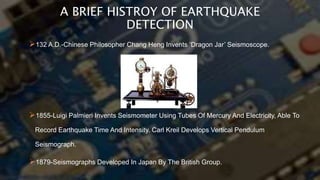
132 A.D.-Chinese Philosopher Chang Heng Invents ‘Dragon Jar’ Seismoscope.
1855-Luigi Palmieri Invents Seismometer Using Tubes Of Mercury And Electricity, Able To
Record Earthquake Time And Intensity. Carl Kreil Develops Vertical Pendulum
Seismograph.
1879-Seismographs Developed In Japan By The British Group.
ACCELEROMETER:
• VCC
• X-OUT
• Y-OUT
• Z-OUT
• GND
• ST
ADXL335 is accelerometer sensor which works on the principle of
Piezoelectric effect.
Pin Description of accelerometer:
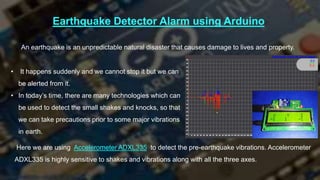
Earthquake Detector Alarm using Arduino
• It happens suddenly and we cannot stop it but we can
be alerted from it.
• In today’s time, there are many technologies which can
be used to detect the small shakes and knocks, so that
we can take precautions prior to some major vibrations
in earth.
An earthquake is an unpredictable natural disaster that causes damage to lives and property.
Here we are using Accelerometer ADXL335 to detect the pre-earthquake vibrations. Accelerometer
ADXL335 is highly sensitive to shakes and vibrations along with all the three axes.
Accelerometer ADXL335
Power supply
Arduino UNO
Buzzer &LED Indication
Processing Plot Of
Earthquake Over Computer
BLOCK DIAGRAM
CIRCUIT DIAGRAM
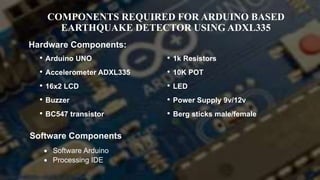
COMPONENTS REQUIRED FOR ARDUINO BASED
EARTHQUAKE DETECTOR USING ADXL335
• Arduino UNO
• Accelerometer ADXL335
• 16x2 LCD
• Buzzer
• BC547 transistor
• 1k Resistors
• 10K POT
• LED
• Power Supply 9v/12v
• Berg sticks male/female
Hardware Components:
Software Components
 Software Arduino
 Processing IDE
Merits:
• All the components required are easily available.
• It is accurate {Errors are nullified} & precise as it is Digital.
• Manual errors can be avoided to some extent.
• Easy to use
• Secure and reliable communication
• Leading edge technology that meets today’s and tomorrow’s needs.
De-Merits:
• One time investment cost
• It has to be planted throughout area.
• Public: Citizens, including schoolchildren, drop, cover and hold on;
turn off stoves, safely, safely stop vehicles.
• Business: Personal move to safe locations, automated systems
ensure elevators doors open, production lines are shut down,
sensitive equipment is placed in safe mode.
• Medical services: Surgeons, dentists and other stop delicate
procedures.
• Emergency responders: Open firehouse doors, personal prepare and
prioritize response decision.
• Power infrastructure: Protect power stations and grid facilities from
strong shaking.
Applications:
• 70% of the Earth is covered by oceans, and many disastrous earthquakes
and related natural disasters (i.e. tsunamis) originate under water.
Monitoring of earthquake phenomena requires a multi-disciplinary
approach.
• Countries should evaluate with their national seismological agencies the
present international structure of seismological, and initiate a discussion on
possible future structural changes within their own country.
• The goal of the initiative is to create a global earthquake risk analysis
information resource, using internationally agreed standards.
• A cost-benefit approach to earthquake protection should be encouraged.
Conclusion

Earthquake

  • 1.
    DONE BY T AMARTHYANADH- 11169C114 TRAJEEV SARMA- INNOVATIVE SYSTEM DESIGN LAB MINI PROJECT
  • 2.
    CONTENTS • Abstract • Objective •A brief history of earthquake detection • Accelerometer • Block diagram • Circuit diagram • Components required • Merits & De-Merits • Applications • Conclusion
  • 3.
    ABSTRACT: Seismology is thatbranch of Science that deals with the study of Earthquake and Seismic wave through the body and Surface of Earth. Today, Detection of Earthquake is carried out everywhere but a need to predict it is urgent to prevent deterioration to both life and property! In this, we have given brief information about what is earthquake and designed a model to predict it. The Accelerometer ADLX335 has been used in combination with Arduino Uno (AT Mega 328) at the earthquake prone areas which are connected with the Data Centers by a wireless network. ADLX335 is capable of sensing vibrations from all the directions X, Y as well as Z .The ADXL335 is a low power, complete 3-axis accelerometer with signal conditioned voltage outputs and can measure static and dynamic accelerations. Programming for the controller is carried out using the software Arduino. By which we obtain the graphical data of seismic waves in X, Y, Z directions.
  • 4.
    OBJECTIVE: The main objectiveof this project is to monitoring the earthquake issues by using Seismic Noise Detection Sensor and the relevant information will be displayed on the LCD display via Arduino Uno. The location of the earthquake will identified by using Accelerometer.
  • 5.
    EARTHQUAKE  A suddenviolent shaking of the ground, typically causing great destruction, as a result of movements within the earth’s crust or volcanic action.
  • 6.
    A BRIEF HISTROYOF EARTHQUAKE DETECTION 132 A.D.-Chinese Philosopher Chang Heng Invents ‘Dragon Jar’ Seismoscope. 1855-Luigi Palmieri Invents Seismometer Using Tubes Of Mercury And Electricity, Able To Record Earthquake Time And Intensity. Carl Kreil Develops Vertical Pendulum Seismograph. 1879-Seismographs Developed In Japan By The British Group.
  • 7.
    ACCELEROMETER: • VCC • X-OUT •Y-OUT • Z-OUT • GND • ST ADXL335 is accelerometer sensor which works on the principle of Piezoelectric effect. Pin Description of accelerometer:
  • 8.
    Earthquake Detector Alarmusing Arduino • It happens suddenly and we cannot stop it but we can be alerted from it. • In today’s time, there are many technologies which can be used to detect the small shakes and knocks, so that we can take precautions prior to some major vibrations in earth. An earthquake is an unpredictable natural disaster that causes damage to lives and property. Here we are using Accelerometer ADXL335 to detect the pre-earthquake vibrations. Accelerometer ADXL335 is highly sensitive to shakes and vibrations along with all the three axes.
  • 9.
    Accelerometer ADXL335 Power supply ArduinoUNO Buzzer &LED Indication Processing Plot Of Earthquake Over Computer BLOCK DIAGRAM
  • 10.
  • 11.
    COMPONENTS REQUIRED FORARDUINO BASED EARTHQUAKE DETECTOR USING ADXL335 • Arduino UNO • Accelerometer ADXL335 • 16x2 LCD • Buzzer • BC547 transistor • 1k Resistors • 10K POT • LED • Power Supply 9v/12v • Berg sticks male/female Hardware Components: Software Components  Software Arduino  Processing IDE
  • 12.
    Merits: • All thecomponents required are easily available. • It is accurate {Errors are nullified} & precise as it is Digital. • Manual errors can be avoided to some extent. • Easy to use • Secure and reliable communication • Leading edge technology that meets today’s and tomorrow’s needs. De-Merits: • One time investment cost • It has to be planted throughout area.
  • 13.
    • Public: Citizens,including schoolchildren, drop, cover and hold on; turn off stoves, safely, safely stop vehicles. • Business: Personal move to safe locations, automated systems ensure elevators doors open, production lines are shut down, sensitive equipment is placed in safe mode. • Medical services: Surgeons, dentists and other stop delicate procedures. • Emergency responders: Open firehouse doors, personal prepare and prioritize response decision. • Power infrastructure: Protect power stations and grid facilities from strong shaking. Applications:
  • 14.
    • 70% ofthe Earth is covered by oceans, and many disastrous earthquakes and related natural disasters (i.e. tsunamis) originate under water. Monitoring of earthquake phenomena requires a multi-disciplinary approach. • Countries should evaluate with their national seismological agencies the present international structure of seismological, and initiate a discussion on possible future structural changes within their own country. • The goal of the initiative is to create a global earthquake risk analysis information resource, using internationally agreed standards. • A cost-benefit approach to earthquake protection should be encouraged. Conclusion