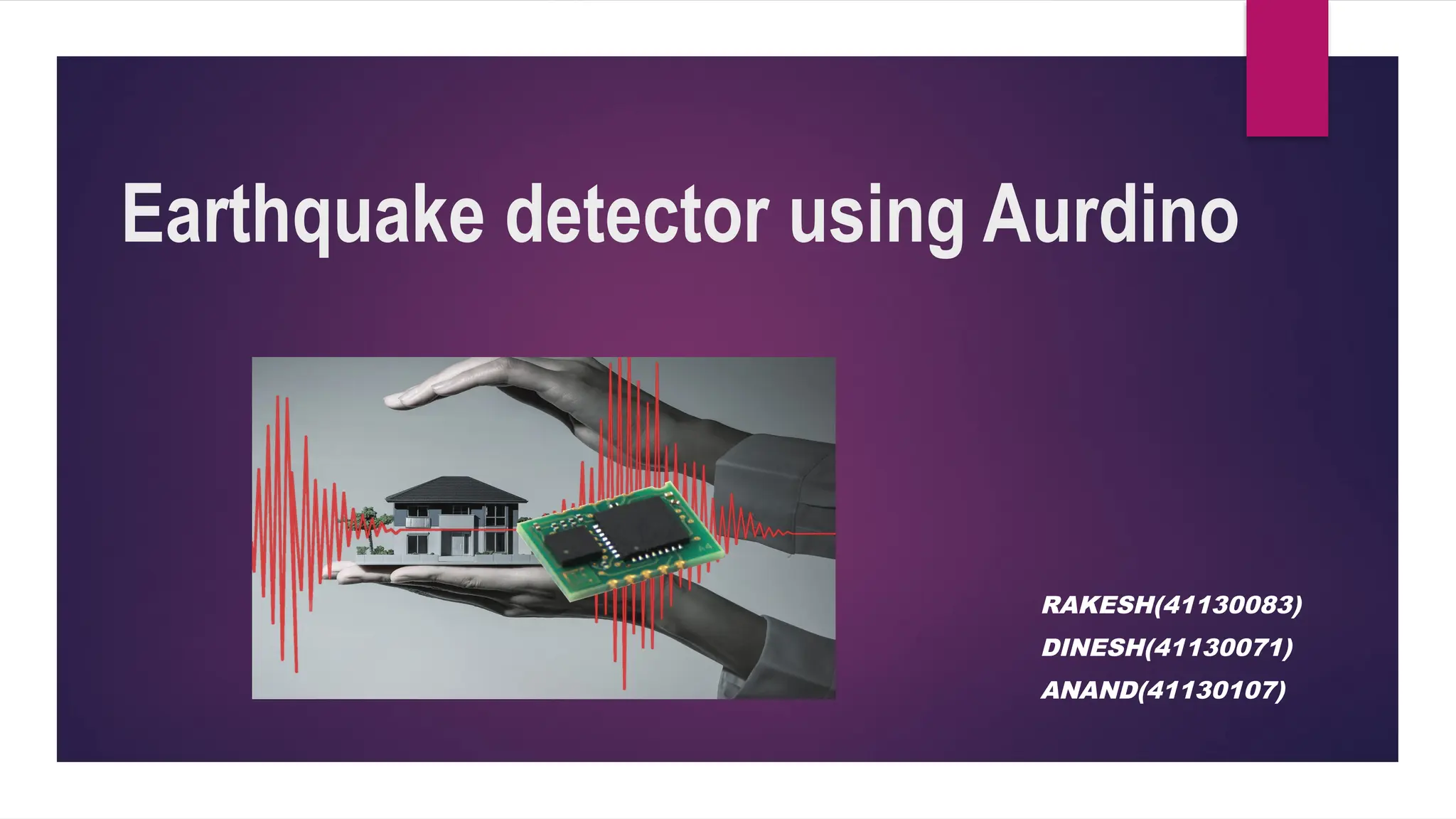
Earthquake detector using Aurdino
RAKESH(41130083)
DINESH(41130071)
ANAND(41130107)
Contents
 Introduction
 Block Diagram
 Circuit Diagram
 Components Required
 Merits and Demerits
 Conclusion
 Steps to Build
 Literature survey
 References
Introduction
 Seismology is that branch of Science that deals with the study of
Earthquake and Seismic wave through the body and Surface of Earth.
Today, Detection of Earthquake is carried out everywhere but a need to
predict it is urgent to prevent deterioration to both life and property! Inthis,
we have given brief information about what is earthquake and designed a
model to predict it. The Accelerometer ADLX335 has been used in
combination with Arduino Uno (AT Mega 328) atthe earthquake prone
areas which are connected with the Data Centers by a wireless network.
ADLX335 is capable of sensing
Block Digram
Circuit Diagram
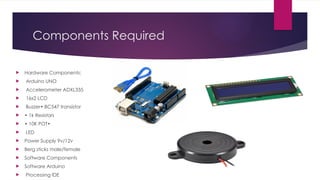
Components Required
 Hardware Components:
 Arduino UNO
 Accelerometer ADXL335
 16x2 LCD
 Buzzer• BC547 transistor
 • 1k Resistors
 • 10K POT•
 LED
 Power Supply 9v/12v
 Berg sticks male/female
 Software Components
 Software Arduino
 Processing IDE
Merits and Demeritis
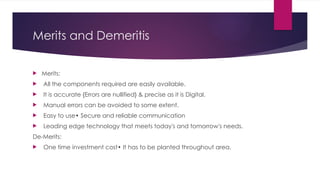
 Merits:
 All the components required are easily available.
 It is accurate {Errors are nullified} & precise as it is Digital.
 Manual errors can be avoided to some extent.
 Easy to use• Secure and reliable communication
 Leading edge technology that meets today's and tomorrow's needs.
De-Merits:
 One time investment cost• It has to be planted throughout area.
Conclusion
 70% of the Earth is covered by oceans, and many disastrous earthquakesand
related natural disasters (i.e. tsunamis) originate under water. Monitoring of
earthquake phenomena requires a multi-disciplinaryapproach.
 • Countries should evaluate with their national seismological agencies the
present international structure of seismological, and initiate a discussion
onpossible future structural changes within their own country.
 • The goal of the initiative is to create a global earthquake risk
analysisinformation resource, using internationally agreed standards.
 • A cost-benefit approach to earthquake protection should be encouraged.
Steps to Build:
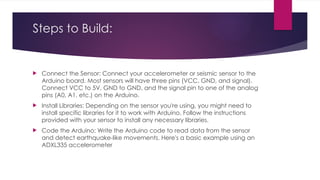
 Connect the Sensor: Connect your accelerometer or seismic sensor to the
Arduino board. Most sensors will have three pins (VCC, GND, and signal).
Connect VCC to 5V, GND to GND, and the signal pin to one of the analog
pins (A0, A1, etc.) on the Arduino.
 Install Libraries: Depending on the sensor you're using, you might need to
install specific libraries for it to work with Arduino. Follow the instructions
provided with your sensor to install any necessary libraries.
 Code the Arduino: Write the Arduino code to read data from the sensor
and detect earthquake-like movements. Here's a basic example using an
ADXL335 accelerometer
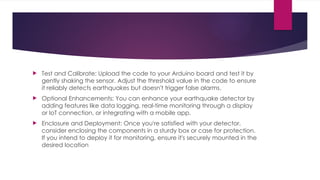
 Test and Calibrate: Upload the code to your Arduino board and test it by
gently shaking the sensor. Adjust the threshold value in the code to ensure
it reliably detects earthquakes but doesn't trigger false alarms.
 Optional Enhancements: You can enhance your earthquake detector by
adding features like data logging, real-time monitoring through a display
or IoT connection, or integrating with a mobile app.
 Enclosure and Deployment: Once you're satisfied with your detector,
consider enclosing the components in a sturdy box or case for protection.
If you intend to deploy it for monitoring, ensure it's securely mounted in the
desired location
LITERATURE SURVEY
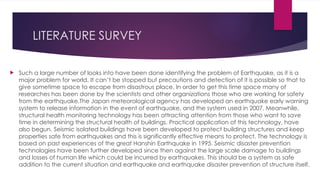
 Such a large number of looks into have been done identifying the problem of Earthquake, as it is a
major problem for world. It can’t be stopped but precautions and detection of it is possible so that to
give sometime space to escape from disastrous place. In order to get this time space many of
researches has been done by the scientists and other organizations those who are working for safety
from the earthquake.The Japan meteorological agency has developed an earthquake early warning
system to release information in the event of earthquake, and the system used in 2007. Meanwhile,
structural health monitoring technology has been attracting attention from those who want to save
time in determining the structural health of buildings. Practical application of this technology, have
also begun. Seismic isolated buildings have been developed to protect building structures and keep
properties safe from earthquakes and this is significantly effective means to protect. The technology is
based on past experiences of the great Hanshin Earthquake in 1995. Seismic disaster prevention
technologies have been further developed since then against the large scale damage to buildings
and losses of human life which could be incurred by earthquakes. This should be a system as safe
addition to the current situation and earthquake and earthquake disaster prevention of structure itself.
REFERENCES
 [1] International journal of engineering trends and technology(IJETT) –VOLUME 12
NUMBER 3- JUN 2014 Wireless earthquake alarm system using atmega328p and adxl335
[2] International journal of research in advent technology, vol. 4, n0.8,august 2016
EISSN:2321-9637[3] AKI, K. (1965).Maximum likelihood estimate of b in the formulae
login=a-bm and its confidence limits. Bull . earthquake res. Inst. Tokyo university,43, 237-
239[4] Ringdal , f.(1975). On the estimation of sysmic detection thresholds. B.S.S.A.,66,
789-802[5] 13th world conference on earthquake engineering, august 2004, paper no.
908[6] Nakamura, Y, “research and development of intelligent earthquake disaster
prevention system, Japan society of civil engineers, no.531/I-34, pp.1-33, jan 1996.[7]
IJMEC Earthquake alarm detector microcontroller based circuit EISSN 2305 0543

rakesh ppt on Earthquake detector using aurdino

  • 1.
    Earthquake detector usingAurdino RAKESH(41130083) DINESH(41130071) ANAND(41130107)
  • 2.
    Contents  Introduction  BlockDiagram  Circuit Diagram  Components Required  Merits and Demerits  Conclusion  Steps to Build  Literature survey  References
  • 3.
    Introduction  Seismology isthat branch of Science that deals with the study of Earthquake and Seismic wave through the body and Surface of Earth. Today, Detection of Earthquake is carried out everywhere but a need to predict it is urgent to prevent deterioration to both life and property! Inthis, we have given brief information about what is earthquake and designed a model to predict it. The Accelerometer ADLX335 has been used in combination with Arduino Uno (AT Mega 328) atthe earthquake prone areas which are connected with the Data Centers by a wireless network. ADLX335 is capable of sensing
  • 4.
  • 5.
  • 6.
    Components Required  HardwareComponents:  Arduino UNO  Accelerometer ADXL335  16x2 LCD  Buzzer• BC547 transistor  • 1k Resistors  • 10K POT•  LED  Power Supply 9v/12v  Berg sticks male/female  Software Components  Software Arduino  Processing IDE
  • 7.
    Merits and Demeritis Merits:  All the components required are easily available.  It is accurate {Errors are nullified} & precise as it is Digital.  Manual errors can be avoided to some extent.  Easy to use• Secure and reliable communication  Leading edge technology that meets today's and tomorrow's needs. De-Merits:  One time investment cost• It has to be planted throughout area.
  • 8.
    Conclusion  70% ofthe Earth is covered by oceans, and many disastrous earthquakesand related natural disasters (i.e. tsunamis) originate under water. Monitoring of earthquake phenomena requires a multi-disciplinaryapproach.  • Countries should evaluate with their national seismological agencies the present international structure of seismological, and initiate a discussion onpossible future structural changes within their own country.  • The goal of the initiative is to create a global earthquake risk analysisinformation resource, using internationally agreed standards.  • A cost-benefit approach to earthquake protection should be encouraged.
  • 9.
    Steps to Build: Connect the Sensor: Connect your accelerometer or seismic sensor to the Arduino board. Most sensors will have three pins (VCC, GND, and signal). Connect VCC to 5V, GND to GND, and the signal pin to one of the analog pins (A0, A1, etc.) on the Arduino.  Install Libraries: Depending on the sensor you're using, you might need to install specific libraries for it to work with Arduino. Follow the instructions provided with your sensor to install any necessary libraries.  Code the Arduino: Write the Arduino code to read data from the sensor and detect earthquake-like movements. Here's a basic example using an ADXL335 accelerometer
  • 10.
     Test andCalibrate: Upload the code to your Arduino board and test it by gently shaking the sensor. Adjust the threshold value in the code to ensure it reliably detects earthquakes but doesn't trigger false alarms.  Optional Enhancements: You can enhance your earthquake detector by adding features like data logging, real-time monitoring through a display or IoT connection, or integrating with a mobile app.  Enclosure and Deployment: Once you're satisfied with your detector, consider enclosing the components in a sturdy box or case for protection. If you intend to deploy it for monitoring, ensure it's securely mounted in the desired location
  • 11.
    LITERATURE SURVEY  Sucha large number of looks into have been done identifying the problem of Earthquake, as it is a major problem for world. It can’t be stopped but precautions and detection of it is possible so that to give sometime space to escape from disastrous place. In order to get this time space many of researches has been done by the scientists and other organizations those who are working for safety from the earthquake.The Japan meteorological agency has developed an earthquake early warning system to release information in the event of earthquake, and the system used in 2007. Meanwhile, structural health monitoring technology has been attracting attention from those who want to save time in determining the structural health of buildings. Practical application of this technology, have also begun. Seismic isolated buildings have been developed to protect building structures and keep properties safe from earthquakes and this is significantly effective means to protect. The technology is based on past experiences of the great Hanshin Earthquake in 1995. Seismic disaster prevention technologies have been further developed since then against the large scale damage to buildings and losses of human life which could be incurred by earthquakes. This should be a system as safe addition to the current situation and earthquake and earthquake disaster prevention of structure itself.
  • 12.
    REFERENCES  [1] Internationaljournal of engineering trends and technology(IJETT) –VOLUME 12 NUMBER 3- JUN 2014 Wireless earthquake alarm system using atmega328p and adxl335 [2] International journal of research in advent technology, vol. 4, n0.8,august 2016 EISSN:2321-9637[3] AKI, K. (1965).Maximum likelihood estimate of b in the formulae login=a-bm and its confidence limits. Bull . earthquake res. Inst. Tokyo university,43, 237- 239[4] Ringdal , f.(1975). On the estimation of sysmic detection thresholds. B.S.S.A.,66, 789-802[5] 13th world conference on earthquake engineering, august 2004, paper no. 908[6] Nakamura, Y, “research and development of intelligent earthquake disaster prevention system, Japan society of civil engineers, no.531/I-34, pp.1-33, jan 1996.[7] IJMEC Earthquake alarm detector microcontroller based circuit EISSN 2305 0543