Musings on research in
supply chain management
S G Deshmukh
ABV-Indian Institute of Information Technology &
Management , Gwalior
International Conference on Operations & SCM
Symbiosis Institute of OM (SIOM) , Nashik
11 Aug 2016
1
Acknowledgement
This presentation is based on extensive knowledge
sharing sessions with
 Prof Abid Haleem (Jamia) ,Prof N K Sharma (IITK), Dr
Jitesh Thakkar (IITKgp), Prof Manoj Tiwari(IITKgp),
Prof Ravi Shankar(IITD) and Prof R P Mohanty (ICFAI)
 Thankful to numerous research scholars and faculty
members from various institutes participating in our
FDPs and Dr Manoj Dash (ABVV-IIITMG)
You may look at some of my presentations available at
http://www.slideshare.net/SanjeevDeshmukh/presentations
2
Speaking points..
 Opening remarks..
 Context & historical view
 About research..
Various perspectives
 Visibility and research opportunities
 Closing remarks..
3
Opening remarks:
IT is making world flatter !
(Thanks to Friedman)
 Outsourcing dominated paradigm
 Geography has become history: Time and distance are no
longer the important variables
 Mobile dense and multimedia rich environment has accelerated
digital environment.
 Internet is changing the way we communicate with –
 Disruptive models of business –Flipkart/Anazon etc.
Source : Friedman, T L, The World is flat: Farrar, Straus &
Giroux , 2005
http://video.mit.edu/watch/the-world-is-flat-9145/
4
Observations ..1..
 Everywhere transformation(digital !) taking
place
 Traditional ways of conducting research and
disseminating outcomes have also changed
 The way we communicate and disseminate has
changed.
 Contemporary research in SCM is no exception
to this !
5
Observations ..2…
 Supply Chain Management has matured as a
discipline
 Developments in IT have made integration
possible: The fundamental premise on which SCM
is based !!
 Basic concerns in SCM : Management of Material
Flow, Information Flow and Money Flow
 These concerns are valid in a variety of contexts ,
hence plethora of opportunities available ,
especially in emerging economies like India
What is happening today..
 An increasing focus on interdisciplinary/
multidisciplinary/trans-disciplinary research
 SCM , by design provides an ideal platform for this !
 An enhanced importance on large scale problems,
rather than techniques; Thanks to data
science/analytics !!
 Greater emphasis on collaborative work
 Research in SCM : Integrative, crossing discipline
boundaries
7
Research in supply chain
management domain …
 Huge scope for integration
 Empirical and case based ?
 Context/culture based?
 Applied ?
 Opportunity to make some contributions to
society ?
History- Generations of researchers !
1G Prof A Subash Babu
2G Dr S G Deshmukh
3G Dr Arshinder
4G Dr P Kalpana
 Continuity
 Change
 Methodology
 Tools
 Most importantly :
Problem areas…
Supply chain of researchers !!
Generation gap?..
G Name Title of the Phd Thesis Year
G1 A Subash Babu Optimal Policies for Spares in Multi-Echelon
Repair-Inventory Systems (IIT Delhi)
1980
G2 S G Deshmukh Evaluation of Effectiveness of a Class of
Integrated Procurement-Production Systems
( IIT Bombay)
1989
G3 Arshinder An Integrative Framework for Supply Chain
Coordination (IIT Delhi)
2008
G4 Kalpana Split Ordering decisions in Single Period
Supply Chain with Contracts and Information
Sharing (IIT Madras)
2013
Change in focus
 Inventory control/Materials Management
 Production-procurement systems
 Supply Chain Management
 Supply Chain Analytics
 Role of information sharing
Fragmented to Integrated ?
Myopic to long term?
Tool centric to issue centric?
Model based to practice based?
Research in SCM
Passion
 Deeply influenced by
subject matter
 Driven by choice
 Desire to make an impact
 Driven by “will to excel”
Process
 Mechanistic part
 Definite expectations to be
met
 Skeleton or frame
 Typical example:
documentation
12
Various perspectives …
 ARC Perspective on Research
 Music Perspective on Research
 Railway track Perspective on Research
ARC perspective on research
 Attributional
 Relational
 Classificational
Source: Deshpande R S, Institute for Social & Economic Change, B’lore
14
ARC Perspective (contd)
 Attributional:
 Attributing a measurement (definition) to a particular
Concept.
 Growth, Logistic efficiency, Inventory turns
 Relational:
 Relating a phenomenon with its determinants
 Explaining performance measurement vis-à-vis human
motivation ?
 Logistical performance !
 Classificational:
 Understanding by categorizing on the basis of some
indicators
 Taxonomy: Innovators Vs Followers, Leaders Vs Laggards15
Music Perspective :
AROHA and AVAROHA
A - Algorithm
A – Approach V - Variables
R – Review A - Arrangement
O - Objectives R - Results
H - Hypothesis O - Objectivity
A - Analysis H – Humanistic
A – Analytical Rigour
16
Source: Deshpande R S, Institute for Social & Economic Change, B’lore
Dance your Ph D…
http://gonzolabs.org/dance
http://www.sciencemag.org/news/2016/0
6/science-launches-2016-dance-
your-phd-contest
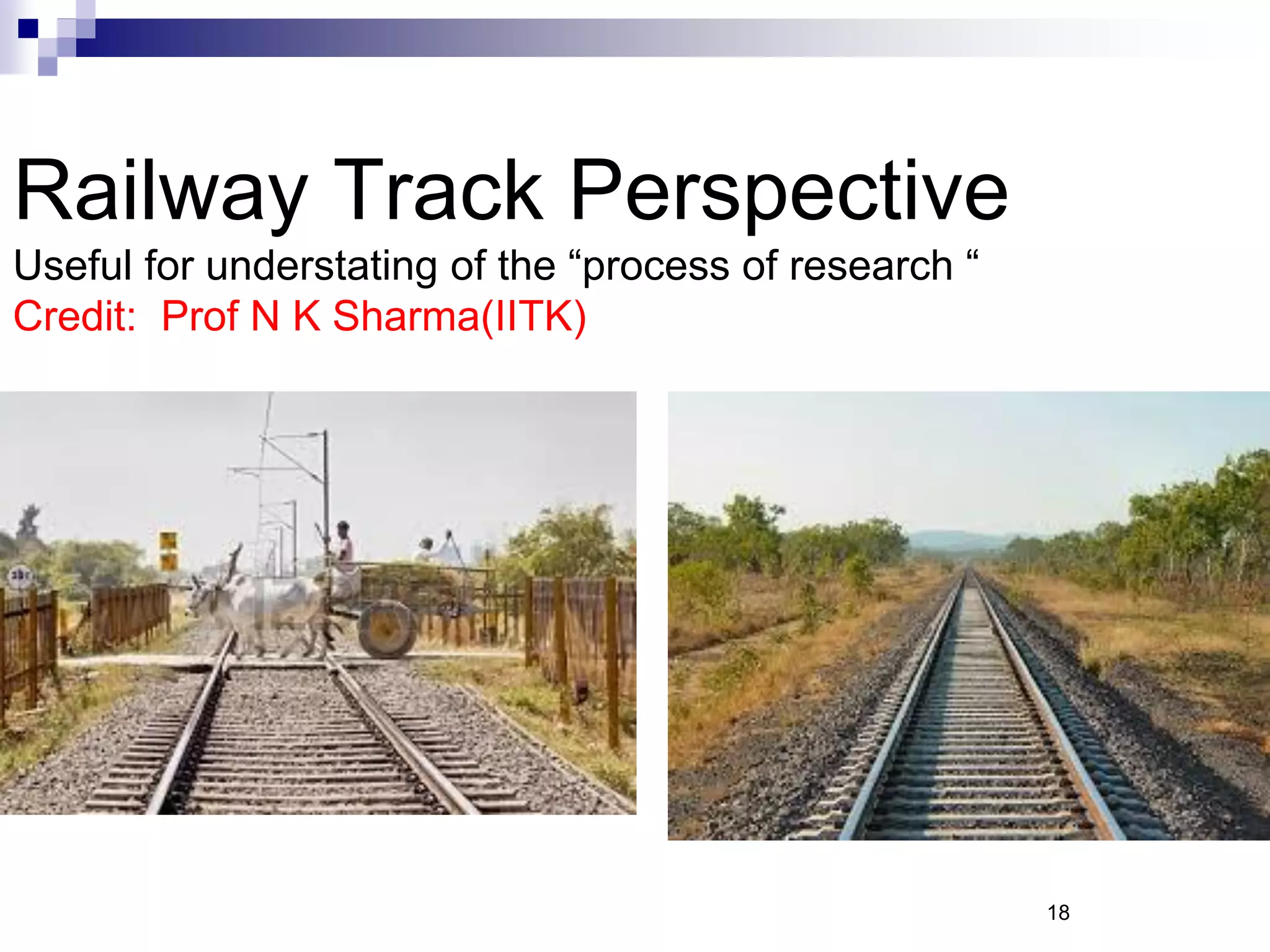
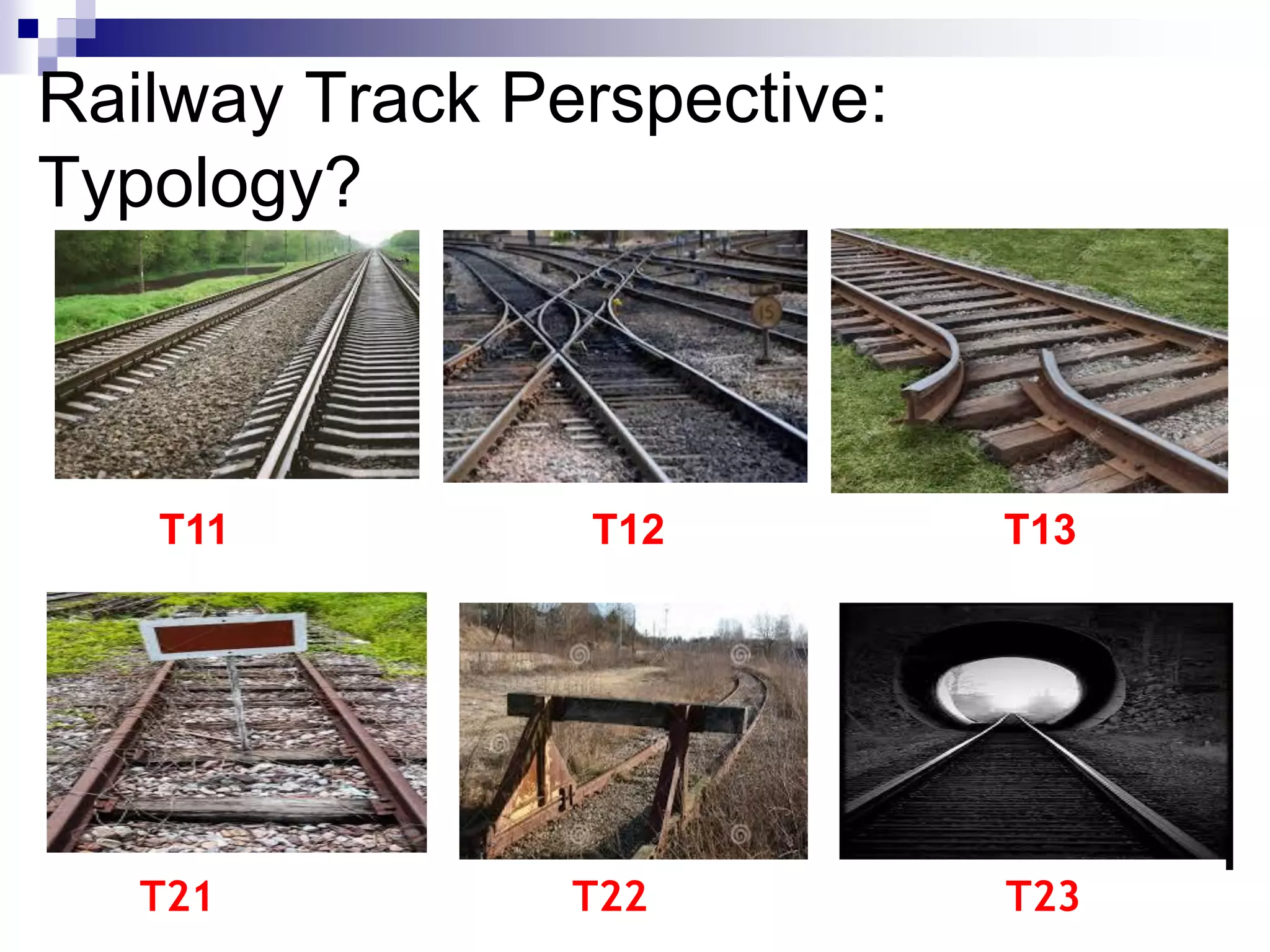
Railway Track Perspective
Useful for understating of the “process of research “
Credit: Prof N K Sharma(IITK)
18
Remarks..
 Railway: Symbol of progress and confidence
in technological modernity.
 Railway track symbolizes a fixed and definite
path
 Railways even enter our everyday language:
we 'fast-track', 'side-track' and 'go off the rails’
 It also represent “Process” part of the research
(fixed, methodical, systematic )!
19
Revill, George (2012). Railway. Objekt Series. London: Reaktion
Railway Track Perspective:
Typology?
T11 T12 T13
T21 T22 T23
Research in SCM is guided by
some aspects of boundary
 Discipline Boundary (Maths, Computer Science,
HR, Finance !!)
 Time or Resource Boundary
 Information or Data Boundary (availability, form
and content )
 Contextual boundary(guided by the situation)
15 21
Importance of Research in SCM
 For gaining acceptance by the academic
community
 For enhancing quality of pedagogy (especially
in Business schools)
 For increase in reach and visibility
 For making some difference & impact since
SCM affects and gets affected by a whole array
of disciplines cutting across the discipline
boundaries !
22
How Emerald measures impact *?
 Citations/Usage
 Inclusion of research in courseware/
Training material
 Implementation in Practice
 Transformation of Research for new
audience
 Awards
*Source http://www.emeraldinsight.com/authors/impact/index.htm
23
Altmetrics : a tool for visibility !
altmetrics is the creation and study of new metrics
based on the Social Web for analyzing, and informing
scholarship. www.altmetrics.org
 Supplement to traditional peer-reviewed metrics
 Looks at downloads
 “Crowdsource peer-review
 Many tools currently available:
 Google Scholar Profile/citations
 Mendeley
 Total-Impact
 ReaderMeter
24
Observations..
 Our thinking & way of working is shaped by
environment and the context within which we
operate
 Research in SCM is governed by ‘Context”!
 We are “Textual” rather than ‘Contextual”
Insightful remark by Mr K P Fabian, Ex-
ambassador, (4 Aug 2016 at ABV-IIITM Gwalior)
25
Research in SCM …
 It is crucial to make sure that your research in
SCM is visible
 Visibility from Academia point of view and from
Society point of view
 If your papers are available on the web, it is
more likely that other researchers will read your
papers and cite you.
26
 Networks for researchers
 One can share and
disseminate
 Contributions in terms of
publications, downloads,
datasets etc.
 Platforms : Research Gate,,
Academia , Mendeley
27
Pegrum, M., "'I link therefore I am': network literacy as a core digital literacy",
E-learning and Digital Media 7(4), 346-354 2010
doi:10.2304/elea.2010.7.4.346
Sharing platforms..
Visibility earned by sharing &
Collaboration
 With Industry
 Transfer of knowhow from you to industry (may be outcome
of your consultancy! : example: transshipment model to a
leading tyre company )
 Translating the needs of industry; Logistics, finance etc
 Establishing a dialogue with industry & Sharing of research
outcomes
 Building case studies and improving management pedagogy
 With society
Relevance of your research to society
Synchronization with the societal view 28
Issues for considerations..
1. How research and its visibility are evaluated
today will not be the same in five years ahead
2. What are good indicators of visibilty? What can
we measure? What should we be measuring?
3. How should we be measuring them? What do
they mean?
4. Measurements in future will allow for greater
granularity.
29
Opportunities for Research in SCM
: Classification view
(Recollect ARC perspective !)
 Technology Oriented
 Social Networking
 Information security
 Service Oriented Architecture
 People Oriented
 Humanitarian Logistics
 Unorganized Sector/SMEs
 SCM in mission mode
Humanitarian Logistics & Disaster
Management : Research Posers
 How to define “Responsiveness” for disaster supply chains?
 What are the dimensions of “flexibility” in such supply chains?
 What are the behavioral implications of disaster supply chains?
 Are service chains different from the production chains in the
context of disaster supply chains?
 How to locate and dislocate facilities on a short term basis for such
supply chains?
 How to develop Performance Measurement System for such
chains?
 Attributional & relational view
SCM for SMEs: context
 Vital contributor to Indian economy
 Low levels or absence of organizational hierarchy;
 Involvement of CEO/Chief in operational decisions rather than
strategic decisions as in large scale organizations ;
 “blurred” departmental walls;
 Tremendous scope for implementing concepts of “Lean or agile “
manufacturing and consequently “Lean/agile” supply chains
 By design, SMEs are prone to “sustainability” due to their size and
much less danger to the environment
 Faster rate of changes in business environment which affect SMEs
to a great extent than in LSEs : SMEs are also able to respond to
these changes positively.
SMEs : Research Posers
 Is there any difference between IT applications of SCM required for
SMEs as compared to LSEs?
 What are the behavioral implications of performance measurement
systems in SMEs?
 Does the “Scale” matters for sustainability?
 What are the relevant dimensions of “Sustainability” for SMEs?
 What are the societal costs for sustaining the supply chains?
 What are the coordination issues as far as coupling of LSE and SME
are concerned?
 Attrubutional & relational view
 AROHA & AVAROHA view
SCM for Unorganized Sector:
Context
 Estimation of contribution of unorganized sector in
economy
 Assessment of training needs of unorganized sector
from SC point of view
 Inter-linkages of production, distribution, quality
systems and service for unorganized sector
 Evolution of SC best practices for unorganized sector
 Design and development of performance
measurement systems for unorganized sector
SCM in Unorganized Sector:
Research Posers
 What are the linkages between the supply chains of organized sector
vis-à-vis unorganized sector?
 Are there any opportunities to borrow some good practices from
organized sector and map them into unorganized sector?
 What are the dimensions required in the performance measurement
systems of such supply chains?
 How to leverage huge human potential existing in our country to
make these supply chains more responsive yet financially viable?
 What are the learnings from the other developing countries (such as
East Asian or SAARC countries)
 Cuthbertson R and Piotrowicz, 2011, Performance measurement systems in Supply chains: A framework fro
contextual analysis, Int J of Productivity & Performance Measurement , 60(6),583-602
SCM in
Swachhata Abhiyan : Context
 Mission mode project, launched by the prime minister
in Oct 2014
 Supply chain of garbage, waste, debris, disposables
etc.
 Material flow, information flows
 Huge scope for improvement
 A social supply chain & Community led supply chain
 Reverse supply chain for waste recycle ?
Attributional & Relational view
https://swachhbharat.mygov.in/ 36
Closing remarks..
 “Passion” & “Process” : both are necessary
ingredients for research in SCM
 Various perspectives on research
 There are various imperatives for making a
researcher visible
 Research in SCM offers opportunities to make
meaningful impact
 Immense research opportunities in “People led
SCM” in unorganized and mission mode
projects37
References
 Digital Researcher http://www.vitae.ac.uk/researchers/315321/Digital-
Researcher.html
 Cann, A., Dimitriou, K., Hooley, T., "Social Media : A guide for researchers",
(February), 2011
http://www.rin.ac.uk/our-work/communicating-and-disseminating-
research/social-media-guide-researchers
 Pegrum, M., "'I link therefore I am': network literacy as a core digital literacy",
E-learning and Digital Media 7(4), 346-354 2010
doi:10.2304/elea.2010.7.4.346
 iGoogle http://www.google.com/ig
38
Thank you..
deshmukh.sg@gmail.com
http://www.slideshare.net/SanjeevDeshmukh
http://sgdeshmuk.blogspot.in/
39

Scm deshmukh-siom-11-aug-2016

  • 1.
    Musings on researchin supply chain management S G Deshmukh ABV-Indian Institute of Information Technology & Management , Gwalior International Conference on Operations & SCM Symbiosis Institute of OM (SIOM) , Nashik 11 Aug 2016 1
  • 2.
    Acknowledgement This presentation isbased on extensive knowledge sharing sessions with  Prof Abid Haleem (Jamia) ,Prof N K Sharma (IITK), Dr Jitesh Thakkar (IITKgp), Prof Manoj Tiwari(IITKgp), Prof Ravi Shankar(IITD) and Prof R P Mohanty (ICFAI)  Thankful to numerous research scholars and faculty members from various institutes participating in our FDPs and Dr Manoj Dash (ABVV-IIITMG) You may look at some of my presentations available at http://www.slideshare.net/SanjeevDeshmukh/presentations 2
  • 3.
    Speaking points..  Openingremarks..  Context & historical view  About research.. Various perspectives  Visibility and research opportunities  Closing remarks.. 3
  • 4.
    Opening remarks: IT ismaking world flatter ! (Thanks to Friedman)  Outsourcing dominated paradigm  Geography has become history: Time and distance are no longer the important variables  Mobile dense and multimedia rich environment has accelerated digital environment.  Internet is changing the way we communicate with –  Disruptive models of business –Flipkart/Anazon etc. Source : Friedman, T L, The World is flat: Farrar, Straus & Giroux , 2005 http://video.mit.edu/watch/the-world-is-flat-9145/ 4
  • 5.
    Observations ..1..  Everywheretransformation(digital !) taking place  Traditional ways of conducting research and disseminating outcomes have also changed  The way we communicate and disseminate has changed.  Contemporary research in SCM is no exception to this ! 5
  • 6.
    Observations ..2…  SupplyChain Management has matured as a discipline  Developments in IT have made integration possible: The fundamental premise on which SCM is based !!  Basic concerns in SCM : Management of Material Flow, Information Flow and Money Flow  These concerns are valid in a variety of contexts , hence plethora of opportunities available , especially in emerging economies like India
  • 7.
    What is happeningtoday..  An increasing focus on interdisciplinary/ multidisciplinary/trans-disciplinary research  SCM , by design provides an ideal platform for this !  An enhanced importance on large scale problems, rather than techniques; Thanks to data science/analytics !!  Greater emphasis on collaborative work  Research in SCM : Integrative, crossing discipline boundaries 7
  • 8.
    Research in supplychain management domain …  Huge scope for integration  Empirical and case based ?  Context/culture based?  Applied ?  Opportunity to make some contributions to society ?
  • 9.
    History- Generations ofresearchers ! 1G Prof A Subash Babu 2G Dr S G Deshmukh 3G Dr Arshinder 4G Dr P Kalpana  Continuity  Change  Methodology  Tools  Most importantly : Problem areas… Supply chain of researchers !!
  • 10.
    Generation gap?.. G NameTitle of the Phd Thesis Year G1 A Subash Babu Optimal Policies for Spares in Multi-Echelon Repair-Inventory Systems (IIT Delhi) 1980 G2 S G Deshmukh Evaluation of Effectiveness of a Class of Integrated Procurement-Production Systems ( IIT Bombay) 1989 G3 Arshinder An Integrative Framework for Supply Chain Coordination (IIT Delhi) 2008 G4 Kalpana Split Ordering decisions in Single Period Supply Chain with Contracts and Information Sharing (IIT Madras) 2013
  • 11.
    Change in focus Inventory control/Materials Management  Production-procurement systems  Supply Chain Management  Supply Chain Analytics  Role of information sharing Fragmented to Integrated ? Myopic to long term? Tool centric to issue centric? Model based to practice based?
  • 12.
    Research in SCM Passion Deeply influenced by subject matter  Driven by choice  Desire to make an impact  Driven by “will to excel” Process  Mechanistic part  Definite expectations to be met  Skeleton or frame  Typical example: documentation 12
  • 13.
    Various perspectives … ARC Perspective on Research  Music Perspective on Research  Railway track Perspective on Research
  • 14.
    ARC perspective onresearch  Attributional  Relational  Classificational Source: Deshpande R S, Institute for Social & Economic Change, B’lore 14
  • 15.
    ARC Perspective (contd) Attributional:  Attributing a measurement (definition) to a particular Concept.  Growth, Logistic efficiency, Inventory turns  Relational:  Relating a phenomenon with its determinants  Explaining performance measurement vis-à-vis human motivation ?  Logistical performance !  Classificational:  Understanding by categorizing on the basis of some indicators  Taxonomy: Innovators Vs Followers, Leaders Vs Laggards15
  • 16.
    Music Perspective : AROHAand AVAROHA A - Algorithm A – Approach V - Variables R – Review A - Arrangement O - Objectives R - Results H - Hypothesis O - Objectivity A - Analysis H – Humanistic A – Analytical Rigour 16 Source: Deshpande R S, Institute for Social & Economic Change, B’lore
  • 17.
    Dance your PhD… http://gonzolabs.org/dance http://www.sciencemag.org/news/2016/0 6/science-launches-2016-dance- your-phd-contest
  • 18.
    Railway Track Perspective Usefulfor understating of the “process of research “ Credit: Prof N K Sharma(IITK) 18
  • 19.
    Remarks..  Railway: Symbolof progress and confidence in technological modernity.  Railway track symbolizes a fixed and definite path  Railways even enter our everyday language: we 'fast-track', 'side-track' and 'go off the rails’  It also represent “Process” part of the research (fixed, methodical, systematic )! 19 Revill, George (2012). Railway. Objekt Series. London: Reaktion
  • 20.
  • 21.
    Research in SCMis guided by some aspects of boundary  Discipline Boundary (Maths, Computer Science, HR, Finance !!)  Time or Resource Boundary  Information or Data Boundary (availability, form and content )  Contextual boundary(guided by the situation) 15 21
  • 22.
    Importance of Researchin SCM  For gaining acceptance by the academic community  For enhancing quality of pedagogy (especially in Business schools)  For increase in reach and visibility  For making some difference & impact since SCM affects and gets affected by a whole array of disciplines cutting across the discipline boundaries ! 22
  • 23.
    How Emerald measuresimpact *?  Citations/Usage  Inclusion of research in courseware/ Training material  Implementation in Practice  Transformation of Research for new audience  Awards *Source http://www.emeraldinsight.com/authors/impact/index.htm 23
  • 24.
    Altmetrics : atool for visibility ! altmetrics is the creation and study of new metrics based on the Social Web for analyzing, and informing scholarship. www.altmetrics.org  Supplement to traditional peer-reviewed metrics  Looks at downloads  “Crowdsource peer-review  Many tools currently available:  Google Scholar Profile/citations  Mendeley  Total-Impact  ReaderMeter 24
  • 25.
    Observations..  Our thinking& way of working is shaped by environment and the context within which we operate  Research in SCM is governed by ‘Context”!  We are “Textual” rather than ‘Contextual” Insightful remark by Mr K P Fabian, Ex- ambassador, (4 Aug 2016 at ABV-IIITM Gwalior) 25
  • 26.
    Research in SCM…  It is crucial to make sure that your research in SCM is visible  Visibility from Academia point of view and from Society point of view  If your papers are available on the web, it is more likely that other researchers will read your papers and cite you. 26
  • 27.
     Networks forresearchers  One can share and disseminate  Contributions in terms of publications, downloads, datasets etc.  Platforms : Research Gate,, Academia , Mendeley 27 Pegrum, M., "'I link therefore I am': network literacy as a core digital literacy", E-learning and Digital Media 7(4), 346-354 2010 doi:10.2304/elea.2010.7.4.346 Sharing platforms..
  • 28.
    Visibility earned bysharing & Collaboration  With Industry  Transfer of knowhow from you to industry (may be outcome of your consultancy! : example: transshipment model to a leading tyre company )  Translating the needs of industry; Logistics, finance etc  Establishing a dialogue with industry & Sharing of research outcomes  Building case studies and improving management pedagogy  With society Relevance of your research to society Synchronization with the societal view 28
  • 29.
    Issues for considerations.. 1.How research and its visibility are evaluated today will not be the same in five years ahead 2. What are good indicators of visibilty? What can we measure? What should we be measuring? 3. How should we be measuring them? What do they mean? 4. Measurements in future will allow for greater granularity. 29
  • 30.
    Opportunities for Researchin SCM : Classification view (Recollect ARC perspective !)  Technology Oriented  Social Networking  Information security  Service Oriented Architecture  People Oriented  Humanitarian Logistics  Unorganized Sector/SMEs  SCM in mission mode
  • 31.
    Humanitarian Logistics &Disaster Management : Research Posers  How to define “Responsiveness” for disaster supply chains?  What are the dimensions of “flexibility” in such supply chains?  What are the behavioral implications of disaster supply chains?  Are service chains different from the production chains in the context of disaster supply chains?  How to locate and dislocate facilities on a short term basis for such supply chains?  How to develop Performance Measurement System for such chains?  Attributional & relational view
  • 32.
    SCM for SMEs:context  Vital contributor to Indian economy  Low levels or absence of organizational hierarchy;  Involvement of CEO/Chief in operational decisions rather than strategic decisions as in large scale organizations ;  “blurred” departmental walls;  Tremendous scope for implementing concepts of “Lean or agile “ manufacturing and consequently “Lean/agile” supply chains  By design, SMEs are prone to “sustainability” due to their size and much less danger to the environment  Faster rate of changes in business environment which affect SMEs to a great extent than in LSEs : SMEs are also able to respond to these changes positively.
  • 33.
    SMEs : ResearchPosers  Is there any difference between IT applications of SCM required for SMEs as compared to LSEs?  What are the behavioral implications of performance measurement systems in SMEs?  Does the “Scale” matters for sustainability?  What are the relevant dimensions of “Sustainability” for SMEs?  What are the societal costs for sustaining the supply chains?  What are the coordination issues as far as coupling of LSE and SME are concerned?  Attrubutional & relational view  AROHA & AVAROHA view
  • 34.
    SCM for UnorganizedSector: Context  Estimation of contribution of unorganized sector in economy  Assessment of training needs of unorganized sector from SC point of view  Inter-linkages of production, distribution, quality systems and service for unorganized sector  Evolution of SC best practices for unorganized sector  Design and development of performance measurement systems for unorganized sector
  • 35.
    SCM in UnorganizedSector: Research Posers  What are the linkages between the supply chains of organized sector vis-à-vis unorganized sector?  Are there any opportunities to borrow some good practices from organized sector and map them into unorganized sector?  What are the dimensions required in the performance measurement systems of such supply chains?  How to leverage huge human potential existing in our country to make these supply chains more responsive yet financially viable?  What are the learnings from the other developing countries (such as East Asian or SAARC countries)  Cuthbertson R and Piotrowicz, 2011, Performance measurement systems in Supply chains: A framework fro contextual analysis, Int J of Productivity & Performance Measurement , 60(6),583-602
  • 36.
    SCM in Swachhata Abhiyan: Context  Mission mode project, launched by the prime minister in Oct 2014  Supply chain of garbage, waste, debris, disposables etc.  Material flow, information flows  Huge scope for improvement  A social supply chain & Community led supply chain  Reverse supply chain for waste recycle ? Attributional & Relational view https://swachhbharat.mygov.in/ 36
  • 37.
    Closing remarks..  “Passion”& “Process” : both are necessary ingredients for research in SCM  Various perspectives on research  There are various imperatives for making a researcher visible  Research in SCM offers opportunities to make meaningful impact  Immense research opportunities in “People led SCM” in unorganized and mission mode projects37
  • 38.
    References  Digital Researcherhttp://www.vitae.ac.uk/researchers/315321/Digital- Researcher.html  Cann, A., Dimitriou, K., Hooley, T., "Social Media : A guide for researchers", (February), 2011 http://www.rin.ac.uk/our-work/communicating-and-disseminating- research/social-media-guide-researchers  Pegrum, M., "'I link therefore I am': network literacy as a core digital literacy", E-learning and Digital Media 7(4), 346-354 2010 doi:10.2304/elea.2010.7.4.346  iGoogle http://www.google.com/ig 38
  • 39.