OER and the Open Agenda
                                        Dr Malcolm Read, JISC Executive Secretary


Joint Information Systems Committee                 19/05/2010 | Supporting education and research research
                                                                          Supporting education and | Slide 1
English higher education sector
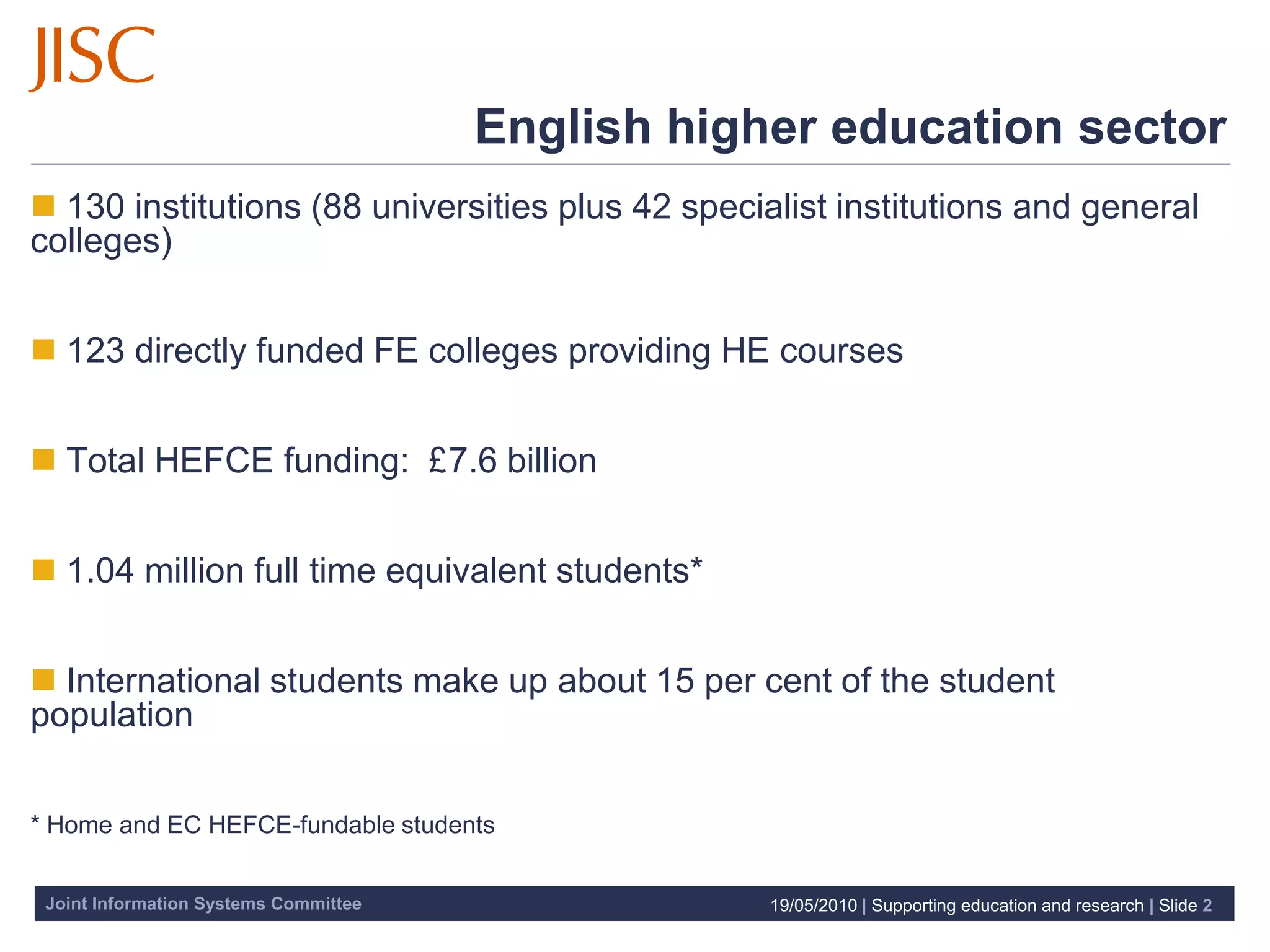
 130 institutions (88 universities plus 42 specialist institutions and general
colleges)


 123 directly funded FE colleges providing HE courses


 Total HEFCE funding: £7.6 billion


 1.04 million full time equivalent students*


 International students make up about 15 per cent of the student
population


* Home and EC HEFCE-fundable students


 Joint Information Systems Committee               19/05/2010 | Supporting education and research | Slide 2
English higher education sector (continued)
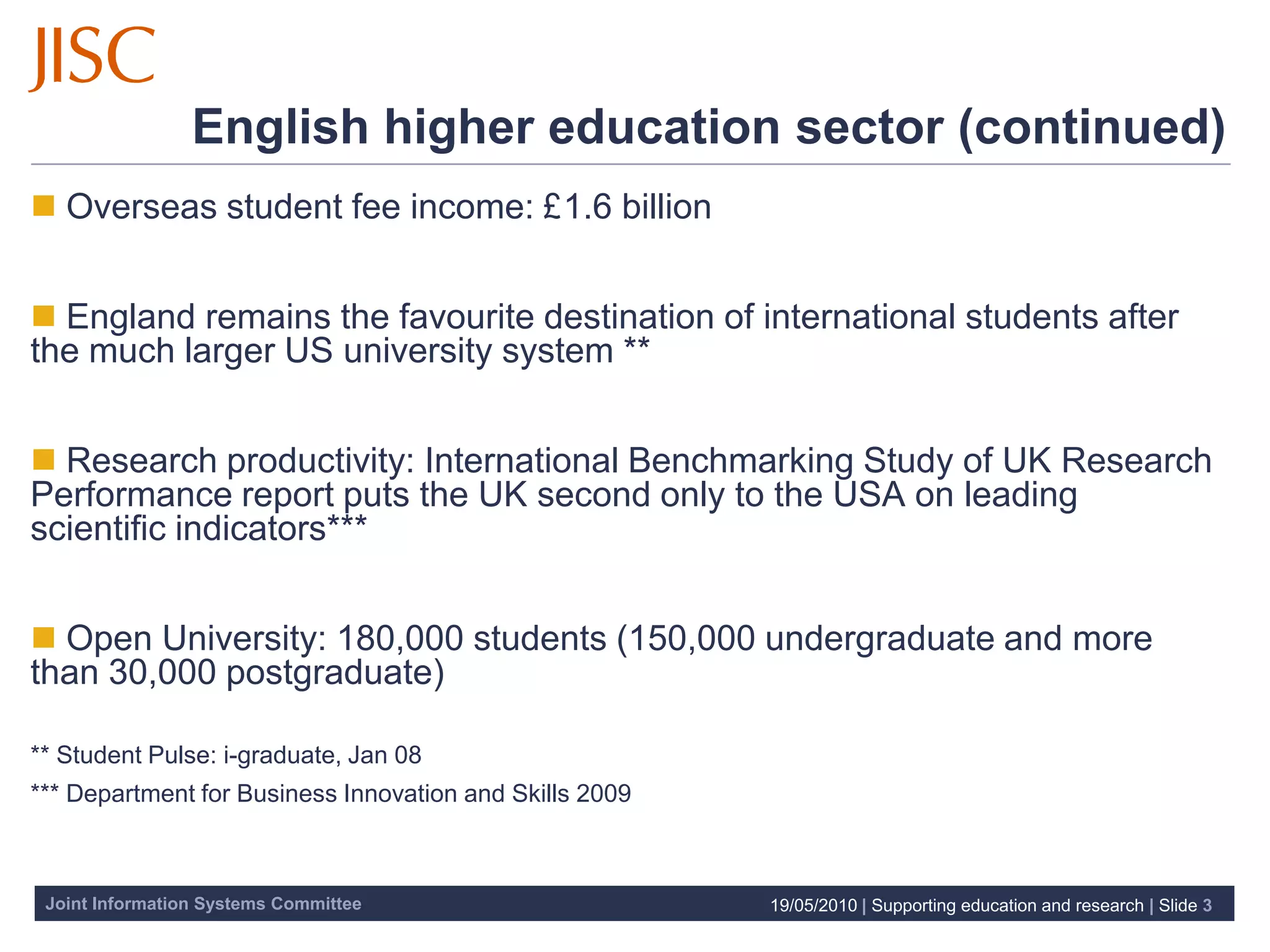
 Overseas student fee income: £1.6 billion


 England remains the favourite destination of international students after
the much larger US university system **


 Research productivity: International Benchmarking Study of UK Research
Performance report puts the UK second only to the USA on leading
scientific indicators***


 Open University: 180,000 students (150,000 undergraduate and more
than 30,000 postgraduate)

** Student Pulse: i-graduate, Jan 08
*** Department for Business Innovation and Skills 2009


 Joint Information Systems Committee                     19/05/2010 | Supporting education and research | Slide 3
About JISC
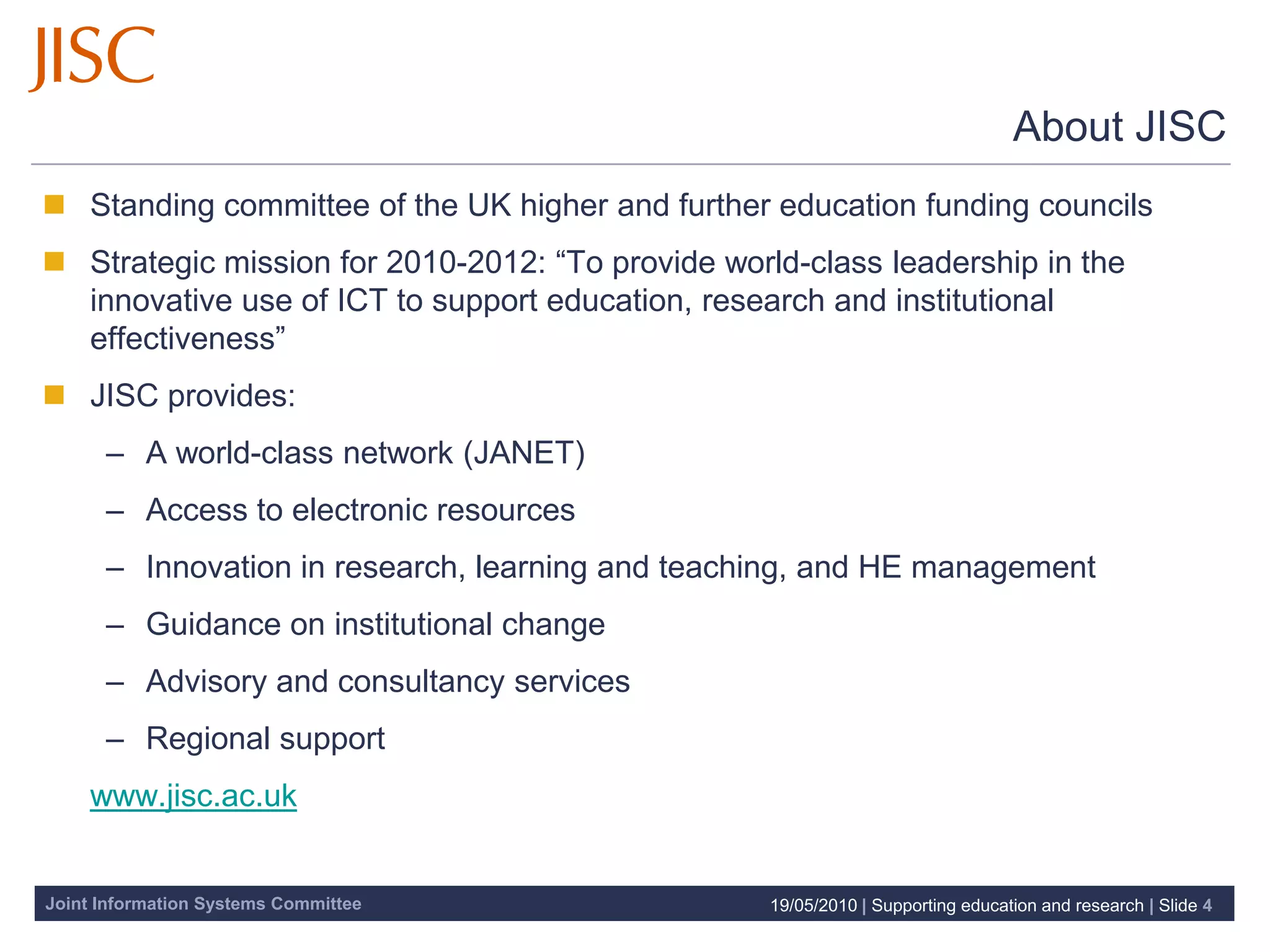
 Standing committee of the UK higher and further education funding councils
 Strategic mission for 2010-2012: “To provide world-class leadership in the
  innovative use of ICT to support education, research and institutional
  effectiveness”
 JISC provides:
      – A world-class network (JANET)
      – Access to electronic resources
      – Innovation in research, learning and teaching, and HE management
      – Guidance on institutional change
      – Advisory and consultancy services
      – Regional support
    www.jisc.ac.uk


Joint Information Systems Committee                19/05/2010 | Supporting education and research | Slide 4
Three aspects of OER

 OER is part of a wider “open agenda”


 OER works across educational sectors


 OER is a global movement


Joint Information Systems Committee      19/05/2010 | Supporting education and research | Slide 5
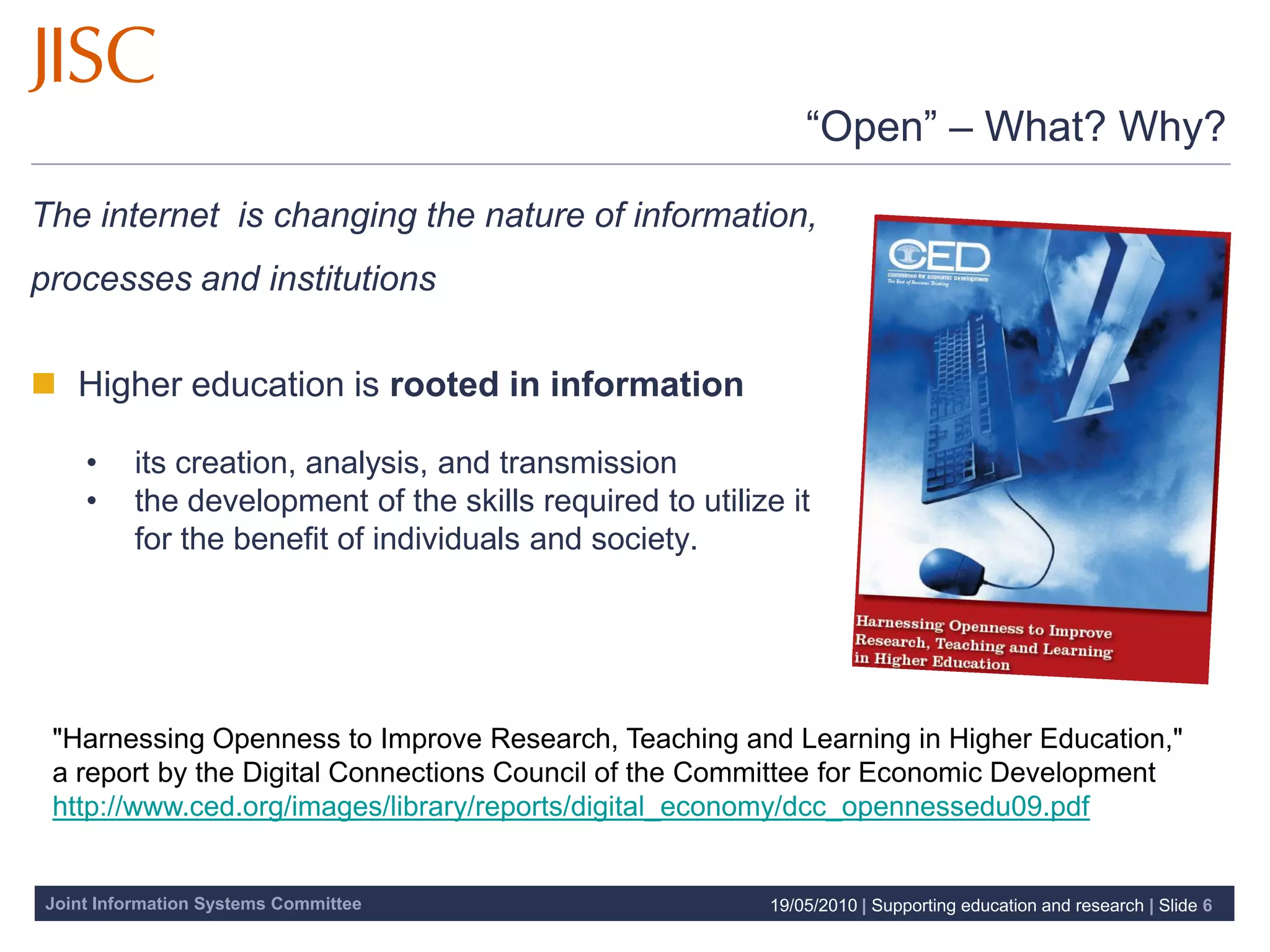
“Open” – What? Why?

The internet is changing the nature of information,
processes and institutions

 Higher education is rooted in information

    •    its creation, analysis, and transmission
    •    the development of the skills required to utilize it
         for the benefit of individuals and society.


 "Harnessing Openness to Improve Research, Teaching and Learning in Higher Education,"
 a report by the Digital Connections Council of the Committee for Economic Development
 http://www.ced.org/images/library/reports/digital_economy/dcc_opennessedu09.pdf


Joint Information Systems Committee                      19/05/2010 | Supporting education and research | Slide 6
The Openness Agenda

 Open Source – software

 Open Standards – interoperability

 Open Access – research outputs

 Open Data – research data, public data, others

 Open Educational Resources – course material

 Open Science – and open innovation


Joint Information Systems Committee          19/05/2010 | Supporting education and research | Slide 7
Academia and Openness

 Collegiality

 Communities of scholars

 Building on the work of others

 Consensus decisions

 Collaboration

 Reputation built by attribution – and more valuable than material reward


Joint Information Systems Committee           19/05/2010 | Supporting education and research | Slide 8
The Business of Academia

 Institutional competition (for students, grants, projects…)

 Multiple sources of funding

 The Enterprise Office – knowledge exploitation and transfer

 Employer links and employer “ownership” of information

 Short term staff contracts – need to “build a profile”


                         All these activities can benefit from openness


Joint Information Systems Committee                      19/05/2010 | Supporting education and research | Slide 9
The OER use case

 For prospective learners – to get a sense of what studying a particular
  course at a particular institution is like
 For formal and informal learners – to get access to a range of material
  to complement and inform their studies
 For institutions – to allow the world to see the quality of their learning
  resources and the learning experiences they offer
 For academics – to reuse and repurpose material rather than creating
  new material, saving time and leading to higher quality material


Joint Information Systems Committee             19/05/2010 | Supporting education and research | Slide 10
And for…

 Learners in compulsory schooling

 Learners in adult education

 Learners in industry

 Informal Learners

 ...

 All can benefit from the “taste of HE” that OER in HE can offer.

 And other sectors release OER!


Joint Information Systems Committee            19/05/2010 | Supporting education and research | Slide 11
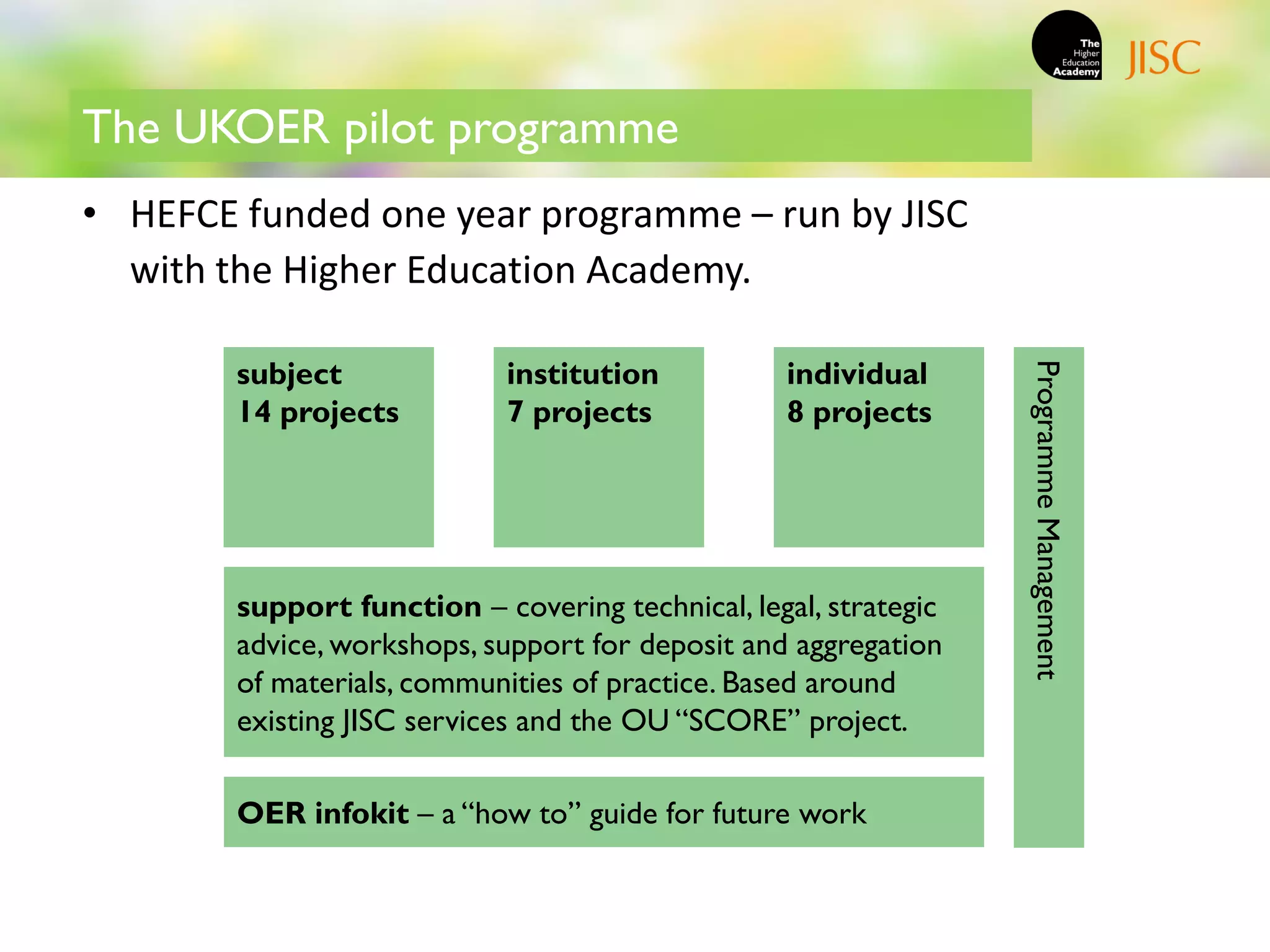
The UKOER pilot programme
• HEFCE funded one year programme – run by JISC
  with the Higher Education Academy.

        subject              institution          individual


                                                                  Programme Management
        14 projects          7 projects           8 projects


        support function – covering technical, legal, strategic
        advice, workshops, support for deposit and aggregation
        of materials, communities of practice. Based around
        existing JISC services and the OU “SCORE” project.

        OER infokit – a “how to” guide for future work
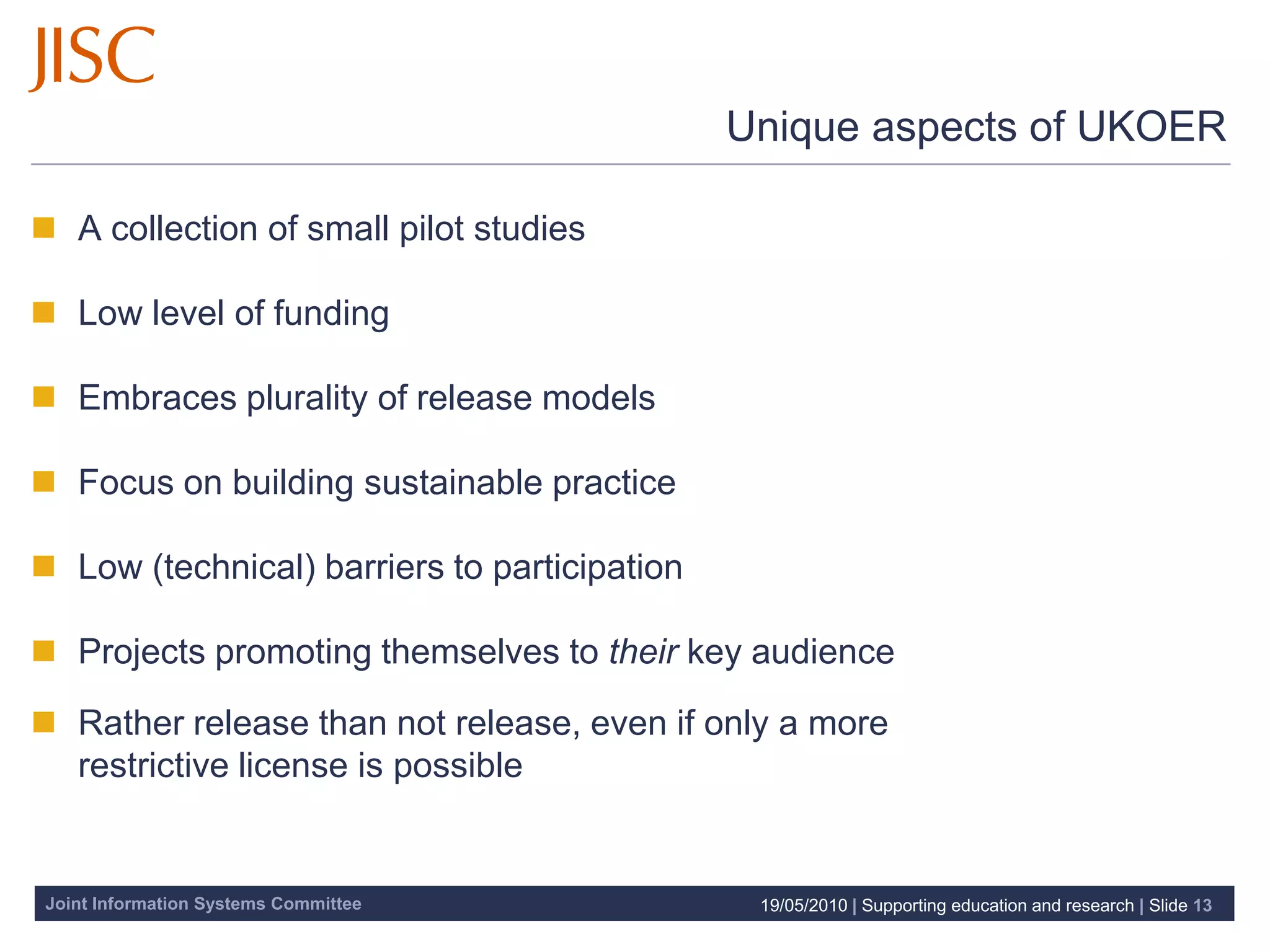
Unique aspects of UKOER

 A collection of small pilot studies

 Low level of funding

 Embraces plurality of release models

 Focus on building sustainable practice

 Low (technical) barriers to participation

 Projects promoting themselves to their key audience

 Rather release than not release, even if only a more
  restrictive license is possible


Joint Information Systems Committee            19/05/2010 | Supporting education and research | Slide 13
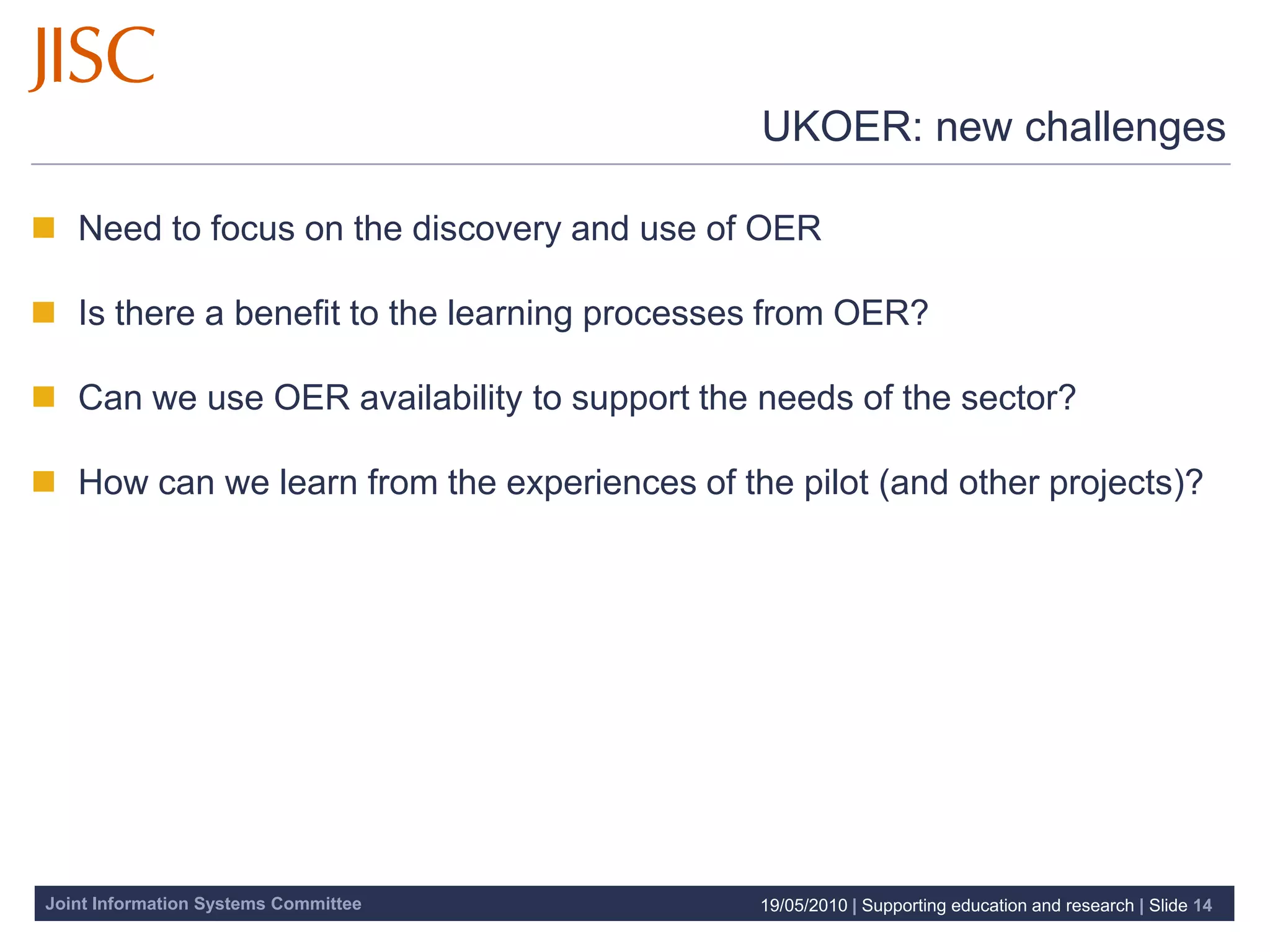
UKOER: new challenges

 Need to focus on the discovery and use of OER

 Is there a benefit to the learning processes from OER?

 Can we use OER availability to support the needs of the sector?

 How can we learn from the experiences of the pilot (and other projects)?


Joint Information Systems Committee           19/05/2010 | Supporting education and research | Slide 14
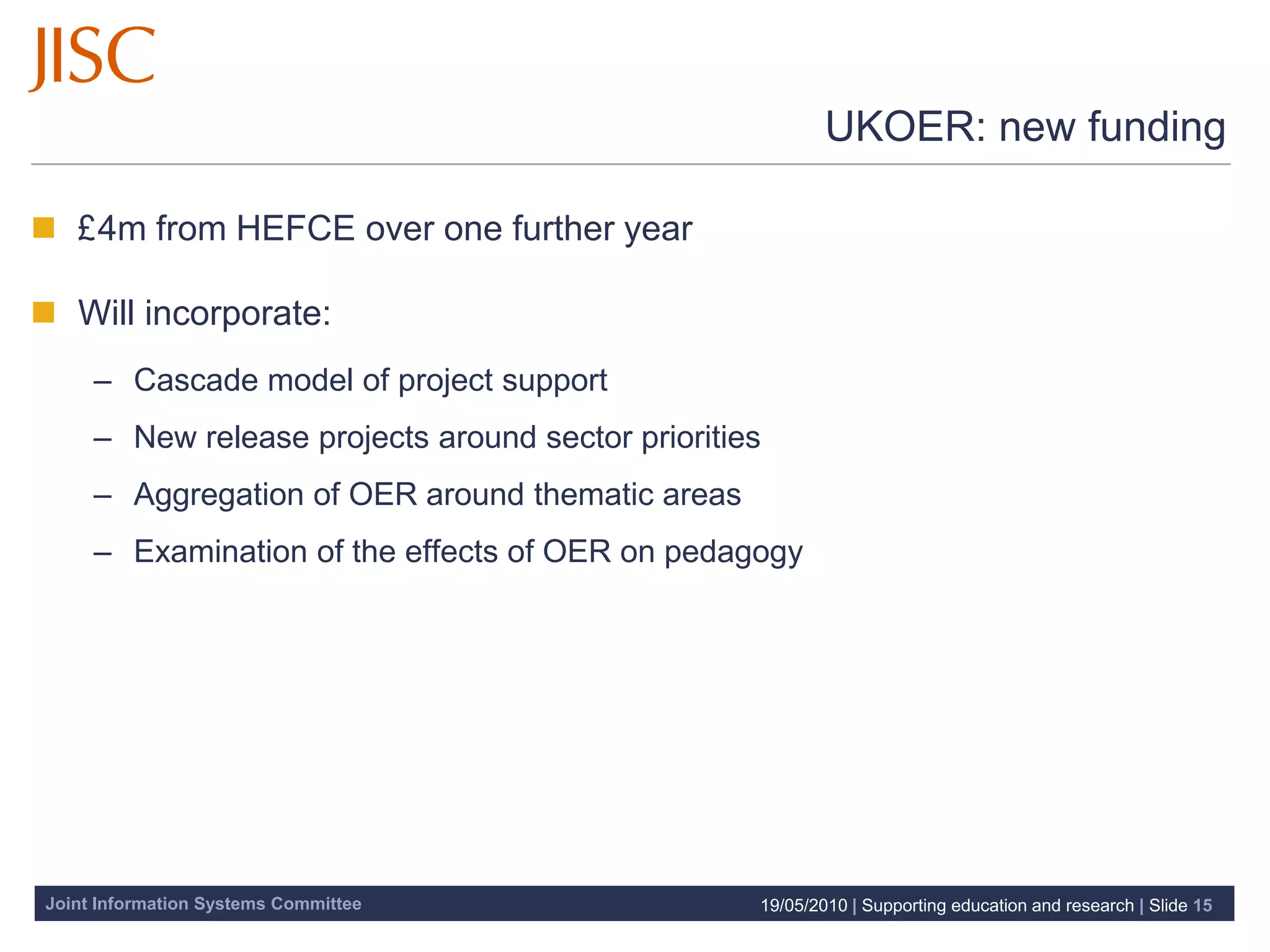
UKOER: new funding

 £4m from HEFCE over one further year

 Will incorporate:
     – Cascade model of project support
     – New release projects around sector priorities
     – Aggregation of OER around thematic areas
     – Examination of the effects of OER on pedagogy


Joint Information Systems Committee                19/05/2010 | Supporting education and research | Slide 15
Discoverability

 A Library Way – a directory/database which uses a common
  hierarchical set of vocabularies.
   Great when…
   you know exactly what you are looking for
   Great when…
   your conception of what something should be categorised under
   matches that of the person who filed it
 A Web Way – powerful (and unrestricted) free text search.
   Great when…
   you are looking for information rather than a particular item
   Great when…
   you are capable of validating the quality and utility of material for
   yourself
Joint Information Systems Committee           19/05/2010 | Supporting education and research | Slide 16
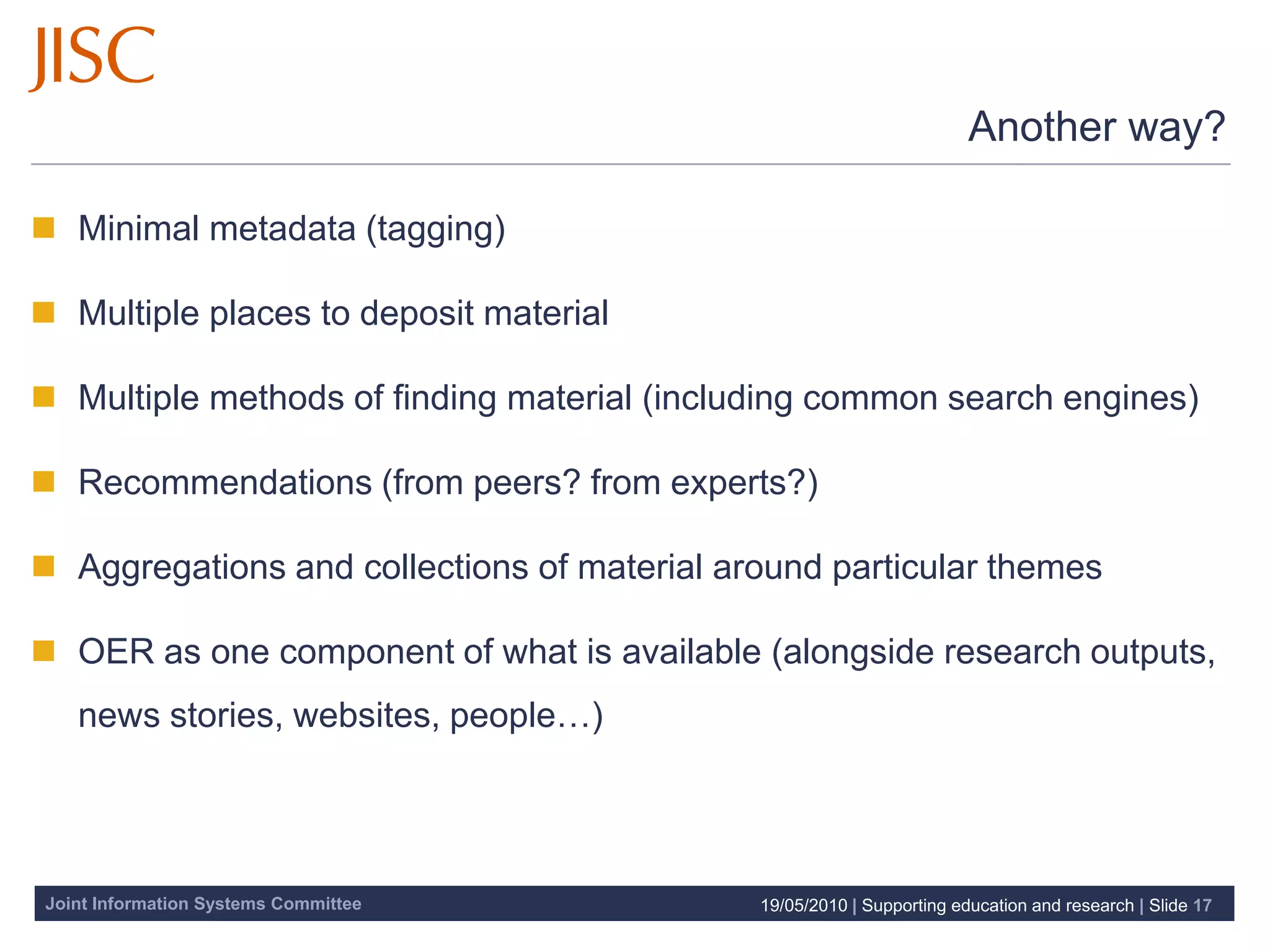
Another way?

 Minimal metadata (tagging)

 Multiple places to deposit material

 Multiple methods of finding material (including common search engines)

 Recommendations (from peers? from experts?)

 Aggregations and collections of material around particular themes

 OER as one component of what is available (alongside research outputs,
   news stories, websites, people…)


Joint Information Systems Committee          19/05/2010 | Supporting education and research | Slide 17
A wider context

 OER should be seen as one part of a "layer" of open academic and
  scholarly content, alongside:
     –     research outputs (journal articles, monographs etc)
     –     research data
     –     on-line text books


 and organised as an international resource to benefit society, education,
  research and culture


 Resources will be world wide or regional/local depending on language


Joint Information Systems Committee              19/05/2010 | Supporting education and research | Slide 18
OER worldwide


 Thousands of institutions worldwide are involved in the creation or reuse
  of OER

 Millions of people

 Millions of potential use cases


 How can the world’s open educational resources best be exploited for the
                                      good of mankind and society?

Joint Information Systems Committee                       19/05/2010 | Supporting education and research | Slide 19
Conclusions

 OER should be seen as a part of a wider movement making information
  and tools widely available for the greater good.


 There is unlikely to be one way of organising or discovering OER – we
  need to consider multiple structures and working with users.


 The “user” experience of OER is under-researched – some work is
  ongoing (eg. OlNet) but there is a need for much more.


 And we need to identify and replicate low-cost, sustainable models of
  release.


Joint Information Systems Committee           19/05/2010 | Supporting education and research | Slide 20

Malcolm read

  • 1.
    OER and theOpen Agenda Dr Malcolm Read, JISC Executive Secretary Joint Information Systems Committee 19/05/2010 | Supporting education and research research Supporting education and | Slide 1
  • 2.
    English higher educationsector  130 institutions (88 universities plus 42 specialist institutions and general colleges)  123 directly funded FE colleges providing HE courses  Total HEFCE funding: £7.6 billion  1.04 million full time equivalent students*  International students make up about 15 per cent of the student population * Home and EC HEFCE-fundable students Joint Information Systems Committee 19/05/2010 | Supporting education and research | Slide 2
  • 3.
    English higher educationsector (continued)  Overseas student fee income: £1.6 billion  England remains the favourite destination of international students after the much larger US university system **  Research productivity: International Benchmarking Study of UK Research Performance report puts the UK second only to the USA on leading scientific indicators***  Open University: 180,000 students (150,000 undergraduate and more than 30,000 postgraduate) ** Student Pulse: i-graduate, Jan 08 *** Department for Business Innovation and Skills 2009 Joint Information Systems Committee 19/05/2010 | Supporting education and research | Slide 3
  • 4.
    About JISC  Standingcommittee of the UK higher and further education funding councils  Strategic mission for 2010-2012: “To provide world-class leadership in the innovative use of ICT to support education, research and institutional effectiveness”  JISC provides: – A world-class network (JANET) – Access to electronic resources – Innovation in research, learning and teaching, and HE management – Guidance on institutional change – Advisory and consultancy services – Regional support www.jisc.ac.uk Joint Information Systems Committee 19/05/2010 | Supporting education and research | Slide 4
  • 5.
    Three aspects ofOER  OER is part of a wider “open agenda”  OER works across educational sectors  OER is a global movement Joint Information Systems Committee 19/05/2010 | Supporting education and research | Slide 5
  • 6.
    “Open” – What?Why? The internet is changing the nature of information, processes and institutions  Higher education is rooted in information • its creation, analysis, and transmission • the development of the skills required to utilize it for the benefit of individuals and society. "Harnessing Openness to Improve Research, Teaching and Learning in Higher Education," a report by the Digital Connections Council of the Committee for Economic Development http://www.ced.org/images/library/reports/digital_economy/dcc_opennessedu09.pdf Joint Information Systems Committee 19/05/2010 | Supporting education and research | Slide 6
  • 7.
    The Openness Agenda Open Source – software  Open Standards – interoperability  Open Access – research outputs  Open Data – research data, public data, others  Open Educational Resources – course material  Open Science – and open innovation Joint Information Systems Committee 19/05/2010 | Supporting education and research | Slide 7
  • 8.
    Academia and Openness Collegiality  Communities of scholars  Building on the work of others  Consensus decisions  Collaboration  Reputation built by attribution – and more valuable than material reward Joint Information Systems Committee 19/05/2010 | Supporting education and research | Slide 8
  • 9.
    The Business ofAcademia  Institutional competition (for students, grants, projects…)  Multiple sources of funding  The Enterprise Office – knowledge exploitation and transfer  Employer links and employer “ownership” of information  Short term staff contracts – need to “build a profile” All these activities can benefit from openness Joint Information Systems Committee 19/05/2010 | Supporting education and research | Slide 9
  • 10.
    The OER usecase  For prospective learners – to get a sense of what studying a particular course at a particular institution is like  For formal and informal learners – to get access to a range of material to complement and inform their studies  For institutions – to allow the world to see the quality of their learning resources and the learning experiences they offer  For academics – to reuse and repurpose material rather than creating new material, saving time and leading to higher quality material Joint Information Systems Committee 19/05/2010 | Supporting education and research | Slide 10
  • 11.
    And for…  Learnersin compulsory schooling  Learners in adult education  Learners in industry  Informal Learners  ...  All can benefit from the “taste of HE” that OER in HE can offer.  And other sectors release OER! Joint Information Systems Committee 19/05/2010 | Supporting education and research | Slide 11
  • 12.
    The UKOER pilotprogramme • HEFCE funded one year programme – run by JISC with the Higher Education Academy. subject institution individual Programme Management 14 projects 7 projects 8 projects support function – covering technical, legal, strategic advice, workshops, support for deposit and aggregation of materials, communities of practice. Based around existing JISC services and the OU “SCORE” project. OER infokit – a “how to” guide for future work
  • 13.
    Unique aspects ofUKOER  A collection of small pilot studies  Low level of funding  Embraces plurality of release models  Focus on building sustainable practice  Low (technical) barriers to participation  Projects promoting themselves to their key audience  Rather release than not release, even if only a more restrictive license is possible Joint Information Systems Committee 19/05/2010 | Supporting education and research | Slide 13
  • 14.
    UKOER: new challenges Need to focus on the discovery and use of OER  Is there a benefit to the learning processes from OER?  Can we use OER availability to support the needs of the sector?  How can we learn from the experiences of the pilot (and other projects)? Joint Information Systems Committee 19/05/2010 | Supporting education and research | Slide 14
  • 15.
    UKOER: new funding £4m from HEFCE over one further year  Will incorporate: – Cascade model of project support – New release projects around sector priorities – Aggregation of OER around thematic areas – Examination of the effects of OER on pedagogy Joint Information Systems Committee 19/05/2010 | Supporting education and research | Slide 15
  • 16.
    Discoverability  A LibraryWay – a directory/database which uses a common hierarchical set of vocabularies. Great when… you know exactly what you are looking for Great when… your conception of what something should be categorised under matches that of the person who filed it  A Web Way – powerful (and unrestricted) free text search. Great when… you are looking for information rather than a particular item Great when… you are capable of validating the quality and utility of material for yourself Joint Information Systems Committee 19/05/2010 | Supporting education and research | Slide 16
  • 17.
    Another way?  Minimalmetadata (tagging)  Multiple places to deposit material  Multiple methods of finding material (including common search engines)  Recommendations (from peers? from experts?)  Aggregations and collections of material around particular themes  OER as one component of what is available (alongside research outputs, news stories, websites, people…) Joint Information Systems Committee 19/05/2010 | Supporting education and research | Slide 17
  • 18.
    A wider context OER should be seen as one part of a "layer" of open academic and scholarly content, alongside: – research outputs (journal articles, monographs etc) – research data – on-line text books  and organised as an international resource to benefit society, education, research and culture  Resources will be world wide or regional/local depending on language Joint Information Systems Committee 19/05/2010 | Supporting education and research | Slide 18
  • 19.
    OER worldwide  Thousandsof institutions worldwide are involved in the creation or reuse of OER  Millions of people  Millions of potential use cases How can the world’s open educational resources best be exploited for the good of mankind and society? Joint Information Systems Committee 19/05/2010 | Supporting education and research | Slide 19
  • 20.
    Conclusions  OER shouldbe seen as a part of a wider movement making information and tools widely available for the greater good.  There is unlikely to be one way of organising or discovering OER – we need to consider multiple structures and working with users.  The “user” experience of OER is under-researched – some work is ongoing (eg. OlNet) but there is a need for much more.  And we need to identify and replicate low-cost, sustainable models of release. Joint Information Systems Committee 19/05/2010 | Supporting education and research | Slide 20