Higher Education and Research for
Reaching the Education for All Goals
A Project of the International Association of Universities
developed with the support of an international Reference
Group and partial funding from the Swedish agency SIDA
Introduction
• EFA?
• MDGs?
• United Nations Millennium Declaration, New York, US, 2000
• 8 MDGs: Eradicate Extreme Poverty and Hunger; Universal Primary
Education; Gender Parity and Empowerment of Women; Reduce
Child Mortality; Improve Maternal Health; Combat HIV/AID, Malaria;
Ensure Environmental Sustainability; Develop Global Partnerships for
Development
• Education First?
• Initiative of the United Nations Secretary –General, 2012
• 3 priority areas: Put every child in school; Improve the quality of
learning; Foster global citizenship
• Post-2015 Development Agenda?
What has changed?
• Many programmes/projects/activities have taken and are taking
place
• Progress has been registered in primary schooling and gender equity
• Higher education was included in Ministers’ Statement (GEM, 2012)
BUT
• The United Nations’ Education For All (EFA) initiative is coming to an
end in 2015
• But, according to the latest Global Monitoring Report (GMR), the 6
set objectives will not be met by 2015
• In some places, progress is receiding
• Education is not as high on the global agenda as it used to be
(reason for the Education First Initiative)
Why higher education?
• The higher education sector as a sector and in all its missions
has not systematically been involved in EFA until now
• This does not include teachers’ training and individual
consultancies
• To reach the EFA goals all the three primary missions
(teaching; research and community service) of higher
education institutions can be of help
• The higher education sector is generally not aware of the
initiative, issues at stake, and how to proceed to help
• The higher education sector will be or is already, impacted by:
• A growing number of secondary-school graduates;
• The quality of pre-higher education schooling;
• Reforms of teacher education
What are IAU’s objectives?
• To raise awareness of EFA within the higher education sector
• To increase the level of involvement of the higher education
sector in EFA-related issues and in all three HE missions (not
only teachers’ training)
• To improve the visibility of higher education’s role and
activities in/for EFA within and outside the higher education
sector, locally and internationally
• To create a higher education community for EFA
• To help reach EFA
• To help the higher education sector deal with the impact of
EFA : enrolment, quality, bogus universities, rankings,
employment, brain drain, etc…
• Reflect and share its position on the post-2015 agenda
VisualforIAUProject
All age groups are offered and enjoy the possibility of education
What is the project doing?
• Community Building
• The IAU HEEFA Reference Group is composed of 30 people from
all regions of the world;
Neerja Sharma, India
Valtencir Mendes, Spain
• The HEEFA Portal aims to be the main-entry point for data
collection and information on higher education projects,
publications (in particular theses) and experts for EFA.
www.heefa.net
• Published on a quarterly-basis, the HEEFA Newsletter reaches
over 800 subscribers,.
RegionsasrepresentedwithintheReferenceGroup
Voluntary focus on Africa and all regions represented
+ 2 persons from IAU
Africa
Americas
Asia
Europe
What is the project doing?
• Commitment Building
• Development of a commonly agreed upon - and regularly
reviewed - project by representatives of the higher education
sector from all regions of the world (Maputo Seminar, Paris
Conference, and upcoming Ankara Seminar)
Experts’Seminar,Maputo,Mozambique
30 participants
InnovationConference,Paris,France
60 participants
What is the project doing?
• Capacity Building
• A three-step collaborative workshop was developed :
• to inform both the higher education community of what EFA is and
the other EFA stakeholders of what higher education can bring to
EFA,
• to subsequently identify local needs and higher education’s possible
intervention(s), and
• to end with a commonly agreed upon document for a way forward.
What is the project doing?
• IAU’s capacity building approach to involving the higher education
sector in EFA is:
• Participant-centred
• Questionnaire/Workshops with IAU intervening only as facilitator
• Inclusive
• All EFA stakeholders at the national level are invited
• Based on Dialogue
• Mixed groups including every categories of stakeholders + HEIs
• Commonly agreed-upon way forward
• Result-focused
• All activities leading/aiming at the validation of a way forward
• Embedded in a process
• Pre and post-workshop activities
• Local but not closed
• With experts from other regions
Cuernavaca,Mexico
100 participants, A Declaration, Several Groups of reflexion/action created, An annual
meeting planned and taking place
Ouagadougou,BurkinaFaso
40 participants, Recommendations to Ministers, Follow-up workshop to be organized
Kathmandu,Nepal
Nairobi,Kenya
Main Results to Date
• Growing awareness of the need to more systematically involve
higher education institutions at local, regional and international
levels
• Invitation to IAU to participate in EFA High Level Meeting in
Jomtien, Thailand in 2011.
• IAU sits on the Coordination Group of UNESCO Collective
Consultation of NGOs for EFA for two years starting in 2012
• IAU’s General Conference (Puerto Rico, November 2012) addressed:
Higher Education and the Global Agenda
• UNESCO ‘s post 2015 agenda includes post-basic education (used as
a generic term that includes tertiary education)
• Growing community of higher education for EFA
• Follow-up of capacity building sessions are taking place
• Mexico: Action plan taken up by Mexican governement
• Burkina Faso: Considering the possibility of a follow-up session
Main Results to Date
• But there is still:
• Lack of information: the HEEFA portal is still empty, difficulty to
know who is doing what and where
• Need for evidence-based data to evaluate progress to date and
consider possible ways forward
• Need for higher education champions and advocates so that a
holistic vision of education that includes higher education be
comprised in the post-2015 development agenda
Africa
Kenya: University of Nairobi
• Project: Education in Emergencies Specialization Programme
• Keywords: Training Programme; Emergencies; Education
• Objectives:
• Build capacities of students, faculty, and practitionners to
respond to the educational needs of children and youth affected
by crisis in East Africa and beyond
• Document, stock and share practices and policy innovations with
the larger education in emergencies community
• Establish the University of Nairobi as a hub of expertise in East
Africa in the field
Americas
Mexico: Universidad Pedagogica Nacional
• Project: Intercultural Bilingual Urban School
• Keywords: Bilingual education; Culturally-sensitive education;
Urban schools; Indigenous populations
• Objectives:
• Preserve and make the most of local indigenous cultures;
• Ensure quality education to children from indigenous populations
• Ensure access for and improve success of children from
indigenous populations
• Serve as a practicum school for research projects
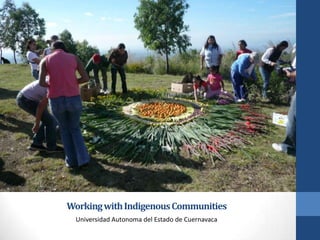
WorkingwithIndigenousCommunities
Universidad Autonoma del Estado de Cuernavaca
Arab States
Lebanon: Balamand University
• Project: University Students for Literacy
• Keywords: Adult Literacy; Health
• Objectives:
• Provide mothers and young men in rural areas with the
opportunity to acquire reading and writing skills
• Break the link between illiteracy, poverty and poor health
• Teach students how to become responsible citizens by
participating in the development of their community
• Create a bridge between the university and the community;
between urban and rural areas; men and women
Europe
Germany : Universität Hildesheim
• Project: Men in Primary and Pre-Primary Schools (Thesis)
• Keywords: Gender; Primary Schools; Early Childhood
Education
• Objectives:
• Propose solutions to the issue of the lack of male teachers in pre-
primary and primary schools
• Research the implications of a totally female-guided pre-primary
and primary school education
Asia
India : Lady Irwin College
• Project:
• Keywords:
• Objectives:
Expectations
• The capacity building model facilitates interactions between
the traditional EFA stakeholders and the HE sector and is
widely taken up as such or adapted
• Information on HE projects and research results is made
available and accessible to all
• Research on pre and post-2015 issues is developing
• Higher education institutions are given the means to better
interact with the other EFA stakeholders
• HE institutions’ possible role in EFA is recognised and valued
• The community of HE for EFA is expanding
• More EFA goals are reached
• The HE sector is prepared for EFA knock-on effects
Cuernavaca,Mexico-25-26May
2010
27
Today’s Workshop
Objective:
Envisioning a global initiative
(EFA) locally (Delhi)
Previous sessions:
Universidad Autonoma del
Estado de
Morelos, Cuernavaca, Mexi
co ;
Université de
Ouagadougou, Burkina
Faso
Tribhuvan University, Nepal
University of Nairobi, Kenya
Participants: All local EFA
stakeholders
(universities;
Representatives from the
Government; schools;
students; NGOs;
UNESCO)
Aim: To collectively explore
and develop a concrete
tool to strengthen higher
education participation
in EFA at the local level.
Cuernavaca,Mexico-25-26May
2010
28
Today’s Workshop
First Day (morning
session):
- Opening
- Learn more on the global
EFA initiative (UNESCO)
and IAU Project on links
between HE and EFA and
its capacity building
session
First Day (afternoon
session)
- Different stakeholders’
perspectives on local
priorities to reach EFA
- Rotating workshops
Cuernavaca,Mexico-25-26May
2010
29
Today’s Workshop
Rotating workshops
3 groups: the group you
should join has been
indicated to you upon
registration
3 topics (research;
teaching/learning;
community service); 1
per group
3 rounds: Each group will
attend the 3 workshops
in turn
Aim: Discuss the results of the
questionnaire and come up
with a commonly approved
set of priorities in EFA
Pre-validated answers: > 50% of
total answers (Green). No
discussion
Pre-rejected answers: less than
10 answers (Red). No
discussion
In between are to be discussed
(Yellow)
Each group will be informed of
and allowed to discuss and
change the choices made by
preceding groups.
Cuernavaca,Mexico-25-26May
2010
30
Today’s Workshop
2nd day
- Presentation of the results
of the Workshops
- Higher education activities
in EFA
- Discussion on and drafting
of a way forward in groups
- What are the key strategies
to be put in place to
improve HE’s role in EFA?
- Which
principles, products, structur
es should be put in place to
mobilize, develop, utilize, m
aintain, retain HE
involvement in EFA?
- Hands-on session on the
HEEFA Portal
- Discussion on and
drafting of a way forward
in plenary session
The summary of the
discussions will be
presented at the end of
the meeting
IAU
• IAU is a Membership organization. It has
institutional, organisational, and affiliates members in 120 countries
• IAU Secretariat is located in Paris, France. It has been hosted by
UNESCO since its creation (1950)
• IAU serves the higher education community worldwide and defends
academic values
• IAU promotes knowledge sharing, collaboration and solidarity
through projects, statements, conferences, reference and scientific
publications, and services.
• IAU functions with 15 permanent staff members, an elected Board
composed of 22 persons and an Executive Committee composed of
6 persons, both with equitable regional/gender representation, plus
all its Members on a voluntary basis
More at: www.iau-aiu.net
My contact: i.turmaine@iau-aiu.net

IAU HEEFA Workshop Overview India

  • 1.
    Higher Education andResearch for Reaching the Education for All Goals A Project of the International Association of Universities developed with the support of an international Reference Group and partial funding from the Swedish agency SIDA
  • 2.
    Introduction • EFA? • MDGs? •United Nations Millennium Declaration, New York, US, 2000 • 8 MDGs: Eradicate Extreme Poverty and Hunger; Universal Primary Education; Gender Parity and Empowerment of Women; Reduce Child Mortality; Improve Maternal Health; Combat HIV/AID, Malaria; Ensure Environmental Sustainability; Develop Global Partnerships for Development • Education First? • Initiative of the United Nations Secretary –General, 2012 • 3 priority areas: Put every child in school; Improve the quality of learning; Foster global citizenship • Post-2015 Development Agenda?
  • 3.
    What has changed? •Many programmes/projects/activities have taken and are taking place • Progress has been registered in primary schooling and gender equity • Higher education was included in Ministers’ Statement (GEM, 2012) BUT • The United Nations’ Education For All (EFA) initiative is coming to an end in 2015 • But, according to the latest Global Monitoring Report (GMR), the 6 set objectives will not be met by 2015 • In some places, progress is receiding • Education is not as high on the global agenda as it used to be (reason for the Education First Initiative)
  • 4.
    Why higher education? •The higher education sector as a sector and in all its missions has not systematically been involved in EFA until now • This does not include teachers’ training and individual consultancies • To reach the EFA goals all the three primary missions (teaching; research and community service) of higher education institutions can be of help • The higher education sector is generally not aware of the initiative, issues at stake, and how to proceed to help • The higher education sector will be or is already, impacted by: • A growing number of secondary-school graduates; • The quality of pre-higher education schooling; • Reforms of teacher education
  • 5.
    What are IAU’sobjectives? • To raise awareness of EFA within the higher education sector • To increase the level of involvement of the higher education sector in EFA-related issues and in all three HE missions (not only teachers’ training) • To improve the visibility of higher education’s role and activities in/for EFA within and outside the higher education sector, locally and internationally • To create a higher education community for EFA • To help reach EFA • To help the higher education sector deal with the impact of EFA : enrolment, quality, bogus universities, rankings, employment, brain drain, etc… • Reflect and share its position on the post-2015 agenda
  • 6.
    VisualforIAUProject All age groupsare offered and enjoy the possibility of education
  • 7.
    What is theproject doing? • Community Building • The IAU HEEFA Reference Group is composed of 30 people from all regions of the world; Neerja Sharma, India Valtencir Mendes, Spain • The HEEFA Portal aims to be the main-entry point for data collection and information on higher education projects, publications (in particular theses) and experts for EFA. www.heefa.net • Published on a quarterly-basis, the HEEFA Newsletter reaches over 800 subscribers,.
  • 8.
    RegionsasrepresentedwithintheReferenceGroup Voluntary focus onAfrica and all regions represented + 2 persons from IAU Africa Americas Asia Europe
  • 9.
    What is theproject doing? • Commitment Building • Development of a commonly agreed upon - and regularly reviewed - project by representatives of the higher education sector from all regions of the world (Maputo Seminar, Paris Conference, and upcoming Ankara Seminar)
  • 10.
  • 11.
  • 12.
    What is theproject doing? • Capacity Building • A three-step collaborative workshop was developed : • to inform both the higher education community of what EFA is and the other EFA stakeholders of what higher education can bring to EFA, • to subsequently identify local needs and higher education’s possible intervention(s), and • to end with a commonly agreed upon document for a way forward.
  • 13.
    What is theproject doing? • IAU’s capacity building approach to involving the higher education sector in EFA is: • Participant-centred • Questionnaire/Workshops with IAU intervening only as facilitator • Inclusive • All EFA stakeholders at the national level are invited • Based on Dialogue • Mixed groups including every categories of stakeholders + HEIs • Commonly agreed-upon way forward • Result-focused • All activities leading/aiming at the validation of a way forward • Embedded in a process • Pre and post-workshop activities • Local but not closed • With experts from other regions
  • 14.
    Cuernavaca,Mexico 100 participants, ADeclaration, Several Groups of reflexion/action created, An annual meeting planned and taking place
  • 15.
    Ouagadougou,BurkinaFaso 40 participants, Recommendationsto Ministers, Follow-up workshop to be organized
  • 16.
  • 17.
  • 18.
    Main Results toDate • Growing awareness of the need to more systematically involve higher education institutions at local, regional and international levels • Invitation to IAU to participate in EFA High Level Meeting in Jomtien, Thailand in 2011. • IAU sits on the Coordination Group of UNESCO Collective Consultation of NGOs for EFA for two years starting in 2012 • IAU’s General Conference (Puerto Rico, November 2012) addressed: Higher Education and the Global Agenda • UNESCO ‘s post 2015 agenda includes post-basic education (used as a generic term that includes tertiary education) • Growing community of higher education for EFA • Follow-up of capacity building sessions are taking place • Mexico: Action plan taken up by Mexican governement • Burkina Faso: Considering the possibility of a follow-up session
  • 19.
    Main Results toDate • But there is still: • Lack of information: the HEEFA portal is still empty, difficulty to know who is doing what and where • Need for evidence-based data to evaluate progress to date and consider possible ways forward • Need for higher education champions and advocates so that a holistic vision of education that includes higher education be comprised in the post-2015 development agenda
  • 20.
    Africa Kenya: University ofNairobi • Project: Education in Emergencies Specialization Programme • Keywords: Training Programme; Emergencies; Education • Objectives: • Build capacities of students, faculty, and practitionners to respond to the educational needs of children and youth affected by crisis in East Africa and beyond • Document, stock and share practices and policy innovations with the larger education in emergencies community • Establish the University of Nairobi as a hub of expertise in East Africa in the field
  • 21.
    Americas Mexico: Universidad PedagogicaNacional • Project: Intercultural Bilingual Urban School • Keywords: Bilingual education; Culturally-sensitive education; Urban schools; Indigenous populations • Objectives: • Preserve and make the most of local indigenous cultures; • Ensure quality education to children from indigenous populations • Ensure access for and improve success of children from indigenous populations • Serve as a practicum school for research projects
  • 22.
  • 23.
    Arab States Lebanon: BalamandUniversity • Project: University Students for Literacy • Keywords: Adult Literacy; Health • Objectives: • Provide mothers and young men in rural areas with the opportunity to acquire reading and writing skills • Break the link between illiteracy, poverty and poor health • Teach students how to become responsible citizens by participating in the development of their community • Create a bridge between the university and the community; between urban and rural areas; men and women
  • 24.
    Europe Germany : UniversitätHildesheim • Project: Men in Primary and Pre-Primary Schools (Thesis) • Keywords: Gender; Primary Schools; Early Childhood Education • Objectives: • Propose solutions to the issue of the lack of male teachers in pre- primary and primary schools • Research the implications of a totally female-guided pre-primary and primary school education
  • 25.
    Asia India : LadyIrwin College • Project: • Keywords: • Objectives:
  • 26.
    Expectations • The capacitybuilding model facilitates interactions between the traditional EFA stakeholders and the HE sector and is widely taken up as such or adapted • Information on HE projects and research results is made available and accessible to all • Research on pre and post-2015 issues is developing • Higher education institutions are given the means to better interact with the other EFA stakeholders • HE institutions’ possible role in EFA is recognised and valued • The community of HE for EFA is expanding • More EFA goals are reached • The HE sector is prepared for EFA knock-on effects
  • 27.
    Cuernavaca,Mexico-25-26May 2010 27 Today’s Workshop Objective: Envisioning aglobal initiative (EFA) locally (Delhi) Previous sessions: Universidad Autonoma del Estado de Morelos, Cuernavaca, Mexi co ; Université de Ouagadougou, Burkina Faso Tribhuvan University, Nepal University of Nairobi, Kenya Participants: All local EFA stakeholders (universities; Representatives from the Government; schools; students; NGOs; UNESCO) Aim: To collectively explore and develop a concrete tool to strengthen higher education participation in EFA at the local level.
  • 28.
    Cuernavaca,Mexico-25-26May 2010 28 Today’s Workshop First Day(morning session): - Opening - Learn more on the global EFA initiative (UNESCO) and IAU Project on links between HE and EFA and its capacity building session First Day (afternoon session) - Different stakeholders’ perspectives on local priorities to reach EFA - Rotating workshops
  • 29.
    Cuernavaca,Mexico-25-26May 2010 29 Today’s Workshop Rotating workshops 3groups: the group you should join has been indicated to you upon registration 3 topics (research; teaching/learning; community service); 1 per group 3 rounds: Each group will attend the 3 workshops in turn Aim: Discuss the results of the questionnaire and come up with a commonly approved set of priorities in EFA Pre-validated answers: > 50% of total answers (Green). No discussion Pre-rejected answers: less than 10 answers (Red). No discussion In between are to be discussed (Yellow) Each group will be informed of and allowed to discuss and change the choices made by preceding groups.
  • 30.
    Cuernavaca,Mexico-25-26May 2010 30 Today’s Workshop 2nd day -Presentation of the results of the Workshops - Higher education activities in EFA - Discussion on and drafting of a way forward in groups - What are the key strategies to be put in place to improve HE’s role in EFA? - Which principles, products, structur es should be put in place to mobilize, develop, utilize, m aintain, retain HE involvement in EFA? - Hands-on session on the HEEFA Portal - Discussion on and drafting of a way forward in plenary session The summary of the discussions will be presented at the end of the meeting
  • 31.
    IAU • IAU isa Membership organization. It has institutional, organisational, and affiliates members in 120 countries • IAU Secretariat is located in Paris, France. It has been hosted by UNESCO since its creation (1950) • IAU serves the higher education community worldwide and defends academic values • IAU promotes knowledge sharing, collaboration and solidarity through projects, statements, conferences, reference and scientific publications, and services. • IAU functions with 15 permanent staff members, an elected Board composed of 22 persons and an Executive Committee composed of 6 persons, both with equitable regional/gender representation, plus all its Members on a voluntary basis More at: www.iau-aiu.net My contact: i.turmaine@iau-aiu.net