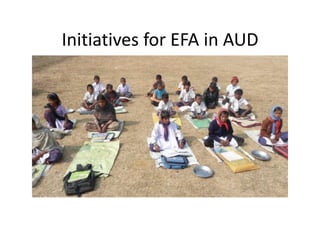
Initiatives for EFA in AUD
EFA GOAL 1 : EXPAND ECCE
• Center for Early Childhood Education and
Development (CECED) established in 2009.
• Functions of the Center: (a) expand the
landscape of indigenous research in ECCE (b)
promote quality of ECCE and capacity building
© advocacy and networking.
• In four years it has tried to address issues
linked to Quality of ECCE through its functions
………………………….
CECED Initiatives
Research :
• Longitudinal, mixed method research on sample of about 3000
children in 3 states to understand impact of quality of ECE on school
readiness levels of children at age 5 and subsequent performance.
• 9 Case studies of good practices in ECCE.
• Survey of Teacher Education in ECCE in 8 states.
• Evaluations of ECE enrichment programs egAkshara Foundation;
• Situation analysis of children in atypical settings--NizammudinBasti;
Bihar; Tihar Jail, Delhi.
• Involved in Early Stimulation impact study of Yale university.
Quality promotion and Capacity
building
• Technical support to states: West Bengal and
Rajasthan for development of strategy for ECCE
strengthening
• M.A. in ECCE to be launched in Academic year-
2014-2015-three trajectories proposed.
• Curriculum development in ECCE including
working on early learning standards.
• Proposed innovative two tiered professional
development program for community workers in
collaboration with Pratham involving a mentors
training and community workers training.
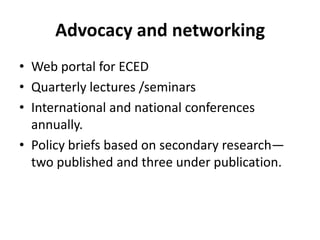
Advocacy and networking
• Web portal for ECED
• Quarterly lectures /seminars
• International and national conferences
annually.
• Policy briefs based on secondary research—
two published and three under publication.
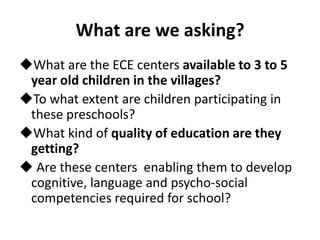
What are we asking?
What are the ECE centers available to 3 to 5
year old children in the villages?
To what extent are children participating in
these preschools?
What kind of quality of education are they
getting?
 Are these centers enabling them to develop
cognitive, language and psycho-social
competencies required for school?
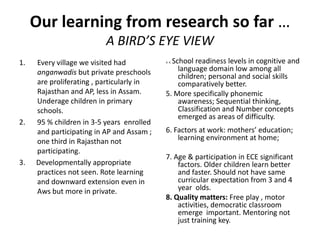
Our learning from research so far …
A BIRD’S EYE VIEW
1. Every village we visited had
anganwadis but private preschools
are proliferating , particularly in
Rajasthan and AP, less in Assam.
Underage children in primary
schools.
2. 95 % children in 3-5 years enrolled
and participating in AP and Assam ;
one third in Rajasthan not
participating.
3. Developmentally appropriate
practices not seen. Rote learning
and downward extension even in
Aws but more in private.
4. 4. School readiness levels in cognitive and
language domain low among all
children; personal and social skills
comparatively better.
5. More specifically phonemic
awareness; Sequential thinking,
Classification and Number concepts
emerged as areas of difficulty.
6. Factors at work: mothers’ education;
learning environment at home;
7. Age & participation in ECE significant
factors. Older children learn better
and faster. Should not have same
curricular expectation from 3 and 4
year olds.
8. Quality matters: Free play , motor
activities, democratic classroom
emerge important. Mentoring not
just training key.
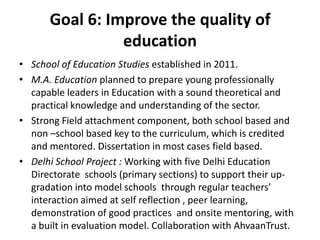
Goal 6: Improve the quality of
education
• School of Education Studies established in 2011.
• M.A. Education planned to prepare young professionally
capable leaders in Education with a sound theoretical and
practical knowledge and understanding of the sector.
• Strong Field attachment component, both school based and
non –school based key to the curriculum, which is credited
and mentored. Dissertation in most cases field based.
• Delhi School Project : Working with five Delhi Education
Directorate schools (primary sections) to support their up-
gradation into model schools through regular teachers’
interaction aimed at self reflection , peer learning,
demonstration of good practices and onsite mentoring, with
a built in evaluation model. Collaboration with AhvaanTrust.
Challenges
Supportive management key to success
CECED:
• Dependence on external funding
• Staff largely project based.
• Administrative Systems not in tune with project mode of
functioning.
SES
• Balancing teaching with research.
• Individual vs School based research
• Regular flow of funds needed to supplement AUD funds.
• Govt permissions to enter schools a big challenge.

Ambedkar University, Delhi and EFA

  • 1.
  • 2.
    EFA GOAL 1: EXPAND ECCE • Center for Early Childhood Education and Development (CECED) established in 2009. • Functions of the Center: (a) expand the landscape of indigenous research in ECCE (b) promote quality of ECCE and capacity building © advocacy and networking. • In four years it has tried to address issues linked to Quality of ECCE through its functions ………………………….
  • 3.
    CECED Initiatives Research : •Longitudinal, mixed method research on sample of about 3000 children in 3 states to understand impact of quality of ECE on school readiness levels of children at age 5 and subsequent performance. • 9 Case studies of good practices in ECCE. • Survey of Teacher Education in ECCE in 8 states. • Evaluations of ECE enrichment programs egAkshara Foundation; • Situation analysis of children in atypical settings--NizammudinBasti; Bihar; Tihar Jail, Delhi. • Involved in Early Stimulation impact study of Yale university.
  • 4.
    Quality promotion andCapacity building • Technical support to states: West Bengal and Rajasthan for development of strategy for ECCE strengthening • M.A. in ECCE to be launched in Academic year- 2014-2015-three trajectories proposed. • Curriculum development in ECCE including working on early learning standards. • Proposed innovative two tiered professional development program for community workers in collaboration with Pratham involving a mentors training and community workers training.
  • 5.
    Advocacy and networking •Web portal for ECED • Quarterly lectures /seminars • International and national conferences annually. • Policy briefs based on secondary research— two published and three under publication.
  • 6.
    What are weasking? What are the ECE centers available to 3 to 5 year old children in the villages? To what extent are children participating in these preschools? What kind of quality of education are they getting?  Are these centers enabling them to develop cognitive, language and psycho-social competencies required for school?
  • 7.
    Our learning fromresearch so far … A BIRD’S EYE VIEW 1. Every village we visited had anganwadis but private preschools are proliferating , particularly in Rajasthan and AP, less in Assam. Underage children in primary schools. 2. 95 % children in 3-5 years enrolled and participating in AP and Assam ; one third in Rajasthan not participating. 3. Developmentally appropriate practices not seen. Rote learning and downward extension even in Aws but more in private. 4. 4. School readiness levels in cognitive and language domain low among all children; personal and social skills comparatively better. 5. More specifically phonemic awareness; Sequential thinking, Classification and Number concepts emerged as areas of difficulty. 6. Factors at work: mothers’ education; learning environment at home; 7. Age & participation in ECE significant factors. Older children learn better and faster. Should not have same curricular expectation from 3 and 4 year olds. 8. Quality matters: Free play , motor activities, democratic classroom emerge important. Mentoring not just training key.
  • 8.
    Goal 6: Improvethe quality of education • School of Education Studies established in 2011. • M.A. Education planned to prepare young professionally capable leaders in Education with a sound theoretical and practical knowledge and understanding of the sector. • Strong Field attachment component, both school based and non –school based key to the curriculum, which is credited and mentored. Dissertation in most cases field based. • Delhi School Project : Working with five Delhi Education Directorate schools (primary sections) to support their up- gradation into model schools through regular teachers’ interaction aimed at self reflection , peer learning, demonstration of good practices and onsite mentoring, with a built in evaluation model. Collaboration with AhvaanTrust.
  • 9.
    Challenges Supportive management keyto success CECED: • Dependence on external funding • Staff largely project based. • Administrative Systems not in tune with project mode of functioning. SES • Balancing teaching with research. • Individual vs School based research • Regular flow of funds needed to supplement AUD funds. • Govt permissions to enter schools a big challenge.