E-safety Parent 
Session 
Helping to keep your children safe online 
18.11.14
Aims of the session 
• Reflect on the potential risks of internet use for children. 
• Discuss the importance of communication with children about the 
time they are spending online. 
• Understand how to set up parental controls on home and mobile 
devices. 
• Know what to do if your child encounters problems online. 
• Q&A
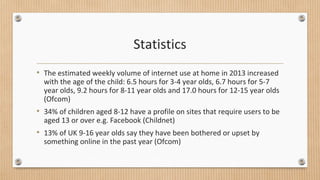
Statistics 
• The estimated weekly volume of internet use at home in 2013 increased 
with the age of the child: 6.5 hours for 3-4 year olds, 6.7 hours for 5-7 
year olds, 9.2 hours for 8-11 year olds and 17.0 hours for 12-15 year olds 
(Ofcom) 
• 34% of children aged 8-12 have a profile on sites that require users to be 
aged 13 or over e.g. Facebook (Childnet) 
• 13% of UK 9-16 year olds say they have been bothered or upset by 
something online in the past year (Ofcom)
EVERY 
minute of 
EVERY day…
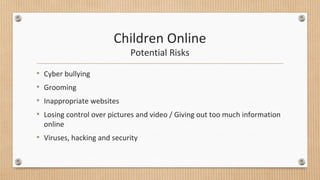
Children Online 
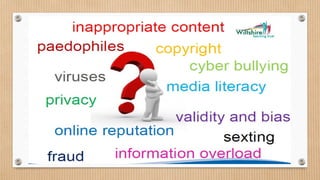
Potential Risks 
• Cyber bullying 
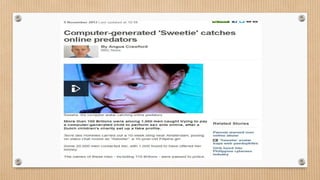
• Grooming 
• Inappropriate websites 
• Losing control over pictures and video / Giving out too much information 
online 
• Viruses, hacking and security
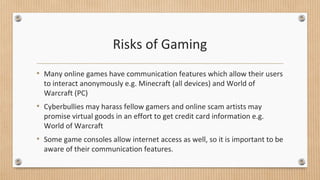
Risks of Gaming 
• Many online games have communication features which allow their users 
to interact anonymously e.g. Minecraft (all devices) and World of 
Warcraft (PC) 
• Cyberbullies may harass fellow gamers and online scam artists may 
promise virtual goods in an effort to get credit card information e.g. 
World of Warcraft 
• Some game consoles allow internet access as well, so it is important to be 
aware of their communication features.
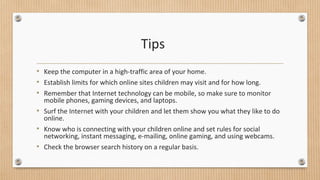
Tips 
• Keep the computer in a high-traffic area of your home. 
• Establish limits for which online sites children may visit and for how long. 
• Remember that Internet technology can be mobile, so make sure to monitor 
mobile phones, gaming devices, and laptops. 
• Surf the Internet with your children and let them show you what they like to do 
online. 
• Know who is connecting with your children online and set rules for social 
networking, instant messaging, e-mailing, online gaming, and using webcams. 
• Check the browser search history on a regular basis.
•Recent research has shown hi-tech 
devices in children’s bedrooms – 
particularly smartphones and laptops 
– are partially to blame for disrupting 
sleep. 
•Light emitted from the screens 
tricks the brain into thinking it is day.
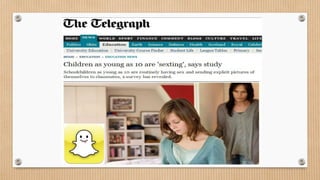
‘SEXTING’
Communication 
• Be a part of their online life; involve the whole family and show an 
interest. Find out what sites they visit and what they love about them. 
• No filter or parental controls tool is 100% effective, and many of the risks 
that young people face online are because of their own and other’s 
behaviour. 
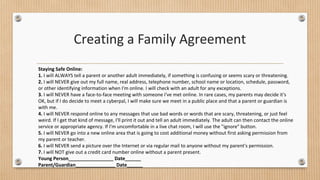
• Create a family agreement for internet use, such as on 
http://www.childnet.com/resources/know-it-all-for-parents/kiafp-cd
Creating a Family Agreement 
Staying Safe Online: 
1. I will ALWAYS tell a parent or another adult immediately, if something is confusing or seems scary or threatening. 
2. I will NEVER give out my full name, real address, telephone number, school name or location, schedule, password, 
or other identifying information when I'm online. I will check with an adult for any exceptions. 
3. I will NEVER have a face-to-face meeting with someone I've met online. In rare cases, my parents may decide it's 
OK, but if I do decide to meet a cyberpal, I will make sure we meet in a public place and that a parent or guardian is 
with me. 
4. I will NEVER respond online to any messages that use bad words or words that are scary, threatening, or just feel 
weird. If I get that kind of message, I'll print it out and tell an adult immediately. The adult can then contact the online 
service or appropriate agency. If I'm uncomfortable in a live chat room, I will use the "ignore" button. 
5. I will NEVER go into a new online area that is going to cost additional money without first asking permission from 
my parent or teacher. 
6. I will NEVER send a picture over the Internet or via regular mail to anyone without my parent's permission. 
7. I will NOT give out a credit card number online without a parent present. 
Young Person_________________ Date______ 
Parent/Guardian_______________ Date______
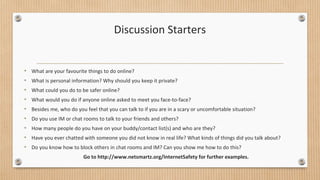
Discussion Starters 
• What are your favourite things to do online? 
• What is personal information? Why should you keep it private? 
• What could you do to be safer online? 
• What would you do if anyone online asked to meet you face-to-face? 
• Besides me, who do you feel that you can talk to if you are in a scary or uncomfortable situation? 
• Do you use IM or chat rooms to talk to your friends and others? 
• How many people do you have on your buddy/contact list(s) and who are they? 
• Have you ever chatted with someone you did not know in real life? What kinds of things did you talk about? 
• Do you know how to block others in chat rooms and IM? Can you show me how to do this? 
Go to http://www.netsmartz.org/InternetSafety for further examples.
Parental Controls 
Internet Providers 
• The 5 big internet providers in the UK – BT, Sky, TalkTalk, Plusnet and Virgin 
Media - provide their customers with free parental controls. 
• These providers offer filter levels e.g. BT provides ‘light’, ‘moderate’ or ‘strict’ 
filter levels. 
• Parents can : 
- customise their parental controls. 
- allow and block specific sites. 
- set filter times. 
- set limits for time online.
Parental Controls 
Gaming Devices 
• Parental controls can also be set up on games consoles, such as 
Playstation, Xbox and Nintendo Wii. 
• Restrict games based on age rating. 
• Restrict time spent e.g. On the Xbox 360 activate the “Family Timer” to 
limit the total amount. 
• Control your child’s friend requests so you know who they’re playing with 
online. 
• Restrict online user-to-user communication and the exchange of user-generated 
content.
Parental Controls 
Smartphones 
• Capable of a range of internet functions: social networking, listening to music, playing 
games, browsing the internet, checking emails, taking photos and videos and watching 
TV. 
• Out and about, users access the internet via 3G connection which is provided by the 
data allowance in their mobile contract. 
• All mobile network providers provide parental controls. 
• Some will have these on as default, but others you will need to request to be turned 
on. 
e.g. Tesco Mobile and O2 have a parental control option to ensure that only websites 
they have classified as suitable for children under 12 can be accessed. Contact your 
service provider to find out about filtering options.
Parental Controls 
Smartphones 
• Internet on smartphones can be accessed by Wi-Fi from home, therefore 
home internet controls apply. 
• Some apps can help filter out age-inappropriate content or help restrict 
some of the smartphone functions, so have a look in the app store. 
• Check what parental controls are available for the specific smartphone; 
some devices may have options for switching off the internet browser.
Parental Controls 
iPads 
• Look at age ratings and customer reviews before your child downloads an app. 
• There are tools available which can block some communication apps. For 
example there are parental control settings on the iPad to disable the following 
functions: 
- FaceTime: a video calling app 
- Ping: an instant messaging app 
• Multiplayer gaming: You can choose settings to prevent multiplayer games and 
adding friends. Find the parental control settings and in the Game Centre 
section select ‘Off’ for ‘Multiplayer Games’ and ‘Adding Friends’.
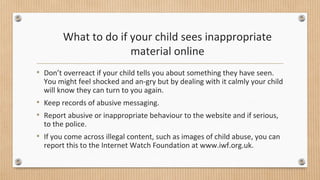
What to do if your child sees inappropriate 
material online 
• Don’t overreact if your child tells you about something they have seen. 
You might feel shocked and an-gry but by dealing with it calmly your child 
will know they can turn to you again. 
• Keep records of abusive messaging. 
• Report abusive or inappropriate behaviour to the website and if serious, 
to the police. 
• If you come across illegal content, such as images of child abuse, you can 
report this to the Internet Watch Foundation at www.iwf.org.uk.
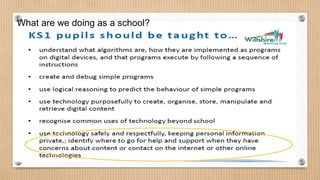
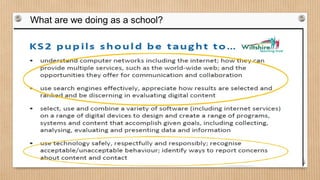
What are we doing as a school?
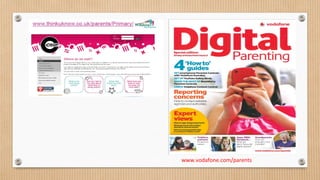
www.vodafone.com/parents
Useful Websites 
• www.saferinternet.org.uk/advice-and-resources/a-parents-guide/ 
internet-enabled-devices 
• www.kidsmart.org.uk/beingsmart 
• www.childnet.com/resources/parental-controls 
• https://www.thinkuknow.co.uk/parents/Primary/ 
• http://www.netsmartz.org/Parents
‘E-Safety is not a box that can ever be ticked’ 
David Brown, HMI and National Adviser for 
ICT, Ofsted.
Thank you for attending.

E safety-parent-workshop

  • 1.
    E-safety Parent Session Helping to keep your children safe online 18.11.14
  • 2.
    Aims of thesession • Reflect on the potential risks of internet use for children. • Discuss the importance of communication with children about the time they are spending online. • Understand how to set up parental controls on home and mobile devices. • Know what to do if your child encounters problems online. • Q&A
  • 5.
    Statistics • Theestimated weekly volume of internet use at home in 2013 increased with the age of the child: 6.5 hours for 3-4 year olds, 6.7 hours for 5-7 year olds, 9.2 hours for 8-11 year olds and 17.0 hours for 12-15 year olds (Ofcom) • 34% of children aged 8-12 have a profile on sites that require users to be aged 13 or over e.g. Facebook (Childnet) • 13% of UK 9-16 year olds say they have been bothered or upset by something online in the past year (Ofcom)
  • 6.
    EVERY minute of EVERY day…
  • 7.
    Children Online PotentialRisks • Cyber bullying • Grooming • Inappropriate websites • Losing control over pictures and video / Giving out too much information online • Viruses, hacking and security
  • 8.
    Risks of Gaming • Many online games have communication features which allow their users to interact anonymously e.g. Minecraft (all devices) and World of Warcraft (PC) • Cyberbullies may harass fellow gamers and online scam artists may promise virtual goods in an effort to get credit card information e.g. World of Warcraft • Some game consoles allow internet access as well, so it is important to be aware of their communication features.
  • 9.
    Tips • Keepthe computer in a high-traffic area of your home. • Establish limits for which online sites children may visit and for how long. • Remember that Internet technology can be mobile, so make sure to monitor mobile phones, gaming devices, and laptops. • Surf the Internet with your children and let them show you what they like to do online. • Know who is connecting with your children online and set rules for social networking, instant messaging, e-mailing, online gaming, and using webcams. • Check the browser search history on a regular basis.
  • 10.
    •Recent research hasshown hi-tech devices in children’s bedrooms – particularly smartphones and laptops – are partially to blame for disrupting sleep. •Light emitted from the screens tricks the brain into thinking it is day.
  • 12.
  • 15.
    Communication • Bea part of their online life; involve the whole family and show an interest. Find out what sites they visit and what they love about them. • No filter or parental controls tool is 100% effective, and many of the risks that young people face online are because of their own and other’s behaviour. • Create a family agreement for internet use, such as on http://www.childnet.com/resources/know-it-all-for-parents/kiafp-cd
  • 16.
    Creating a FamilyAgreement Staying Safe Online: 1. I will ALWAYS tell a parent or another adult immediately, if something is confusing or seems scary or threatening. 2. I will NEVER give out my full name, real address, telephone number, school name or location, schedule, password, or other identifying information when I'm online. I will check with an adult for any exceptions. 3. I will NEVER have a face-to-face meeting with someone I've met online. In rare cases, my parents may decide it's OK, but if I do decide to meet a cyberpal, I will make sure we meet in a public place and that a parent or guardian is with me. 4. I will NEVER respond online to any messages that use bad words or words that are scary, threatening, or just feel weird. If I get that kind of message, I'll print it out and tell an adult immediately. The adult can then contact the online service or appropriate agency. If I'm uncomfortable in a live chat room, I will use the "ignore" button. 5. I will NEVER go into a new online area that is going to cost additional money without first asking permission from my parent or teacher. 6. I will NEVER send a picture over the Internet or via regular mail to anyone without my parent's permission. 7. I will NOT give out a credit card number online without a parent present. Young Person_________________ Date______ Parent/Guardian_______________ Date______
  • 17.
    Discussion Starters •What are your favourite things to do online? • What is personal information? Why should you keep it private? • What could you do to be safer online? • What would you do if anyone online asked to meet you face-to-face? • Besides me, who do you feel that you can talk to if you are in a scary or uncomfortable situation? • Do you use IM or chat rooms to talk to your friends and others? • How many people do you have on your buddy/contact list(s) and who are they? • Have you ever chatted with someone you did not know in real life? What kinds of things did you talk about? • Do you know how to block others in chat rooms and IM? Can you show me how to do this? Go to http://www.netsmartz.org/InternetSafety for further examples.
  • 18.
    Parental Controls InternetProviders • The 5 big internet providers in the UK – BT, Sky, TalkTalk, Plusnet and Virgin Media - provide their customers with free parental controls. • These providers offer filter levels e.g. BT provides ‘light’, ‘moderate’ or ‘strict’ filter levels. • Parents can : - customise their parental controls. - allow and block specific sites. - set filter times. - set limits for time online.
  • 19.
    Parental Controls GamingDevices • Parental controls can also be set up on games consoles, such as Playstation, Xbox and Nintendo Wii. • Restrict games based on age rating. • Restrict time spent e.g. On the Xbox 360 activate the “Family Timer” to limit the total amount. • Control your child’s friend requests so you know who they’re playing with online. • Restrict online user-to-user communication and the exchange of user-generated content.
  • 20.
    Parental Controls Smartphones • Capable of a range of internet functions: social networking, listening to music, playing games, browsing the internet, checking emails, taking photos and videos and watching TV. • Out and about, users access the internet via 3G connection which is provided by the data allowance in their mobile contract. • All mobile network providers provide parental controls. • Some will have these on as default, but others you will need to request to be turned on. e.g. Tesco Mobile and O2 have a parental control option to ensure that only websites they have classified as suitable for children under 12 can be accessed. Contact your service provider to find out about filtering options.
  • 21.
    Parental Controls Smartphones • Internet on smartphones can be accessed by Wi-Fi from home, therefore home internet controls apply. • Some apps can help filter out age-inappropriate content or help restrict some of the smartphone functions, so have a look in the app store. • Check what parental controls are available for the specific smartphone; some devices may have options for switching off the internet browser.
  • 22.
    Parental Controls iPads • Look at age ratings and customer reviews before your child downloads an app. • There are tools available which can block some communication apps. For example there are parental control settings on the iPad to disable the following functions: - FaceTime: a video calling app - Ping: an instant messaging app • Multiplayer gaming: You can choose settings to prevent multiplayer games and adding friends. Find the parental control settings and in the Game Centre section select ‘Off’ for ‘Multiplayer Games’ and ‘Adding Friends’.
  • 23.
    What to doif your child sees inappropriate material online • Don’t overreact if your child tells you about something they have seen. You might feel shocked and an-gry but by dealing with it calmly your child will know they can turn to you again. • Keep records of abusive messaging. • Report abusive or inappropriate behaviour to the website and if serious, to the police. • If you come across illegal content, such as images of child abuse, you can report this to the Internet Watch Foundation at www.iwf.org.uk.
  • 24.
    What are wedoing as a school?
  • 25.
    What are wedoing as a school?
  • 26.
  • 27.
    Useful Websites •www.saferinternet.org.uk/advice-and-resources/a-parents-guide/ internet-enabled-devices • www.kidsmart.org.uk/beingsmart • www.childnet.com/resources/parental-controls • https://www.thinkuknow.co.uk/parents/Primary/ • http://www.netsmartz.org/Parents
  • 28.
    ‘E-Safety is nota box that can ever be ticked’ David Brown, HMI and National Adviser for ICT, Ofsted.
  • 29.
    Thank you forattending.

Editor's Notes

  • #7 Some may call for better policing…
  • #13 Paul – would you like to speak on this from a police perspective and in your experience? Have you heard of this – what is it? (indecent images sent via mobiles) THE LAW: What is an indecent image? UK law does not give a definition of what makes an indecent image of a child.  Whether an image is indecent is a question of fact that the jury or magistrate decide. SO where young people are taking images of themselves, a practical way to demonstrate this might be to ask whether the image in question would be considered 'decent' in the eyes of that person's parents and family. If the answer is no, then it is likely that a jury would come to the same conclusion.   What are the consequences? the distress caused to young people from their friends and family seeing these pictures; the potential for young people to be bullied about the images; the digital footprint (permanency) of the images if they make their way onto the internet and the lack of control young people have over this situation the impact on a young persons future (potential employer)   THE LAW - OFFENCES Those involved in sexting may be committing a criminal offence.   Crime which involve indecent photographs of a person under 18 years of age fall under Section 1 of the Protection of Children Act, 1978, and Section 160 of the Criminal Justice Act, under this legislation it is an offence to: take an indecent photograph or allow an indecent photograph to be taken; to make an indecent photograph (this includes downloading or opening an image that has been sent); to distribute or show such an image; to possess with the intention of distributing images; to advertise; to possess such images   the Police will become involved, on some occasions media equipment could be removed. The real harm in relation to 'sexting' is that those in the photographs may become victims should the images be sent to others.   Lots of young people send inappropriate photos to their friends, boyfriend or girlfriend.   Discuss the risks of this: Could these people forward the photos to someone else? What is they had a fight with their partner/friend? What if they lost their phone and someone else found the photos?   Jessica Logan is the tragic case of a girl who sexted and was then bullied as a result.  She ultimately took her own live, being unable to deal with the constant taunting and verbal abuse. Pupils who have posted or sent images that may be deemed to be inappropriate need to recognise that something which starts out 'a bit of fun' can sometimes have far more serious consequences than they might have imagined.   Just a suggestion – watch this film, its part of the lesson I deliver to many schools. Sexting is a huge problem which is growing. Young people don’t seem to recognise that what they are creating are indecent images, they are often shared by many causing humiliation, bullying, depression, feelings of desperation and of course occasionally suicide.
  • #25 Explain the new NC criteria and how it has been updated to include esafety. Use of SWGfL internet and safety measures.