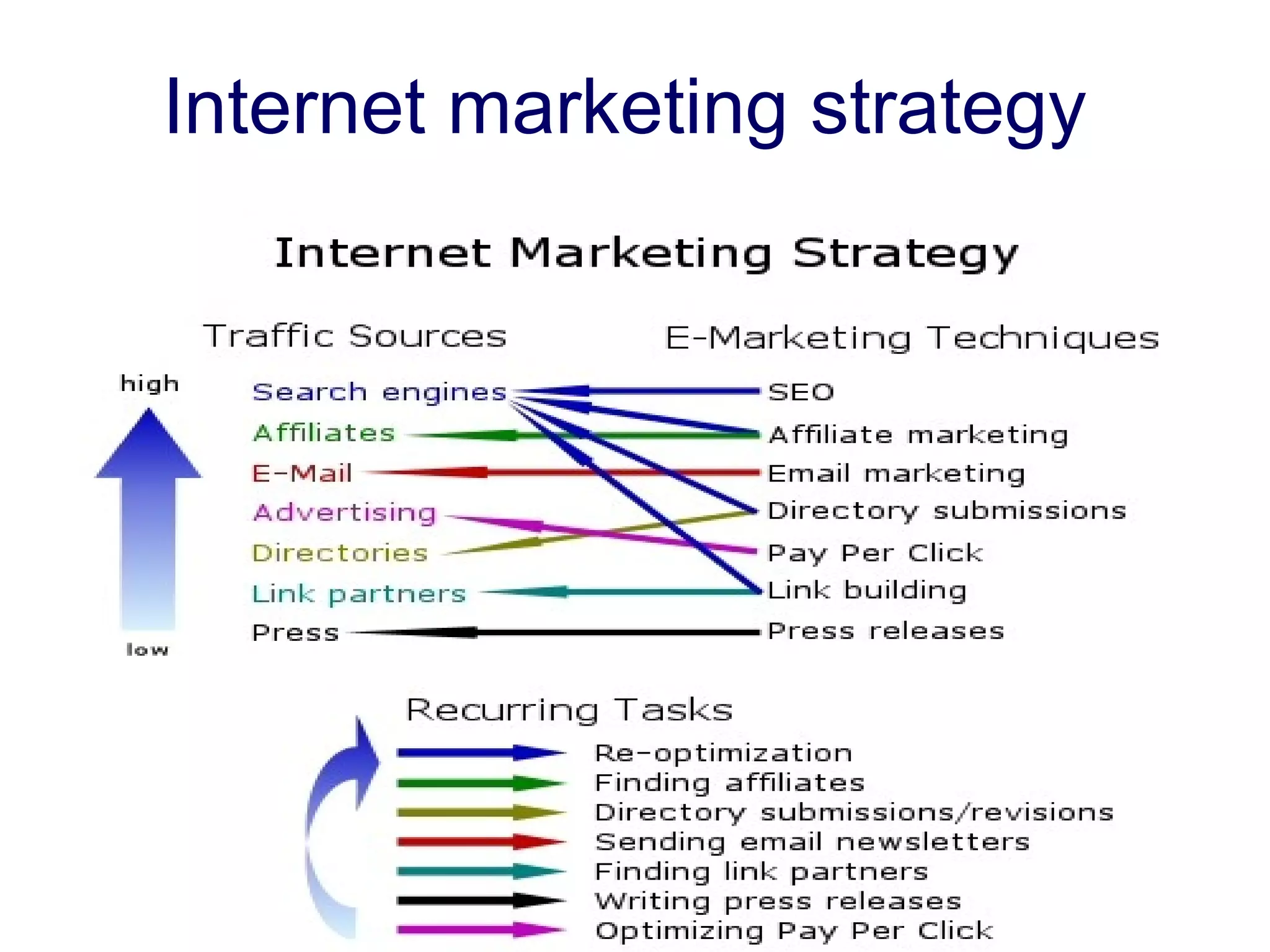
Internet marketing strategy
‘ The key question is not whether to deploy Internet technology – companies have no choice if they want to stay competitive – but how to deploy it .’ Porter, M. (2001) Strategy and the Internet,  Harvard Business review,  March 2001, 62–78.
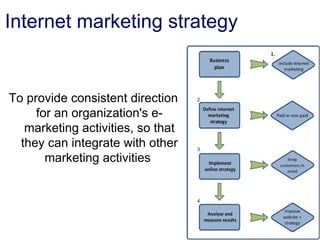
Internet marketing strategy To provide consistent direction for an organization's e-marketing activities, so that they can integrate with other marketing activities
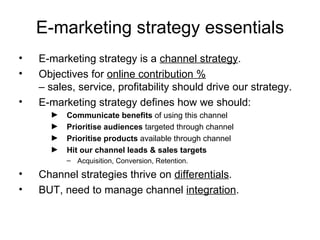
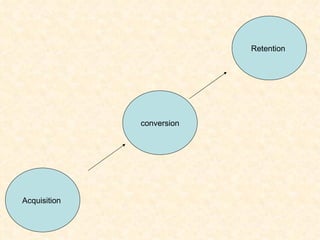
E-marketing strategy essentials E-marketing strategy is a  channel strategy . Objectives for  online contribution %   – sales, service, profitability should drive our strategy. E-marketing strategy defines how we should: Communicate benefits  of using this channel Prioritise audiences  targeted through channel Prioritise products  available through channel Hit our channel leads & sales targets Acquisition, Conversion, Retention. Channel strategies thrive on  differentials . BUT, need to manage channel  integration .
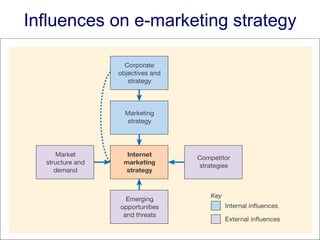
Influences on e-marketing strategy
Acquisition  conversion Retention
 
Problems if no E-marketing strategy Underestimated demand for online services Market share loss Resource duplication Insufficient resource Insufficient customer data Efficiencies available through online marketing Opportunities for applying online marketing tools Changes required to internal IT systems Inadequate tracking Senior management support limited
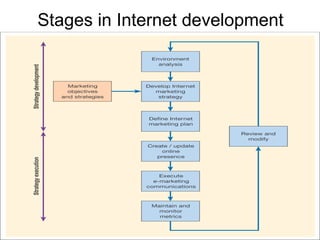
Stages in Internet development
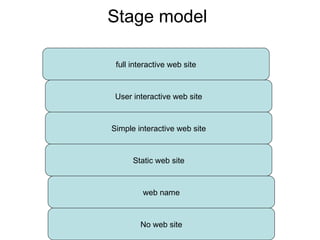
Stage model No web site web name Static web site Simple interactive web site User interactive web site full interactive web site
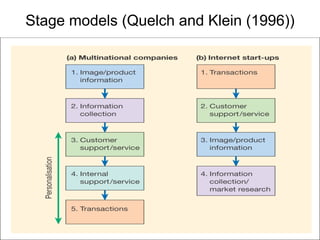
Stage models (Quelch and Klein (1996))
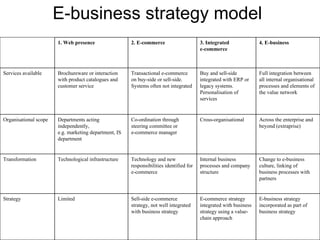
E-business strategy model E-business strategy incorporated as part of business strategy E-commerce strategy integrated with business strategy using a value-chain approach Sell-side e-commerce strategy, not well integrated with business strategy Limited Strategy Change to e-business culture, linking of business processes with partners Internal business processes and company structure Technology and new responsibilities identified for e-commerce Technological infrastructure Transformation Across the enterprise and beyond (extraprise) Cross-organisational Co-ordination through steering committee or e-commerce manager Departments acting independently,  e.g. marketing department, IS department Organisational scope Full integration between all internal organisational processes and elements of the value network Buy and sell-side integrated with ERP or legacy systems. Personalisation of services Transactional e-commerce on buy-side or sell-side. Systems often not integrated Brochureware or interaction with product catalogues and customer service Services available 4. E-business 3. Integrated e-commerce 2. E-commerce 1. Web presence
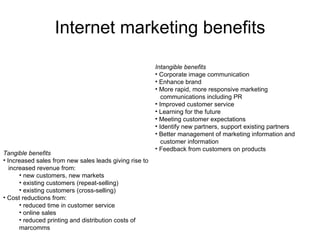
Internet marketing benefits Tangible benefits Increased sales from new sales leads giving rise to  increased revenue from: new customers, new markets existing customers (repeat-selling) existing customers (cross-selling) Cost reductions from: reduced time in customer service  online sales reduced printing and distribution costs of  marcomms Intangible benefits Corporate image communication Enhance brand More rapid, more responsive marketing  communications including PR Improved customer service Learning for the future Meeting customer expectations  Identify new partners, support existing partners Better management of marketing information and  customer information Feedback from customers on products
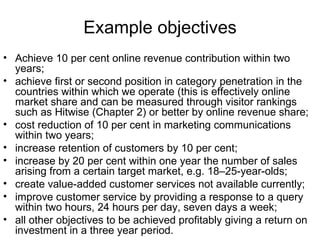
Example objectives Achieve 10 per cent online revenue contribution within two years; achieve first or second position in category penetration in the countries within which we operate (this is effectively online market share and can be measured through visitor rankings such as Hitwise (Chapter 2) or better by online revenue share; cost reduction of 10 per cent in marketing communications within two years; increase retention of customers by 10 per cent; increase by 20 per cent within one year the number of sales arising from a certain target market, e.g. 18–25-year-olds; create value-added customer services not available currently; improve customer service by providing a response to a query within two hours, 24 hours per day, seven days a week; all other objectives to be achieved profitably giving a return on investment in a three year period.

internet marketingx 7 8

  • 1.
  • 2.
    ‘ The keyquestion is not whether to deploy Internet technology – companies have no choice if they want to stay competitive – but how to deploy it .’ Porter, M. (2001) Strategy and the Internet, Harvard Business review, March 2001, 62–78.
  • 3.
    Internet marketing strategyTo provide consistent direction for an organization's e-marketing activities, so that they can integrate with other marketing activities
  • 4.
    E-marketing strategy essentialsE-marketing strategy is a channel strategy . Objectives for online contribution % – sales, service, profitability should drive our strategy. E-marketing strategy defines how we should: Communicate benefits of using this channel Prioritise audiences targeted through channel Prioritise products available through channel Hit our channel leads & sales targets Acquisition, Conversion, Retention. Channel strategies thrive on differentials . BUT, need to manage channel integration .
  • 5.
  • 6.
  • 7.
  • 8.
    Problems if noE-marketing strategy Underestimated demand for online services Market share loss Resource duplication Insufficient resource Insufficient customer data Efficiencies available through online marketing Opportunities for applying online marketing tools Changes required to internal IT systems Inadequate tracking Senior management support limited
  • 9.
    Stages in Internetdevelopment
  • 10.
    Stage model Noweb site web name Static web site Simple interactive web site User interactive web site full interactive web site
  • 11.
    Stage models (Quelchand Klein (1996))
  • 12.
    E-business strategy modelE-business strategy incorporated as part of business strategy E-commerce strategy integrated with business strategy using a value-chain approach Sell-side e-commerce strategy, not well integrated with business strategy Limited Strategy Change to e-business culture, linking of business processes with partners Internal business processes and company structure Technology and new responsibilities identified for e-commerce Technological infrastructure Transformation Across the enterprise and beyond (extraprise) Cross-organisational Co-ordination through steering committee or e-commerce manager Departments acting independently, e.g. marketing department, IS department Organisational scope Full integration between all internal organisational processes and elements of the value network Buy and sell-side integrated with ERP or legacy systems. Personalisation of services Transactional e-commerce on buy-side or sell-side. Systems often not integrated Brochureware or interaction with product catalogues and customer service Services available 4. E-business 3. Integrated e-commerce 2. E-commerce 1. Web presence
  • 13.
    Internet marketing benefitsTangible benefits Increased sales from new sales leads giving rise to increased revenue from: new customers, new markets existing customers (repeat-selling) existing customers (cross-selling) Cost reductions from: reduced time in customer service online sales reduced printing and distribution costs of marcomms Intangible benefits Corporate image communication Enhance brand More rapid, more responsive marketing communications including PR Improved customer service Learning for the future Meeting customer expectations Identify new partners, support existing partners Better management of marketing information and customer information Feedback from customers on products
  • 14.
    Example objectives Achieve10 per cent online revenue contribution within two years; achieve first or second position in category penetration in the countries within which we operate (this is effectively online market share and can be measured through visitor rankings such as Hitwise (Chapter 2) or better by online revenue share; cost reduction of 10 per cent in marketing communications within two years; increase retention of customers by 10 per cent; increase by 20 per cent within one year the number of sales arising from a certain target market, e.g. 18–25-year-olds; create value-added customer services not available currently; improve customer service by providing a response to a query within two hours, 24 hours per day, seven days a week; all other objectives to be achieved profitably giving a return on investment in a three year period.