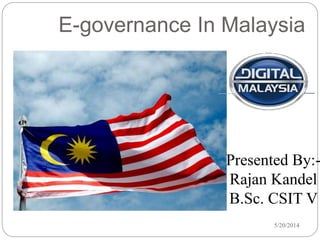

E-governance In Malaysia
5/20/2014
Presented By:-
Rajan Kandel
B.Sc. CSIT V
We will be discussing on :
5/20/20142
About Malaysia
Initiation
Major Projects
Achievements
Challenges
About Malaysia
5/20/20143
• Federal constitutional monarchy in Asia
• Capital : Kuala Lumpur
• Dialing code :+60
• Population : 29.24 million
• Area :329,847 square kilometres
• Official Language : Malaysian Language
Initiation
5/20/20144
The implementation of e-government started since the
initiation of Multimedia Super Corridor (MSC) in 1996 by
the Malaysian government.
In 24 February 2004 with strategies to achieve Vision
2020.
The Malaysian Administrative Modernization and
Management Planning Unit (MAMPU) is promoting the
use of e-Government among the public.
Initiation
contd..
5/20/20145
Image Source:
http://www.msc.com.my/msc/msc.asp
Fig: three phases of MSC’s Vision
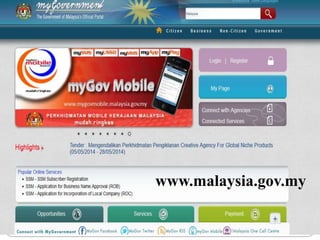
•The myGovernment portal(www.malaysia.gov.my) acts as the one-
stop source of Malaysian government information and services for
the citizens.
•A program Digital Malaysia along with Vision 2020 was launched.
MSC : Multimedia Super Corridor
www.malaysia.gov.my
Major Projects
5/20/20146
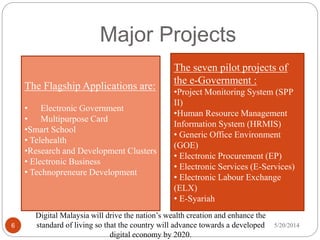
The Flagship Applications are:
• Electronic Government
• Multipurpose Card
•Smart School
• Telehealth
•Research and Development Clusters
• Electronic Business
• Technopreneure Development
The seven pilot projects of
the e-Government :
•Project Monitoring System (SPP
II)
•Human Resource Management
Information System (HRMIS)
• Generic Office Environment
(GOE)
• Electronic Procurement (EP)
• Electronic Services (E-Services)
• Electronic Labour Exchange
(ELX)
• E-Syariah
Digital Malaysia will drive the nation’s wealth creation and enhance the
standard of living so that the country will advance towards a developed
digital economy by 2020.
Project Monitoring System (SPP II)
5/20/20147
 An on-line end-to-end project monitoring system creating a
collaborative environment for better management of
development projects.
 Sending of real time online information electronically.
 Consistent and timely information from centralized
databases.
 Provides a mechanism for monitoring the implementation of
development projects across agencies.
Human Resource Management
Information System(HRMIS)
5/20/20148
 Objective is not just for record keeping but also to provide
transactional functions such as leave applications, loan
processing, competency management, recruitment, and
selection of employees.
 Provide a single interface for government employees to
perform human resource management functions effectively
and efficiently.
 Anchored by the Public Service Department (PSD).
Generic Office Environment(GOE)
5/20/20149
 Enable efficient communication, allowing collaboration across all
workers, and ensuring right information reaching the right people in
a timely manner.
 Consists of Module EIMS that provides:
 universal interface for users to manage,
find, retrieve and compose the information that they need in their
day-to-day
operations Via the Communication and Collaboration Management
Systems.
EIMS: Enterprise-wide Information Management System
Electronic Procurement (EP)
5/20/201410
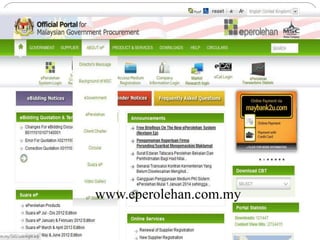
 Allows the Government to conduct procurement activities
electronically via desktops and on-line Suppliers’ Registration .
 Benefits :
Faster turn-around time in processing procurement transactions
Enables government to become a “smart buyer”
On-line submission of Supplier’s registration any day, anytime
Cost saving to the Government & Suppliers BENEFITS
www.eperolehan.com.my
Electronic Services (E-Services)
5/20/201411
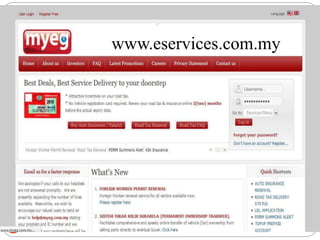
 Enables citizens and businesses to conduct transactions through a
one-stop service window
 BENEFITS :
Provides choice of multiple delivery channels
Accessibility and convenience offered by extended hours, 24 hours,
7 days a week
Multiple services via a single window of access
Enhanced efficiency and effectiveness of Government services
www.eservices.com.my
Electronic Labour Exchange (ELX)
5/20/201412
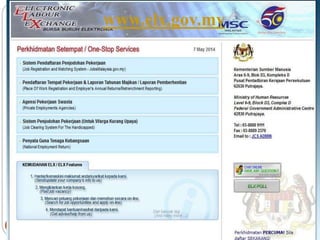
 Engine Data A one-stop centre for labour market
information and systematic matching of job seekers to
job vacancies
• Services:
 Job Counseling Advice
 Registration of job seeker
 Registration of Vacancy
 Details of Job Candidates
www.elx.gov.my
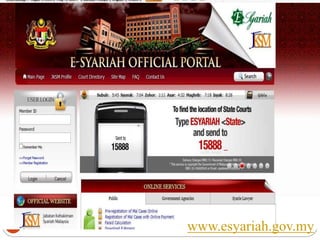
E-Syariah
5/20/201413
Provides efficient and quality management of Syariah
Court .
Speed up the judicial process under syariah law
Facilitate the registration and management of Syarie
Lawyers
Information centre for Syariah Court community and
public
To uphold the Islamic values with the usage of ICT.
www.esyariah.gov.my
Achievement
5/20/201414
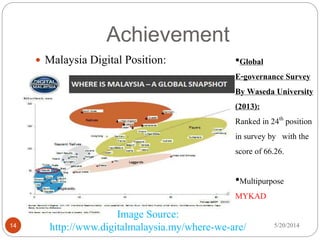
 Malaysia Digital Position: •Global
E-governance Survey
By Waseda University
(2013):
Ranked in 24th position
in survey by with the
score of 66.26.
•Multipurpose
MYKAD
Image Source:
http://www.digitalmalaysia.my/where-we-are/
Challenges
5/20/201415
Reengineering and Streamlining of Current Processes
Managing Diverse Technologies and Obsolescence
Integration and Interoperability of E-Government,
Other Flagship Applications and Legacy Systems
Information Privacy and Security
Education, Training and Accessibility
References
5/20/201416
 www.mampu.gov.my/
 www.cicc.or.jp/japanese/kunibetsu/pdf_ppt/Malaysia-
CIO_JAPAN_version_2.pdf
 A Study Report : “ELECTRONIC GOVERNMENT IN
MALAYSIA” By Salmah Khairuddin Malaysian
 e-Government Initiatives in Malaysia and the Role of the
National Archives of Malaysia in Digital Records
Management by Shaidin Shafie
Thank You !!!
5/20/201417

E governance in malaysia

  • 1.
    E-governance In Malaysia 5/20/2014 PresentedBy:- Rajan Kandel B.Sc. CSIT V
  • 2.
    We will bediscussing on : 5/20/20142 About Malaysia Initiation Major Projects Achievements Challenges
  • 3.
    About Malaysia 5/20/20143 • Federalconstitutional monarchy in Asia • Capital : Kuala Lumpur • Dialing code :+60 • Population : 29.24 million • Area :329,847 square kilometres • Official Language : Malaysian Language
  • 4.
    Initiation 5/20/20144 The implementation ofe-government started since the initiation of Multimedia Super Corridor (MSC) in 1996 by the Malaysian government. In 24 February 2004 with strategies to achieve Vision 2020. The Malaysian Administrative Modernization and Management Planning Unit (MAMPU) is promoting the use of e-Government among the public.
  • 5.
    Initiation contd.. 5/20/20145 Image Source: http://www.msc.com.my/msc/msc.asp Fig: threephases of MSC’s Vision •The myGovernment portal(www.malaysia.gov.my) acts as the one- stop source of Malaysian government information and services for the citizens. •A program Digital Malaysia along with Vision 2020 was launched. MSC : Multimedia Super Corridor www.malaysia.gov.my
  • 6.
    Major Projects 5/20/20146 The FlagshipApplications are: • Electronic Government • Multipurpose Card •Smart School • Telehealth •Research and Development Clusters • Electronic Business • Technopreneure Development The seven pilot projects of the e-Government : •Project Monitoring System (SPP II) •Human Resource Management Information System (HRMIS) • Generic Office Environment (GOE) • Electronic Procurement (EP) • Electronic Services (E-Services) • Electronic Labour Exchange (ELX) • E-Syariah Digital Malaysia will drive the nation’s wealth creation and enhance the standard of living so that the country will advance towards a developed digital economy by 2020.
  • 7.
    Project Monitoring System(SPP II) 5/20/20147  An on-line end-to-end project monitoring system creating a collaborative environment for better management of development projects.  Sending of real time online information electronically.  Consistent and timely information from centralized databases.  Provides a mechanism for monitoring the implementation of development projects across agencies.
  • 8.
    Human Resource Management InformationSystem(HRMIS) 5/20/20148  Objective is not just for record keeping but also to provide transactional functions such as leave applications, loan processing, competency management, recruitment, and selection of employees.  Provide a single interface for government employees to perform human resource management functions effectively and efficiently.  Anchored by the Public Service Department (PSD).
  • 9.
    Generic Office Environment(GOE) 5/20/20149 Enable efficient communication, allowing collaboration across all workers, and ensuring right information reaching the right people in a timely manner.  Consists of Module EIMS that provides:  universal interface for users to manage, find, retrieve and compose the information that they need in their day-to-day operations Via the Communication and Collaboration Management Systems. EIMS: Enterprise-wide Information Management System
  • 10.
    Electronic Procurement (EP) 5/20/201410 Allows the Government to conduct procurement activities electronically via desktops and on-line Suppliers’ Registration .  Benefits : Faster turn-around time in processing procurement transactions Enables government to become a “smart buyer” On-line submission of Supplier’s registration any day, anytime Cost saving to the Government & Suppliers BENEFITS www.eperolehan.com.my
  • 11.
    Electronic Services (E-Services) 5/20/201411 Enables citizens and businesses to conduct transactions through a one-stop service window  BENEFITS : Provides choice of multiple delivery channels Accessibility and convenience offered by extended hours, 24 hours, 7 days a week Multiple services via a single window of access Enhanced efficiency and effectiveness of Government services www.eservices.com.my
  • 12.
    Electronic Labour Exchange(ELX) 5/20/201412  Engine Data A one-stop centre for labour market information and systematic matching of job seekers to job vacancies • Services:  Job Counseling Advice  Registration of job seeker  Registration of Vacancy  Details of Job Candidates www.elx.gov.my
  • 13.
    E-Syariah 5/20/201413 Provides efficient andquality management of Syariah Court . Speed up the judicial process under syariah law Facilitate the registration and management of Syarie Lawyers Information centre for Syariah Court community and public To uphold the Islamic values with the usage of ICT. www.esyariah.gov.my
  • 14.
    Achievement 5/20/201414  Malaysia DigitalPosition: •Global E-governance Survey By Waseda University (2013): Ranked in 24th position in survey by with the score of 66.26. •Multipurpose MYKAD Image Source: http://www.digitalmalaysia.my/where-we-are/
  • 15.
    Challenges 5/20/201415 Reengineering and Streamliningof Current Processes Managing Diverse Technologies and Obsolescence Integration and Interoperability of E-Government, Other Flagship Applications and Legacy Systems Information Privacy and Security Education, Training and Accessibility
  • 16.
    References 5/20/201416  www.mampu.gov.my/  www.cicc.or.jp/japanese/kunibetsu/pdf_ppt/Malaysia- CIO_JAPAN_version_2.pdf A Study Report : “ELECTRONIC GOVERNMENT IN MALAYSIA” By Salmah Khairuddin Malaysian  e-Government Initiatives in Malaysia and the Role of the National Archives of Malaysia in Digital Records Management by Shaidin Shafie
  • 17.