E-Commerce Jason C.H. Chen, Ph.D. School of Business Administration Gonzaga University, Washington, U.S.A. Senior Consultant, Taskco.com [email_address] Nov. 20, 2000
Topics  E-Commerce: From B2C to B2B and Beyond e-Bid Process Features of a B2B application. Business plan for an e-Marketplace (next year) e-CRM and 1-1 Marketing (next year)
E-Commerce: From B2C to B2B and Beyond Jason C.H. Chen, Ph.D. School of Business Administration Gonzaga University, Washington, U.S.A. Senior Consultant, Taskco.com [email_address] Nov. 22, 2000
Outline of Topics EC, B2C and B2B and their models. How big is B2B? Where is the Evidence? What are the revenue models in B2B? What is driving adoption of B2B?  Why now? TASKCo.com
eBusiness Key Concepts eBusiness The strategy of how to automate old business models with the aid of technology to maximize customer value eCommerce The process of buying and selling over digital media eCRM (eCustomer Relationship Management) The process of building, sustaining, and improving eBusiness relationships with existing and potential customers through digital media
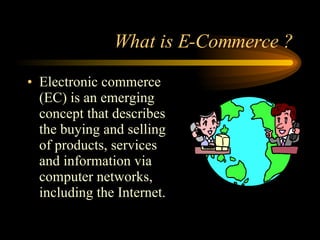
What is E-Commerce ? Electronic commerce (EC) is an emerging concept that describes the buying and selling of products, services and information via computer networks, including the Internet.
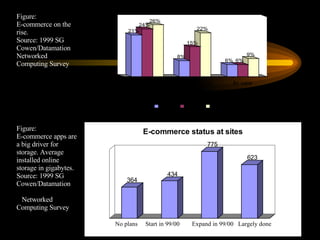
Figure:  E-commerce on the rise. Source: 1999 SG Cowen/Datamation  Networked Computing Survey Figure: E-commerce apps are a big driver for storage. Average installed online storage in gigabytes. Source: 1999 SG Cowen/Datamation  Networked Computing Survey No plans  Start in 99/00  Expand in 99/00  Largely done
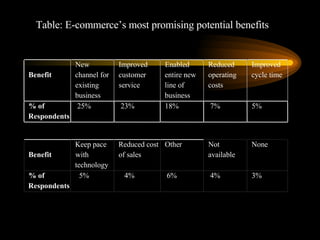
Table: E-commerce’s most promising potential benefits Benefit New channel for existing business Improved customer service Enabled entire new line of business Reduced operating costs Improved cycle time % of Respondents 25% 23% 18% 7% 5% Benefit Keep pace with technology Reduced cost of sales Other Not available None % of Respondents 5% 4% 6% 4% 3%
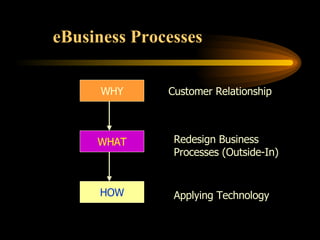
eBusiness Processes WHY Customer Relationship Redesign Business Processes (Outside-In) Applying Technology WHAT HOW
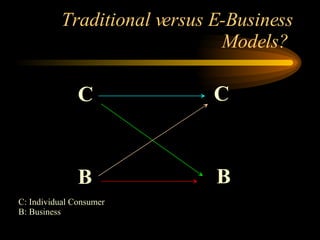
Traditional versus E-Business Models?  C B C B C: Individual Consumer B: Business
What is B2C? B2C (or Extranets) is just web-enabled relationships between existing partners; they tend to be run by a single company seeking to lower the cost of doing business with its current suppliers or individual customers. Examples? Amazon.com Egghead.com
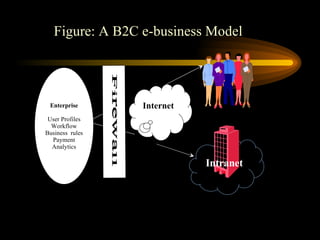
Enterprise User Profiles Workflow Business  rules Payment Analytics Internet Firewall Figure: A B2C e-business Model Intranet
B2C Applications Electronic storefront Electronic malls Advertising online Service online selling books, toys, computers e-banking (cyberbanking) online stock trading online job market, travel, real estate
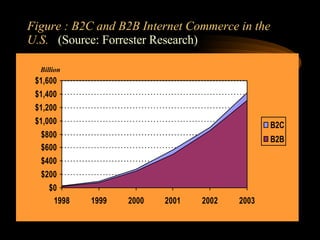
Figure : B2C and B2B Internet Commerce in the U.S.  (Source: Forrester Research) Billion
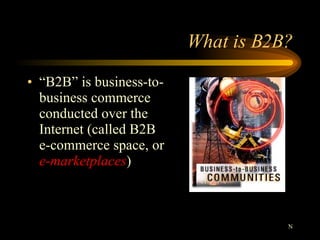
What is B2B? “ B2B” is business-to- business commerce conducted over the Internet (called B2B e-commerce space, or  e-marketplaces ) N
B2B e-Markepplaces: A CEO’s Perspective “ The next chapter in the e-business revolution involves the transformation of entire markets and the redefinition of industries.  We will see the rise of a new class of entities --  e-Marketplaces  -- that will help online buyers and sellers find each other, attack the inefficiencies of traditional markets, and carve out for themselves important roles in the e-business economy.” Louis V. Gerstner Jr. Chairman  of the Board and CEO IBM Corporation
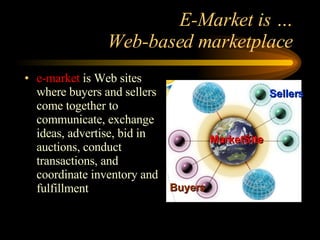
E-Market is … Web-based marketplace e-market  is Web sites where buyers and sellers come together to communicate, exchange ideas, advertise, bid in auctions, conduct transactions, and coordinate inventory and fulfillment MarketSite Buyers Sellers
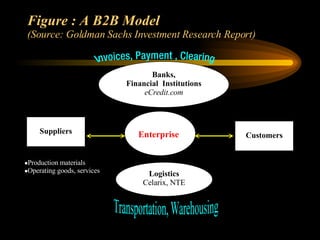
Figure : A B2B Model (Source: Goldman Sachs Investment Research Report) Banks, Financial  Institutions   eCredit.com Suppliers Production materials Operating goods, services Invoices, Payment , Clearing Enterprise Customers Logistics Celarix, NTE Transportation, Warehousing
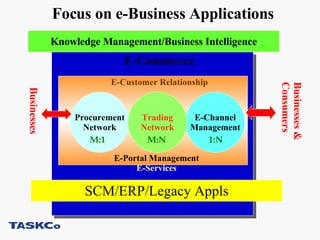
E-Channel Management Procurement Network Trading Network E-Customer Relationship E-Commerce E-Portal Management E-Services SCM/ERP/Legacy Appls Businesses Businesses & Consumers 1:N M:1 M:N Knowledge Management/Business Intelligence Focus on e-Business Applications
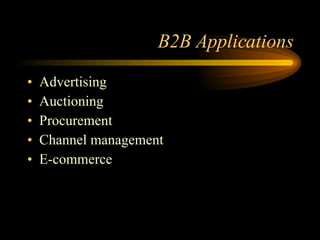
B2B Applications Advertising Auctioning Procurement Channel management E-commerce
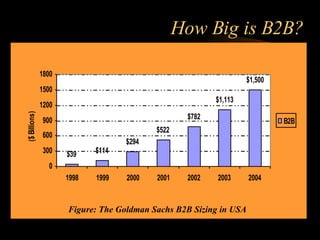
How Big is B2B? Figure: The Goldman Sachs B2B Sizing in USA
Where is the Evidence Three highlights from the Goldman Sachs B2B survey 1.0: E-Commerce spending on proprietary Web site, e-market, and procurement (75% say, in 2000) Business are increasingly likely to develop B2B e-markets and to favor online auctions (74% say, in 2000) Outsourcing e-commerce spending is commonplace among businesses (25% say, up to 75% of e-C spending)
B2B Revenue Model B2B companies exhibit varying business models, depending on the key products and services they offer. The models include: transaction fees, auction-driving commissions, advertising, content subscriptions, software licensing
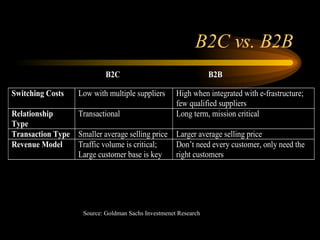
B2C vs. B2B Source: Goldman Sachs Investmenet Research
The Magnificent Seven B2B Drivers Increasing competition and globalization Growing interactivity Financial opportunity Efficiencies and cost savings Enhanced market and customer reach Real-time needs Regulatory and taxation issues N
Small Business Likely to Fuel B2B Small businesses will fuel the B2B market the use of and dependence on the Internet by small businesses as a medium for marketing, distribution, and commerce will likely fuel the B2B market. as more small business access the Internet and set up corporate Web pages, the more they will employ the Internet to execute their business strategy.
Benefits of B2B B2B solutions create competitive dynamics through: cost savings the composition of cost (product versus process costs) the number of intermediaries in the supply chain. new financial (revenue) opportunities the rate of industry-wide B2B adoption business model N
Why Now? B2B catalysts are now arising to stimulate adoption (mentioned earlier). Interactive networks have recently become ubiquitous and inexpensive, accelerating the use of B2B applications. A viral effect will spur copycat behavior throughout the market as more companies continue to implement B2B applications.
Which Industries are Likely to Embrace B2B Solutions Industries that are B2B inclined exhibit certain key characteristics: the supply chain is highly diffuse, techno-innovators dominate the culture, process represents more than 20% of total costs, products exhibit complex configurations, expense pressure is intense.
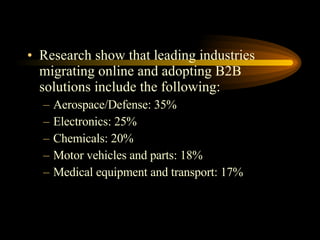
Research show that leading industries migrating online and adopting B2B solutions include the following: Aerospace/Defense: 35% Electronics: 25% Chemicals: 20% Motor vehicles and parts: 18% Medical equipment and transport: 17%
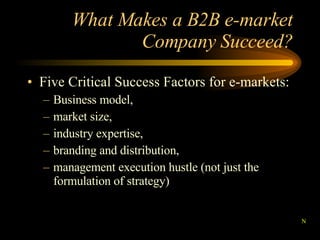
What Makes a B2B e-market Company Succeed? Five Critical Success Factors for e-markets: Business model, market size, industry expertise, branding and distribution, management execution hustle (not just the formulation of strategy) N
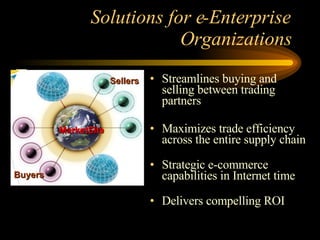
Solutions for e-Enterprise Organizations Streamlines buying and selling between trading partners Maximizes trade efficiency across the entire supply chain Strategic e-commerce capabilities in Internet time Delivers compelling ROI Buyers Sellers MarketSite
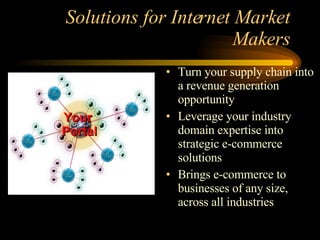
Solutions for Internet Market Makers Turn your supply chain into a revenue generation opportunity  Leverage your industry domain expertise into strategic e-commerce solutions Brings e-commerce to businesses of any size, across all industries Your  Portal
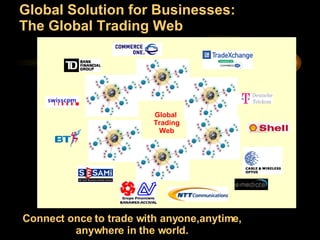
Global Solution for Businesses: The Global Trading Web Global  Trading Web Connect once to trade with anyone,anytime, anywhere in the world.
European e-markets B2C e-commerce in Europe is likely to remain approximately  two  to  three  years behind the U.S. . B2B in Europe currently lags the U.S. by  two  years. How about in Asia?
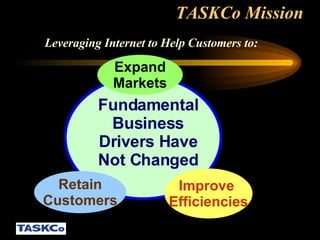
TASKCo Mission Expand Markets Improve  Efficiencies Retain Customers Fundamental Business Drivers Have Not Changed Leveraging Internet to Help Customers to:

E Commerce+ Ppt

  • 1.
    E-Commerce Jason C.H.Chen, Ph.D. School of Business Administration Gonzaga University, Washington, U.S.A. Senior Consultant, Taskco.com [email_address] Nov. 20, 2000
  • 2.
    Topics E-Commerce:From B2C to B2B and Beyond e-Bid Process Features of a B2B application. Business plan for an e-Marketplace (next year) e-CRM and 1-1 Marketing (next year)
  • 3.
    E-Commerce: From B2Cto B2B and Beyond Jason C.H. Chen, Ph.D. School of Business Administration Gonzaga University, Washington, U.S.A. Senior Consultant, Taskco.com [email_address] Nov. 22, 2000
  • 4.
    Outline of TopicsEC, B2C and B2B and their models. How big is B2B? Where is the Evidence? What are the revenue models in B2B? What is driving adoption of B2B? Why now? TASKCo.com
  • 5.
    eBusiness Key ConceptseBusiness The strategy of how to automate old business models with the aid of technology to maximize customer value eCommerce The process of buying and selling over digital media eCRM (eCustomer Relationship Management) The process of building, sustaining, and improving eBusiness relationships with existing and potential customers through digital media
  • 6.
    What is E-Commerce? Electronic commerce (EC) is an emerging concept that describes the buying and selling of products, services and information via computer networks, including the Internet.
  • 7.
    Figure: E-commerceon the rise. Source: 1999 SG Cowen/Datamation Networked Computing Survey Figure: E-commerce apps are a big driver for storage. Average installed online storage in gigabytes. Source: 1999 SG Cowen/Datamation Networked Computing Survey No plans Start in 99/00 Expand in 99/00 Largely done
  • 8.
    Table: E-commerce’s mostpromising potential benefits Benefit New channel for existing business Improved customer service Enabled entire new line of business Reduced operating costs Improved cycle time % of Respondents 25% 23% 18% 7% 5% Benefit Keep pace with technology Reduced cost of sales Other Not available None % of Respondents 5% 4% 6% 4% 3%
  • 9.
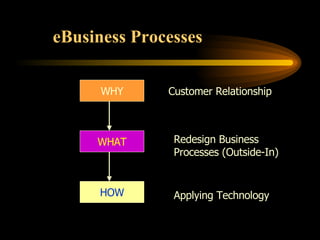
    eBusiness Processes WHYCustomer Relationship Redesign Business Processes (Outside-In) Applying Technology WHAT HOW
  • 10.
    eBusiness Processes WHYCustomer Relationship Redesign Business Processes (Outside-In) Applying Technology WHAT HOW
  • 11.
    Traditional versus E-BusinessModels? C B C B C: Individual Consumer B: Business
  • 12.
    What is B2C?B2C (or Extranets) is just web-enabled relationships between existing partners; they tend to be run by a single company seeking to lower the cost of doing business with its current suppliers or individual customers. Examples? Amazon.com Egghead.com
  • 13.
    Enterprise User ProfilesWorkflow Business rules Payment Analytics Internet Firewall Figure: A B2C e-business Model Intranet
  • 14.
    B2C Applications Electronicstorefront Electronic malls Advertising online Service online selling books, toys, computers e-banking (cyberbanking) online stock trading online job market, travel, real estate
  • 15.
    Figure : B2Cand B2B Internet Commerce in the U.S. (Source: Forrester Research) Billion
  • 16.
    What is B2B?“ B2B” is business-to- business commerce conducted over the Internet (called B2B e-commerce space, or e-marketplaces ) N
  • 17.
    B2B e-Markepplaces: ACEO’s Perspective “ The next chapter in the e-business revolution involves the transformation of entire markets and the redefinition of industries. We will see the rise of a new class of entities -- e-Marketplaces -- that will help online buyers and sellers find each other, attack the inefficiencies of traditional markets, and carve out for themselves important roles in the e-business economy.” Louis V. Gerstner Jr. Chairman of the Board and CEO IBM Corporation
  • 18.
    E-Market is …Web-based marketplace e-market is Web sites where buyers and sellers come together to communicate, exchange ideas, advertise, bid in auctions, conduct transactions, and coordinate inventory and fulfillment MarketSite Buyers Sellers
  • 19.
    Figure : AB2B Model (Source: Goldman Sachs Investment Research Report) Banks, Financial Institutions eCredit.com Suppliers Production materials Operating goods, services Invoices, Payment , Clearing Enterprise Customers Logistics Celarix, NTE Transportation, Warehousing
  • 20.
    E-Channel Management ProcurementNetwork Trading Network E-Customer Relationship E-Commerce E-Portal Management E-Services SCM/ERP/Legacy Appls Businesses Businesses & Consumers 1:N M:1 M:N Knowledge Management/Business Intelligence Focus on e-Business Applications
  • 21.
    B2B Applications AdvertisingAuctioning Procurement Channel management E-commerce
  • 22.
    How Big isB2B? Figure: The Goldman Sachs B2B Sizing in USA
  • 23.
    Where is theEvidence Three highlights from the Goldman Sachs B2B survey 1.0: E-Commerce spending on proprietary Web site, e-market, and procurement (75% say, in 2000) Business are increasingly likely to develop B2B e-markets and to favor online auctions (74% say, in 2000) Outsourcing e-commerce spending is commonplace among businesses (25% say, up to 75% of e-C spending)
  • 24.
    B2B Revenue ModelB2B companies exhibit varying business models, depending on the key products and services they offer. The models include: transaction fees, auction-driving commissions, advertising, content subscriptions, software licensing
  • 25.
    B2C vs. B2BSource: Goldman Sachs Investmenet Research
  • 26.
    The Magnificent SevenB2B Drivers Increasing competition and globalization Growing interactivity Financial opportunity Efficiencies and cost savings Enhanced market and customer reach Real-time needs Regulatory and taxation issues N
  • 27.
    Small Business Likelyto Fuel B2B Small businesses will fuel the B2B market the use of and dependence on the Internet by small businesses as a medium for marketing, distribution, and commerce will likely fuel the B2B market. as more small business access the Internet and set up corporate Web pages, the more they will employ the Internet to execute their business strategy.
  • 28.
    Benefits of B2BB2B solutions create competitive dynamics through: cost savings the composition of cost (product versus process costs) the number of intermediaries in the supply chain. new financial (revenue) opportunities the rate of industry-wide B2B adoption business model N
  • 29.
    Why Now? B2Bcatalysts are now arising to stimulate adoption (mentioned earlier). Interactive networks have recently become ubiquitous and inexpensive, accelerating the use of B2B applications. A viral effect will spur copycat behavior throughout the market as more companies continue to implement B2B applications.
  • 30.
    Which Industries areLikely to Embrace B2B Solutions Industries that are B2B inclined exhibit certain key characteristics: the supply chain is highly diffuse, techno-innovators dominate the culture, process represents more than 20% of total costs, products exhibit complex configurations, expense pressure is intense.
  • 31.
    Research show thatleading industries migrating online and adopting B2B solutions include the following: Aerospace/Defense: 35% Electronics: 25% Chemicals: 20% Motor vehicles and parts: 18% Medical equipment and transport: 17%
  • 32.
    What Makes aB2B e-market Company Succeed? Five Critical Success Factors for e-markets: Business model, market size, industry expertise, branding and distribution, management execution hustle (not just the formulation of strategy) N
  • 33.
    Solutions for e-EnterpriseOrganizations Streamlines buying and selling between trading partners Maximizes trade efficiency across the entire supply chain Strategic e-commerce capabilities in Internet time Delivers compelling ROI Buyers Sellers MarketSite
  • 34.
    Solutions for InternetMarket Makers Turn your supply chain into a revenue generation opportunity Leverage your industry domain expertise into strategic e-commerce solutions Brings e-commerce to businesses of any size, across all industries Your Portal
  • 35.
    Global Solution forBusinesses: The Global Trading Web Global Trading Web Connect once to trade with anyone,anytime, anywhere in the world.
  • 36.
    European e-markets B2Ce-commerce in Europe is likely to remain approximately two to three years behind the U.S. . B2B in Europe currently lags the U.S. by two years. How about in Asia?
  • 37.
    TASKCo Mission ExpandMarkets Improve Efficiencies Retain Customers Fundamental Business Drivers Have Not Changed Leveraging Internet to Help Customers to: