Electronic Commerce Eighth Edition Chapter 1 Introduction to Electronic Commerce
Electronic Commerce, Eighth Edition Electronic Commerce, Eighth Edition Learning Objectives In this chapter, you will learn about: What electronic commerce is and how it is experiencing a second wave of growth with a new focus on profitability Why companies concentrate on revenue models and the analysis of business processes instead of business models when they undertake electronic commerce initiatives How economic forces have created a business environment that is fostering the second wave of electronic commerce
Electronic Commerce, Eighth Edition Electronic Commerce, Eighth Edition Learning Objectives (cont’d.) How businesses use value chains and SWOT  analysis to identify electronic commerce opportunities The international nature of electronic commerce and the challenges that arise in engaging in electronic commerce on a global scale
Electronic Commerce, Eighth Edition Electronic Commerce, Eighth Edition Electronic Commerce: The Second Wave Electronic commerce history First wave Mid-1990s to 2000: rapid growth “ Dot-com boom” followed by “dot-com bust” 2000 to 2003: overly gloomy news reports Second wave 2003: signs of new life Sales growth Profits
Electronic Commerce, Eighth Edition Electronic Commerce, Eighth Edition Electronic Commerce and Electronic Business Electronic commerce Shopping on the Web Businesses trading with other businesses Internal company processes Broader term:  electronic business  ( e-business ) Electronic commerce includes:  All business activities using Internet technologies Internet and World Wide Web (Web) Wireless transmissions and personal digital assistants Dot-com  ( pure   dot-com ) Businesses operate only online
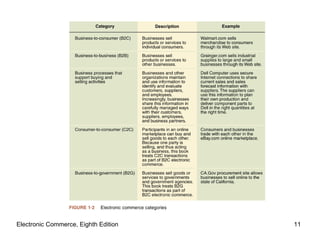
Electronic Commerce, Eighth Edition Electronic Commerce, Eighth Edition Categories of Electronic Commerce Business-to-consumer (B2C) Consumer shopping on the Web Business-to-business (B2B):  e-procurement Transactions conducted between Web businesses Business processes Using Internet technologies to support organization selling and purchasing activities Consumer-to-consumer Business-to-government Supply management (procurement)  departments Negotiate purchase transactions with suppliers
Electronic Commerce, Eighth Edition
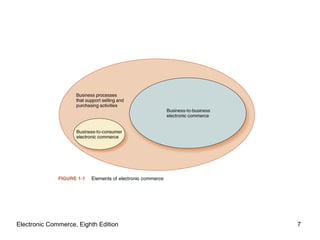
Electronic Commerce, Eighth Edition Elements of electronic commerce Relative sizes of elements Rough approximation Dollar volume and number of transactions B2B much greater than B2C Number of transactions Supporting business processes greater than B2C and B2B combined Categories of Electronic Commerce (cont’d.)
Electronic Commerce, Eighth Edition Electronic Commerce, Eighth Edition Categories of Electronic Commerce (cont’d.) Activity Task performed by worker in the course of doing job Transaction:  exchange of value Purchase, sale, conversion of raw materials into finished product Involves at least one activity Might not be related to transaction Business processes Group of logical, related, sequential activities and transactions
Electronic Commerce, Eighth Edition Electronic Commerce, Eighth Edition Categories of Electronic Commerce (cont’d.) Web helping people work more effectively Telecommuting  ( telework) Consumer-to-consumer  ( C2C ) Individuals buying and selling among themselves Web auction site C2C sales included in B2C category Seller acts as a business (for transaction purposes) Business-to-government  ( B2G ) Business transactions with government agencies Paying taxes, filing required reports B2G transactions included in B2B discussions
Electronic Commerce, Eighth Edition
Electronic Commerce, Eighth Edition Electronic Commerce, Eighth Edition The Development and Growth of Electronic Commerce People engaging in commerce: Adopt available tools and technologies Internet  Changed way people buy, sell, hire, organize business activities More rapidly than any other technology Electronic Funds Transfers (EFTs) Wire transfers Electronic transmissions of account exchange information Uses private communications networks
Electronic Commerce, Eighth Edition Electronic Commerce, Eighth Edition The Development and Growth of Electronic Commerce (cont’d.) Electronic Data Interchange (EDI) Business-to-business transmission Computer-readable data in standard format Standard transmitting formats benefits Reduces errors Avoids printing and mailing costs Eliminates need to reenter data Trading partners Businesses engaging in EDI with each other EDI pioneers (General Electric, Sears, Wal-Mart) Improved purchasing processes and supplier relationships
Electronic Commerce, Eighth Edition Electronic Commerce, Eighth Edition The Development and Growth of Electronic Commerce (cont’d.) EDI pioneers problem High implementation cost Expensive computer hardware and software Establishing direct network connections to trading partners or subscribing to value-added network Value-added network (VAN) Independent firm offering EDI connection and transaction-forwarding services Ensure transmitted data security Charge fixed monthly fee plus per transaction charge Gradually moved EDI traffic to the Internet Reduced EDI costs
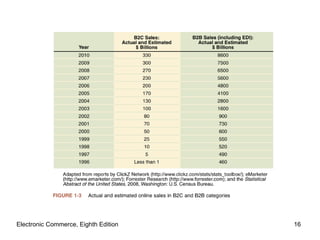
Electronic Commerce, Eighth Edition Electronic Commerce, Eighth Edition The Dot-Com Boom, Bust, and Rebirth 1997 to 2000 irrational exuberance 12,000 Internet-related businesses started $100 billion of investors’ money 5,000+ companies went out of business or acquired 2000 to 2003 $200 billion invested  Fueled online business activity growth rebirth Online B2C sales growth continued due to: Increasing number of people with Internet access B2B sales online increasing steadily
Electronic Commerce, Eighth Edition
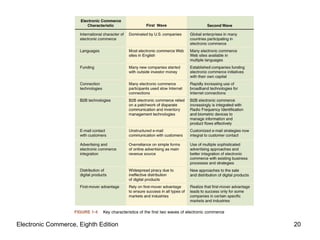
Electronic Commerce, Eighth Edition Electronic Commerce, Eighth Edition The Second Wave of Electronic Commerce Four waves based on Industrial Revolution First and second wave characteristics Regional scope First wave: United States phenomenon Second wave: international Start-up capital First wave: easy to obtain Second wave: companies using internal funds Internet technologies used First wave: slow and inexpensive (especially B2C) Second wave: broadband connections
Electronic Commerce, Eighth Edition Electronic Commerce, Eighth Edition The Second Wave of Electronic Commerce (cont’d.) First and second wave characteristics (cont’d.) Internet technology integration First wave: bar codes, scanners Second wave:  Radio Frequency Identification (RFID) devices, smart cards, biometric technologies Electronic mail (or e-mail) use First wave: unstructured communication Second wave: integral part of marketing, customer contact strategies
Electronic Commerce, Eighth Edition Electronic Commerce, Eighth Edition The Second Wave of Electronic Commerce (cont’d.) First and second wave characteristics (cont’d.) Revenue source First wave: online advertising (failed) Second wave: Internet advertising (more successful) Digital product sales First wave: fraught with difficulties (music industry) Second wave: fulfilling available technology promise Business online strategy  First wave:  first-mover advantage Second wave: fewer businesses rely on first-mover advantage
Electronic Commerce, Eighth Edition
Electronic Commerce, Eighth Edition Electronic Commerce, Eighth Edition Business Models, Revenue Models, and Business Processes Business model Set of processes combined to achieve company goal Yield profit Electronic commerce first wave Investors sought out appealing business models Expectations of rapid sales growth, market dominance Michael Porter argued business models did not exist Key to success: copy successful model Neither easy nor wise
Electronic Commerce, Eighth Edition Electronic Commerce, Eighth Edition Business Models, Revenue Models, and Business Processes (cont’d.) Instead of copying model, examine business elements Streamline, enhance, replace with Internet technology driven processes Revenue model Specific collection of business processes Identify customers Market to those customers Generate sales Helpful for classifying revenue-generating activities Communication and analysis purposes
Electronic Commerce, Eighth Edition Electronic Commerce, Eighth Edition Focus on Specific Business Processes Companies think in business process terms Purchasing raw materials or goods for resale Converting materials and labor into finished goods Managing transportation and logistics Hiring and training employees Managing business finances Identify processes benefiting from e-commerce technology Uses of Internet technologies Improve existing business processes, identify new business opportunities, adapt to change
Electronic Commerce, Eighth Edition Electronic Commerce, Eighth Edition Role of Merchandising Merchandising Combination of store design, layout, product display knowledge Salespeople skills Identify customer needs Find products or services meeting needs Merchandising and personal selling Difficult to practice remotely Web site success Transfer merchandising skills to the Web Easier for some products than others
Electronic Commerce, Eighth Edition Electronic Commerce, Eighth Edition Product/Process Suitability to Electronic Commerce Electronic commerce good candidates No physical characteristics experience required Selling  commodity item Hard to distinguish product or service from same products or services provided by other sellers Features: standardized and well known Product’s shipping profile Note value-to-weight ratio Strong brand reputation (Kodak camera) Electronic commerce site advantage One site offers wider selection than physical store
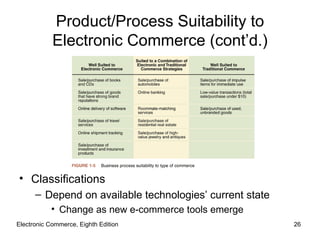
Electronic Commerce, Eighth Edition Classifications Depend on available technologies’ current state Change as new e-commerce tools emerge Product/Process Suitability to Electronic Commerce (cont’d.)
Electronic Commerce, Eighth Edition Electronic Commerce, Eighth Edition Product/Process Suitability to Electronic Commerce (cont’d.) Electronic commerce site not advantageous Personal product inspection required Solution Combination of traditional commerce and electronic commerce Works best when process includes commodity and personal inspection elements
Electronic Commerce, Eighth Edition Electronic Commerce, Eighth Edition Advantages of Electronic Commerce Virtual community:  gathering of people online Seller Increases profits and sales; decreases costs Buyer Increases purchasing opportunities Identifies new suppliers and business partners Easier negotiating price and delivery terms Efficiently obtain competitive bid information Increases speed, information exchange accuracy Wider range of choices Customizes prospective purchase information detail
Electronic Commerce, Eighth Edition Electronic Commerce, Eighth Edition Advantages of Electronic Commerce (cont’d.) Benefits extend to general society welfare Lower costs to issue: Electronic payments of tax refunds Public retirement Welfare support Secure and quick Internet transmission Fraud, theft loss protection Electronic payments easier to audit and monitor Reduced commuter-caused traffic, pollution Due to telecommuting Products and services available in remote areas
Electronic Commerce, Eighth Edition Electronic Commerce, Eighth Edition Disadvantages of Electronic Commerce Poor choices for electronic commerce Perishable foods and high-cost, unique items Disadvantages will disappear when: E-commerce matures Becomes more available to and accepted by general population Critical masses of buyers become equipped, willing to buy through Internet  Online grocery industry example
Electronic Commerce, Eighth Edition Electronic Commerce, Eighth Edition Disadvantages of Electronic Commerce (cont’d.) Additional problems Calculating return on investment Recruiting and retaining employees Technology and software issues Cultural differences Consumers resistant to change Conflicting laws
Electronic Commerce, Eighth Edition Electronic Commerce, Eighth Edition Economic Forces and Electronic Commerce Economics Study how people allocate scarce resources Through commerce and government actions Commerce organizations participate in  markets Potential sellers come into contact with buyers Medium of exchange available (currency or barter) Organization hierarchy (flat or many levels) Bottom level includes largest number of employees Transaction costs Motivation for moving to hierarchically structured firms
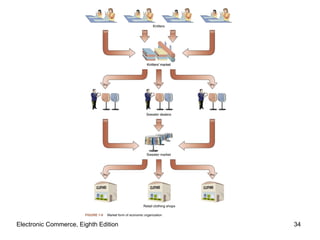
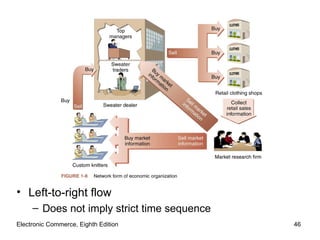
Electronic Commerce, Eighth Edition Electronic Commerce, Eighth Edition Transaction Costs Total of all costs that a buyer and seller incur Gathering information and negotiating purchase-and-sale transaction Brokerage fees and sales commissions Cost of information search and acquisition Sweater dealer example (Figure 1-6)
Electronic Commerce, Eighth Edition
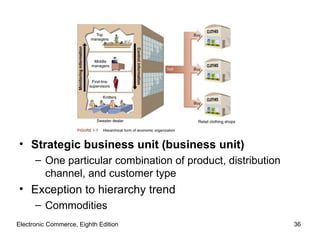
Electronic Commerce, Eighth Edition Electronic Commerce, Eighth Edition Markets and Hierarchies General trend toward hierarchies Coase’s analysis of high transaction costs Hierarchical organizations formed Replace market-negotiated transactions Strong supervision and worker-monitoring elements Sweater example (Figure 1-7) Oliver Williamson (extended Coase’s analysis) Complex manufacturing, assembly operations Hierarchically organized, vertically integrated Manufacturing innovations increased monitoring activities’ efficiency effectiveness
Electronic Commerce, Eighth Edition Strategic business unit (business unit) One particular combination of product, distribution channel, and customer type Exception to hierarchy trend Commodities
Electronic Commerce, Eighth Edition Electronic Commerce, Eighth Edition Using Electronic Commerce to Reduce Transaction Costs Electronic commerce Change vertical integration attractiveness Change transaction costs’ level and nature Example: employment transaction Telecommuting May reduce or eliminated transaction costs
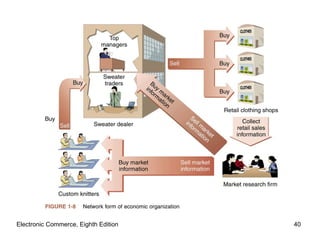
Electronic Commerce, Eighth Edition Electronic Commerce, Eighth Edition Network Economic Structures Neither market nor hierarchy Strategic alliances (strategic partnerships) Coordinate strategies, resources, skill sets Form long-term, stable relationships with other companies and individuals Based on shared purposes Strategic partners Come together for specific project or activity Form many intercompany teams Undertake variety of ongoing activities
Electronic Commerce, Eighth Edition Electronic Commerce, Eighth Edition Network Economic Structures (cont’d.) Network organizations Well suited to technology industries  Information intensive Sweater example Knitters organize into networks of smaller organizations Specialize in styles or designs  Electronic commerce role Makes such networks easier to construct, maintain Predominant in near future
Electronic Commerce, Eighth Edition
Electronic Commerce, Eighth Edition Electronic Commerce, Eighth Edition Network Effects Activities yield less value as consumption amount increases Law of diminishing returns Example: hamburger consumption Networks ( network effect) Exception to law of diminishing returns  More people or organizations participate in network Value of network to each participant increases Example: fax machine
Electronic Commerce, Eighth Edition Electronic Commerce, Eighth Edition Using Electronic Commerce to Create Network Effects E-mail account Provides access to network of people with e-mail accounts Smaller network E-mail generally less valuable Internet e-mail accounts Far more valuable than single-organization e-mail Due to network effect Need way to identify business processes Evaluate electronic commerce suitability For each process
Electronic Commerce, Eighth Edition Electronic Commerce, Eighth Edition Identifying Electronic Commerce Opportunities Focus on specific business processes Break business down Series of value-adding activities Combine to generate profits, meet firm’s goal Commerce: conducted by firms of all sizes Firm Multiple business units owned by a common set of shareholders or company  Industry Multiple firms selling similar products to similar customers
Electronic Commerce, Eighth Edition Strategic Business Unit Value Chains Value chain Organizing strategic business unit activities to design, produce, promote, market, deliver, and support the products or services Porter includes  supporting activities Human resource management and purchasing Strategic business unit  primary activities Identify customers, design, purchase materials and supplies, manufacture product or create service, market and sell, deliver, provide after-sale service and support
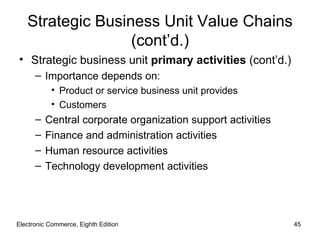
Electronic Commerce, Eighth Edition Strategic Business Unit Value Chains (cont’d.) Strategic business unit  primary activities  (cont’d.) Importance depends on: Product or service business unit provides Customers  Central corporate organization support activities Finance and administration activities Human resource activities Technology development activities
Electronic Commerce, Eighth Edition Left-to-right flow   Does not imply strict time sequence
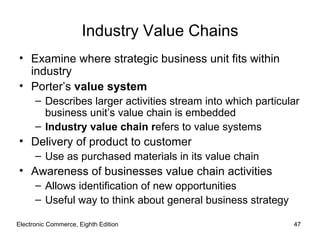
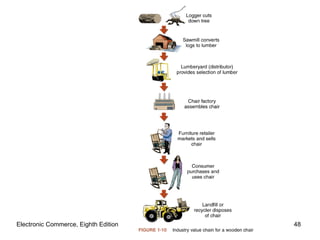
Electronic Commerce, Eighth Edition Industry Value Chains Examine where strategic business unit fits within industry Porter’s  value system Describes larger activities stream into which particular business unit’s value chain is embedded Industry value chain r efers to value systems Delivery of product to customer Use as purchased materials in its value chain Awareness of businesses value chain activities Allows identification of new opportunities Useful way to think about general business strategy
Electronic Commerce, Eighth Edition
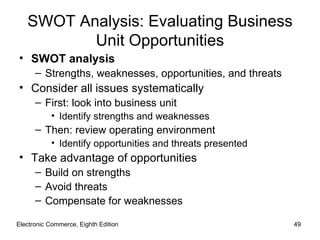
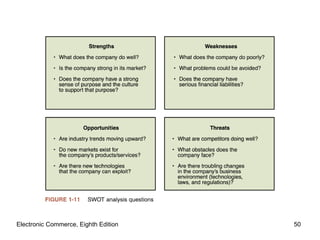
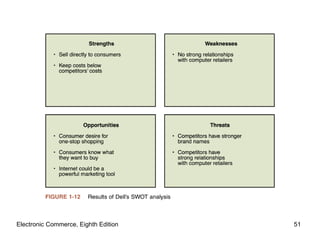
Electronic Commerce, Eighth Edition SWOT Analysis: Evaluating Business Unit Opportunities SWOT analysis Strengths, weaknesses, opportunities, and threats Consider all issues systematically First: look into business unit Identify strengths and weaknesses Then: review operating environment Identify opportunities and threats presented Take advantage of opportunities Build on strengths Avoid threats Compensate for weaknesses
Electronic Commerce, Eighth Edition
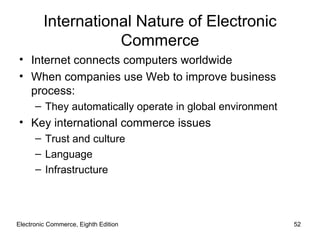
Electronic Commerce, Eighth Edition International Nature of Electronic Commerce Internet connects computers worldwide When companies use Web to improve business process: They automatically operate in global environment Key international commerce issues Trust and culture Language Infrastructure
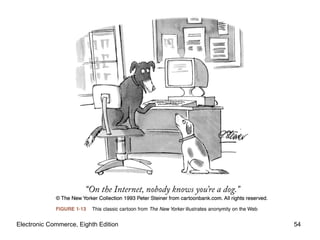
Electronic Commerce, Eighth Edition Trust Issues on the Web Important to establish trusting relationships with customers Rely on established brand names Difficult for online businesses Anonymity exists in Web presence Banking example: browsing site’s pages Difficult to determine bank size or how well established Business must overcome distrust in Web “strangers”
Electronic Commerce, Eighth Edition
Electronic Commerce, Eighth Edition Language Issues Business must adapt to local cultures “ Think globally, act locally” Provide local language versions of Web site Customers more likely to buy from sites translated into own language 50 percent of Internet content in English Half of current Internet users do not read English Languages may require multiple translations Separate dialects
Electronic Commerce, Eighth Edition Language Issues (cont’d.) Large site translation may be prohibitive Decided by corporate department responsible for page content Mandatory translation into all supported languages Home page All first-level links to home page Highly recommended pages to translate Marketing, product information, establishing brand Use translation services and software Human translation: key marketing messages Software: routine transaction processing functions
Electronic Commerce, Eighth Edition Cultural Issues Business partners Ideally have common legal structure for resolving disputes Culture Combination of language and customs Varies across national boundaries, regions within nations Personal property concept Valued in North America and Europe (Not Asia) Cultural issue example Virtual Vineyards (now Wine.com)
Electronic Commerce, Eighth Edition Cultural Issues (cont’d.) Subtle language and cultural standard errors General Motors’ Chevrolet Nova automobile Baby food in jars in Africa Select icons carefully Shopping cart versus shopping baskets, trolleys Hand signal for “OK”: obscene gesture in Brazil Dramatic cultural overtones India: inappropriate to use cow image in cartoon Muslim countries: offended by human arms or legs uncovered White color (purity versus death)
Electronic Commerce, Eighth Edition Cultural Issues (cont’d.) Online business apprehension Japanese shoppers unwillingness to pay by credit Nike Created special Web pages to attract customers outside United States Nike Football site appeals to soccer fans throughout world
Electronic Commerce, Eighth Edition Culture and Government Online discussion inhospitable to cultural environments Government controls in some cultures Unfettered communication not desired Unfettered communication not considered acceptable Denounced Internet material content Unrestricted Internet access forbidden Filter Web content Regularly reviews ISPs and their records Impose language requirements
Electronic Commerce, Eighth Edition Culture and Government (cont’d.) Internet censorship Restricts electronic commerce Reduces online participant interest levels
Electronic Commerce, Eighth Edition Infrastructure Issues Internet infrastructure Computers and software connected to Internet Communications networks’ message packets travel Infrastructure variations and inadequacies exist Outside United States Government-owned industry Heavily regulated High local telephone connection costs Affect buying online behavior International orders: global problem No process to handle order and paperwork
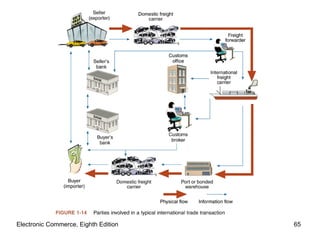
Electronic Commerce, Eighth Edition Infrastructure Issues (cont’d.) The Organization for Economic Cooperation and Development’s (OECD) Directorate of Science, Technology, and Industry Issued  OECD Statements on Information and Communications Policy Freight forwarder Arranges international transactions shipping and insurance Customs broker Arranges tariff payment and compliance
Electronic Commerce, Eighth Edition Infrastructure Issues (cont’d.) Bonded warehouse Secure location Holds international shipments until customs requirements or payments satisfied Handling international transactions paperwork Annual cost: $800 billion Software automates some paperwork Countries have own paper-based forms, procedures Countries have incompatible computer systems Figure 1-14: complex information flows
Electronic Commerce, Eighth Edition
Electronic Commerce, Eighth Edition Electronic Commerce, Eighth Edition Summary Electronic commerce Application of new Internet and Web technologies Help individuals, businesses, other organizations conduct effective business Adopted in waves of change First wave ended in 2000 Second wave focuses on improving specific business processes Technology improvements Create new products and services Improved promotion, marketing, delivery of existing offerings
Electronic Commerce, Eighth Edition Electronic Commerce, Eighth Edition Summary (cont’d.) Technology improvements (cont’d.) Improve purchasing and supply activities Identify new customers Operate finance, administration, human resource management activities more efficiently Reduce transaction costs Create network economic effects Leads to greater revenue opportunities Electronic commerce Fits into markets, hierarchies, networks
Electronic Commerce, Eighth Edition Electronic Commerce, Eighth Edition Summary (cont’d.) Value chains Occur at business unit, industry levels Value chains and SWOT analysis Tools to understand business processes Analyze suitability for electronic commerce implementation

MIST 450 ppt ch01

  • 1.
    Electronic Commerce EighthEdition Chapter 1 Introduction to Electronic Commerce
  • 2.
    Electronic Commerce, EighthEdition Electronic Commerce, Eighth Edition Learning Objectives In this chapter, you will learn about: What electronic commerce is and how it is experiencing a second wave of growth with a new focus on profitability Why companies concentrate on revenue models and the analysis of business processes instead of business models when they undertake electronic commerce initiatives How economic forces have created a business environment that is fostering the second wave of electronic commerce
  • 3.
    Electronic Commerce, EighthEdition Electronic Commerce, Eighth Edition Learning Objectives (cont’d.) How businesses use value chains and SWOT analysis to identify electronic commerce opportunities The international nature of electronic commerce and the challenges that arise in engaging in electronic commerce on a global scale
  • 4.
    Electronic Commerce, EighthEdition Electronic Commerce, Eighth Edition Electronic Commerce: The Second Wave Electronic commerce history First wave Mid-1990s to 2000: rapid growth “ Dot-com boom” followed by “dot-com bust” 2000 to 2003: overly gloomy news reports Second wave 2003: signs of new life Sales growth Profits
  • 5.
    Electronic Commerce, EighthEdition Electronic Commerce, Eighth Edition Electronic Commerce and Electronic Business Electronic commerce Shopping on the Web Businesses trading with other businesses Internal company processes Broader term: electronic business ( e-business ) Electronic commerce includes: All business activities using Internet technologies Internet and World Wide Web (Web) Wireless transmissions and personal digital assistants Dot-com ( pure dot-com ) Businesses operate only online
  • 6.
    Electronic Commerce, EighthEdition Electronic Commerce, Eighth Edition Categories of Electronic Commerce Business-to-consumer (B2C) Consumer shopping on the Web Business-to-business (B2B): e-procurement Transactions conducted between Web businesses Business processes Using Internet technologies to support organization selling and purchasing activities Consumer-to-consumer Business-to-government Supply management (procurement) departments Negotiate purchase transactions with suppliers
  • 7.
  • 8.
    Electronic Commerce, EighthEdition Elements of electronic commerce Relative sizes of elements Rough approximation Dollar volume and number of transactions B2B much greater than B2C Number of transactions Supporting business processes greater than B2C and B2B combined Categories of Electronic Commerce (cont’d.)
  • 9.
    Electronic Commerce, EighthEdition Electronic Commerce, Eighth Edition Categories of Electronic Commerce (cont’d.) Activity Task performed by worker in the course of doing job Transaction: exchange of value Purchase, sale, conversion of raw materials into finished product Involves at least one activity Might not be related to transaction Business processes Group of logical, related, sequential activities and transactions
  • 10.
    Electronic Commerce, EighthEdition Electronic Commerce, Eighth Edition Categories of Electronic Commerce (cont’d.) Web helping people work more effectively Telecommuting ( telework) Consumer-to-consumer ( C2C ) Individuals buying and selling among themselves Web auction site C2C sales included in B2C category Seller acts as a business (for transaction purposes) Business-to-government ( B2G ) Business transactions with government agencies Paying taxes, filing required reports B2G transactions included in B2B discussions
  • 11.
  • 12.
    Electronic Commerce, EighthEdition Electronic Commerce, Eighth Edition The Development and Growth of Electronic Commerce People engaging in commerce: Adopt available tools and technologies Internet Changed way people buy, sell, hire, organize business activities More rapidly than any other technology Electronic Funds Transfers (EFTs) Wire transfers Electronic transmissions of account exchange information Uses private communications networks
  • 13.
    Electronic Commerce, EighthEdition Electronic Commerce, Eighth Edition The Development and Growth of Electronic Commerce (cont’d.) Electronic Data Interchange (EDI) Business-to-business transmission Computer-readable data in standard format Standard transmitting formats benefits Reduces errors Avoids printing and mailing costs Eliminates need to reenter data Trading partners Businesses engaging in EDI with each other EDI pioneers (General Electric, Sears, Wal-Mart) Improved purchasing processes and supplier relationships
  • 14.
    Electronic Commerce, EighthEdition Electronic Commerce, Eighth Edition The Development and Growth of Electronic Commerce (cont’d.) EDI pioneers problem High implementation cost Expensive computer hardware and software Establishing direct network connections to trading partners or subscribing to value-added network Value-added network (VAN) Independent firm offering EDI connection and transaction-forwarding services Ensure transmitted data security Charge fixed monthly fee plus per transaction charge Gradually moved EDI traffic to the Internet Reduced EDI costs
  • 15.
    Electronic Commerce, EighthEdition Electronic Commerce, Eighth Edition The Dot-Com Boom, Bust, and Rebirth 1997 to 2000 irrational exuberance 12,000 Internet-related businesses started $100 billion of investors’ money 5,000+ companies went out of business or acquired 2000 to 2003 $200 billion invested Fueled online business activity growth rebirth Online B2C sales growth continued due to: Increasing number of people with Internet access B2B sales online increasing steadily
  • 16.
  • 17.
    Electronic Commerce, EighthEdition Electronic Commerce, Eighth Edition The Second Wave of Electronic Commerce Four waves based on Industrial Revolution First and second wave characteristics Regional scope First wave: United States phenomenon Second wave: international Start-up capital First wave: easy to obtain Second wave: companies using internal funds Internet technologies used First wave: slow and inexpensive (especially B2C) Second wave: broadband connections
  • 18.
    Electronic Commerce, EighthEdition Electronic Commerce, Eighth Edition The Second Wave of Electronic Commerce (cont’d.) First and second wave characteristics (cont’d.) Internet technology integration First wave: bar codes, scanners Second wave: Radio Frequency Identification (RFID) devices, smart cards, biometric technologies Electronic mail (or e-mail) use First wave: unstructured communication Second wave: integral part of marketing, customer contact strategies
  • 19.
    Electronic Commerce, EighthEdition Electronic Commerce, Eighth Edition The Second Wave of Electronic Commerce (cont’d.) First and second wave characteristics (cont’d.) Revenue source First wave: online advertising (failed) Second wave: Internet advertising (more successful) Digital product sales First wave: fraught with difficulties (music industry) Second wave: fulfilling available technology promise Business online strategy First wave: first-mover advantage Second wave: fewer businesses rely on first-mover advantage
  • 20.
  • 21.
    Electronic Commerce, EighthEdition Electronic Commerce, Eighth Edition Business Models, Revenue Models, and Business Processes Business model Set of processes combined to achieve company goal Yield profit Electronic commerce first wave Investors sought out appealing business models Expectations of rapid sales growth, market dominance Michael Porter argued business models did not exist Key to success: copy successful model Neither easy nor wise
  • 22.
    Electronic Commerce, EighthEdition Electronic Commerce, Eighth Edition Business Models, Revenue Models, and Business Processes (cont’d.) Instead of copying model, examine business elements Streamline, enhance, replace with Internet technology driven processes Revenue model Specific collection of business processes Identify customers Market to those customers Generate sales Helpful for classifying revenue-generating activities Communication and analysis purposes
  • 23.
    Electronic Commerce, EighthEdition Electronic Commerce, Eighth Edition Focus on Specific Business Processes Companies think in business process terms Purchasing raw materials or goods for resale Converting materials and labor into finished goods Managing transportation and logistics Hiring and training employees Managing business finances Identify processes benefiting from e-commerce technology Uses of Internet technologies Improve existing business processes, identify new business opportunities, adapt to change
  • 24.
    Electronic Commerce, EighthEdition Electronic Commerce, Eighth Edition Role of Merchandising Merchandising Combination of store design, layout, product display knowledge Salespeople skills Identify customer needs Find products or services meeting needs Merchandising and personal selling Difficult to practice remotely Web site success Transfer merchandising skills to the Web Easier for some products than others
  • 25.
    Electronic Commerce, EighthEdition Electronic Commerce, Eighth Edition Product/Process Suitability to Electronic Commerce Electronic commerce good candidates No physical characteristics experience required Selling commodity item Hard to distinguish product or service from same products or services provided by other sellers Features: standardized and well known Product’s shipping profile Note value-to-weight ratio Strong brand reputation (Kodak camera) Electronic commerce site advantage One site offers wider selection than physical store
  • 26.
    Electronic Commerce, EighthEdition Classifications Depend on available technologies’ current state Change as new e-commerce tools emerge Product/Process Suitability to Electronic Commerce (cont’d.)
  • 27.
    Electronic Commerce, EighthEdition Electronic Commerce, Eighth Edition Product/Process Suitability to Electronic Commerce (cont’d.) Electronic commerce site not advantageous Personal product inspection required Solution Combination of traditional commerce and electronic commerce Works best when process includes commodity and personal inspection elements
  • 28.
    Electronic Commerce, EighthEdition Electronic Commerce, Eighth Edition Advantages of Electronic Commerce Virtual community: gathering of people online Seller Increases profits and sales; decreases costs Buyer Increases purchasing opportunities Identifies new suppliers and business partners Easier negotiating price and delivery terms Efficiently obtain competitive bid information Increases speed, information exchange accuracy Wider range of choices Customizes prospective purchase information detail
  • 29.
    Electronic Commerce, EighthEdition Electronic Commerce, Eighth Edition Advantages of Electronic Commerce (cont’d.) Benefits extend to general society welfare Lower costs to issue: Electronic payments of tax refunds Public retirement Welfare support Secure and quick Internet transmission Fraud, theft loss protection Electronic payments easier to audit and monitor Reduced commuter-caused traffic, pollution Due to telecommuting Products and services available in remote areas
  • 30.
    Electronic Commerce, EighthEdition Electronic Commerce, Eighth Edition Disadvantages of Electronic Commerce Poor choices for electronic commerce Perishable foods and high-cost, unique items Disadvantages will disappear when: E-commerce matures Becomes more available to and accepted by general population Critical masses of buyers become equipped, willing to buy through Internet Online grocery industry example
  • 31.
    Electronic Commerce, EighthEdition Electronic Commerce, Eighth Edition Disadvantages of Electronic Commerce (cont’d.) Additional problems Calculating return on investment Recruiting and retaining employees Technology and software issues Cultural differences Consumers resistant to change Conflicting laws
  • 32.
    Electronic Commerce, EighthEdition Electronic Commerce, Eighth Edition Economic Forces and Electronic Commerce Economics Study how people allocate scarce resources Through commerce and government actions Commerce organizations participate in markets Potential sellers come into contact with buyers Medium of exchange available (currency or barter) Organization hierarchy (flat or many levels) Bottom level includes largest number of employees Transaction costs Motivation for moving to hierarchically structured firms
  • 33.
    Electronic Commerce, EighthEdition Electronic Commerce, Eighth Edition Transaction Costs Total of all costs that a buyer and seller incur Gathering information and negotiating purchase-and-sale transaction Brokerage fees and sales commissions Cost of information search and acquisition Sweater dealer example (Figure 1-6)
  • 34.
  • 35.
    Electronic Commerce, EighthEdition Electronic Commerce, Eighth Edition Markets and Hierarchies General trend toward hierarchies Coase’s analysis of high transaction costs Hierarchical organizations formed Replace market-negotiated transactions Strong supervision and worker-monitoring elements Sweater example (Figure 1-7) Oliver Williamson (extended Coase’s analysis) Complex manufacturing, assembly operations Hierarchically organized, vertically integrated Manufacturing innovations increased monitoring activities’ efficiency effectiveness
  • 36.
    Electronic Commerce, EighthEdition Strategic business unit (business unit) One particular combination of product, distribution channel, and customer type Exception to hierarchy trend Commodities
  • 37.
    Electronic Commerce, EighthEdition Electronic Commerce, Eighth Edition Using Electronic Commerce to Reduce Transaction Costs Electronic commerce Change vertical integration attractiveness Change transaction costs’ level and nature Example: employment transaction Telecommuting May reduce or eliminated transaction costs
  • 38.
    Electronic Commerce, EighthEdition Electronic Commerce, Eighth Edition Network Economic Structures Neither market nor hierarchy Strategic alliances (strategic partnerships) Coordinate strategies, resources, skill sets Form long-term, stable relationships with other companies and individuals Based on shared purposes Strategic partners Come together for specific project or activity Form many intercompany teams Undertake variety of ongoing activities
  • 39.
    Electronic Commerce, EighthEdition Electronic Commerce, Eighth Edition Network Economic Structures (cont’d.) Network organizations Well suited to technology industries Information intensive Sweater example Knitters organize into networks of smaller organizations Specialize in styles or designs Electronic commerce role Makes such networks easier to construct, maintain Predominant in near future
  • 40.
  • 41.
    Electronic Commerce, EighthEdition Electronic Commerce, Eighth Edition Network Effects Activities yield less value as consumption amount increases Law of diminishing returns Example: hamburger consumption Networks ( network effect) Exception to law of diminishing returns More people or organizations participate in network Value of network to each participant increases Example: fax machine
  • 42.
    Electronic Commerce, EighthEdition Electronic Commerce, Eighth Edition Using Electronic Commerce to Create Network Effects E-mail account Provides access to network of people with e-mail accounts Smaller network E-mail generally less valuable Internet e-mail accounts Far more valuable than single-organization e-mail Due to network effect Need way to identify business processes Evaluate electronic commerce suitability For each process
  • 43.
    Electronic Commerce, EighthEdition Electronic Commerce, Eighth Edition Identifying Electronic Commerce Opportunities Focus on specific business processes Break business down Series of value-adding activities Combine to generate profits, meet firm’s goal Commerce: conducted by firms of all sizes Firm Multiple business units owned by a common set of shareholders or company Industry Multiple firms selling similar products to similar customers
  • 44.
    Electronic Commerce, EighthEdition Strategic Business Unit Value Chains Value chain Organizing strategic business unit activities to design, produce, promote, market, deliver, and support the products or services Porter includes supporting activities Human resource management and purchasing Strategic business unit primary activities Identify customers, design, purchase materials and supplies, manufacture product or create service, market and sell, deliver, provide after-sale service and support
  • 45.
    Electronic Commerce, EighthEdition Strategic Business Unit Value Chains (cont’d.) Strategic business unit primary activities (cont’d.) Importance depends on: Product or service business unit provides Customers Central corporate organization support activities Finance and administration activities Human resource activities Technology development activities
  • 46.
    Electronic Commerce, EighthEdition Left-to-right flow Does not imply strict time sequence
  • 47.
    Electronic Commerce, EighthEdition Industry Value Chains Examine where strategic business unit fits within industry Porter’s value system Describes larger activities stream into which particular business unit’s value chain is embedded Industry value chain r efers to value systems Delivery of product to customer Use as purchased materials in its value chain Awareness of businesses value chain activities Allows identification of new opportunities Useful way to think about general business strategy
  • 48.
  • 49.
    Electronic Commerce, EighthEdition SWOT Analysis: Evaluating Business Unit Opportunities SWOT analysis Strengths, weaknesses, opportunities, and threats Consider all issues systematically First: look into business unit Identify strengths and weaknesses Then: review operating environment Identify opportunities and threats presented Take advantage of opportunities Build on strengths Avoid threats Compensate for weaknesses
  • 50.
  • 51.
  • 52.
    Electronic Commerce, EighthEdition International Nature of Electronic Commerce Internet connects computers worldwide When companies use Web to improve business process: They automatically operate in global environment Key international commerce issues Trust and culture Language Infrastructure
  • 53.
    Electronic Commerce, EighthEdition Trust Issues on the Web Important to establish trusting relationships with customers Rely on established brand names Difficult for online businesses Anonymity exists in Web presence Banking example: browsing site’s pages Difficult to determine bank size or how well established Business must overcome distrust in Web “strangers”
  • 54.
  • 55.
    Electronic Commerce, EighthEdition Language Issues Business must adapt to local cultures “ Think globally, act locally” Provide local language versions of Web site Customers more likely to buy from sites translated into own language 50 percent of Internet content in English Half of current Internet users do not read English Languages may require multiple translations Separate dialects
  • 56.
    Electronic Commerce, EighthEdition Language Issues (cont’d.) Large site translation may be prohibitive Decided by corporate department responsible for page content Mandatory translation into all supported languages Home page All first-level links to home page Highly recommended pages to translate Marketing, product information, establishing brand Use translation services and software Human translation: key marketing messages Software: routine transaction processing functions
  • 57.
    Electronic Commerce, EighthEdition Cultural Issues Business partners Ideally have common legal structure for resolving disputes Culture Combination of language and customs Varies across national boundaries, regions within nations Personal property concept Valued in North America and Europe (Not Asia) Cultural issue example Virtual Vineyards (now Wine.com)
  • 58.
    Electronic Commerce, EighthEdition Cultural Issues (cont’d.) Subtle language and cultural standard errors General Motors’ Chevrolet Nova automobile Baby food in jars in Africa Select icons carefully Shopping cart versus shopping baskets, trolleys Hand signal for “OK”: obscene gesture in Brazil Dramatic cultural overtones India: inappropriate to use cow image in cartoon Muslim countries: offended by human arms or legs uncovered White color (purity versus death)
  • 59.
    Electronic Commerce, EighthEdition Cultural Issues (cont’d.) Online business apprehension Japanese shoppers unwillingness to pay by credit Nike Created special Web pages to attract customers outside United States Nike Football site appeals to soccer fans throughout world
  • 60.
    Electronic Commerce, EighthEdition Culture and Government Online discussion inhospitable to cultural environments Government controls in some cultures Unfettered communication not desired Unfettered communication not considered acceptable Denounced Internet material content Unrestricted Internet access forbidden Filter Web content Regularly reviews ISPs and their records Impose language requirements
  • 61.
    Electronic Commerce, EighthEdition Culture and Government (cont’d.) Internet censorship Restricts electronic commerce Reduces online participant interest levels
  • 62.
    Electronic Commerce, EighthEdition Infrastructure Issues Internet infrastructure Computers and software connected to Internet Communications networks’ message packets travel Infrastructure variations and inadequacies exist Outside United States Government-owned industry Heavily regulated High local telephone connection costs Affect buying online behavior International orders: global problem No process to handle order and paperwork
  • 63.
    Electronic Commerce, EighthEdition Infrastructure Issues (cont’d.) The Organization for Economic Cooperation and Development’s (OECD) Directorate of Science, Technology, and Industry Issued OECD Statements on Information and Communications Policy Freight forwarder Arranges international transactions shipping and insurance Customs broker Arranges tariff payment and compliance
  • 64.
    Electronic Commerce, EighthEdition Infrastructure Issues (cont’d.) Bonded warehouse Secure location Holds international shipments until customs requirements or payments satisfied Handling international transactions paperwork Annual cost: $800 billion Software automates some paperwork Countries have own paper-based forms, procedures Countries have incompatible computer systems Figure 1-14: complex information flows
  • 65.
  • 66.
    Electronic Commerce, EighthEdition Electronic Commerce, Eighth Edition Summary Electronic commerce Application of new Internet and Web technologies Help individuals, businesses, other organizations conduct effective business Adopted in waves of change First wave ended in 2000 Second wave focuses on improving specific business processes Technology improvements Create new products and services Improved promotion, marketing, delivery of existing offerings
  • 67.
    Electronic Commerce, EighthEdition Electronic Commerce, Eighth Edition Summary (cont’d.) Technology improvements (cont’d.) Improve purchasing and supply activities Identify new customers Operate finance, administration, human resource management activities more efficiently Reduce transaction costs Create network economic effects Leads to greater revenue opportunities Electronic commerce Fits into markets, hierarchies, networks
  • 68.
    Electronic Commerce, EighthEdition Electronic Commerce, Eighth Edition Summary (cont’d.) Value chains Occur at business unit, industry levels Value chains and SWOT analysis Tools to understand business processes Analyze suitability for electronic commerce implementation