E-Commerce: Expanding
   Business Online
           Janette Toral
http://e-commercephilippines.com
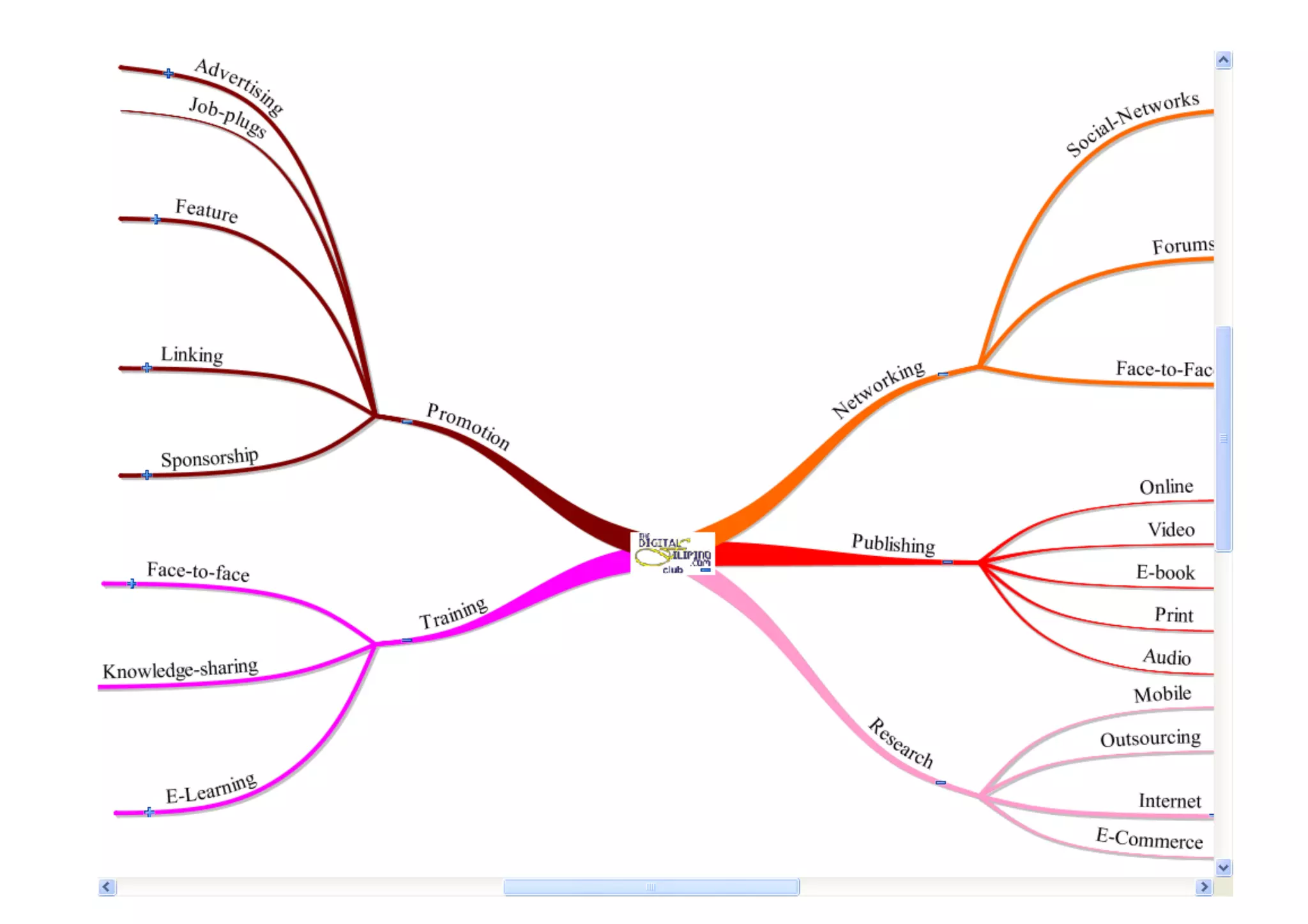
DigitalFilipino.com Club
•  http://www.e-commercephilippines.com
•  Free research reports, marketing
   assistance, referrals, and consulting.
•  Have individual, SME, and corporate
   membership
•  Nearly 100 members.
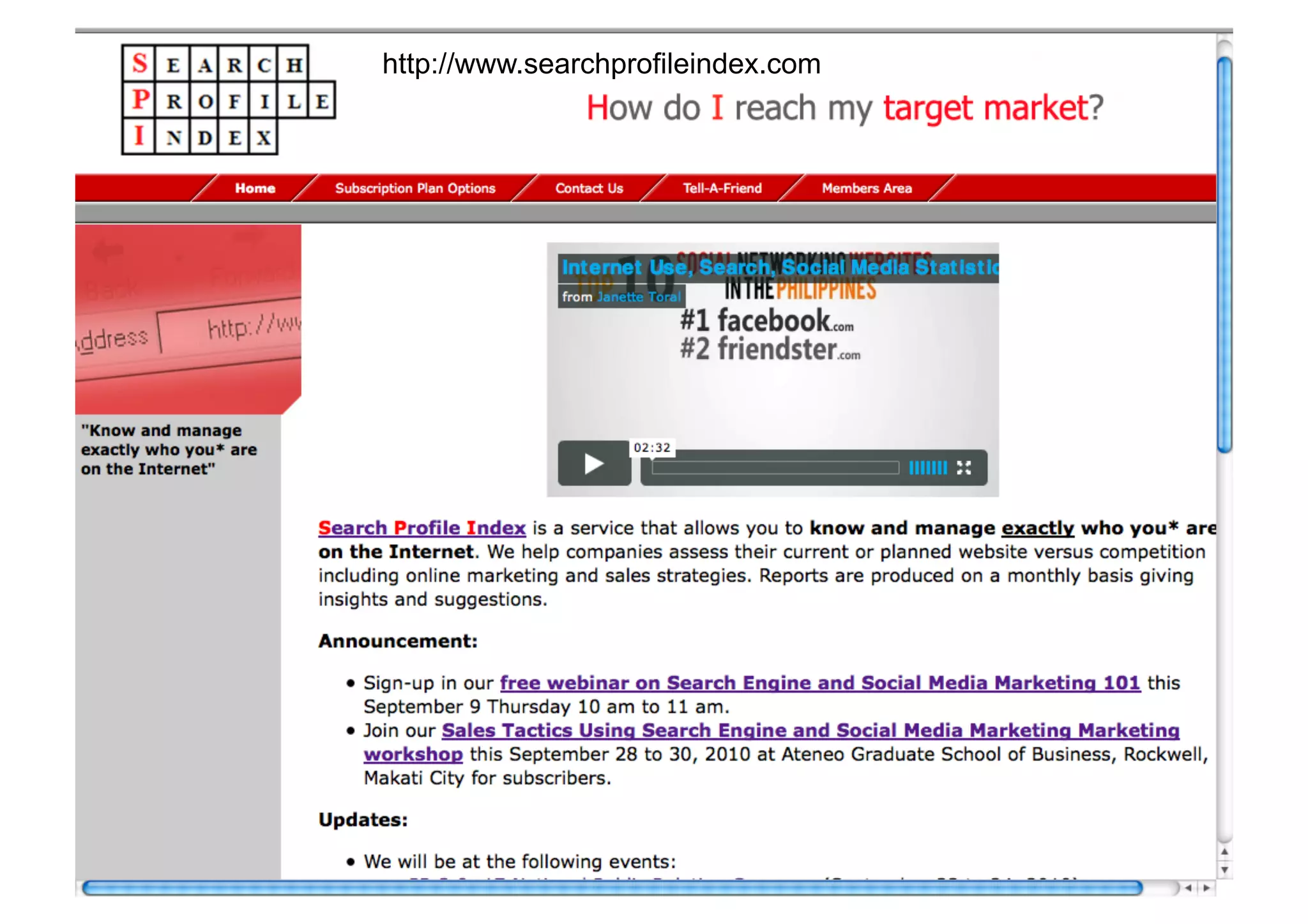
http://www.searchprofileindex.com
http://www.adinteresting.com


http://www.homebasedelite.com
http://digientrepreneur.com
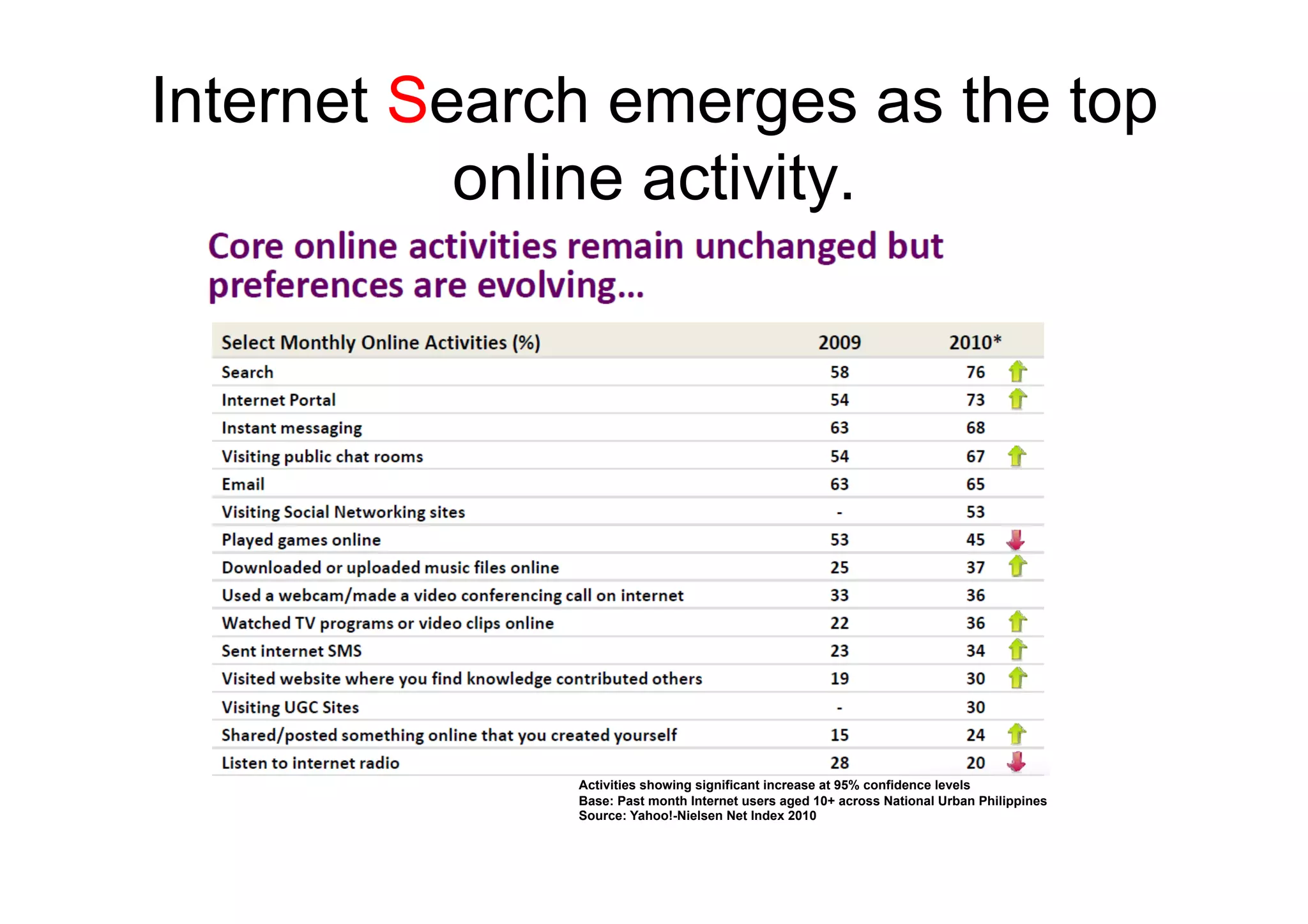
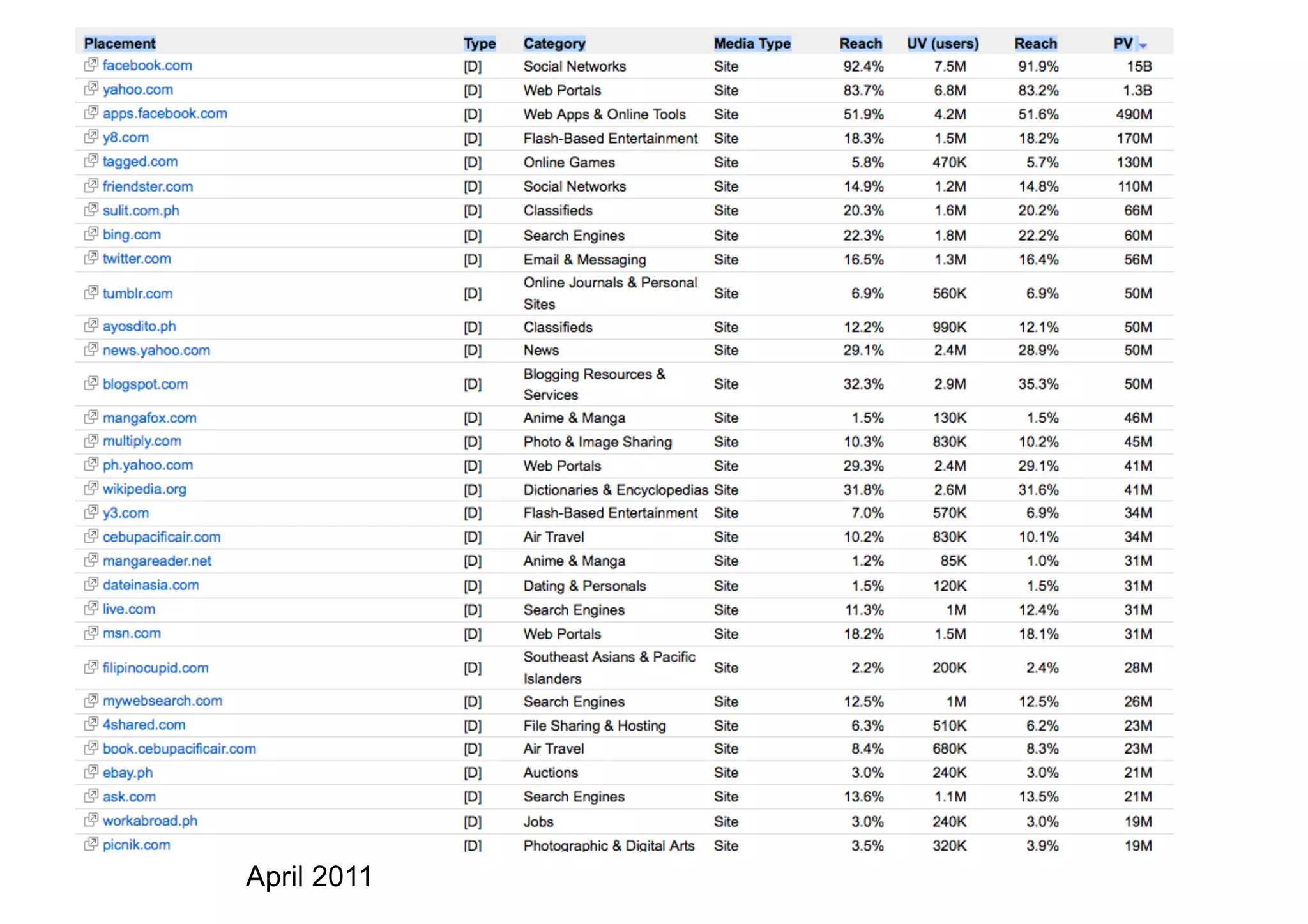
Internet Search emerges as the top
           online activity.


              Activities showing significant increase at 95% confidence levels
              Base: Past month Internet users aged 10+ across National Urban Philippines
              Source: Yahoo!-Nielsen Net Index 2010
April 2011
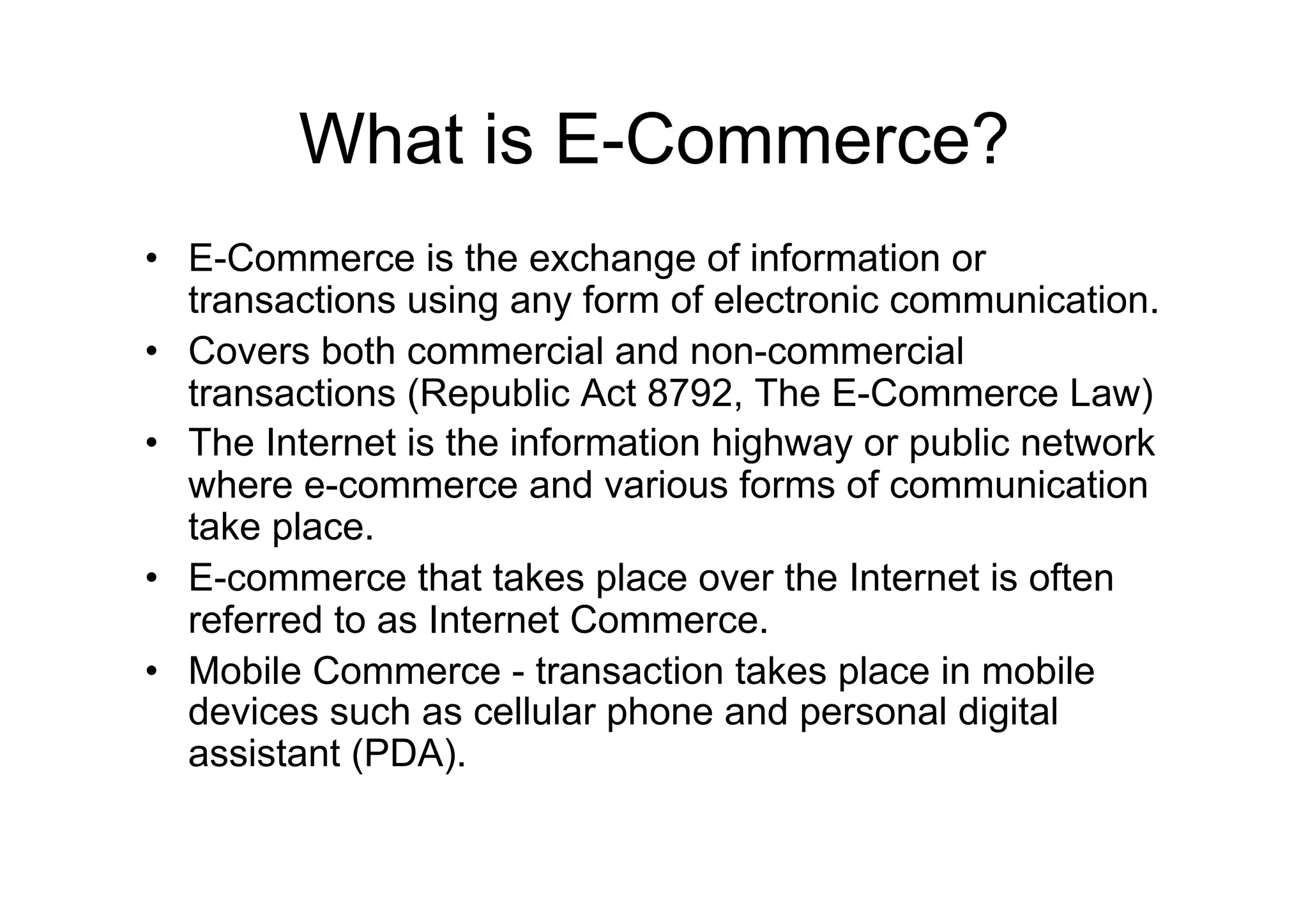
What is E-Commerce?
•  E-Commerce is the exchange of information or
   transactions using any form of electronic communication.
•  Covers both commercial and non-commercial
   transactions (Republic Act 8792, The E-Commerce Law)
•  The Internet is the information highway or public network
   where e-commerce and various forms of communication
   take place.
•  E-commerce that takes place over the Internet is often
   referred to as Internet Commerce.
•  Mobile Commerce - transaction takes place in mobile
   devices such as cellular phone and personal digital
   assistant (PDA).
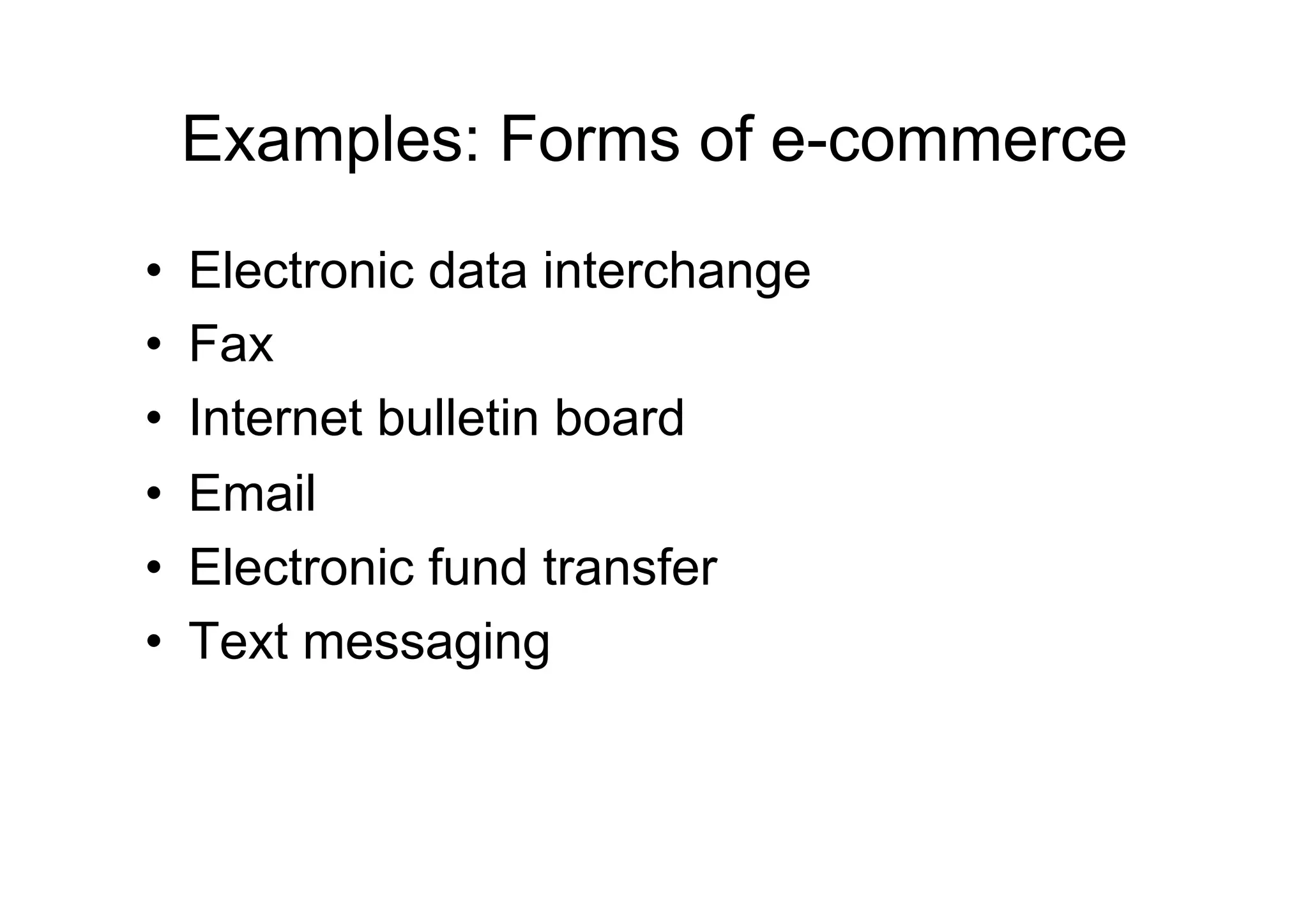
Examples: Forms of e-commerce
•    Electronic data interchange
•    Fax
•    Internet bulletin board
•    Email
•    Electronic fund transfer
•    Text messaging
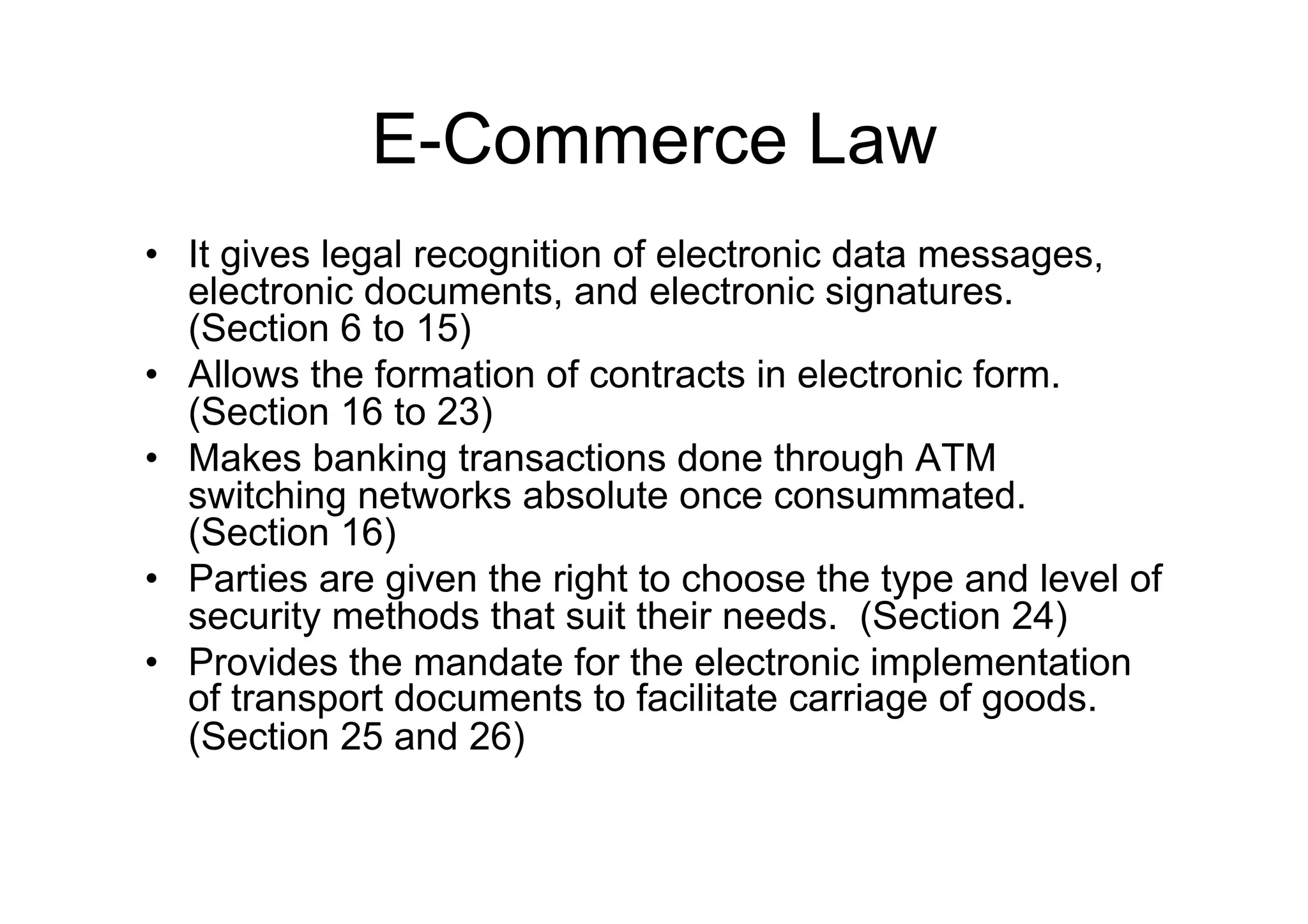
E-Commerce Law
•  It gives legal recognition of electronic data messages,
   electronic documents, and electronic signatures.
   (Section 6 to 15)
•  Allows the formation of contracts in electronic form.
   (Section 16 to 23)
•  Makes banking transactions done through ATM
   switching networks absolute once consummated.
   (Section 16)
•  Parties are given the right to choose the type and level of
   security methods that suit their needs. (Section 24)
•  Provides the mandate for the electronic implementation
   of transport documents to facilitate carriage of goods.
   (Section 25 and 26)
E-Commerce Law
•  Mandates the government to have the capability to do e-
   commerce within 2 years or before June 19, 2002.
   (Section 27)
•  Mandates RPWeb to be implemented. RPWeb is a
   strategy that intends to connect all government offices to
   the Internet and provide universal access to the general
   public. (Section 28)
•  Made cable, broadcast, and wireless physical
   infrastructure within the activity of telecommunications.
   (Section 28)
•  Empowers the Department of Trade and Industry to
   supervise the development of e-commerce in the
   country. (Section 29)
E-Commerce Law
•  Provided guidelines as to when a service provider can be liable.
   (Section 30)
•  Authorities and parties with the legal right can only gain access to
   electronic documents, electronic data messages, and electronic
   signatures. For confidentiality purposes, it shall not share or convey
   to any other person. (Section 31 and 32)
•  Hacking or cracking, refers to unauthorized access including the
   introduction of computer viruses, is punishable by a fine from 100
   thousand to maximum commensurate to the damage. This includes
   mandatory imprisonment from 6 months to 3 years. (Section 33a)
•  Piracy through the use of telecommunication networks, such as the
   Internet, that infringes intellectual property rights is punishable. The
   penalties are the same as hacking. (Section 33b)
•  All existing laws such as the Consumer Act of the Philippines also
   applies to e-commerce transactions. (Section 33c and 33d)
E-Commerce Law
•  Tasks the DTI, DBM, and BSP to enforce this law and
   issue implementing rules and regulations, in coordination
   with DOTC, NTC, NCC, ITECC, CoA, other concerned
   agencies and the private sector. (Section 34)
•  Create a Congressional Oversight Committee composed
   of the Committees on Trade and Industry/Commerce,
   Science and Technology, Finance and Appropriations of
   both the Senate and House of Representatives to
   oversee the law's implementation. (Section 35)
•  Funding for continued implementation of the E-
   Commerce Law shall be included in the annual General
   Appropriations Act. (Section 36)
IRR for ECA
•  Authority of the Department of Trade and Industry in supervising
   and directing the implementation of the law. (Section 2)
•  Principles that shall govern the implementation of the E-Commerce
   Law. Mechanisms for private sector input and involvement in policy-
   making by government agencies, in respect to the implementation of
   the law, shall be promoted and widely used. (Section 3a and b)
•  Equal tax treatment to both e-commerce and traditional transactions
   (Section 3d)
•  Mandates businesses to protect the privacy of users and give them
   control to protect such. (Section 3e)
•  Encourage small and medium enterprises in order to gain access to
   IT resources. (Section 3g)
•  Government to provide equal and transparent access to information.
   (Section 3l)
•  Private sector is encouraged to explore means of settling e-
   commerce disputes such as arbitration and mediation. (Section 3m)
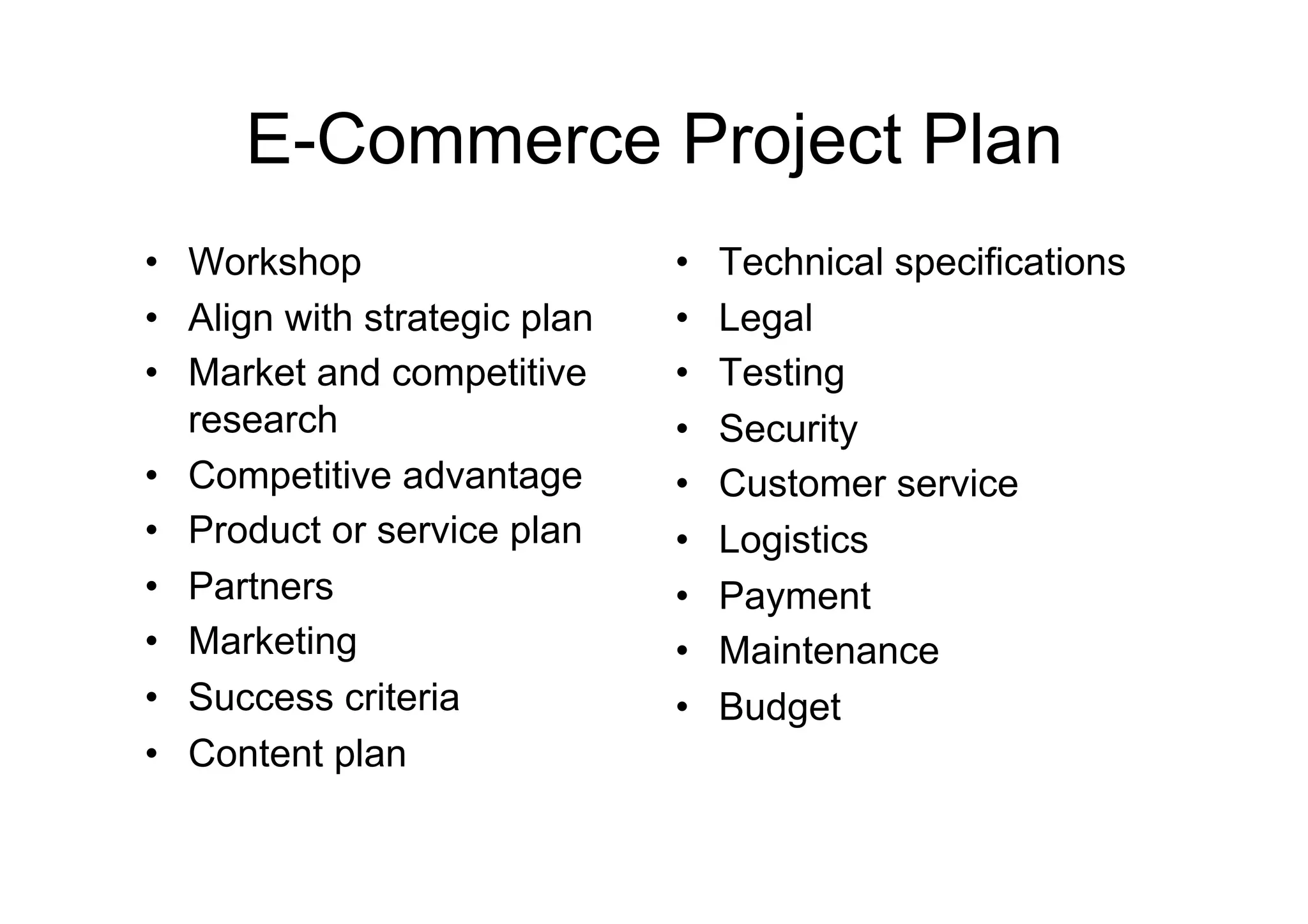
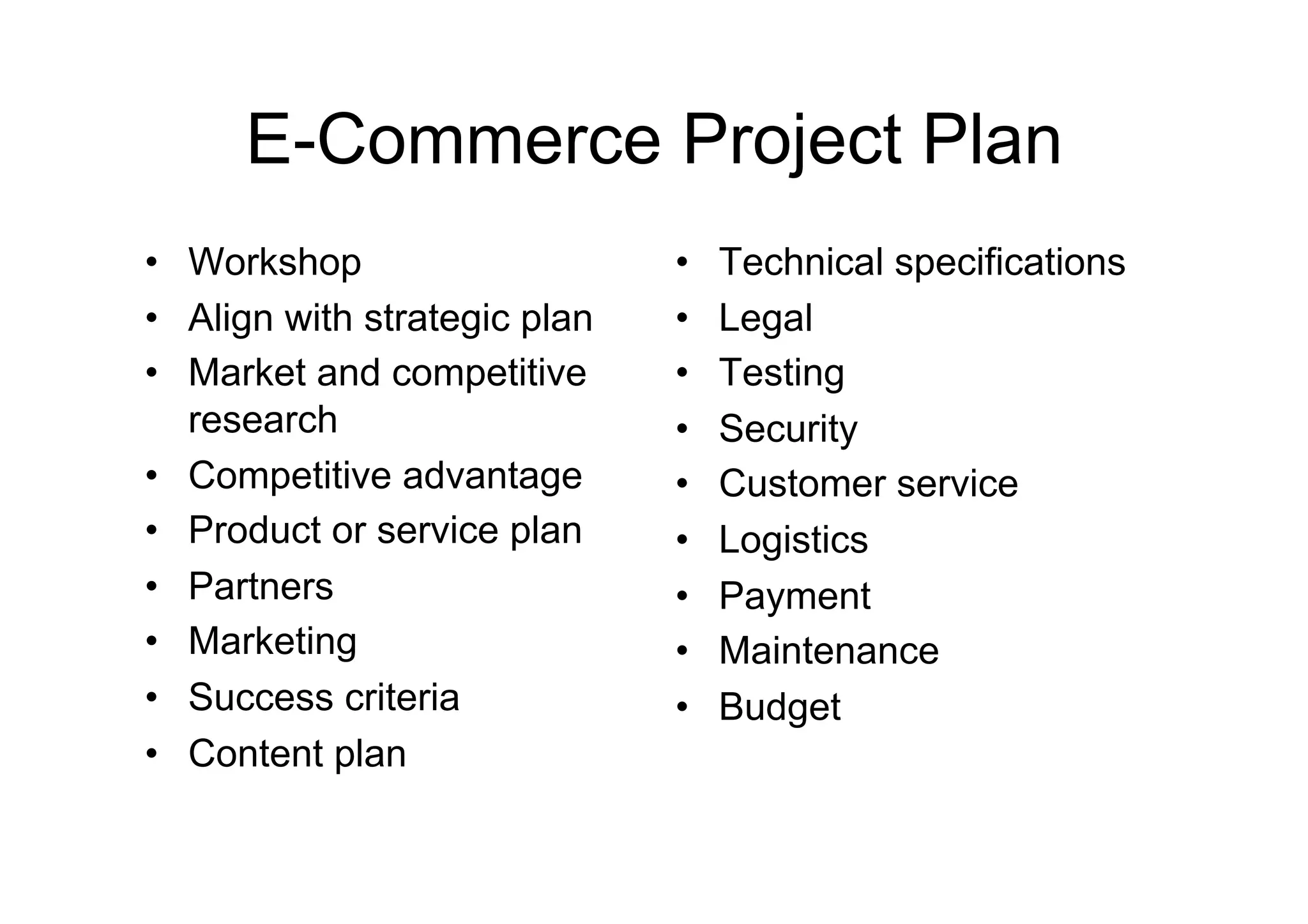
E-Commerce Project Plan
•  Workshop                    •    Technical specifications
•  Align with strategic plan   •    Legal
•  Market and competitive      •    Testing
   research                    •    Security
•  Competitive advantage       •    Customer service
•  Product or service plan     •    Logistics
•  Partners                    •    Payment
•  Marketing                   •    Maintenance
•  Success criteria            •    Budget
•  Content plan
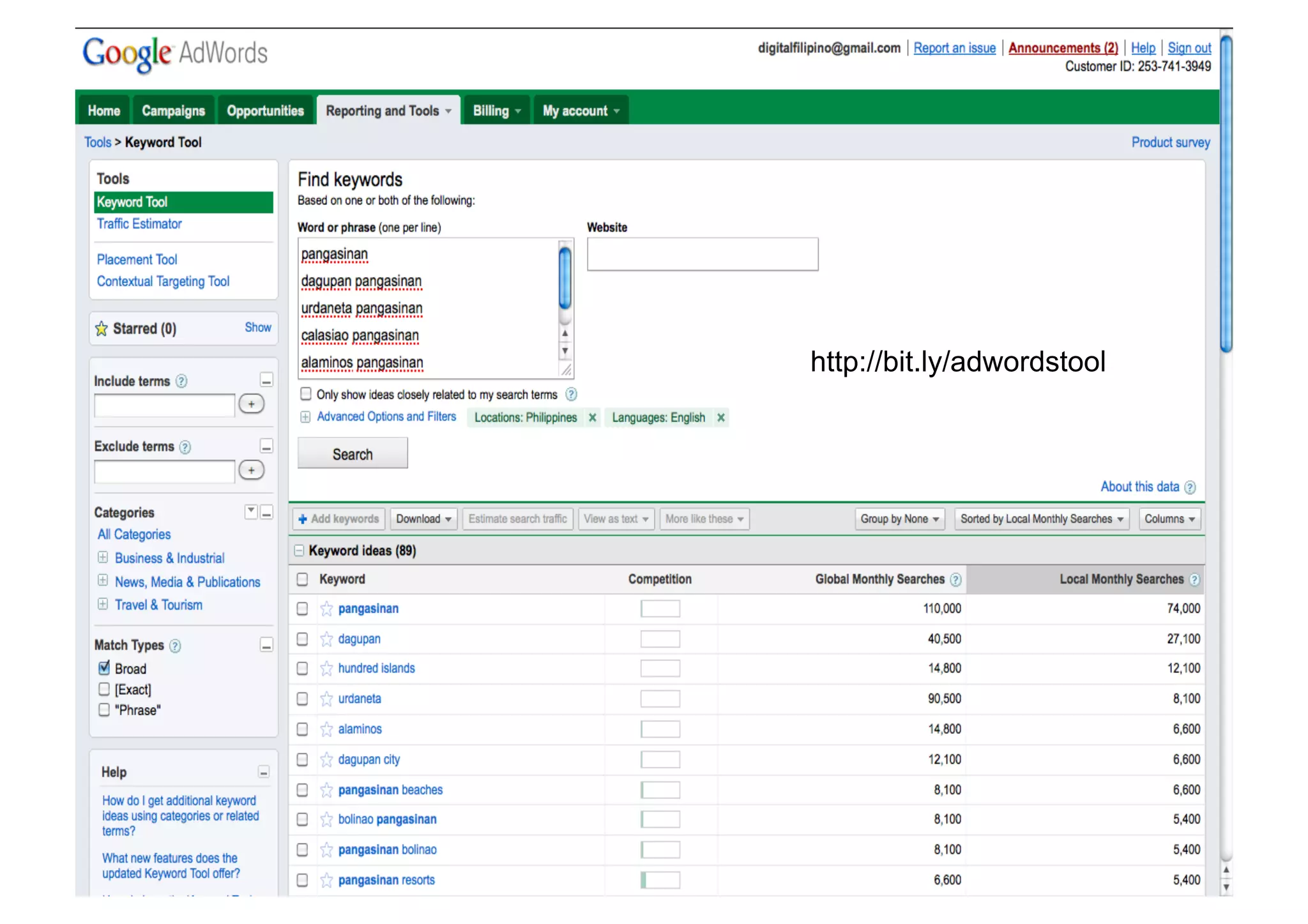
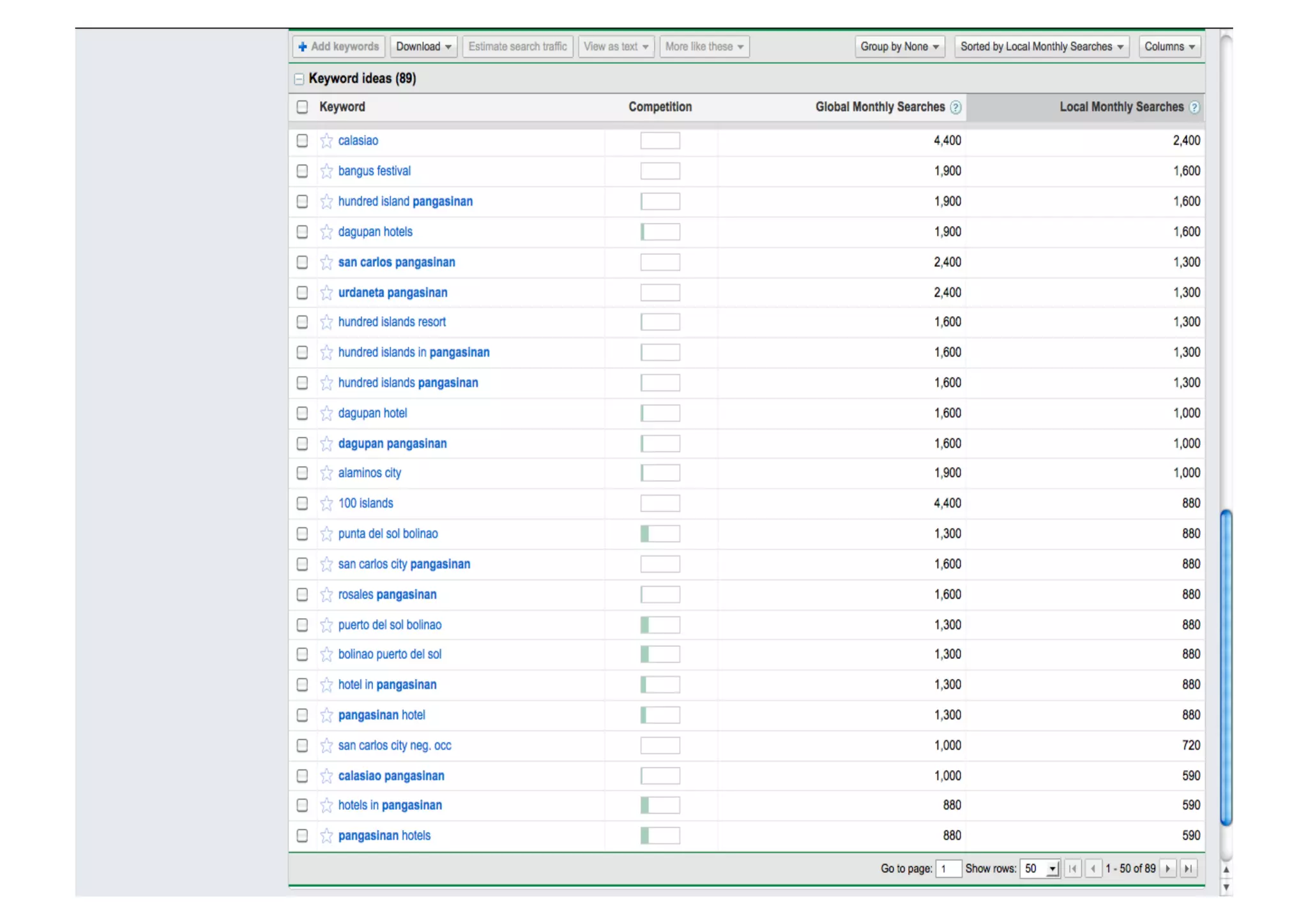
http://bit.ly/adwordstool
Find out competition through
      search engine.
   Search engine is a reputation
             engine.
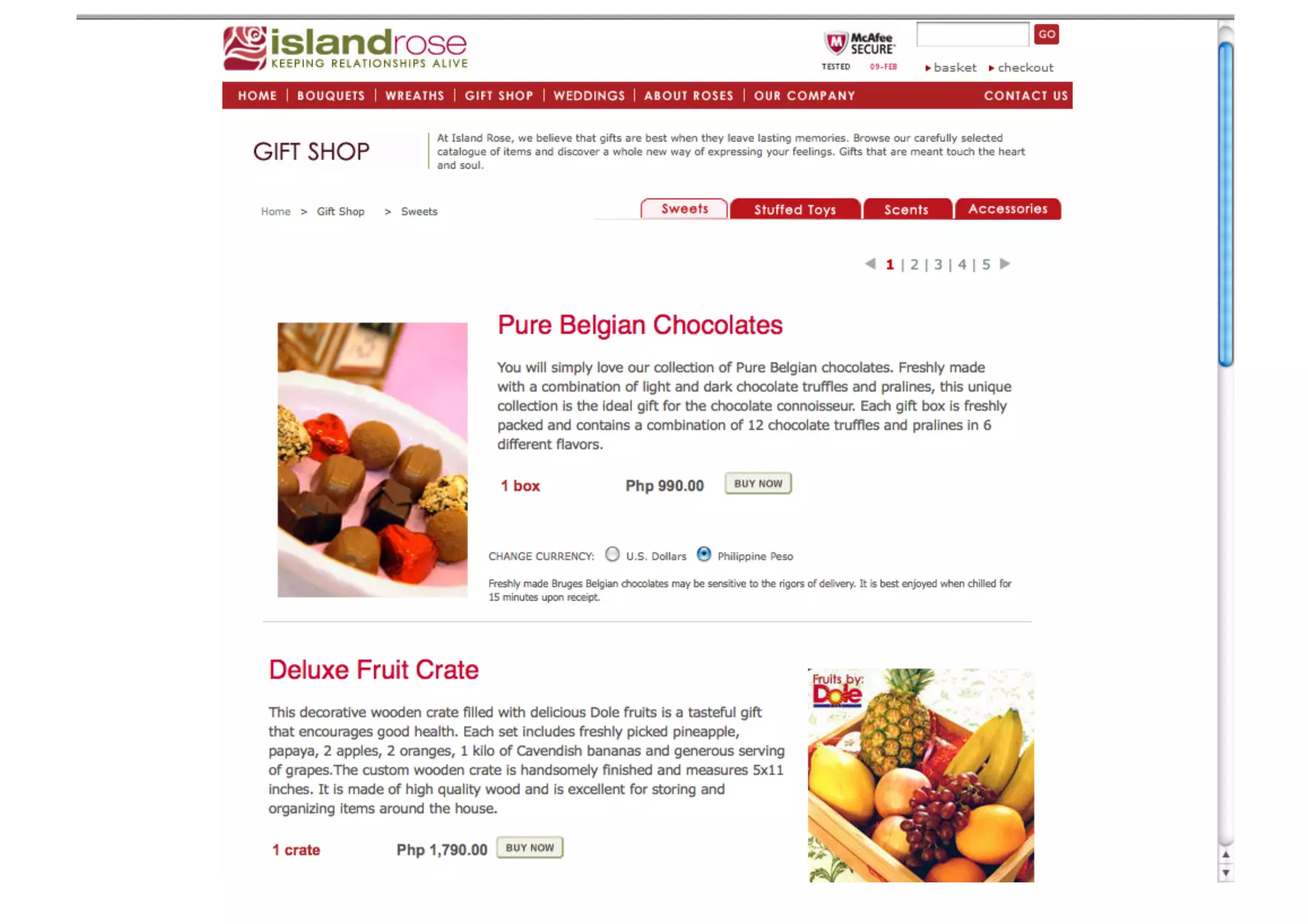
From family delicacy gifts to full-blown
export business.


                                           http://bit.ly/pinoydelikasi
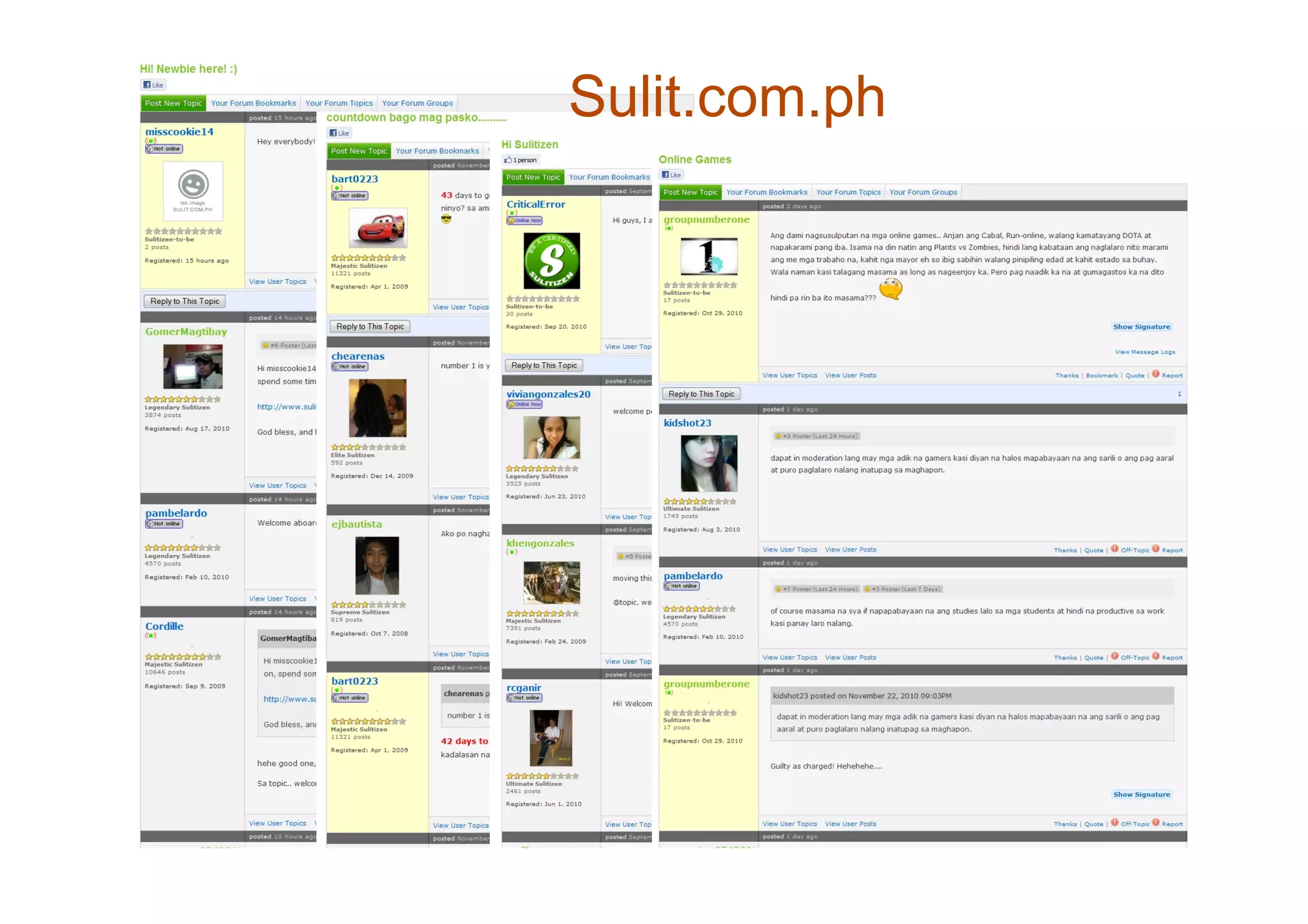
Sulit.com.ph
http://bit.ly/ayannah


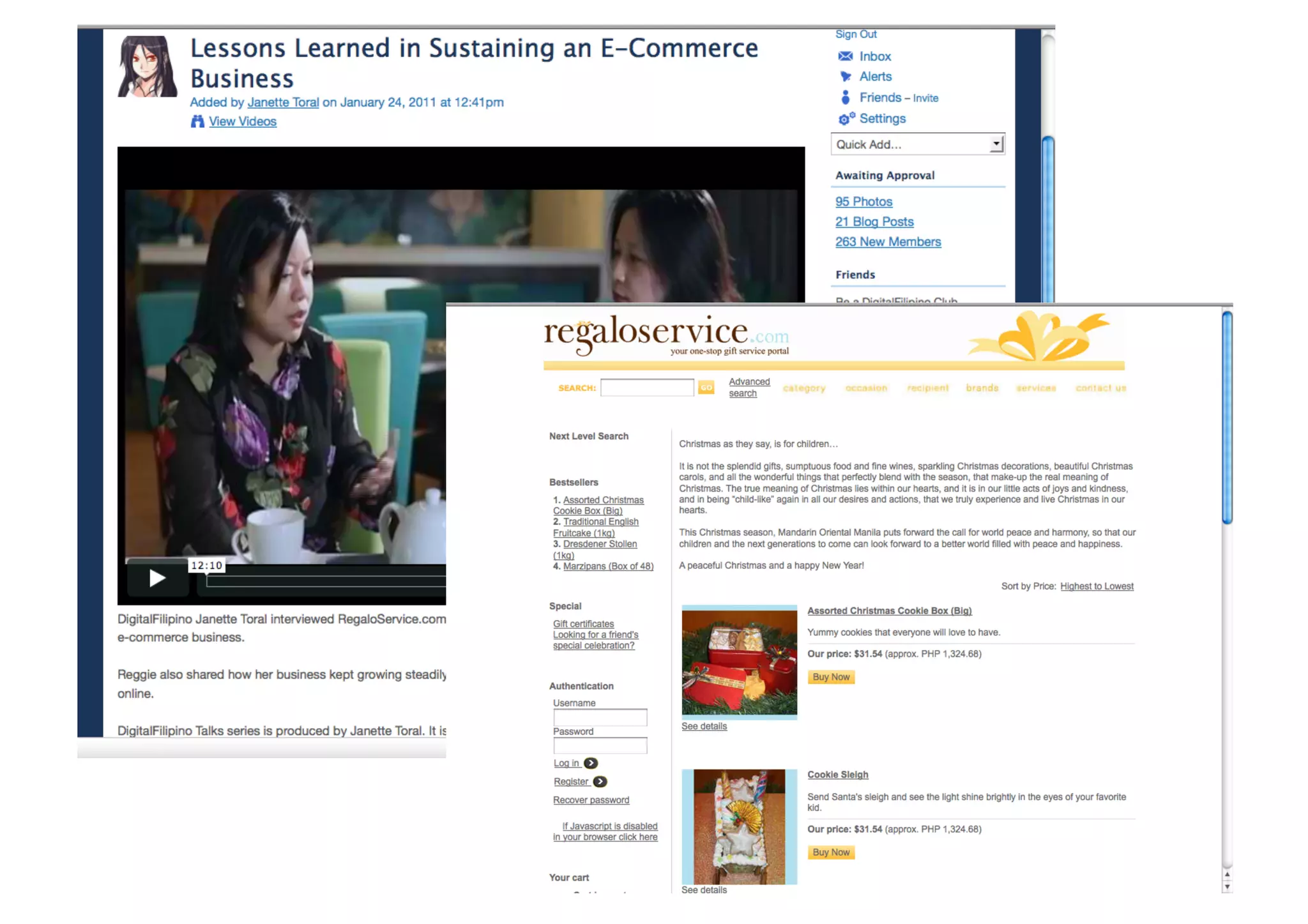
Provide solution and collaboration
opportunity.
http://bit.ly/jamflores


Educate the
market, show
potential.
2011 will be year of Mobile Content
and Mobile Marketing
http://bit.ly/chitjuan


Use social media to engage,
generate results, proactively
connect.
http://www.architerra.org
http://digientrepreneur.com
E-Commerce Project Plan
•  Workshop                    •    Technical specifications
•  Align with strategic plan   •    Legal
•  Market and competitive      •    Testing
   research                    •    Security
•  Competitive advantage       •    Customer service
•  Product or service plan     •    Logistics
•  Partners                    •    Payment
•  Marketing                   •    Maintenance
•  Success criteria            •    Budget
•  Content plan
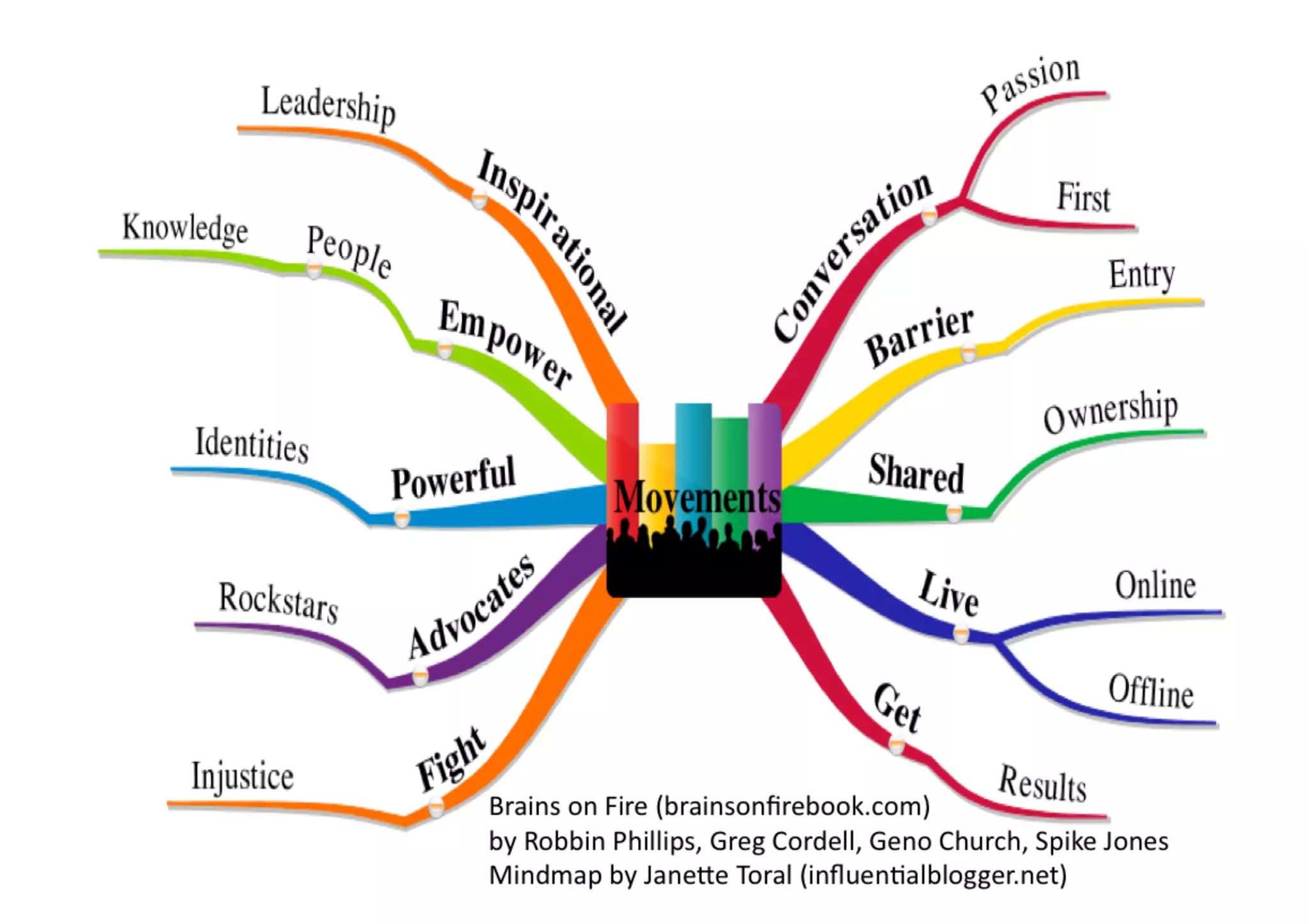
Book reference: Brains on Fire
Improve
•    Products
•    Marketing
•    Content
•    Sales
•    Customer Service
Content


                                             Continuous Research
                                       Community


                    Cost-effective
Capacity building


      Commitment
                                     Photo credit: PinayAds.com
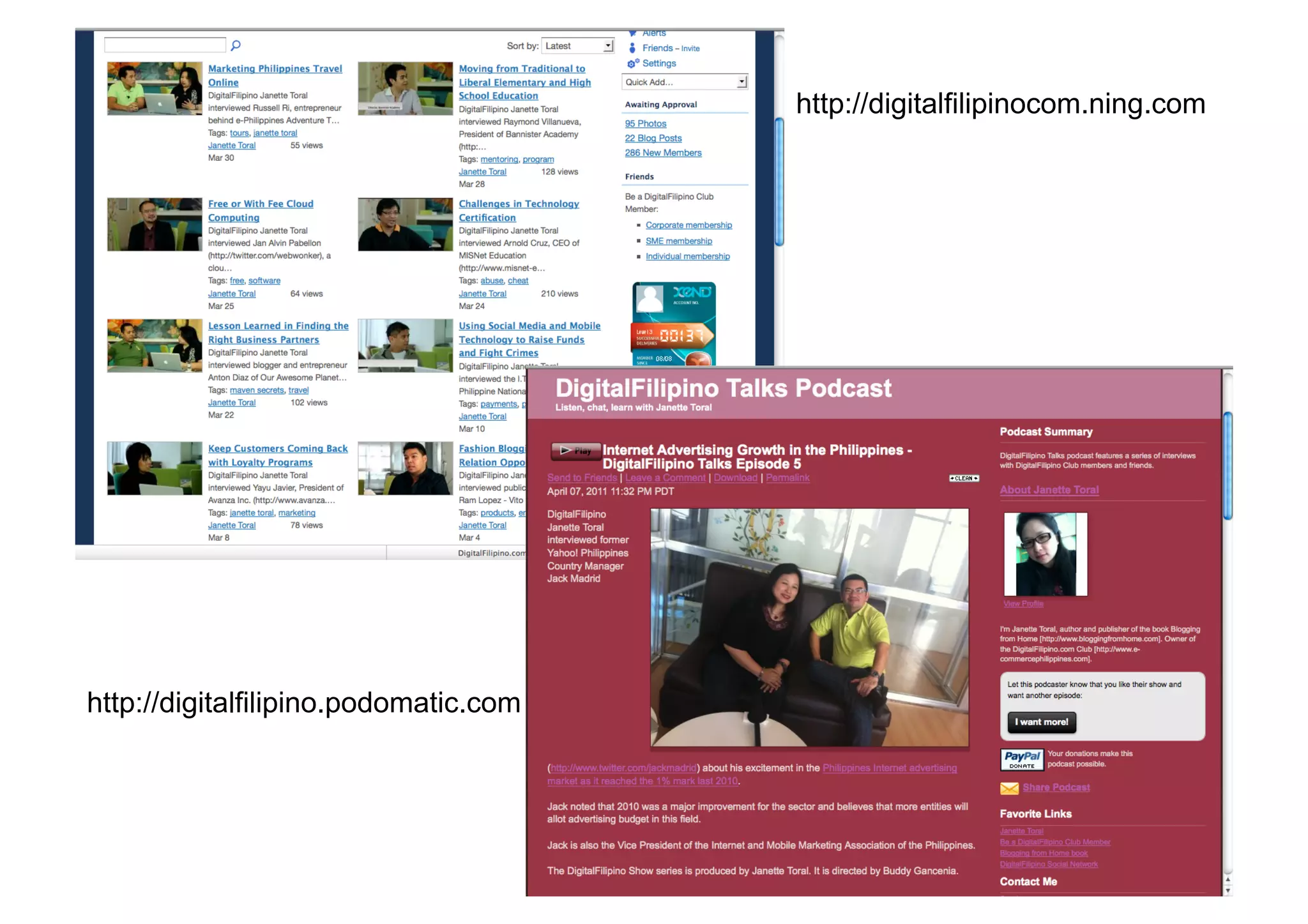
http://digitalfilipinocom.ning.com


http://digitalfilipino.podomatic.com
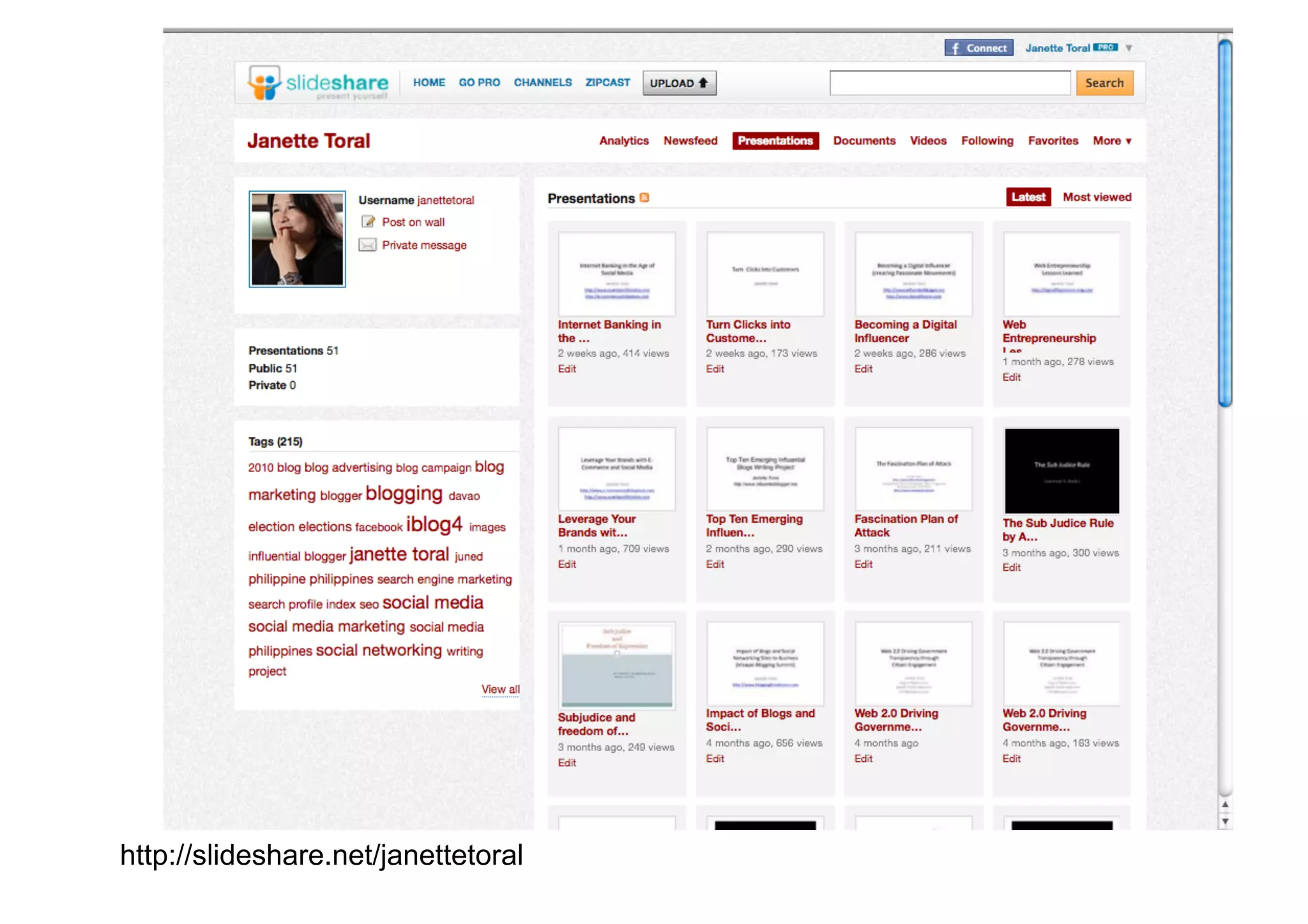
http://slideshare.net/janettetoral
Engages the audience


Winner of DigitalFilipino Social Networking Awards 2010 (Social Network
category)
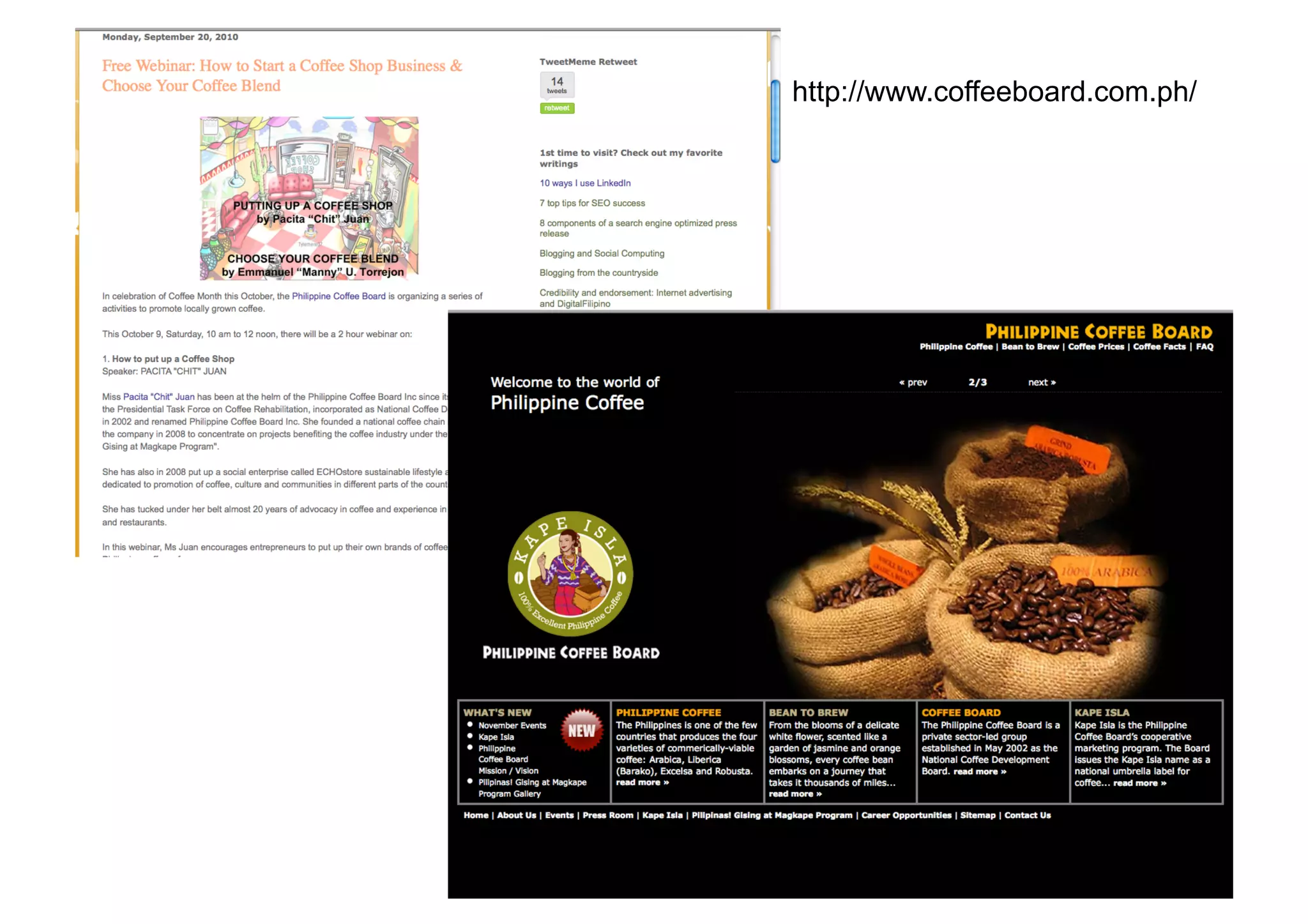
http://www.coffeeboard.com.ph/
Brand Background
   Real Leaf green tea is the newest
   ready-to-drink (RTD) tea in the
   market launched mid-2009.

   Real Leaf is brewed from 100%
   whole green tea leaves, naturally
   packed with Theanine, with a
   delicious hint of fruit and honey.


Real Leaf Green Tea won the blog category in
DigitalFilipino Social Networking Awards 2010
Key Learnings
•  Incentivized consumer engagement with the blogger community
   around a strong concept can drive rich RESPONSE and online brand
   presence.

             	
  Big	
  Idea	
                      Medium	
                            	
  	
  “What’s	
  in	
  it	
  for	
  me?”	


  Real	
  Leaf	
  Paparazzi
                            	
               Key	
  Blogs	
  &	
                iPod	
  Nanos,	
  cash	
  &	
  products


  Blog	
  Networks  	


                                                       =
                                     150+	
  product-­‐related	
  photos	
  
                                              400+	
  blog	
  posts	
  
                                       40+	
  related	
  search	
  results
                                                                         	
  
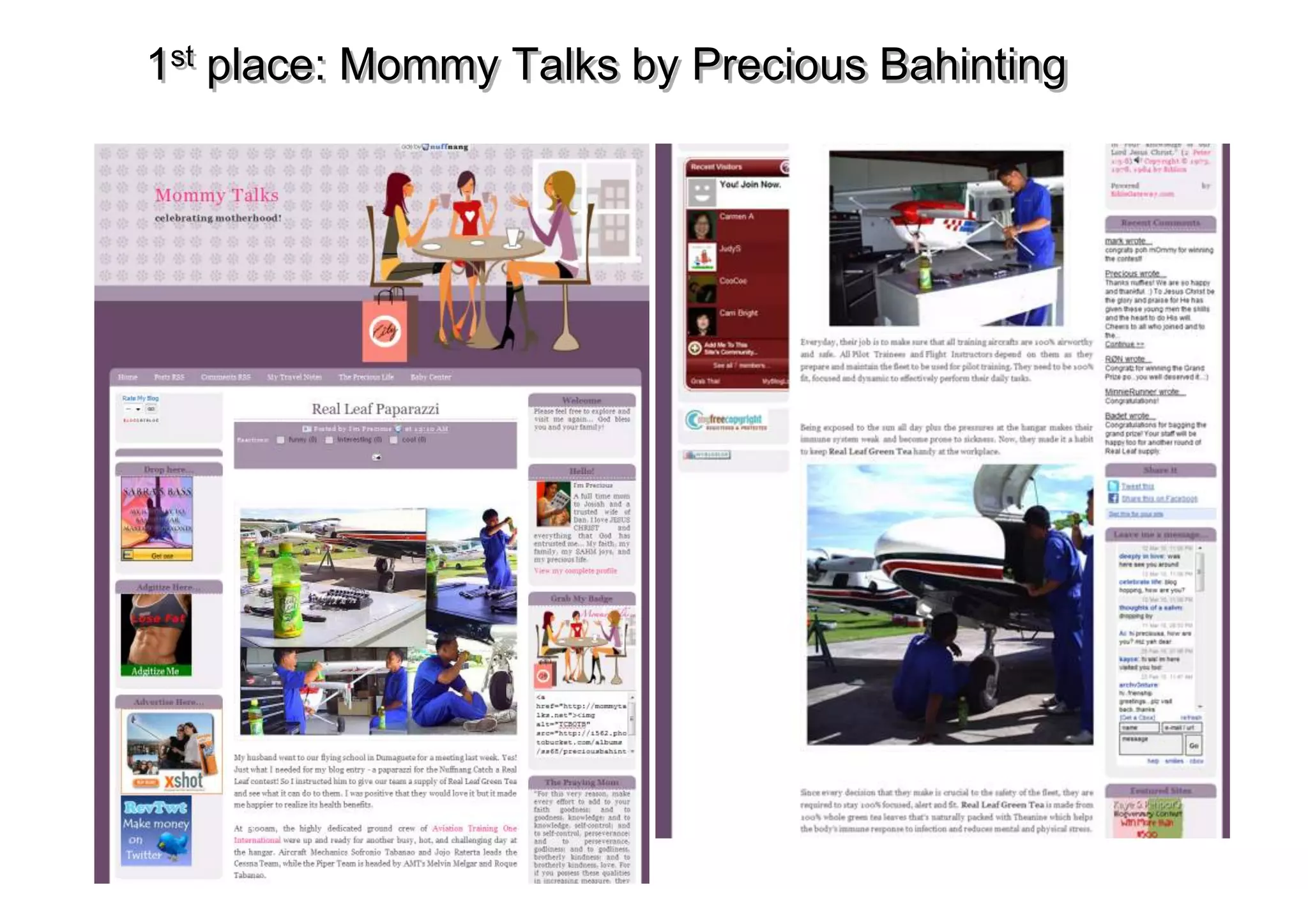
1st place: Mommy Talks by Precious Bahinting
http://www.mommytalks.net/2010/01/real-leaf-paparazzi.html
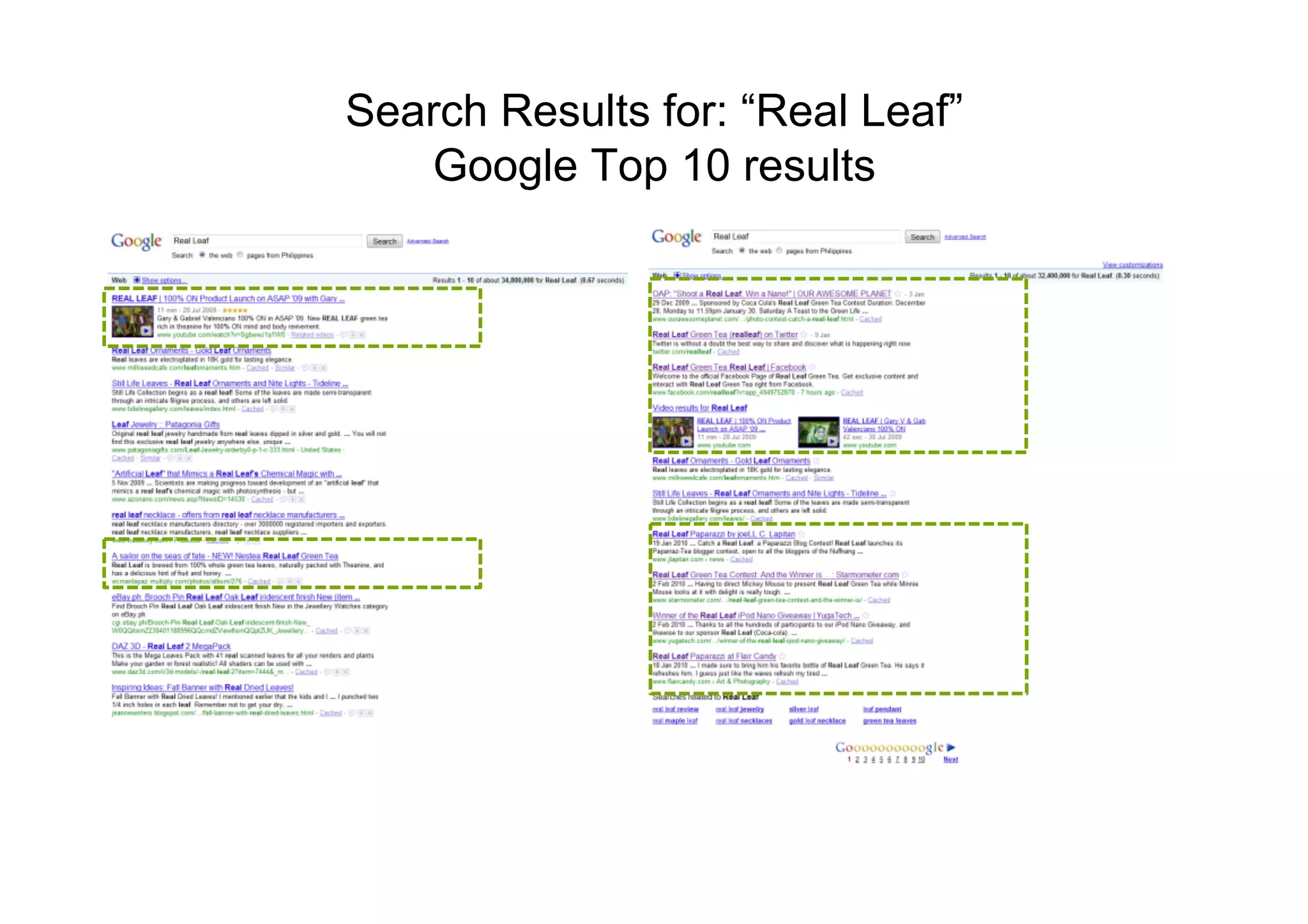
Search Results for: “Real Leaf”
                                   Google Top 10 results
Before:	
  1	
  video,	
  1	
  employee	
  post	
     AJer:	
  8	
  on	
  the	
  Top	
  10	
  	
  search	
  results	
  
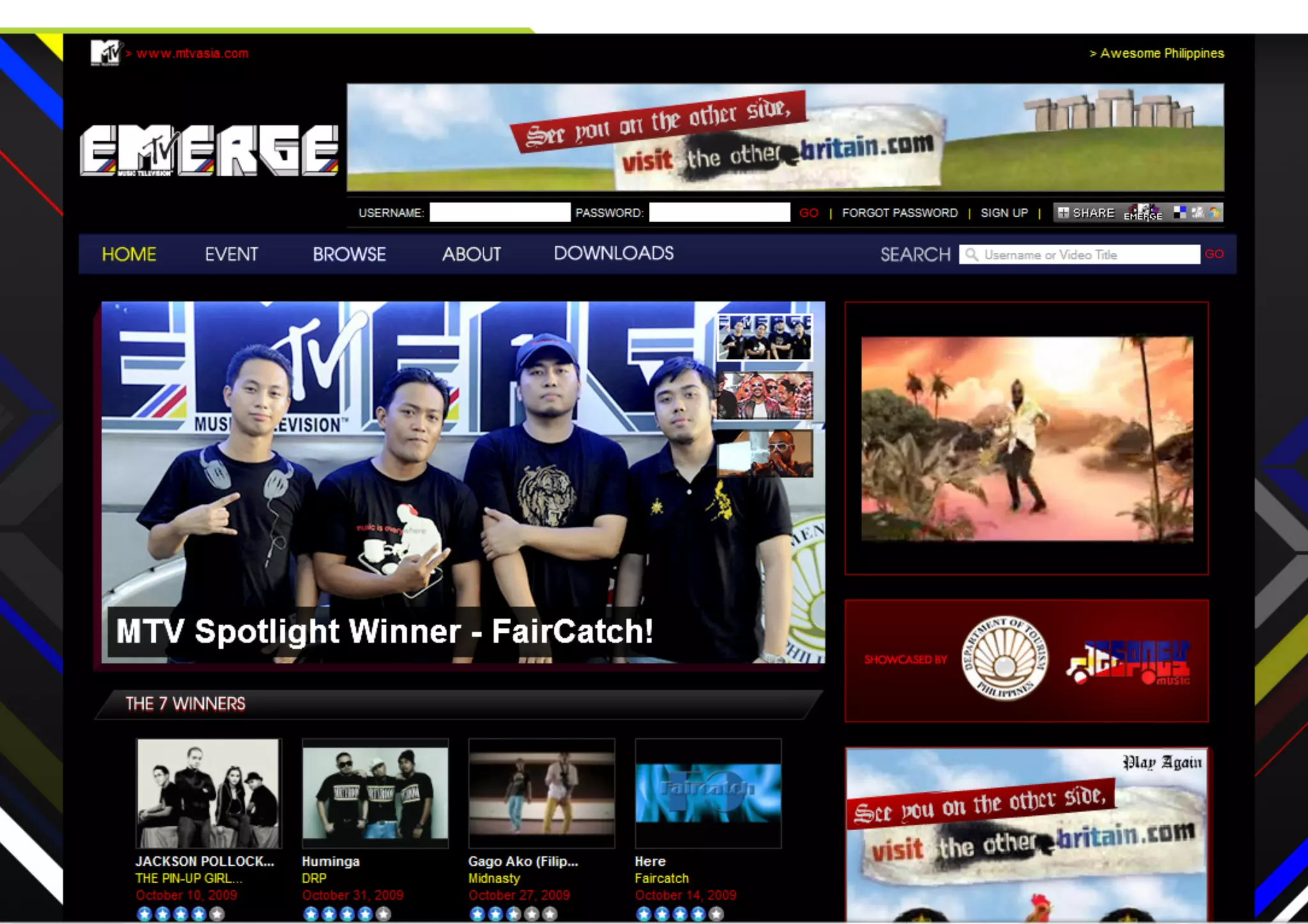
BACKGROUND
           Apl de Ap + MTV Asia + PH DOT
         were in search for the next unsigned
                    PINOY ARTIST


MTV Emerge won the media voting category in
DigitalFilipino Social Networking Awards 2010
http://bit.ly/bradgeiser


Proactively care about people.
tag
             plug

hide
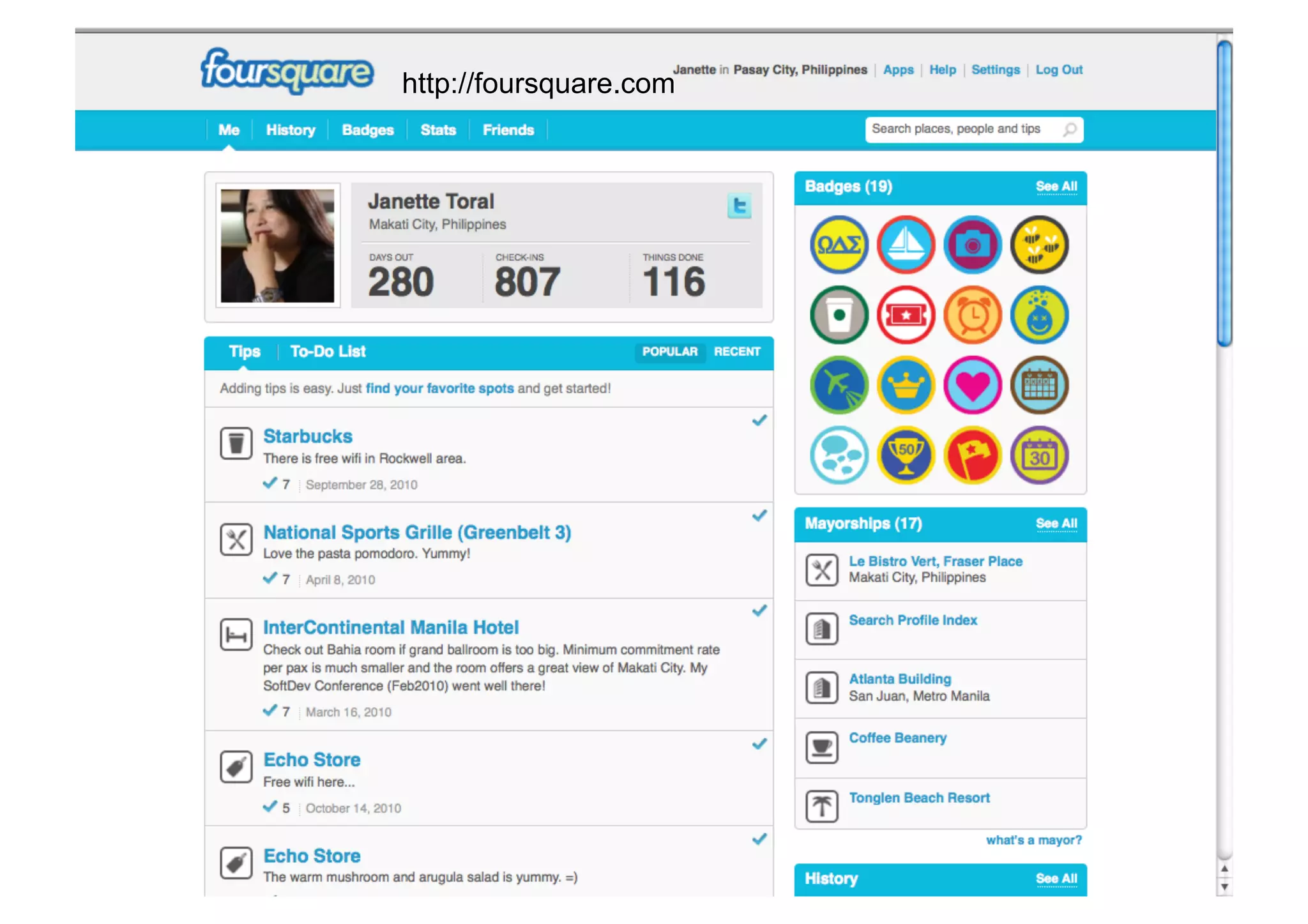
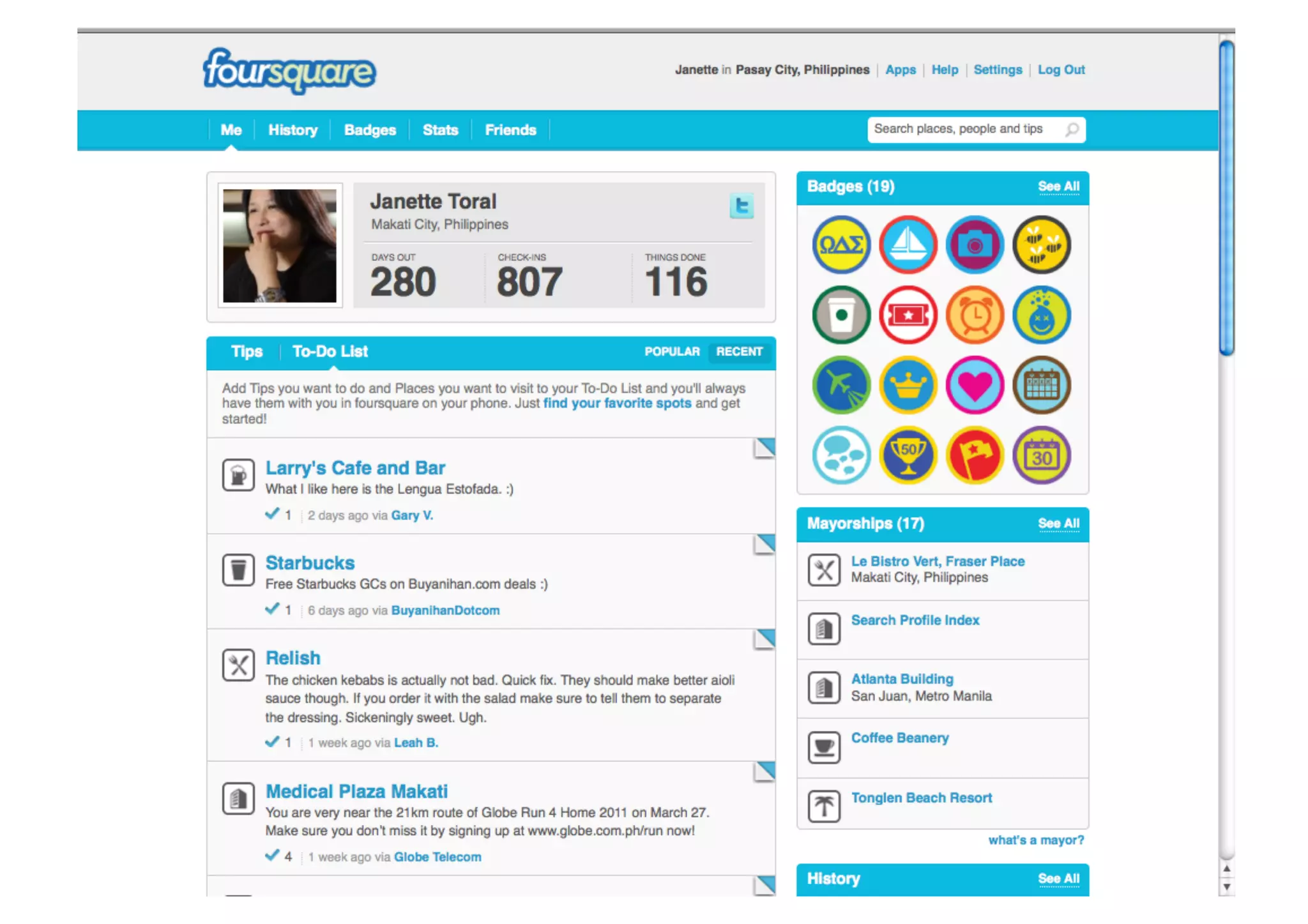
http://foursquare.com
#3 Be relevant to your audience.
TV          PRINT        POS          CRM

digital       digital     digital      digital

  social        social      social       social
     game         game         game         game


 mobile        mobile      mobile       mobile


              Be Useful
Ways to accept payment
•    Cash – person to person
•    Bank deposit
•    Remittance service
•    Credit card
•    SMS
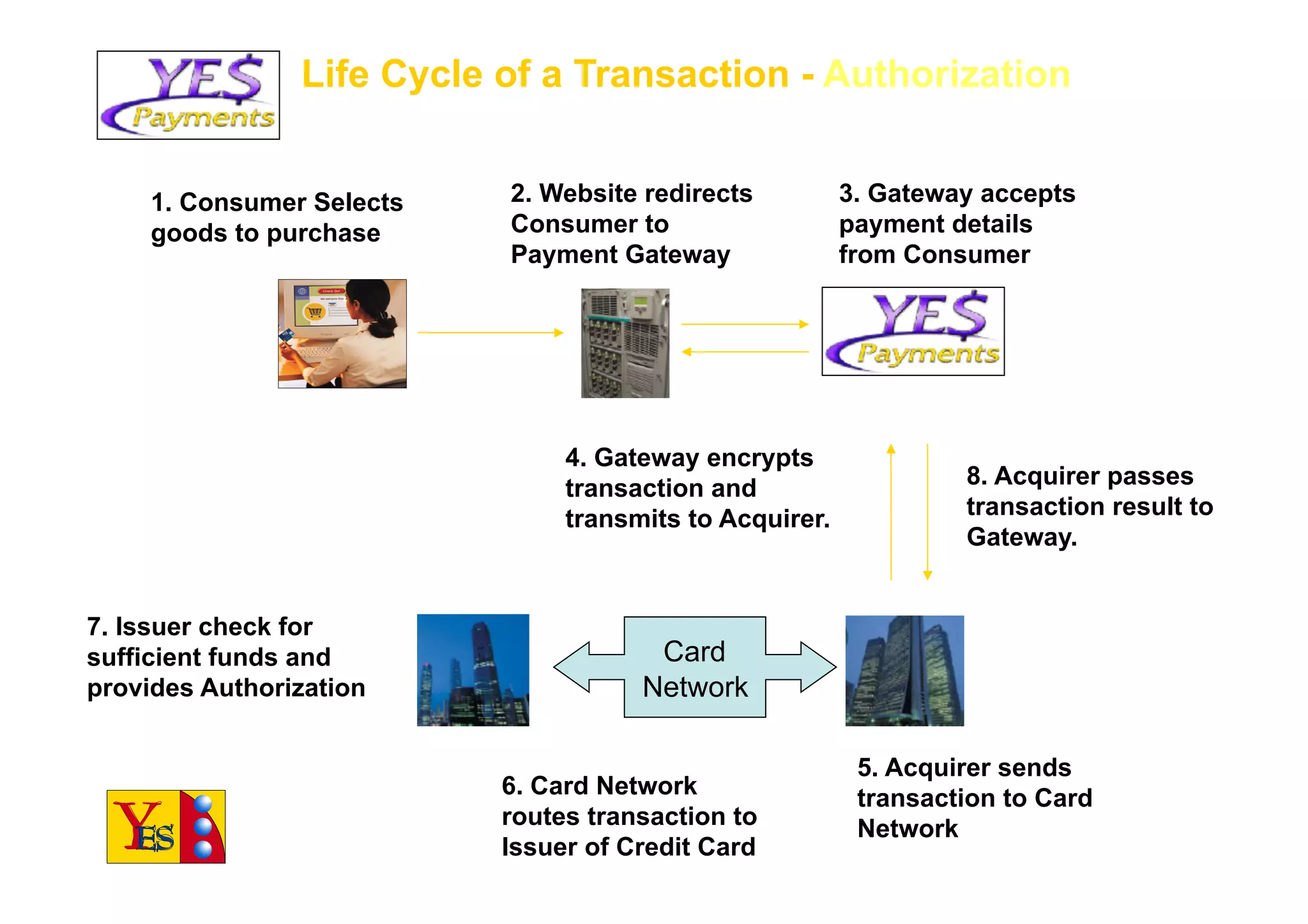
Life Cycle of a Transaction - Authorization


     1. Consumer Selects   2. Website redirects          3. Gateway accepts
     goods to purchase     Consumer to                   payment details
                           Payment Gateway               from Consumer


                                4. Gateway encrypts
                                transaction and                   8. Acquirer passes
                                transmits to Acquirer.            transaction result to
                                                                  Gateway.


7. Issuer check for
sufficient funds and                   Card
provides Authorization                Network

                                                          5. Acquirer sends
                           6. Card Network                transaction to Card
                           routes transaction to          Network
                           Issuer of Credit Card
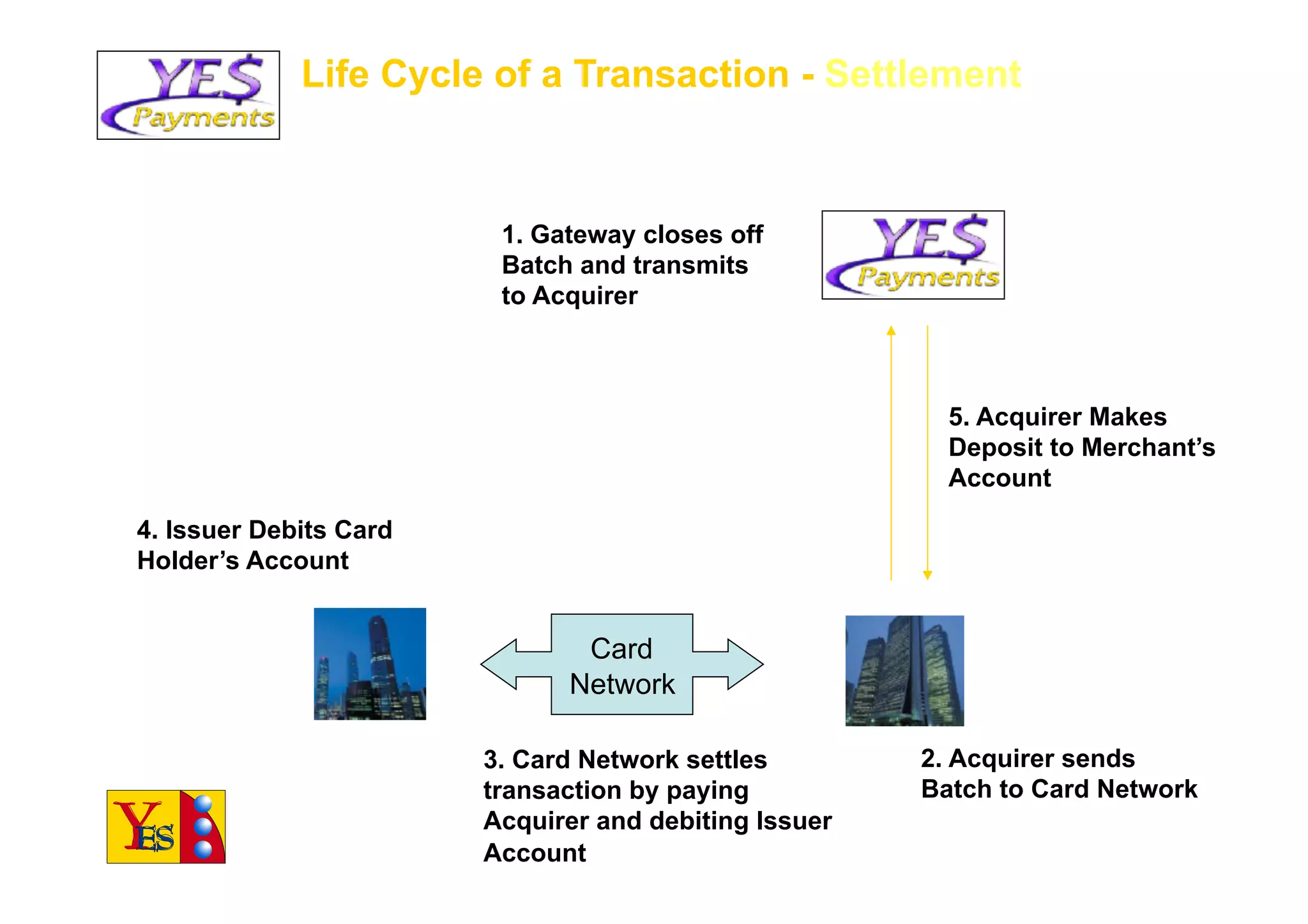
Life Cycle of a Transaction - Settlement


                         1. Gateway closes off
                         Batch and transmits
                         to Acquirer


                                                         5. Acquirer Makes
                                                         Deposit to Merchant’s
                                                         Account

4. Issuer Debits Card
Holder’s Account


                               Card
                              Network

                        3. Card Network settles        2. Acquirer sends
                        transaction by paying          Batch to Card Network
                        Acquirer and debiting Issuer
                        Account
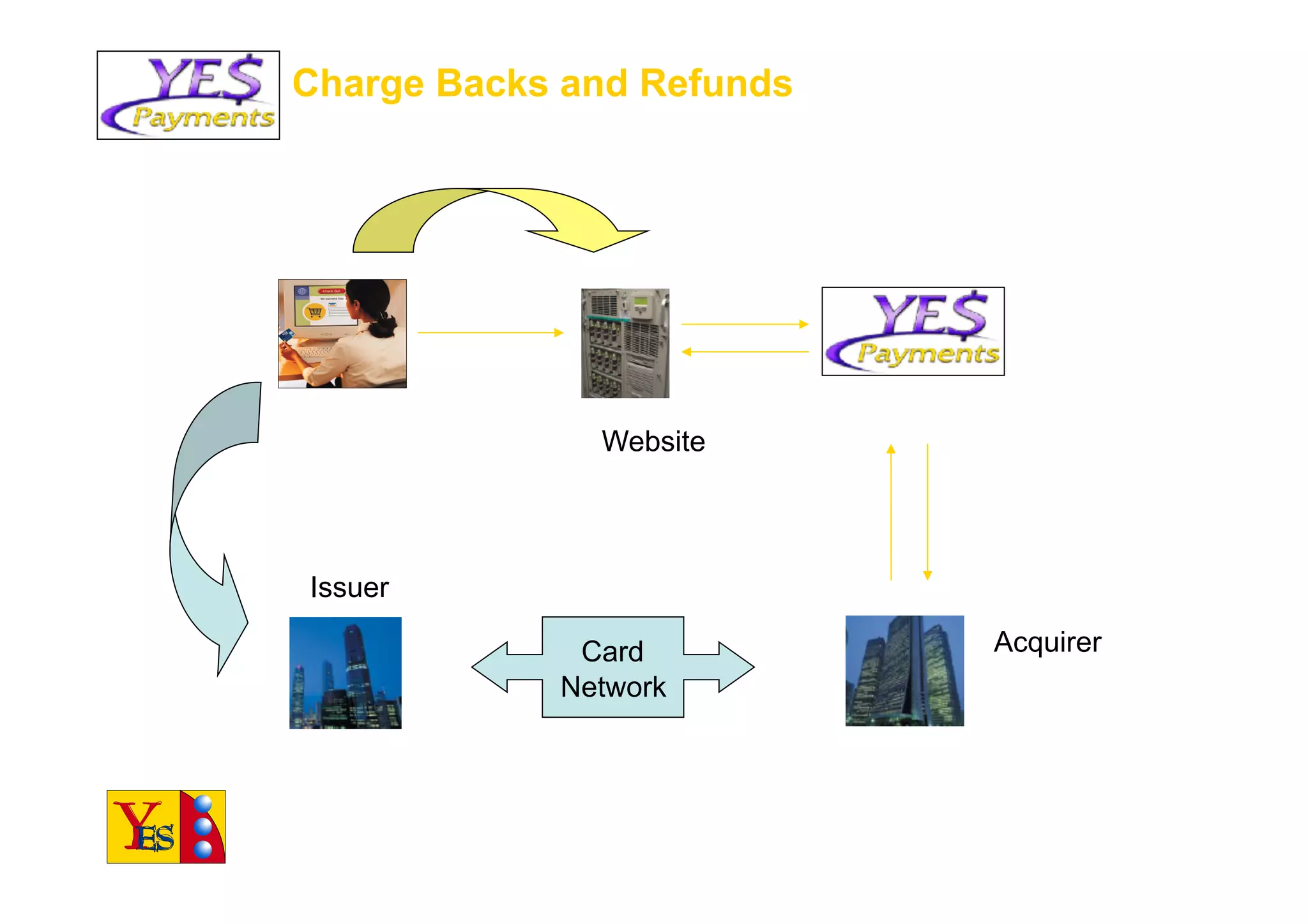
Charge Backs and Refunds


              Website


Issuer

             Card          Acquirer
            Network
Be prepared
•    IPV4 to IPV6
•    Cheaper bandwidth
•    Powerful mobile devices
•    Tools-empowered generation
•    Knowledge society
     –  Thinking
     –  Discerning
     –  Vocal
See you online
http://facebook.com/janettetoral
http://slideshare.net/janettetoral
 http://twitter.com/digitalfilipino

E commerce: Expanding Business Online

  • 1.
    E-Commerce: Expanding Business Online Janette Toral http://e-commercephilippines.com
  • 5.
    DigitalFilipino.com Club •  http://www.e-commercephilippines.com • Free research reports, marketing assistance, referrals, and consulting. •  Have individual, SME, and corporate membership •  Nearly 100 members.
  • 8.
  • 9.
  • 10.
  • 11.
    Internet Search emergesas the top online activity. Activities showing significant increase at 95% confidence levels Base: Past month Internet users aged 10+ across National Urban Philippines Source: Yahoo!-Nielsen Net Index 2010
  • 12.
  • 13.
    What is E-Commerce? • E-Commerce is the exchange of information or transactions using any form of electronic communication. •  Covers both commercial and non-commercial transactions (Republic Act 8792, The E-Commerce Law) •  The Internet is the information highway or public network where e-commerce and various forms of communication take place. •  E-commerce that takes place over the Internet is often referred to as Internet Commerce. •  Mobile Commerce - transaction takes place in mobile devices such as cellular phone and personal digital assistant (PDA).
  • 14.
    Examples: Forms ofe-commerce •  Electronic data interchange •  Fax •  Internet bulletin board •  Email •  Electronic fund transfer •  Text messaging
  • 15.
    E-Commerce Law •  Itgives legal recognition of electronic data messages, electronic documents, and electronic signatures. (Section 6 to 15) •  Allows the formation of contracts in electronic form. (Section 16 to 23) •  Makes banking transactions done through ATM switching networks absolute once consummated. (Section 16) •  Parties are given the right to choose the type and level of security methods that suit their needs. (Section 24) •  Provides the mandate for the electronic implementation of transport documents to facilitate carriage of goods. (Section 25 and 26)
  • 16.
    E-Commerce Law •  Mandatesthe government to have the capability to do e- commerce within 2 years or before June 19, 2002. (Section 27) •  Mandates RPWeb to be implemented. RPWeb is a strategy that intends to connect all government offices to the Internet and provide universal access to the general public. (Section 28) •  Made cable, broadcast, and wireless physical infrastructure within the activity of telecommunications. (Section 28) •  Empowers the Department of Trade and Industry to supervise the development of e-commerce in the country. (Section 29)
  • 17.
    E-Commerce Law •  Providedguidelines as to when a service provider can be liable. (Section 30) •  Authorities and parties with the legal right can only gain access to electronic documents, electronic data messages, and electronic signatures. For confidentiality purposes, it shall not share or convey to any other person. (Section 31 and 32) •  Hacking or cracking, refers to unauthorized access including the introduction of computer viruses, is punishable by a fine from 100 thousand to maximum commensurate to the damage. This includes mandatory imprisonment from 6 months to 3 years. (Section 33a) •  Piracy through the use of telecommunication networks, such as the Internet, that infringes intellectual property rights is punishable. The penalties are the same as hacking. (Section 33b) •  All existing laws such as the Consumer Act of the Philippines also applies to e-commerce transactions. (Section 33c and 33d)
  • 18.
    E-Commerce Law •  Tasksthe DTI, DBM, and BSP to enforce this law and issue implementing rules and regulations, in coordination with DOTC, NTC, NCC, ITECC, CoA, other concerned agencies and the private sector. (Section 34) •  Create a Congressional Oversight Committee composed of the Committees on Trade and Industry/Commerce, Science and Technology, Finance and Appropriations of both the Senate and House of Representatives to oversee the law's implementation. (Section 35) •  Funding for continued implementation of the E- Commerce Law shall be included in the annual General Appropriations Act. (Section 36)
  • 19.
    IRR for ECA • Authority of the Department of Trade and Industry in supervising and directing the implementation of the law. (Section 2) •  Principles that shall govern the implementation of the E-Commerce Law. Mechanisms for private sector input and involvement in policy- making by government agencies, in respect to the implementation of the law, shall be promoted and widely used. (Section 3a and b) •  Equal tax treatment to both e-commerce and traditional transactions (Section 3d) •  Mandates businesses to protect the privacy of users and give them control to protect such. (Section 3e) •  Encourage small and medium enterprises in order to gain access to IT resources. (Section 3g) •  Government to provide equal and transparent access to information. (Section 3l) •  Private sector is encouraged to explore means of settling e- commerce disputes such as arbitration and mediation. (Section 3m)
  • 20.
    E-Commerce Project Plan • Workshop •  Technical specifications •  Align with strategic plan •  Legal •  Market and competitive •  Testing research •  Security •  Competitive advantage •  Customer service •  Product or service plan •  Logistics •  Partners •  Payment •  Marketing •  Maintenance •  Success criteria •  Budget •  Content plan
  • 21.
  • 23.
    Find out competitionthrough search engine. Search engine is a reputation engine.
  • 25.
    From family delicacygifts to full-blown export business. http://bit.ly/pinoydelikasi
  • 30.
  • 31.
  • 35.
  • 36.
    2011 will beyear of Mobile Content and Mobile Marketing
  • 37.
    http://bit.ly/chitjuan Use social mediato engage, generate results, proactively connect.
  • 38.
  • 39.
  • 40.
    E-Commerce Project Plan • Workshop •  Technical specifications •  Align with strategic plan •  Legal •  Market and competitive •  Testing research •  Security •  Competitive advantage •  Customer service •  Product or service plan •  Logistics •  Partners •  Payment •  Marketing •  Maintenance •  Success criteria •  Budget •  Content plan
  • 41.
  • 42.
    Improve •  Products •  Marketing •  Content •  Sales •  Customer Service
  • 43.
    Content Continuous Research Community Cost-effective Capacity building Commitment Photo credit: PinayAds.com
  • 44.
  • 45.
  • 46.
    Engages the audience Winnerof DigitalFilipino Social Networking Awards 2010 (Social Network category)
  • 48.
  • 49.
    Brand Background Real Leaf green tea is the newest ready-to-drink (RTD) tea in the market launched mid-2009. Real Leaf is brewed from 100% whole green tea leaves, naturally packed with Theanine, with a delicious hint of fruit and honey. Real Leaf Green Tea won the blog category in DigitalFilipino Social Networking Awards 2010
  • 50.
    Key Learnings •  Incentivizedconsumer engagement with the blogger community around a strong concept can drive rich RESPONSE and online brand presence.  Big  Idea   Medium      “What’s  in  it  for  me?”      Real  Leaf  Paparazzi   Key  Blogs  &   iPod  Nanos,  cash  &  products    Blog  Networks     = 150+  product-­‐related  photos   400+  blog  posts   40+  related  search  results  
  • 51.
    1st place: MommyTalks by Precious Bahinting http://www.mommytalks.net/2010/01/real-leaf-paparazzi.html
  • 52.
    Search Results for:“Real Leaf” Google Top 10 results Before:  1  video,  1  employee  post   AJer:  8  on  the  Top  10    search  results  
  • 53.
    BACKGROUND Apl de Ap + MTV Asia + PH DOT were in search for the next unsigned PINOY ARTIST MTV Emerge won the media voting category in DigitalFilipino Social Networking Awards 2010
  • 57.
  • 58.
    tag plug hide
  • 60.
  • 63.
    #3 Be relevantto your audience.
  • 64.
    TV PRINT POS CRM digital digital digital digital social social social social game game game game mobile mobile mobile mobile Be Useful
  • 65.
    Ways to acceptpayment •  Cash – person to person •  Bank deposit •  Remittance service •  Credit card •  SMS
  • 66.
    Life Cycle ofa Transaction - Authorization 1. Consumer Selects 2. Website redirects 3. Gateway accepts goods to purchase Consumer to payment details Payment Gateway from Consumer 4. Gateway encrypts transaction and 8. Acquirer passes transmits to Acquirer. transaction result to Gateway. 7. Issuer check for sufficient funds and Card provides Authorization Network 5. Acquirer sends 6. Card Network transaction to Card routes transaction to Network Issuer of Credit Card
  • 67.
    Life Cycle ofa Transaction - Settlement 1. Gateway closes off Batch and transmits to Acquirer 5. Acquirer Makes Deposit to Merchant’s Account 4. Issuer Debits Card Holder’s Account Card Network 3. Card Network settles 2. Acquirer sends transaction by paying Batch to Card Network Acquirer and debiting Issuer Account
  • 68.
    Charge Backs andRefunds Website Issuer Card Acquirer Network
  • 69.
    Be prepared •  IPV4 to IPV6 •  Cheaper bandwidth •  Powerful mobile devices •  Tools-empowered generation •  Knowledge society –  Thinking –  Discerning –  Vocal
  • 70.