Dysphagia and
Esophageal Cancer
Mustafa AlWard
1
2
Anatomy
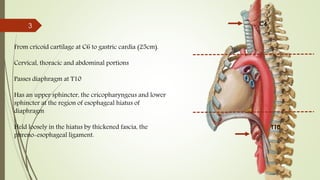
From cricoid cartilage at C6 to gastric cardia (25cm).
Cervical, thoracic and abdominal portions
Passes diaphragm at T10
Has an upper sphincter, the cricopharyngeus and lower
sphincter at the region of esophageal hiatus of
diaphragm
Held loosely in the hiatus by thickened fascia, the
phreno-esophageal ligament.
3 C6
T10
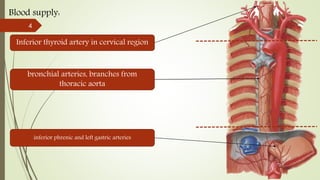
Blood supply:
Inferior thyroid artery in cervical region
bronchial arteries, branches from
thoracic aorta
inferior phrenic and left gastric arteries
4
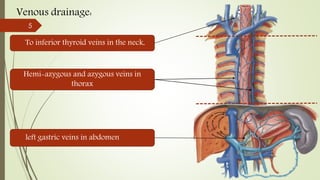
Venous drainage:
To inferior thyroid veins in the neck,
Hemi-azygous and azygous veins in
thorax
left gastric veins in abdomen
5
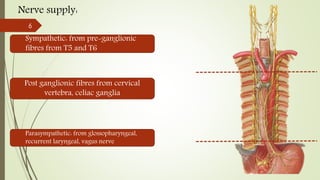
Nerve supply:
Sympathetic: from pre-ganglionic
fibres from T5 and T6
Post ganglionic fibres from cervical
vertebra, celiac ganglia
Parasympathetic: from glossopharyngeal,
recurrent laryngeal, vagus nerve
6
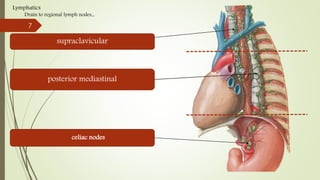
Lymphatics
Drain to regional lymph nodes,,,
supraclavicular
posterior mediastinal
celiac nodes
7
8
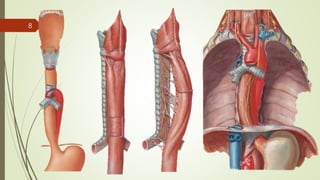
Layers of Esophagus
 Layers of esophageal wall:
 Outer adventitial connective
tissue layer
 Outer longitudinal muscle layer
 Inner circular muscle layer -
upper third is of striated muscle
and lower part of smooth
muscle
 Auerbach’s neural plexus
 Submucosa – mucous glands,
lymphatics, Meissner’s neural
plexus
 Mucosa – stratified squamous
except for distal 1-2cm which
is lined by columnar
10
Physiology
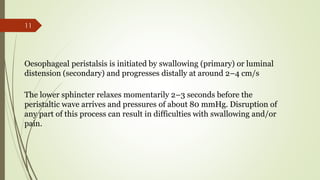
Oesophageal peristalsis is initiated by swallowing (primary) or luminal
distension (secondary) and progresses distally at around 2–4 cm/s
The lower sphincter relaxes momentarily 2–3 seconds before the
peristaltic wave arrives and pressures of about 80 mmHg. Disruption of
any part of this process can result in difficulties with swallowing and/or
pain.
11
Between the outer longitudinal muscle layer and the inner circular
layer is a nerve plexus (Auerbach’s or myenteric plexus) receiving
parasympathetic motor innervation to smooth muscle cells from
vagal nuclei.
Between the inner muscular layer and the submucosa is another
nerve plexus (Meissner’s or submucosal plexus), which relays signals
from the numerous free nerve endings in the mucosa and
submucosa to vagal afferent fibres. This sensory information is sent
back to the brain via the vagus nerve trunks.
12
13
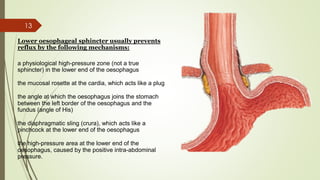
Lower oesophageal sphincter usually prevents
reflux by the following mechanisms:
a physiological high-pressure zone (not a true
sphincter) in the lower end of the oesophagus
the mucosal rosette at the cardia, which acts like a plug
the angle at which the oesophagus joins the stomach
between the left border of the oesophagus and the
fundus (angle of His)
the diaphragmatic sling (crura), which acts like a
pinchcock at the lower end of the oesophagus
the high-pressure area at the lower end of the
oesophagus, caused by the positive intra-abdominal
pressure.
14
Pathology
Dysphagia
 Difficulty in swallowing.
 Onset:
 Sudden  foreign body
 Over weeks  carcinoma
 Over years  achalasia, benign strictures
 Site correlates poorly with the site of obstruction
 Progression:
 Rapid in carcinoma
 Slowly in achalasia
 Severity:
 Difficulty in swallowing solids initially  carcinoma
 If liquids initially  achalasia
15
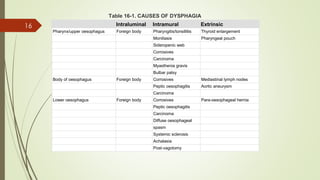
Table 16-1. CAUSES OF DYSPHAGIA
Intraluminal Intramural Extrinsic
Pharynx/upper oesophagus Foreign body Pharyngitis/tonsillitis Thyroid enlargement
Moniliasis Pharyngeal pouch
Sideropenic web
Corrosives
Carcinoma
Myasthenia gravis
Bulbar palsy
Body of oesophagus Foreign body Corrosives Mediastinal lymph nodes
Peptic oesophagitis Aortic aneurysm
Carcinoma
Lower oesophagus Foreign body Corrosives Para-oesophageal hernia
Peptic oesophagitis
Carcinoma
Diffuse oesophageal
spasm
Systemic sclerosis
Achalasia
Post-vagotomy
16
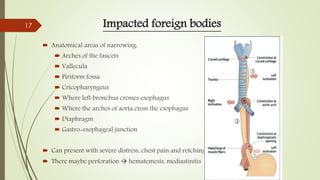
Impacted foreign bodies
 Anatomical areas of narrowing:
 Arches of the faucets
 Vallecula
 Piriform fossa
 Cricopharyngeus
 Where left bronchus crosses esophagus
 Where the arches of aorta cross the esophagus
 Diaphragm
 Gastro-esophageal junction
 Can present with severe distress, chest pain and retching.
 There maybe perforation  hematemesis, mediastinitis
17
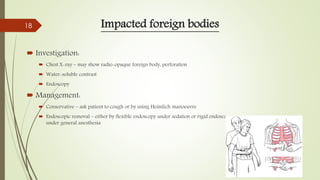
Impacted foreign bodies
 Investigation:
 Chest X-ray – may show radio-opaque foreign body, perforation
 Water-soluble contrast
 Endoscopy
 Management:
 Conservative – ask patient to cough or by using Heimlich manoeuvre
 Endoscopic removal – either by flexible endoscopy under sedation or rigid endoscopy
under general anesthesia
18
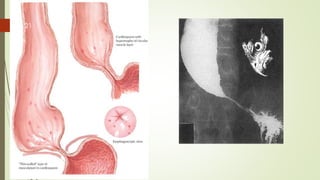
Achalasia
 Failure of relaxation of the lower esophageal sphincter – as
disease progress, obstructed esophagus dilates and peristalsis
becomes uncoordinated
 Due to partial or complete degeneration of the myentric
plexus of Auerbach and in later stages due to loss of dorsal
vagal nuclei.
 Infestation with Trypanosoma cruzi
19
Achalasia
 Clinical features:
 30-40 age group, F > M
 Progressive dysphagia over years – for both solids and liquids
 Retrosternal pain – decreases gradually as esophagus loses peristaltic activity
 Weight loss, halitosis, regurgitation, aspiration pneumonia, recurrent chest infection
 Predispose to squamous cell carcinoma of esophagus
 Investigations:
 Barium swallow –
 Dilatation of esophagus followed by tapered narrowing end
 Chest X-ray –
 Widened mediastinum, fluid level behind heart
 Endoscopy
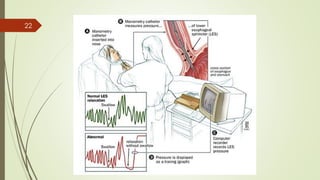
 Esophageal manometry
20
21
22
Achalasia
 Management:
 Balloon dilatation of lower sphincter (risk of perforation)
 Patients who require more than 2 dilatations should be considered for surgery
 Endoscopic injection of gastro-esophageal junction with botulinum
toxin
 Heller’s cardiomyotomy
Either thoracic or abdominal approach
Complications: perforation, reflux esophagitis, stricture, esophageal
diverticulum, recurrent dysphagia if inadequate myotomy done
To prevent perforation – abdominal approach preferred plus a partial
anterior fundoplication carried out
23
24
Plummer – Vinson Syndrome
 Post-cricoid web that results in dysphagia.
 The web is related to iron deficiency anaemia, but may be congenital or
traumatic in origin.
 The squamous epithelium becomes hyperplastic and there is hyperkeratosis
and desquamation, which leads to web formation.
Clinical features
 Middle-aged females
 Dysphagia is the main presenting complaint,
 Symptoms and signs of anaemia, including koilonychia, smooth tongue and
angular stomatitis
25
Plummer – Vinson Syndrome
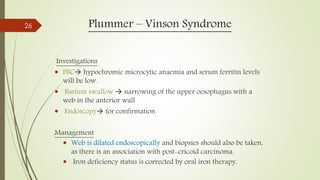
Investigations
 FBC hypochromic microcytic anaemia and serum ferritin levels
will be low.
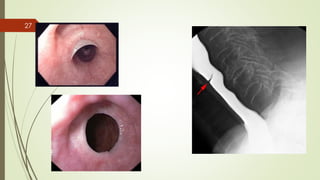
 Barium swallow  narrowing of the upper oesophagus with a
web in the anterior wall
 Endoscopy for confirmation
Management
 Web is dilated endoscopically and biopsies should also be taken,
as there is an association with post-cricoid carcinoma.
 Iron deficiency status is corrected by oral iron therapy.
26
27
Gastro-esophageal Reflux
 Retrograde flow of gastric acid through an incomplete cardiac sphincter into lower
esophagus
 Clinical features:
 Heartburn – retrosternal burning pain, radiating to epigastrium and to neck
 Regurgitation of acid contents into the mouth (waterbrash)
 Dysphagia
28
Gastro-esophageal Reflux
 Investigations:
 Barium swallow and meal
 Endoscopy - confirmatory
 Ph monitoring and esophageal manometry
Ambulatory 24-hour pH monitoring – gold standard
Manometry  exclude other motility disorders, to ensure
there is adequate muscular contraction
29
Gastro-esophageal Reflux
Management:
 General
 Weight loss, sleeping with additional pillows, raising head of the bed, avoid
smoking, coffee, alcohol
 Medical
 H2 receptor antagonists or proton pump inhibitor – reduces acid secretion
 Metoclopramide  improves esophageal muscle tone, promote gastric
emptying
 Anti-reflux surgery
 For those whose symptoms are not controlled with medical treatment, those
with recurrent strictures, young patients who do not wish to continue acid
suppression therapy
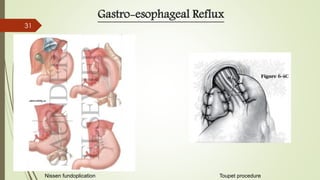
 Most common: Nissen fundoplication
 Others include: Toupet and Watson repairs
30
Gastro-esophageal Reflux
Toupet procedureNissen fundoplication
31
Tumors of Esophagus
 Benign tumors:
 < 1% of esophageal neoplasms
 Most common is benign mixed stromal cell tumor (GIST)
 Asymptomatic, may cause bleeding and dysphagia
 Treated by local enucleation
32
Carcinoma of the esophagus
 Male to female ratio is 3:1
 Adenocarcinoma :
 Predominantly a disease of western white males
Mostly lower and middle oesophagus (in Barrett’s oesophagus)
Risk factors: reflux, obesity
 Squamous cell carcinoma :
 Far East and black males
 Risk factors: alcohol, smoking, leucoplakia, achalasia, consumption of
salted fish, chewing tobacco and betel nuts
33
Carcinoma of the esophagus
 Clinical features:
 Dysphagia that progresses from solids to liquids
 Retrosternal pain on swallowing (odynophagia)
 Regurgitation and aspiration pneumonia
 Metastatic disease  enlarged cervical nodes, jaundice,
hepatomegaly, hoarseness, chest pain
 Investigations:
 Confirmed by endoscopy and biopsy
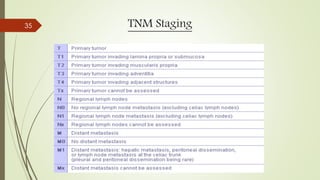
 Staging done by:
 Endoscopic ultrasonography – for local tumor stage and
nodal spread
 Chest X-ray, Abdominal ultrasound, CT – for distant
metastases
 Routine blood tests
34
TNM Staging35
Carcinoma of the esophagus
Management:
 Surgical resection
Patient with disease confined to the esophagus and who are fit
for surgery should be considered for resection.
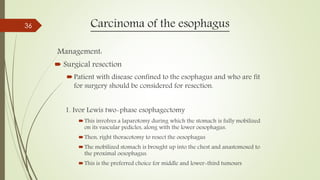
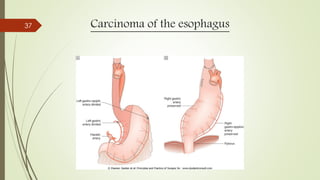
1. Ivor Lewis two-phase esophagectomy
This involves a laparotomy during which the stomach is fully mobilized
on its vascular pedicles, along with the lower oesophagus.
Then, right thoracotomy to resect the oesophagus
The mobilized stomach is brought up into the chest and anastomosed to
the proximal oesophagus.
This is the preferred choice for middle and lower-third tumours
36
Carcinoma of the esophagus37
Carcinoma of the esophagus
 Left thoracolaparotomy:
 For tumors around the esophago-gastric junction.
 Transhiatal esophagectomy:
 Involves two surgeons, one operating through neck and the other in the abdomen
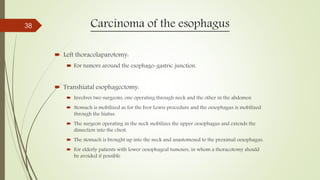
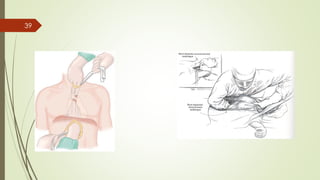
 Stomach is mobilized as for the Ivor Lewis procedure and the oesophagus is mobilized
through the hiatus.
 The surgeon operating in the neck mobilizes the upper oesophagus and extends the
dissection into the chest.
 The stomach is brought up into the neck and anastomosed to the proximal oesophagus.
 For elderly patients with lower oesophageal tumours, in whom a thoracotomy should
be avoided if possible
38
39
Complications
 Chest infections
Adequate chest drainage, good analgesia and chest physiotherapy
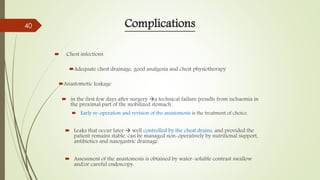
Anastomotic leakage
 in the first few days after surgery a technical failure (results from ischaemia in
the proximal part of the mobilized stomach.
 Early re-operation and revision of the anastomosis is the treatment of choice.
 Leaks that occur later  well controlled by the chest drains, and provided the
patient remains stable, can be managed non-operatively by nutritional support,
antibiotics and nasogastric drainage.
 Assessment of the anastomosis is obtained by water-soluble contrast swallow
and/or careful endoscopy.
40
Radiotherapy and Chemotherapy
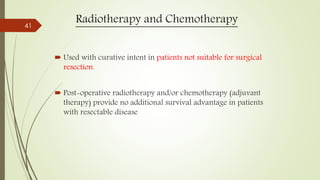
 Used with curative intent in patients not suitable for surgical
resection.
 Post-operative radiotherapy and/or chemotherapy (adjuvant
therapy) provide no additional survival advantage in patients
with resectable disease
41
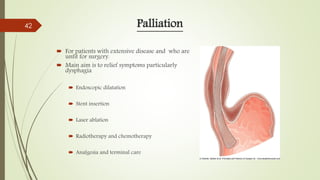
Palliation
 For patients with extensive disease and who are
unfit for surgery.
 Main aim is to relief symptoms particularly
dysphagia
 Endoscopic dilatation
 Stent insertion
 Laser ablation
 Radiotherapy and chemotherapy
 Analgesia and terminal care
42

Dysphagia and esophagus

  • 1.
  • 2.
  • 3.
    From cricoid cartilageat C6 to gastric cardia (25cm). Cervical, thoracic and abdominal portions Passes diaphragm at T10 Has an upper sphincter, the cricopharyngeus and lower sphincter at the region of esophageal hiatus of diaphragm Held loosely in the hiatus by thickened fascia, the phreno-esophageal ligament. 3 C6 T10
  • 4.
    Blood supply: Inferior thyroidartery in cervical region bronchial arteries, branches from thoracic aorta inferior phrenic and left gastric arteries 4
  • 5.
    Venous drainage: To inferiorthyroid veins in the neck, Hemi-azygous and azygous veins in thorax left gastric veins in abdomen 5
  • 6.
    Nerve supply: Sympathetic: frompre-ganglionic fibres from T5 and T6 Post ganglionic fibres from cervical vertebra, celiac ganglia Parasympathetic: from glossopharyngeal, recurrent laryngeal, vagus nerve 6
  • 7.
    Lymphatics Drain to regionallymph nodes,,, supraclavicular posterior mediastinal celiac nodes 7
  • 8.
  • 9.
    Layers of Esophagus Layers of esophageal wall:  Outer adventitial connective tissue layer  Outer longitudinal muscle layer  Inner circular muscle layer - upper third is of striated muscle and lower part of smooth muscle  Auerbach’s neural plexus  Submucosa – mucous glands, lymphatics, Meissner’s neural plexus  Mucosa – stratified squamous except for distal 1-2cm which is lined by columnar
  • 10.
  • 11.
    Oesophageal peristalsis isinitiated by swallowing (primary) or luminal distension (secondary) and progresses distally at around 2–4 cm/s The lower sphincter relaxes momentarily 2–3 seconds before the peristaltic wave arrives and pressures of about 80 mmHg. Disruption of any part of this process can result in difficulties with swallowing and/or pain. 11
  • 12.
    Between the outerlongitudinal muscle layer and the inner circular layer is a nerve plexus (Auerbach’s or myenteric plexus) receiving parasympathetic motor innervation to smooth muscle cells from vagal nuclei. Between the inner muscular layer and the submucosa is another nerve plexus (Meissner’s or submucosal plexus), which relays signals from the numerous free nerve endings in the mucosa and submucosa to vagal afferent fibres. This sensory information is sent back to the brain via the vagus nerve trunks. 12
  • 13.
    13 Lower oesophageal sphincterusually prevents reflux by the following mechanisms: a physiological high-pressure zone (not a true sphincter) in the lower end of the oesophagus the mucosal rosette at the cardia, which acts like a plug the angle at which the oesophagus joins the stomach between the left border of the oesophagus and the fundus (angle of His) the diaphragmatic sling (crura), which acts like a pinchcock at the lower end of the oesophagus the high-pressure area at the lower end of the oesophagus, caused by the positive intra-abdominal pressure.
  • 14.
  • 15.
    Dysphagia  Difficulty inswallowing.  Onset:  Sudden  foreign body  Over weeks  carcinoma  Over years  achalasia, benign strictures  Site correlates poorly with the site of obstruction  Progression:  Rapid in carcinoma  Slowly in achalasia  Severity:  Difficulty in swallowing solids initially  carcinoma  If liquids initially  achalasia 15
  • 16.
    Table 16-1. CAUSESOF DYSPHAGIA Intraluminal Intramural Extrinsic Pharynx/upper oesophagus Foreign body Pharyngitis/tonsillitis Thyroid enlargement Moniliasis Pharyngeal pouch Sideropenic web Corrosives Carcinoma Myasthenia gravis Bulbar palsy Body of oesophagus Foreign body Corrosives Mediastinal lymph nodes Peptic oesophagitis Aortic aneurysm Carcinoma Lower oesophagus Foreign body Corrosives Para-oesophageal hernia Peptic oesophagitis Carcinoma Diffuse oesophageal spasm Systemic sclerosis Achalasia Post-vagotomy 16
  • 17.
    Impacted foreign bodies Anatomical areas of narrowing:  Arches of the faucets  Vallecula  Piriform fossa  Cricopharyngeus  Where left bronchus crosses esophagus  Where the arches of aorta cross the esophagus  Diaphragm  Gastro-esophageal junction  Can present with severe distress, chest pain and retching.  There maybe perforation  hematemesis, mediastinitis 17
  • 18.
    Impacted foreign bodies Investigation:  Chest X-ray – may show radio-opaque foreign body, perforation  Water-soluble contrast  Endoscopy  Management:  Conservative – ask patient to cough or by using Heimlich manoeuvre  Endoscopic removal – either by flexible endoscopy under sedation or rigid endoscopy under general anesthesia 18
  • 19.
    Achalasia  Failure ofrelaxation of the lower esophageal sphincter – as disease progress, obstructed esophagus dilates and peristalsis becomes uncoordinated  Due to partial or complete degeneration of the myentric plexus of Auerbach and in later stages due to loss of dorsal vagal nuclei.  Infestation with Trypanosoma cruzi 19
  • 20.
    Achalasia  Clinical features: 30-40 age group, F > M  Progressive dysphagia over years – for both solids and liquids  Retrosternal pain – decreases gradually as esophagus loses peristaltic activity  Weight loss, halitosis, regurgitation, aspiration pneumonia, recurrent chest infection  Predispose to squamous cell carcinoma of esophagus  Investigations:  Barium swallow –  Dilatation of esophagus followed by tapered narrowing end  Chest X-ray –  Widened mediastinum, fluid level behind heart  Endoscopy  Esophageal manometry 20
  • 21.
  • 22.
  • 23.
    Achalasia  Management:  Balloondilatation of lower sphincter (risk of perforation)  Patients who require more than 2 dilatations should be considered for surgery  Endoscopic injection of gastro-esophageal junction with botulinum toxin  Heller’s cardiomyotomy Either thoracic or abdominal approach Complications: perforation, reflux esophagitis, stricture, esophageal diverticulum, recurrent dysphagia if inadequate myotomy done To prevent perforation – abdominal approach preferred plus a partial anterior fundoplication carried out 23
  • 24.
  • 25.
    Plummer – VinsonSyndrome  Post-cricoid web that results in dysphagia.  The web is related to iron deficiency anaemia, but may be congenital or traumatic in origin.  The squamous epithelium becomes hyperplastic and there is hyperkeratosis and desquamation, which leads to web formation. Clinical features  Middle-aged females  Dysphagia is the main presenting complaint,  Symptoms and signs of anaemia, including koilonychia, smooth tongue and angular stomatitis 25
  • 26.
    Plummer – VinsonSyndrome Investigations  FBC hypochromic microcytic anaemia and serum ferritin levels will be low.  Barium swallow  narrowing of the upper oesophagus with a web in the anterior wall  Endoscopy for confirmation Management  Web is dilated endoscopically and biopsies should also be taken, as there is an association with post-cricoid carcinoma.  Iron deficiency status is corrected by oral iron therapy. 26
  • 27.
  • 28.
    Gastro-esophageal Reflux  Retrogradeflow of gastric acid through an incomplete cardiac sphincter into lower esophagus  Clinical features:  Heartburn – retrosternal burning pain, radiating to epigastrium and to neck  Regurgitation of acid contents into the mouth (waterbrash)  Dysphagia 28
  • 29.
    Gastro-esophageal Reflux  Investigations: Barium swallow and meal  Endoscopy - confirmatory  Ph monitoring and esophageal manometry Ambulatory 24-hour pH monitoring – gold standard Manometry  exclude other motility disorders, to ensure there is adequate muscular contraction 29
  • 30.
    Gastro-esophageal Reflux Management:  General Weight loss, sleeping with additional pillows, raising head of the bed, avoid smoking, coffee, alcohol  Medical  H2 receptor antagonists or proton pump inhibitor – reduces acid secretion  Metoclopramide  improves esophageal muscle tone, promote gastric emptying  Anti-reflux surgery  For those whose symptoms are not controlled with medical treatment, those with recurrent strictures, young patients who do not wish to continue acid suppression therapy  Most common: Nissen fundoplication  Others include: Toupet and Watson repairs 30
  • 31.
  • 32.
    Tumors of Esophagus Benign tumors:  < 1% of esophageal neoplasms  Most common is benign mixed stromal cell tumor (GIST)  Asymptomatic, may cause bleeding and dysphagia  Treated by local enucleation 32
  • 33.
    Carcinoma of theesophagus  Male to female ratio is 3:1  Adenocarcinoma :  Predominantly a disease of western white males Mostly lower and middle oesophagus (in Barrett’s oesophagus) Risk factors: reflux, obesity  Squamous cell carcinoma :  Far East and black males  Risk factors: alcohol, smoking, leucoplakia, achalasia, consumption of salted fish, chewing tobacco and betel nuts 33
  • 34.
    Carcinoma of theesophagus  Clinical features:  Dysphagia that progresses from solids to liquids  Retrosternal pain on swallowing (odynophagia)  Regurgitation and aspiration pneumonia  Metastatic disease  enlarged cervical nodes, jaundice, hepatomegaly, hoarseness, chest pain  Investigations:  Confirmed by endoscopy and biopsy  Staging done by:  Endoscopic ultrasonography – for local tumor stage and nodal spread  Chest X-ray, Abdominal ultrasound, CT – for distant metastases  Routine blood tests 34
  • 35.
  • 36.
    Carcinoma of theesophagus Management:  Surgical resection Patient with disease confined to the esophagus and who are fit for surgery should be considered for resection. 1. Ivor Lewis two-phase esophagectomy This involves a laparotomy during which the stomach is fully mobilized on its vascular pedicles, along with the lower oesophagus. Then, right thoracotomy to resect the oesophagus The mobilized stomach is brought up into the chest and anastomosed to the proximal oesophagus. This is the preferred choice for middle and lower-third tumours 36
  • 37.
    Carcinoma of theesophagus37
  • 38.
    Carcinoma of theesophagus  Left thoracolaparotomy:  For tumors around the esophago-gastric junction.  Transhiatal esophagectomy:  Involves two surgeons, one operating through neck and the other in the abdomen  Stomach is mobilized as for the Ivor Lewis procedure and the oesophagus is mobilized through the hiatus.  The surgeon operating in the neck mobilizes the upper oesophagus and extends the dissection into the chest.  The stomach is brought up into the neck and anastomosed to the proximal oesophagus.  For elderly patients with lower oesophageal tumours, in whom a thoracotomy should be avoided if possible 38
  • 39.
  • 40.
    Complications  Chest infections Adequatechest drainage, good analgesia and chest physiotherapy Anastomotic leakage  in the first few days after surgery a technical failure (results from ischaemia in the proximal part of the mobilized stomach.  Early re-operation and revision of the anastomosis is the treatment of choice.  Leaks that occur later  well controlled by the chest drains, and provided the patient remains stable, can be managed non-operatively by nutritional support, antibiotics and nasogastric drainage.  Assessment of the anastomosis is obtained by water-soluble contrast swallow and/or careful endoscopy. 40
  • 41.
    Radiotherapy and Chemotherapy Used with curative intent in patients not suitable for surgical resection.  Post-operative radiotherapy and/or chemotherapy (adjuvant therapy) provide no additional survival advantage in patients with resectable disease 41
  • 42.
    Palliation  For patientswith extensive disease and who are unfit for surgery.  Main aim is to relief symptoms particularly dysphagia  Endoscopic dilatation  Stent insertion  Laser ablation  Radiotherapy and chemotherapy  Analgesia and terminal care 42