Dynamics' of flight
Mazen Mohamed tarek presented to :Dr,Mohamed
abassy
Contents
 What is air ?
 How wings lift the plane .
 Laws of motion .
 Forces of flight .
 Regimes of Flight .
What is air ?
 Air is a physical substance which has weight .
 Moving air has force .
 Hot air expands and spreads out and it becomes
lighter than cool air .
 In 1640, Evagelista Torricelli discovered that air
has weight. When experimenting with measuring
mercury, he discovered that air put pressure on
the mercury .
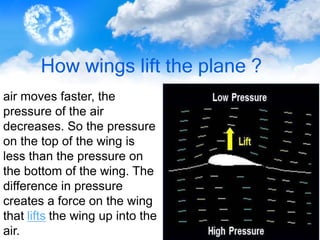
How wings lift the plane ?
air moves faster, the
pressure of the air
decreases. So the pressure
on the top of the wing is
less than the pressure on
the bottom of the wing. The
difference in pressure
creates a force on the wing
that lifts the wing up into the
air.
Laws of motion
 Sir Isaac Newton proposed three laws of motion in
1665. These Laws of Motion help to explain how a
planes flies .
 1. If an object is not moving, it will not start moving
by itself. If an object is moving, it will not stop or
change direction unless something pushes it .
 2. Objects will move farther and faster when they
are pushed harder .
 3. When an object is pushed in one direction,
there is always a resistance of the same size in
the opposite direction .
Forces of flight
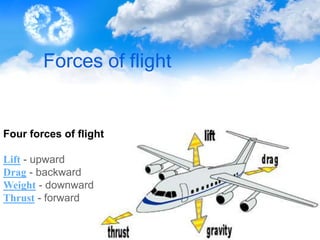
Four forces of flight
Lift - upward
Drag - backward
Weight - downward
Thrust - forward
Sound Barrier
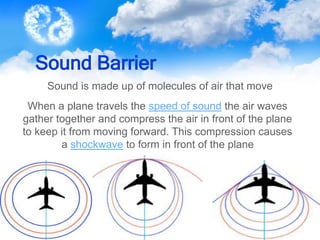
Sound is made up of molecules of air that move
When a plane travels the speed of sound the air waves
gather together and compress the air in front of the plane
to keep it from moving forward. This compression causes
a shockwave to form in front of the plane
Regimes of Flight
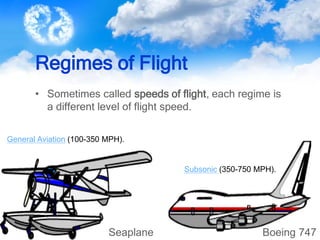
• Sometimes called speeds of flight, each regime is
a different level of flight speed.
Seaplane
General Aviation (100-350 MPH).
Boeing 747
Subsonic (350-750 MPH).
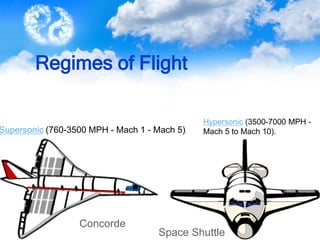
Regimes of Flight
Concorde
Supersonic (760-3500 MPH - Mach 1 - Mach 5).
Space Shuttle
Hypersonic (3500-7000 MPH -
Mach 5 to Mach 10).
Thank you ….,,

Dynamic's of flight.

  • 1.
    Dynamics' of flight MazenMohamed tarek presented to :Dr,Mohamed abassy
  • 2.
    Contents  What isair ?  How wings lift the plane .  Laws of motion .  Forces of flight .  Regimes of Flight .
  • 3.
    What is air?  Air is a physical substance which has weight .  Moving air has force .  Hot air expands and spreads out and it becomes lighter than cool air .  In 1640, Evagelista Torricelli discovered that air has weight. When experimenting with measuring mercury, he discovered that air put pressure on the mercury .
  • 4.
    How wings liftthe plane ? air moves faster, the pressure of the air decreases. So the pressure on the top of the wing is less than the pressure on the bottom of the wing. The difference in pressure creates a force on the wing that lifts the wing up into the air.
  • 5.
    Laws of motion Sir Isaac Newton proposed three laws of motion in 1665. These Laws of Motion help to explain how a planes flies .  1. If an object is not moving, it will not start moving by itself. If an object is moving, it will not stop or change direction unless something pushes it .  2. Objects will move farther and faster when they are pushed harder .  3. When an object is pushed in one direction, there is always a resistance of the same size in the opposite direction .
  • 6.
    Forces of flight Fourforces of flight Lift - upward Drag - backward Weight - downward Thrust - forward
  • 7.
    Sound Barrier Sound ismade up of molecules of air that move When a plane travels the speed of sound the air waves gather together and compress the air in front of the plane to keep it from moving forward. This compression causes a shockwave to form in front of the plane
  • 8.
    Regimes of Flight •Sometimes called speeds of flight, each regime is a different level of flight speed. Seaplane General Aviation (100-350 MPH). Boeing 747 Subsonic (350-750 MPH).
  • 9.
    Regimes of Flight Concorde Supersonic(760-3500 MPH - Mach 1 - Mach 5). Space Shuttle Hypersonic (3500-7000 MPH - Mach 5 to Mach 10).
  • 10.