Who
was
Montessori
?
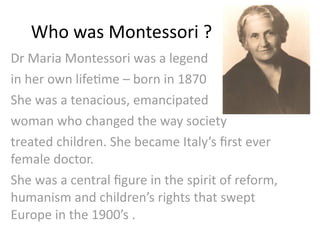
Dr
Maria
Montessori
was
a
legend

in
her
own
life4me
–
born
in
1870

She
was
a
tenacious,
emancipated
woman
who
changed
the
way
society

treated
children.
She
became
Italy’s
first
ever

female
doctor.
She
was
a
central
figure
in
the
spirit
of
reform,

humanism
and
children’s
rights
that
swept

Europe
in
the
1900’s
.
Dr
Montessori
opened
her
first
‘Casa
dei

Bambini’
(house
for
children)
in
1907
in
Italy
and

it
is
s4ll
in
opera4on
today.

Montessori’s
approach
to
educa4on
was
deeply

rooted
in
her
observa4on
of
children’s
needs
and

sensi4vi4es
at
different
ages.
Through
these

observa4ons,
she
came
to
believe
that
every

child
has
an
inborn
desire
and
ability
to
discover,

explore
and
learn.
The
full
development
of
the
human
being
from

birth
to
adulthood
became
her
life’s
work.


Respect
for
the
child
is
the


cornerstone
of
the
Montessori

         philosophy.


In
a
Montessori
3‐6
class
there
are
five

 main
areas
the
children
can
explore:

          Prac4cal
life,
           Sensorial,
            Math's,
           Language,
            Culture.

Prac7cal
Life
–

it
is
here
the
children
can
prac4ce
things
that
will

aid
them
for
life
,
giving
them
opportuni4es
to

develop
and
refine
certain
skills
for
example
–
a

series
of
dressing
frames
where
they
can

manipulate
buYons,
laces,
buckles
and
poppers

&
bows
–
which
will
later
help
them
to
dress

themselves.

They
also
learn
how
to
open
and
close
doors

carefully,
how
to
walk
gracefully,
how
to
blow

their
nose
and
wash
their
hands,
all
things
many

adults
just
expect
children
to
know!


Threading,
cu]ng,
polishing
and
pouring,

    sewing,
flower
arranging,
orange
squeezing
–

    each
assist
hand
eye‐coordina4on
and
in
turn

    help
the
child
acquire
the
skills
of
those

    mastered
by
the
adults
around
him.
The
large

    gross
motor
skills
are
also
catered
for
through

    such
ac4vi4es
as
dish
washing,
scrubbing
a

    table,
cleaning
the
art
easel,
cleaning
the

    windows,
washing
the
clothes
and
pegging

    them
out!

In
the
Montessori
environment
the
sensorial

materials

call
the
children
to
explore
the

quali4es
of:
dimension,
colour,
weight,
taste,

smell
and
shape,
helping
them
to
beYer

understand
the
world
they
live
in.

Math's
‐
coun7ng
and
numbers.
Numbers
and
coun4ng
come
alive
for
the
child

when
they
are
taught
as
a
sequence
of
carefully

planned
steps,
taking
the
child
from
the
concrete

to
the
abstract.
Numbers
in
a

Montessori
class
are
approached

from
a
sensorial
view

point
using
concrete

materials.


0‐10

is
the
first
area
children
explore.
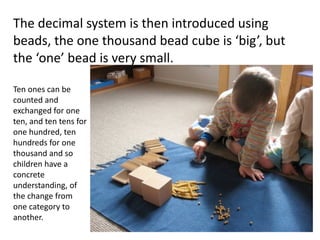
The
decimal
system
is
then
introduced
using

beads,
the
one
thousand
bead
cube
is
‘big’,
but

the
‘one’
bead
is
very
small.

Ten
ones
can
be

counted
and
exchanged
for
one
ten,
and
ten
tens
for
one
hundred,
ten
hundreds
for
one
thousand
and
so
children
have
a

concrete

understanding,
of

the
change
from
one
category
to
another.
Childern
then
explore
'teens',
where
ten
and
one

make
eleven,
ten
and
two
twelve…….
This
is
shown

clearly
with
beads
and
the
wriYen
number.
The
tens

are
introduced
in
this
way
too….
Two
tens
are

twenty,
three
tens
are
thirty……
Language

The
Montessori
language
materials
offer
a

systema4c
approach
to
wri4ng
and
reading
–

this

enables
the
child
to
experience
the
structure
of

language
step
by
step.
The
alphabet
is
taught
phone4cally
at
first,
with
the

common
blends
introduced
e.g.
th,
sh,
ou..and
later

non
phone4c
words
are
introduced.

The
shape
and
forma4on
of
each
leYer
is

presented
in
a
sensorial
way
allowing
the
child
to

gain
a
muscular
memory
of
the
leYer
before

introducing

the
complexity
of
using
a
wri4ng

implement
.

Stories,
songs,
poems
and
a
wealth
of
language

materials
enrich
the
child’s
vocabulary
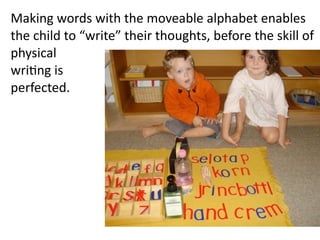
Making
words
with
the
moveable
alphabet
enables

the
child
to
“write”
their
thoughts,
before
the
skill
of

physical

wri4ng
is
perfected.
“
“Educa-on
is
a
natural
process
carried

out
by
the
child
and
is
not
acquired
by

listening
to
words
but
by
experiences
in

the
environment”


 Maria
Montessori
Understanding
our
own
culture,
and
the

world
we
live
in
is
an
important
part
of
the

Montessori
philosophy.

We
learn
from
globes

and
maps
about
the

different
con4nents,

and
who
lives
there.

Geography,

history,

zoology,

botany
and

science
are

all

fascina4ng

to
children.

Why
Montessori
today
–
100
years
later?

Dr
Montessori
was
twice
nominated
for
the
Nobel
Peace

prize.
She
discovered
facts
regarding
brain
development

that
are
finally
being
proven
today!

And
a
testament
to
her
philosophy
being
more
deeply

rooted
than
just
a
passing
trend
‐
today
Montessori
is
the

single
largest
method
of
educa4on
in
the
world
today

with
over
22,000
schools
in
more
than
100
countries
with

just
100
Montessori
schools
in
New
Zealand.

Dr
Montessori’s
philosophy
of
educa4on
is
flourishing

today
though
there
are
insufficient
teachers
to
meet

demand
–
could
this
be
a
career
for
you?

Montessori
–
A
Career
For
You!

 The
next
AMI
3‐6
teacher
training
course
in

  Auckland
will
be
January
2012
–
February

2013.
This
is
your
passport
to
travel
the
world

with
an
interna4onally
recognised
Montessori

Diploma.
Visit
the
website
www.mmef.org.nz,

email
mmef@ihug.co.nz
or
text
021
111
4133

     for
more
informa4on.
Apply
today!

Careers presentation