Ms. M. Mohanamalar, M.Sc., M.Phil.,
Ms. N. Malathi, M.Sc.,
DYNAMICS (18UMTC41)
II B.Sc. Mathematics (SF)
Apse and Apsidal Distance
In mechanics, either of the two points of an orbit which are
nearest to and farthest from the centre of motion. They are called
the lower or nearer, and the higher or more distant apsides
respectively. The "line of apsides" is that which joins them, forming
the major axis of the orbit. The length of the line of apsides is
called the apsidal distance
If there is a point A on a central orbit at which the velocity
of the particle is perpendicular to the radius OA, then the point A is
called an Apse and the length OA is the corresponding apsidal
distance.
Hence at an apse, the particle is moving at right angles to the radius
vector.
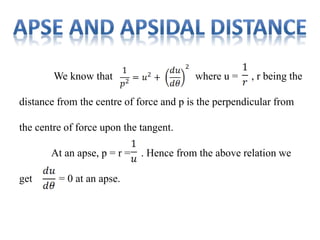
We know that where u = , r being the
distance from the centre of force and p is the perpendicular from
the centre of force upon the tangent.
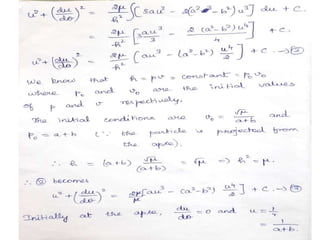
At an apse, p = r = . Hence from the above relation we
get = 0 at an apse.
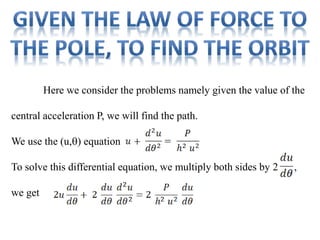
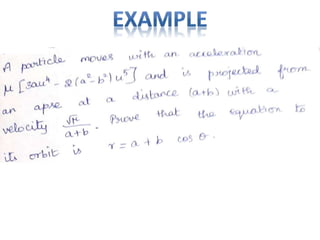
Here we consider the problems namely given the value of the
central acceleration P, we will find the path.
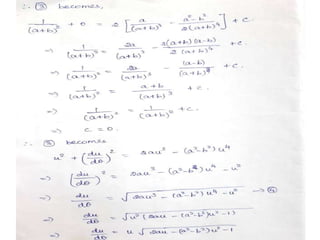
We use the (u,) equation
To solve this differential equation, we multiply both sides by 2 ,
we get
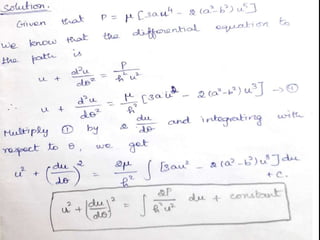
Hence we get
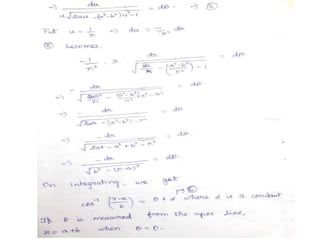
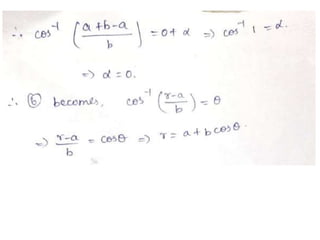
Integrating both sides with respect to ,
Dynamics Apse and Apsidal Distance

Dynamics Apse and Apsidal Distance

  • 1.
    Ms. M. Mohanamalar,M.Sc., M.Phil., Ms. N. Malathi, M.Sc., DYNAMICS (18UMTC41) II B.Sc. Mathematics (SF)
  • 2.
  • 3.
    In mechanics, eitherof the two points of an orbit which are nearest to and farthest from the centre of motion. They are called the lower or nearer, and the higher or more distant apsides respectively. The "line of apsides" is that which joins them, forming the major axis of the orbit. The length of the line of apsides is called the apsidal distance
  • 4.
    If there isa point A on a central orbit at which the velocity of the particle is perpendicular to the radius OA, then the point A is called an Apse and the length OA is the corresponding apsidal distance. Hence at an apse, the particle is moving at right angles to the radius vector.
  • 5.
    We know thatwhere u = , r being the distance from the centre of force and p is the perpendicular from the centre of force upon the tangent. At an apse, p = r = . Hence from the above relation we get = 0 at an apse.
  • 6.
    Here we considerthe problems namely given the value of the central acceleration P, we will find the path. We use the (u,) equation To solve this differential equation, we multiply both sides by 2 , we get
  • 7.
    Hence we get Integratingboth sides with respect to ,