NUMERICAL ANALYSIS (15UMTC64)
III B.SC. MATHEMATICS (SF)
Ms. M. Mohanamalar, M.Sc., M.Phil.,
Ms. N. Malathi, M.Sc.,
• Calculus is the mathematics of change. Because engineers
must continuously deal with systems and processes that
change, calculus is an essential tool of engineering.
• Standing in the heart of calculus are the mathematical concepts
of differentiation and integration
• Numerical differentiation is the process of finding the
numerical value of the derivative of a given function at a given
point.
For some particular value of x from the given data (xi,yi), i=1, 2,
3…..n where y=f(x) i explicitly, the interpolation to be used depends on
the particular value of x which derivatives are required.
•If the values of x are not equally spaced, we represent the function by
difference formula and the derivatives are obtained.
•If the values of x are equally spaced, the derivatives are calculated by
using Newton’s Forward interpolation formula or backward interpolation
formula.
Principle:
First fit a polynomial for the given difference data interpolation using
Newton ’s divided difference interpolation formula and compute the
derivatives for a given x.
Example
Example
erivatives using Finite difference
Newton’s Forward Difference formula is
Newton’s Backward Difference formula is
erivatives using Finite difference
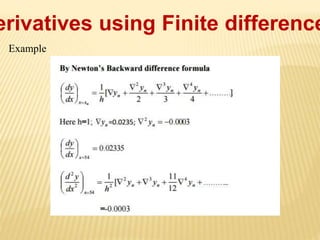
Example 2.
Find the first two derivatives of y at x=54 from the following data
x 50 51 52 53 54
y 3.6840 3.7083 3.7325 3.7563 3.7798
erivatives using Finite difference
Example
erivatives using Finite difference
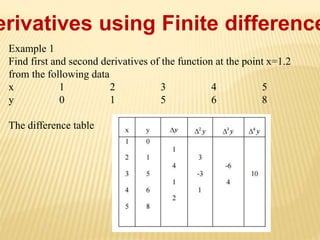
Example 1
Find first and second derivatives of the function at the point x=1.2
from the following data
x 1 2 3 4 5
y 0 1 5 6 8
The difference table
erivatives using Finite difference
Example
Numerical analysis (15 umtc64)

Numerical analysis (15 umtc64)

  • 1.
    NUMERICAL ANALYSIS (15UMTC64) IIIB.SC. MATHEMATICS (SF) Ms. M. Mohanamalar, M.Sc., M.Phil., Ms. N. Malathi, M.Sc.,
  • 2.
    • Calculus isthe mathematics of change. Because engineers must continuously deal with systems and processes that change, calculus is an essential tool of engineering. • Standing in the heart of calculus are the mathematical concepts of differentiation and integration • Numerical differentiation is the process of finding the numerical value of the derivative of a given function at a given point.
  • 3.
    For some particularvalue of x from the given data (xi,yi), i=1, 2, 3…..n where y=f(x) i explicitly, the interpolation to be used depends on the particular value of x which derivatives are required. •If the values of x are not equally spaced, we represent the function by difference formula and the derivatives are obtained. •If the values of x are equally spaced, the derivatives are calculated by using Newton’s Forward interpolation formula or backward interpolation formula.
  • 4.
    Principle: First fit apolynomial for the given difference data interpolation using Newton ’s divided difference interpolation formula and compute the derivatives for a given x.
  • 5.
  • 6.
  • 7.
    erivatives using Finitedifference Newton’s Forward Difference formula is Newton’s Backward Difference formula is
  • 8.
  • 9.
  • 10.
    erivatives using Finitedifference Example 2. Find the first two derivatives of y at x=54 from the following data x 50 51 52 53 54 y 3.6840 3.7083 3.7325 3.7563 3.7798
  • 11.
    erivatives using Finitedifference Example
  • 12.
    erivatives using Finitedifference Example 1 Find first and second derivatives of the function at the point x=1.2 from the following data x 1 2 3 4 5 y 0 1 5 6 8 The difference table
  • 13.
    erivatives using Finitedifference Example