Session 2633
Dynamic Otto Cycle Analysis
Joseph P. Callinan
Loyola Marymount University
Abstract
Engineering students encounter the Otto cycle in their first course in thermodynamics (usually
during the sophomore year). This cycle is the theoretical basis for the spark ignition (SI) internal
combustion engine (ICE). The traditional analysis (the air-standard analysis) of the Otto cycle is
a static thermodynamic analysis that cannot be used to predict the dynamic performance of a SI
ICE. Given sufficient information, the work per cycle for a particular engine can be computed.
However, by making three simple modifications, the air-standard analysis can be extended to
include a computation of the dynamic performance of a SI ICE. The first of these modifications
is the selection of representative values of specific heats and specific heat ratios for the working
fluid during each process. This improves the accuracy of the analysis. The second is an
equation relating the heat release during combustion to pertinent engine parameters (the fuel-air
ratio and the compression ratio). The third is the inclusion of an equation for the volumetric
efficiency of the engine as a function of engine speed. This incorporates into the analysis the
single most significant loss and results in performance that is dependent on engine speed. The
resulting analysis predicts the dynamic performance (power and torque as a function of engine
speed) of contemporary SI ICE engines with reasonable accuracy. Most importantly, this
analysis can be easily understood and conducted by engineering students in their first
thermodynamics course. Students have used this analysis, with excellent results, to analyze
typical engines for a variety of applications (various types of passenger cars, pick-up trucks,
SUV’s, Formula 1 vehicles and, even, “monster” trucks).
Background
The engine used for most contemporary motor vehicles is the four-stroke spark-ignition (SI)
internal combustion engine (ICE). The engine typically has 4, 6 or 8 cylinders. The SI ICE
combines non-flow and semiflow thermodynamic processes. The four strokes, which occur for
each cylinder over two revolutions of the engine’s crankshaft, are the intake stroke, the
compression stroke, the power (expansion) stroke and the exhaust stroke. Combustion of fuel
and air occurs as the compression stroke ends and the power stroke begins. These processes and
their thermodynamic modeling are discussed in detail in books on thermodynamics1
and internal
combustion engines2
.
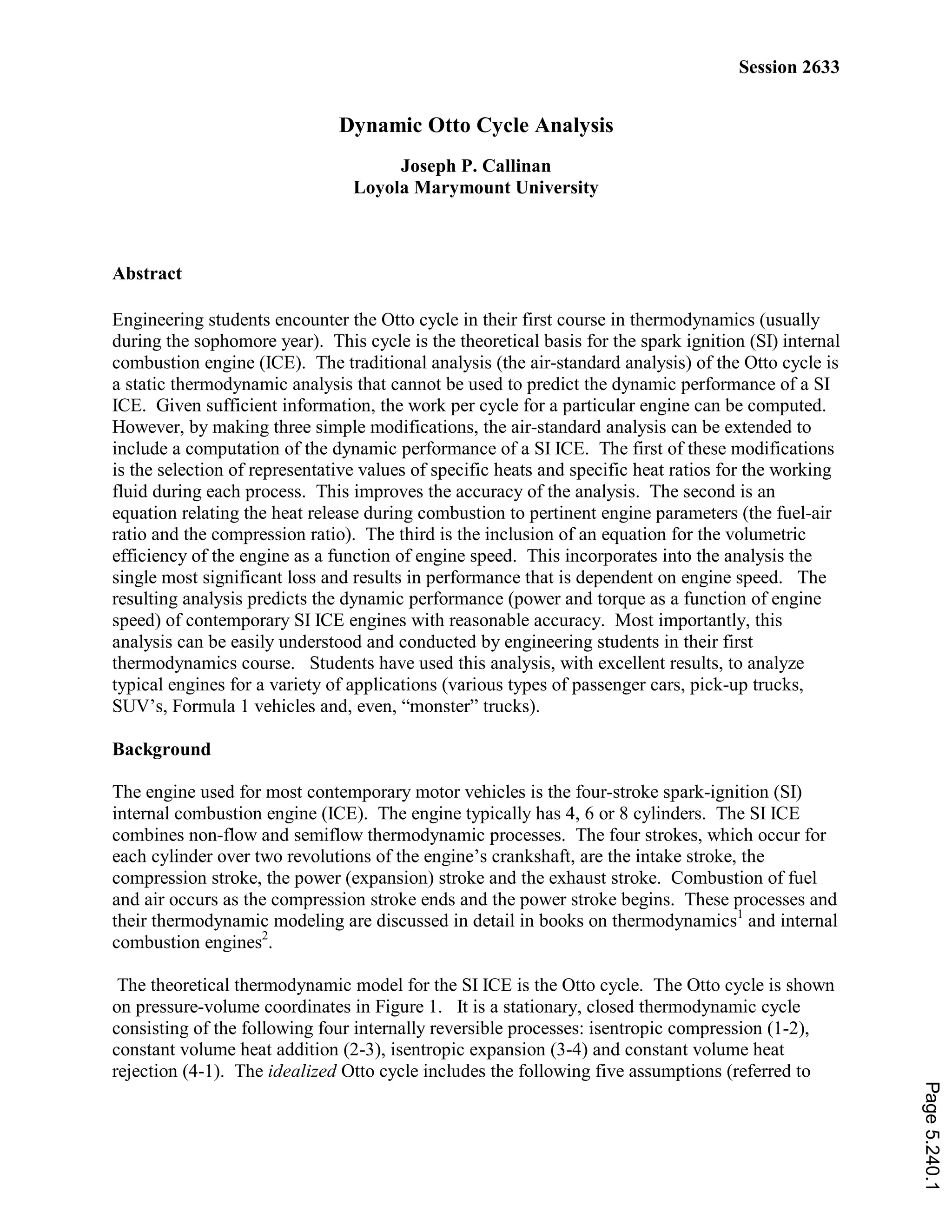
The theoretical thermodynamic model for the SI ICE is the Otto cycle. The Otto cycle is shown
on pressure-volume coordinates in Figure 1. It is a stationary, closed thermodynamic cycle
consisting of the following four internally reversible processes: isentropic compression (1-2),
constant volume heat addition (2-3), isentropic expansion (3-4) and constant volume heat
rejection (4-1). The idealized Otto cycle includes the following five assumptions (referred to
Page5.240.1
as the “cold-air-standard” assumptions1
) that are made to simplify the analysis:
1. the working fluid is air (at ambient temperature and pressure at state 1),
2. air behaves as an ideal gas,
3. air has constant specific heats,
determined at 25o
C,
4. the combustion process is replaced
by external heating and
5. the exhaust/intake processes are
replaced by external cooling.
The net work produced by the idealized
Otto cycle can be computed through a First
Law of Thermodynamics analysis. The
mass of air contained in a cylinder of an
engine modeled by the idealized Otto cycle
is a fixed value (independent of engine
speed), dependent only on engine geometry
and the ambient temperature and pressure.
As a consequence, the work done per cycle is a constant and the power output of such an engine
varies linearly with the engine speed (i.e., the number of cycles per second).
The Dynamic Otto Cycle Analysis
The goal of this study was to develop a simple First Law of Thermodynamics analysis that would
predict, with reasonable accuracy, performance curves (power vs. engine speed and torque vs.
engine speed) for contemporary automotive engines. The dynamic Otto cycle analysis
developed in this study uses the assumptions of the idealized Otto cycle described above, with
just two exceptions. First, and most importantly, the mass of air in the cylinder is dependent on
the engine speed as well as engine geometry and ambient temperature and pressure. Second, the
specific heats used in the analysis are assumed constant for each process but their numerical
values are determined at the approximate mean temperatures for each process. In addition, the
quantity of heat transferred during the heating process is related to engine parameters.
The power output of a four-stroke SI ICE is
( ) cnetc WNNW ,2
.
= (1)
where
.
W = the power output of engine, kW,
cN = the number of cylinders in the engine,
N = the engine speed (crankshaft rotations per second), Hz, and
cnetW , = the net work produced by one cylinder during two revolutions of
the crankshaft (i.e., for one power stroke), kJ .
Figure 1. The Otto Cycle P-V Diagram
Volume
Pressure
1
2
3
4
Page5.240.2
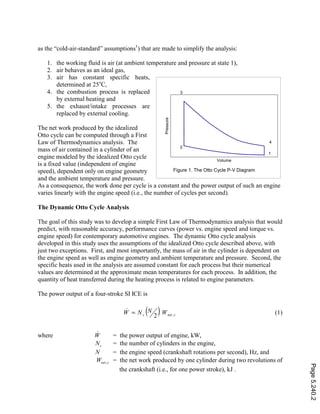
The net work per cylinder, Wnet,c, is determined using a First Law of Thermodynamics analysis
of the modified Otto cycle (as described above). The result is
( ) ( )12,34,, TTcmTTcmW cvcevccnet −−−−= (2)
where cm = the mass of air in the cylinder, kg,
iT = the temperature of the air at each of the four terminal states,
respectively, of the cycle (see Figure 1.), K,
cv,e = the mean specific heat at constant volume for the air during the
expansion stroke (process 3-4), kJ/kg-K, and
cv,c = the mean specific heat at constant volume for the air during the
compression stroke (process 1-2). KJ/kg-K.
The air temperature at state 1, T1, is the ambient temperature and is known. T2, T3 and T4 in
Eq. (2) are determined using the following three equations:
for the isentropic compression process (1-2),
1
1
2 −
= ck
r
T
T
(3)
for the constant volume heating process (2-3), ( )23, TTcmQ hvcH −= (4)
and for the isentropic expansion process (3-4),
1
3
4 −
= ek
r
T
T
(5)
where r = the compression ratio for the engine = V1/V2 ,
V1 = the total volume of the cylinder, m3
,
V2 = cylinder clearance volume, m3
,
kc = mean ratio of specific heats, cp/cv, for air during the isentropic
compression process,
ke = mean ratio of specific heats, cp/cv, for air during the isentropic
expansion process,
cv,h= the mean specific heat at constant volume for the air during the
constant volume heating process (process 2-3), kJ/kg-K, and
and QH = the quantity of heat added per cylinder during process 2-3 (and
which must be known), kJ.
The recommended mean values of cv and k for the processes of the dynamic Otto cycle are
presented in Table 1. The quantity of heat added to the air in the cylinder during process 2-3 is
rcH qmQ = (6)
where qr = the heat per unit mass of air added during during process 2-3, kJ/kg.
Page5.240.3
In the SI ICE, qr results from the combustion of
gasoline and air. A parametric study of the
constant volume combustion of air and octane was
conducted, using software3
that simultaneously
solves the First and Second Laws of
Thermodynamics, to develop an approximate
relationship for qr in terms of pertinent engine
parameters. The resulting equation is
( )[ ]( ) 3/1
0665.0//11700 frrqr −= (7)
where f = the fuel-air ratio, kg fuel/kg air.
The chemically correct value of the fuel-air ratio is f = 0.0665 and its practical range is
0.0600 < f < 0.0700
where the lower limit corresponds to a very fuel lean mixture ratio and the upper limit
corresponds to a very rich mixture ratio. Lean mixture ratios (f < 0.0665) tend to result in better
fuel economy and more oxides of nitrogen in the exhaust gases while rich mixture ratios (f >
0.0665) tend to result in greater power output and more carbon monoxide and hydrocarbons in
the exhaust gases.
The power output of an actual SI ICE
increases as engine speed increases, reaching
a maximum and then decreasing as engine
speed continues to increase (Figure 2). The
deviation from the linear relationship
(described above) for the idealized Otto cycle
is primarily a consequence of the engine’s
inability to efficiently pump fresh air into the
cylinder as the piston speed (engine speed)
increases. This phenomenon can be
incorporated into the Otto cycle analysis
through the introduction of the volumetric
efficiency of the engine2
. For this analysis,
the volumetric efficiency, e, is defined as
cac mme /= (8)
where mc = the actual mass of air contained in one cylinder, kg, and
mca = mass of air, at ambient temperature and pressure, contained in one
cylinder, kg.
Table 1. Representative
Property Values
1
Property Temperature
cv,c = 0.736 kJ/kg-K 470 K
kc = 1.39 470 K
cv,h = 0.800 kJ/kg-K 750 K
cv,e = 0.820 kJ/kg-K 840 K
Figure2. PowerOutputvs. EngineSpeed
EngineSpeed
PowerOutput
Page5.240.4
The mass of air at ambient temperature and pressure contained in one cylinder is
1Vmca αρ= (9)
where ρa = the density of air at the ambient temperature, T1, and pressure, P1,
(computed using the equation of state for an ideal gas), kg/m3
.
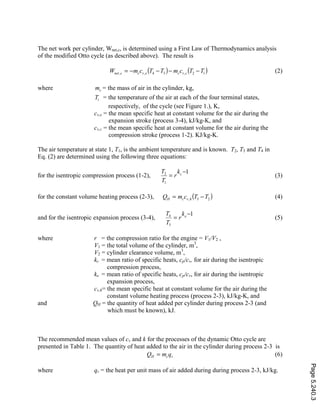
An appropriate relationship for the volumetric efficiency of engines for contemporary
family-sized automobiles, found by studying the performance of this class of automobile, is
897.010719.110651.91067.7 32537
+×−×+×−= −−−
NNNe (10)
where 0 < N < 150 Hz.
Equation (5) applies to engines that are neither supercharged nor turbocharged and that have
their maximum power output occurring at 6600 rpm (110 Hz). This equation can be generalized
to allow for turbocharging, supercharging and higher or lower operational speeds (characteristic
of other classes of motor vehicles) as follows,
)897.010719.110651.91067.7( 32537
+×−×+×−= −−−
pppb NNNFe (11)
where Fb = Pi/Pa = turbocharging boost factor,
Pa = ambient pressure, kPa,
Pi = engine inlet pressure after turbo/supercharging, kPa,
Np = 110 (N/Nmax) = engine speed parameter, Hz, ( 0 < Np < 150 Hz) and
Nmax = engine speed at which maximum power output occurs, Hz
Combining Equations (8) and (9), the mass of air contained in one cylinder is
1Vemc αρ= (12)
The volume of one cylinder, V1, can be expressed in terms of engine parameters as follows,
( )[ ]1/)4/( 2
1 −= rrSBV π (13)
where B = the cylinder bore (diameter), m, and
S = the piston stroke, m.
The displacement volume of one cylinder can be expressed as
( ) rrVVVV cd /1121, −=−= (14)
Page5.240.5
The displacement volume of the engine is
cdcd VNV ,= . (15)
The engine torque is2
( )N
W
πτ 2
= (16)
where τ = engine torque, m-N.
Analytical Procedure
For the purpose of this analysis, a unique engine design is defined by specifying the ambient
temperature and pressure, T1 and P1; the bore, B, and stroke, S; the number of cylinders, Nc; the
compression ratio, r; and the fuel-air ratio, f. The power output of the engine as a function of
engine speed is computed
using Eq. (1) where the
net work produced by one
cylinder is given by Eq.
(2). The temperatures in
Eq. (2) are computed
using Eqs. (3), (4) and (5).
The mass of air in one
cylinder, as a function of
engine speed, is computed
using Eqs. (12), (10) or
(11), (13) and the
equation of state for an
ideal gas. The engine
displacement volume is
computed using Eqs. (13),
(14) and (15). The torque
as a function of engine
speed is computed using
Eq. (16). A spreadsheet
analysis is the best method for computing the desired results.
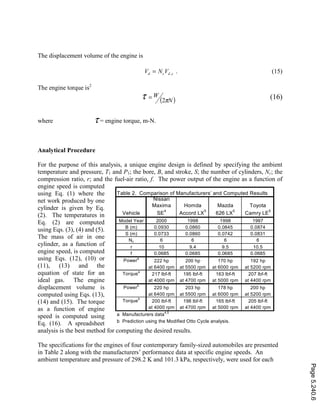
The specifications for the engines of four contemporary family-sized automobiles are presented
in Table 2 along with the manufacturers’ performance data at specific engine speeds. An
ambient temperature and pressure of 298.2 K and 101.3 kPa, respectively, were used for each
Table 2. Comparison of Manufacturers’ and Computed Results
Vehicle
Nissan
Maxima
SE
4
Homda
Accord LX
5
Mazda
626 LX
5
Toyota
Camry LE
5
Model Year 2000 1998 1998 1997
B (m) 0.0930 0.0860 0.0845 0.0874
S (m) 0.0733 0.0860 0.0742 0.0831
Nc 6 6 6 6
r 10 9.4 9.5 10.5
f 0.0685 0.0685 0.0685 0.0685
Power
a
222 hp 200 hp 170 hp 192 hp
at 6400 rpm at 5500 rpm at 6000 rpm at 5200 rpm
Torquea
217 lbf-ft 195 lbf-ft 163 lbf-ft 207 lbf-ft
at 4000 rpm at 4700 rpm at 5000 rpm at 4400 rpm
Power
b
220 hp 203 hp 178 hp 200 hp
at 6400 rpm at 5500 rpm at 6000 rpm at 5200 rpm
Torque
b
200 lbf-ft 198 lbf-ft 165 lbf-ft 205 lbf-ft
at 4000 rpm at 4700 rpm at 5000 rpm at 4400 rpm
a Manufacturers data4,5
b Prediction using the Modified Otto Cycle analysis.
Page5.240.6
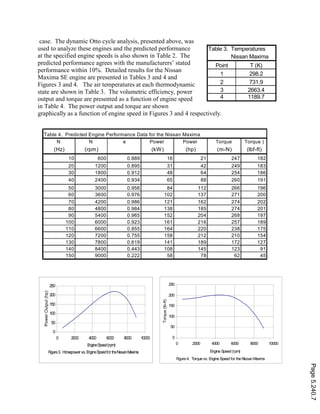
case. The dynamic Otto cycle analysis, presented above, was
used to analyze these engines and the predicted performance
at the specified engine speeds is also shown in Table 2. The
predicted performance agrees with the manufacturers’ stated
performance within 10%. Detailed results for the Nissan
Maxima SE engine are presented in Tables 3 and 4 and
Figures 3 and 4. The air temperatures at each thermodynamic
state are shown in Table 3. The volumetric efficiency, power
output and torque are presented as a function of engine speed
in Table 4. The power output and torque are shown
graphically as a function of engine speed in Figures 3 and 4 respectively.
Table 4. Predicted Engine Performance Data for the Nissan Maxima
N N e Power Power Torque Torque )
(Hz) (rpm) (kW) (hp) (m-N) (lbf-ft)
10 600 0.889 16 21 247 182
20 1200 0.895 31 42 249 183
30 1800 0.912 48 64 254 186
40 2400 0.934 65 88 260 191
50 3000 0.956 84 112 266 196
60 3600 0.976 102 137 271 200
70 4200 0.986 121 162 274 202
80 4800 0.984 138 185 274 201
90 5400 0.965 152 204 268 197
100 6000 0.923 161 216 257 189
110 6600 0.855 164 220 238 175
120 7200 0.755 158 212 210 154
130 7800 0.619 141 189 172 127
140 8400 0.443 108 145 123 91
150 9000 0.222 58 78 62 45
Table 3. Temperatures
Nissan Maxima
Point T (K)
1 298.2
2 731.9
3 2663.4
4 1189.7
Figure3. Horsepowervs.EngineSpeedfortheNissanMaxima
0
50
100
150
200
250
0 2000 4000 6000 8000 10000
EngineSpeed(rpm)
PowerOutput(hp)
Figure4. Torquevs. EngineSpeed for theNissanMaxima
0
50
100
150
200
250
0 2000 4000 6000 8000 10000
Engine Speed(rpm)
Torque(lb-ft)
Page5.240.7
Recapitulation
The cold air standard Otto cycle analysis was modified so that performance curves for a
particular SI ICE could be determined with reasonable accuracy. This analysis allows students
to investigate the effect of varying engine parameters on the performance of the SI ICE. The
analysis can also be used for the preliminary design of a SI ICE, which is required to produce a
particular power output at a specified engine speed. This is an open-ended problem and a
number of design decisions must be made.
Bibliography
1. Cengel, Y.A. & Boles, M.A., Thermodynamics, an Engineering Approach, 3rd
edition. Boston, MA: WCB
McGraw-Hill (1998).
2. Heywood, J.B., Internal Combustion Engine Fundamentals. New York, NY: McGraw-Hill (1988).
3. Pratt, D.T. & Pratt, B.S., EQLBRM (software for solving combustion problems). Seattle, WA: University of
Washington (1988).
4. Matani, S. 2000 Nissan Maxima SE. Road and Track Magazine, V. 50, No.10. p.p. 108-112 (June 1999).
5. Nagy, B. Toyota Camry LE vs. Honda Accord LX vs. Mazda 626 LX. Motor Trend Magazine, Vol. 50, No. 2.
p.p. 84-93 (February, 1998).
JOSEPH P. CALLINAN
Joe Callinan is a Professor of Mechanical Engineering at Loyola Marymount University in Los Angeles. He is a
registered Professional Mechanical Engineer in California. He served as Dean of Loyola Marymount University’s
College of Science and Engineering from 1981 to 1990. He earned a B.S.E. degree in Mechanical Engineering from
Loyola University of Los Angeles in 1957 and M.S. and Ph.D. degrees from the University of California at Los
Angeles in 1961 and 1968 respectively. He is a Fellow of the American Society of Mechanical Engineers.
Page5.240.8

Dynamic otto-cycle-analysis

  • 1.
    Session 2633 Dynamic OttoCycle Analysis Joseph P. Callinan Loyola Marymount University Abstract Engineering students encounter the Otto cycle in their first course in thermodynamics (usually during the sophomore year). This cycle is the theoretical basis for the spark ignition (SI) internal combustion engine (ICE). The traditional analysis (the air-standard analysis) of the Otto cycle is a static thermodynamic analysis that cannot be used to predict the dynamic performance of a SI ICE. Given sufficient information, the work per cycle for a particular engine can be computed. However, by making three simple modifications, the air-standard analysis can be extended to include a computation of the dynamic performance of a SI ICE. The first of these modifications is the selection of representative values of specific heats and specific heat ratios for the working fluid during each process. This improves the accuracy of the analysis. The second is an equation relating the heat release during combustion to pertinent engine parameters (the fuel-air ratio and the compression ratio). The third is the inclusion of an equation for the volumetric efficiency of the engine as a function of engine speed. This incorporates into the analysis the single most significant loss and results in performance that is dependent on engine speed. The resulting analysis predicts the dynamic performance (power and torque as a function of engine speed) of contemporary SI ICE engines with reasonable accuracy. Most importantly, this analysis can be easily understood and conducted by engineering students in their first thermodynamics course. Students have used this analysis, with excellent results, to analyze typical engines for a variety of applications (various types of passenger cars, pick-up trucks, SUV’s, Formula 1 vehicles and, even, “monster” trucks). Background The engine used for most contemporary motor vehicles is the four-stroke spark-ignition (SI) internal combustion engine (ICE). The engine typically has 4, 6 or 8 cylinders. The SI ICE combines non-flow and semiflow thermodynamic processes. The four strokes, which occur for each cylinder over two revolutions of the engine’s crankshaft, are the intake stroke, the compression stroke, the power (expansion) stroke and the exhaust stroke. Combustion of fuel and air occurs as the compression stroke ends and the power stroke begins. These processes and their thermodynamic modeling are discussed in detail in books on thermodynamics1 and internal combustion engines2 . The theoretical thermodynamic model for the SI ICE is the Otto cycle. The Otto cycle is shown on pressure-volume coordinates in Figure 1. It is a stationary, closed thermodynamic cycle consisting of the following four internally reversible processes: isentropic compression (1-2), constant volume heat addition (2-3), isentropic expansion (3-4) and constant volume heat rejection (4-1). The idealized Otto cycle includes the following five assumptions (referred to Page5.240.1
  • 2.
    as the “cold-air-standard”assumptions1 ) that are made to simplify the analysis: 1. the working fluid is air (at ambient temperature and pressure at state 1), 2. air behaves as an ideal gas, 3. air has constant specific heats, determined at 25o C, 4. the combustion process is replaced by external heating and 5. the exhaust/intake processes are replaced by external cooling. The net work produced by the idealized Otto cycle can be computed through a First Law of Thermodynamics analysis. The mass of air contained in a cylinder of an engine modeled by the idealized Otto cycle is a fixed value (independent of engine speed), dependent only on engine geometry and the ambient temperature and pressure. As a consequence, the work done per cycle is a constant and the power output of such an engine varies linearly with the engine speed (i.e., the number of cycles per second). The Dynamic Otto Cycle Analysis The goal of this study was to develop a simple First Law of Thermodynamics analysis that would predict, with reasonable accuracy, performance curves (power vs. engine speed and torque vs. engine speed) for contemporary automotive engines. The dynamic Otto cycle analysis developed in this study uses the assumptions of the idealized Otto cycle described above, with just two exceptions. First, and most importantly, the mass of air in the cylinder is dependent on the engine speed as well as engine geometry and ambient temperature and pressure. Second, the specific heats used in the analysis are assumed constant for each process but their numerical values are determined at the approximate mean temperatures for each process. In addition, the quantity of heat transferred during the heating process is related to engine parameters. The power output of a four-stroke SI ICE is ( ) cnetc WNNW ,2 . = (1) where . W = the power output of engine, kW, cN = the number of cylinders in the engine, N = the engine speed (crankshaft rotations per second), Hz, and cnetW , = the net work produced by one cylinder during two revolutions of the crankshaft (i.e., for one power stroke), kJ . Figure 1. The Otto Cycle P-V Diagram Volume Pressure 1 2 3 4 Page5.240.2
  • 3.
    The net workper cylinder, Wnet,c, is determined using a First Law of Thermodynamics analysis of the modified Otto cycle (as described above). The result is ( ) ( )12,34,, TTcmTTcmW cvcevccnet −−−−= (2) where cm = the mass of air in the cylinder, kg, iT = the temperature of the air at each of the four terminal states, respectively, of the cycle (see Figure 1.), K, cv,e = the mean specific heat at constant volume for the air during the expansion stroke (process 3-4), kJ/kg-K, and cv,c = the mean specific heat at constant volume for the air during the compression stroke (process 1-2). KJ/kg-K. The air temperature at state 1, T1, is the ambient temperature and is known. T2, T3 and T4 in Eq. (2) are determined using the following three equations: for the isentropic compression process (1-2), 1 1 2 − = ck r T T (3) for the constant volume heating process (2-3), ( )23, TTcmQ hvcH −= (4) and for the isentropic expansion process (3-4), 1 3 4 − = ek r T T (5) where r = the compression ratio for the engine = V1/V2 , V1 = the total volume of the cylinder, m3 , V2 = cylinder clearance volume, m3 , kc = mean ratio of specific heats, cp/cv, for air during the isentropic compression process, ke = mean ratio of specific heats, cp/cv, for air during the isentropic expansion process, cv,h= the mean specific heat at constant volume for the air during the constant volume heating process (process 2-3), kJ/kg-K, and and QH = the quantity of heat added per cylinder during process 2-3 (and which must be known), kJ. The recommended mean values of cv and k for the processes of the dynamic Otto cycle are presented in Table 1. The quantity of heat added to the air in the cylinder during process 2-3 is rcH qmQ = (6) where qr = the heat per unit mass of air added during during process 2-3, kJ/kg. Page5.240.3
  • 4.
    In the SIICE, qr results from the combustion of gasoline and air. A parametric study of the constant volume combustion of air and octane was conducted, using software3 that simultaneously solves the First and Second Laws of Thermodynamics, to develop an approximate relationship for qr in terms of pertinent engine parameters. The resulting equation is ( )[ ]( ) 3/1 0665.0//11700 frrqr −= (7) where f = the fuel-air ratio, kg fuel/kg air. The chemically correct value of the fuel-air ratio is f = 0.0665 and its practical range is 0.0600 < f < 0.0700 where the lower limit corresponds to a very fuel lean mixture ratio and the upper limit corresponds to a very rich mixture ratio. Lean mixture ratios (f < 0.0665) tend to result in better fuel economy and more oxides of nitrogen in the exhaust gases while rich mixture ratios (f > 0.0665) tend to result in greater power output and more carbon monoxide and hydrocarbons in the exhaust gases. The power output of an actual SI ICE increases as engine speed increases, reaching a maximum and then decreasing as engine speed continues to increase (Figure 2). The deviation from the linear relationship (described above) for the idealized Otto cycle is primarily a consequence of the engine’s inability to efficiently pump fresh air into the cylinder as the piston speed (engine speed) increases. This phenomenon can be incorporated into the Otto cycle analysis through the introduction of the volumetric efficiency of the engine2 . For this analysis, the volumetric efficiency, e, is defined as cac mme /= (8) where mc = the actual mass of air contained in one cylinder, kg, and mca = mass of air, at ambient temperature and pressure, contained in one cylinder, kg. Table 1. Representative Property Values 1 Property Temperature cv,c = 0.736 kJ/kg-K 470 K kc = 1.39 470 K cv,h = 0.800 kJ/kg-K 750 K cv,e = 0.820 kJ/kg-K 840 K Figure2. PowerOutputvs. EngineSpeed EngineSpeed PowerOutput Page5.240.4
  • 5.
    The mass ofair at ambient temperature and pressure contained in one cylinder is 1Vmca αρ= (9) where ρa = the density of air at the ambient temperature, T1, and pressure, P1, (computed using the equation of state for an ideal gas), kg/m3 . An appropriate relationship for the volumetric efficiency of engines for contemporary family-sized automobiles, found by studying the performance of this class of automobile, is 897.010719.110651.91067.7 32537 +×−×+×−= −−− NNNe (10) where 0 < N < 150 Hz. Equation (5) applies to engines that are neither supercharged nor turbocharged and that have their maximum power output occurring at 6600 rpm (110 Hz). This equation can be generalized to allow for turbocharging, supercharging and higher or lower operational speeds (characteristic of other classes of motor vehicles) as follows, )897.010719.110651.91067.7( 32537 +×−×+×−= −−− pppb NNNFe (11) where Fb = Pi/Pa = turbocharging boost factor, Pa = ambient pressure, kPa, Pi = engine inlet pressure after turbo/supercharging, kPa, Np = 110 (N/Nmax) = engine speed parameter, Hz, ( 0 < Np < 150 Hz) and Nmax = engine speed at which maximum power output occurs, Hz Combining Equations (8) and (9), the mass of air contained in one cylinder is 1Vemc αρ= (12) The volume of one cylinder, V1, can be expressed in terms of engine parameters as follows, ( )[ ]1/)4/( 2 1 −= rrSBV π (13) where B = the cylinder bore (diameter), m, and S = the piston stroke, m. The displacement volume of one cylinder can be expressed as ( ) rrVVVV cd /1121, −=−= (14) Page5.240.5
  • 6.
    The displacement volumeof the engine is cdcd VNV ,= . (15) The engine torque is2 ( )N W πτ 2 = (16) where τ = engine torque, m-N. Analytical Procedure For the purpose of this analysis, a unique engine design is defined by specifying the ambient temperature and pressure, T1 and P1; the bore, B, and stroke, S; the number of cylinders, Nc; the compression ratio, r; and the fuel-air ratio, f. The power output of the engine as a function of engine speed is computed using Eq. (1) where the net work produced by one cylinder is given by Eq. (2). The temperatures in Eq. (2) are computed using Eqs. (3), (4) and (5). The mass of air in one cylinder, as a function of engine speed, is computed using Eqs. (12), (10) or (11), (13) and the equation of state for an ideal gas. The engine displacement volume is computed using Eqs. (13), (14) and (15). The torque as a function of engine speed is computed using Eq. (16). A spreadsheet analysis is the best method for computing the desired results. The specifications for the engines of four contemporary family-sized automobiles are presented in Table 2 along with the manufacturers’ performance data at specific engine speeds. An ambient temperature and pressure of 298.2 K and 101.3 kPa, respectively, were used for each Table 2. Comparison of Manufacturers’ and Computed Results Vehicle Nissan Maxima SE 4 Homda Accord LX 5 Mazda 626 LX 5 Toyota Camry LE 5 Model Year 2000 1998 1998 1997 B (m) 0.0930 0.0860 0.0845 0.0874 S (m) 0.0733 0.0860 0.0742 0.0831 Nc 6 6 6 6 r 10 9.4 9.5 10.5 f 0.0685 0.0685 0.0685 0.0685 Power a 222 hp 200 hp 170 hp 192 hp at 6400 rpm at 5500 rpm at 6000 rpm at 5200 rpm Torquea 217 lbf-ft 195 lbf-ft 163 lbf-ft 207 lbf-ft at 4000 rpm at 4700 rpm at 5000 rpm at 4400 rpm Power b 220 hp 203 hp 178 hp 200 hp at 6400 rpm at 5500 rpm at 6000 rpm at 5200 rpm Torque b 200 lbf-ft 198 lbf-ft 165 lbf-ft 205 lbf-ft at 4000 rpm at 4700 rpm at 5000 rpm at 4400 rpm a Manufacturers data4,5 b Prediction using the Modified Otto Cycle analysis. Page5.240.6
  • 7.
    case. The dynamicOtto cycle analysis, presented above, was used to analyze these engines and the predicted performance at the specified engine speeds is also shown in Table 2. The predicted performance agrees with the manufacturers’ stated performance within 10%. Detailed results for the Nissan Maxima SE engine are presented in Tables 3 and 4 and Figures 3 and 4. The air temperatures at each thermodynamic state are shown in Table 3. The volumetric efficiency, power output and torque are presented as a function of engine speed in Table 4. The power output and torque are shown graphically as a function of engine speed in Figures 3 and 4 respectively. Table 4. Predicted Engine Performance Data for the Nissan Maxima N N e Power Power Torque Torque ) (Hz) (rpm) (kW) (hp) (m-N) (lbf-ft) 10 600 0.889 16 21 247 182 20 1200 0.895 31 42 249 183 30 1800 0.912 48 64 254 186 40 2400 0.934 65 88 260 191 50 3000 0.956 84 112 266 196 60 3600 0.976 102 137 271 200 70 4200 0.986 121 162 274 202 80 4800 0.984 138 185 274 201 90 5400 0.965 152 204 268 197 100 6000 0.923 161 216 257 189 110 6600 0.855 164 220 238 175 120 7200 0.755 158 212 210 154 130 7800 0.619 141 189 172 127 140 8400 0.443 108 145 123 91 150 9000 0.222 58 78 62 45 Table 3. Temperatures Nissan Maxima Point T (K) 1 298.2 2 731.9 3 2663.4 4 1189.7 Figure3. Horsepowervs.EngineSpeedfortheNissanMaxima 0 50 100 150 200 250 0 2000 4000 6000 8000 10000 EngineSpeed(rpm) PowerOutput(hp) Figure4. Torquevs. EngineSpeed for theNissanMaxima 0 50 100 150 200 250 0 2000 4000 6000 8000 10000 Engine Speed(rpm) Torque(lb-ft) Page5.240.7
  • 8.
    Recapitulation The cold airstandard Otto cycle analysis was modified so that performance curves for a particular SI ICE could be determined with reasonable accuracy. This analysis allows students to investigate the effect of varying engine parameters on the performance of the SI ICE. The analysis can also be used for the preliminary design of a SI ICE, which is required to produce a particular power output at a specified engine speed. This is an open-ended problem and a number of design decisions must be made. Bibliography 1. Cengel, Y.A. & Boles, M.A., Thermodynamics, an Engineering Approach, 3rd edition. Boston, MA: WCB McGraw-Hill (1998). 2. Heywood, J.B., Internal Combustion Engine Fundamentals. New York, NY: McGraw-Hill (1988). 3. Pratt, D.T. & Pratt, B.S., EQLBRM (software for solving combustion problems). Seattle, WA: University of Washington (1988). 4. Matani, S. 2000 Nissan Maxima SE. Road and Track Magazine, V. 50, No.10. p.p. 108-112 (June 1999). 5. Nagy, B. Toyota Camry LE vs. Honda Accord LX vs. Mazda 626 LX. Motor Trend Magazine, Vol. 50, No. 2. p.p. 84-93 (February, 1998). JOSEPH P. CALLINAN Joe Callinan is a Professor of Mechanical Engineering at Loyola Marymount University in Los Angeles. He is a registered Professional Mechanical Engineer in California. He served as Dean of Loyola Marymount University’s College of Science and Engineering from 1981 to 1990. He earned a B.S.E. degree in Mechanical Engineering from Loyola University of Los Angeles in 1957 and M.S. and Ph.D. degrees from the University of California at Los Angeles in 1961 and 1968 respectively. He is a Fellow of the American Society of Mechanical Engineers. Page5.240.8