Fundamentals of Human Resource Management, 10/e, DeCenzo/Robbins
Chapter 1
The Dynamic Environment
of Human Resource
Management (HRM)
Objectives:
At the end of the session, the students are able to:
1.Define Human Resource Management.
2.Explain the relevance of Human Resource
Management.
3.Articulate the importance of Human capital to
organizations.
Introduction
Strong employees = competitive advantage.
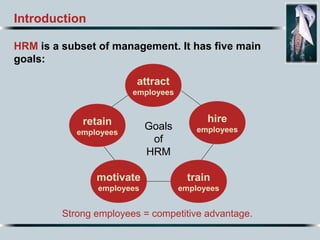
HRM is a subset of management. It has five main
goals:
Goals
of
HRM
hire
employees
attract
employees
retain
employees
motivate
employees
train
employees
HRM helps employees understand other countries’
political and economic conditions.
Understanding Cultural Environments
Countries have different
 values
 morals
 customs
 political, economic, and legal systems
HRM operates in a global business environment.
The Changing World of Technology
HRM information systems help to
 facilitate HR plans
 make decisions faster
 clearly define jobs
 evaluate performance
 provide desirable, cost-effective benefits
The Changing World of Technology
HR managers use technology to:
 recruit, hire, and train employees
 motivate and monitor workers
 research fair compensation packages
 communicate throughout the
organization
 evaluate decentralized employees’
performance
Workforce Diversity
Today’s workers want a healthy work/life
balance.
They
 can work any time, from almost anywhere
 work more than 40 hours per week
 are part of a dual-income household
#1 reason
for leaving a company:
lack of work schedule flexibility
The Labor Supply
HR managers monitor the labor supply.
Trend is to rightsize: fit company goals to
workforce numbers.
For agility, companies build a contingent
workforce of
 part-time workers
 temporary workers
 contract workers
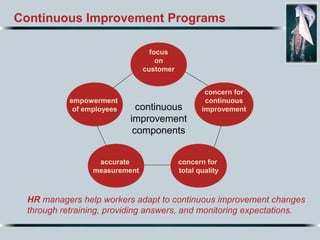
Continuous Improvement Programs
HR managers help workers adapt to continuous improvement changes
through retraining, providing answers, and monitoring expectations.
continuous
improvement
components
empowerment
of employees
accurate
measurement
concern for
total quality
focus
on
customer
concern for
continuous
improvement
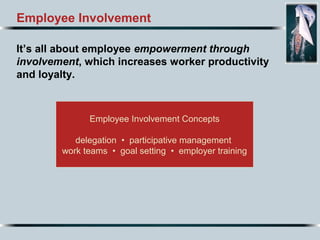
Employee Involvement
It’s all about employee empowerment through
involvement, which increases worker productivity
and loyalty.
Employee Involvement Concepts
delegation • participative management
work teams • goal setting • employer training
Other HRM Challenges
Challenges for HRM:
 The recession has brought layoffs and low
morale.
 Increased offshoring means jobs can move
overseas, even HR.
 Today’s spate of mergers and acquisitions
increase HR’s role.
A Look at Ethics
Code of ethics: a formal statement of an
organization’s primary values and the ethical rules
it expects members to follow.
HR managers must take part in enforcing ethics
rules.
Requires proper financial recordkeeping
for public companies
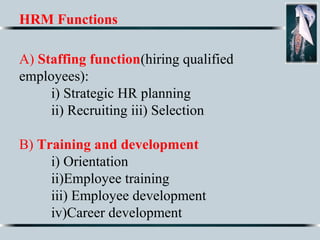
HRM Functions
A) Staffing function(hiring qualified
employees):
i) Strategic HR planning
ii) Recruiting iii) Selection
B) Training and development
i) Orientation
ii)Employee training
iii) Employee development
iv)Career development
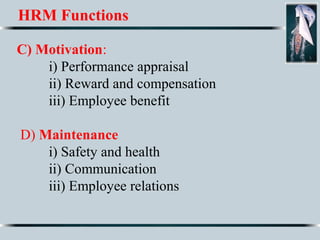
HRM Functions
C) Motivation:
i) Performance appraisal
ii) Reward and compensation
iii) Employee benefit
D) Maintenance
i) Safety and health
ii) Communication
iii) Employee relations
 

Chapter 1-introduction

  • 1.
    Fundamentals of HumanResource Management, 10/e, DeCenzo/Robbins Chapter 1 The Dynamic Environment of Human Resource Management (HRM)
  • 2.
    Objectives: At the endof the session, the students are able to: 1.Define Human Resource Management. 2.Explain the relevance of Human Resource Management. 3.Articulate the importance of Human capital to organizations.
  • 3.
    Introduction Strong employees =competitive advantage. HRM is a subset of management. It has five main goals: Goals of HRM hire employees attract employees retain employees motivate employees train employees
  • 4.
    HRM helps employeesunderstand other countries’ political and economic conditions. Understanding Cultural Environments Countries have different  values  morals  customs  political, economic, and legal systems HRM operates in a global business environment.
  • 5.
    The Changing Worldof Technology HRM information systems help to  facilitate HR plans  make decisions faster  clearly define jobs  evaluate performance  provide desirable, cost-effective benefits
  • 6.
    The Changing Worldof Technology HR managers use technology to:  recruit, hire, and train employees  motivate and monitor workers  research fair compensation packages  communicate throughout the organization  evaluate decentralized employees’ performance
  • 7.
    Workforce Diversity Today’s workerswant a healthy work/life balance. They  can work any time, from almost anywhere  work more than 40 hours per week  are part of a dual-income household #1 reason for leaving a company: lack of work schedule flexibility
  • 8.
    The Labor Supply HRmanagers monitor the labor supply. Trend is to rightsize: fit company goals to workforce numbers. For agility, companies build a contingent workforce of  part-time workers  temporary workers  contract workers
  • 9.
    Continuous Improvement Programs HRmanagers help workers adapt to continuous improvement changes through retraining, providing answers, and monitoring expectations. continuous improvement components empowerment of employees accurate measurement concern for total quality focus on customer concern for continuous improvement
  • 10.
    Employee Involvement It’s allabout employee empowerment through involvement, which increases worker productivity and loyalty. Employee Involvement Concepts delegation • participative management work teams • goal setting • employer training
  • 11.
    Other HRM Challenges Challengesfor HRM:  The recession has brought layoffs and low morale.  Increased offshoring means jobs can move overseas, even HR.  Today’s spate of mergers and acquisitions increase HR’s role.
  • 12.
    A Look atEthics Code of ethics: a formal statement of an organization’s primary values and the ethical rules it expects members to follow. HR managers must take part in enforcing ethics rules. Requires proper financial recordkeeping for public companies
  • 13.
    HRM Functions A) Staffingfunction(hiring qualified employees): i) Strategic HR planning ii) Recruiting iii) Selection B) Training and development i) Orientation ii)Employee training iii) Employee development iv)Career development
  • 14.
    HRM Functions C) Motivation: i)Performance appraisal ii) Reward and compensation iii) Employee benefit D) Maintenance i) Safety and health ii) Communication iii) Employee relations