Prophylaxis for Deep
Venous Thrombosis
Moderator: Prof. Vijay Kumar
Co-Moderator: Dr. Suman Presenter: Dr Namith R
Outline
• What is DVT
• Why should we bother
• How to screen and diagnose
• How to prevent
What is
DVT
Deep Vein
Thrombosis
Definition
“Formation of one or more blood clots in one
of the body’s large veins”
• Most commonly seen in lower limbs
HYPERCOAGULAB
ILITY OF BLOOD
THOMBOSIS
Pathophysiology
• Virchow’s triad
STASIS
ENDOTHELIAL
INJURY
Vessel
trauma
Clotting
cascade
Platelet
aggregati
on
Platelets
and fibrin
form the
initial clot
RBC are
trapped in
the fibrin
meshwork
Definite
thrombus
Pathophysiolog
y
Stasis
• Surgery
• Paresis
• Old age
• Pregnancy
Vessel Injury
• Previous DVT
• Smoking
• Varicose veins
Hypercoagulability
• Old age
• Malignancy
• Cancer therapy
• HRT
• Acute Medical illness
• Inherited or acquired
thrombophilias
Risk factors
Why
Should we
bother
Problem statement
•10 million cases of PE per year world-wide
•100,000 deaths related to PE in US
• Over two-third are due to deep vein thrombosis
Is it an Orthopaedic problem?
• Use of tourniquet, immobilization and bed rest cause venous blood stasis
• Surgical manipulations of the limb cause endothelial vascular injuries
• Trauma increases thromboplastin agents
• Use of polymethylmethacrylate (PMMA) bone cement increase
hypercoagulability
What do the numbers say?
• Incidence of DVT ranges up to 40% to 60% in major orthopaedic surgery
• 6.8% to 43.8% after elective hip replacement 42% to 50% after hip fracture
surgery
• 25% to 37 % after TKA ( bilateral > unilateral)
• Fatal pulmonary embolism may occur in up to 1.7% of patients
• 10% die within 1 hour of onset
Orthopedic surgery (28%), trauma (16%), and
immobilization >3 days (14%) were the most
common risk factors for VTE
True incidence is likely to be more as these diseases are
frequently undiagnosed or diagnosed only at autopsy
Highly under-reported !!!
Risk assessment model
Accurately identify all patients at risk
Reliably exclude patients -unlikely to develop
Predict the correct level of risk
Simple to use in routine clinical practice
Risk factors for venous thromboembolism in orthopedic surgery patients
ACCP MODEL
THRIFT II
Duration of VTE
risk after
orthopedic
surgery
• The peak incidence occur 5-10 days after hip
or knee replacement surgery (Fitzgerald et al)
• Risk may extend for up to several months
(Fitzgerald et al)
• Persists for longer than after abdominal
surgery (Gallus et al)
• Recommendation – extended duration
thromboprophylaxis
Method of extended thromboprophylaxis after major orthopedic
surgery
How to
screen and
diagnose
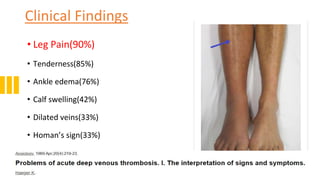
Clinical Findings
• Leg Pain(90%)
• Tenderness(85%)
• Ankle edema(76%)
• Calf swelling(42%)
• Dilated veins(33%)
• Homan’s sign(33%)
Wells’ Score
• Low probability: 0 or less
• Moderate probability: 1-2
• High probability: 3 or more
Reduced the need for serial ultrasound testing and reduced the
rate of false-negative or false-positive ultrasound studies
Screening Investigation
D-dimer tests
• Laboratory tests: ELISA/ Latex agglutination
• Near patient tests: Agglutination test
(SimpliRED)
Result: There was no difference in D-dimer levels between patients with or without a DVT
Plethysmography
(screening)
• Digital photoplethysmography
• Strain gauge plethysmography
• Impedance plethysmography
Definitive investigations
Venography
• Gold standard
• Invasive
• Uses contrast - anaphylaxis
Ultrasonography:
• Compression ultrasound
• Duplex ultrasonography
• Colour coded Doppler
ultrasonography (IOC)
Adjuncts
• Computed tomography
• Magnetic resonance imaging
How to
prevent
Mechanical Prophylaxis
Mobilization
• Most simple and applicable method
of VTE prophylaxis
• Associated with a lower incidence of
post-THR symptomatic VTE
Graduated Compression
Stocking
• Need to be sized and fitted
properly
• Can cause impairment in tissue
oxygenation
Intermittent Pneumatic
Compression Device
• Stimulate endogenous
fibrinolytic activity by reduction
of plasminogen activator
inhibitor-1 levels
• Difficulty of implementation or
suboptimal compliance
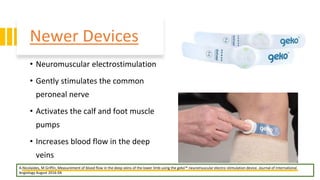
Newer Devices
• Neuromuscular electrostimulation
• Gently stimulates the common
peroneal nerve
• Activates the calf and foot muscle
pumps
• Increases blood flow in the deep
veins
A.Nicolaides, M Griffin, Measurement of blood flow in the deep veins of the lower limb using the geko™ neuromuscular electro-stimulation device. Journal of International
Angiology August 2016-04
Mechanical prophylaxis is less
effective method than
pharmacological prophylaxis
but is better than no
prophylaxis
Pharmacological
Prophylaxis
Antiplatelet Agents:
Aspirin
• Inexpensive,
• Orally administered and
• Widely available medication ‘use of aspirin as the sole agent for VTE prophylaxis is
not appropriate’
The Controversy….
Aspirin provided comparable VTE prophylaxis compared with
factor Xa inhibitors with improved VTE prophylaxis compared
with enoxaparin and warfarin with the lowest risk of
bleeding.
Aspirin is an effective and safe prophylactic
against deep vein thrombosis following major
elective lower limb arthroplasty surgery
• Usually given subcutaneously in lower doses
• LMWHs have a longer half-life than UFH
• Use of UFH may be preferable if there is a risk of accumulation of
LMWH due to renal impairment
Unfractionated and Low Molecular Weight
Heparin
‘In orthopaedic surgery, LMWH is significantly superior to both UFH and
warfarin for prevention of DVT, and results in significantly less minor
bleeding complications when compared to UFH, but significantly more
minor bleeding when compared to warfarin’
Fondaparinux
• Synthetic pentasaccharide
• Specific anti-Xa activity that is higher than that
of LMWH
• Half-life that is longer than that of LMWH
• Subcutaneous injection
• 2.5 mg daily
• Benefit - does not inactivate thrombin (factor
IIa), has no effect on the platelets
PENTHIFRA Trial
• Multicentric double blinded RCT
• Fondaparinux or placebo for 21 days
• Significant reduction of both symptomatic venous thromboembolism (1.4% versus
35.0%, respectively) and asymptomatic venous thromboembolism (0.3% versus
2.7%, respectively)
Oral Anticoagulants
Direct Factor Xa Inhibitor
• Rivaroxaban: 10mg OD
• Apixaban: 2.5mg OD
Direct Thrombin Inhibitor
• Dabigatran: 150mg OD
• Associated with an increased risk of
myocardial infarction or acute
coronary syndrome (Uchino et al)
• Administer at fixed doses
• As effective as enoxaparin for VTE prophylaxis
• No need of laboratory monitoring
• Currently not recommended for hip fracture surgery
‘The risk of a recurrent event was significantly lower
with rivaroxaban at either a treatment dose (20 mg)
or a prophylactic dose (10 mg) than with aspirin,
without a significant increase in bleeding rates’
Attractive alternative to other
anticoagulants
What does the
Guidelines
Recommend?
Numerous !!
• ACCP (2012)
• National Institute for Health and Care
Excellence (NICE) (2018)
• AAOS (2011)
• SIGN(2010, updated in 2015)
• British Orthopaedic Association (2007)
Case 1
60-year-old female patient, a Hypertensive, Diabetic, CKD
and obese with inflammatory arthritis of bilateral hip
joint, undergoes bilateral Total Hip Replacement.
Q)What would you advise?
a) LMWH 60mg S/C daily
b) Aspirin 75mg daily
c) Rivaroxaban 10mg OD
d) Warfarin
THA/TKA
Case 1
60-year-old female patient, a Hypertensive, CKD, Diabetic
and obese with inflammatory arthritis of bilateral hip
joint, undergoes bilateral Total Hip Replacement.
Q)What would you advise?
LMWH > Aspirin Rivaroxaban
Case 2
70-year-old male patient, with HTN, COPD and Type II DM
suffers Intertrochanteric # of right Femur, undergoes CRIF
with PFN
Q)What would you advise?
a) LMWH 60mg S/C daily
b) Aspirin 75mg daily
c) Rivaroxaban 10mg OD
d) Warfarin
Hip Fracture Surgery
Case 2
70-year-old male patient, with HTN, COPD and Type II DM
suffers Intertrochanteric # of right Femur undergoes CRIF
with PFN
Q)What would you advise?
LMWH 60mg S/C daily
No evidence for DOACs in Hip fracture surgeries
Case 3
70-year-old male patient, with HTN, COPD and Type II DM
suffers Intertrochanteric # of right Femur. Surgery is
delayed for more than 24 hours due to poor chest
condition, pending Pulmonology review.
Q) Do you consider Pre-operative prophylaxis ?
i. Yes
ii. No
Pre-operative VTE prophylaxis
NICE
• For people with fragility fractures of the pelvis, hip or
proximal femur
• If surgery is delayed beyond the day after admission
• Give the last dose no less than 12 hours before surgery for
LMWH or
• 24 hours before surgery for fondaparinux sodium
Case 3
70-year-old male patient, with HTN, COPD and Type II DM
suffers Intertrochanteric # of right Femur. Surgery is
delayed for more than for 48 hours due to poor chest
condition, pending Pulmonology review.
Q) Do you consider Pre-operative prophylaxis ?
Yes
Also consider mechanical prophylaxis almost immediately after admission
Case 4
50-year-old male patient, with fall from 2 story high
building, has weakness in bilateral lower-limb(Grade 0/5)
and tenderness over lumbar spine. No co-morbidities. CT
image shows burst fracture L5 with retropulsion.
Underwent decompression + PI.
Q)What would you advise?
a) LMWH 60mg S/C daily
b) Aspirin 75mg daily
c) Rivaroxaban 10mg OD
Case 5
60 year old female patient undergoing TLIF L5-S1 for
degenerative disc disease. No known Co-morbidities
Q)What would you advise?
a) LMWH 60mg S/C daily
b) Aspirin 75mg daily
c) Rivaroxaban 10mg OD
Spine Surgery - ACCP
Case 4
50-year-old male patient, with fall from 2 story high
building, has weakness in bilateral lower-limb(Grade 0/5)
and tenderness over lumbar spine. No co-morbidities. CT
image shows burst fracture L5 with retropulsion.
Underwent decompression + PI.
LMWH
Case 5
1) 60 year old female patient undergoing TLIF L5-S1 for
degenerative disc disease. No known Co-morbidities
Elective
surgery !!
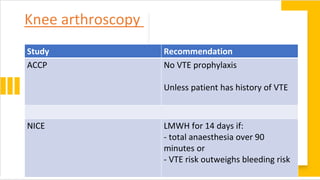
Knee arthroscopy
Study Recommendation
ACCP No VTE prophylaxis
Unless patient has history of VTE
NICE LMWH for 14 days if:
- total anaesthesia over 90
minutes or
- VTE risk outweighs bleeding risk
Isolated lower-leg injuries distal to the knee
ACCP
•No VTE prophylaxis
Isolated foot and ankle surgery
NICE
Consider pharmacological VTE prophylaxis if:
• Immobilization is required
• Total anaesthesia over 90 minutes or
• VTE risk outweighs bleeding risk
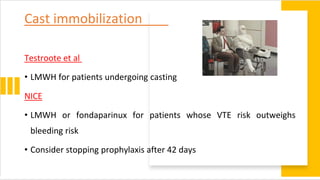
Cast immobilization
Testroote et al
• LMWH for patients undergoing casting
NICE
• LMWH or fondaparinux for patients whose VTE risk outweighs
bleeding risk
• Consider stopping prophylaxis after 42 days
Upper limb surgery
NICE
• VTE prophylaxis is generally not needed if patients receive local or regional
anaesthesia
• Consider VTE prophylaxis if:
i. Total time under general anaesthesia over 90 minutes
ii. Difficulty to mobilize due to operation
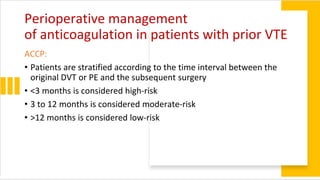
Perioperative management
of anticoagulation in patients with prior VTE
ACCP:
• Patients are stratified according to the time interval between the
original DVT or PE and the subsequent surgery
• <3 months is considered high-risk
• 3 to 12 months is considered moderate-risk
• >12 months is considered low-risk
Perioperative management of patients
receiving anticoagulants
• Estimate thromboembolic risk: Prefer to delay surgery until the risk returns to
baseline
• Estimate bleeding risk: higher bleeding risk confers a greater need for
perioperative hemostasis, Procedures with a low bleeding risk (eg, dental
extractions, minor skin surgery) often can be performed without interruption of
anticoagulation
• Determine the timing of anticoagulant interruption: depending on Agent
• Determine whether to use bridging anticoagulation
• A 76-year-old female with non-valvular atrial fibrillation, hypertension, and prior stroke three
months ago, receiving warfarin, requires elective hip replacement with neuraxial anesthesia;
renal function is normal, and weight is 75 kg. This patient has a very high thromboembolic risk
and a high bleeding risk.
• Omit warfarin for five days before the procedure (last dose on preoperative day minus 6)
• Preoperative bridging with dose LMW heparin starting on preoperative day minus 3, with last
dose on the morning of day minus 1
• Postoperative low-dose LMW heparin for VTE prevention within 24 hours after surgery until
postoperative bridging is started
• Postoperative bridging on postoperative day 2 or 3, when hemostasis is secured; continue for
at least four to five days, until the INR is therapeutic
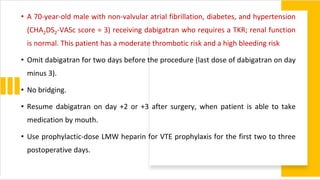
• A 70-year-old male with non-valvular atrial fibrillation, diabetes, and hypertension
(CHA2DS2-VASc score = 3) receiving dabigatran who requires a TKR; renal function
is normal. This patient has a moderate thrombotic risk and a high bleeding risk
• Omit dabigatran for two days before the procedure (last dose of dabigatran on day
minus 3).
• No bridging.
• Resume dabigatran on day +2 or +3 after surgery, when patient is able to take
medication by mouth.
• Use prophylactic-dose LMW heparin for VTE prophylaxis for the first two to three
postoperative days.
• A 55-year-old male with an unprovoked deep vein thrombosis (DVT) four months ago,
receiving apixaban 5 mg twice daily, who requires CRIF with nailing for fracture of right
humerus; renal function is normal. This patient has a high thrombotic risk and a low
bleeding risk .
• Omit apixaban for one day before the procedure (last dose of apixaban on day minus 2).
• No bridging.
• Resume apixaban the day after the procedure, after at least 24 hours have elapsed when
hemostasis secured. If the patient requires polyp removal, delay resumption of apixaban
for one to two more days.
Please refer: https://www.uptodate.com/contents/perioperative-management-of-patients-receiving-
anticoagulants for further read
Temporary vena cava filters
• Placement of a temporary inferior vena caval (IVC) filter indicated in patients with a
recent (within the prior three to four weeks) acute VTE
• Who require interruption of anticoagulation for a surgery or major procedure in which
it is anticipated that therapeutic-dose anticoagulation will need to be delayed for more
than 12 hours postoperatively
• As an example, most patients who require surgery using general or neuraxial anesthesia
that must be performed within three to four weeks of an acute VTE would require
placement of an IVC filter
Despite the availability of resources for DVT
prophylaxis, there is still ignorance regards its
use in medics and paramedics
SUMMARY
NICE ACCP
Fragility fractures of HIP/
Pelvis
LMWH starting 6–12 hours
after surgery
LMWH for 10 - 14 days
THA LMWH for 10 days followed
by aspirin (75 or 150 mg) for a
further 28 days
Or LMWH for 28 days
LMWH for 10 - 14 days
TKA Aspirin (75 or 150 mg) for
14 days
LMWH for 14 days
LMWH for 10 - 14 days
Thank you
BEWARE
Proximal Humeral Fractures
- Pon Aravindan
Next week…
Any Questions ?

Dvt prophylaxis in orthopaedic surgery

  • 1.
    Prophylaxis for Deep VenousThrombosis Moderator: Prof. Vijay Kumar Co-Moderator: Dr. Suman Presenter: Dr Namith R
  • 2.
    Outline • What isDVT • Why should we bother • How to screen and diagnose • How to prevent
  • 3.
  • 4.
    Deep Vein Thrombosis Definition “Formation ofone or more blood clots in one of the body’s large veins” • Most commonly seen in lower limbs
  • 5.
    HYPERCOAGULAB ILITY OF BLOOD THOMBOSIS Pathophysiology •Virchow’s triad STASIS ENDOTHELIAL INJURY
  • 6.
    Vessel trauma Clotting cascade Platelet aggregati on Platelets and fibrin form the initialclot RBC are trapped in the fibrin meshwork Definite thrombus Pathophysiolog y
  • 7.
    Stasis • Surgery • Paresis •Old age • Pregnancy Vessel Injury • Previous DVT • Smoking • Varicose veins Hypercoagulability • Old age • Malignancy • Cancer therapy • HRT • Acute Medical illness • Inherited or acquired thrombophilias Risk factors
  • 8.
  • 9.
    Problem statement •10 millioncases of PE per year world-wide •100,000 deaths related to PE in US • Over two-third are due to deep vein thrombosis
  • 10.
    Is it anOrthopaedic problem? • Use of tourniquet, immobilization and bed rest cause venous blood stasis • Surgical manipulations of the limb cause endothelial vascular injuries • Trauma increases thromboplastin agents • Use of polymethylmethacrylate (PMMA) bone cement increase hypercoagulability
  • 11.
    What do thenumbers say? • Incidence of DVT ranges up to 40% to 60% in major orthopaedic surgery • 6.8% to 43.8% after elective hip replacement 42% to 50% after hip fracture surgery • 25% to 37 % after TKA ( bilateral > unilateral) • Fatal pulmonary embolism may occur in up to 1.7% of patients • 10% die within 1 hour of onset
  • 12.
    Orthopedic surgery (28%),trauma (16%), and immobilization >3 days (14%) were the most common risk factors for VTE
  • 13.
    True incidence islikely to be more as these diseases are frequently undiagnosed or diagnosed only at autopsy Highly under-reported !!!
  • 14.
    Risk assessment model Accuratelyidentify all patients at risk Reliably exclude patients -unlikely to develop Predict the correct level of risk Simple to use in routine clinical practice
  • 15.
    Risk factors forvenous thromboembolism in orthopedic surgery patients
  • 16.
  • 17.
  • 18.
    Duration of VTE riskafter orthopedic surgery • The peak incidence occur 5-10 days after hip or knee replacement surgery (Fitzgerald et al) • Risk may extend for up to several months (Fitzgerald et al) • Persists for longer than after abdominal surgery (Gallus et al) • Recommendation – extended duration thromboprophylaxis
  • 19.
    Method of extendedthromboprophylaxis after major orthopedic surgery
  • 20.
  • 21.
    Clinical Findings • LegPain(90%) • Tenderness(85%) • Ankle edema(76%) • Calf swelling(42%) • Dilated veins(33%) • Homan’s sign(33%)
  • 22.
  • 23.
    • Low probability:0 or less • Moderate probability: 1-2 • High probability: 3 or more Reduced the need for serial ultrasound testing and reduced the rate of false-negative or false-positive ultrasound studies
  • 24.
    Screening Investigation D-dimer tests •Laboratory tests: ELISA/ Latex agglutination • Near patient tests: Agglutination test (SimpliRED)
  • 25.
    Result: There wasno difference in D-dimer levels between patients with or without a DVT
  • 26.
    Plethysmography (screening) • Digital photoplethysmography •Strain gauge plethysmography • Impedance plethysmography
  • 27.
    Definitive investigations Venography • Goldstandard • Invasive • Uses contrast - anaphylaxis
  • 28.
    Ultrasonography: • Compression ultrasound •Duplex ultrasonography • Colour coded Doppler ultrasonography (IOC)
  • 29.
    Adjuncts • Computed tomography •Magnetic resonance imaging
  • 33.
  • 34.
    Mechanical Prophylaxis Mobilization • Mostsimple and applicable method of VTE prophylaxis • Associated with a lower incidence of post-THR symptomatic VTE
  • 35.
    Graduated Compression Stocking • Needto be sized and fitted properly • Can cause impairment in tissue oxygenation
  • 36.
    Intermittent Pneumatic Compression Device •Stimulate endogenous fibrinolytic activity by reduction of plasminogen activator inhibitor-1 levels • Difficulty of implementation or suboptimal compliance
  • 37.
    Newer Devices • Neuromuscularelectrostimulation • Gently stimulates the common peroneal nerve • Activates the calf and foot muscle pumps • Increases blood flow in the deep veins A.Nicolaides, M Griffin, Measurement of blood flow in the deep veins of the lower limb using the geko™ neuromuscular electro-stimulation device. Journal of International Angiology August 2016-04
  • 38.
    Mechanical prophylaxis isless effective method than pharmacological prophylaxis but is better than no prophylaxis
  • 39.
    Pharmacological Prophylaxis Antiplatelet Agents: Aspirin • Inexpensive, •Orally administered and • Widely available medication ‘use of aspirin as the sole agent for VTE prophylaxis is not appropriate’
  • 40.
  • 41.
    Aspirin provided comparableVTE prophylaxis compared with factor Xa inhibitors with improved VTE prophylaxis compared with enoxaparin and warfarin with the lowest risk of bleeding.
  • 42.
    Aspirin is aneffective and safe prophylactic against deep vein thrombosis following major elective lower limb arthroplasty surgery
  • 44.
    • Usually givensubcutaneously in lower doses • LMWHs have a longer half-life than UFH • Use of UFH may be preferable if there is a risk of accumulation of LMWH due to renal impairment Unfractionated and Low Molecular Weight Heparin
  • 45.
    ‘In orthopaedic surgery,LMWH is significantly superior to both UFH and warfarin for prevention of DVT, and results in significantly less minor bleeding complications when compared to UFH, but significantly more minor bleeding when compared to warfarin’
  • 46.
    Fondaparinux • Synthetic pentasaccharide •Specific anti-Xa activity that is higher than that of LMWH • Half-life that is longer than that of LMWH • Subcutaneous injection • 2.5 mg daily • Benefit - does not inactivate thrombin (factor IIa), has no effect on the platelets
  • 47.
    PENTHIFRA Trial • Multicentricdouble blinded RCT • Fondaparinux or placebo for 21 days • Significant reduction of both symptomatic venous thromboembolism (1.4% versus 35.0%, respectively) and asymptomatic venous thromboembolism (0.3% versus 2.7%, respectively)
  • 48.
    Oral Anticoagulants Direct FactorXa Inhibitor • Rivaroxaban: 10mg OD • Apixaban: 2.5mg OD Direct Thrombin Inhibitor • Dabigatran: 150mg OD • Associated with an increased risk of myocardial infarction or acute coronary syndrome (Uchino et al) • Administer at fixed doses • As effective as enoxaparin for VTE prophylaxis • No need of laboratory monitoring • Currently not recommended for hip fracture surgery
  • 49.
    ‘The risk ofa recurrent event was significantly lower with rivaroxaban at either a treatment dose (20 mg) or a prophylactic dose (10 mg) than with aspirin, without a significant increase in bleeding rates’
  • 50.
    Attractive alternative toother anticoagulants
  • 51.
  • 52.
    Numerous !! • ACCP(2012) • National Institute for Health and Care Excellence (NICE) (2018) • AAOS (2011) • SIGN(2010, updated in 2015) • British Orthopaedic Association (2007)
  • 53.
    Case 1 60-year-old femalepatient, a Hypertensive, Diabetic, CKD and obese with inflammatory arthritis of bilateral hip joint, undergoes bilateral Total Hip Replacement. Q)What would you advise? a) LMWH 60mg S/C daily b) Aspirin 75mg daily c) Rivaroxaban 10mg OD d) Warfarin
  • 54.
  • 56.
    Case 1 60-year-old femalepatient, a Hypertensive, CKD, Diabetic and obese with inflammatory arthritis of bilateral hip joint, undergoes bilateral Total Hip Replacement. Q)What would you advise? LMWH > Aspirin Rivaroxaban
  • 57.
    Case 2 70-year-old malepatient, with HTN, COPD and Type II DM suffers Intertrochanteric # of right Femur, undergoes CRIF with PFN Q)What would you advise? a) LMWH 60mg S/C daily b) Aspirin 75mg daily c) Rivaroxaban 10mg OD d) Warfarin
  • 58.
  • 59.
    Case 2 70-year-old malepatient, with HTN, COPD and Type II DM suffers Intertrochanteric # of right Femur undergoes CRIF with PFN Q)What would you advise? LMWH 60mg S/C daily No evidence for DOACs in Hip fracture surgeries
  • 60.
    Case 3 70-year-old malepatient, with HTN, COPD and Type II DM suffers Intertrochanteric # of right Femur. Surgery is delayed for more than 24 hours due to poor chest condition, pending Pulmonology review. Q) Do you consider Pre-operative prophylaxis ? i. Yes ii. No
  • 61.
    Pre-operative VTE prophylaxis NICE •For people with fragility fractures of the pelvis, hip or proximal femur • If surgery is delayed beyond the day after admission • Give the last dose no less than 12 hours before surgery for LMWH or • 24 hours before surgery for fondaparinux sodium
  • 62.
    Case 3 70-year-old malepatient, with HTN, COPD and Type II DM suffers Intertrochanteric # of right Femur. Surgery is delayed for more than for 48 hours due to poor chest condition, pending Pulmonology review. Q) Do you consider Pre-operative prophylaxis ? Yes Also consider mechanical prophylaxis almost immediately after admission
  • 63.
    Case 4 50-year-old malepatient, with fall from 2 story high building, has weakness in bilateral lower-limb(Grade 0/5) and tenderness over lumbar spine. No co-morbidities. CT image shows burst fracture L5 with retropulsion. Underwent decompression + PI. Q)What would you advise? a) LMWH 60mg S/C daily b) Aspirin 75mg daily c) Rivaroxaban 10mg OD
  • 64.
    Case 5 60 yearold female patient undergoing TLIF L5-S1 for degenerative disc disease. No known Co-morbidities Q)What would you advise? a) LMWH 60mg S/C daily b) Aspirin 75mg daily c) Rivaroxaban 10mg OD
  • 65.
  • 66.
    Case 4 50-year-old malepatient, with fall from 2 story high building, has weakness in bilateral lower-limb(Grade 0/5) and tenderness over lumbar spine. No co-morbidities. CT image shows burst fracture L5 with retropulsion. Underwent decompression + PI. LMWH
  • 67.
    Case 5 1) 60year old female patient undergoing TLIF L5-S1 for degenerative disc disease. No known Co-morbidities Elective surgery !!
  • 68.
    Knee arthroscopy Study Recommendation ACCPNo VTE prophylaxis Unless patient has history of VTE NICE LMWH for 14 days if: - total anaesthesia over 90 minutes or - VTE risk outweighs bleeding risk
  • 69.
    Isolated lower-leg injuriesdistal to the knee ACCP •No VTE prophylaxis
  • 70.
    Isolated foot andankle surgery NICE Consider pharmacological VTE prophylaxis if: • Immobilization is required • Total anaesthesia over 90 minutes or • VTE risk outweighs bleeding risk
  • 71.
    Cast immobilization Testroote etal • LMWH for patients undergoing casting NICE • LMWH or fondaparinux for patients whose VTE risk outweighs bleeding risk • Consider stopping prophylaxis after 42 days
  • 72.
    Upper limb surgery NICE •VTE prophylaxis is generally not needed if patients receive local or regional anaesthesia • Consider VTE prophylaxis if: i. Total time under general anaesthesia over 90 minutes ii. Difficulty to mobilize due to operation
  • 73.
    Perioperative management of anticoagulationin patients with prior VTE ACCP: • Patients are stratified according to the time interval between the original DVT or PE and the subsequent surgery • <3 months is considered high-risk • 3 to 12 months is considered moderate-risk • >12 months is considered low-risk
  • 74.
    Perioperative management ofpatients receiving anticoagulants • Estimate thromboembolic risk: Prefer to delay surgery until the risk returns to baseline • Estimate bleeding risk: higher bleeding risk confers a greater need for perioperative hemostasis, Procedures with a low bleeding risk (eg, dental extractions, minor skin surgery) often can be performed without interruption of anticoagulation • Determine the timing of anticoagulant interruption: depending on Agent • Determine whether to use bridging anticoagulation
  • 75.
    • A 76-year-oldfemale with non-valvular atrial fibrillation, hypertension, and prior stroke three months ago, receiving warfarin, requires elective hip replacement with neuraxial anesthesia; renal function is normal, and weight is 75 kg. This patient has a very high thromboembolic risk and a high bleeding risk. • Omit warfarin for five days before the procedure (last dose on preoperative day minus 6) • Preoperative bridging with dose LMW heparin starting on preoperative day minus 3, with last dose on the morning of day minus 1 • Postoperative low-dose LMW heparin for VTE prevention within 24 hours after surgery until postoperative bridging is started • Postoperative bridging on postoperative day 2 or 3, when hemostasis is secured; continue for at least four to five days, until the INR is therapeutic
  • 76.
    • A 70-year-oldmale with non-valvular atrial fibrillation, diabetes, and hypertension (CHA2DS2-VASc score = 3) receiving dabigatran who requires a TKR; renal function is normal. This patient has a moderate thrombotic risk and a high bleeding risk • Omit dabigatran for two days before the procedure (last dose of dabigatran on day minus 3). • No bridging. • Resume dabigatran on day +2 or +3 after surgery, when patient is able to take medication by mouth. • Use prophylactic-dose LMW heparin for VTE prophylaxis for the first two to three postoperative days.
  • 77.
    • A 55-year-oldmale with an unprovoked deep vein thrombosis (DVT) four months ago, receiving apixaban 5 mg twice daily, who requires CRIF with nailing for fracture of right humerus; renal function is normal. This patient has a high thrombotic risk and a low bleeding risk . • Omit apixaban for one day before the procedure (last dose of apixaban on day minus 2). • No bridging. • Resume apixaban the day after the procedure, after at least 24 hours have elapsed when hemostasis secured. If the patient requires polyp removal, delay resumption of apixaban for one to two more days. Please refer: https://www.uptodate.com/contents/perioperative-management-of-patients-receiving- anticoagulants for further read
  • 78.
    Temporary vena cavafilters • Placement of a temporary inferior vena caval (IVC) filter indicated in patients with a recent (within the prior three to four weeks) acute VTE • Who require interruption of anticoagulation for a surgery or major procedure in which it is anticipated that therapeutic-dose anticoagulation will need to be delayed for more than 12 hours postoperatively • As an example, most patients who require surgery using general or neuraxial anesthesia that must be performed within three to four weeks of an acute VTE would require placement of an IVC filter
  • 79.
    Despite the availabilityof resources for DVT prophylaxis, there is still ignorance regards its use in medics and paramedics
  • 80.
    SUMMARY NICE ACCP Fragility fracturesof HIP/ Pelvis LMWH starting 6–12 hours after surgery LMWH for 10 - 14 days THA LMWH for 10 days followed by aspirin (75 or 150 mg) for a further 28 days Or LMWH for 28 days LMWH for 10 - 14 days TKA Aspirin (75 or 150 mg) for 14 days LMWH for 14 days LMWH for 10 - 14 days
  • 81.
  • 82.
    Proximal Humeral Fractures -Pon Aravindan Next week…
  • 83.