Professor Alejandro Armellini
@alejandroa
Ale.Armellini@northampton.ac.uk
Pedagogic innovation for teaching excellence:
a strategic approach to enhancing teaching quality
in higher education
Plan
1. Principles
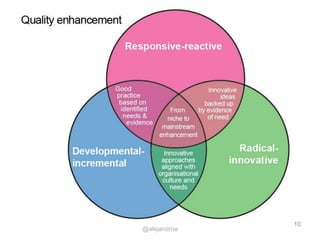
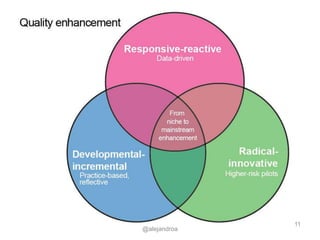
2. Quality enhancement
3. Raising the VLE bar
4. Pedagogic innovation (or absence of it)
a. Flipping right!
b. MOOCs
5. Conclusions
@alejandroa 2
Principles
• Quality of teaching central to the quality of the
student experience
• Transformational learning experiences can be
achieved through inspirational teaching
• Knowledge and learning are open, mobile,
connected and scalable
3@alejandroa
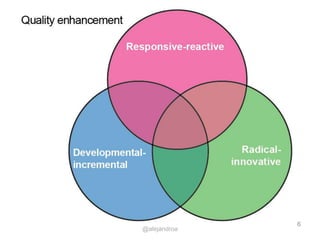
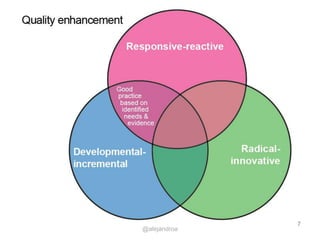
Quality enhancement
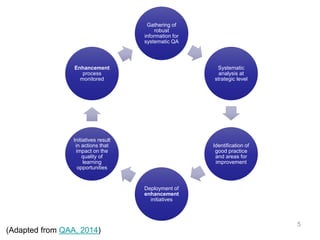
Deliberate steps at provider level to improve the
quality of students' learning opportunities.
Quality assurance generates information for quality
enhancement to take place. Enhancement is a
routine part of the way that higher education is
managed.
(QAA, 2014)
4
@alejandroa
Gathering of
robust
information for
systematic QA
Systematic
analysis at
strategic level
Identification of
good practice
and areas for
improvement
Deployment of
enhancement
initiatives
Initiatives result
in actions that
impact on the
quality of
learning
opportunities
Enhancement
process
monitored
5
(Adapted from QAA, 2014)
6
@alejandroa
7
@alejandroa
8
@alejandroa
9
@alejandroa
10
@alejandroa
11
@alejandroa
Level Focus Key features
12
@alejandroa
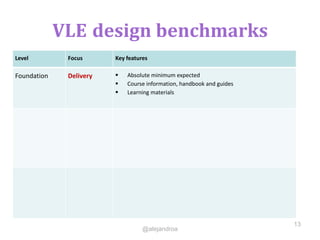
VLE design benchmarks
Level Focus Key features
Foundation Delivery  Absolute minimum expected
 Course information, handbook and guides
 Learning materials
13
@alejandroa
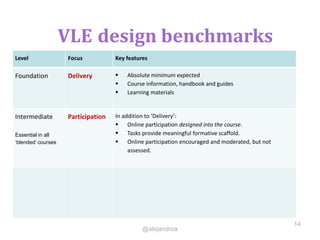
Level Focus Key features
Foundation Delivery  Absolute minimum expected
 Course information, handbook and guides
 Learning materials
Intermediate
Essential in all
‘blended’ courses
Participation In addition to ‘Delivery’:
 Online participation designed into the course.
 Tasks provide meaningful formative scaffold.
 Online participation encouraged and moderated, but not
assessed.
14
@alejandroa
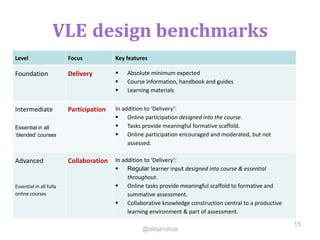
VLE design benchmarks
Level Focus Key features
Foundation Delivery  Absolute minimum expected
 Course information, handbook and guides
 Learning materials
Intermediate
Essential in all
‘blended’ courses
Participation In addition to ‘Delivery’:
 Online participation designed into the course.
 Tasks provide meaningful formative scaffold.
 Online participation encouraged and moderated, but not
assessed.
Advanced
Essential in all fully
online courses
Collaboration In addition to ‘Delivery’:
 Regular learner input designed into course & essential
throughout.
 Online tasks provide meaningful scaffold to formative and
summative assessment.
 Collaborative knowledge construction central to a productive
learning environment & part of assessment.
15
@alejandroa
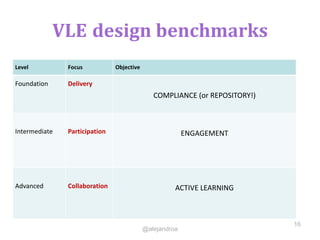
VLE design benchmarks
Level Focus Objective
Foundation Delivery
COMPLIANCE (or REPOSITORY!)
Intermediate Participation ENGAGEMENT
Advanced Collaboration ACTIVE LEARNING
16
@alejandroa
VLE design benchmarks
17
@alejandroa
The resource is not the course
18
@alejandroa
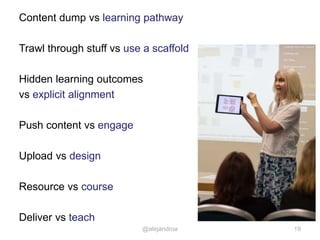
Content dump vs learning pathway
Trawl through stuff vs use a scaffold
Hidden learning outcomes
vs explicit alignment
Push content vs engage
Upload vs design
Resource vs course
Deliver vs teach
19@alejandroa
Task 1
What do these four concepts
have in common?
1. Over-promises and
under-delivery
2. Relentless optimism
3. Innovation
4. Potential
Innovation
“A new idea or a further development of an
existing product, process or method that is
applied in a specific context with the
intention to create a value added”.
(Kirkland and Sutch, 2009)
21
@alejandroa
What exactly is pedagogic innovation?
Definitions in the literature are:
– Lacking: people write about innovation without ever
stating what it is
– Vague or recursive
– Mistaken. For example, using technologies in
learning and teaching activities is not per se a
pedagogic innovation
22
@alejandroa
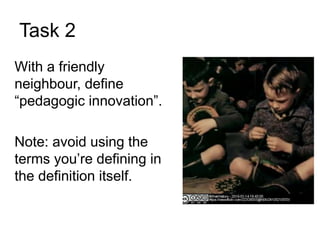
Task 2
With a friendly
neighbour, define
“pedagogic innovation”.
Note: avoid using the
terms you’re defining in
the definition itself.
Pedagogic innovation
“Adapting to characteristics of students and
responding to their development is an inherent
aspect of pedagogy. […] These adaptations
can be considered innovations if are based
[sic] on a new idea and when they have the
potential to improve student learning, or when
they are linked with other outcomes […]”
(Vieluf, Kaplan, Klieeme & Bayer, 2012)
24
@alejandroa
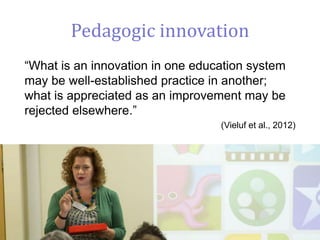
Pedagogic innovation
“What is an innovation in one education system
may be well-established practice in another;
what is appreciated as an improvement may be
rejected elsewhere.”
(Vieluf et al., 2012)
@alejandroa 25
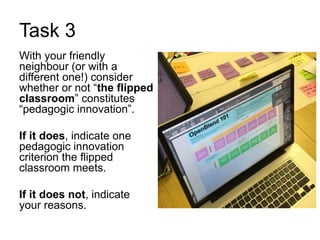
Task 3
With your friendly
neighbour (or with a
different one!) consider
whether or not “the flipped
classroom” constitutes
“pedagogic innovation”.
If it does, indicate one
pedagogic innovation
criterion the flipped
classroom meets.
If it does not, indicate
your reasons.
To flip or not to flip?
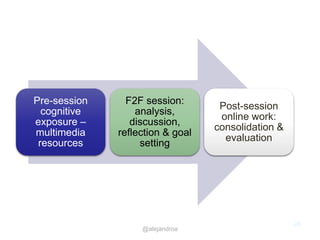
Pre-session
cognitive
exposure –
multimedia
resources
F2F session:
analysis,
discussion,
reflection & goal
setting
Post-session
online work:
consolidation &
evaluation
28
@alejandroa
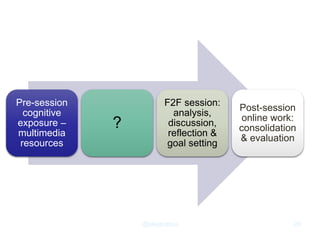
Pre-session
cognitive
exposure –
multimedia
resources
?
F2F session:
analysis,
discussion,
reflection &
goal setting
Post-session
online work:
consolidation
& evaluation
@alejandroa 29
Digital
resources
Tasks for
sense-
making
Analysis,
discussion,
reflection &
goal setting
Consolidation
& action
planning
ONLINE & F2F ONLINE
& F2F
FACE TO FACE
@alejandroa
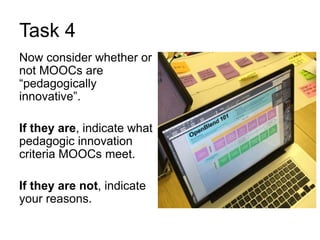
Task 4
Now consider whether or
not MOOCs are
“pedagogically
innovative”.
If they are, indicate what
pedagogic innovation
criteria MOOCs meet.
If they are not, indicate
your reasons.
32
@alejandroa
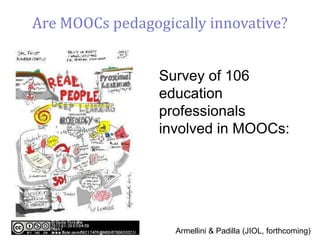
Are MOOCs pedagogically innovative?
Survey of 106
education
professionals
involved in MOOCs:
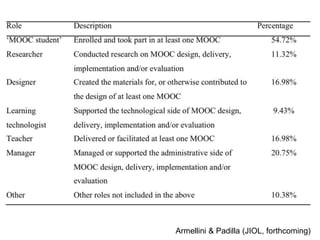
Armellini & Padilla (JIOL, forthcoming)
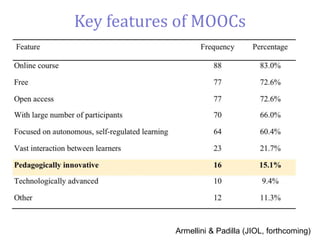
Key features of MOOCs
Armellini & Padilla (JIOL, forthcoming)
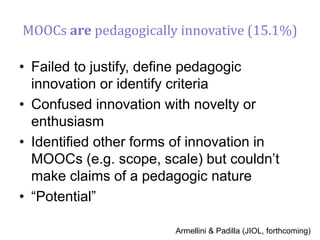
MOOCs are pedagogically innovative (15.1%)
• Failed to justify, define pedagogic
innovation or identify criteria
• Confused innovation with novelty or
enthusiasm
• Identified other forms of innovation in
MOOCs (e.g. scope, scale) but couldn’t
make claims of a pedagogic nature
• “Potential”
Armellini & Padilla (JIOL, forthcoming)
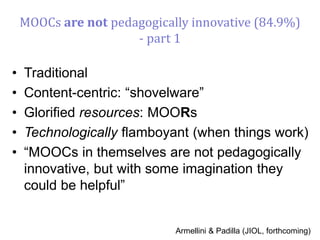
MOOCs are not pedagogically innovative (84.9%)
- part 1
• Traditional
• Content-centric: “shovelware”
• Glorified resources: MOORs
• Technologically flamboyant (when things work)
• “MOOCs in themselves are not pedagogically
innovative, but with some imagination they
could be helpful”
Armellini & Padilla (JIOL, forthcoming)
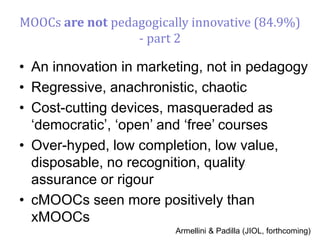
• An innovation in marketing, not in pedagogy
• Regressive, anachronistic, chaotic
• Cost-cutting devices, masqueraded as
‘democratic’, ‘open’ and ‘free’ courses
• Over-hyped, low completion, low value,
disposable, no recognition, quality
assurance or rigour
• cMOOCs seen more positively than
xMOOCs
Armellini & Padilla (JIOL, forthcoming)
MOOCs are not pedagogically innovative (84.9%)
- part 2
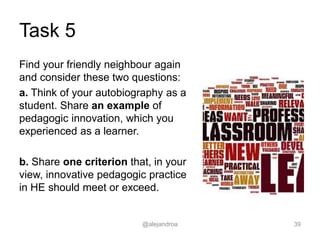
Task 5
Find your friendly neighbour again
and consider these two questions:
a. Think of your autobiography as a
student. Share an example of
pedagogic innovation, which you
experienced as a learner.
b. Share one criterion that, in your
view, innovative pedagogic practice
in HE should meet or exceed.
@alejandroa 39
Old wine in new bottles?
Task 6
Old wine
Learners generate content as
homework, which is used creatively in
the following seminar
Course in a (digital) box
Talk to your classmates
New bottles
Flipped classroom
xMOOC
Social learning
Learners bring their books and pencil
cases (among many other
technologies)
Loops of personalised assessment for
learning & feedback
Study on the bus or train, on campus
or at home
Teaching methods
Bring your own device (BYOD)
Dynamic assessment
Mobile learning
Pedagogies
@alejandroa 40
Task 7: next steps
What will your next
pedagogic innovation
be?
(be very specific!)
@alejandroa 41
“Now please redesign your course _____”:
…For employability
…For WBL
…To include more technology-enhanced learning
…For Team-based learning
…For blended learning
…So we have an online version of it
…To meet the new institutional challenges and priorities
@alejandroa 42
Redesign as a habit
• Pedagogic innovation is the exception, not
the rule.
• There’s far less innovation than meets the
eye.
• Pedagogic innovation keeps us refreshed,
motivated and engaged with what we do.
BUT…
@alejandroa 43
Conclusions: innovation and
excellence
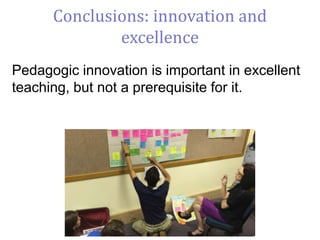
Pedagogic innovation is important in excellent
teaching, but not a prerequisite for it.
Conclusions: innovation and
excellence
Thank
you
Professor Alejandro Armellini
University of Northampton
@alejandroa | Ale.Armellini@northampton.ac.uk

Hull keynote 15 june 2016

  • 1.
    Professor Alejandro Armellini @alejandroa Ale.Armellini@northampton.ac.uk Pedagogicinnovation for teaching excellence: a strategic approach to enhancing teaching quality in higher education
  • 2.
    Plan 1. Principles 2. Qualityenhancement 3. Raising the VLE bar 4. Pedagogic innovation (or absence of it) a. Flipping right! b. MOOCs 5. Conclusions @alejandroa 2
  • 3.
    Principles • Quality ofteaching central to the quality of the student experience • Transformational learning experiences can be achieved through inspirational teaching • Knowledge and learning are open, mobile, connected and scalable 3@alejandroa
  • 4.
    Quality enhancement Deliberate stepsat provider level to improve the quality of students' learning opportunities. Quality assurance generates information for quality enhancement to take place. Enhancement is a routine part of the way that higher education is managed. (QAA, 2014) 4 @alejandroa
  • 5.
    Gathering of robust information for systematicQA Systematic analysis at strategic level Identification of good practice and areas for improvement Deployment of enhancement initiatives Initiatives result in actions that impact on the quality of learning opportunities Enhancement process monitored 5 (Adapted from QAA, 2014)
  • 6.
  • 7.
  • 8.
  • 9.
  • 10.
  • 11.
  • 12.
    Level Focus Keyfeatures 12 @alejandroa VLE design benchmarks
  • 13.
    VLE design benchmarks LevelFocus Key features Foundation Delivery  Absolute minimum expected  Course information, handbook and guides  Learning materials 13 @alejandroa
  • 14.
    Level Focus Keyfeatures Foundation Delivery  Absolute minimum expected  Course information, handbook and guides  Learning materials Intermediate Essential in all ‘blended’ courses Participation In addition to ‘Delivery’:  Online participation designed into the course.  Tasks provide meaningful formative scaffold.  Online participation encouraged and moderated, but not assessed. 14 @alejandroa VLE design benchmarks
  • 15.
    Level Focus Keyfeatures Foundation Delivery  Absolute minimum expected  Course information, handbook and guides  Learning materials Intermediate Essential in all ‘blended’ courses Participation In addition to ‘Delivery’:  Online participation designed into the course.  Tasks provide meaningful formative scaffold.  Online participation encouraged and moderated, but not assessed. Advanced Essential in all fully online courses Collaboration In addition to ‘Delivery’:  Regular learner input designed into course & essential throughout.  Online tasks provide meaningful scaffold to formative and summative assessment.  Collaborative knowledge construction central to a productive learning environment & part of assessment. 15 @alejandroa VLE design benchmarks
  • 16.
    Level Focus Objective FoundationDelivery COMPLIANCE (or REPOSITORY!) Intermediate Participation ENGAGEMENT Advanced Collaboration ACTIVE LEARNING 16 @alejandroa VLE design benchmarks
  • 17.
  • 18.
    The resource isnot the course 18 @alejandroa
  • 19.
    Content dump vslearning pathway Trawl through stuff vs use a scaffold Hidden learning outcomes vs explicit alignment Push content vs engage Upload vs design Resource vs course Deliver vs teach 19@alejandroa
  • 20.
    Task 1 What dothese four concepts have in common? 1. Over-promises and under-delivery 2. Relentless optimism 3. Innovation 4. Potential
  • 21.
    Innovation “A new ideaor a further development of an existing product, process or method that is applied in a specific context with the intention to create a value added”. (Kirkland and Sutch, 2009) 21 @alejandroa
  • 22.
    What exactly ispedagogic innovation? Definitions in the literature are: – Lacking: people write about innovation without ever stating what it is – Vague or recursive – Mistaken. For example, using technologies in learning and teaching activities is not per se a pedagogic innovation 22 @alejandroa
  • 23.
    Task 2 With afriendly neighbour, define “pedagogic innovation”. Note: avoid using the terms you’re defining in the definition itself.
  • 24.
    Pedagogic innovation “Adapting tocharacteristics of students and responding to their development is an inherent aspect of pedagogy. […] These adaptations can be considered innovations if are based [sic] on a new idea and when they have the potential to improve student learning, or when they are linked with other outcomes […]” (Vieluf, Kaplan, Klieeme & Bayer, 2012) 24 @alejandroa
  • 25.
    Pedagogic innovation “What isan innovation in one education system may be well-established practice in another; what is appreciated as an improvement may be rejected elsewhere.” (Vieluf et al., 2012) @alejandroa 25
  • 26.
    Task 3 With yourfriendly neighbour (or with a different one!) consider whether or not “the flipped classroom” constitutes “pedagogic innovation”. If it does, indicate one pedagogic innovation criterion the flipped classroom meets. If it does not, indicate your reasons.
  • 27.
    To flip ornot to flip?
  • 28.
    Pre-session cognitive exposure – multimedia resources F2F session: analysis, discussion, reflection& goal setting Post-session online work: consolidation & evaluation 28 @alejandroa
  • 29.
    Pre-session cognitive exposure – multimedia resources ? F2F session: analysis, discussion, reflection& goal setting Post-session online work: consolidation & evaluation @alejandroa 29
  • 30.
    Digital resources Tasks for sense- making Analysis, discussion, reflection & goalsetting Consolidation & action planning ONLINE & F2F ONLINE & F2F FACE TO FACE @alejandroa
  • 31.
    Task 4 Now considerwhether or not MOOCs are “pedagogically innovative”. If they are, indicate what pedagogic innovation criteria MOOCs meet. If they are not, indicate your reasons.
  • 32.
  • 33.
    Are MOOCs pedagogicallyinnovative? Survey of 106 education professionals involved in MOOCs: Armellini & Padilla (JIOL, forthcoming)
  • 34.
    Armellini & Padilla(JIOL, forthcoming)
  • 35.
    Key features ofMOOCs Armellini & Padilla (JIOL, forthcoming)
  • 36.
    MOOCs are pedagogicallyinnovative (15.1%) • Failed to justify, define pedagogic innovation or identify criteria • Confused innovation with novelty or enthusiasm • Identified other forms of innovation in MOOCs (e.g. scope, scale) but couldn’t make claims of a pedagogic nature • “Potential” Armellini & Padilla (JIOL, forthcoming)
  • 37.
    MOOCs are notpedagogically innovative (84.9%) - part 1 • Traditional • Content-centric: “shovelware” • Glorified resources: MOORs • Technologically flamboyant (when things work) • “MOOCs in themselves are not pedagogically innovative, but with some imagination they could be helpful” Armellini & Padilla (JIOL, forthcoming)
  • 38.
    • An innovationin marketing, not in pedagogy • Regressive, anachronistic, chaotic • Cost-cutting devices, masqueraded as ‘democratic’, ‘open’ and ‘free’ courses • Over-hyped, low completion, low value, disposable, no recognition, quality assurance or rigour • cMOOCs seen more positively than xMOOCs Armellini & Padilla (JIOL, forthcoming) MOOCs are not pedagogically innovative (84.9%) - part 2
  • 39.
    Task 5 Find yourfriendly neighbour again and consider these two questions: a. Think of your autobiography as a student. Share an example of pedagogic innovation, which you experienced as a learner. b. Share one criterion that, in your view, innovative pedagogic practice in HE should meet or exceed. @alejandroa 39
  • 40.
    Old wine innew bottles? Task 6 Old wine Learners generate content as homework, which is used creatively in the following seminar Course in a (digital) box Talk to your classmates New bottles Flipped classroom xMOOC Social learning Learners bring their books and pencil cases (among many other technologies) Loops of personalised assessment for learning & feedback Study on the bus or train, on campus or at home Teaching methods Bring your own device (BYOD) Dynamic assessment Mobile learning Pedagogies @alejandroa 40
  • 41.
    Task 7: nextsteps What will your next pedagogic innovation be? (be very specific!) @alejandroa 41
  • 42.
    “Now please redesignyour course _____”: …For employability …For WBL …To include more technology-enhanced learning …For Team-based learning …For blended learning …So we have an online version of it …To meet the new institutional challenges and priorities @alejandroa 42 Redesign as a habit
  • 43.
    • Pedagogic innovationis the exception, not the rule. • There’s far less innovation than meets the eye. • Pedagogic innovation keeps us refreshed, motivated and engaged with what we do. BUT… @alejandroa 43 Conclusions: innovation and excellence
  • 44.
    Pedagogic innovation isimportant in excellent teaching, but not a prerequisite for it. Conclusions: innovation and excellence
  • 45.
    Thank you Professor Alejandro Armellini Universityof Northampton @alejandroa | Ale.Armellini@northampton.ac.uk

Editor's Notes

  • #4 Ale
  • #23 Examples of papers with no clear, explicit definition of pedagogical innovation: Conole, G., De Laat, M., Dillon, T., & Darby, J. (2008). ‘Disruptive technologies’,‘pedagogical innovation’: What’s new? Findings from an in-depth study of students’ use and perception of technology. Computers & Education,50(2), 511-524. Salmon, G. (2005). Flying not flapping: a strategic framework for e-learning and pedagogical innovation in higher education institutions. Research in Learning Technology, 13(3), 201-218. Sharples, M., Adams, A., Ferguson, R., Gaved, M., McAndrew, P., Rienties, B., Weller, M., & Whitelock, D. (2014). Innovating Pedagogy 2014: Open University Innovation Report 3. Milton Keynes, UK: The Open University.
  • #25 Vieluf, S., Kaplan, D., Klieeme, E. & Bayer, S. (2012). Teaching Practices and Pedagogical Innovation: Evidence from TALIS. OECD Publishing. http://dx.doi.org/10.1787/9789264123540-en If we consider this true, then anything could be considered innovative! A “definition”: “Adapting to characteristics of students and responding to their development is an inherent aspect of pedagogy. […] These adaptations can be considered innovations if are based on a new idea and when they have the potential to improve student learning, or when they are linked with other outcomes (such as improving the health of students, preventing teenage violence or drug abuse, or improving the job satisfaction and well-being of teachers)” (Vieluf, Kaplan, Klieeme & Bayer, 2012).
  • #26 Vieluf, S., Kaplan, D., Klieeme, E. & Bayer, S. (2012). Teaching Practices and Pedagogical Innovation: Evidence from TALIS. OECD Publishing. http://dx.doi.org/10.1787/9789264123540-en If we consider this true, then anything could be considered innovative! A “definition”: “Adapting to characteristics of students and responding to their development is an inherent aspect of pedagogy. […] These adaptations can be considered innovations if are based on a new idea and when they have the potential to improve student learning, or when they are linked with other outcomes (such as improving the health of students, preventing teenage violence or drug abuse, or improving the job satisfaction and well-being of teachers)” (Vieluf, Kaplan, Klieeme & Bayer, 2012).
  • #29 Ale
  • #30 Ale
  • #31 Ale
  • #33 Esto se puede reemplazar con las anteriores dos diapositivas.