Enabling and enhancing
student learning and
support through technology
Professor Peter Francis, deputy vice-chancellor,
Northumbria University
Enabling and enhancing student
learning and support through
technology
Professor Peter Francis, Deputy Vice Chancellor,
Professor of Criminology, Northumbria University
Abstract
In recent months Universities have rapidly implemented significant and often
unplanned changes to the ways in which education is delivered. In part the
nature of such changes will be temporary, although the significance of such
changes may be long lasting. One can foresee that many Universities will
need to focus more time and energy on their approach to technology for
student learning, and as a result their digital leadership.
Yet technology on its own is not the solution; it is an enabler. In this session I
will reflect briefly on Northumbria’s journey towards technology enhanced
learning and support, one that encompasses a broad array of technological
developments, and involved many colleagues and students, the aim of which
is the delivery of a high-quality and inclusive student experience for all.
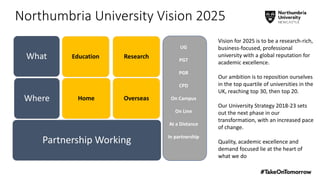
Northumbria University Vision 2025
Partnership Working
Where Home
Education
Overseas
ResearchWhat
UG
PGT
PGR
CPD
On Campus
On Line
At a Distance
In partnership
Vision for 2025 is to be a research-rich,
business-focused, professional
university with a global reputation for
academic excellence.
Our ambition is to reposition ourselves
in the top quartile of universities in the
UK, reaching top 30, then top 20.
Our University Strategy 2018-23 sets
out the next phase in our
transformation, with an increased pace
of change.
Quality, academic excellence and
demand focused lie at the heart of
what we do
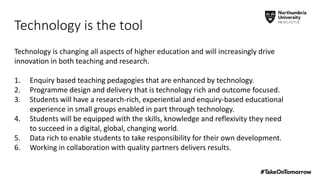
Technology is the tool
Technology is changing all aspects of higher education and will increasingly drive
innovation in both teaching and research.
1. Enquiry based teaching pedagogies that are enhanced by technology.
2. Programme design and delivery that is technology rich and outcome focused.
3. Students will have a research-rich, experiential and enquiry-based educational
experience in small groups enabled in part through technology.
4. Students will be equipped with the skills, knowledge and reflexivity they need
to succeed in a digital, global, changing world.
5. Data rich to enable students to take responsibility for their own development.
6. Working in collaboration with quality partners delivers results.
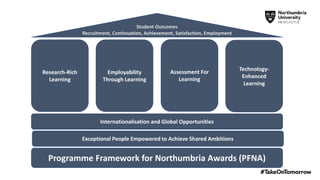
Programme Framework for Northumbria Awards (PFNA)
Exceptional People Empowered to Achieve Shared Ambitions
Internationalisation and Global Opportunities
Research-Rich
Learning
Employability
Through Learning
Assessment For
Learning
Technology-
Enhanced
Learning
Student Outcomes
Recruitment, Continuation, Achievement, Satisfaction, Employment
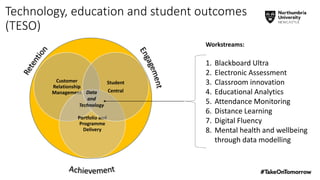
Technology, education and student outcomes
(TESO)
Customer
Relationship
Management
Portfolio and
Programme
Delivery
Student
CentralData
and
Technology
Workstreams:
1. Blackboard Ultra
2. Electronic Assessment
3. Classroom innovation
4. Educational Analytics
5. Attendance Monitoring
6. Distance Learning
7. Digital Fluency
8. Mental health and wellbeing
through data modelling
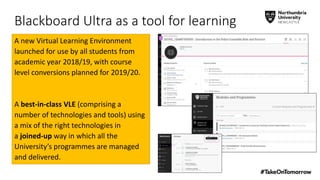
Blackboard Ultra as a tool for learning
A new Virtual Learning Environment
launched for use by all students from
academic year 2018/19, with course
level conversions planned for 2019/20.
A best-in-class VLE (comprising a
number of technologies and tools) using
a mix of the right technologies in
a joined-up way in which all the
University’s programmes are managed
and delivered.
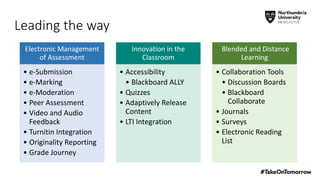
Northumbria’s journey to Blackboard Ultra
Electronic Management
of Assessment
• e-Submission
• e-Marking
• e-Moderation
• Peer Assessment
• Video and Audio
Feedback
• Turnitin Integration
• Originality Reporting
• Grade Journey
Innovation in the
Classroom
• Accessibility
• Blackboard ALLY
• Quizzes
• Adaptively Release
Content
• LTI Integration
Blended and Distance
Learning
• Collaboration Tools
• Discussion Boards
• Blackboard
Collaborate
• Journals
• Surveys
• Electronic Reading
List
Leading the way
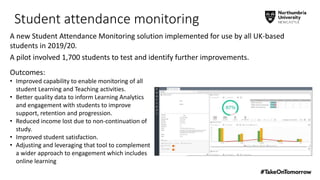
Student attendance monitoring
A new Student Attendance Monitoring solution implemented for use by all UK-based
students in 2019/20.
A pilot involved 1,700 students to test and identify further improvements.
Outcomes:
• Improved capability to enable monitoring of all
student Learning and Teaching activities.
• Better quality data to inform Learning Analytics
and engagement with students to improve
support, retention and progression.
• Reduced income lost due to non-continuation of
study.
• Improved student satisfaction.
• Adjusting and leveraging that tool to complement
a wider approach to engagement which includes
online learning
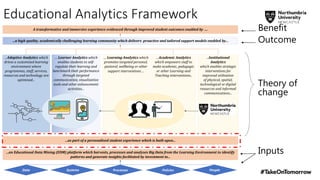
Educational Analytics Framework
...an Educational Data Mining (EDM) platform which harvests, processes and analyses Big Data from the Learning Environment to identify
patterns and generate insights facilitated by investment in...
...Institutional
Analytics
which enables strategic
interventions for
improved utilisation
of physical, spatial,
technological or digital
resources and informed
communications...
Academic Analytics
which empowers staff to
make academic, pedagogic
or other Learning and
Teaching interventions..
Learning Analytics which
promotes targeted personal,
pastoral, wellbeing or other
support interventions ...
Learner Analytics which
enables students to self-
regulate their learning and
benchmark their performance
through targeted
communication, visualisation
tools and other enhancement
activities...
A transformative and immersive experience evidenced through improved student outcomes enabled by
Northumbria Educational Analytics 2023
Systems PeopleData
Adaptive Analytics which
drives a customised learning
environment where
programmes, staff, services,
resources and technology are
optimised...
...as part of a personalised student experience which is built upon...
...a high quality, academically challenging learning community which delivers proactive and tailored support models enabled by...
Processes Policies
Benefit
Outcome
Theory of
change
Inputs
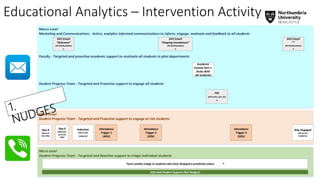
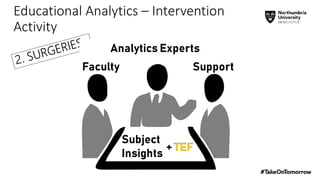
Educational Analytics – Intervention ActivitySemester 1 High Level Nudge Plan
Meso Level
Student Progress Team - Targeted and Proactive support to engage at risk students
Micro Level
Student Progress Team - Targeted and Reactive support to triage individual students
Macro Level
Marketing and Communications - Active, analytics informed communications to inform, engage, motivate and feedback to all students
Faculty - Targeted and proactive academic support to motivate all students in pilot departments
Student Progress Team - Targeted and Proactive support to engage all students
DVC Email
Welcome
(At Northumbria)
+
Academic
Comms Part 1:
Study Skills
(all students)
DVC Email
Keeping momentum
(At Northumbria)
+
DVC Email
(At Northumbria)
+
PEC
(All at NU, Ldn, DL)
+
Stay Engaged
(All at risk
students)
Twice weekly nudge to students who have dropped a prediction status ^
Informed Student Support (Not Nudges)
Induction
(All at risk
students)
Day 0
(New at
risk UGs)
Attendance
Trigger 2
(50%)
Attendance
Trigger 3
(50%)
Attendance
Trigger 1
(40%)
Day 0
(Returnin
g at risk
UGs)
Educational Analytics – Intervention
Activity
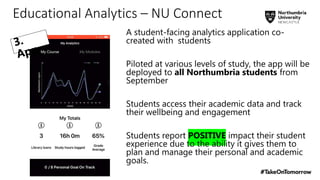
A student-facing analytics application co-
created with students
Piloted at various levels of study, the app will be
deployed to all Northumbria students from
September
Students access their academic data and track
their wellbeing and engagement
Students report POSITIVE impact their student
experience due to the ability it gives them to
plan and manage their personal and academic
goals.
Educational Analytics – NU Connect
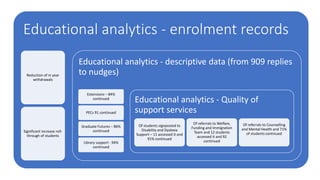
Reduction of in year
withdrawals
Significant increase roll-
through of students
Educational analytics - descriptive data (from 909 replies
to nudges)
Extensions – 84%
continued
PECs 91 continued
Graduate Futures – 86%
continued
Library support - 94%
continued
Educational analytics - Quality of
support services
Of students signposted to
Disability and Dyslexia
Support – 11 accessed it and
91% continued
Of referrals to Welfare,
Funding and Immigration
Team and 12 students
accessed it and 92
continued
Of referrals to Counselling
and Mental Health and 71%
of students continued
Educational analytics - enrolment records
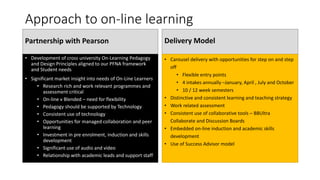
Approach to on-line learning
Partnership with Pearson
• Development of cross university On-Learning Pedagogy
and Design Principles aligned to our PFNA framework
and Student needs
• Significant market insight into needs of On-Line Learners
• Research rich and work relevant programmes and
assessment critical
• On-line v Blended – need for flexibility
• Pedagogy should be supported by Technology
• Consistent use of technology
• Opportunities for managed collaboration and peer
learning
• Investment in pre enrolment, induction and skills
development
• Significant use of audio and video
• Relationship with academic leads and support staff
Delivery Model
• Carousel delivery with opportunities for step on and step
off
• Flexible entry points
• 4 intakes annually –January, April , July and October
• 10 / 12 week semesters
• Distinctive and consistent learning and teaching strategy
• Work related assessment
• Consistent use of collaborative tools – BBUltra
Collaborate and Discussion Boards
• Embedded on-line induction and academic skills
development
• Use of Success Advisor model
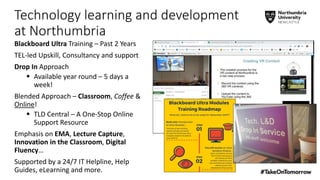
Technology learning and development
at Northumbria
Blackboard Ultra Training – Past 2 Years
TEL-led Upskill, Consultancy and support
Drop In Approach
 Available year round – 5 days a
week!
Blended Approach – Classroom, Coffee &
Online!
 TLD Central – A One-Stop Online
Support Resource
Emphasis on EMA, Lecture Capture,
Innovation in the Classroom, Digital
Fluency…
Supported by a 24/7 IT Helpline, Help
Guides, eLearning and more.
‘Digital Leadership’ in
education and the
student experience
Digital leadership is about:
• A programmatic / structured action
orientated approach.
• A transformation agenda.
• Connecting vision, strategy, culture
and technology.
• A participative approach to people.
• Engagement and communication.
• Using data to understand.
• Outcome rather than process.
• Cocreating rather than imposing.
Digital leadership is not about:
• The technology.
1. Ensure the pedagogy and learning opportunities
inform the approach.
2. Technology is the enabler – the tool.
3. Content is the most important, quality informed
by academic excellence.
4. Bringing excellent people – staff and students -
and technology together to enhance education
and contribute to a dynamic total student
experience.
5. Ensuring innovation, flexibility and creativity are
actively encouraged and supported through a
model that is effective, efficient and accessible.
6. Informed by evidence from evaluation and
research at institutional, sector and trans-sector
levels.
7. Reflective at all points, and able and willing to
pause, take stock, assess, move forward, and
evaluate.
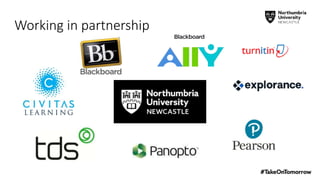
Working in partnership
Professor Peter Francis
Deputy Vice Chancellor
Northumbria University
Email: peter.francis@northumbria.ac.uk
Twitter: @ProfPFrancis
T: +44 (0)191 243 7400
M: +44 (0)793 5518767

Enabling and enhancing student learning and support through technology

  • 1.
    Enabling and enhancing studentlearning and support through technology Professor Peter Francis, deputy vice-chancellor, Northumbria University
  • 2.
    Enabling and enhancingstudent learning and support through technology Professor Peter Francis, Deputy Vice Chancellor, Professor of Criminology, Northumbria University
  • 3.
    Abstract In recent monthsUniversities have rapidly implemented significant and often unplanned changes to the ways in which education is delivered. In part the nature of such changes will be temporary, although the significance of such changes may be long lasting. One can foresee that many Universities will need to focus more time and energy on their approach to technology for student learning, and as a result their digital leadership. Yet technology on its own is not the solution; it is an enabler. In this session I will reflect briefly on Northumbria’s journey towards technology enhanced learning and support, one that encompasses a broad array of technological developments, and involved many colleagues and students, the aim of which is the delivery of a high-quality and inclusive student experience for all.
  • 4.
    Northumbria University Vision2025 Partnership Working Where Home Education Overseas ResearchWhat UG PGT PGR CPD On Campus On Line At a Distance In partnership Vision for 2025 is to be a research-rich, business-focused, professional university with a global reputation for academic excellence. Our ambition is to reposition ourselves in the top quartile of universities in the UK, reaching top 30, then top 20. Our University Strategy 2018-23 sets out the next phase in our transformation, with an increased pace of change. Quality, academic excellence and demand focused lie at the heart of what we do
  • 5.
    Technology is thetool Technology is changing all aspects of higher education and will increasingly drive innovation in both teaching and research. 1. Enquiry based teaching pedagogies that are enhanced by technology. 2. Programme design and delivery that is technology rich and outcome focused. 3. Students will have a research-rich, experiential and enquiry-based educational experience in small groups enabled in part through technology. 4. Students will be equipped with the skills, knowledge and reflexivity they need to succeed in a digital, global, changing world. 5. Data rich to enable students to take responsibility for their own development. 6. Working in collaboration with quality partners delivers results.
  • 6.
    Programme Framework forNorthumbria Awards (PFNA) Exceptional People Empowered to Achieve Shared Ambitions Internationalisation and Global Opportunities Research-Rich Learning Employability Through Learning Assessment For Learning Technology- Enhanced Learning Student Outcomes Recruitment, Continuation, Achievement, Satisfaction, Employment
  • 7.
    Technology, education andstudent outcomes (TESO) Customer Relationship Management Portfolio and Programme Delivery Student CentralData and Technology Workstreams: 1. Blackboard Ultra 2. Electronic Assessment 3. Classroom innovation 4. Educational Analytics 5. Attendance Monitoring 6. Distance Learning 7. Digital Fluency 8. Mental health and wellbeing through data modelling
  • 8.
    Blackboard Ultra asa tool for learning A new Virtual Learning Environment launched for use by all students from academic year 2018/19, with course level conversions planned for 2019/20. A best-in-class VLE (comprising a number of technologies and tools) using a mix of the right technologies in a joined-up way in which all the University’s programmes are managed and delivered.
  • 9.
  • 10.
    Electronic Management of Assessment •e-Submission • e-Marking • e-Moderation • Peer Assessment • Video and Audio Feedback • Turnitin Integration • Originality Reporting • Grade Journey Innovation in the Classroom • Accessibility • Blackboard ALLY • Quizzes • Adaptively Release Content • LTI Integration Blended and Distance Learning • Collaboration Tools • Discussion Boards • Blackboard Collaborate • Journals • Surveys • Electronic Reading List Leading the way
  • 11.
    Student attendance monitoring Anew Student Attendance Monitoring solution implemented for use by all UK-based students in 2019/20. A pilot involved 1,700 students to test and identify further improvements. Outcomes: • Improved capability to enable monitoring of all student Learning and Teaching activities. • Better quality data to inform Learning Analytics and engagement with students to improve support, retention and progression. • Reduced income lost due to non-continuation of study. • Improved student satisfaction. • Adjusting and leveraging that tool to complement a wider approach to engagement which includes online learning
  • 12.
    Educational Analytics Framework ...anEducational Data Mining (EDM) platform which harvests, processes and analyses Big Data from the Learning Environment to identify patterns and generate insights facilitated by investment in... ...Institutional Analytics which enables strategic interventions for improved utilisation of physical, spatial, technological or digital resources and informed communications... Academic Analytics which empowers staff to make academic, pedagogic or other Learning and Teaching interventions.. Learning Analytics which promotes targeted personal, pastoral, wellbeing or other support interventions ... Learner Analytics which enables students to self- regulate their learning and benchmark their performance through targeted communication, visualisation tools and other enhancement activities... A transformative and immersive experience evidenced through improved student outcomes enabled by Northumbria Educational Analytics 2023 Systems PeopleData Adaptive Analytics which drives a customised learning environment where programmes, staff, services, resources and technology are optimised... ...as part of a personalised student experience which is built upon... ...a high quality, academically challenging learning community which delivers proactive and tailored support models enabled by... Processes Policies Benefit Outcome Theory of change Inputs
  • 13.
    Educational Analytics –Intervention ActivitySemester 1 High Level Nudge Plan Meso Level Student Progress Team - Targeted and Proactive support to engage at risk students Micro Level Student Progress Team - Targeted and Reactive support to triage individual students Macro Level Marketing and Communications - Active, analytics informed communications to inform, engage, motivate and feedback to all students Faculty - Targeted and proactive academic support to motivate all students in pilot departments Student Progress Team - Targeted and Proactive support to engage all students DVC Email Welcome (At Northumbria) + Academic Comms Part 1: Study Skills (all students) DVC Email Keeping momentum (At Northumbria) + DVC Email (At Northumbria) + PEC (All at NU, Ldn, DL) + Stay Engaged (All at risk students) Twice weekly nudge to students who have dropped a prediction status ^ Informed Student Support (Not Nudges) Induction (All at risk students) Day 0 (New at risk UGs) Attendance Trigger 2 (50%) Attendance Trigger 3 (50%) Attendance Trigger 1 (40%) Day 0 (Returnin g at risk UGs)
  • 14.
    Educational Analytics –Intervention Activity
  • 15.
    A student-facing analyticsapplication co- created with students Piloted at various levels of study, the app will be deployed to all Northumbria students from September Students access their academic data and track their wellbeing and engagement Students report POSITIVE impact their student experience due to the ability it gives them to plan and manage their personal and academic goals. Educational Analytics – NU Connect
  • 16.
    Reduction of inyear withdrawals Significant increase roll- through of students Educational analytics - descriptive data (from 909 replies to nudges) Extensions – 84% continued PECs 91 continued Graduate Futures – 86% continued Library support - 94% continued Educational analytics - Quality of support services Of students signposted to Disability and Dyslexia Support – 11 accessed it and 91% continued Of referrals to Welfare, Funding and Immigration Team and 12 students accessed it and 92 continued Of referrals to Counselling and Mental Health and 71% of students continued Educational analytics - enrolment records
  • 17.
    Approach to on-linelearning Partnership with Pearson • Development of cross university On-Learning Pedagogy and Design Principles aligned to our PFNA framework and Student needs • Significant market insight into needs of On-Line Learners • Research rich and work relevant programmes and assessment critical • On-line v Blended – need for flexibility • Pedagogy should be supported by Technology • Consistent use of technology • Opportunities for managed collaboration and peer learning • Investment in pre enrolment, induction and skills development • Significant use of audio and video • Relationship with academic leads and support staff Delivery Model • Carousel delivery with opportunities for step on and step off • Flexible entry points • 4 intakes annually –January, April , July and October • 10 / 12 week semesters • Distinctive and consistent learning and teaching strategy • Work related assessment • Consistent use of collaborative tools – BBUltra Collaborate and Discussion Boards • Embedded on-line induction and academic skills development • Use of Success Advisor model
  • 18.
    Technology learning anddevelopment at Northumbria Blackboard Ultra Training – Past 2 Years TEL-led Upskill, Consultancy and support Drop In Approach  Available year round – 5 days a week! Blended Approach – Classroom, Coffee & Online!  TLD Central – A One-Stop Online Support Resource Emphasis on EMA, Lecture Capture, Innovation in the Classroom, Digital Fluency… Supported by a 24/7 IT Helpline, Help Guides, eLearning and more.
  • 19.
    ‘Digital Leadership’ in educationand the student experience Digital leadership is about: • A programmatic / structured action orientated approach. • A transformation agenda. • Connecting vision, strategy, culture and technology. • A participative approach to people. • Engagement and communication. • Using data to understand. • Outcome rather than process. • Cocreating rather than imposing. Digital leadership is not about: • The technology. 1. Ensure the pedagogy and learning opportunities inform the approach. 2. Technology is the enabler – the tool. 3. Content is the most important, quality informed by academic excellence. 4. Bringing excellent people – staff and students - and technology together to enhance education and contribute to a dynamic total student experience. 5. Ensuring innovation, flexibility and creativity are actively encouraged and supported through a model that is effective, efficient and accessible. 6. Informed by evidence from evaluation and research at institutional, sector and trans-sector levels. 7. Reflective at all points, and able and willing to pause, take stock, assess, move forward, and evaluate.
  • 20.
  • 21.
    Professor Peter Francis DeputyVice Chancellor Northumbria University Email: peter.francis@northumbria.ac.uk Twitter: @ProfPFrancis T: +44 (0)191 243 7400 M: +44 (0)793 5518767

Editor's Notes

  • #9 KMB and HW Why? We needed a new VLE to support our students and help enable our vision and new strategy. Quick video to summarise our journey to Ultra The Outcomes from the transition are: A consistent module experience for all students – campus, online, distance, overseas Mobile responsive, anytime, anywhere, anyway Improved Accessibility New functionality on a rolling basis Deeper internal and external system integration
  • #19 Underpinning much of the Technology-led activity at Northumbria is the training and support offer provided by the Technology Learning & Development team. Consisting of a team of academics & technologists, the TLD team for the past two years particularly have been heavily involved in the training, support and consultancy surrounding the VLE project. Through a phased approach, the team have delivered in excess of 130 face to face training sessions for the move to Ultra base navigation, whilst right now are in the midst of delivering close to 250 sessions to the academic populous at Northumbria in anticipation of the move to Ultra course view for the academic year 2019-20. Centric to much of the work that the team undertakes, is the university business outcome surrounding digital fluency which has led to a vast range of training, support & upskill being not only developed by the team but delivered through a range of mediums such as asynchronous eLearning, bespoke help & video guidance, face to face training, blended learning methodologies and much more, which has led to over 80% of the academic populous having engaged with the Tech. L&D training offer at some point. And in order to truly support this diverse populous at Northumbria, consisting not only of Academic staff but Professional Support staff too, the team have evolved their approach to delivery following analysis over the past three years, moving away from the traditional ‘one size fits all’ approach often found within the TEL-discipline, we now offer a fully bespoke, 5 day a week, drop-in and consultancy service which has seen widespread use and adoption since it’s inception in September last year. The team have a clear focus which is underpinned, supported and driven by the universities various boards and overarching strategy and as such we have placed a heavy emphasis on supporting staff in enabling their programmes of study for electronic management of assessment, undertaking and engaging with lecture capture, innovation within the classroom and delivering the universities business outcome regarding enabling all staff and students to become digitally fluent. We have fostered an excellent working relationship with our academic colleagues through embracing a hearts and minds approach to the training as opposed to a dictatorial one, which I’m delighted to say has yielded excellent results in terms of staff engagement with the training offer and impact that the upskill of our staff is having on the student experience at Northumbria University.