Cities and growth 
Gilles Duranton 
Wharton 
oecd, 26 September 2014
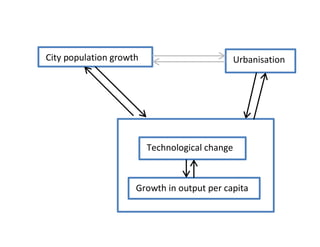
City population growth Urbanisation 
Technological change 
Growth in output per capita
Three sets of issues 
 The eect of economic growth and technological change 
on cities 
 The interaction between urbanisation and development 
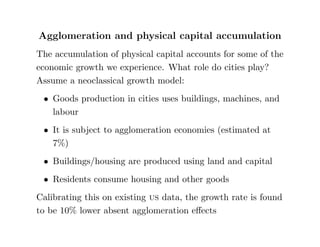
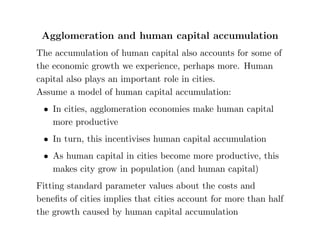
 The eects of cities on economic growth and 
technological change
What drives the population growth of cities? 
It is a hard question but much easier than the identi
cation 
of drivers of country growth 
 Many more cities than countries 
 Far fewer determinants 
 Lots more data 
 Population is easier to count than gdp 
 Data heterogeneity is less 
 A common history makes identi
cation easier 
As a result, some progress
The main drivers of population growth for US 
cities 
 Amenities 
 Roads 
 Human capital and entrepreneurship
Some caveats 
 We know a lot more about us cities but most results have 
been replicated elsewhere in fully urbanised countries 
 Despite some well identi
ed channels, we can explain 
maybe half the story 
 There are some areas of complete ignorance. For instance: 
{ Urban policies 
{ Urban leadership / governance
Amenities 
 Very strong association: 1 s.d. of January temperature 
leads to 0.6 s.d. of population growth 
 Focusing on exogenous amenities alleviates simultaneity 
concerns 
 Warm Januaries may still be correlated with other 
growth factors 
 Main explanation: a wealth/demand eect
Transport 
 Another strong association: 1 s.d. of Interstate Highway 
km leads to 0.7 s.d. of population growth 
 Roads also induce urban decentralisation 
 Roads are not randomly given. Identi
cation using 
historical instruments, random placements of rural roads, 
historical accidents 
 Main explanation: roads lower travel costs and make a 
city cheaper as predicted by the monocentric model 
 Wrinkle: the eects of roads on population growth is 
`small' 
 More generally, transport technology greatly shapes cities
Human capital 
 The third strong association: 1 s.d. of the initial share of 
university graduates leads to 0.25 s.d. of population 
growth 
 Worry the more skilled may choose to locate in fast 
growing cities 
 A variety of identi
cation strategies including the 
establishment of land grant colleges c. 1860 
 Entrepreneurship as a speci
c form of human capital 
 Key underlying mechanism: cities are better places for 
exploiting human capital and accumulating it through 
learning
Summary 
 Amenities, roads, and human capital are the main known 
drivers of city population growth 
 Results are broadly consistent across rich (`oecd') 
countries that are fully urbanised 
 Less is known about city growth in developing countries 
which are still urbanising 
 Transportation matters perhaps more whereas the role of 
amenities is in doubt 
 This is the world inside the technology frontier and inside 
the urbanisation frontier that comprises the large 
majority of mankind
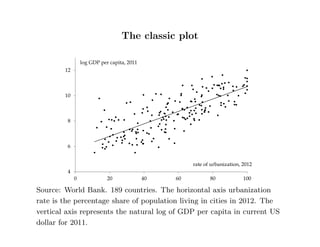
The classic plot 
12 
10 
8 
6 
4 
log GDP per capita, 2011 
rate of urbanization, 2012 
0 20 40 60 80 100 
Source: World Bank. 189 countries. The horizontal axis urbanization 
rate is the percentage share of population living in cities in 2012. The 
vertical axis represents the natural log of GDP per capita in current US 
dollar for 2011.
Well known, extremely robust 
 Each extra percentage point of urban population is 
associated with an extra 5 percent of gdp per capita 
 Agglomeration economies can explain at most a small 
part of the relationship (a
fth?) 
 Models of structural change? 
{ Simple models of manufacturing pull require 
quantitatively implausible parameter values 
{ Models of rural push are even worse 
{ Suggestive of strong frictions in the process or that 
urbanisation is an outcome of `development' 
{ We need to take this question more seriously. 50 
million rural dwellers move to cities every year
The really important but really hard question 
Do cities aect growth? 
 We can write models where they do 
 Identifying out of the cross-section of countries is really 
hard 
 Route 1: use the cross-section of cities 
{ But many questions will be hard to analyse 
{ We cannot look at gdp growth directly but only at 
correlates of growth 
 Route 2: rely more strongly on models
A well-established fact... 
Innovative activity is geographically highly concentrated 
 RD labs are much more concentrated than labour in 
the us 
 Several large us cities receive a share of patents that is 5 
times of more their share of population 
 For small metropolitan, the population share is nearly 3 
times the patent share 
 For non-metro areas, it is more than 10 times. 
 Strong tendency for RD labs and establishments in 
RD intensive activities to locate extremely close to each 
other

Cities and growth, Gilles Duranton

  • 1.
    Cities and growth Gilles Duranton Wharton oecd, 26 September 2014
  • 2.
    City population growthUrbanisation Technological change Growth in output per capita
  • 3.
    Three sets ofissues The eect of economic growth and technological change on cities The interaction between urbanisation and development The eects of cities on economic growth and technological change
  • 4.
    What drives thepopulation growth of cities? It is a hard question but much easier than the identi
  • 5.
    cation of driversof country growth Many more cities than countries Far fewer determinants Lots more data Population is easier to count than gdp Data heterogeneity is less A common history makes identi
  • 6.
    cation easier Asa result, some progress
  • 7.
    The main driversof population growth for US cities Amenities Roads Human capital and entrepreneurship
  • 8.
    Some caveats We know a lot more about us cities but most results have been replicated elsewhere in fully urbanised countries Despite some well identi
  • 9.
    ed channels, wecan explain maybe half the story There are some areas of complete ignorance. For instance: { Urban policies { Urban leadership / governance
  • 10.
    Amenities Verystrong association: 1 s.d. of January temperature leads to 0.6 s.d. of population growth Focusing on exogenous amenities alleviates simultaneity concerns Warm Januaries may still be correlated with other growth factors Main explanation: a wealth/demand eect
  • 11.
    Transport Anotherstrong association: 1 s.d. of Interstate Highway km leads to 0.7 s.d. of population growth Roads also induce urban decentralisation Roads are not randomly given. Identi
  • 12.
    cation using historicalinstruments, random placements of rural roads, historical accidents Main explanation: roads lower travel costs and make a city cheaper as predicted by the monocentric model Wrinkle: the eects of roads on population growth is `small' More generally, transport technology greatly shapes cities
  • 13.
    Human capital The third strong association: 1 s.d. of the initial share of university graduates leads to 0.25 s.d. of population growth Worry the more skilled may choose to locate in fast growing cities A variety of identi
  • 14.
    cation strategies includingthe establishment of land grant colleges c. 1860 Entrepreneurship as a speci
  • 15.
    c form ofhuman capital Key underlying mechanism: cities are better places for exploiting human capital and accumulating it through learning
  • 16.
    Summary Amenities,roads, and human capital are the main known drivers of city population growth Results are broadly consistent across rich (`oecd') countries that are fully urbanised Less is known about city growth in developing countries which are still urbanising Transportation matters perhaps more whereas the role of amenities is in doubt This is the world inside the technology frontier and inside the urbanisation frontier that comprises the large majority of mankind
  • 17.
    The classic plot 12 10 8 6 4 log GDP per capita, 2011 rate of urbanization, 2012 0 20 40 60 80 100 Source: World Bank. 189 countries. The horizontal axis urbanization rate is the percentage share of population living in cities in 2012. The vertical axis represents the natural log of GDP per capita in current US dollar for 2011.
  • 18.
    Well known, extremelyrobust Each extra percentage point of urban population is associated with an extra 5 percent of gdp per capita Agglomeration economies can explain at most a small part of the relationship (a
  • 19.
    fth?) Modelsof structural change? { Simple models of manufacturing pull require quantitatively implausible parameter values { Models of rural push are even worse { Suggestive of strong frictions in the process or that urbanisation is an outcome of `development' { We need to take this question more seriously. 50 million rural dwellers move to cities every year
  • 20.
    The really importantbut really hard question Do cities aect growth? We can write models where they do Identifying out of the cross-section of countries is really hard Route 1: use the cross-section of cities { But many questions will be hard to analyse { We cannot look at gdp growth directly but only at correlates of growth Route 2: rely more strongly on models
  • 21.
    A well-established fact... Innovative activity is geographically highly concentrated RD labs are much more concentrated than labour in the us Several large us cities receive a share of patents that is 5 times of more their share of population For small metropolitan, the population share is nearly 3 times the patent share For non-metro areas, it is more than 10 times. Strong tendency for RD labs and establishments in RD intensive activities to locate extremely close to each other