A NEW GLOBAL ORDER OF
METROPOLITAN AREAS
Soo-Jin KIM
OECD Centre for Entrepreneurship, SMEs, Regions and Cities
Cities, Urban Policies and Sustainable Development Division
“Post-Habitat III Future challenges of the metropolis:
A contribution to the New Urban Agenda” conference
Barcelona, 22 May 2018
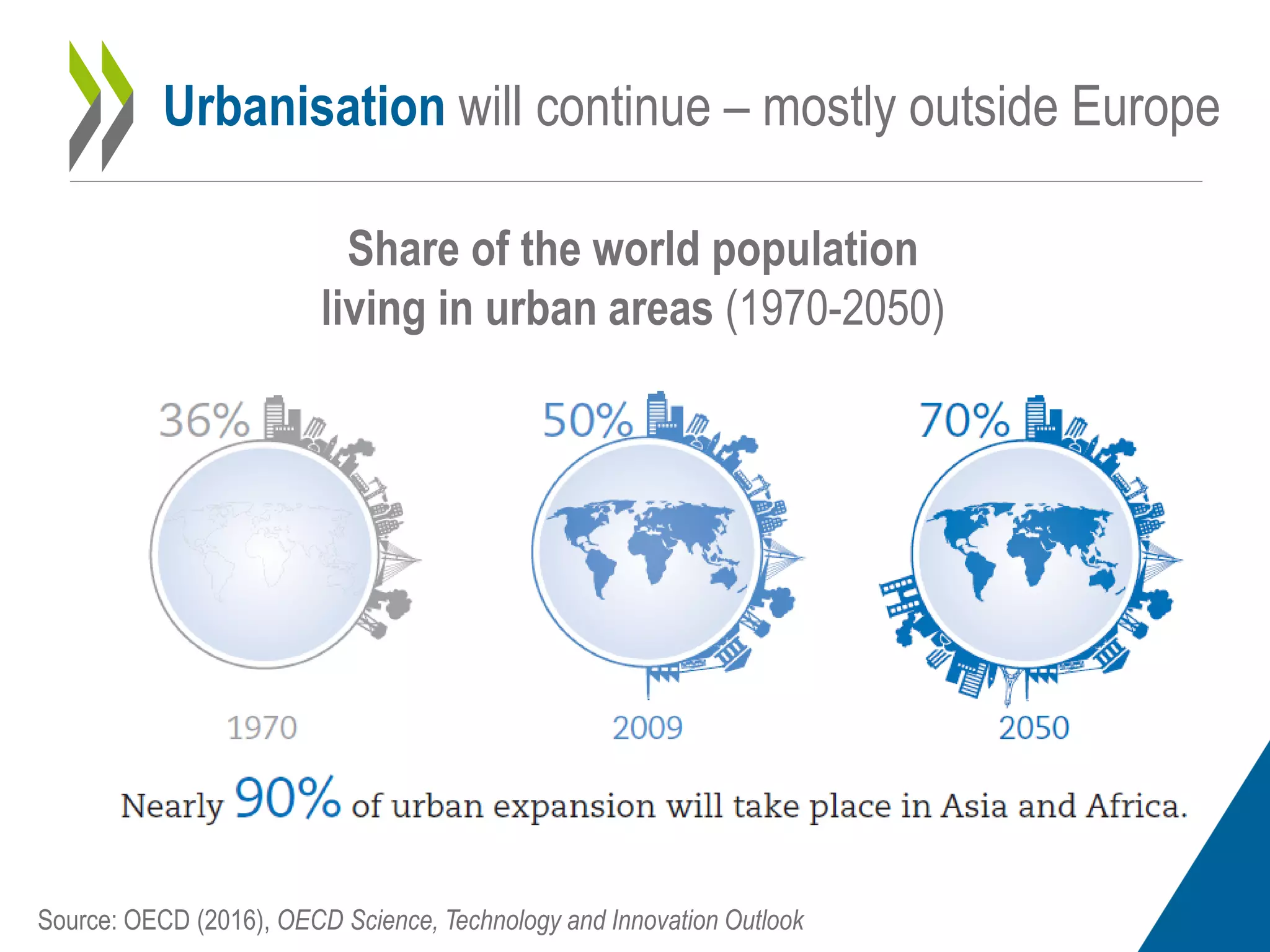
Urbanisation will continue – mostly outside Europe
Share of the world population
living in urban areas (1970-2050)
Source: OECD (2016), OECD Science, Technology and Innovation Outlook
Urbanisation alone is no guarantee
for economic success
Urbanisation and development
Annual observations of country GDP per capita (relative to the US) and share of urban population (1970 -2013)
China
India
Colombia
Korea
Australia
Source: OECD (2015), The Metropolitan Century: Understanding Urbanisation and Its Consequences
… but many
have urbanised
without growing rich
No country grew rich
without urbanising
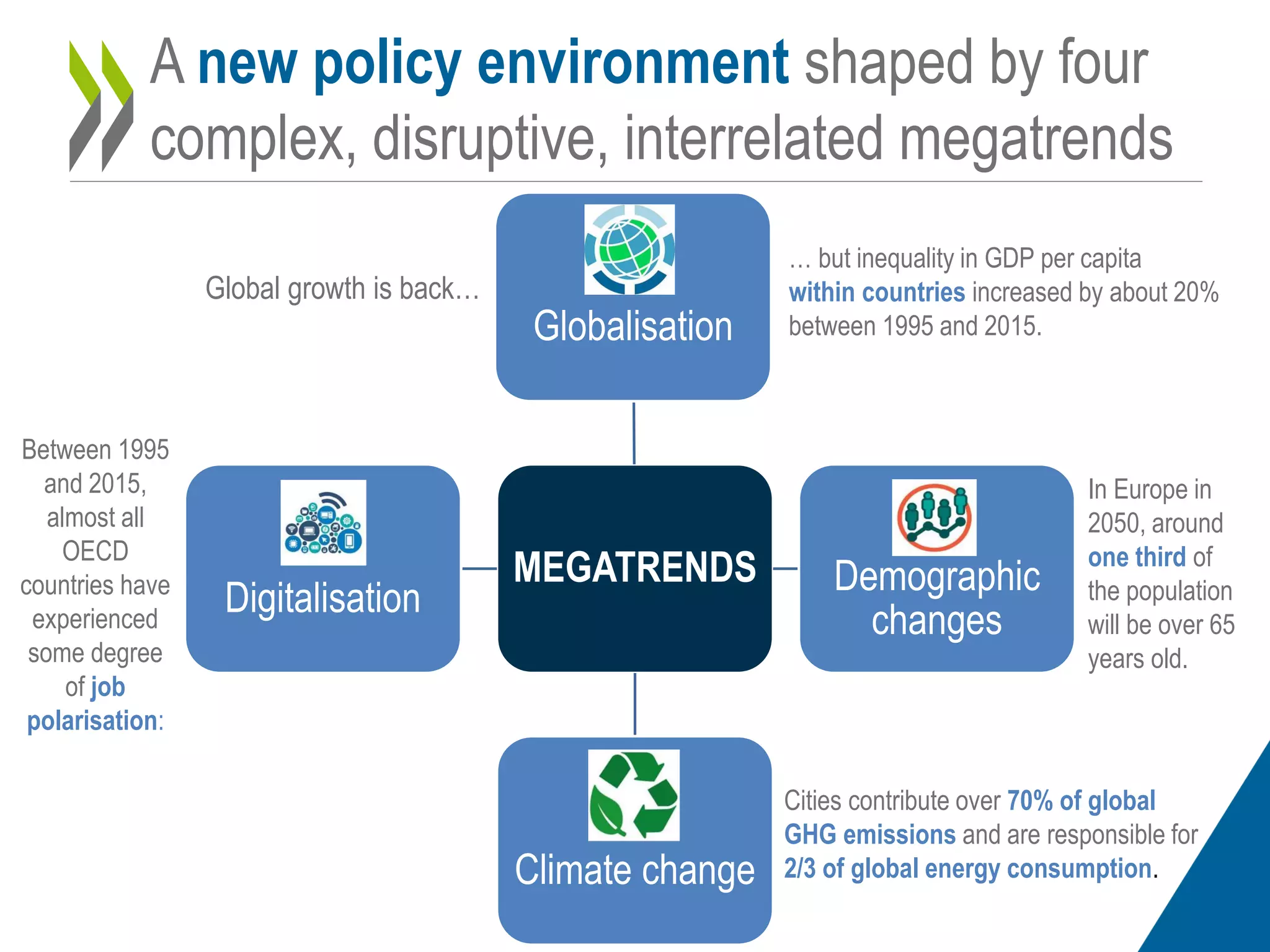
MEGATRENDS
Globalisation
Demographic
changes
Climate change
Digitalisation
A new policy environment shaped by four
complex, disruptive, interrelated megatrends
Cities contribute over 70% of global
GHG emissions and are responsible for
2/3 of global energy consumption.
In Europe in
2050, around
one third of
the population
will be over 65
years old.
Between 1995
and 2015,
almost all
OECD
countries have
experienced
some degree
of job
polarisation:
… but inequality in GDP per capita
within countries increased by about 20%
between 1995 and 2015.
Global growth is back…
How does a “city of cities” function?
the example of Paris (France)
City of Paris
Core of FUA
City of Paris
Commuting zone of FUA
Core of FUA
City of Paris
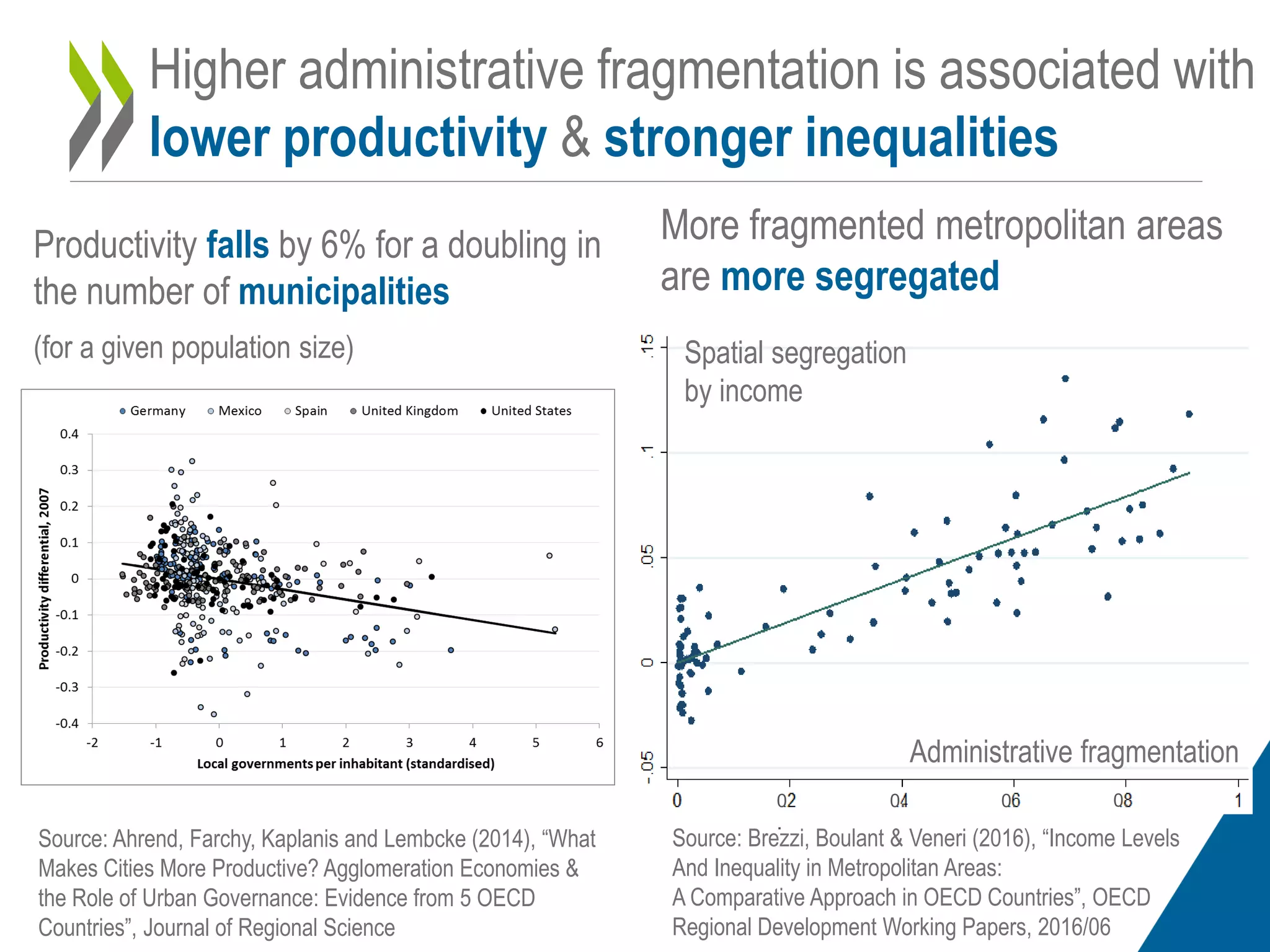
Higher administrative fragmentation is associated with
lower productivity & stronger inequalities
Productivity falls by 6% for a doubling in
the number of municipalities
(for a given population size)
Source: Ahrend, Farchy, Kaplanis and Lembcke (2014), “What
Makes Cities More Productive? Agglomeration Economies &
the Role of Urban Governance: Evidence from 5 OECD
Countries”, Journal of Regional Science
0
.
0. 0. 0.
Spatial segregation
by income
Administrative fragmentation
Source: Brezzi, Boulant & Veneri (2016), “Income Levels
And Inequality in Metropolitan Areas:
A Comparative Approach in OECD Countries”, OECD
Regional Development Working Papers, 2016/06
More fragmented metropolitan areas
are more segregated
Shaping more effective policies
at the right (metropolitan) scale
Italy:
14 città metropolitane
UK:
23 directly elected mayors
France:
19 métropoles
+ 2 with special status

A new global order of metropolitan areas

  • 1.
    A NEW GLOBALORDER OF METROPOLITAN AREAS Soo-Jin KIM OECD Centre for Entrepreneurship, SMEs, Regions and Cities Cities, Urban Policies and Sustainable Development Division “Post-Habitat III Future challenges of the metropolis: A contribution to the New Urban Agenda” conference Barcelona, 22 May 2018
  • 2.
    Urbanisation will continue– mostly outside Europe Share of the world population living in urban areas (1970-2050) Source: OECD (2016), OECD Science, Technology and Innovation Outlook
  • 3.
    Urbanisation alone isno guarantee for economic success Urbanisation and development Annual observations of country GDP per capita (relative to the US) and share of urban population (1970 -2013) China India Colombia Korea Australia Source: OECD (2015), The Metropolitan Century: Understanding Urbanisation and Its Consequences … but many have urbanised without growing rich No country grew rich without urbanising
  • 4.
    MEGATRENDS Globalisation Demographic changes Climate change Digitalisation A newpolicy environment shaped by four complex, disruptive, interrelated megatrends Cities contribute over 70% of global GHG emissions and are responsible for 2/3 of global energy consumption. In Europe in 2050, around one third of the population will be over 65 years old. Between 1995 and 2015, almost all OECD countries have experienced some degree of job polarisation: … but inequality in GDP per capita within countries increased by about 20% between 1995 and 2015. Global growth is back…
  • 5.
    How does a“city of cities” function? the example of Paris (France) City of Paris Core of FUA City of Paris Commuting zone of FUA Core of FUA City of Paris
  • 6.
    Higher administrative fragmentationis associated with lower productivity & stronger inequalities Productivity falls by 6% for a doubling in the number of municipalities (for a given population size) Source: Ahrend, Farchy, Kaplanis and Lembcke (2014), “What Makes Cities More Productive? Agglomeration Economies & the Role of Urban Governance: Evidence from 5 OECD Countries”, Journal of Regional Science 0 . 0. 0. 0. Spatial segregation by income Administrative fragmentation Source: Brezzi, Boulant & Veneri (2016), “Income Levels And Inequality in Metropolitan Areas: A Comparative Approach in OECD Countries”, OECD Regional Development Working Papers, 2016/06 More fragmented metropolitan areas are more segregated
  • 7.
    Shaping more effectivepolicies at the right (metropolitan) scale Italy: 14 città metropolitane UK: 23 directly elected mayors France: 19 métropoles + 2 with special status