Closing remarks
Alain de Serres, OECD
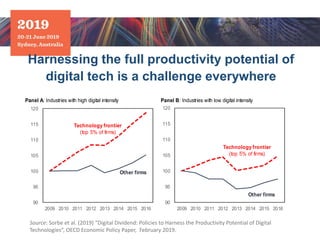
Harnessing the full productivity potential of
digital tech is a challenge everywhere
Panel A: Industries with high digital intensity Panel B: Industries with low digital intensity
90
95
100
105
110
115
120
2009 2010 2011 2012 2013 2014 2015 2016
Other firms
Technology frontier
(top 5% of firms)
90
95
100
105
110
115
120
2009 2010 2011 2012 2013 2014 2015 2016
Other firms
Technology frontier
(top 5% of firms)
Source: Sorbe et al. (2019) “Digital Dividend: Policies to Harness the Productivity Potential of Digital
Technologies”, OECD Economic Policy Paper, February 2019.
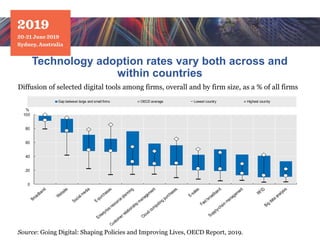
Technology adoption rates vary both across and
within countries
0
20
40
60
80
100
%
Gap between large and small firms OECD average Lowest country Highest country
Diffusion of selected digital tools among firms, overall and by firm size, as a % of all firms
Source: Going Digital: Shaping Policies and Improving Lives, OECD Report, 2019.
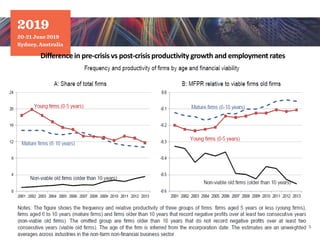
Difference in pre-crisisvs post-crisisproductivity growth and employment rates
5Source: Andrews, Criscuolo and Gal, 2016. “The Best vs the Rest” OECD Productivity Working
Paper No. 05.
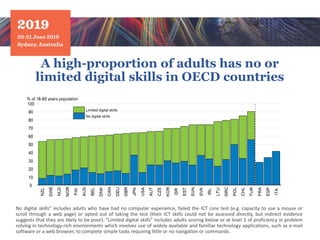
A high-proportion of adults has no or
limited digital skills in OECD countries
No digital skills” includes adults who have had no computer experience, failed the ICT core test (e.g. capacity to use a mouse or
scroll through a web page) or opted out of taking the test (their ICT skills could not be assessed directly, but indirect evidence
suggests that they are likely to be poor). “Limited digital skills” includes adults scoring below or at level 1 of proficiency in problem
solving in technology-rich environments which involves use of widely available and familiar technology applications, such as e-mail
software or a web browser, to complete simple tasks requiring little or no navigation or commands.

Closing remarks

  • 2.
  • 3.
    Harnessing the fullproductivity potential of digital tech is a challenge everywhere Panel A: Industries with high digital intensity Panel B: Industries with low digital intensity 90 95 100 105 110 115 120 2009 2010 2011 2012 2013 2014 2015 2016 Other firms Technology frontier (top 5% of firms) 90 95 100 105 110 115 120 2009 2010 2011 2012 2013 2014 2015 2016 Other firms Technology frontier (top 5% of firms) Source: Sorbe et al. (2019) “Digital Dividend: Policies to Harness the Productivity Potential of Digital Technologies”, OECD Economic Policy Paper, February 2019.
  • 4.
    Technology adoption ratesvary both across and within countries 0 20 40 60 80 100 % Gap between large and small firms OECD average Lowest country Highest country Diffusion of selected digital tools among firms, overall and by firm size, as a % of all firms Source: Going Digital: Shaping Policies and Improving Lives, OECD Report, 2019.
  • 5.
    Difference in pre-crisisvspost-crisisproductivity growth and employment rates 5Source: Andrews, Criscuolo and Gal, 2016. “The Best vs the Rest” OECD Productivity Working Paper No. 05.
  • 6.
    A high-proportion ofadults has no or limited digital skills in OECD countries No digital skills” includes adults who have had no computer experience, failed the ICT core test (e.g. capacity to use a mouse or scroll through a web page) or opted out of taking the test (their ICT skills could not be assessed directly, but indirect evidence suggests that they are likely to be poor). “Limited digital skills” includes adults scoring below or at level 1 of proficiency in problem solving in technology-rich environments which involves use of widely available and familiar technology applications, such as e-mail software or a web browser, to complete simple tasks requiring little or no navigation or commands.