DuPont™ Solamet® Enable Next Generation High Efficiency Solar Cells 
Dr. Alex Wu 
Technology Manager, Taiwan 
DuPont Microcircuit Materials 
Aug. 16, 2013
© E. I. DuPont 2013 
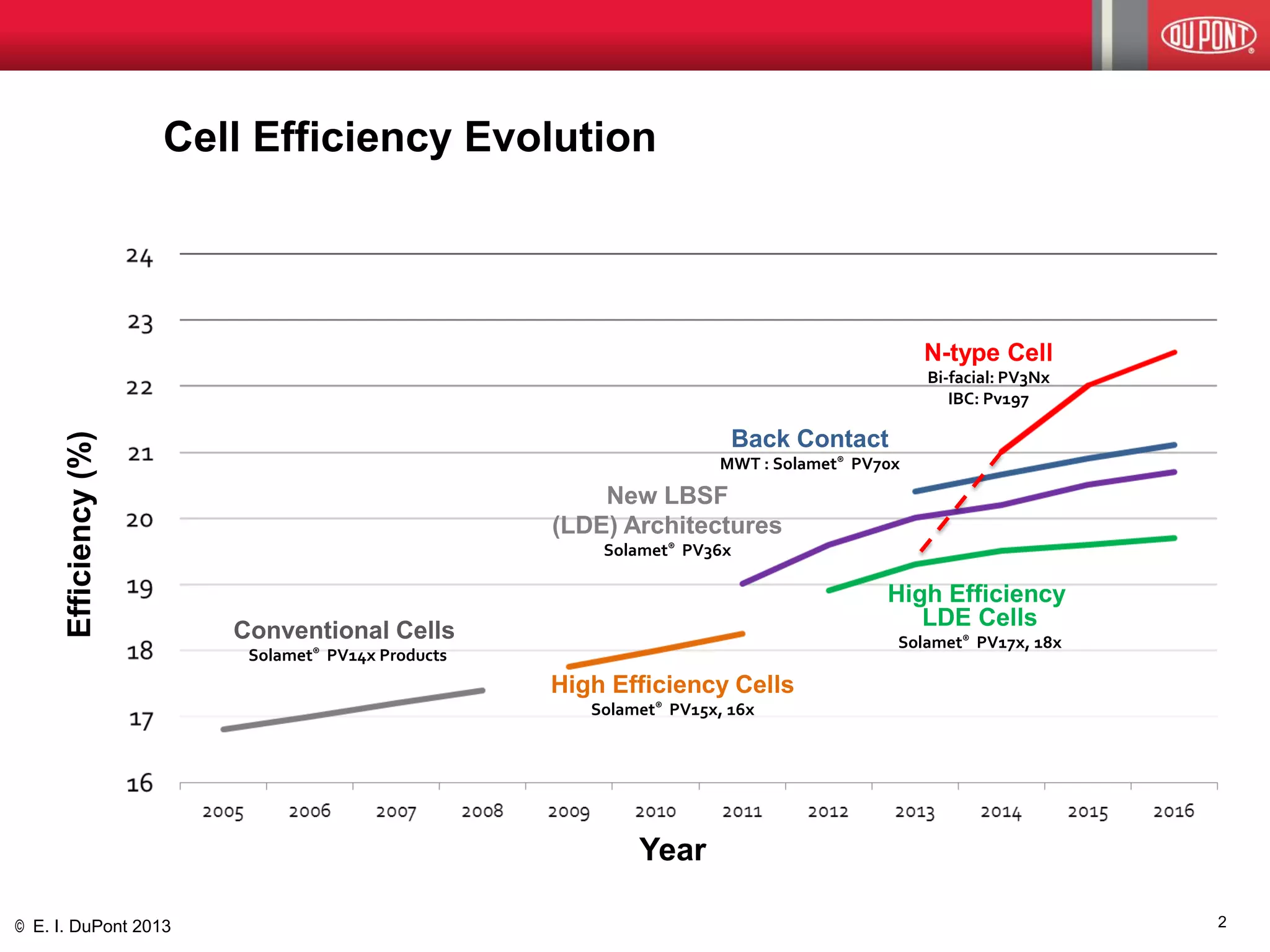
Efficiency (%) 
Year 
Conventional Cells 
Solamet® PV14x Products 
High Efficiency Cells 
Solamet® PV15x, 16x 
High Efficiency 
LDE Cells 
Solamet® PV17x, 18x 
New LBSF 
(LDE) Architectures 
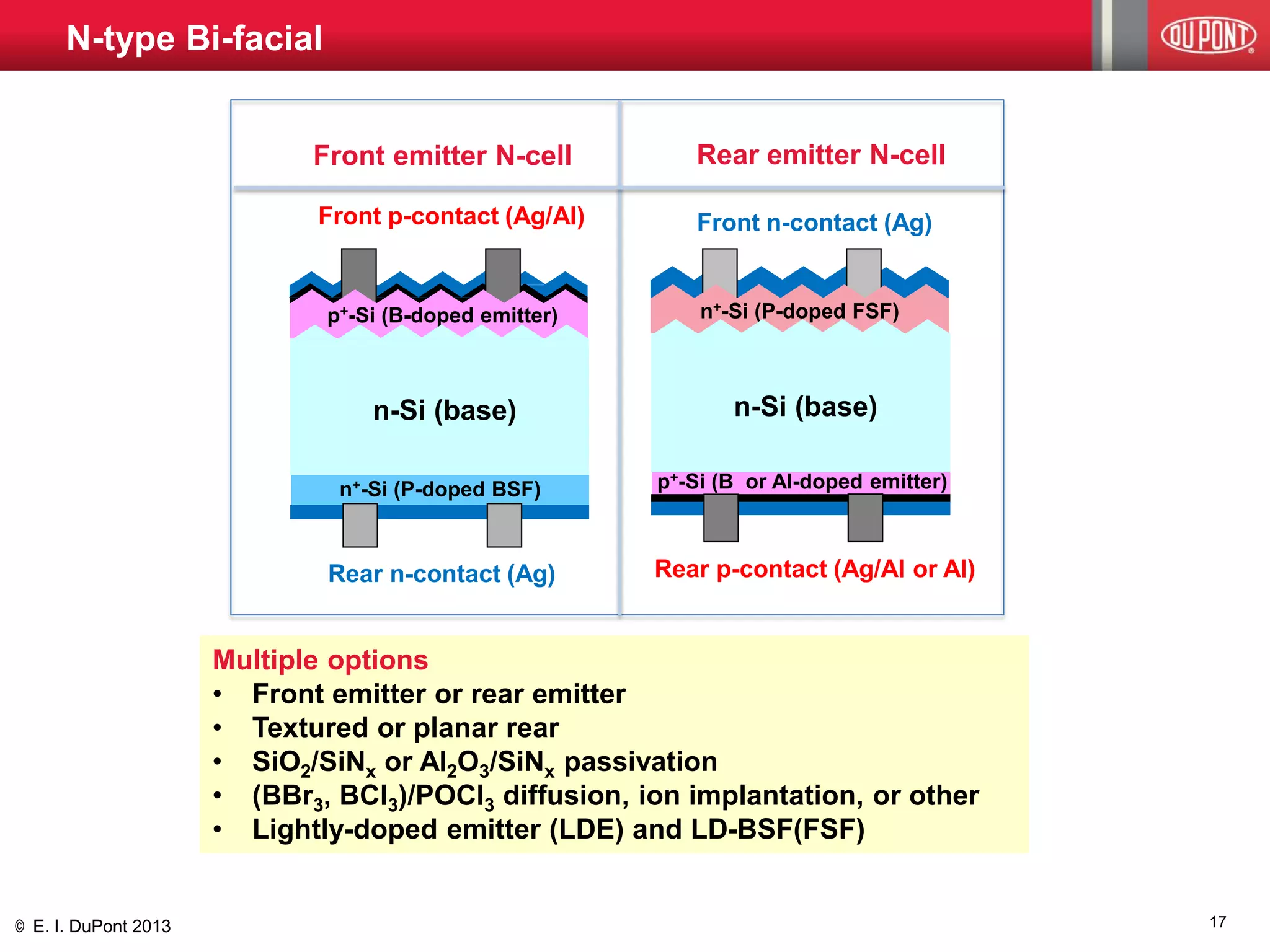
Solamet® PV36x 
N-type Cell Bi-facial: PV3Nx 
IBC: Pv197 
Back Contact 
MWT : Solamet® PV70x 
Cell Efficiency Evolution 
2
© E. I. DuPont 2013 
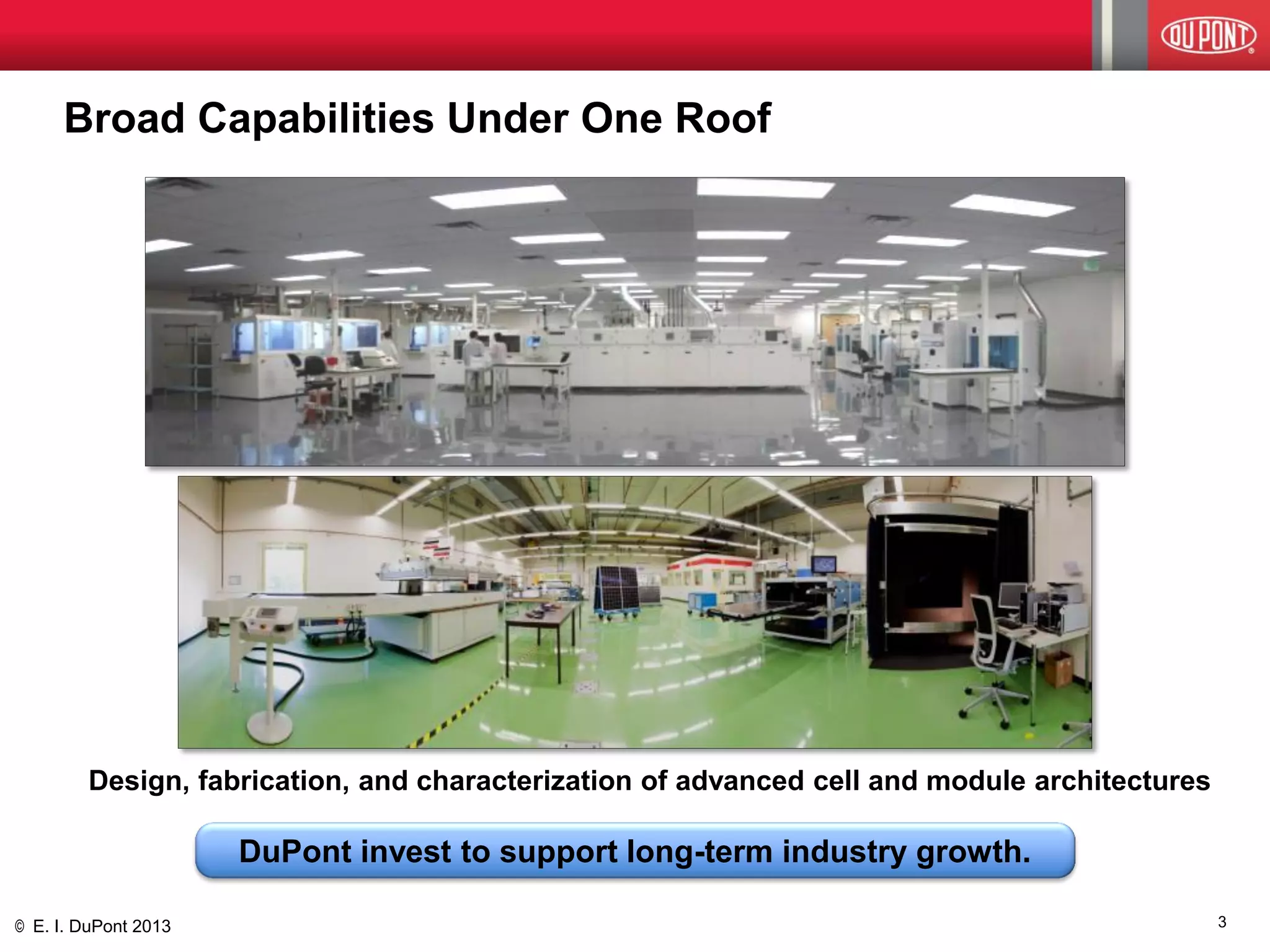
Broad Capabilities Under One Roof 
Design, fabrication, and characterization of advanced cell and module architectures 
DuPont invest to support long-term industry growth. 
3
© E. I. DuPont 2013 
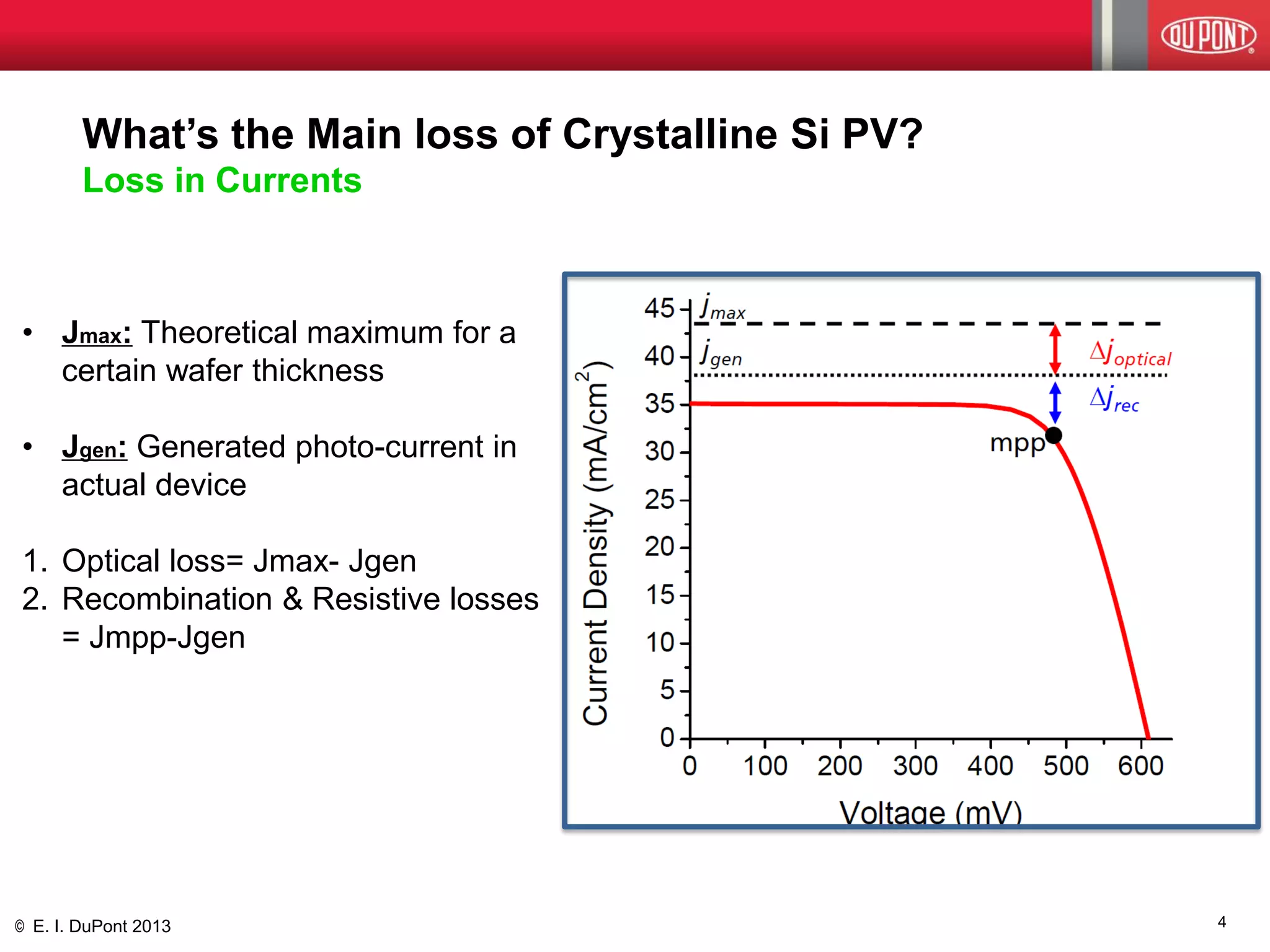
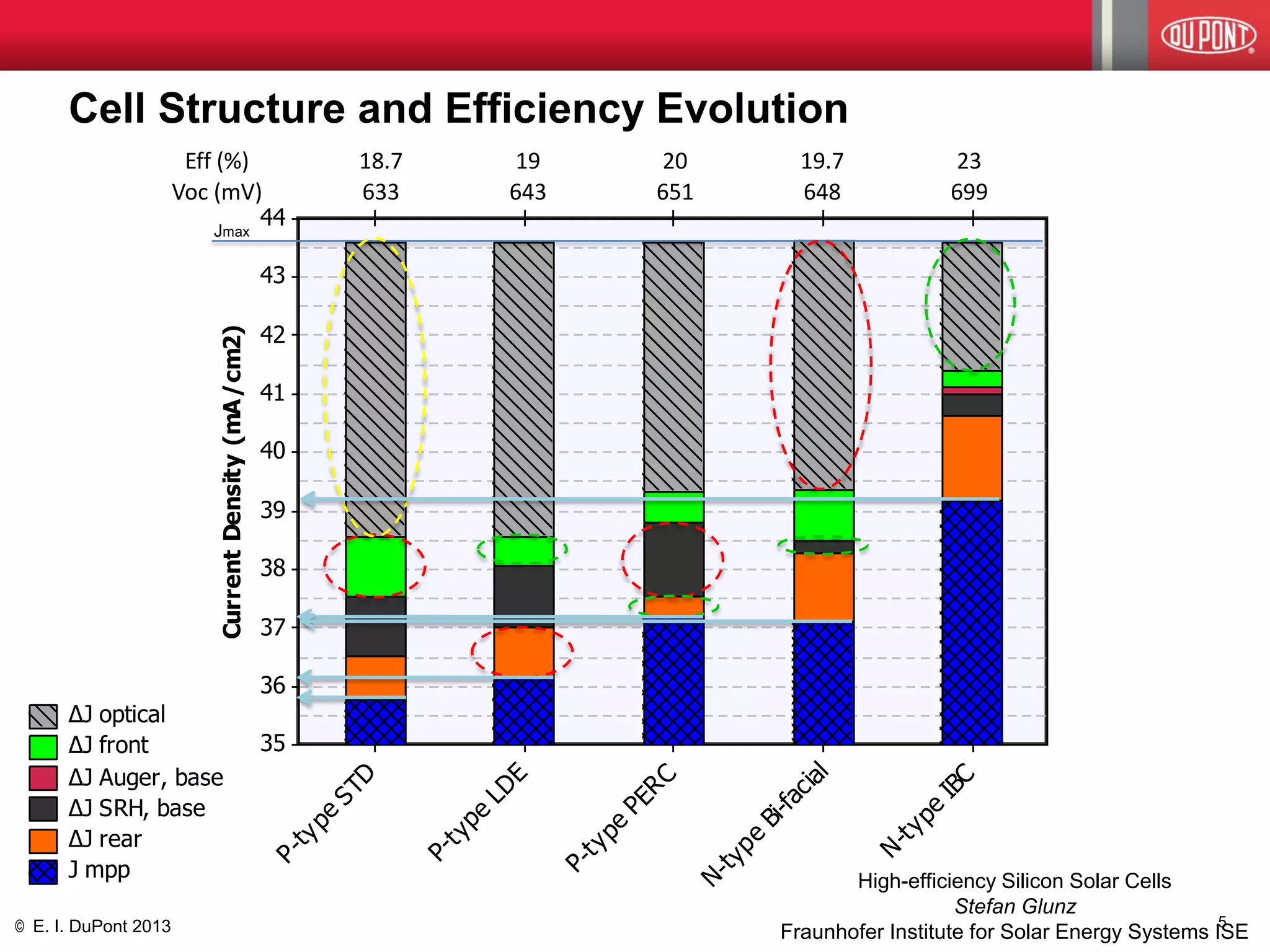
What’s the Main loss of Crystalline Si PV? Loss in Currents 
4 
•Jmax: Theoretical maximum for a certain wafer thickness 
•Jgen: Generated photo-current in actual device 
1.Optical loss= Jmax- Jgen 
2.Recombination & Resistive losses = Jmpp-Jgen
© E. I. DuPont 2013 
Eff (%) 18.7 19 20 19.7 23 
Voc (mV) 633 643 651 648 699 
Cell Structure and Efficiency Evolution 
N-ty pe IBC 
N-ty pe Bi-facial 
P-type PERC 
P-ty pe LDE 
P-ty pe STD 
N-type IBC 
N-type Bi-facial 
P-type PERC 
P-type LDE 
P-ty pe STD 
44 
43 
42 
41 
40 
39 
38 
37 
36 
35 
Current Density (mA/cm2) 
ΔJ optical 
ΔJ front 
ΔJ Auger, base 
ΔJ SRH, base 
ΔJ rear 
J mpp 
Jmax 
High-efficiency Silicon Solar Cells 
Stefan Glunz 
Fraunhofer Institute for Solar Energy Systems ISE 
5
© E. I. DuPont 2013 
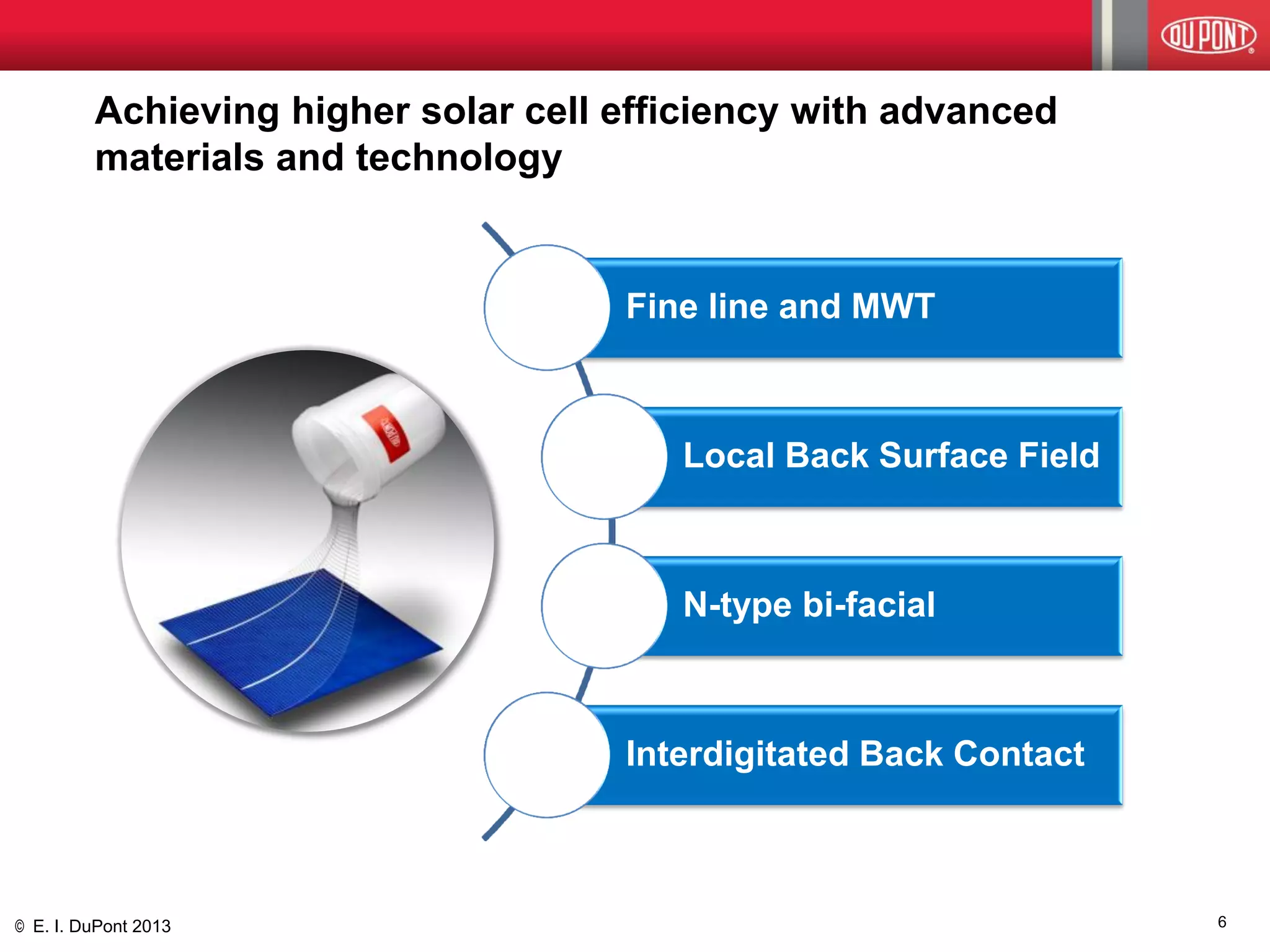
Achieving higher solar cell efficiency with advanced 
materials and technology 
Fine line and MWT 
Local Back Surface Field 
N-type bi-facial 
Interdigitated Back Contact 
6
© E. I. DuPont 2013 
7 
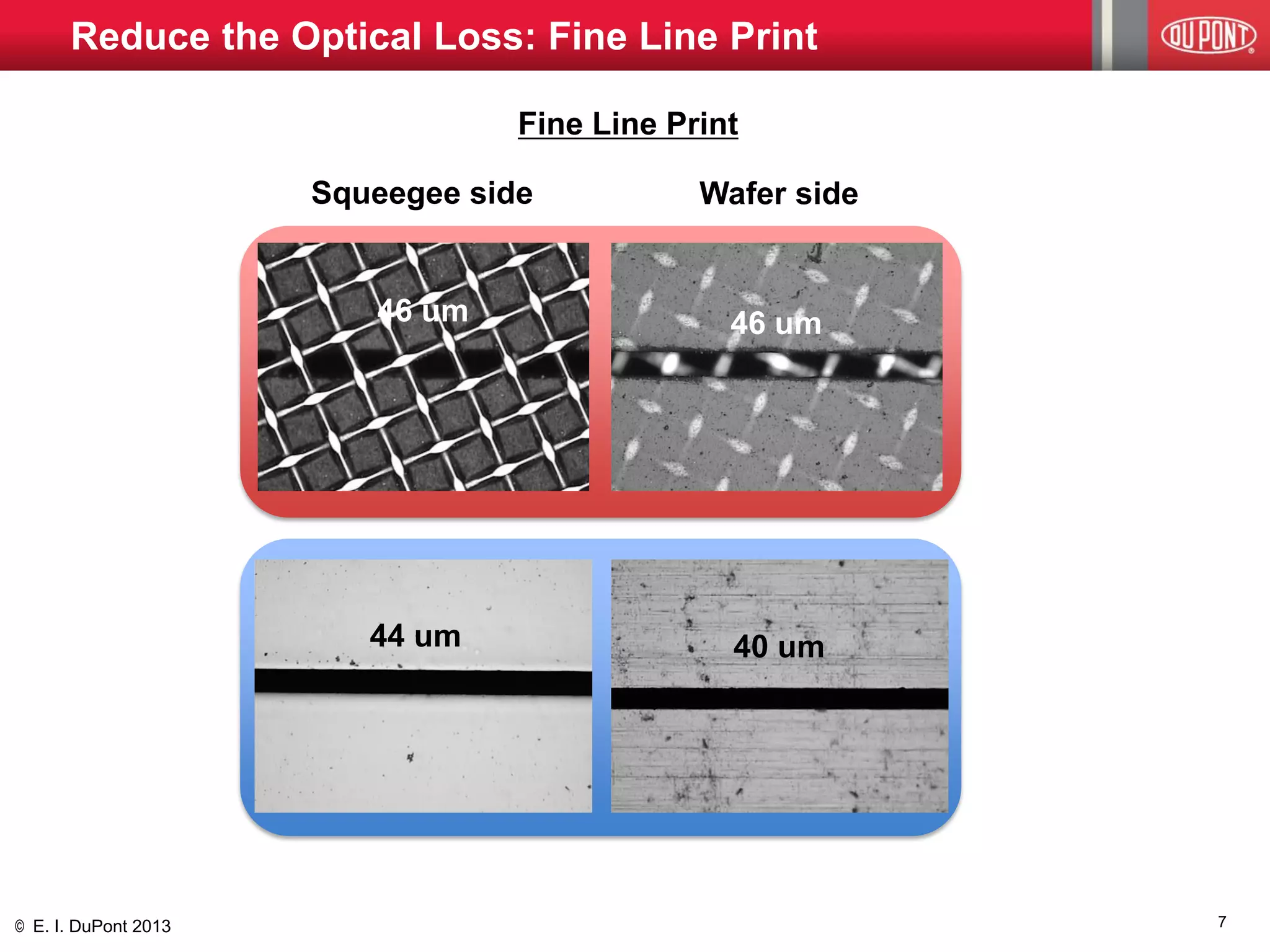
Reduce the Optical Loss: Fine Line Print 
Squeegee side 
Wafer side 
44 um 
40 um 
46 um 
46 um 
Fine Line Print
© E. I. DuPont 2013 
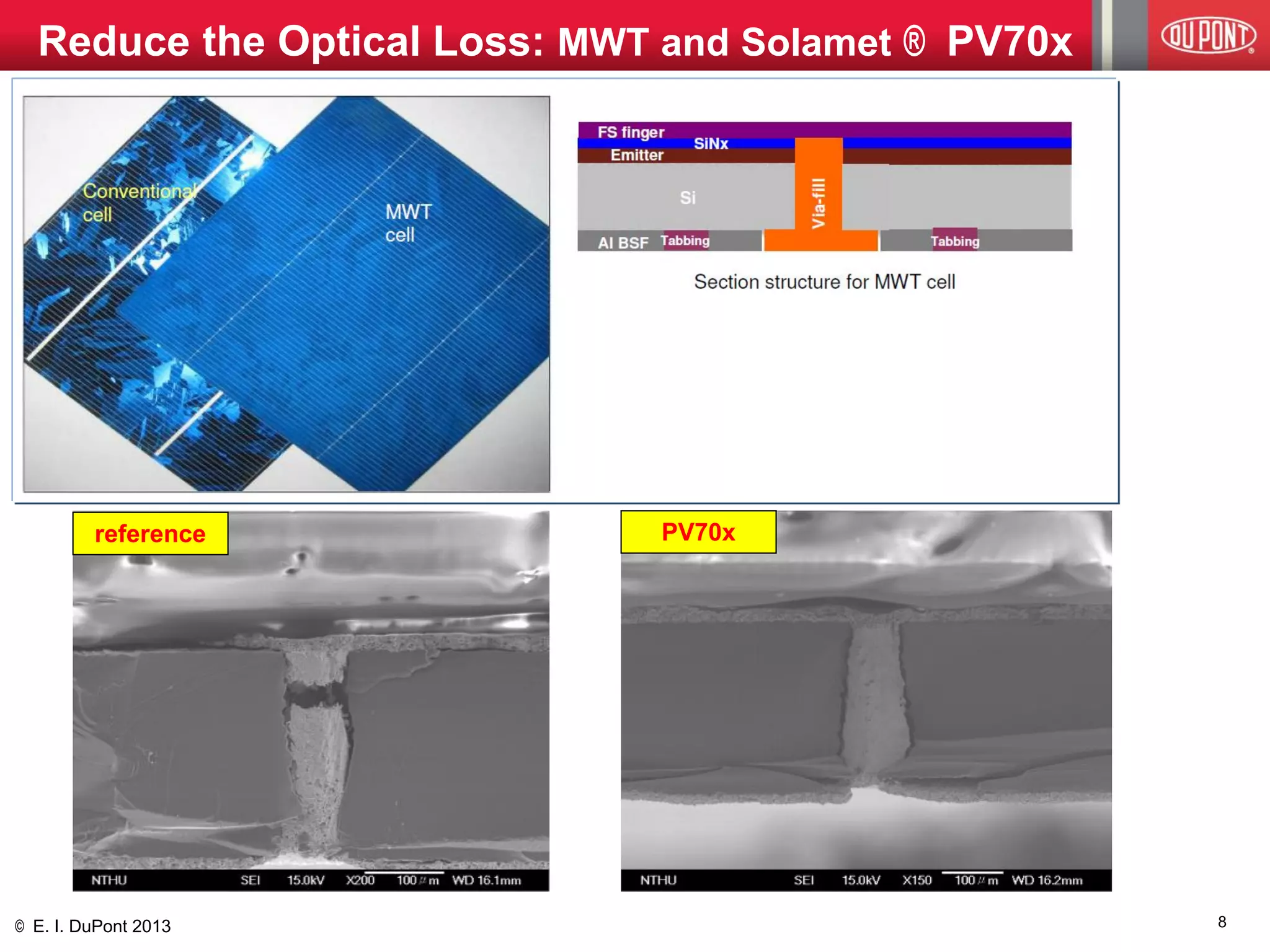
Reduce the Optical Loss: MWT and Solamet ® PV70x 
reference 
PV70x 
8
© E. I. DuPont 2013 
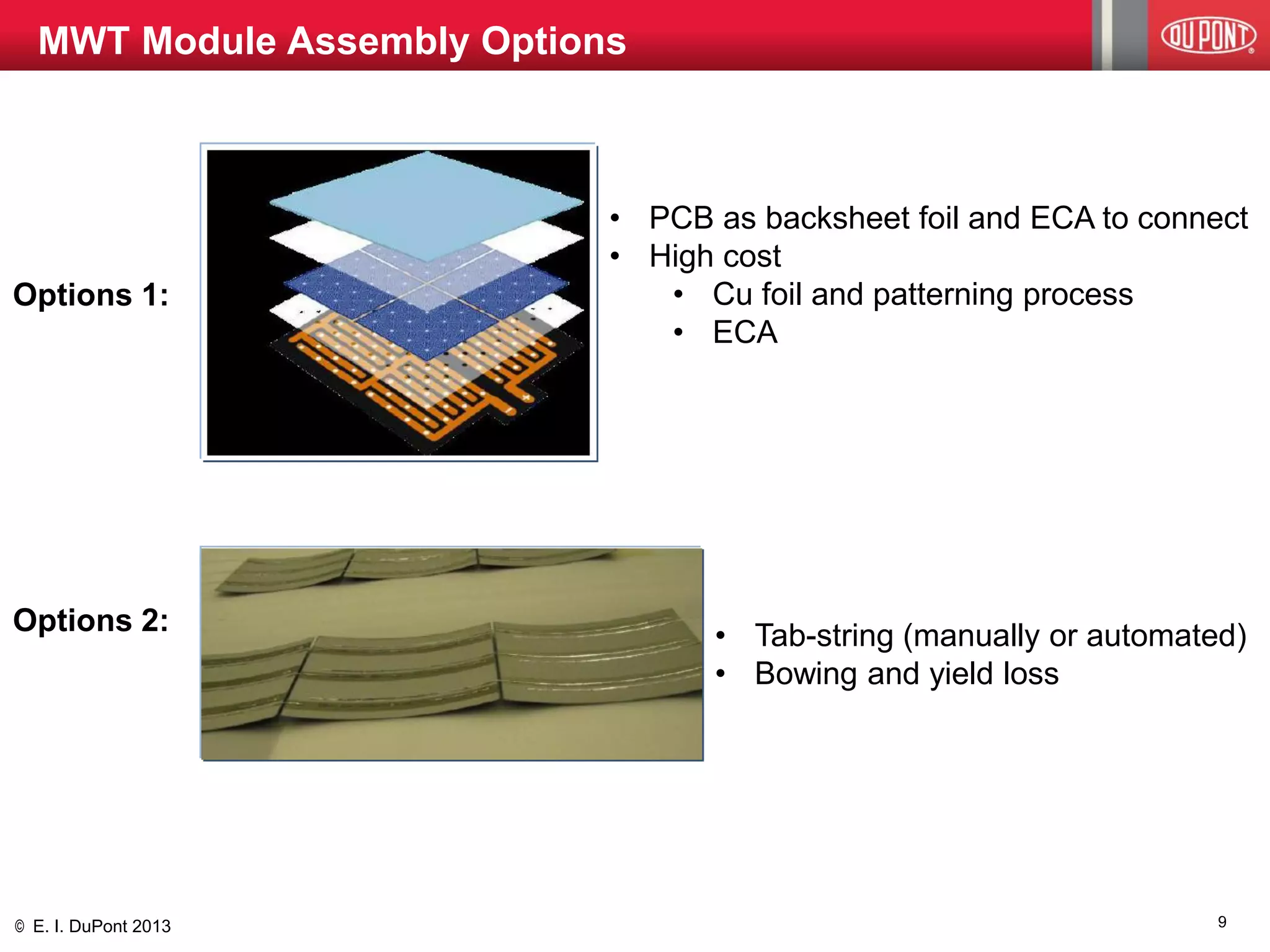
Options 1: 
Options 2: 
MWT Module Assembly Options 
•PCB as backsheet foil and ECA to connect 
•High cost 
•Cu foil and patterning process 
•ECA 
•Tab-string (manually or automated) 
•Bowing and yield loss 
9
© E. I. DuPont 2013 
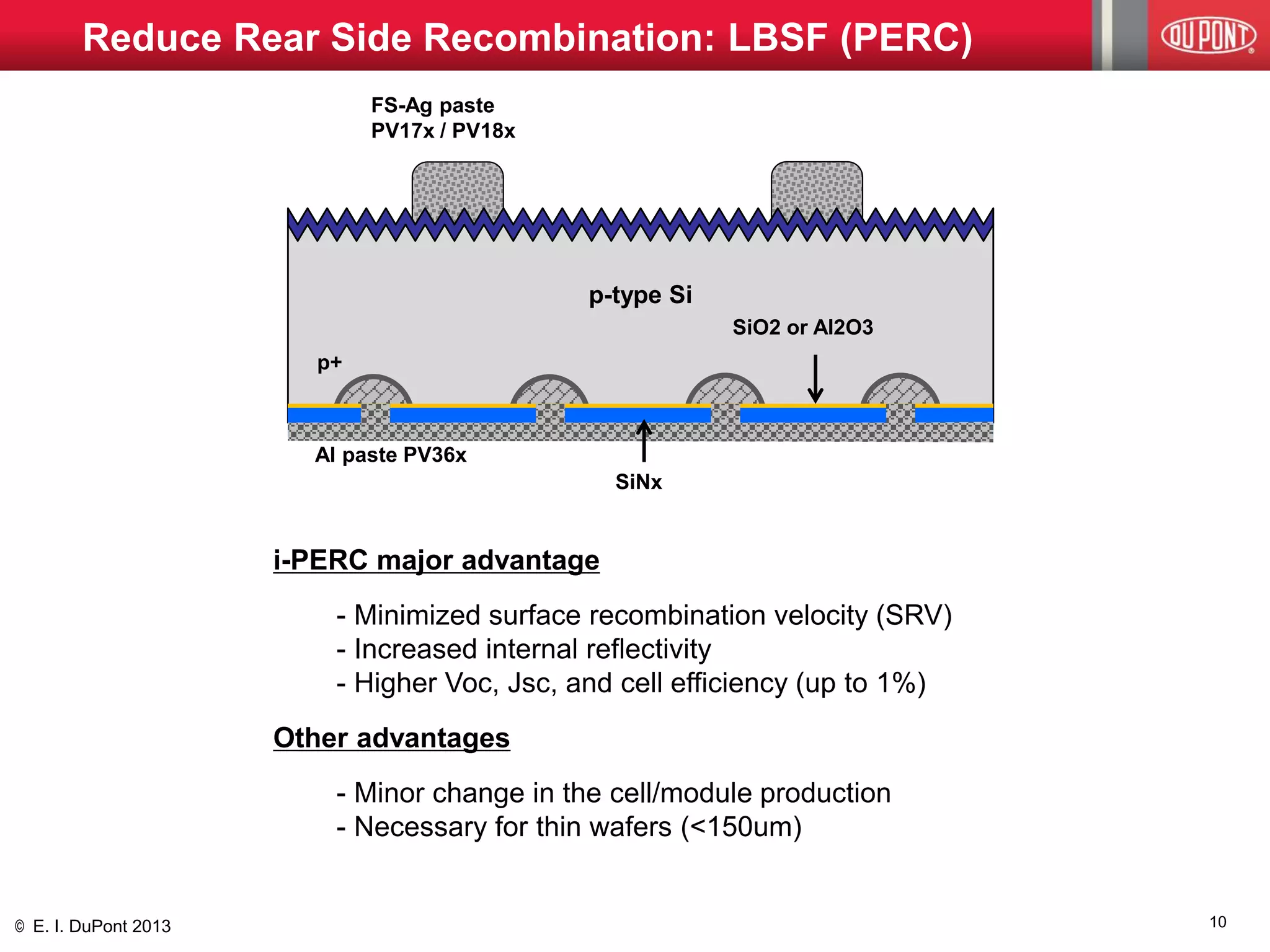
Reduce Rear Side Recombination: LBSF (PERC) 
p-type Si 
p+ 
Al paste PV36x 
SiO2 or Al2O3 
FS-Ag paste PV17x / PV18x 
SiNx 
i-PERC major advantage 
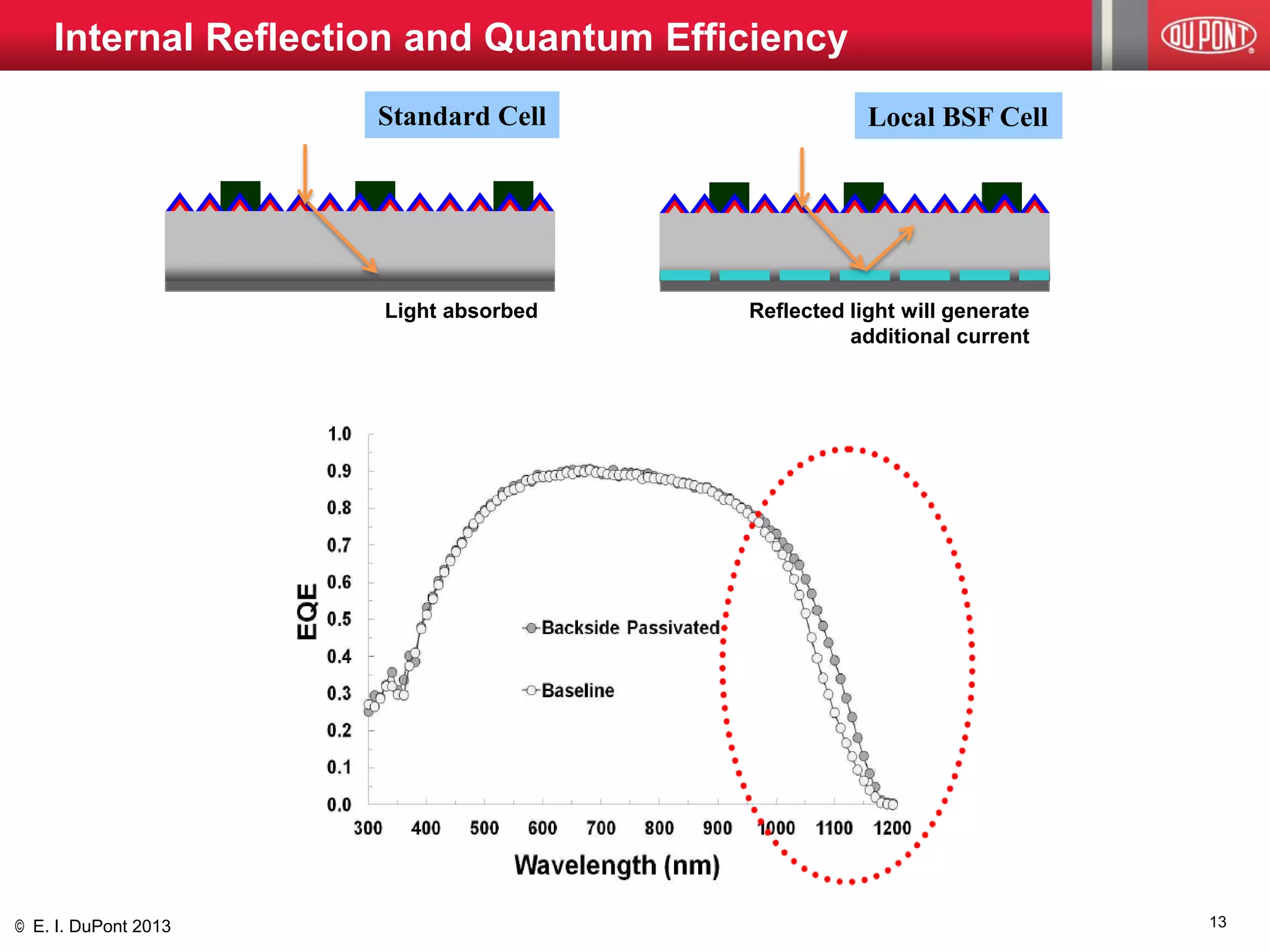
- Minimized surface recombination velocity (SRV) - Increased internal reflectivity - Higher Voc, Jsc, and cell efficiency (up to 1%) 
Other advantages 
- Minor change in the cell/module production - Necessary for thin wafers (<150um) 
10
© E. I. DuPont 2013 
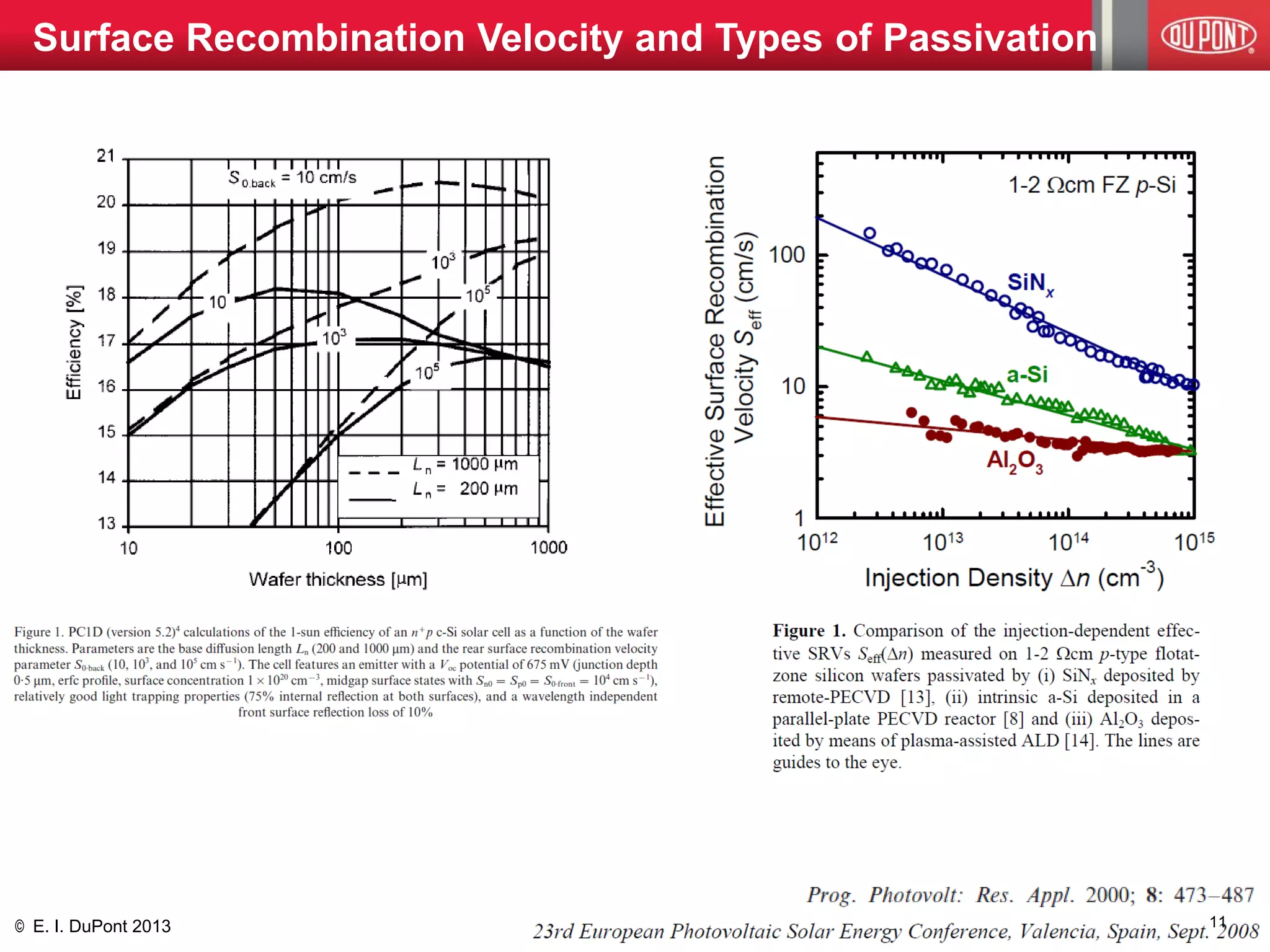
Surface Recombination Velocity and Types of Passivation 
11
© E. I. DuPont 2013 
+++++++++++++ 
P+ 
Induced n-type layer 
+++++++++++ 
- - - - - - - - 
P+ 
Al2O3 or SiO2 layer 
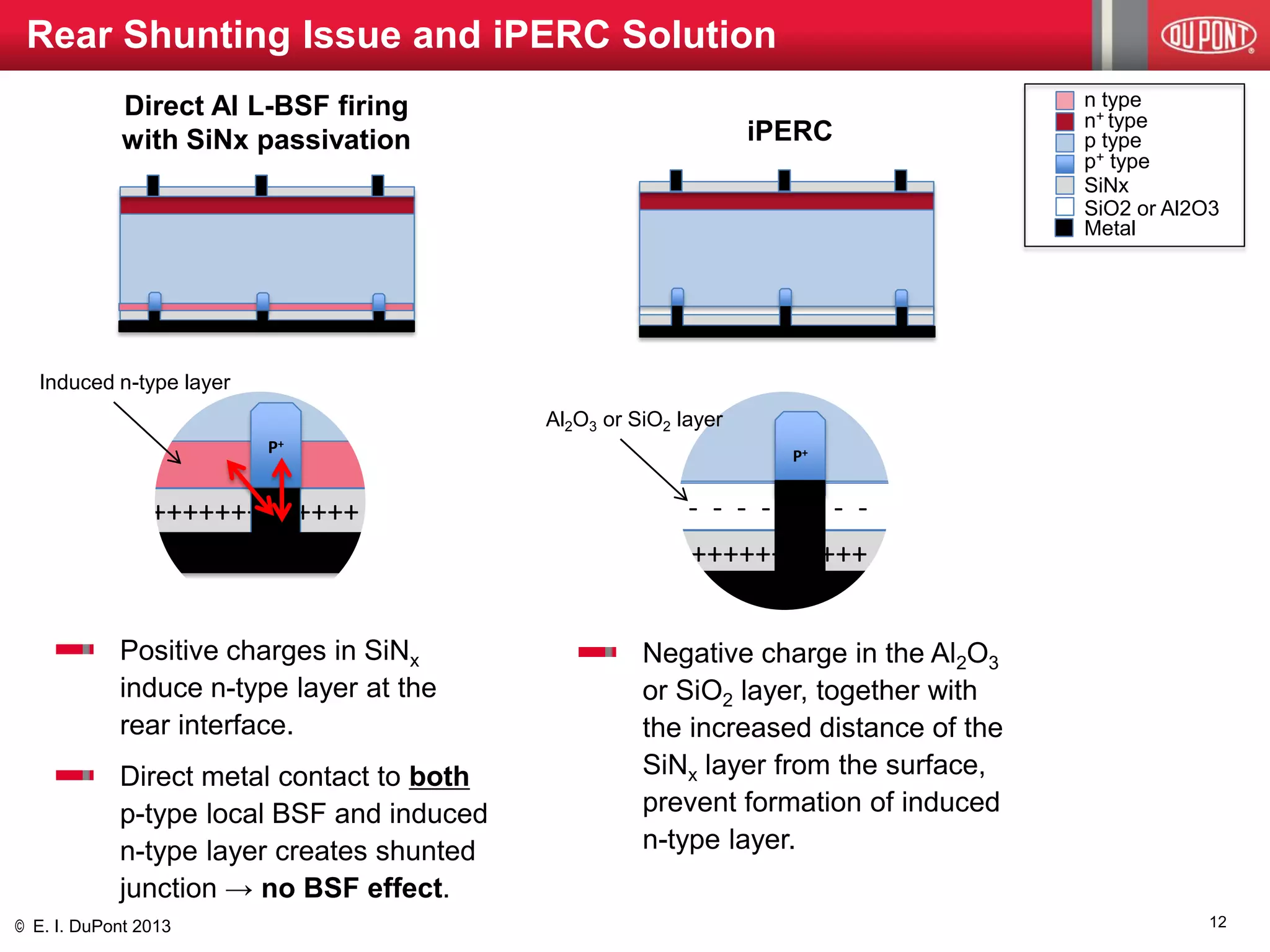
Rear Shunting Issue and iPERC Solution 
Direct Al L-BSF firing with SiNx passivation 
iPERC 
p type 
p+ type 
n type 
n+ type 
SiNx 
SiO2 or Al2O3 
Metal Positive charges in SiNx induce n-type layer at the rear interface. Direct metal contact to both p-type local BSF and induced n-type layer creates shunted junction → no BSF effect. Negative charge in the Al2O3 or SiO2 layer, together with the increased distance of the SiNx layer from the surface, prevent formation of induced n-type layer. 
12
© E. I. DuPont 2013 
Internal Reflection and Quantum Efficiency 
Light absorbed Reflected light will generate 
additional current 
Standard Cell Local BSF Cell 
13
© E. I. DuPont 2013 
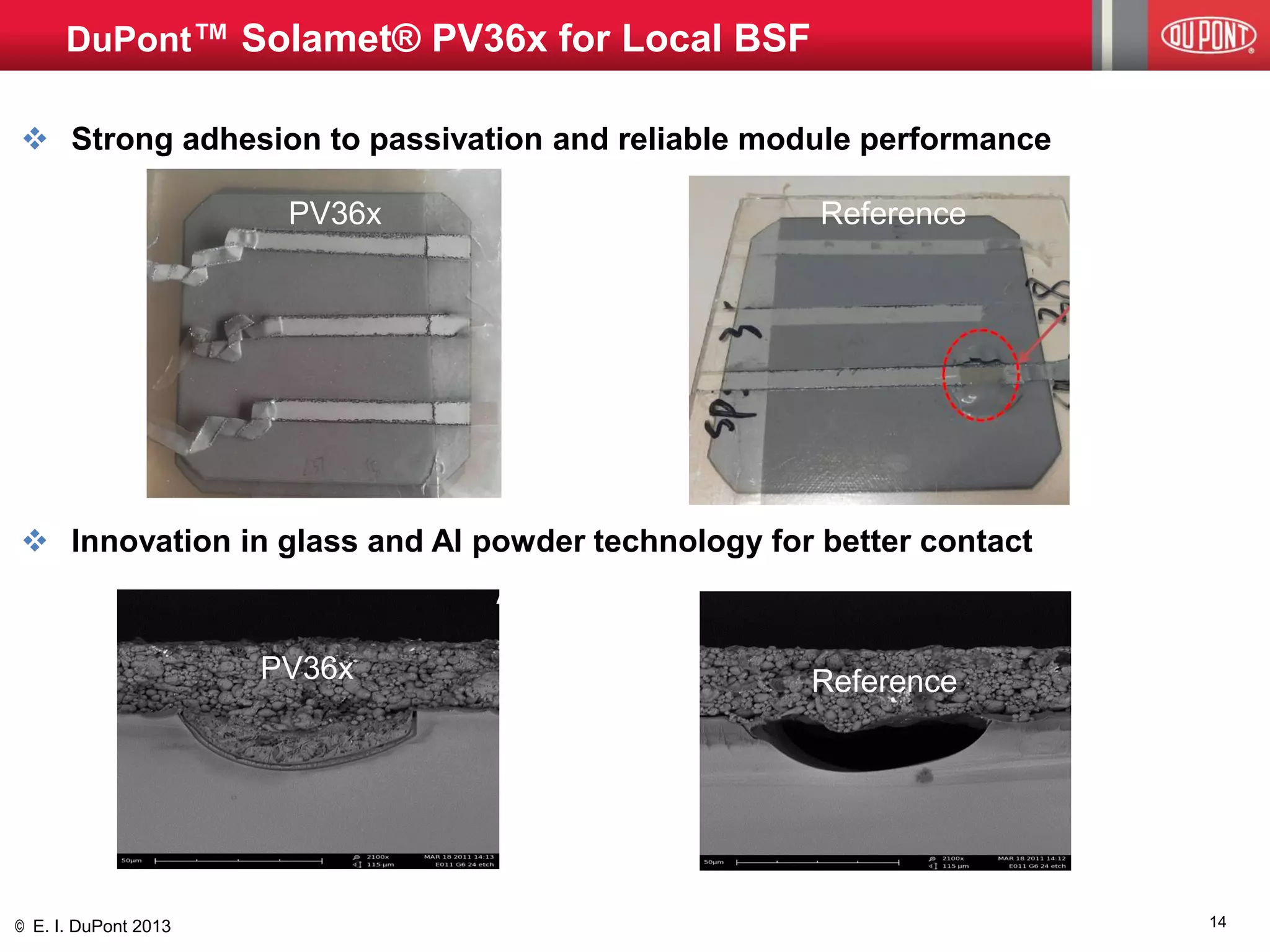
DuPont™ Solamet® PV36x for Local BSF 
Strong adhesion to passivation and reliable module performance 
Innovation in glass and Al powder technology for better contact 
Reference 
PV36x 
Al 
Si 
Al 
Si 
PV36x 
Reference 
14
© E. I. DuPont 2013 
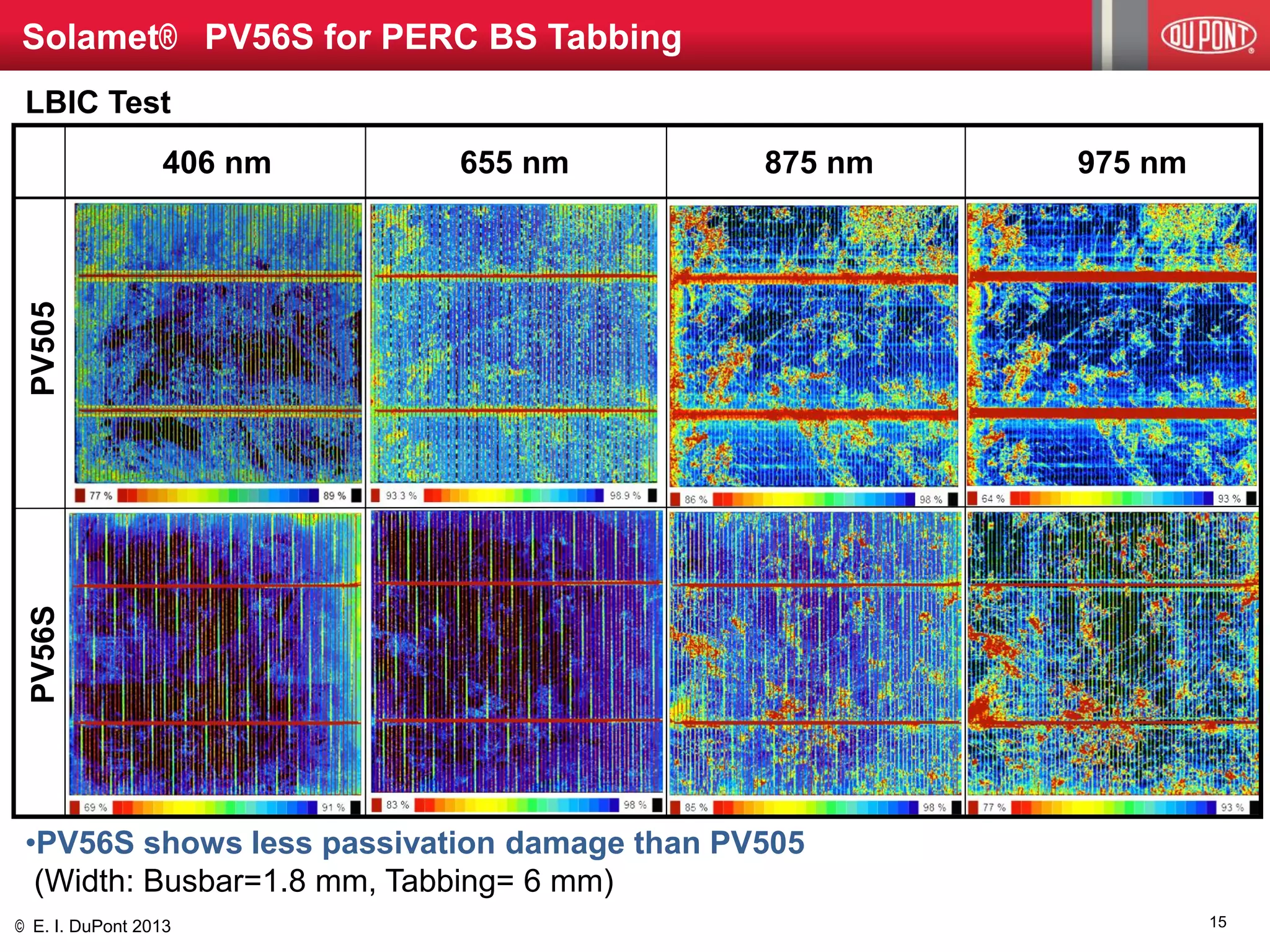
406 nm 
655 nm 
875 nm 
975 nm 
PV505 
PV56S 
LBIC Test 
•PV56S shows less passivation damage than PV505 (Width: Busbar=1.8 mm, Tabbing= 6 mm) 
Solamet® PV56S for PERC BS Tabbing 
15
© E. I. DuPont 2013 
16 
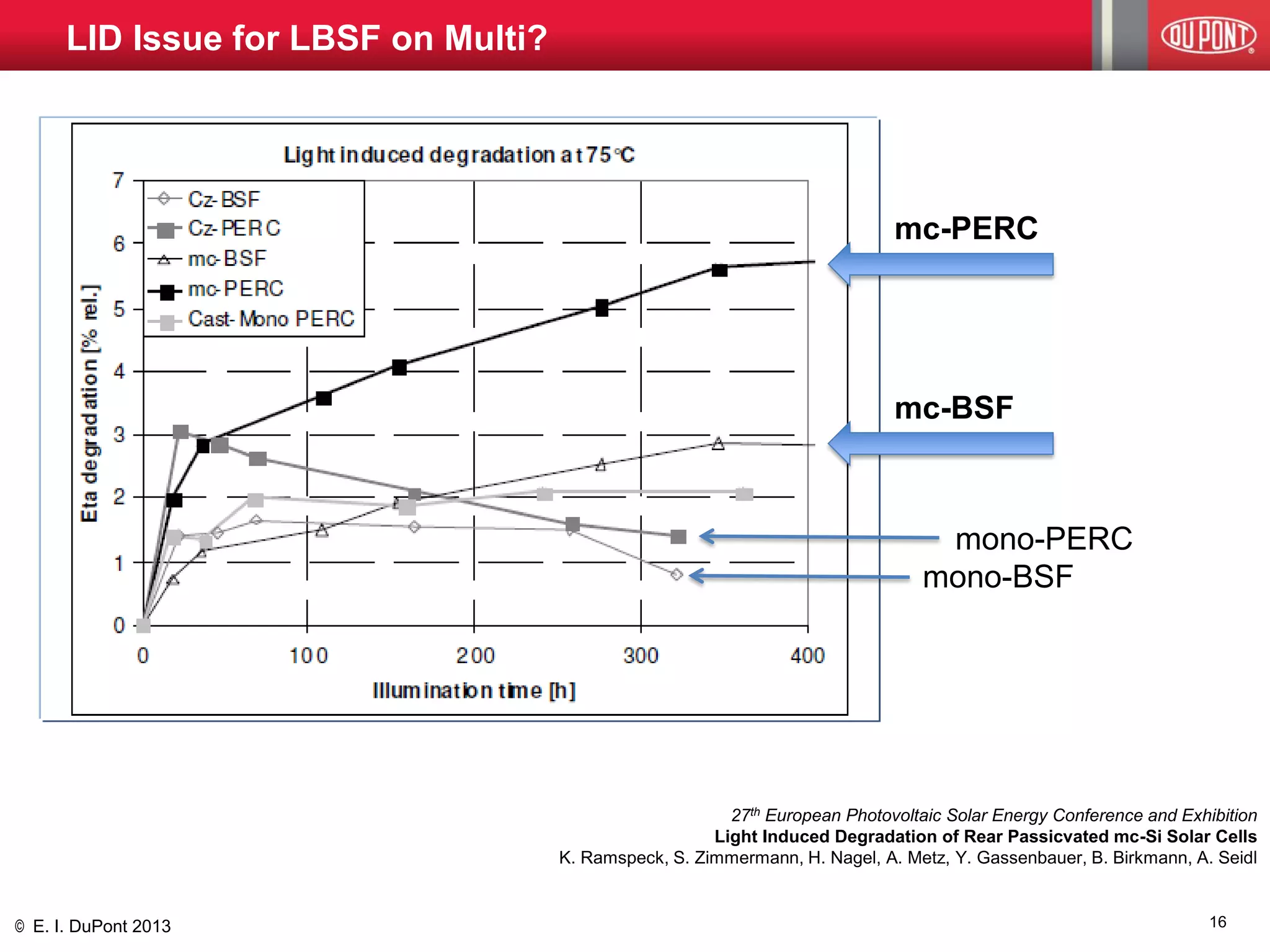
LID Issue for LBSF on Multi? 
27th European Photovoltaic Solar Energy Conference and Exhibition Light Induced Degradation of Rear Passicvated mc-Si Solar Cells K. Ramspeck, S. Zimmermann, H. Nagel, A. Metz, Y. Gassenbauer, B. Birkmann, A. Seidl 
mc-PERC 
mc-BSF 
mono-PERC 
mono-BSF
© E. I. DuPont 2013 
17 
p+-Si (B-doped emitter) 
n-Si (base) 
n+-Si (P-doped BSF) 
n+-Si (P-doped FSF) 
n-Si (base) 
p+-Si (B or Al-doped emitter) 
Rear emitter N-cell 
Rear p-contact (Ag/Al or Al) 
Front p-contact (Ag/Al) 
Rear n-contact (Ag) 
Front n-contact (Ag) 
Multiple options 
•Front emitter or rear emitter 
•Textured or planar rear 
•SiO2/SiNx or Al2O3/SiNx passivation 
•(BBr3, BCl3)/POCl3 diffusion, ion implantation, or other 
•Lightly-doped emitter (LDE) and LD-BSF(FSF) 
N-type Bi-facial 
Front emitter N-cell
© E. I. DuPont 2013 
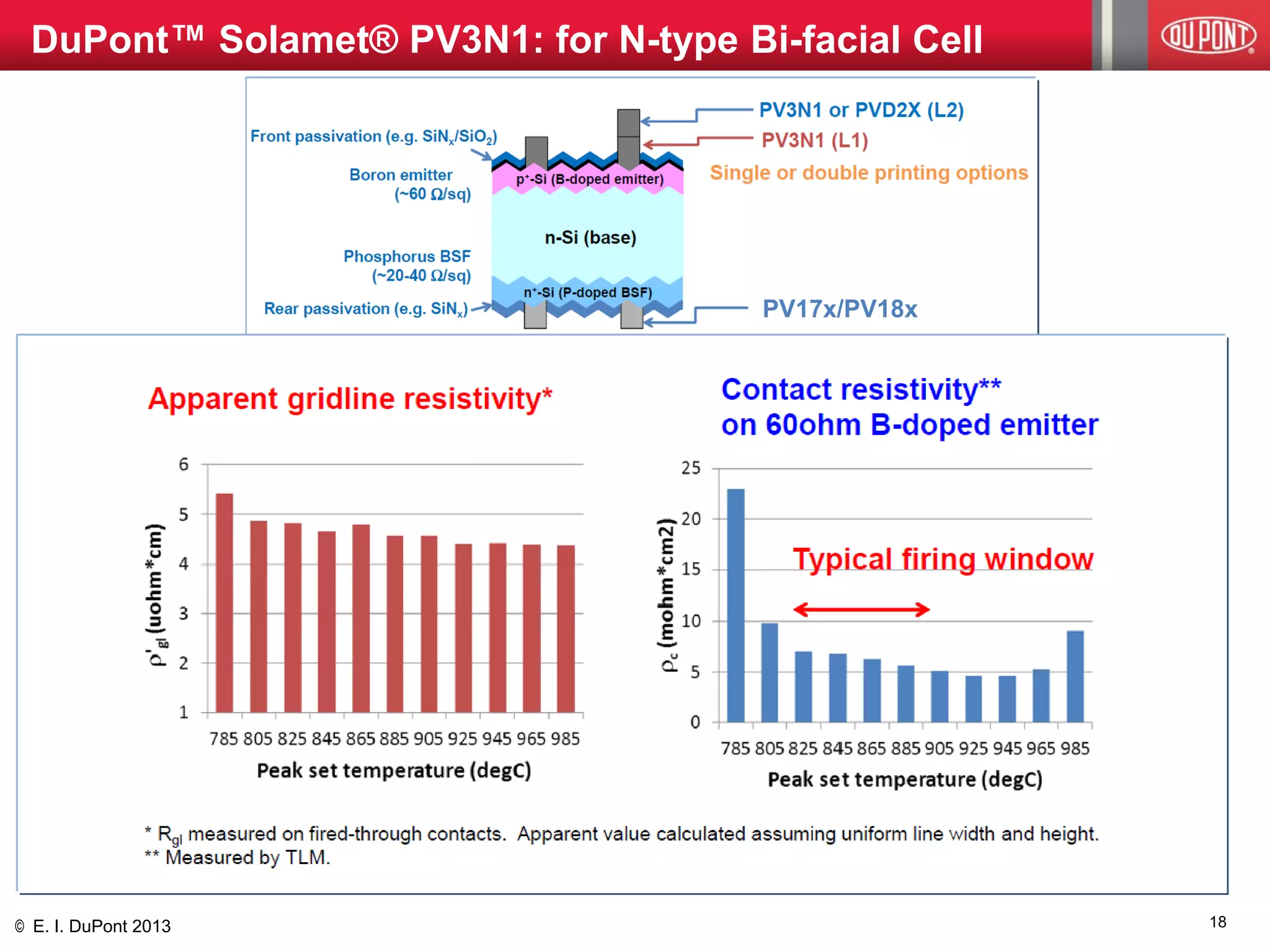
DuPont™ Solamet® PV3N1: for N-type Bi-facial Cell 
PV17x/PV18x 
18
© E. I. DuPont 2013 
19 
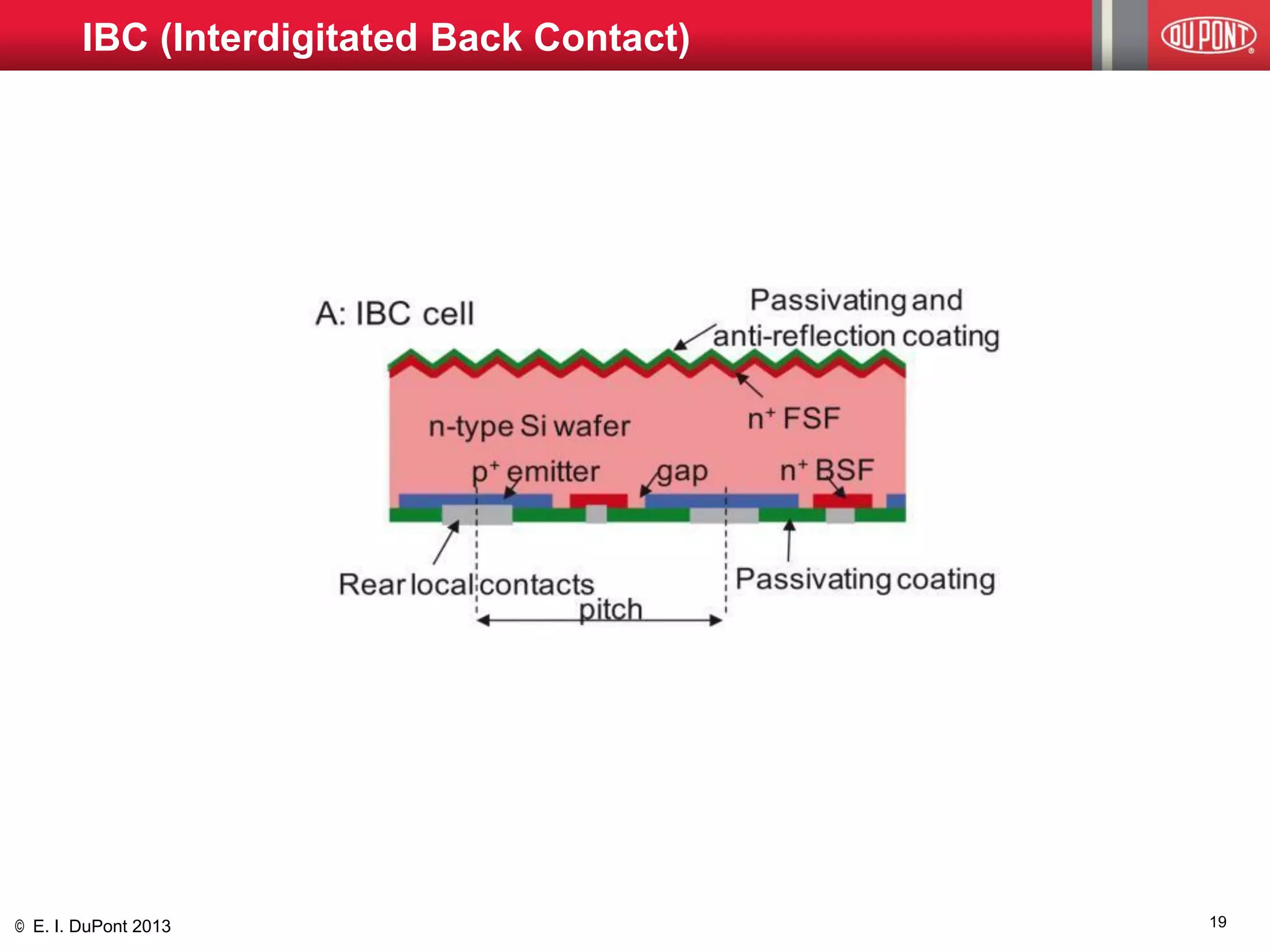
IBC (Interdigitated Back Contact)
© E. I. DuPont 2013 
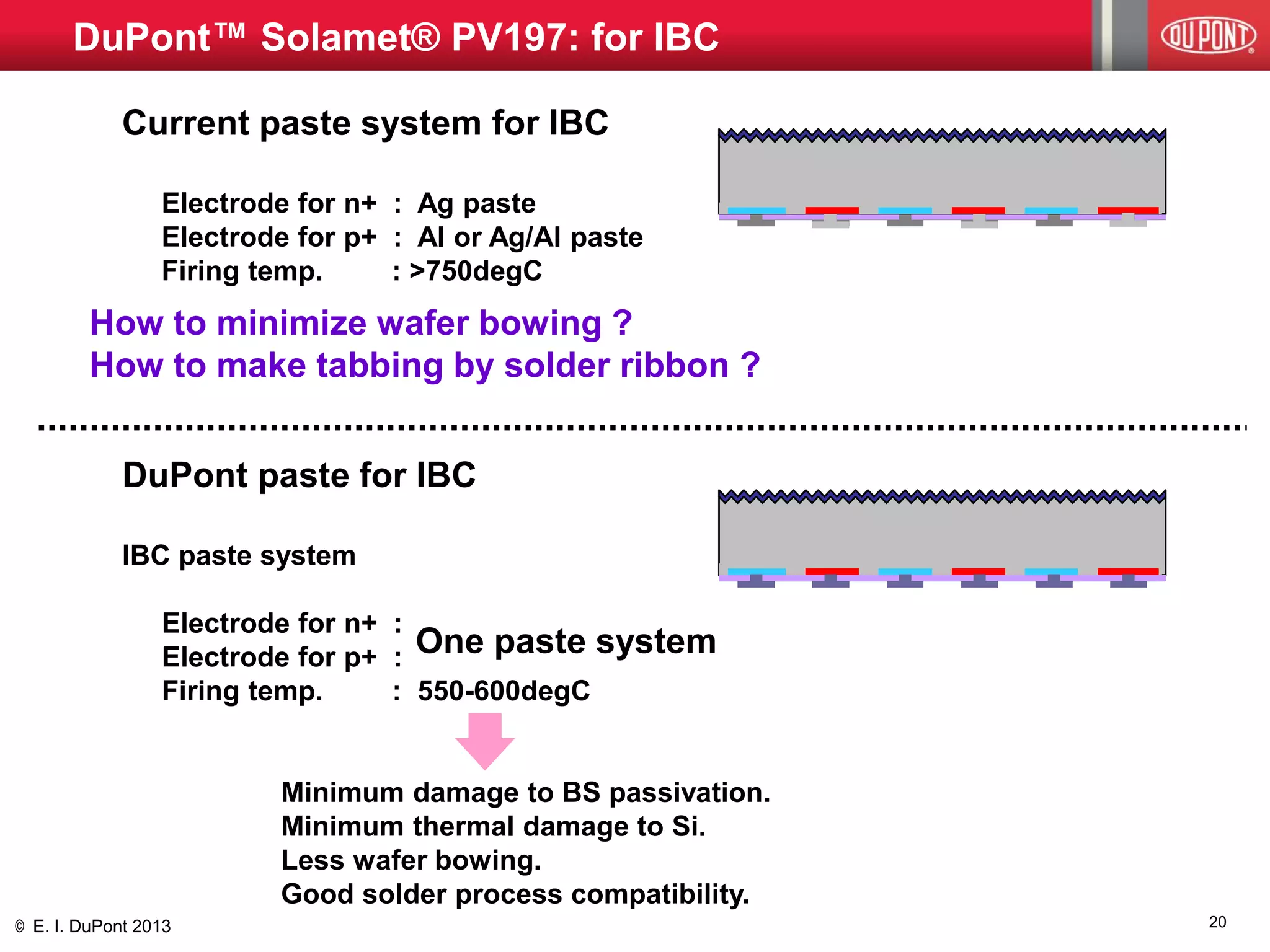
DuPont™ Solamet® PV197: for IBC 
Current paste system for IBC Electrode for n+ : Ag paste Electrode for p+ : Al or Ag/Al paste Firing temp. : >750degC 
DuPont paste for IBC 
IBC paste system 
Electrode for n+ : Electrode for p+ : 
Firing temp. : 550-600degC 
Minimum damage to BS passivation. 
Minimum thermal damage to Si. 
Less wafer bowing. Good solder process compatibility. 
p+ 
p+ 
p+ 
n+ 
n+ 
n+ 
One paste system 
How to minimize wafer bowing ? How to make tabbing by solder ribbon ? 
20
© E. I. DuPont 2013 
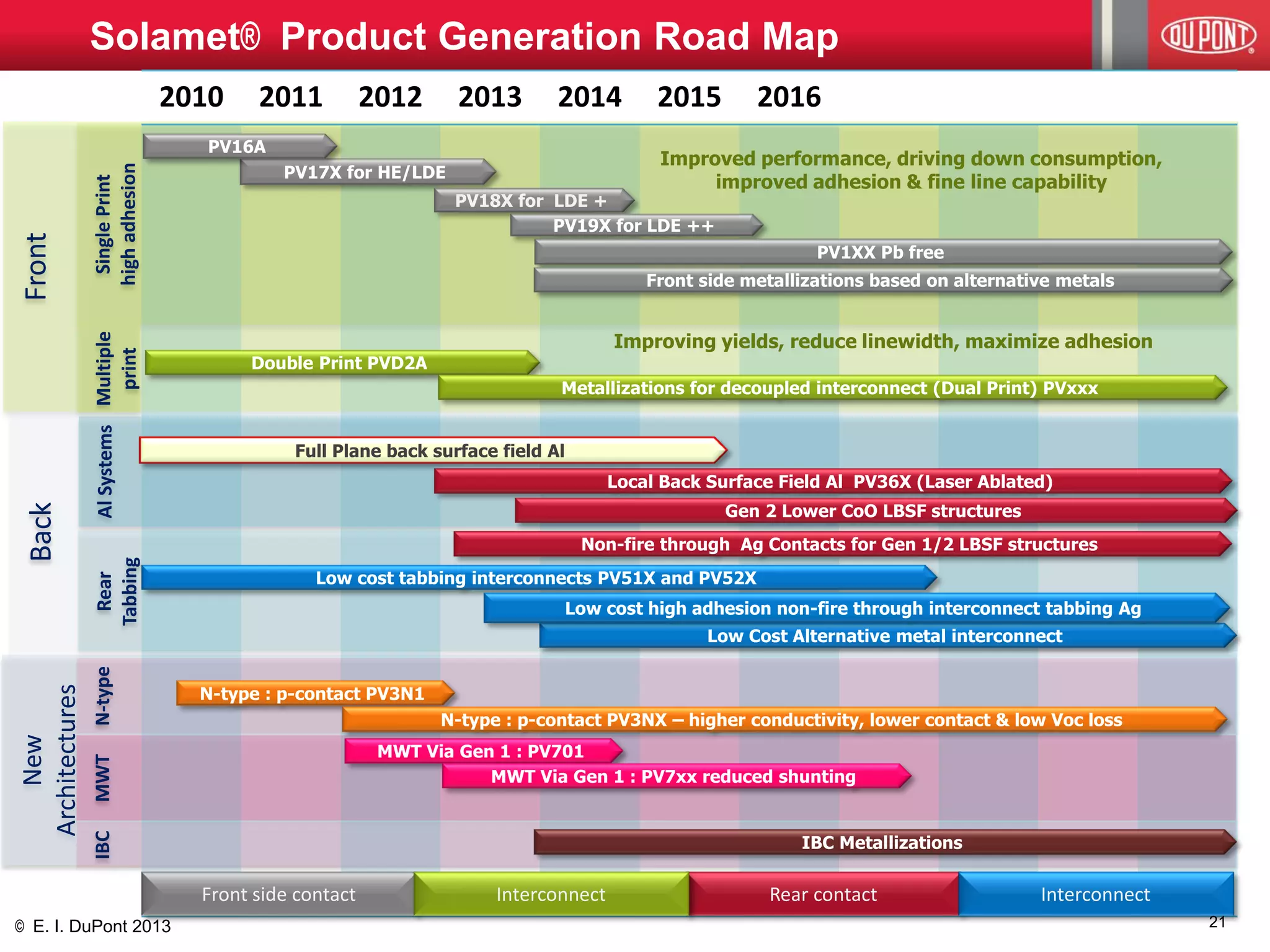
New Architectures 
IBC 
MWT 
N-type 
Back 
Rear Tabbing 
Al Systems 
Front 
Single Print high adhesion 
2010 
2011 
2012 
2013 
2014 
2015 
2016 
Solamet® Product Generation Road Map 
Front side contact 
Rear contact 
Interconnect 
Interconnect 
Double Print PVD2A 
Non-fire through Ag Contacts for Gen 1/2 LBSF structures 
PV17X for HE/LDE 
Low Cost Alternative metal interconnect 
Local Back Surface Field Al PV36X (Laser Ablated) 
IBC Metallizations 
Metallizations for decoupled interconnect (Dual Print) PVxxx 
Full Plane back surface field Al 
PV16A 
PV18X for LDE + 
PV19X for LDE ++ 
Improved performance, driving down consumption, improved adhesion & fine line capability 
PV1XX Pb free 
Low cost tabbing interconnects PV51X and PV52X 
Low cost high adhesion non-fire through interconnect tabbing Ag 
MWT Via Gen 1 : PV701 
MWT Via Gen 1 : PV7xx reduced shunting 
N-type : p-contact PV3N1 
N-type : p-contact PV3NX – higher conductivity, lower contact & low Voc loss 
Front side metallizations based on alternative metals 
Gen 2 Lower CoO LBSF structures 
Improving yields, reduce linewidth, maximize adhesion 
Multiple print 
21
© E. I. DuPont 2013 
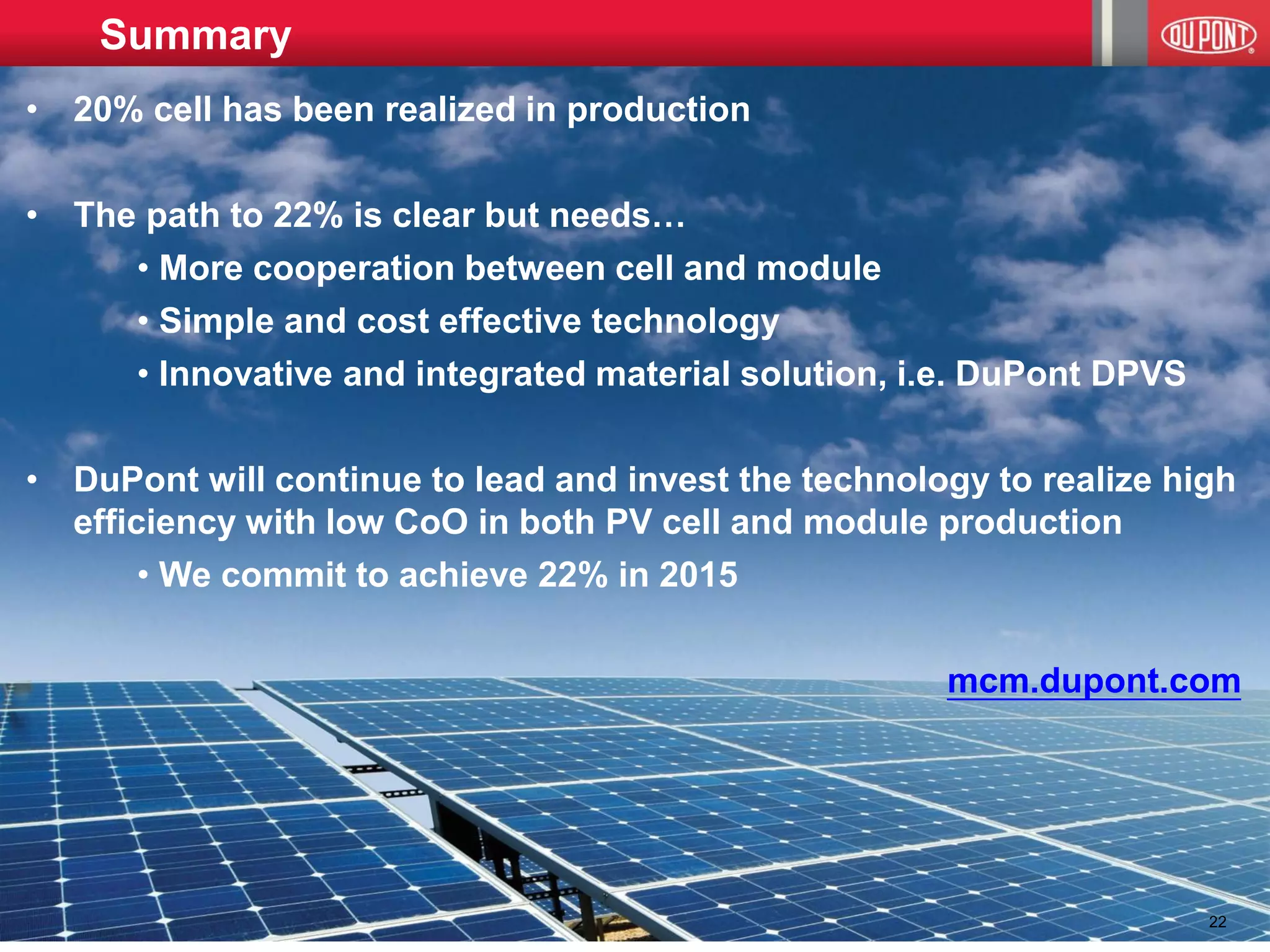
•20% cell has been realized in production 
•The path to 22% is clear but needs… 
• More cooperation between cell and module 
• Simple and cost effective technology 
• Innovative and integrated material solution, i.e. DuPont DPVS 
•DuPont will continue to lead and invest the technology to realize high efficiency with low CoO in both PV cell and module production 
• We commit to achieve 22% in 2015 mcm.dupont.com 
Summary 
22
Copyright © 2013 DuPont or its affiliates. All rights reserved. The DuPont Oval Logo, DuPont™, The miracles of science™ and all products denoted with ™ or ® are registered trademarks or trademarks of E. I. du Pont de Nemours and Company or its affiliates. 
Images reproduced by E. I. du Pont de Nemours and Company under license from the National Geographic Society. 
photovoltaics.dupont.com

DuPont: Enable Next Generation High Efficiency Solar Cells (Aug 2013)

  • 1.
    DuPont™ Solamet® EnableNext Generation High Efficiency Solar Cells Dr. Alex Wu Technology Manager, Taiwan DuPont Microcircuit Materials Aug. 16, 2013
  • 2.
    © E. I.DuPont 2013 Efficiency (%) Year Conventional Cells Solamet® PV14x Products High Efficiency Cells Solamet® PV15x, 16x High Efficiency LDE Cells Solamet® PV17x, 18x New LBSF (LDE) Architectures Solamet® PV36x N-type Cell Bi-facial: PV3Nx IBC: Pv197 Back Contact MWT : Solamet® PV70x Cell Efficiency Evolution 2
  • 3.
    © E. I.DuPont 2013 Broad Capabilities Under One Roof Design, fabrication, and characterization of advanced cell and module architectures DuPont invest to support long-term industry growth. 3
  • 4.
    © E. I.DuPont 2013 What’s the Main loss of Crystalline Si PV? Loss in Currents 4 •Jmax: Theoretical maximum for a certain wafer thickness •Jgen: Generated photo-current in actual device 1.Optical loss= Jmax- Jgen 2.Recombination & Resistive losses = Jmpp-Jgen
  • 5.
    © E. I.DuPont 2013 Eff (%) 18.7 19 20 19.7 23 Voc (mV) 633 643 651 648 699 Cell Structure and Efficiency Evolution N-ty pe IBC N-ty pe Bi-facial P-type PERC P-ty pe LDE P-ty pe STD N-type IBC N-type Bi-facial P-type PERC P-type LDE P-ty pe STD 44 43 42 41 40 39 38 37 36 35 Current Density (mA/cm2) ΔJ optical ΔJ front ΔJ Auger, base ΔJ SRH, base ΔJ rear J mpp Jmax High-efficiency Silicon Solar Cells Stefan Glunz Fraunhofer Institute for Solar Energy Systems ISE 5
  • 6.
    © E. I.DuPont 2013 Achieving higher solar cell efficiency with advanced materials and technology Fine line and MWT Local Back Surface Field N-type bi-facial Interdigitated Back Contact 6
  • 7.
    © E. I.DuPont 2013 7 Reduce the Optical Loss: Fine Line Print Squeegee side Wafer side 44 um 40 um 46 um 46 um Fine Line Print
  • 8.
    © E. I.DuPont 2013 Reduce the Optical Loss: MWT and Solamet ® PV70x reference PV70x 8
  • 9.
    © E. I.DuPont 2013 Options 1: Options 2: MWT Module Assembly Options •PCB as backsheet foil and ECA to connect •High cost •Cu foil and patterning process •ECA •Tab-string (manually or automated) •Bowing and yield loss 9
  • 10.
    © E. I.DuPont 2013 Reduce Rear Side Recombination: LBSF (PERC) p-type Si p+ Al paste PV36x SiO2 or Al2O3 FS-Ag paste PV17x / PV18x SiNx i-PERC major advantage - Minimized surface recombination velocity (SRV) - Increased internal reflectivity - Higher Voc, Jsc, and cell efficiency (up to 1%) Other advantages - Minor change in the cell/module production - Necessary for thin wafers (<150um) 10
  • 11.
    © E. I.DuPont 2013 Surface Recombination Velocity and Types of Passivation 11
  • 12.
    © E. I.DuPont 2013 +++++++++++++ P+ Induced n-type layer +++++++++++ - - - - - - - - P+ Al2O3 or SiO2 layer Rear Shunting Issue and iPERC Solution Direct Al L-BSF firing with SiNx passivation iPERC p type p+ type n type n+ type SiNx SiO2 or Al2O3 Metal Positive charges in SiNx induce n-type layer at the rear interface. Direct metal contact to both p-type local BSF and induced n-type layer creates shunted junction → no BSF effect. Negative charge in the Al2O3 or SiO2 layer, together with the increased distance of the SiNx layer from the surface, prevent formation of induced n-type layer. 12
  • 13.
    © E. I.DuPont 2013 Internal Reflection and Quantum Efficiency Light absorbed Reflected light will generate additional current Standard Cell Local BSF Cell 13
  • 14.
    © E. I.DuPont 2013 DuPont™ Solamet® PV36x for Local BSF Strong adhesion to passivation and reliable module performance Innovation in glass and Al powder technology for better contact Reference PV36x Al Si Al Si PV36x Reference 14
  • 15.
    © E. I.DuPont 2013 406 nm 655 nm 875 nm 975 nm PV505 PV56S LBIC Test •PV56S shows less passivation damage than PV505 (Width: Busbar=1.8 mm, Tabbing= 6 mm) Solamet® PV56S for PERC BS Tabbing 15
  • 16.
    © E. I.DuPont 2013 16 LID Issue for LBSF on Multi? 27th European Photovoltaic Solar Energy Conference and Exhibition Light Induced Degradation of Rear Passicvated mc-Si Solar Cells K. Ramspeck, S. Zimmermann, H. Nagel, A. Metz, Y. Gassenbauer, B. Birkmann, A. Seidl mc-PERC mc-BSF mono-PERC mono-BSF
  • 17.
    © E. I.DuPont 2013 17 p+-Si (B-doped emitter) n-Si (base) n+-Si (P-doped BSF) n+-Si (P-doped FSF) n-Si (base) p+-Si (B or Al-doped emitter) Rear emitter N-cell Rear p-contact (Ag/Al or Al) Front p-contact (Ag/Al) Rear n-contact (Ag) Front n-contact (Ag) Multiple options •Front emitter or rear emitter •Textured or planar rear •SiO2/SiNx or Al2O3/SiNx passivation •(BBr3, BCl3)/POCl3 diffusion, ion implantation, or other •Lightly-doped emitter (LDE) and LD-BSF(FSF) N-type Bi-facial Front emitter N-cell
  • 18.
    © E. I.DuPont 2013 DuPont™ Solamet® PV3N1: for N-type Bi-facial Cell PV17x/PV18x 18
  • 19.
    © E. I.DuPont 2013 19 IBC (Interdigitated Back Contact)
  • 20.
    © E. I.DuPont 2013 DuPont™ Solamet® PV197: for IBC Current paste system for IBC Electrode for n+ : Ag paste Electrode for p+ : Al or Ag/Al paste Firing temp. : >750degC DuPont paste for IBC IBC paste system Electrode for n+ : Electrode for p+ : Firing temp. : 550-600degC Minimum damage to BS passivation. Minimum thermal damage to Si. Less wafer bowing. Good solder process compatibility. p+ p+ p+ n+ n+ n+ One paste system How to minimize wafer bowing ? How to make tabbing by solder ribbon ? 20
  • 21.
    © E. I.DuPont 2013 New Architectures IBC MWT N-type Back Rear Tabbing Al Systems Front Single Print high adhesion 2010 2011 2012 2013 2014 2015 2016 Solamet® Product Generation Road Map Front side contact Rear contact Interconnect Interconnect Double Print PVD2A Non-fire through Ag Contacts for Gen 1/2 LBSF structures PV17X for HE/LDE Low Cost Alternative metal interconnect Local Back Surface Field Al PV36X (Laser Ablated) IBC Metallizations Metallizations for decoupled interconnect (Dual Print) PVxxx Full Plane back surface field Al PV16A PV18X for LDE + PV19X for LDE ++ Improved performance, driving down consumption, improved adhesion & fine line capability PV1XX Pb free Low cost tabbing interconnects PV51X and PV52X Low cost high adhesion non-fire through interconnect tabbing Ag MWT Via Gen 1 : PV701 MWT Via Gen 1 : PV7xx reduced shunting N-type : p-contact PV3N1 N-type : p-contact PV3NX – higher conductivity, lower contact & low Voc loss Front side metallizations based on alternative metals Gen 2 Lower CoO LBSF structures Improving yields, reduce linewidth, maximize adhesion Multiple print 21
  • 22.
    © E. I.DuPont 2013 •20% cell has been realized in production •The path to 22% is clear but needs… • More cooperation between cell and module • Simple and cost effective technology • Innovative and integrated material solution, i.e. DuPont DPVS •DuPont will continue to lead and invest the technology to realize high efficiency with low CoO in both PV cell and module production • We commit to achieve 22% in 2015 mcm.dupont.com Summary 22
  • 23.
    Copyright © 2013DuPont or its affiliates. All rights reserved. The DuPont Oval Logo, DuPont™, The miracles of science™ and all products denoted with ™ or ® are registered trademarks or trademarks of E. I. du Pont de Nemours and Company or its affiliates. Images reproduced by E. I. du Pont de Nemours and Company under license from the National Geographic Society. photovoltaics.dupont.com