Challenging Assumptions
  (The Role of Healthy Skepticism
  In NASA Program Management)


       PM Challenge 2008

       Bryan O’Connor
       Chief, NASA Safety and Mission Assurance
Mission Success Starts With Safety

      Safety Quote of the Day


Life moves pretty fast, if you don't stop and look
  around once in a while, you might miss it.

                                     Ferris Bueller


                                                 6 Feb 07
Mission Success Starts With Safety

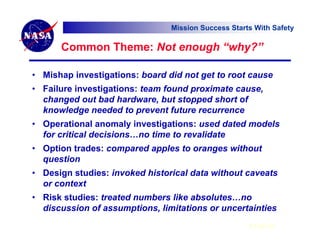
      Common Theme: Not enough “why?”

• Mishap investigations: board did not get to root cause
• Failure investigations: team found proximate cause,
  changed out bad hardware, but stopped short of
  knowledge needed to prevent future recurrence
• Operational anomaly investigations: used dated models
  for critical decisions…no time to revalidate
• Option trades: compared apples to oranges without
  question
• Design studies: invoked historical data without caveats
  or context
• Risk studies: treated numbers like absolutes…no
  discussion of assumptions, limitations or uncertainties
                                                     6 Feb 07
Mission Success Starts With Safety

     Skepticism as a Cultural Habit


There is no harm in doubt and skepticism, for it is
   through these that new discoveries are made

                                        Richard Feynman


                                                 6 Feb 07
Mission Success Starts With Safety

        Healthy Skepticism…(Core Values)

• Skepticism leads to a healthy result
   – Mission objectives are accomplished
   – Team can go home to their families intact (Safety)
   – Taxpayers are served as they deserve (Integrity)

• Healthy skepticism enables a healthy environment
   –   Professional (Excellence)
   –   Respectful (Teamwork, Integrity)
   –   Communications (Safety, Teamwork)
   –   “Safety culture” (Safety, Teamwork, Excellence)
   –   “Learning organization” (Excellence)
   –   “Engineering curiosity” (Excellence)


                                                          6 Feb 07
Mission Success Starts With Safety

     Cynicism vs. Skepticism

  The skeptic doesn’t trust the analysis…
   the cynic doesn’t trust the analyst

                                       Today’s Briefer


A cynic is not merely one who reads bitter lessons
    from the past, he is one who is prematurely
              disappointed in the future

                                      Sidney J. Harris

                                                6 Feb 07
Mission Success Starts With Safety

What We Need on Our Team


      Optimistic Pessimists
            or maybe
      Pessimistic Optimists
            who are
     Fearless Communicators


                                       6 Feb 07
Mission Success Starts With Safety

     Common Communications Barriers
• Language (literal and figurative)
• Technology (not enough…too much)
• Regulatory Limits (security, export control,
  privacy, etc)
• Volume (wheat and chaff)
• Human Limitations (pride, forgetfulness,
  cynicism, fear, communication skills)
• Organizational Competitiveness (knowledge is
  power)
• Time: “who has time to go over the lessons
  learned?”
                                               6 Feb 07
Mission Success Starts With Safety

     Lessons Learned: Why Bother?


No one wants to learn by mistakes, but we cannot
  learn enough from successes to go beyond the
                  state of the art.

                                        Henry Petrosky


                                               6 Feb 07
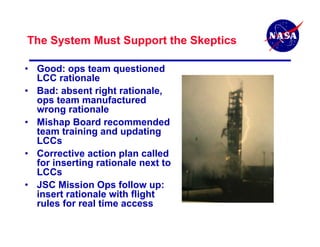
The System Must Support the Skeptics

• Good: ops team questioned
  LCC rationale
• Bad: absent right rationale,
  ops team manufactured
  wrong rationale
• Mishap Board recommended
  team training and updating
  LCCs
• Corrective action plan called
  for inserting rationale next to
  LCCs
• JSC Mission Ops follow up:
  insert rationale with flight
  rules for real time access
Mission Success Starts With Safety

       Examples of Healthy Skepticism

• Ask the risk analyst to present uncertainties
• Ask for verification of a catastrophic hazard control
• Take the time to read draft change board minutes
• Ask Engineering to review assumptions inherent in
  rarely used damage model before the mission
• Challenge the rationale for an unusual test request
• Ask “why” one more time after the analyst proposes
  “root cause”
• Ask that rationale be readily available for all new
  requirements
   Be skeptical of this rationale: “Because that’s the way we always do it”
       “Because that’s the way we always do it” is not a good rationale!
                                                                    6 Feb 07
Mission Success Starts With Safety

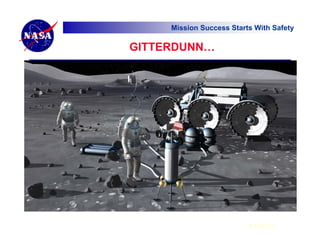
GITTERDUNN…


                          6 Feb 07

Bryan.oconnor

  • 1.
    Challenging Assumptions (The Role of Healthy Skepticism In NASA Program Management) PM Challenge 2008 Bryan O’Connor Chief, NASA Safety and Mission Assurance
  • 2.
    Mission Success StartsWith Safety Safety Quote of the Day Life moves pretty fast, if you don't stop and look around once in a while, you might miss it. Ferris Bueller 6 Feb 07
  • 3.
    Mission Success StartsWith Safety Common Theme: Not enough “why?” • Mishap investigations: board did not get to root cause • Failure investigations: team found proximate cause, changed out bad hardware, but stopped short of knowledge needed to prevent future recurrence • Operational anomaly investigations: used dated models for critical decisions…no time to revalidate • Option trades: compared apples to oranges without question • Design studies: invoked historical data without caveats or context • Risk studies: treated numbers like absolutes…no discussion of assumptions, limitations or uncertainties 6 Feb 07
  • 4.
    Mission Success StartsWith Safety Skepticism as a Cultural Habit There is no harm in doubt and skepticism, for it is through these that new discoveries are made Richard Feynman 6 Feb 07
  • 5.
    Mission Success StartsWith Safety Healthy Skepticism…(Core Values) • Skepticism leads to a healthy result – Mission objectives are accomplished – Team can go home to their families intact (Safety) – Taxpayers are served as they deserve (Integrity) • Healthy skepticism enables a healthy environment – Professional (Excellence) – Respectful (Teamwork, Integrity) – Communications (Safety, Teamwork) – “Safety culture” (Safety, Teamwork, Excellence) – “Learning organization” (Excellence) – “Engineering curiosity” (Excellence) 6 Feb 07
  • 6.
    Mission Success StartsWith Safety Cynicism vs. Skepticism The skeptic doesn’t trust the analysis… the cynic doesn’t trust the analyst Today’s Briefer A cynic is not merely one who reads bitter lessons from the past, he is one who is prematurely disappointed in the future Sidney J. Harris 6 Feb 07
  • 7.
    Mission Success StartsWith Safety What We Need on Our Team Optimistic Pessimists or maybe Pessimistic Optimists who are Fearless Communicators 6 Feb 07
  • 8.
    Mission Success StartsWith Safety Common Communications Barriers • Language (literal and figurative) • Technology (not enough…too much) • Regulatory Limits (security, export control, privacy, etc) • Volume (wheat and chaff) • Human Limitations (pride, forgetfulness, cynicism, fear, communication skills) • Organizational Competitiveness (knowledge is power) • Time: “who has time to go over the lessons learned?” 6 Feb 07
  • 9.
    Mission Success StartsWith Safety Lessons Learned: Why Bother? No one wants to learn by mistakes, but we cannot learn enough from successes to go beyond the state of the art. Henry Petrosky 6 Feb 07
  • 10.
    The System MustSupport the Skeptics • Good: ops team questioned LCC rationale • Bad: absent right rationale, ops team manufactured wrong rationale • Mishap Board recommended team training and updating LCCs • Corrective action plan called for inserting rationale next to LCCs • JSC Mission Ops follow up: insert rationale with flight rules for real time access
  • 11.
    Mission Success StartsWith Safety Examples of Healthy Skepticism • Ask the risk analyst to present uncertainties • Ask for verification of a catastrophic hazard control • Take the time to read draft change board minutes • Ask Engineering to review assumptions inherent in rarely used damage model before the mission • Challenge the rationale for an unusual test request • Ask “why” one more time after the analyst proposes “root cause” • Ask that rationale be readily available for all new requirements Be skeptical of this rationale: “Because that’s the way we always do it” “Because that’s the way we always do it” is not a good rationale! 6 Feb 07
  • 12.
    Mission Success StartsWith Safety GITTERDUNN… 6 Feb 07