Deconstructing the Big Dig: Lessons Learned from the Country’s
                      Largest Mega Project
          NASA PM Challenge 2010 Above and Beyond, Galveston, Texas
                                 Presented By:
           Virginia A. Greiman, Assistant Professor, Boston University


© 2009 V. Greiman


                                 Used with permission
Presentation of Research
     Literature review of cost escalation on mega
     projects and comparison to Big Dig

     Detailed analysis of cost and schedule data over life
     of project

     Presentation of techniques for analyzing data

     Discussion of lessons learned

     Recommendations for mega project managers


© 2009 V. Greiman
Existing Literature
     Focus on causes of mega project cost
     increases

     Techniques for estimating costs

     Governance and support mechanisms

     Frameworks used in different countries

     Little comparative research on strategies and
     methodologies for cost estimation
     management
© 2009 V. Greiman
Why Study Mega Projects? R & D
             Laboratories
     Major driver of economic development and globalization

     Largest Investment of Capital Worldwide

     Output of Technology and Innovation

     Critical cause of poverty is lack of access to infrastructure

     Resolution of political, legal and financial challenges

     Absence of research on cost estimation management

     Interdisciplinary

© 2009 V. Greiman
Transportation Research Board
     In 2006, the Transportation Research Board’s
     Final Report for Cost Estimation and
     Management for Highway Projects, identified
     eight strategies to address cost escalation,
     and linked these strategies to 18 different
     causes of cost escalation on highway
     projects in the United States. Notably, the
     research concluded that most efforts in cost
     estimation have focused on creating tools to
     improve cost estimates with less emphasis
     on tools for cost estimation management.

      (Anderson et. al. 2006).
© 2009 V. Greiman
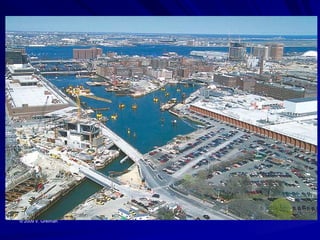
Why the Big Dig?

     I-90 Never Finished in 1952

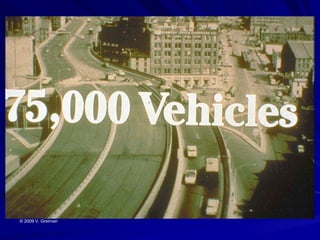
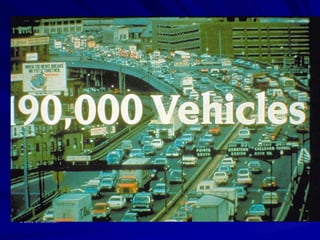
     10-14 Hours of Gridlock Per Day

     Accident Rate Four Times National Average

     Rapidly Deteriorating Structure

     Improve Regional Network

     Economic Stimulation

     Environmental Improvements
© 2009 V. Greiman
© 2009 V. Greiman
© 2009 V. Greiman
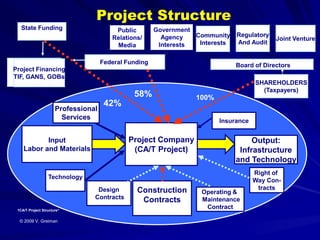
Project Structure
   State Funding                         Public        Government
                                        Relations/       Agency   Community    Regulatory
                                                                                            Joint Venture
                                         Media          Interests  Interests   And Audit


                                     Federal Funding                           Board of Directors
Project Financing
TIF, GANS, GOBs
                                                                                     SHAREHOLDERS
                                                                                       (Taxpayers)
                                               58%                100%
                                      42%
                      Professional
                        Services                                         Insurance


           Input                             Project Company                        Output:
    Labor and Materials                       (CA/T Project)                    Infrastructure
                                                                               and Technology
                                                                                     Right of
                  Technology
                                                                                     Way Con-
                                  Design        Construction                          tracts
                                                                    Operating &
                                 Contracts       Contracts          Maintenance
 1CA/T Project Structure”
                                                                     Contract

  © 2009 V. Greiman
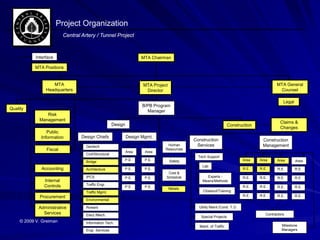
Project Organization
                           Central Artery / Tunnel Project


            Interface                                                   MTA Chairman

           MTA Positions


                    MTA                                                 MTA Project                                                          MTA General
                 Headquarters                                            Director                                                             Counsel

                                                                                                                                                 Legal
                                                                        B/PB Program
Quality
                                                                          Manager
                Risk
             Management
                                                                                                                                               Claims &
                                                        Design                                                       Construction
                                                                                                                                               Changes
                 Public
              Information          Design Chiefs                 Design Mgmt.
                                                                                               Construction                          Construction
                                     Geotech                                       Human        Services                             Management
                 Fiscal                                          Area    Area
                                                                                  Resources
                                     Civil/Structural
                                                                                                 Tech Support
                                                             P.E.        P.E.         Safety                                 Area   Area     Area        Area
                                     Bridge
                                                                                                   Lab
              Accounting             Architecture            P.E.        P.E.                                                R.E.   R.E.      R.E.       R.E.
                                                                                   Cost &
                                     IPCS                    P.E.        P.E.     Schedule           Experts -               R.E.   R.E.      R.E.       R.E.
                Internal                                                                           Means/Methods
                Controls             Traffic Engr.
                                                             P.E.        P.E.                                                R.E.   R.E.      R.E.       R.E.
                                                                                      Metals
                                     Traffic Mgmt.                                                 Closeout/Training
              Procurement                                                                                                    R.E.   R.E.      R.E.       R.E.
                                     Environmental

             Administrative          Rowars                                                      Utility Maint./Cond. T.O.
               Services              Elect./Mech.                                                                                      Contractors
                                                                                                  Special Projects
     © 2009 V. Greiman               Information Tech.
                                                                                                 Maint. of Traffic                              Milestone
                                     Engr. Services                                                                                             Managers
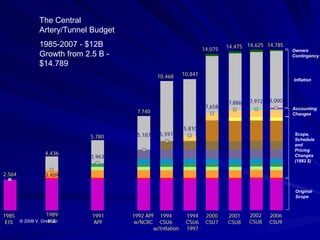
Cost History And Scope Evolution
              The Central
              Artery/Tunnel Budget
              1985-2007 - $12B                                                           14,475 14,625 14,785
                                                                                14,075                           Owners
              Growth from 2.5 B -                                                                                Contingency
              $14.789
                                                           10,468      10,841
                                                                                                                 Inflation


                                                                                         7,886   7,972   8,000
                                                                                 7,658                           Accounting
                                                   7,740                                                         Changes


                                                                        5,810
                                 5,780             5,187    5,597                                                 Scope,
                                                                                                                  Schedule
                                                                                                                  and
                                                                                                                  Pricing
                4,436                    4,317
                                 3,963                                                                            Changes
                         3,708                                                                                    (1982 $)


2,564           3,409

                                                                                                                  Original
                                                                                                                  Scope


1985             1989            1991            1992 APF 1994           1994 2000       2001    2002    2006
                  ICE
 EIS © 2009 V. Greiman           APF             w/NCRC CSU6             CSU6 CSU7       CSU8    CSU8    CSU9
                                                         w/Inflation     1997
                                                                       Rebaseline
Eurotunnel Facts
     Project cost twice as much as original estimates.
     Project finance included a suspension of interest
     payments and conversion of debt to bonds.
     Project risks included a fire that damaged image and
     revenues.
     Enhanced environmental, safety, and security
     demands increased cost.
     Project was initially weakly staffed through
     seconded employees.
     Contracts were less tight than normal for a project
     financing of this size.
Bent Flyvbjerg, Megaprojects and Risk, p. 97-98

© 2009 V. Greiman
Why are Mega Projects Consistently
        Underestimated?
     A review of large public works projects
     over the last century concluded that
     costs are consistently underestimated,
     a phenomenon attributed to the desire
     of the project advocates to have their
     projects approved.
     (Flyvjberg 2002)


© 2009 V. Greiman
Underestimation of Costs is the
       Rule Rather than the Exception!
  “The difference between actual and
  estimated investment cost is often 50-
  100 per cent, and for many projects cost
  overruns end up threatening project
  viability. Underestimation of costs at the
  time of the decision to build is the rule
  rather than the exception for
  transportation infrastructure projects.”
  (Flyvjberg 2002 and 2006)
© 2009 V. Greiman
© 2009 V. Greiman
© 2009 V. Greiman
© 2009 V. Greiman
© 2009 V. Greiman
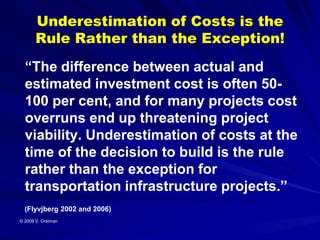
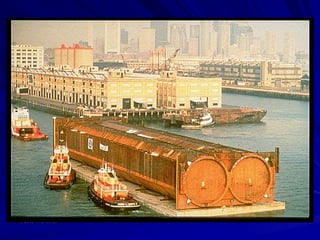
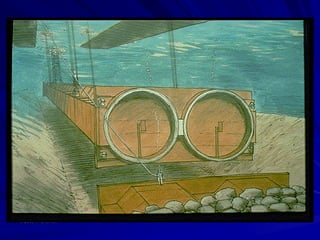
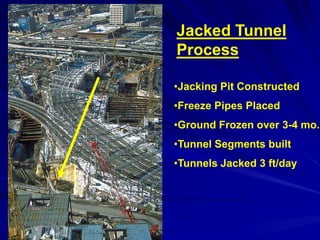
Jacked Tunnel
                    Process

                    •Jacking Pit Constructed
                    •Freeze Pipes Placed
                    •Ground Frozen over 3-4 mo.
                    •Tunnel Segments built
                    •Tunnels Jacked 3 ft/day


© 2009 V. Greiman
© 2009 V. Greiman
© 2009 V. Greiman
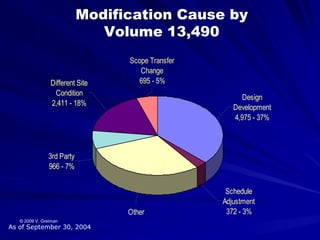
Modification Cause by
                              Volume 13,490
                                 Scope Transfer
                                    Change
                Different Site      695 - 5%
                 Condition
                                                       Design
                2,411 - 18%
                                                     Development
                                                     4,975 - 37%


               3rd Party
               966 - 7%


                                                   Schedule
                                                  Adjustment
                                 Other             372 - 3%
   © 2009 V. Greiman
As of September 30, 2004
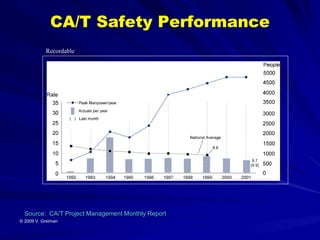
CA/T Safety Performance
           Recordable


  Source: CA/T Project Management Monthly Report
© 2009 V. Greiman
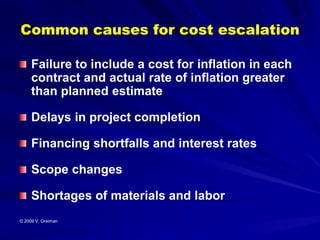
Common causes for cost escalation

     Failure to include a cost for inflation in each
     contract and actual rate of inflation greater
     than planned estimate

     Delays in project completion

     Financing shortfalls and interest rates

     Scope changes

     Shortages of materials and labor
© 2009 V. Greiman
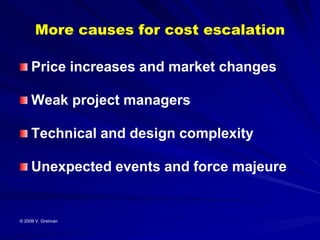
More causes for cost escalation

     Price increases and market changes

     Weak project managers

     Technical and design complexity

     Unexpected events and force majeure


© 2009 V. Greiman
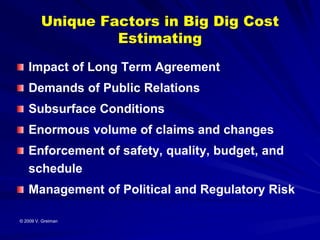
Unique Factors in Big Dig Cost
                  Estimating
   Impact of Long Term Agreement
   Demands of Public Relations
   Subsurface Conditions
   Enormous volume of claims and changes
   Enforcement of safety, quality, budget, and
   schedule
   Management of Political and Regulatory Risk

© 2009 V. Greiman
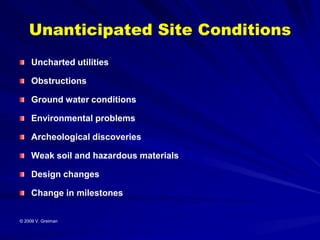
Unanticipated Site Conditions
     Uncharted utilities

     Obstructions

     Ground water conditions

     Environmental problems

     Archeological discoveries

     Weak soil and hazardous materials

     Design changes

     Change in milestones


© 2009 V. Greiman
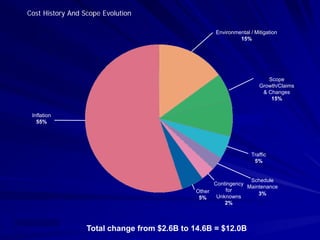
Cost History And Scope Evolution

                                                       Environmental / Mitigation
                                                                15%


                                                                            Scope
                                                                         Growth/Claims
                                                                          & Changes
                                                                             15%


     Inflation
       55%


                                                                      Traffic
                                                                       5%


                                                                   Schedule
                                                      Contingency
                                                                  Maintenance
                                                Other     for
                                                                      3%
                                                 5%    Unknowns
                                                          2%


© 2009 V. Greiman
                     Total change from $2.6B to 14.6B = $12.0B
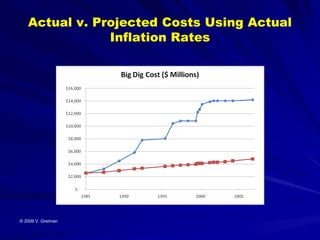
Actual v. Projected Costs Using Actual
               Inflation Rates


© 2009 V. Greiman
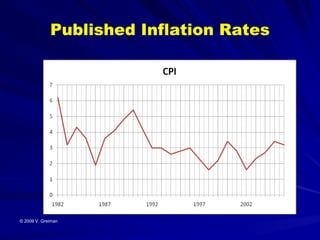
Published Inflation Rates


© 2009 V. Greiman
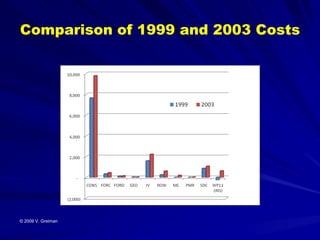
Comparison of 1999 and 2003 Costs


© 2009 V. Greiman
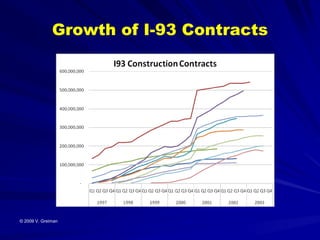
Growth of I-93 Contracts


© 2009 V. Greiman
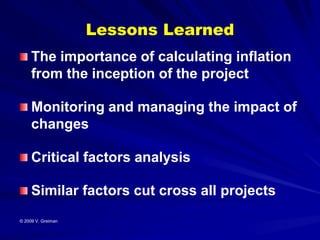
Lessons Learned
     The importance of calculating inflation
     from the inception of the project

     Monitoring and managing the impact of
     changes

     Critical factors analysis

     Similar factors cut cross all projects
© 2009 V. Greiman
Recommendations
         Study the historical data from mega project
     –         the patterns in the data are valuable indicators of trouble.

     –         Recognize the limitations of the assumptions in
               historical projects with comparable
               characteristics.
         Identify the attributes of the project that will grow
         and change over time.
         Recognize that the accuracy of cost estimates vary
         throughout the project.
         Adopt a baseline for cost control during inception
         and update the baseline when schedule, scope and
         quality change.
© 2009 V. Greiman
More Recommendations!

     Enforce project standards and
     requirements on all project contractors.

     Utilize contingency reserves and
     management reserves solely within the
     framework for which they are
     maintained.


© 2009 V. Greiman
The Most Important Recommendations!
     Establish an open and transparent process!

      – Throughout the project

      – Necessity for accurate and realistic estimation and
        budgeting

     Plot instantaneous data

      – No matter what the accountants say!

      – Every blip is a management decision

     Do your own analysis

      – Use the primary data

© 2009 V. Greiman
References
     Anderson, S., Molenaar, K., Schexnayder, C. (2006, September) Final Report
     for NCHRP Report 574: Guidance for Cost Estimation and Management for
     Highway Project During Planning, Programming, and Preconstruction. National
     Cooperative Highway Research Program, Transportation Research Board of the
     National Academies. 52, 55, 56

     Flyvjberg, B., Holm, M. and Buhl, S. (2002). Underestimating Costs in Public
     Works Projects, Error or Lie?, Journal of the American Planning Association,
     Vol 68, No. 3, American Planning Association, Chicago, Illinois 279-295

     Flyvbjerg B., Bruzelious, N., and Rotherngatter, W., (2006) Megaprojects and
     Risk, Cambridge University Press


© 2009 V. Greiman
Contact Information

                      Virginia A. Greiman
                      Assistant Professor
                       Boston University
                         617-353-6860
                      ggreiman@bu.edu


© 2009 V. Greiman

Grieman

  • 1.
    Deconstructing the BigDig: Lessons Learned from the Country’s Largest Mega Project NASA PM Challenge 2010 Above and Beyond, Galveston, Texas Presented By: Virginia A. Greiman, Assistant Professor, Boston University © 2009 V. Greiman Used with permission
  • 2.
    Presentation of Research Literature review of cost escalation on mega projects and comparison to Big Dig Detailed analysis of cost and schedule data over life of project Presentation of techniques for analyzing data Discussion of lessons learned Recommendations for mega project managers © 2009 V. Greiman
  • 3.
    Existing Literature Focus on causes of mega project cost increases Techniques for estimating costs Governance and support mechanisms Frameworks used in different countries Little comparative research on strategies and methodologies for cost estimation management © 2009 V. Greiman
  • 4.
    Why Study MegaProjects? R & D Laboratories Major driver of economic development and globalization Largest Investment of Capital Worldwide Output of Technology and Innovation Critical cause of poverty is lack of access to infrastructure Resolution of political, legal and financial challenges Absence of research on cost estimation management Interdisciplinary © 2009 V. Greiman
  • 5.
    Transportation Research Board In 2006, the Transportation Research Board’s Final Report for Cost Estimation and Management for Highway Projects, identified eight strategies to address cost escalation, and linked these strategies to 18 different causes of cost escalation on highway projects in the United States. Notably, the research concluded that most efforts in cost estimation have focused on creating tools to improve cost estimates with less emphasis on tools for cost estimation management. (Anderson et. al. 2006). © 2009 V. Greiman
  • 6.
    Why the BigDig? I-90 Never Finished in 1952 10-14 Hours of Gridlock Per Day Accident Rate Four Times National Average Rapidly Deteriorating Structure Improve Regional Network Economic Stimulation Environmental Improvements © 2009 V. Greiman
  • 7.
    © 2009 V.Greiman
  • 8.
    © 2009 V.Greiman
  • 9.
    Project Structure State Funding Public Government Relations/ Agency Community Regulatory Joint Venture Media Interests Interests And Audit Federal Funding Board of Directors Project Financing TIF, GANS, GOBs SHAREHOLDERS (Taxpayers) 58% 100% 42% Professional Services Insurance Input Project Company Output: Labor and Materials (CA/T Project) Infrastructure and Technology Right of Technology Way Con- Design Construction tracts Operating & Contracts Contracts Maintenance 1CA/T Project Structure” Contract © 2009 V. Greiman
  • 10.
    Project Organization Central Artery / Tunnel Project Interface MTA Chairman MTA Positions MTA MTA Project MTA General Headquarters Director Counsel Legal B/PB Program Quality Manager Risk Management Claims & Design Construction Changes Public Information Design Chiefs Design Mgmt. Construction Construction Geotech Human Services Management Fiscal Area Area Resources Civil/Structural Tech Support P.E. P.E. Safety Area Area Area Area Bridge Lab Accounting Architecture P.E. P.E. R.E. R.E. R.E. R.E. Cost & IPCS P.E. P.E. Schedule Experts - R.E. R.E. R.E. R.E. Internal Means/Methods Controls Traffic Engr. P.E. P.E. R.E. R.E. R.E. R.E. Metals Traffic Mgmt. Closeout/Training Procurement R.E. R.E. R.E. R.E. Environmental Administrative Rowars Utility Maint./Cond. T.O. Services Elect./Mech. Contractors Special Projects © 2009 V. Greiman Information Tech. Maint. of Traffic Milestone Engr. Services Managers
  • 11.
    Cost History AndScope Evolution The Central Artery/Tunnel Budget 1985-2007 - $12B 14,475 14,625 14,785 14,075 Owners Growth from 2.5 B - Contingency $14.789 10,468 10,841 Inflation 7,886 7,972 8,000 7,658 Accounting 7,740 Changes 5,810 5,780 5,187 5,597 Scope, Schedule and Pricing 4,436 4,317 3,963 Changes 3,708 (1982 $) 2,564 3,409 Original Scope 1985 1989 1991 1992 APF 1994 1994 2000 2001 2002 2006 ICE EIS © 2009 V. Greiman APF w/NCRC CSU6 CSU6 CSU7 CSU8 CSU8 CSU9 w/Inflation 1997 Rebaseline
  • 12.
    Eurotunnel Facts Project cost twice as much as original estimates. Project finance included a suspension of interest payments and conversion of debt to bonds. Project risks included a fire that damaged image and revenues. Enhanced environmental, safety, and security demands increased cost. Project was initially weakly staffed through seconded employees. Contracts were less tight than normal for a project financing of this size. Bent Flyvbjerg, Megaprojects and Risk, p. 97-98 © 2009 V. Greiman
  • 13.
    Why are MegaProjects Consistently Underestimated? A review of large public works projects over the last century concluded that costs are consistently underestimated, a phenomenon attributed to the desire of the project advocates to have their projects approved. (Flyvjberg 2002) © 2009 V. Greiman
  • 14.
    Underestimation of Costsis the Rule Rather than the Exception! “The difference between actual and estimated investment cost is often 50- 100 per cent, and for many projects cost overruns end up threatening project viability. Underestimation of costs at the time of the decision to build is the rule rather than the exception for transportation infrastructure projects.” (Flyvjberg 2002 and 2006) © 2009 V. Greiman
  • 15.
    © 2009 V.Greiman
  • 16.
    © 2009 V.Greiman
  • 17.
    © 2009 V.Greiman
  • 18.
    © 2009 V.Greiman
  • 19.
    Jacked Tunnel Process •Jacking Pit Constructed •Freeze Pipes Placed •Ground Frozen over 3-4 mo. •Tunnel Segments built •Tunnels Jacked 3 ft/day © 2009 V. Greiman
  • 20.
    © 2009 V.Greiman
  • 21.
    © 2009 V.Greiman
  • 22.
    Modification Cause by Volume 13,490 Scope Transfer Change Different Site 695 - 5% Condition Design 2,411 - 18% Development 4,975 - 37% 3rd Party 966 - 7% Schedule Adjustment Other 372 - 3% © 2009 V. Greiman As of September 30, 2004
  • 23.
    CA/T Safety Performance Recordable Source: CA/T Project Management Monthly Report © 2009 V. Greiman
  • 24.
    Common causes forcost escalation Failure to include a cost for inflation in each contract and actual rate of inflation greater than planned estimate Delays in project completion Financing shortfalls and interest rates Scope changes Shortages of materials and labor © 2009 V. Greiman
  • 25.
    More causes forcost escalation Price increases and market changes Weak project managers Technical and design complexity Unexpected events and force majeure © 2009 V. Greiman
  • 26.
    Unique Factors inBig Dig Cost Estimating Impact of Long Term Agreement Demands of Public Relations Subsurface Conditions Enormous volume of claims and changes Enforcement of safety, quality, budget, and schedule Management of Political and Regulatory Risk © 2009 V. Greiman
  • 27.
    Unanticipated Site Conditions Uncharted utilities Obstructions Ground water conditions Environmental problems Archeological discoveries Weak soil and hazardous materials Design changes Change in milestones © 2009 V. Greiman
  • 28.
    Cost History AndScope Evolution Environmental / Mitigation 15% Scope Growth/Claims & Changes 15% Inflation 55% Traffic 5% Schedule Contingency Maintenance Other for 3% 5% Unknowns 2% © 2009 V. Greiman Total change from $2.6B to 14.6B = $12.0B
  • 29.
    Actual v. ProjectedCosts Using Actual Inflation Rates © 2009 V. Greiman
  • 30.
  • 31.
    Comparison of 1999and 2003 Costs © 2009 V. Greiman
  • 32.
    Growth of I-93Contracts © 2009 V. Greiman
  • 33.
    Lessons Learned The importance of calculating inflation from the inception of the project Monitoring and managing the impact of changes Critical factors analysis Similar factors cut cross all projects © 2009 V. Greiman
  • 34.
    Recommendations Study the historical data from mega project – the patterns in the data are valuable indicators of trouble. – Recognize the limitations of the assumptions in historical projects with comparable characteristics. Identify the attributes of the project that will grow and change over time. Recognize that the accuracy of cost estimates vary throughout the project. Adopt a baseline for cost control during inception and update the baseline when schedule, scope and quality change. © 2009 V. Greiman
  • 35.
    More Recommendations! Enforce project standards and requirements on all project contractors. Utilize contingency reserves and management reserves solely within the framework for which they are maintained. © 2009 V. Greiman
  • 36.
    The Most ImportantRecommendations! Establish an open and transparent process! – Throughout the project – Necessity for accurate and realistic estimation and budgeting Plot instantaneous data – No matter what the accountants say! – Every blip is a management decision Do your own analysis – Use the primary data © 2009 V. Greiman
  • 37.
    References Anderson, S., Molenaar, K., Schexnayder, C. (2006, September) Final Report for NCHRP Report 574: Guidance for Cost Estimation and Management for Highway Project During Planning, Programming, and Preconstruction. National Cooperative Highway Research Program, Transportation Research Board of the National Academies. 52, 55, 56 Flyvjberg, B., Holm, M. and Buhl, S. (2002). Underestimating Costs in Public Works Projects, Error or Lie?, Journal of the American Planning Association, Vol 68, No. 3, American Planning Association, Chicago, Illinois 279-295 Flyvbjerg B., Bruzelious, N., and Rotherngatter, W., (2006) Megaprojects and Risk, Cambridge University Press © 2009 V. Greiman
  • 38.
    Contact Information Virginia A. Greiman Assistant Professor Boston University 617-353-6860 ggreiman@bu.edu © 2009 V. Greiman