Platform Performance Evolution -
Learning from Reference Storage Platform
DUG’20
Sarika Mehta, Storage Performance Engineer – Intel Corporation
2
Legal Disclaimers
All product plans and roadmaps are subject to change without notice.
Intel optimizations, for Intel compilers or other products, may not optimize to the same degree for non-Intel products.
Intel technologies may require enabled hardware, software, or service activation.
Intel disclaims all express and implied warranties, including without limitation, the implied warranties of merchantability, fitness for a particular purpose, and non-infringement, as
well as any warranty arising from course of performance, course of dealing, or usage intrade.
Performance varies by use, configuration, and other factors. Learn more at www.intel.com/PerformanceIndex.
Performance results are based on testing as of dates shown in the configurations and may not reflect all publicly available security updates. See backup for configuration details. No
product or component can be absolutely secure.
Your costs and results may vary.
Intel does not control or audit third-party data. You should consult other sources to evaluate accuracy.
Results have been estimated or simulated.
© Intel Corporation. Intel, the Intel logo, and other Intel marks are trademarks of Intel Corporationoritssubsidiaries. Other names and brands may be claimed as the property of
others.
3
Reference Storage Platform
Performance evolution
over time
• Bandwidth and IOPS
• Read QoS(quality of service)
• Read QoS in presence of
writes
Agenda
4
Reference Storage Platform – A Learning Vehicle
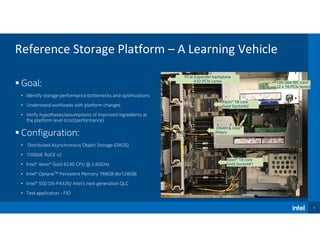
 Goal:
• Identify storage performance bottlenecks and optimizations
• Understand workloads with platform changes
• Verify hypotheses/assumptions of improved ingredients at
the platform level (cost/performance)
 Configuration:
• Distributed Asynchronous Object Storage (DAOS)
• 100GbE RoCE v2
• Intel® Xeon® Gold 6240 CPU @ 2.60GHz
• Intel® OptaneTM Persistent Memory 768GB (6x128GB)
• Intel® SSD D5-P4326/ Intel’s next generation QLC
• Test application - FIO
PCIe Expander backplane
X32 PCIe Lanes 100 Gbe NIC card
(2 x 16 PCIe lanes)
Xeon® 18 core
Gold Socket#2
Xeon® 18 core
Gold Socket#1
DRAM & Intel®
PMem
5
Performance Improvements Over Time
0
3
6
9
12
15
18
21
24
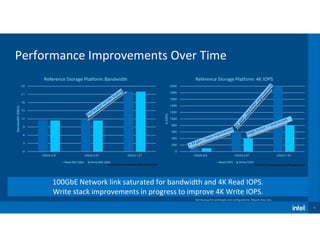
DAOS 0.8 DAOS 0.91 DAOS 1.0*
Bandwidth(GB/s)
Reference Storage Platform: Bandwidth
Read BW GB/s Write BW GB/s
*DAOS1.0 measurements with dual socket
0
200
400
600
800
1000
1200
1400
1600
1800
2000
DAOS 0.8 DAOS 0.91 DAOS 1.0*
KIOPS
Reference Storage Platform: 4K IOPS
Read IOPS Write IOPS
*DAOS1.0 measurements with dual socket
See backup for workloads and configurations. Results may vary.
100GbE Network link saturated for bandwidth and 4K Read IOPS.
Write stack improvements in progress to improve 4K Write IOPS.
6
Intel® Optane™ technology-like write latencies, NAND like read latencies
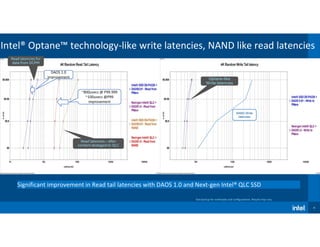
~800usecs @ P99.999
~100usecs @P99
improvement
Read latencies for
data from DCPM
Read latencies – after
content destaged to QLC
DAOS 1.0
improvement Optane-like
Write latencies
See backup for workloads and configurations. Results may vary.
Significant improvement in Read tail latencies with DAOS 1.0 and Next-gen Intel® QLC SSD
NAND Write
latencies
7
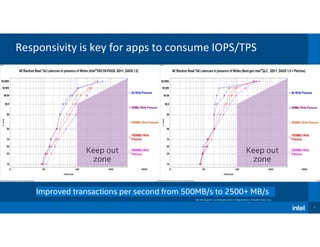
Responsivity is key for apps to consume IOPS/TPS
See backup for workloads and configurations. Results may vary.
Improved transactions per second from 500MB/s to 2500+ MB/s
Keep out
zone
Keep out
zone
8
9
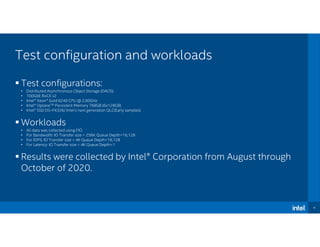
Test configuration and workloads
 Test configurations:
• Distributed Asynchronous Object Storage (DAOS)
• 100GbE RoCE v2
• Intel® Xeon® Gold 6240 CPU @ 2.60GHz
• Intel® OptaneTM Persistent Memory 768GB (6x128GB)
• Intel® SSD D5-P4326/ Intel’s next generation QLC(Early samples)
 Workloads
• All data was collected using FIO.
• For Bandwidth: IO Transfer size = 256K Queue Depth=16,128
• For IOPS: IO Transfer size = 4K Queue Depth=16,128
• For Latency: IO Transfer size = 4K Queue Depth=1
 Results were collected by Intel® Corporation from August through
October of 2020.

DUG'20: 11 - Platform Performance Evolution from bring-up to reaching link saturation – Learning from Reference Storage Platform

  • 1.
    Platform Performance Evolution- Learning from Reference Storage Platform DUG’20 Sarika Mehta, Storage Performance Engineer – Intel Corporation
  • 2.
    2 Legal Disclaimers All productplans and roadmaps are subject to change without notice. Intel optimizations, for Intel compilers or other products, may not optimize to the same degree for non-Intel products. Intel technologies may require enabled hardware, software, or service activation. Intel disclaims all express and implied warranties, including without limitation, the implied warranties of merchantability, fitness for a particular purpose, and non-infringement, as well as any warranty arising from course of performance, course of dealing, or usage intrade. Performance varies by use, configuration, and other factors. Learn more at www.intel.com/PerformanceIndex. Performance results are based on testing as of dates shown in the configurations and may not reflect all publicly available security updates. See backup for configuration details. No product or component can be absolutely secure. Your costs and results may vary. Intel does not control or audit third-party data. You should consult other sources to evaluate accuracy. Results have been estimated or simulated. © Intel Corporation. Intel, the Intel logo, and other Intel marks are trademarks of Intel Corporationoritssubsidiaries. Other names and brands may be claimed as the property of others.
  • 3.
    3 Reference Storage Platform Performanceevolution over time • Bandwidth and IOPS • Read QoS(quality of service) • Read QoS in presence of writes Agenda
  • 4.
    4 Reference Storage Platform– A Learning Vehicle  Goal: • Identify storage performance bottlenecks and optimizations • Understand workloads with platform changes • Verify hypotheses/assumptions of improved ingredients at the platform level (cost/performance)  Configuration: • Distributed Asynchronous Object Storage (DAOS) • 100GbE RoCE v2 • Intel® Xeon® Gold 6240 CPU @ 2.60GHz • Intel® OptaneTM Persistent Memory 768GB (6x128GB) • Intel® SSD D5-P4326/ Intel’s next generation QLC • Test application - FIO PCIe Expander backplane X32 PCIe Lanes 100 Gbe NIC card (2 x 16 PCIe lanes) Xeon® 18 core Gold Socket#2 Xeon® 18 core Gold Socket#1 DRAM & Intel® PMem
  • 5.
    5 Performance Improvements OverTime 0 3 6 9 12 15 18 21 24 DAOS 0.8 DAOS 0.91 DAOS 1.0* Bandwidth(GB/s) Reference Storage Platform: Bandwidth Read BW GB/s Write BW GB/s *DAOS1.0 measurements with dual socket 0 200 400 600 800 1000 1200 1400 1600 1800 2000 DAOS 0.8 DAOS 0.91 DAOS 1.0* KIOPS Reference Storage Platform: 4K IOPS Read IOPS Write IOPS *DAOS1.0 measurements with dual socket See backup for workloads and configurations. Results may vary. 100GbE Network link saturated for bandwidth and 4K Read IOPS. Write stack improvements in progress to improve 4K Write IOPS.
  • 6.
    6 Intel® Optane™ technology-likewrite latencies, NAND like read latencies ~800usecs @ P99.999 ~100usecs @P99 improvement Read latencies for data from DCPM Read latencies – after content destaged to QLC DAOS 1.0 improvement Optane-like Write latencies See backup for workloads and configurations. Results may vary. Significant improvement in Read tail latencies with DAOS 1.0 and Next-gen Intel® QLC SSD NAND Write latencies
  • 7.
    7 Responsivity is keyfor apps to consume IOPS/TPS See backup for workloads and configurations. Results may vary. Improved transactions per second from 500MB/s to 2500+ MB/s Keep out zone Keep out zone
  • 8.
  • 9.
    9 Test configuration andworkloads  Test configurations: • Distributed Asynchronous Object Storage (DAOS) • 100GbE RoCE v2 • Intel® Xeon® Gold 6240 CPU @ 2.60GHz • Intel® OptaneTM Persistent Memory 768GB (6x128GB) • Intel® SSD D5-P4326/ Intel’s next generation QLC(Early samples)  Workloads • All data was collected using FIO. • For Bandwidth: IO Transfer size = 256K Queue Depth=16,128 • For IOPS: IO Transfer size = 4K Queue Depth=16,128 • For Latency: IO Transfer size = 4K Queue Depth=1  Results were collected by Intel® Corporation from August through October of 2020.