Welcome
Kelsey Prantis, Senior Software Engineering Manager
High Performance Computing 2
Notices and Disclaimers
Intel technologies’ features and benefits depend on system configuration and may require enabled hardware, software or service activation. Performance varies depending on
system configuration.
No product or component can be absolutely secure.
Tests document performance of components on a particular test, in specific systems. Differences in hardware, software, or configuration will affect actual performance. For more
complete information about performance and benchmark results, visit http://www.intel.com/benchmarks .
Software and workloads used in performance tests may have been optimized for performance only on Intel microprocessors. Performance tests, such as SYSmark and
MobileMark, are measured using specific computer systems, components, software, operations and functions. Any change to any of those factors may cause the results to vary.
You should consult other information and performance tests to assist you in fully evaluating your contemplated purchases, including the performance of that product when
combined with other products. For more complete information visit http://www.intel.com/benchmarks .
Intel Advanced Vector Extensions (Intel AVX) provides higher throughput to certain processor operations. Due to varying processor power characteristics, utilizing AVX
instructions may cause a) some parts to operate at less than the rated frequency and b) some parts with Intel® Turbo Boost Technology 2.0 to not achieve any or maximum turbo
frequencies. Performance varies depending on hardware, software, and system configuration and you can learn more at http://www.intel.com/go/turbo.
Intel's compilers may or may not optimize to the same degree for non-Intel microprocessors for optimizations that are not unique to Intel microprocessors. These optimizations
include SSE2, SSE3, and SSSE3 instruction sets and other optimizations. Intel does not guarantee the availability, functionality, or effectiveness of any optimization on
microprocessors not manufactured by Intel. Microprocessor-dependent optimizations in this product are intended for use with Intel microprocessors. Certain optimizations not
specific to Intel microarchitecture are reserved for Intel microprocessors. Please refer to the applicable product User and Reference Guides for more information regarding the
specific instruction sets covered by this notice.
Cost reduction scenarios described are intended as examples of how a given Intel-based product, in the specified circumstances and configurations, may affect future costs and
provide cost savings. Circumstances will vary. Intel does not guarantee any costs or cost reduction.
Intel does not control or audit third-party benchmark data or the web sites referenced in this document. You should visit the referenced web site and confirm whether referenced
data are accurate.
© Intel Corporation. Intel, the Intel logo, and other Intel marks are trademarks of Intel Corporation or its subsidiaries. Other names and brands may be claimed as the property of
others.
High Performance Computing 3
Agenda
• Reminder: we have a very full agenda; agenda times will be strictly enforced
• All sessions today will be recorded and posted on our YouTube channel at https://bit.ly/3pHHxcL
Time (CT) Presentation
9:30am Gathering
9:35am Welcome & DAOS Update
Kelsey Prantis, DAOS team manager, Intel DPG
9:45am Accelerating Apache Spark with DAOS on Aurora
Carson Wang, Software Engineering Manager, Intel IAGS
10:00am Online data compression in DAOS with Intel QAT
Weigang Li, Software engineer, Intel NPG
10:15am DAOS Feature Update
Liang Zhen, DAOS architect, Intel DPG
10:35am Very Early Experiences with a 0.5 PByte DAOS Testbed
Steffen Christgau, Supercomputing dept., Zuse Institute Berlin
Tobias Watermann, Supercomputing dept., Zuse Institute Berlin
Thomas Steinke, Supercomputing dept., Zuse Institute Berlin
10:50am DAOS Adventures at CERN Openlab
Miguel F. Medeiros, Computer Engineer, CERN
11:05am Storing High-Energy Physics data in DAOS
Javier Lopez Gomez, Fellow, CERN
Time (CT) Presentation
11:20am DAOS-SEGY Mapping
Merna Moawad, Associate Software Engineers, Brightskies
11:35am DAOS Middleware Update
Mohamad Chaarawi, DAOS architect, Intel DPG
11:50am Storage Orchestration for Composable Storage Architectures
Pavel Lavrenko, Chief Business Development Officer, RSC Group
12:05pm Platform Performance Evolution from bring-up to reaching link
saturation – Learning from Reference Storage Platform
Sarika Mehta, Storage Performance Engineer, Intel NSG
12:20pm DAOS in Lenovo’s HPC Innovation Center
Michael Hennecke, Chief Technologist, HPC Storage and
Networking, Lenovo
12:35pm HPE’s DAOS Solution Plans
Lance Evans, HPE HPC CTO Chief Storage Architect
12:50pm Closing remarks
Kelsey Prantis, DAOS team manager, Intel DPG
High Performance Computing 4
4
NOTE: All information provided in this roadmap is subject to change without notice.
1Q20 2Q20 3Q20 4Q20 1Q21 2Q21 3Q21 4Q21 1Q22 2Q22 3Q22
1.0 1.2 2.0 2.2 2.4
DAOS:
- NVMe & DCPMM support
- Per-pool ACL
- UNS in DAOS via dfuse
- Replication & self-healing (Preview)
Application Interface:
- MPI-IO Driver
- HDF5 DAOS Connector
- Basic POSIX I/O support
DAOS:
- End-to-end data integrity
- Per-container ACL
- Improved control plane
- Replication & self-healing
- Conditional updates
- Erasure Code (Preview)
- Online server addition
- Lustre/UNS integration
Application Interface:
- HDF5 vol w/o async
- POSIX I/O with conditional
update support
- POSIX data mover
- Async HDF5 operations over
DAOS
- Spark
DAOS:
- Erasure code
- Telemetry& per-job statistics
- Advanced control plane
- Distributed transactions
- Multi OFI provider support
Application Interface:
- POSIX I/O with distributed
transaction support
- HDF5 data mover
- Container parking/serialization
DAOS:
- Progressive layout
- Placement optimizations
- Checksum scrubbing
DAOS:
- Catastrophic recovery tools
DAOS Community Roadmap
High Performance Computing 5
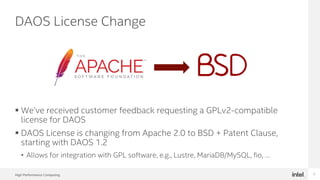
DAOS License Change
§ We’ve received customer feedback requesting a GPLv2-compatible
license for DAOS
§ DAOS License is changing from Apache 2.0 to BSD + Patent Clause,
starting with DAOS 1.2
• Allows for integration with GPL software, e.g., Lustre, MariaDB/MySQL, fio, …
High Performance Computing 6
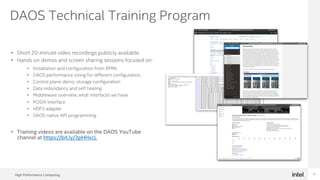
DAOS Technical Training Program
• Short 20-minute video recordings publicly available.
• Hands on demos and screen sharing sessions focused on:
• Installation and configuration from RPMs
• DAOS performance sizing for different configuration.
• Control plane demo, storage configuration
• Data redundancy and self healing
• Middleware overview, what interfaces we have
• POSIX interface
• HDFS adapter
• DAOS native API programming
• Training videos are available on the DAOS YouTube
channel at https://bit.ly/3pHHxcL
High Performance Computing 7
7
Resources
Community Website & Documentation
§ https://daos.io
Source code on GitHub
§ https://github.com/daos-stack/daos
Community mailing list
§ daos@daos.groups.io
Community Slack channel
§ https://bit.ly/38SOLEy
Support
§ https://jira.hpdd.intel.com
DAOS solution brief
§ https://www.intel.com/content/ww
w/us/en/high-performance-
computing/
DAOS technical paper from SCA’20
§ https://rdcu.be/caYtU
DAOS YouTube channel:
§ https://bit.ly/3pHHxcL
8

DUG'20: 01 - Welcome & DAOS Update

  • 1.
    Welcome Kelsey Prantis, SeniorSoftware Engineering Manager
  • 2.
    High Performance Computing2 Notices and Disclaimers Intel technologies’ features and benefits depend on system configuration and may require enabled hardware, software or service activation. Performance varies depending on system configuration. No product or component can be absolutely secure. Tests document performance of components on a particular test, in specific systems. Differences in hardware, software, or configuration will affect actual performance. For more complete information about performance and benchmark results, visit http://www.intel.com/benchmarks . Software and workloads used in performance tests may have been optimized for performance only on Intel microprocessors. Performance tests, such as SYSmark and MobileMark, are measured using specific computer systems, components, software, operations and functions. Any change to any of those factors may cause the results to vary. You should consult other information and performance tests to assist you in fully evaluating your contemplated purchases, including the performance of that product when combined with other products. For more complete information visit http://www.intel.com/benchmarks . Intel Advanced Vector Extensions (Intel AVX) provides higher throughput to certain processor operations. Due to varying processor power characteristics, utilizing AVX instructions may cause a) some parts to operate at less than the rated frequency and b) some parts with Intel® Turbo Boost Technology 2.0 to not achieve any or maximum turbo frequencies. Performance varies depending on hardware, software, and system configuration and you can learn more at http://www.intel.com/go/turbo. Intel's compilers may or may not optimize to the same degree for non-Intel microprocessors for optimizations that are not unique to Intel microprocessors. These optimizations include SSE2, SSE3, and SSSE3 instruction sets and other optimizations. Intel does not guarantee the availability, functionality, or effectiveness of any optimization on microprocessors not manufactured by Intel. Microprocessor-dependent optimizations in this product are intended for use with Intel microprocessors. Certain optimizations not specific to Intel microarchitecture are reserved for Intel microprocessors. Please refer to the applicable product User and Reference Guides for more information regarding the specific instruction sets covered by this notice. Cost reduction scenarios described are intended as examples of how a given Intel-based product, in the specified circumstances and configurations, may affect future costs and provide cost savings. Circumstances will vary. Intel does not guarantee any costs or cost reduction. Intel does not control or audit third-party benchmark data or the web sites referenced in this document. You should visit the referenced web site and confirm whether referenced data are accurate. © Intel Corporation. Intel, the Intel logo, and other Intel marks are trademarks of Intel Corporation or its subsidiaries. Other names and brands may be claimed as the property of others.
  • 3.
    High Performance Computing3 Agenda • Reminder: we have a very full agenda; agenda times will be strictly enforced • All sessions today will be recorded and posted on our YouTube channel at https://bit.ly/3pHHxcL Time (CT) Presentation 9:30am Gathering 9:35am Welcome & DAOS Update Kelsey Prantis, DAOS team manager, Intel DPG 9:45am Accelerating Apache Spark with DAOS on Aurora Carson Wang, Software Engineering Manager, Intel IAGS 10:00am Online data compression in DAOS with Intel QAT Weigang Li, Software engineer, Intel NPG 10:15am DAOS Feature Update Liang Zhen, DAOS architect, Intel DPG 10:35am Very Early Experiences with a 0.5 PByte DAOS Testbed Steffen Christgau, Supercomputing dept., Zuse Institute Berlin Tobias Watermann, Supercomputing dept., Zuse Institute Berlin Thomas Steinke, Supercomputing dept., Zuse Institute Berlin 10:50am DAOS Adventures at CERN Openlab Miguel F. Medeiros, Computer Engineer, CERN 11:05am Storing High-Energy Physics data in DAOS Javier Lopez Gomez, Fellow, CERN Time (CT) Presentation 11:20am DAOS-SEGY Mapping Merna Moawad, Associate Software Engineers, Brightskies 11:35am DAOS Middleware Update Mohamad Chaarawi, DAOS architect, Intel DPG 11:50am Storage Orchestration for Composable Storage Architectures Pavel Lavrenko, Chief Business Development Officer, RSC Group 12:05pm Platform Performance Evolution from bring-up to reaching link saturation – Learning from Reference Storage Platform Sarika Mehta, Storage Performance Engineer, Intel NSG 12:20pm DAOS in Lenovo’s HPC Innovation Center Michael Hennecke, Chief Technologist, HPC Storage and Networking, Lenovo 12:35pm HPE’s DAOS Solution Plans Lance Evans, HPE HPC CTO Chief Storage Architect 12:50pm Closing remarks Kelsey Prantis, DAOS team manager, Intel DPG
  • 4.
    High Performance Computing4 4 NOTE: All information provided in this roadmap is subject to change without notice. 1Q20 2Q20 3Q20 4Q20 1Q21 2Q21 3Q21 4Q21 1Q22 2Q22 3Q22 1.0 1.2 2.0 2.2 2.4 DAOS: - NVMe & DCPMM support - Per-pool ACL - UNS in DAOS via dfuse - Replication & self-healing (Preview) Application Interface: - MPI-IO Driver - HDF5 DAOS Connector - Basic POSIX I/O support DAOS: - End-to-end data integrity - Per-container ACL - Improved control plane - Replication & self-healing - Conditional updates - Erasure Code (Preview) - Online server addition - Lustre/UNS integration Application Interface: - HDF5 vol w/o async - POSIX I/O with conditional update support - POSIX data mover - Async HDF5 operations over DAOS - Spark DAOS: - Erasure code - Telemetry& per-job statistics - Advanced control plane - Distributed transactions - Multi OFI provider support Application Interface: - POSIX I/O with distributed transaction support - HDF5 data mover - Container parking/serialization DAOS: - Progressive layout - Placement optimizations - Checksum scrubbing DAOS: - Catastrophic recovery tools DAOS Community Roadmap
  • 5.
    High Performance Computing5 DAOS License Change § We’ve received customer feedback requesting a GPLv2-compatible license for DAOS § DAOS License is changing from Apache 2.0 to BSD + Patent Clause, starting with DAOS 1.2 • Allows for integration with GPL software, e.g., Lustre, MariaDB/MySQL, fio, …
  • 6.
    High Performance Computing6 DAOS Technical Training Program • Short 20-minute video recordings publicly available. • Hands on demos and screen sharing sessions focused on: • Installation and configuration from RPMs • DAOS performance sizing for different configuration. • Control plane demo, storage configuration • Data redundancy and self healing • Middleware overview, what interfaces we have • POSIX interface • HDFS adapter • DAOS native API programming • Training videos are available on the DAOS YouTube channel at https://bit.ly/3pHHxcL
  • 7.
    High Performance Computing7 7 Resources Community Website & Documentation § https://daos.io Source code on GitHub § https://github.com/daos-stack/daos Community mailing list § daos@daos.groups.io Community Slack channel § https://bit.ly/38SOLEy Support § https://jira.hpdd.intel.com DAOS solution brief § https://www.intel.com/content/ww w/us/en/high-performance- computing/ DAOS technical paper from SCA’20 § https://rdcu.be/caYtU DAOS YouTube channel: § https://bit.ly/3pHHxcL
  • 8.