Scalable High Performance
Flash Systems
Jeff Bonwick
Co-founder and CTO, DSSD / EMC
All computation is the same
• result = math(data);


• To get results faster, both need to improve
- faster math
- faster data


• How’s that going?
2
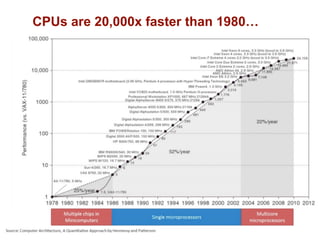
CPUs are 20,000x faster than 1980…
3
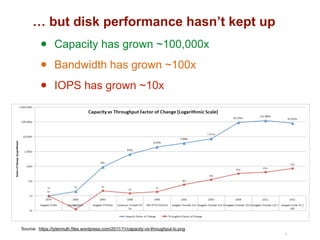
… but disk performance hasn’t kept up
4
Source: https://tylermuth.files.wordpress.com/2011/11/capacity-vs-throughput-lo.png
• Capacity has grown ~100,000x
• Bandwidth has grown ~100x
• IOPS has grown ~10x
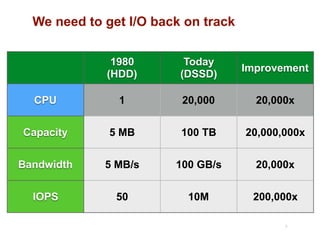
We need to get I/O back on track
5
1980
(HDD)
Today
(DSSD)
Improvement
CPU 1 20,000 20,000x
Capacity 5 MB 100 TB 20,000,000x
Bandwidth 5 MB/s 100 GB/s 20,000x
IOPS 50 10M 200,000x
But how?
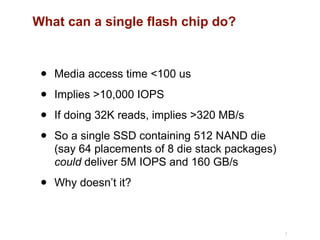
What can a single flash chip do?
• Media access time <100 us
• Implies >10,000 IOPS
• If doing 32K reads, implies >320 MB/s
• So a single SSD containing 512 NAND die
(say 64 placements of 8 die stack packages)
could deliver 5M IOPS and 160 GB/s
• Why doesn’t it?
7
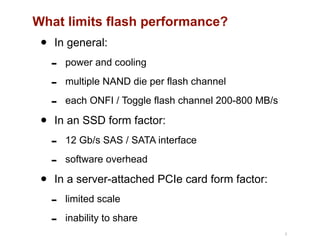
What limits flash performance?
• In general:
- power and cooling
- multiple NAND die per flash channel
- each ONFI / Toggle flash channel 200-800 MB/s
• In an SSD form factor:
- 12 Gb/s SAS / SATA interface
- software overhead
• In a server-attached PCIe card form factor:
- limited scale
- inability to share
8
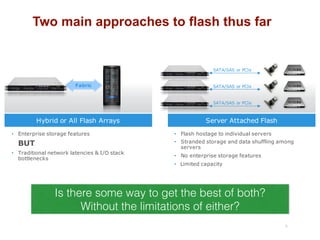
Two main approaches to flash thus far
9
Hybrid or All Flash Arrays Server Attached Flash
• Flash hostage to individual servers
• Stranded storage and data shuffling among
servers
• No enterprise storage features
• Limited capacity
• Enterprise storage features
BUT
• Traditional network latencies & I/O stack
bottlenecks
SATA/SAS or PCIe
SATA/SAS or PCIe
SATA/SAS or PCIe
Fabric
Is there some way to get the best of both?
Without the limitations of either?
Rack-Scale Flash
• Move the flash out of servers (like AFA)
• Support RAID, dual-porting, etc (like AFA)
• Allow all clients to see all data (like AFA)
• Abandon legacy SCSI stack (like PCIe card)
• Provide much stronger data protection (new)
• Exploit massive NAND concurrency (new)
• Move smarts out of individual FMs (new)
10
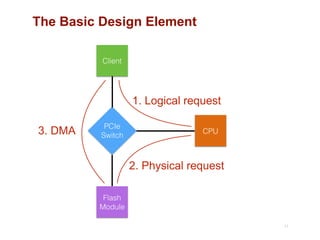
The Basic Design Element
11
PCIe
Switch
Client
CPU
Flash
Module
1. Logical request
2. Physical request
3. DMA
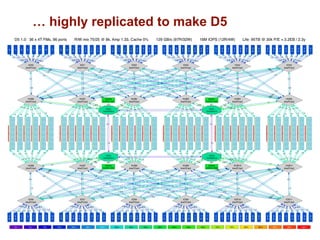
… highly replicated to make D5
12
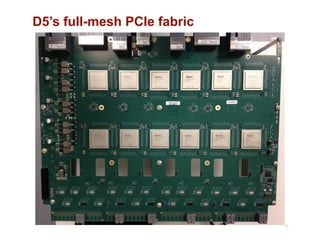
D5’s full-mesh PCIe fabric
13
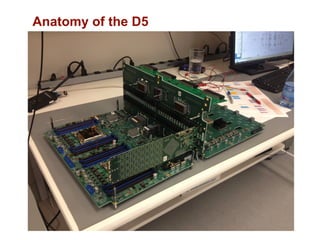
Anatomy of the D5
14
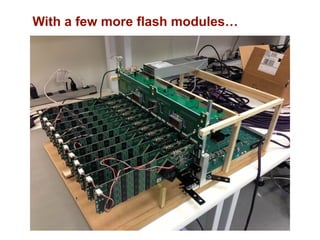
With a few more flash modules…
15
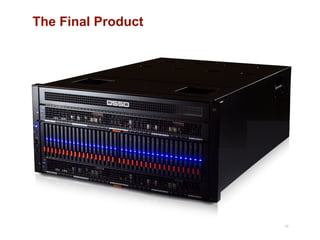
The Final Product
16
Software has to be radically different
• D5 has 32 CPU cores running I/O
• Those 32 cores drive 10M IOPS
• That’s 300k IOPS per core, or
• 3 microseconds per IOP
- a few thousand instructions,
- a dozen cache misses,
- … time’s up!
• How can we do an IOP in 3 us?
17
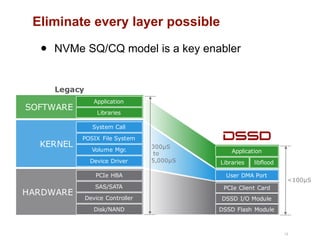
Eliminate every layer possible
• NVMe SQ/CQ model is a key enabler
18
SOFTWARE
Application
Libraries
KERNEL
System Call
POSIX File System
Volume Mgr.
Device Driver
HARDWARE
PCIe HBA
SAS/SATA
Device Controller
Disk/NAND
PCIe Client Card
DSSD I/O Module
DSSD Flash Module
Application
Libraries
User DMA Port
libflood
300µS
to
5,000µS
<100µS
Legacy
19
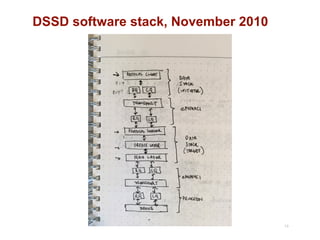
DSSD software stack, November 2010
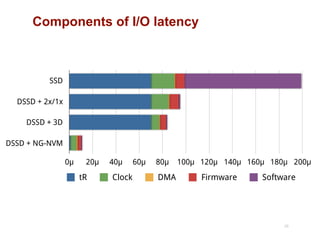
Components of I/O latency
20
3D NAND and NG-NVM
SSD
DSSD + 2x/1x
DSSD + 3D
DSSD + NG-NVM
0µ 20µ 40µ 60µ 80µ 100µ 120µ 140µ 160µ 180µ 200µ
tR Clock DMA Firmware Software
• Our first product eliminates client-side software overhead,
while preserving shared storage paradigm: 200μs → 100μs
• The next big step is media access time: 100μs → 1-10μs
Flash failure modes
• Disk drives fail catastrophically
- and the whole drive fails
• Flash degrades slowly over time
- bit error rate eventually exceeds ECC capacity
- individual cells fail randomly
• Vastly more discrete devices
- 18,000 NAND die vs. array of 25 SSDs
- enables new data protection model
21
Multi-Dimensional RAID
• RAID-6 across channels within each FM
- Survives channel failure, random page failure
- Most page-level errors fixed here, inside the FM,
so that RAID reconstruction does not involve CM
• RAID-6 across FMs
- Survives whole-FM failure and field upgrade
- Repairs errors that channel-level RAID could not
• Layered RAID-of-RAID is pretty good, but we
can do much better
22
1D RAID Reconstruction
23
0, 0
D0
D0
1, 0D1
2, 0D2
3, 0P3
4, 0Q4
0, 1
D1
1, 1
2, 1
3, 1
4, 1
0, 2
D2
1, 2
2, 2
3, 2
4, 2
0, 3
D3
1, 3
2, 3
3, 3
4, 3
0, 4
D4
1, 4
2, 4
3, 4
4, 4
0, 5
D5
1, 5
2, 5
3, 5
4, 5
0, 6
P6
1, 6
2, 6
3, 6
4, 6
0, 7
Q7
1, 7
2, 7
3, 7
4, 7
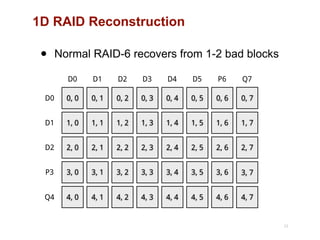
• Normal RAID-6 recovers from 1-2 bad blocks
1D RAID Reconstruction
24
0, 0
D0
D0
1, 0D1
2, 0D2
3, 0P3
4, 0Q4
0, 1
D1
1, 1
2, 1
3, 1
4, 1
0, 2
D2
1, 2
2, 2
3, 2
4, 2
0, 3
D3
1, 3
2, 3
3, 3
4, 3
0, 4
D4
1, 4
2, 4
3, 4
4, 4
0, 5
D5
1, 5
2, 5
3, 5
4, 5
0, 6
P6
1, 6
2, 6
3, 6
4, 6
0, 7
Q7
1, 7
2, 7
3, 7
4, 7
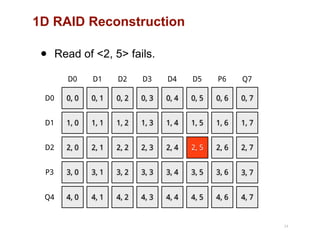
• Read of <2, 5> fails.
1D RAID Reconstruction
25
0, 0
D0
D0
1, 0D1
2, 0D2
3, 0P3
4, 0Q4
0, 1
D1
1, 1
2, 1
3, 1
4, 1
0, 2
D2
1, 2
2, 2
3, 2
4, 2
0, 3
D3
1, 3
2, 3
3, 3
4, 3
0, 4
D4
1, 4
2, 4
3, 4
4, 4
0, 5
D5
1, 5
2, 5
3, 5
4, 5
0, 6
P6
1, 6
2, 6
3, 6
4, 6
0, 7
Q7
1, 7
2, 7
3, 7
4, 7
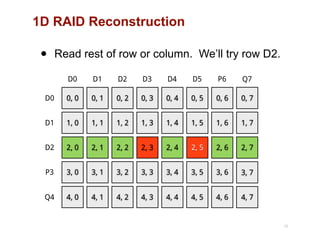
• Read rest of row or column. We’ll try row D2.
1D RAID Reconstruction
26
0, 0
D0
D0
1, 0D1
2, 0D2
3, 0P3
4, 0Q4
0, 1
D1
1, 1
2, 1
3, 1
4, 1
0, 2
D2
1, 2
2, 2
3, 2
4, 2
0, 3
D3
1, 3
2, 3
3, 3
4, 3
0, 4
D4
1, 4
2, 4
3, 4
4, 4
0, 5
D5
1, 5
2, 5
3, 5
4, 5
0, 6
P6
1, 6
2, 6
3, 6
4, 6
0, 7
Q7
1, 7
2, 7
3, 7
4, 7
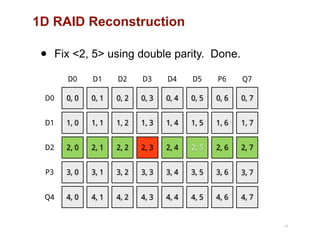
• Fix <2, 5> using double parity. Done.
1D RAID Reconstruction
27
0, 0
D0
D0
1, 0D1
2, 0D2
3, 0P3
4, 0Q4
0, 1
D1
1, 1
2, 1
3, 1
4, 1
0, 2
D2
1, 2
2, 2
3, 2
4, 2
0, 3
D3
1, 3
2, 3
3, 3
4, 3
0, 4
D4
1, 4
2, 4
3, 4
4, 4
0, 5
D5
1, 5
2, 5
3, 5
4, 5
0, 6
P6
1, 6
2, 6
3, 6
4, 6
0, 7
Q7
1, 7
2, 7
3, 7
4, 7
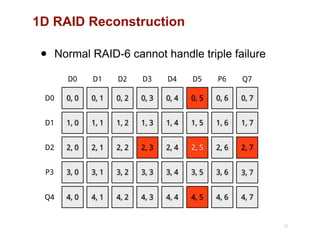
• Normal RAID-6 cannot handle triple failure
1D RAID Reconstruction
28
0, 0
D0
D0
1, 0D1
2, 0D2
3, 0P3
4, 0Q4
0, 1
D1
1, 1
2, 1
3, 1
4, 1
0, 2
D2
1, 2
2, 2
3, 2
4, 2
0, 3
D3
1, 3
2, 3
3, 3
4, 3
0, 4
D4
1, 4
2, 4
3, 4
4, 4
0, 5
D5
1, 5
2, 5
3, 5
4, 5
0, 6
P6
1, 6
2, 6
3, 6
4, 6
0, 7
Q7
1, 7
2, 7
3, 7
4, 7
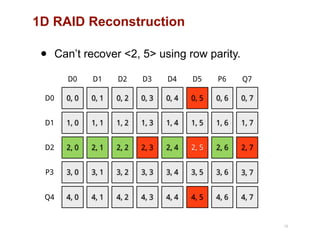
• Can’t recover <2, 5> using row parity.
1D RAID Reconstruction
29
0, 0
D0
D0
1, 0D1
2, 0D2
3, 0P3
4, 0Q4
0, 1
D1
1, 1
2, 1
3, 1
4, 1
0, 2
D2
1, 2
2, 2
3, 2
4, 2
0, 3
D3
1, 3
2, 3
3, 3
4, 3
0, 4
D4
1, 4
2, 4
3, 4
4, 4
0, 5
D5
1, 5
2, 5
3, 5
4, 5
0, 6
P6
1, 6
2, 6
3, 6
4, 6
0, 7
Q7
1, 7
2, 7
3, 7
4, 7
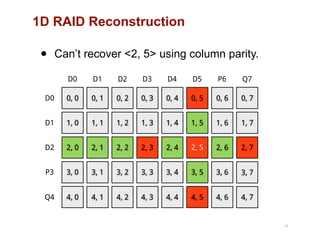
• Can’t recover <2, 5> using column parity.
2D RAID Reconstruction
30
0, 0
D0
D0
1, 0D1
2, 0D2
3, 0P3
4, 0Q4
0, 1
D1
1, 1
2, 1
3, 1
4, 1
0, 2
D2
1, 2
2, 2
3, 2
4, 2
0, 3
D3
1, 3
2, 3
3, 3
4, 3
0, 4
D4
1, 4
2, 4
3, 4
4, 4
0, 5
D5
1, 5
2, 5
3, 5
4, 5
0, 6
P6
1, 6
2, 6
3, 6
4, 6
0, 7
Q7
1, 7
2, 7
3, 7
4, 7
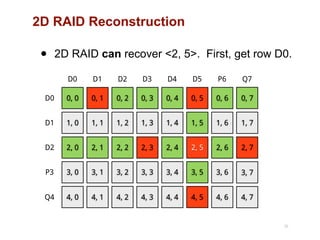
• 2D RAID can recover <2, 5>. First, get row D0.
2D RAID Reconstruction
31
0, 0
D0
D0
1, 0D1
2, 0D2
3, 0P3
4, 0Q4
0, 1
D1
1, 1
2, 1
3, 1
4, 1
0, 2
D2
1, 2
2, 2
3, 2
4, 2
0, 3
D3
1, 3
2, 3
3, 3
4, 3
0, 4
D4
1, 4
2, 4
3, 4
4, 4
0, 5
D5
1, 5
2, 5
3, 5
4, 5
0, 6
P6
1, 6
2, 6
3, 6
4, 6
0, 7
Q7
1, 7
2, 7
3, 7
4, 7
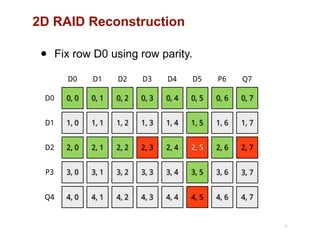
• Fix row D0 using row parity.
2D RAID Reconstruction
32
0, 0
D0
D0
1, 0D1
2, 0D2
3, 0P3
4, 0Q4
0, 1
D1
1, 1
2, 1
3, 1
4, 1
0, 2
D2
1, 2
2, 2
3, 2
4, 2
0, 3
D3
1, 3
2, 3
3, 3
4, 3
0, 4
D4
1, 4
2, 4
3, 4
4, 4
0, 5
D5
1, 5
2, 5
3, 5
4, 5
0, 6
P6
1, 6
2, 6
3, 6
4, 6
0, 7
Q7
1, 7
2, 7
3, 7
4, 7
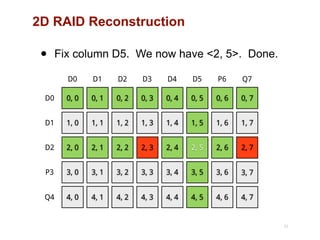
• Fix column D5. We now have <2, 5>. Done.
2D RAID Reconstruction
33
0, 0
D0
D0
1, 0D1
2, 0D2
3, 0P3
4, 0Q4
0, 1
D1
1, 1
2, 1
3, 1
4, 1
0, 2
D2
1, 2
2, 2
3, 2
4, 2
0, 3
D3
1, 3
2, 3
3, 3
4, 3
0, 4
D4
1, 4
2, 4
3, 4
4, 4
0, 5
D5
1, 5
2, 5
3, 5
4, 5
0, 6
P6
1, 6
2, 6
3, 6
4, 6
0, 7
Q7
1, 7
2, 7
3, 7
4, 7
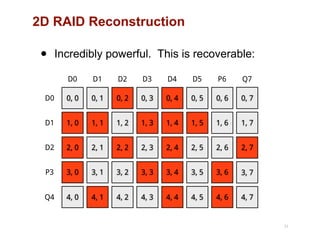
• Incredibly powerful. This is recoverable:
2D RAID Reconstruction
34
0, 0
D0
D0
1, 0D1
2, 0D2
3, 0P3
4, 0Q4
0, 1
D1
1, 1
2, 1
3, 1
4, 1
0, 2
D2
1, 2
2, 2
3, 2
4, 2
0, 3
D3
1, 3
2, 3
3, 3
4, 3
0, 4
D4
1, 4
2, 4
3, 4
4, 4
0, 5
D5
1, 5
2, 5
3, 5
4, 5
0, 6
P6
1, 6
2, 6
3, 6
4, 6
0, 7
Q7
1, 7
2, 7
3, 7
4, 7
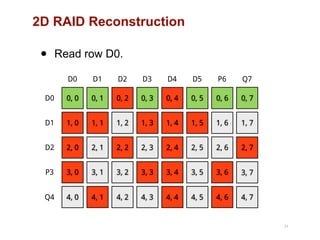
• Read row D0.
2D RAID Reconstruction
35
0, 0
D0
D0
1, 0D1
2, 0D2
3, 0P3
4, 0Q4
0, 1
D1
1, 1
2, 1
3, 1
4, 1
0, 2
D2
1, 2
2, 2
3, 2
4, 2
0, 3
D3
1, 3
2, 3
3, 3
4, 3
0, 4
D4
1, 4
2, 4
3, 4
4, 4
0, 5
D5
1, 5
2, 5
3, 5
4, 5
0, 6
P6
1, 6
2, 6
3, 6
4, 6
0, 7
Q7
1, 7
2, 7
3, 7
4, 7
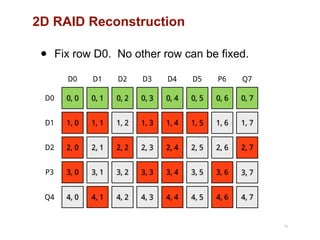
• Fix row D0. No other row can be fixed.
2D RAID Reconstruction
36
0, 0
D0
D0
1, 0D1
2, 0D2
3, 0P3
4, 0Q4
0, 1
D1
1, 1
2, 1
3, 1
4, 1
0, 2
D2
1, 2
2, 2
3, 2
4, 2
0, 3
D3
1, 3
2, 3
3, 3
4, 3
0, 4
D4
1, 4
2, 4
3, 4
4, 4
0, 5
D5
1, 5
2, 5
3, 5
4, 5
0, 6
P6
1, 6
2, 6
3, 6
4, 6
0, 7
Q7
1, 7
2, 7
3, 7
4, 7
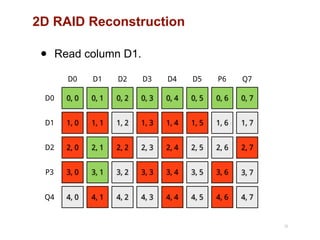
• Read column D1.
2D RAID Reconstruction
37
0, 0
D0
D0
1, 0D1
2, 0D2
3, 0P3
4, 0Q4
0, 1
D1
1, 1
2, 1
3, 1
4, 1
0, 2
D2
1, 2
2, 2
3, 2
4, 2
0, 3
D3
1, 3
2, 3
3, 3
4, 3
0, 4
D4
1, 4
2, 4
3, 4
4, 4
0, 5
D5
1, 5
2, 5
3, 5
4, 5
0, 6
P6
1, 6
2, 6
3, 6
4, 6
0, 7
Q7
1, 7
2, 7
3, 7
4, 7
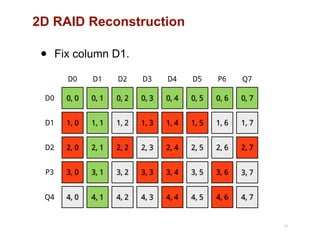
• Fix column D1.
2D RAID Reconstruction
38
0, 0
D0
D0
1, 0D1
2, 0D2
3, 0P3
4, 0Q4
0, 1
D1
1, 1
2, 1
3, 1
4, 1
0, 2
D2
1, 2
2, 2
3, 2
4, 2
0, 3
D3
1, 3
2, 3
3, 3
4, 3
0, 4
D4
1, 4
2, 4
3, 4
4, 4
0, 5
D5
1, 5
2, 5
3, 5
4, 5
0, 6
P6
1, 6
2, 6
3, 6
4, 6
0, 7
Q7
1, 7
2, 7
3, 7
4, 7
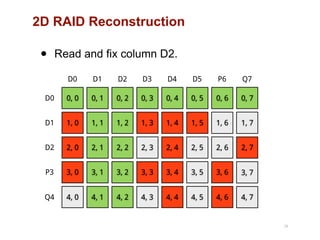
• Read and fix column D2.
2D RAID Reconstruction
39
0, 0
D0
D0
1, 0D1
2, 0D2
3, 0P3
4, 0Q4
0, 1
D1
1, 1
2, 1
3, 1
4, 1
0, 2
D2
1, 2
2, 2
3, 2
4, 2
0, 3
D3
1, 3
2, 3
3, 3
4, 3
0, 4
D4
1, 4
2, 4
3, 4
4, 4
0, 5
D5
1, 5
2, 5
3, 5
4, 5
0, 6
P6
1, 6
2, 6
3, 6
4, 6
0, 7
Q7
1, 7
2, 7
3, 7
4, 7
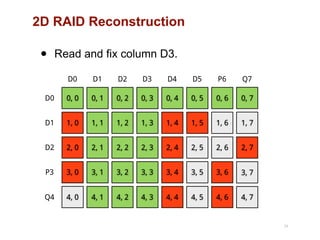
• Read and fix column D3.
2D RAID Reconstruction
40
0, 0
D0
D0
1, 0D1
2, 0D2
3, 0P3
4, 0Q4
0, 1
D1
1, 1
2, 1
3, 1
4, 1
0, 2
D2
1, 2
2, 2
3, 2
4, 2
0, 3
D3
1, 3
2, 3
3, 3
4, 3
0, 4
D4
1, 4
2, 4
3, 4
4, 4
0, 5
D5
1, 5
2, 5
3, 5
4, 5
0, 6
P6
1, 6
2, 6
3, 6
4, 6
0, 7
Q7
1, 7
2, 7
3, 7
4, 7
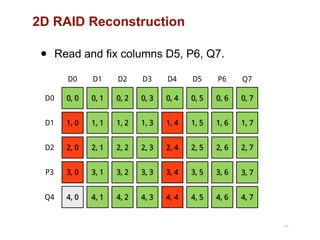
• Read and fix columns D5, P6, Q7.
2D RAID Reconstruction
41
0, 0
D0
D0
1, 0D1
2, 0D2
3, 0P3
4, 0Q4
0, 1
D1
1, 1
2, 1
3, 1
4, 1
0, 2
D2
1, 2
2, 2
3, 2
4, 2
0, 3
D3
1, 3
2, 3
3, 3
4, 3
0, 4
D4
1, 4
2, 4
3, 4
4, 4
0, 5
D5
1, 5
2, 5
3, 5
4, 5
0, 6
P6
1, 6
2, 6
3, 6
4, 6
0, 7
Q7
1, 7
2, 7
3, 7
4, 7
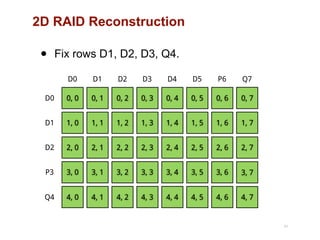
• Fix rows D1, D2, D3, Q4.
Multi-Dimensional RAID Properties
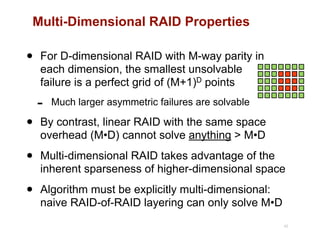
• For D-dimensional RAID with M-way parity in

each dimension, the smallest unsolvable

failure is a perfect grid of (M+1)D points
- Much larger asymmetric failures are solvable
• By contrast, linear RAID with the same space
overhead (M•D) cannot solve anything > M•D
• Multi-dimensional RAID takes advantage of the
inherent sparseness of higher-dimensional space
• Algorithm must be explicitly multi-dimensional:
naive RAID-of-RAID layering can only solve M•D
42
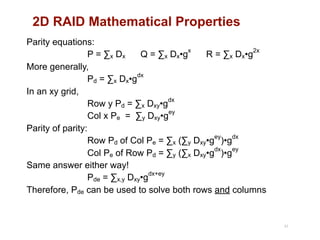
2D RAID Mathematical Properties
43
Parity equations:

P = ∑x Dx Q = ∑x Dx•g
x
R = ∑x Dx•g
2x

More generally,

Pd = ∑x Dx•g
dx

In an xy grid,

Row y Pd = ∑x Dxy•g
dx

Col x Pe = ∑y Dxy•g
ey

Parity of parity:

Row Pd of Col Pe = ∑x (∑y Dxy•g
ey
)•g
dx

Col Pe of Row Pd = ∑y (∑x Dxy•g
dx
)•g
ey

Same answer either way!

Pde = ∑x,y Dxy•g
dx+ey

Therefore, Pde can be used to solve both rows and columns

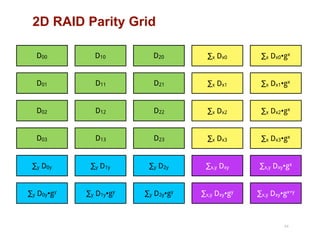
2D RAID Parity Grid
44
D00 D10 D20 ∑x Dx0 ∑x Dx0•gx
D01 D11 D21 ∑x Dx1 ∑x Dx1•gx
D02 D12 D22 ∑x Dx2 ∑x Dx2•gx
D03 D13 D23 ∑x Dx3 ∑x Dx3•gx
∑y D0y ∑y D1y ∑y D2y ∑x,y Dxy ∑x,y Dxy•gx
∑y D0y•gy ∑y D1y•gy ∑y D2y•gy ∑x,y Dxy•gy ∑x,y Dxy•gx+y
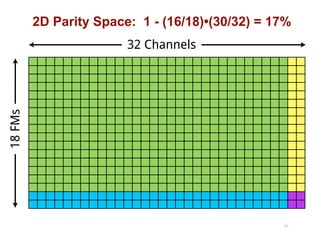
2D Parity Space: 1 - (16/18)•(30/32) = 17%
45
32 Channels
18FMs

DSSD Scalable High Performance Flash Systems

  • 1.
    Scalable High Performance FlashSystems Jeff Bonwick Co-founder and CTO, DSSD / EMC
  • 2.
    All computation isthe same • result = math(data);
 
 • To get results faster, both need to improve - faster math - faster data
 
 • How’s that going? 2
  • 3.
    CPUs are 20,000xfaster than 1980… 3
  • 4.
    … but diskperformance hasn’t kept up 4 Source: https://tylermuth.files.wordpress.com/2011/11/capacity-vs-throughput-lo.png • Capacity has grown ~100,000x • Bandwidth has grown ~100x • IOPS has grown ~10x
  • 5.
    We need toget I/O back on track 5 1980 (HDD) Today (DSSD) Improvement CPU 1 20,000 20,000x Capacity 5 MB 100 TB 20,000,000x Bandwidth 5 MB/s 100 GB/s 20,000x IOPS 50 10M 200,000x
  • 6.
  • 7.
    What can asingle flash chip do? • Media access time <100 us • Implies >10,000 IOPS • If doing 32K reads, implies >320 MB/s • So a single SSD containing 512 NAND die (say 64 placements of 8 die stack packages) could deliver 5M IOPS and 160 GB/s • Why doesn’t it? 7
  • 8.
    What limits flashperformance? • In general: - power and cooling - multiple NAND die per flash channel - each ONFI / Toggle flash channel 200-800 MB/s • In an SSD form factor: - 12 Gb/s SAS / SATA interface - software overhead • In a server-attached PCIe card form factor: - limited scale - inability to share 8
  • 9.
    Two main approachesto flash thus far 9 Hybrid or All Flash Arrays Server Attached Flash • Flash hostage to individual servers • Stranded storage and data shuffling among servers • No enterprise storage features • Limited capacity • Enterprise storage features BUT • Traditional network latencies & I/O stack bottlenecks SATA/SAS or PCIe SATA/SAS or PCIe SATA/SAS or PCIe Fabric Is there some way to get the best of both? Without the limitations of either?
  • 10.
    Rack-Scale Flash • Movethe flash out of servers (like AFA) • Support RAID, dual-porting, etc (like AFA) • Allow all clients to see all data (like AFA) • Abandon legacy SCSI stack (like PCIe card) • Provide much stronger data protection (new) • Exploit massive NAND concurrency (new) • Move smarts out of individual FMs (new) 10
  • 11.
    The Basic DesignElement 11 PCIe Switch Client CPU Flash Module 1. Logical request 2. Physical request 3. DMA
  • 12.
    … highly replicatedto make D5 12
  • 13.
  • 14.
  • 15.
    With a fewmore flash modules… 15
  • 16.
  • 17.
    Software has tobe radically different • D5 has 32 CPU cores running I/O • Those 32 cores drive 10M IOPS • That’s 300k IOPS per core, or • 3 microseconds per IOP - a few thousand instructions, - a dozen cache misses, - … time’s up! • How can we do an IOP in 3 us? 17
  • 18.
    Eliminate every layerpossible • NVMe SQ/CQ model is a key enabler 18 SOFTWARE Application Libraries KERNEL System Call POSIX File System Volume Mgr. Device Driver HARDWARE PCIe HBA SAS/SATA Device Controller Disk/NAND PCIe Client Card DSSD I/O Module DSSD Flash Module Application Libraries User DMA Port libflood 300µS to 5,000µS <100µS Legacy
  • 19.
  • 20.
    Components of I/Olatency 20 3D NAND and NG-NVM SSD DSSD + 2x/1x DSSD + 3D DSSD + NG-NVM 0µ 20µ 40µ 60µ 80µ 100µ 120µ 140µ 160µ 180µ 200µ tR Clock DMA Firmware Software • Our first product eliminates client-side software overhead, while preserving shared storage paradigm: 200μs → 100μs • The next big step is media access time: 100μs → 1-10μs
  • 21.
    Flash failure modes •Disk drives fail catastrophically - and the whole drive fails • Flash degrades slowly over time - bit error rate eventually exceeds ECC capacity - individual cells fail randomly • Vastly more discrete devices - 18,000 NAND die vs. array of 25 SSDs - enables new data protection model 21
  • 22.
    Multi-Dimensional RAID • RAID-6across channels within each FM - Survives channel failure, random page failure - Most page-level errors fixed here, inside the FM, so that RAID reconstruction does not involve CM • RAID-6 across FMs - Survives whole-FM failure and field upgrade - Repairs errors that channel-level RAID could not • Layered RAID-of-RAID is pretty good, but we can do much better 22
  • 23.
    1D RAID Reconstruction 23 0,0 D0 D0 1, 0D1 2, 0D2 3, 0P3 4, 0Q4 0, 1 D1 1, 1 2, 1 3, 1 4, 1 0, 2 D2 1, 2 2, 2 3, 2 4, 2 0, 3 D3 1, 3 2, 3 3, 3 4, 3 0, 4 D4 1, 4 2, 4 3, 4 4, 4 0, 5 D5 1, 5 2, 5 3, 5 4, 5 0, 6 P6 1, 6 2, 6 3, 6 4, 6 0, 7 Q7 1, 7 2, 7 3, 7 4, 7 • Normal RAID-6 recovers from 1-2 bad blocks
  • 24.
    1D RAID Reconstruction 24 0,0 D0 D0 1, 0D1 2, 0D2 3, 0P3 4, 0Q4 0, 1 D1 1, 1 2, 1 3, 1 4, 1 0, 2 D2 1, 2 2, 2 3, 2 4, 2 0, 3 D3 1, 3 2, 3 3, 3 4, 3 0, 4 D4 1, 4 2, 4 3, 4 4, 4 0, 5 D5 1, 5 2, 5 3, 5 4, 5 0, 6 P6 1, 6 2, 6 3, 6 4, 6 0, 7 Q7 1, 7 2, 7 3, 7 4, 7 • Read of <2, 5> fails.
  • 25.
    1D RAID Reconstruction 25 0,0 D0 D0 1, 0D1 2, 0D2 3, 0P3 4, 0Q4 0, 1 D1 1, 1 2, 1 3, 1 4, 1 0, 2 D2 1, 2 2, 2 3, 2 4, 2 0, 3 D3 1, 3 2, 3 3, 3 4, 3 0, 4 D4 1, 4 2, 4 3, 4 4, 4 0, 5 D5 1, 5 2, 5 3, 5 4, 5 0, 6 P6 1, 6 2, 6 3, 6 4, 6 0, 7 Q7 1, 7 2, 7 3, 7 4, 7 • Read rest of row or column. We’ll try row D2.
  • 26.
    1D RAID Reconstruction 26 0,0 D0 D0 1, 0D1 2, 0D2 3, 0P3 4, 0Q4 0, 1 D1 1, 1 2, 1 3, 1 4, 1 0, 2 D2 1, 2 2, 2 3, 2 4, 2 0, 3 D3 1, 3 2, 3 3, 3 4, 3 0, 4 D4 1, 4 2, 4 3, 4 4, 4 0, 5 D5 1, 5 2, 5 3, 5 4, 5 0, 6 P6 1, 6 2, 6 3, 6 4, 6 0, 7 Q7 1, 7 2, 7 3, 7 4, 7 • Fix <2, 5> using double parity. Done.
  • 27.
    1D RAID Reconstruction 27 0,0 D0 D0 1, 0D1 2, 0D2 3, 0P3 4, 0Q4 0, 1 D1 1, 1 2, 1 3, 1 4, 1 0, 2 D2 1, 2 2, 2 3, 2 4, 2 0, 3 D3 1, 3 2, 3 3, 3 4, 3 0, 4 D4 1, 4 2, 4 3, 4 4, 4 0, 5 D5 1, 5 2, 5 3, 5 4, 5 0, 6 P6 1, 6 2, 6 3, 6 4, 6 0, 7 Q7 1, 7 2, 7 3, 7 4, 7 • Normal RAID-6 cannot handle triple failure
  • 28.
    1D RAID Reconstruction 28 0,0 D0 D0 1, 0D1 2, 0D2 3, 0P3 4, 0Q4 0, 1 D1 1, 1 2, 1 3, 1 4, 1 0, 2 D2 1, 2 2, 2 3, 2 4, 2 0, 3 D3 1, 3 2, 3 3, 3 4, 3 0, 4 D4 1, 4 2, 4 3, 4 4, 4 0, 5 D5 1, 5 2, 5 3, 5 4, 5 0, 6 P6 1, 6 2, 6 3, 6 4, 6 0, 7 Q7 1, 7 2, 7 3, 7 4, 7 • Can’t recover <2, 5> using row parity.
  • 29.
    1D RAID Reconstruction 29 0,0 D0 D0 1, 0D1 2, 0D2 3, 0P3 4, 0Q4 0, 1 D1 1, 1 2, 1 3, 1 4, 1 0, 2 D2 1, 2 2, 2 3, 2 4, 2 0, 3 D3 1, 3 2, 3 3, 3 4, 3 0, 4 D4 1, 4 2, 4 3, 4 4, 4 0, 5 D5 1, 5 2, 5 3, 5 4, 5 0, 6 P6 1, 6 2, 6 3, 6 4, 6 0, 7 Q7 1, 7 2, 7 3, 7 4, 7 • Can’t recover <2, 5> using column parity.
  • 30.
    2D RAID Reconstruction 30 0,0 D0 D0 1, 0D1 2, 0D2 3, 0P3 4, 0Q4 0, 1 D1 1, 1 2, 1 3, 1 4, 1 0, 2 D2 1, 2 2, 2 3, 2 4, 2 0, 3 D3 1, 3 2, 3 3, 3 4, 3 0, 4 D4 1, 4 2, 4 3, 4 4, 4 0, 5 D5 1, 5 2, 5 3, 5 4, 5 0, 6 P6 1, 6 2, 6 3, 6 4, 6 0, 7 Q7 1, 7 2, 7 3, 7 4, 7 • 2D RAID can recover <2, 5>. First, get row D0.
  • 31.
    2D RAID Reconstruction 31 0,0 D0 D0 1, 0D1 2, 0D2 3, 0P3 4, 0Q4 0, 1 D1 1, 1 2, 1 3, 1 4, 1 0, 2 D2 1, 2 2, 2 3, 2 4, 2 0, 3 D3 1, 3 2, 3 3, 3 4, 3 0, 4 D4 1, 4 2, 4 3, 4 4, 4 0, 5 D5 1, 5 2, 5 3, 5 4, 5 0, 6 P6 1, 6 2, 6 3, 6 4, 6 0, 7 Q7 1, 7 2, 7 3, 7 4, 7 • Fix row D0 using row parity.
  • 32.
    2D RAID Reconstruction 32 0,0 D0 D0 1, 0D1 2, 0D2 3, 0P3 4, 0Q4 0, 1 D1 1, 1 2, 1 3, 1 4, 1 0, 2 D2 1, 2 2, 2 3, 2 4, 2 0, 3 D3 1, 3 2, 3 3, 3 4, 3 0, 4 D4 1, 4 2, 4 3, 4 4, 4 0, 5 D5 1, 5 2, 5 3, 5 4, 5 0, 6 P6 1, 6 2, 6 3, 6 4, 6 0, 7 Q7 1, 7 2, 7 3, 7 4, 7 • Fix column D5. We now have <2, 5>. Done.
  • 33.
    2D RAID Reconstruction 33 0,0 D0 D0 1, 0D1 2, 0D2 3, 0P3 4, 0Q4 0, 1 D1 1, 1 2, 1 3, 1 4, 1 0, 2 D2 1, 2 2, 2 3, 2 4, 2 0, 3 D3 1, 3 2, 3 3, 3 4, 3 0, 4 D4 1, 4 2, 4 3, 4 4, 4 0, 5 D5 1, 5 2, 5 3, 5 4, 5 0, 6 P6 1, 6 2, 6 3, 6 4, 6 0, 7 Q7 1, 7 2, 7 3, 7 4, 7 • Incredibly powerful. This is recoverable:
  • 34.
    2D RAID Reconstruction 34 0,0 D0 D0 1, 0D1 2, 0D2 3, 0P3 4, 0Q4 0, 1 D1 1, 1 2, 1 3, 1 4, 1 0, 2 D2 1, 2 2, 2 3, 2 4, 2 0, 3 D3 1, 3 2, 3 3, 3 4, 3 0, 4 D4 1, 4 2, 4 3, 4 4, 4 0, 5 D5 1, 5 2, 5 3, 5 4, 5 0, 6 P6 1, 6 2, 6 3, 6 4, 6 0, 7 Q7 1, 7 2, 7 3, 7 4, 7 • Read row D0.
  • 35.
    2D RAID Reconstruction 35 0,0 D0 D0 1, 0D1 2, 0D2 3, 0P3 4, 0Q4 0, 1 D1 1, 1 2, 1 3, 1 4, 1 0, 2 D2 1, 2 2, 2 3, 2 4, 2 0, 3 D3 1, 3 2, 3 3, 3 4, 3 0, 4 D4 1, 4 2, 4 3, 4 4, 4 0, 5 D5 1, 5 2, 5 3, 5 4, 5 0, 6 P6 1, 6 2, 6 3, 6 4, 6 0, 7 Q7 1, 7 2, 7 3, 7 4, 7 • Fix row D0. No other row can be fixed.
  • 36.
    2D RAID Reconstruction 36 0,0 D0 D0 1, 0D1 2, 0D2 3, 0P3 4, 0Q4 0, 1 D1 1, 1 2, 1 3, 1 4, 1 0, 2 D2 1, 2 2, 2 3, 2 4, 2 0, 3 D3 1, 3 2, 3 3, 3 4, 3 0, 4 D4 1, 4 2, 4 3, 4 4, 4 0, 5 D5 1, 5 2, 5 3, 5 4, 5 0, 6 P6 1, 6 2, 6 3, 6 4, 6 0, 7 Q7 1, 7 2, 7 3, 7 4, 7 • Read column D1.
  • 37.
    2D RAID Reconstruction 37 0,0 D0 D0 1, 0D1 2, 0D2 3, 0P3 4, 0Q4 0, 1 D1 1, 1 2, 1 3, 1 4, 1 0, 2 D2 1, 2 2, 2 3, 2 4, 2 0, 3 D3 1, 3 2, 3 3, 3 4, 3 0, 4 D4 1, 4 2, 4 3, 4 4, 4 0, 5 D5 1, 5 2, 5 3, 5 4, 5 0, 6 P6 1, 6 2, 6 3, 6 4, 6 0, 7 Q7 1, 7 2, 7 3, 7 4, 7 • Fix column D1.
  • 38.
    2D RAID Reconstruction 38 0,0 D0 D0 1, 0D1 2, 0D2 3, 0P3 4, 0Q4 0, 1 D1 1, 1 2, 1 3, 1 4, 1 0, 2 D2 1, 2 2, 2 3, 2 4, 2 0, 3 D3 1, 3 2, 3 3, 3 4, 3 0, 4 D4 1, 4 2, 4 3, 4 4, 4 0, 5 D5 1, 5 2, 5 3, 5 4, 5 0, 6 P6 1, 6 2, 6 3, 6 4, 6 0, 7 Q7 1, 7 2, 7 3, 7 4, 7 • Read and fix column D2.
  • 39.
    2D RAID Reconstruction 39 0,0 D0 D0 1, 0D1 2, 0D2 3, 0P3 4, 0Q4 0, 1 D1 1, 1 2, 1 3, 1 4, 1 0, 2 D2 1, 2 2, 2 3, 2 4, 2 0, 3 D3 1, 3 2, 3 3, 3 4, 3 0, 4 D4 1, 4 2, 4 3, 4 4, 4 0, 5 D5 1, 5 2, 5 3, 5 4, 5 0, 6 P6 1, 6 2, 6 3, 6 4, 6 0, 7 Q7 1, 7 2, 7 3, 7 4, 7 • Read and fix column D3.
  • 40.
    2D RAID Reconstruction 40 0,0 D0 D0 1, 0D1 2, 0D2 3, 0P3 4, 0Q4 0, 1 D1 1, 1 2, 1 3, 1 4, 1 0, 2 D2 1, 2 2, 2 3, 2 4, 2 0, 3 D3 1, 3 2, 3 3, 3 4, 3 0, 4 D4 1, 4 2, 4 3, 4 4, 4 0, 5 D5 1, 5 2, 5 3, 5 4, 5 0, 6 P6 1, 6 2, 6 3, 6 4, 6 0, 7 Q7 1, 7 2, 7 3, 7 4, 7 • Read and fix columns D5, P6, Q7.
  • 41.
    2D RAID Reconstruction 41 0,0 D0 D0 1, 0D1 2, 0D2 3, 0P3 4, 0Q4 0, 1 D1 1, 1 2, 1 3, 1 4, 1 0, 2 D2 1, 2 2, 2 3, 2 4, 2 0, 3 D3 1, 3 2, 3 3, 3 4, 3 0, 4 D4 1, 4 2, 4 3, 4 4, 4 0, 5 D5 1, 5 2, 5 3, 5 4, 5 0, 6 P6 1, 6 2, 6 3, 6 4, 6 0, 7 Q7 1, 7 2, 7 3, 7 4, 7 • Fix rows D1, D2, D3, Q4.
  • 42.
    Multi-Dimensional RAID Properties •For D-dimensional RAID with M-way parity in
 each dimension, the smallest unsolvable
 failure is a perfect grid of (M+1)D points - Much larger asymmetric failures are solvable • By contrast, linear RAID with the same space overhead (M•D) cannot solve anything > M•D • Multi-dimensional RAID takes advantage of the inherent sparseness of higher-dimensional space • Algorithm must be explicitly multi-dimensional: naive RAID-of-RAID layering can only solve M•D 42
  • 43.
    2D RAID MathematicalProperties 43 Parity equations:
 P = ∑x Dx Q = ∑x Dx•g x R = ∑x Dx•g 2x
 More generally,
 Pd = ∑x Dx•g dx
 In an xy grid,
 Row y Pd = ∑x Dxy•g dx
 Col x Pe = ∑y Dxy•g ey
 Parity of parity:
 Row Pd of Col Pe = ∑x (∑y Dxy•g ey )•g dx
 Col Pe of Row Pd = ∑y (∑x Dxy•g dx )•g ey
 Same answer either way!
 Pde = ∑x,y Dxy•g dx+ey
 Therefore, Pde can be used to solve both rows and columns

  • 44.
    2D RAID ParityGrid 44 D00 D10 D20 ∑x Dx0 ∑x Dx0•gx D01 D11 D21 ∑x Dx1 ∑x Dx1•gx D02 D12 D22 ∑x Dx2 ∑x Dx2•gx D03 D13 D23 ∑x Dx3 ∑x Dx3•gx ∑y D0y ∑y D1y ∑y D2y ∑x,y Dxy ∑x,y Dxy•gx ∑y D0y•gy ∑y D1y•gy ∑y D2y•gy ∑x,y Dxy•gy ∑x,y Dxy•gx+y
  • 45.
    2D Parity Space:1 - (16/18)•(30/32) = 17% 45 32 Channels 18FMs