Prof. Puneet Mathur
Assistant Professor,
Marwadi University, Rajkot
Design and
Synthesis of Robots
UNIT-5
SENSORS
Sensors
Sensor is a device that acquires a physical parameter and changes it into a
signal that can be processed by the system Eg., temperature, pH, velocity,
rotational rate, flow rate, pressure and many others.
Today, most sensors do not indicate a reading on an analog scale, but,
rather, they produce a voltage or a digital signal that is indicative of the
physical variable they measure.
Those signals are often imported into computer programs, stored in files,
plotted on computers and analyzed to depth.
Need of Sensors
• The significance of sensor technology is constantly growing.
• Sensors allow us to monitor our surroundings in ways we could
barely imagine a few years ago.
• New sensor applications are being identified everyday which
broadens the scope of the technology and expands its impact on
everyday life.
Need of Sensors
In
•
Industry
On the factory floor, networked vibration sensors
warn that a bearing is beginning to fail.
• Mechanics schedule overnight maintenance,
preventing an expensive unplanned shutdown.
Inside a refrigerated grocery truck, temperature and
•
humidity sensors monitor individual containers,
reducing spoilage in fragile fish or produce.
In
•
the Environment
Networks of wireless humidity sensors monitor fire
danger in remote forests.
• Nitrate sensors detect industrial and agricultural
distributed
runoff in rivers, streams and wells, while
seismic monitors provide an early warning
earthquakes.
system for
• Built-in
integrity
stress sensors report on the structural
of bridges, buildings and roadways, and
other man-made structures.
Need of Sensors
For Safety and Security
• Fire fighters scatter wireless sensors
spots
throughout a
burning building to map hot and flare-ups.
Simultaneously, the sensors provide an emergency
communications network.
• Miniature
hospitals,
chemical and biological sensors in
post offices, and transportation centres
raise an alarm at the first sign of anthrax, smallpox or
other terror agents.
Need of Sensors
Characteristics of a sensor
1. Range: It is the minimum and maximum value of physical variable that the sensor can sense
or measure. For example, a Resistance Temperature Detector (RTD) for the measurement of
temperature has a range of -200 to 800oC.
2. Span: It is the difference between the maximum and minimum values of input. In above
example, the span of RTD is 800 – (-200) = 1000oC.
3. Accuracy: The error in measurement is specified in terms of accuracy. It is defined as the
difference between measured value and true value. It is defined in terms of % of full scale or
% of reading.
4. Precision: It is defined as the closeness among set of values. It is different from
accuracy
5. Sensitivity: It is the ratio of change in output to change in input. It should be as
high as possible.
6. Linearity: Linearity is the maximum deviation between the measured values of a
sensor from ideal curve. The sensory device should exhibit the same sensitivity over
its entire operating range
Characteristics of a sensor
7. Hysteresis: It is the difference in output when input is varied in two ways- increasing and
decreasing.
8. Resolution: It is the minimum change in input that can be sensed by the sensor.
9. Reproducibility: It is defined as the ability of sensor to produce the same output
when same input is applied.
10. Repeatability: It is defined as the ability of sensor to produce the same output
every time when the same input is applied and all the physical and measurement
conditions kept the same including the operator, instrument, ambient conditions
etc.
11. Response Time: It is generally expressed as the time at which the output reaches a
certain percentage (for instance, 95%) of its final value, in response to a step change
of the input.
12.It should be suitable for the environment in which it is employed
13.It should have a suitable physical size, cost and ease of operation
14.It should not disturb or have any effect upon the quantity it senses or measures
15.It should include isolation from receiving excess signals or electrical noise that could
give rise to the possibility of misconception or damage of the sensor, circuit or system
Characteristics of a sensor
Types of sensors
• Internal state sensors
• External state sensors
• T
actile sensors
• Non-tactile sensors
Internal state sensors
• These sensors deals with the detection of variable such as arm joint position, which are
used in robot control.
• Internal sensors as the name explains it is used to measure the internal state of a robot.
• It measures position, velocity, acceleration etc. of robot joints and/or end effectors
• Potentiometers
• LVDT or RVDT
• Optical encoders
• Tachometer
• Accelerometer
External state sensors
These type of sensors are used to monitor the robot’s geometric and /or dynamic relation to
its task, environment of the objects that is handling.
• Strain gauges
• Pressure transducer
• Proximity devices
• Ultrasonic sensors
• Electromagnetic sensors
External state sensors may be further classified as
• Tactile (Contact) sensors.
• Non-tactile (Non-contact) sensors.
Tactile sensors
These are contact sensors that must be brought in contact with the object to obtain signals
to measure necessary quantities
• Force sensors
• Torque sensors
• Touch sensors
• Position sensors
Non-tactile sensors
These are contactless sensors which sense signals remotely but only within the specified
range of distance from the object
Non-contact sensors rely on the response of variations in acoustic or electromagnetic
radiation.
• Proximity sensors
• Range imaging sensors
• Ultrasonic sensors
• Electro-optical vision sensors
• Magnetic sensors
Position sensors
• As the name implies, Position Sensors detect the position of something
which means that they are referenced either to or from some fixed point or
position.
• These types of sensors provide a “positional” feedback.
• One method of determining a position, is to use either “distance between
two points such as the distance travelled or moved away from some fixed
point, or by “rotation” (angular movement).
• Determine its distance travelled along the ground. Either way, Position
Sensors can detect the movement of an object in a straight line using Linear
Sensors or by its angular movement using Rotational Sensors.
Proximity Sensors
• This type of sensor is capable of pointing out the availability of a component.
• The proximity sensor will be placed in the robot moving part such as end effector. This
sensor will be turned ON at a specified distance, which will be measured by means of
feet or millimeters.
• It is also used to find the presence of a human being in the work volume so that the
accidents can be reduced.
Range Sensors
• The distance between the object and the robot hand is measured using sensors, within it is
range of operation.
• The calculation of the distance is by visual processing Range sensors find use in robot
navigation and avoidance of the obstacles in the path.
• The location and the general shape characteristics of the part in the work envelope of the
robot is done by special applications for the range sensors.
.
Sensors
Tactile Sensors:
A sensing device that requires the contact between an object, and sensor is considered as
the Tactile Sensor.
This Sensor can be sorted into two key types namely:
• Touch Sensor, and
• Force Sensor.
T
ouch Sensors
• The touch sensor has got the ability to sense and detect the touching of a sensor and
object. Some of the commonly used simple devices as touch sensors are micro –
switches, limit switches, etc.
• If the end effector gets some contact with any solid part, then this sensor will be handy
one to stop the movement of the robot.
• In addition, it can be used as an inspection device, which has a probe to measure the
size of a component.
Force Sensors
• The force sensor is included for calculating the forces of several functions
like the machine loading & unloading, material handling, and so on that are
performed by a robot.
• This sensor will also be a better one in the assembly process for checking
the problems.
• There are several techniques used in this sensor like Joint Sensing, Robot –
Wrist Force Sensing, and TactileArray Sensing.
Position Sensors (LVDT)
• The LVDT full form is “Linear Variable Differential Transformer” is LVDT.
• Generally, LVDT is a normal type of transducer. The main function of this
is to convert the rectilinear movement of object to the equivalent electrical
signal.
• LVDT is used to calculate displacement and works on the transformer
principle.
• The working principle of the linear variable differential transformer or
LVDT working theory is mutual induction.
Position Sensors (LVDT)
• Linear Variable Differential Transformer (LVDT) is an Electromechanical type
Inductive Transducer that converts rectilinear displacement into the Electrical
Signal.
• Since LVDT is a secondary transducer, hence physical quantities such as
Force, Weight, Tension, Pressure, etc are first converted into displacement by
a primary transducer and then LVDT is used to measure it in terms of
corresponding Electrical signal.
• As LVDT is an AC controlled device, so there is no electronics component
inside it. It is the most widely used Inductive Sensor due to its high accuracy
level.
• Its electrical output is obtained because of the difference of secondary
voltages, hence it is called Differential Transformer.
Position Sensors (LVDT)
LVDT Construction:
• LVDT consists of one primary winding P and two
secondary windings S1
cylindrical former.
& S2 mounted on a
• Both the secondary windings (S1 & S2) has an
equal number of turns and placed
either side of the primary winding
identically on
in such a way
of the
that the net output will be the difference
voltage of both secondary windings.
There is a movable soft iron core placed
the former.
• inside
Position Sensors (LVDT)
LVDT working principle:
• The working principle of LVDT is based on the mutual
induction principle.
When AC excitation of 5-15 V at a frequency of 50-400Hz
is applied to the primary winding, then a magnetic field is
produced.
This magnetic field induces a mutual current in secondary
windings. Due to this, the induced voltages in secondary
windings (S1 & S2) are E1 & E2 respectively.
Since both the secondary windings are connected in series
opposition, So the net output voltage will be the difference
of both induced voltages (E1 & E2) in secondary windings.
•
•
•
• Hence Differential Output of LVDT will be E0 = E1 – E2
Position Sensors (LVDT)
Case 1: When the core moves towards S1 (Max
Left).
• When the core of LVDT moves toward Secondary
winding S1.
Then, in this case, the flux linkage with S1 will be
more as compared to S2.
This means the emf induced in S1 will be more than
induced emf in S2.
Hence E1>E2 and Net differential output voltage E0
= E1 – E2 will be positive.
This means the output voltage E0 will be in phase
with the primary voltage.
•
•
•
•
Position Sensors (LVDT)
Case 2: When the core is at Null position.
• When the core is at the null position then the flux
linkage with both the secondary windings will be
the same.
So the induced emf (E1 & E2) in both the windings
will be the same.
Hence the Net differential output voltage E0 = E1
– E2 will be zero (E0 = E1 – E2 = 0).
It shows that no displacement of the core.
•
•
•
Position Sensors (LVDT)
Case 3: When the core moves towards S2 (Max
Right).
• When the core of LVDT moves toward Secondary
winding S2.
Then, in this case, the flux linkage with S2 will be
more as compared to S1.
This means the emf induced in S2 will be more
than induced emf in S1.
Hence E2>E1 and Net differential output
voltage E0 = E1 – E2 will be negative.
This means the output voltage E0 will be in phase
opposition (180 degrees out of phase) with the
primary voltage.
•
•
•
•
Position Sensors (LVDT)
1. The direction of the movement of an object can
with the help of the differential output voltage of
output voltage E0 is positive then this means
moving towards Left from the Null position.
be identified
LVDT. If the
an object is
2. Similarly, If the output voltage E0 is negative then this means
the object is moving towards the Right of the Null position.
The amount or magnitude of displacement is proportional to
the differential output of LVDT. The more the output voltage,
the more will be the displacement of the object.
If we take the core out of the former then the net differential
the output of LVDT will be zero.
In fact corresponding to both the cases, whether the core is
moving either Left or Right to the Null position. Then the
output voltage will be increased linearly up to 5mm from the
Null position and after 5 mm output E0 will be non-linear.
3.
4.
5.
Advantages of LVDT
1.Smooth and Wide Range of Operation :- 1.25mm to 250 mm.
2. High Sensitivity:- 40V/mm.
3.Low Hysteresis Losses:- LVDT gives low hysteresis losses hence
repeatability is excellent under all the conditions.
4.Low Friction Losses:- As the core moves in a hollow Former, So
there is no concept of friction losses. Hence it gives accurate output
value.
5.Rugged Operation:- It can tolerate a high degree of shock and
variation, especially when the core is loaded with spring.
6.Low Power consumption:- LVDT consume very low power of
approx 1W during its operation.
7.Direct conversion to Electrical Signal:- They convert linear
displacement directly to the corresponding electrical voltage signal
which are easy to process further.
8.Fast dynamic Response:- Due to the absence of Friction, Its
dynamic response becomes very fast to change in a core position.
Disadvantages of LVDT
1. Since LVDT is Inductive Transducer, so it is
sensitive to Stray Magnetic Field. Hence an
extra setup is required to protect it from Stray
Magnetic Field.
Since it is an electromagnetic device, so it also
2.
gets affected by the vibrations and
temperature variation.
Application of LVDT
1. LVDT is used to measure the physical quantities
such as Force, Tension, Pressure, Weight, etc. These
quantities are first converted into displacement by
the use of primary transducers and then it is used
convert the displacement to the corresponding
Electrical voltage signal.
It is mostly used in industries as well as a
servomechanism.
It is also used in Industrial Automation, Aircraft.
Turbine, Satellite, hydraulics, etc.
to
2.
3.
Position
(RVDT)
Sensors - Resolver
Position Sensors (RVDT)
• RVDT full form stands for a Rotary variable differential
transformer.
It is an electro-mechanical type of inductive transducer
that converts angular displacement into the
corresponding electrical signal.
As RVDT is an AC controlled device, so there is no
electronics component inside it. It is the most widely
used inductive sensor due to its high accuracy level.
Since the coil of RVDT is designed to measure an
angular position, so it is also known as an angular
position sensor.
The electrical output of RVDT is obtained by the
•
•
•
•
difference in secondary voltages of the transformer,
is called a Differential Transformer.
so it
Position Sensors (RVDT)
RVDT Construction:
• The design and construction of RVDT is similar to
LVDT
.
• The only difference is the shape of the core in
transformer windings.
LVDT uses the soft iron core to measure the linear
displacement whereas RVDT uses the Cam-shaped
•
core (Rotating core) for measuring the angular
displacement.
Position Sensors (RVDT)
RVDT working principle:
• The working principle of RVDT and LVDT both are the
same and based on the mutual induction principle.
When AC excitation of 5-15V at a frequency of 50-400
•
Hz is applied to
magnetic field is
the primary windings of RVDT then a
produced inside the core.
• This magnetic field induces a mutual current in
secondary windings.
Then due to transformer action, the induced voltages
•
in secondary windings (S1 and S2) are Es1 and
Es2 respectively.
• Hence the net output voltage will be the difference
between both the induced secondary voltages.
Hence Output will be E0 = Es1 – Es2
Position Sensors (RVDT)
Case 1: When the core is at Null position.
• When the core is at the null position then the
flux linkage with both the secondary windings
will be the same.
• So the induced emf (Es1 & Es2) in both the
windings will be the same.
Hence the Net differential
• output voltage E0 =
Es1 – Es2 will be zero (E0 = Es1 – Es2 = 0).
It shows that no displacement of the core.
•
Position Sensors (RVDT)
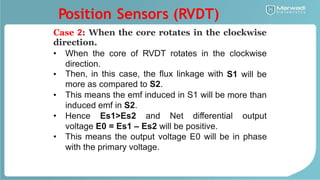
Case 2: When the core rotates in the clockwise
direction.
• When the core of RVDT rotates in the clockwise
direction.
Then, in this case, the flux linkage with
more as compared to S2.
This means the emf induced in S1 will be
induced emf in S2.
• S1 will be
• more than
• Hence Es1>Es2 and Net differential output
voltage E0 = Es1 – Es2 will be positive.
This means the output voltage E0 will be in phase
with the primary voltage.
•
Position Sensors (RVDT)
Case 3: When the core rotates in the anti-
clockwise direction.
• When the core of RVDT rotates in the anti-clockwise
direction.
• Then, in this case, the flux linkage with S2 will be
more as compared to S1.
This means the emf induced in S2 will be more than
induced emf in S1.
•
• Hence Es2>Es1 and Net differential output
voltage E0 = Es1 – Es2 will be negative.
• This means the output voltage E0 will be in phase
opposition (180 degrees out of phase) with the
primary voltage.
Position Sensors (RVDT)
Advantages of RVDT
•
•
•
•
•
•
•
•
•
•
High Accuracy.
Compact and strong construction.
The consistency of RVDT
Long life span.
Very high Resolution.
Low cost.
High durability
Linearity is excellent.
is high.
The performance is repeatable.
Easy to handle
Position Sensors
Applications of RVDT
(RVDT)
•
•
•
•
•
•
•
•
•
•
Actuators for controlling flight as
Fuel valve as well as hydraulics.
Brake with a cable system.
Modern machine tools.
Nose wheel steering systems.
Weapon and T
orpedo system.
Engine fuel control system
Aircraft and avionics.
Engines bleed air systems.
Robotics.
well as engine.
Potentiometer
Potentiometer
• The instrument is designed for measuring
the unknown voltage by comparing it with
the known voltage, such type of instrument
is known as the potentiometer
.
In other words, the potentiometer is the
•
three terminal device used for
by
measuring
manually
the potential differences
varying the resistances.
• The known voltage is drawn by the cell or
any other supply sources.
Potentiometer
• The potentiometer uses the comparative
method which is more accurate than the
deflection method.
• So, it is mostly used in the places where
higher accuracy is required or where no
current flows from the source under test.
The potentiometer is used in the
•
electronic circuit, especially for controlling
the volume.
Potentiometer
The following are the important characteristics
of
1.
the potentiometer
.
The potentiometer is very accurate because
it works on the comparing method rather
than the deflection pointer method for
determining the unknown voltages.
It measures the null or balance point which
does not require power for the
measurement.
The working of the potentiometer is free
from the source resistance because no
current flows through the potentiometer
when it is balanced.
2.
3.
Potentiometer
The construction of the potentiometer is
categorised into two parts.
•
➢ They are the sliding and non-sliding
parts. The sliding contact is a called
wiper
.
The motion of the sliding contacts is either
translatory or rotational.
Some potentiometer uses both the
translatory and rotational motions.
Such type of potentiometer uses the
resistor in the form of a helix, and hence
they are called heliports.
•
•
•
Potentiometer
• The
two
and
potentiometer has three terminals, the
terminals are connected to the resistor
,
the third terminal is connected to the
wiper which is movable with the wire.
Because of this moving wire, the variable
potential is tapped off.
The third terminal is used for controlling the
variable resistor
.
•
•
• The potential
controlled by
at the end of
of the third terminal is
changing the applying potential
the resistor
.
• The body of the potentiometer is made up of
resistive material, and the wire is wound on
it.
Potentiometer (working principle )
• The working principle of the potentiometer
is explained through the circuit shown
below.
Consider S is the switch used for connecting
or disconnecting the galvanometer from the
potentiometer
.
The battery through the rheostat and slide
wire supply the working current.
The working current may vary by changing
the setting of the rheostat.
•
•
•
Potentiometer (working principle )
• The method of findings the unknown
voltage depends on the sliding position of
the contact at which the galvanometer
shows the zero deflection.
The zero or null deflection of galvanometer
shows that the potential of the unknown
source E and the voltage drops E1 across
the sliding wires are equal.
Thus, the potential of the unknown voltage
is evaluated by knowing the voltage drop
across the ac portion of the sliding wire.
•
•
Potentiometer (working principle )
• The slide wire has the uniform cross-section
and resistance across the entire length.
As the resistance of the sliding wire is
known, then it is easily controlled by
adjusting the working current.
The process of equalising the working
•
•
voltage as that of voltage drop is known
the standardisation.
as
Optical encoder
Optical encoder
• The optical encoder is a transducer commonly used
for measuring rotational motion.
It consists of a shaft connected to a circular disc,
containing one or more tracks of alternating
transparent and opaque areas.
A light source and an optical sensor are mounted
on opposite sides of each track.
As the shaft rotates, the light sensor emits a series
of pulses as the light source is interrupted by the
pattern on the disc.
•
•
•
Optical encoder
• This output signal can
digital circuitry.
be directly compatible with
• The number of output pulses per rotation of the
disc is a known quantity, so the number of output
pulses per second can be directly converted to
the rotational speed (or rotations per second) of
the shaft.
Encoders are commonly used in motor speed
control applications.
•
Incremental optical encoder
An incremental optical encoder has two tracks, 90°
out of phase with each other, producing two outputs.
The relative phase between the two channels
•
•
indicates whether the encoder is rotating clockwise
counterclockwise.
Often there is a third track that produces a single
index pulse, to indicate an absolute position
reference.
Otherwise, an incremental encoder produces
only relative position information.
or
•
•
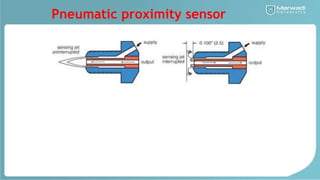
Pneumatic proximity sensor
• Low pressure air is allowed to escape through a
port in front of the sensor
Piezoelectric sensor
• A piezoelectric sensor, also known as a
piezoelectric transducer, is a device that uses the
piezoelectric effect to measure changes in
pressure, acceleration, temperature, strain or force
by converting these into an electrical charge.
The prefix piezo is Greek for press or squeeze. The
ability of piezoelectric material to convert
mechanical stress into electrical charge is called a
piezoelectric effect.
Generated piezoelectricity is proportional to the
pressure applied to solid piezoelectric crystal
materials.
•
•
Piezoelectric sensor
• In the pressure sensor, a thin membrane is placed on
a massive base to transfer the applied force to
the piezoelectric element. Upon application of pressure
on this thin membrane, the piezoelectric material gets
loaded and starts generating electrical voltages. The
produced voltage is proportional to the amount of
pressure applied.
• In accelerometers, seismic mass is attached to the
crystal element to transfer the applied force to
piezoelectric materials. When motion is applied,
material
seismic
according
mass load’s the piezoelectric
to law of motion. The
Newton’s
material
second
piezoelectric generates charge used for
calibration of motion.
68
of
43
Position sensors
• Piezo electric sensor
• LVDT
• RVDT or Resolver
• potentiometer
• Optical encoders
• Pneumatic position sensors
Range sensors
• The function of range sensor is to measure the
distance from a reference point (normally on the
sensor itself)to the objects in the field
of the sensor
Range sensos are employed for robot
and obstacle avoidance
The following techniques are used for
sensing
of operation
navigation
•
• range
1.
2.
3.
triangulation method,
structured lighting approach and
time-of flight range finders
T
riangulation technique
T
riangulation technique
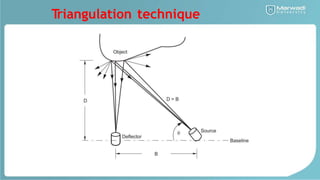
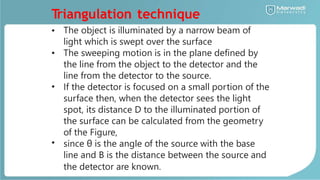
• The object is illuminated by a narrow beam of
light which is swept over the surface
The sweeping motion is in the plane defined by
the line from the object to the detector and the
line from the detector to the source.
If the detector is focused on a small portion of the
surface then, when the detector sees the light
spot, its distance D to the illuminated portion of
the surface can be calculated from the geometry
of the Figure,
since θ is the angle of the source with the base
line and B is the distance between the source and
the detector are known.
•
•
•
T
riangulation technique
•
•
The above method yields a point measurement.
However, if the source-detector arrangement is
moved in a fixed plane, then it is possible to
obtain a set of points whose distance from the
detectors are known.
Then these distances are easily transformed to
three-dimensional co-ordinates by keeping tract
of the location and orientation of the detector as
objects are scanned.
•
Structured lighting approach
• This approach consists of projecting a light pattern
onto a set of objects and using the distortion of
the pattern to calculate the range.
Figure shows the structure light approach.
Specific range values are computed by first
calibrating the system.
The figure shows the arrangement of top view
•
•
•
Time of flight (lapsed time rangers)
• These methods involve the use of a lase and
ultrasonics
Time of flight ranging consists of sending a signal
from a transmitter that bounces back from an
object and is received by a receiver.
The distance between the object and the sensor is
half the distance traveled by the signal, which can
be calculated by measuring the time of flight of
the signal by knowing its speed of travel.
Time of flight Range finder uses laser to determine
the range and to measure the time it takes for an
emitted pulse of light to return coaxially
(along the same path) from the reflecting surface.
•
•
•
•
Proximity sensors
• Proximity sensor (sometimes referred to as
external state sensors) generally have a binary
output which indicates the presence of an
object within a specified distance interval
Range sensors in contrast yield an estimate of
the distance between a sensor and a reflecting
object
•
Types of Proximity sensors
•
•
Contact proximity sensors
Non-contact proximity sensors
i.
ii.
iii.
iv.
v.
vi.
vii.
Optical proximity
Ultrasonic
Eddy current
Inductive
Hall-effect
Capacitive
Pneumatic
sensors
viii.Fire optic scanning
ix. Scanning laser
Contact proximity sensors
• T
ouch sensors are classified into two types
1.
2.
Binary
Analog
Contact proximity sensors
1. Binary
Contact proximity sensors
• Binary sensors are basically switches
respond to the presence or absence
object.
Switches are always microswitches.
which
of an
•
• It is constructed in such a way that, a switch is
placed on the inner surface of each finger of a
manipulator hand.
Multiple binary touch sensors can be used on
the inside surface of each finger to provide
further tactile information.
•
Contact proximity sensors
2. Analog
Contact proximity sensors
• Analog sensors will give a signal as output
proportional to the local force.
The simplest form of these devices consist of a
spring loaded rod, which is mechanically linked
to a rotating shaft in such a way that the
displacement of the rod due to a lateral force
results in a proportional rotation of the shaft.
The rotation is then measured continuously
using a potentiometer or digitally using a code
wheel.
The spring constant yields the force
corresponding to a given displacement.
•
•
•
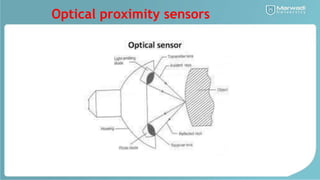
Optical proximity sensors
• Optical proximity sensor consists of a light source called
an emitter and a receiver, which senses the presence or
the absence of the light.
The receiver is usually a photo transistor, and the
emitter is usually LED.
The combination of these two creates a light sensor and
is used in many application including optical encoder.
The sensor is set up in such a way that the light emitted
by the emitter, is not received by the receiver, unless an
object is close by.
Unless a reflective object is within range of the switch,
the light is not seen by the receiver, therefore there will
be no signal.
•
•
•
•
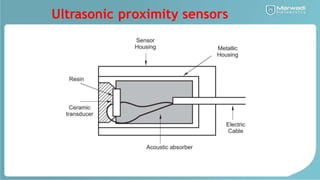
Ultrasonic proximity sensors
• An ultrasonic range finder uses an ultrasonic chirp
which is transmitted over a short time period and
since the speed of sound is known for a specified
medium, a simple calculation involving the time
interval between the outgoing pulse and return
echo yields an estimate of the distance to the
reflecting surface.
The basic element is an electro acoustic
transducer, often of the piezoelectric ceramic
type.
The resin layer protects the transducer against
humidity, dust and other environmental factors.
•
•
Ultrasonic proximity sensors
•
•
It also acts as an acoustical impedance matcher.
The same-transducer is generally used for both
transmitting and receiving, and fast damping of the
acoustic energy is necessary to detect the object at
closest range.
This is accomplished by providing acoustic absorbers
and by decoupling the transducer from its housing.
•
• The housing is
acoustic beam
directionality.
The previously
designed so that it produces a narrow
for efficient energy transfer and signal
• discussed proximity sensors are useful
for detection of ferro-magnetic matter only.
If the robot has to handle other type of materials
ultrasonic sensors find the application.
•
Eddy current proximity sensors
Eddy current sensors
• Eddy current sensor operates based on the
inductive eddy-current principle.
When the sensing coil is supplied with an
alternating current, it causes a magnetic field
to form around the coil.
If an electrically conducting material is placed
in this field, eddy current field is induced
according to the Faraday’s induction law.
When the object moves, it causes the change
in the impedance of the coil, which is
proportional to the change in the distance
between the sensor and the target.
•
•
•
Eddy current sensors
• Eddy current sensors have
resistance
superior
towards
(sensors
temperature stability and
pressure, temperature, dirt and oil.
do not recognize non-conductive materials.)
Capable of operating at pressure up to 4000
bar, they are one of the best wear-free, non-
•
contact sensors for measuring displacement
and
The
and
position in harsh industrial environment.
• sensors are generally miniature in size
therefore, are suitable for measuring in
an area where access is restricted.
These sensors are also low-cost.
•
Applications - Eddy current sensors
• Measure vibrations of actuators in steel
galvanising plants
Cylinder movements in an internal
combustion engine
Measure thickness of sheet metals in roller
gap
Measure movement of hydraulic cylinders
Used in airplanes to measure movement of
door lock switches and landing gear flaps
•
•
•
•
Inductive proximity sensors
• This sensor is based on a change of inductance due
to the presence of a metallic object
The inductive sensor basically consists of a wound
coil located next to a permanent magnet packaged in
a simple, rugged housing.
The effect of bringing the sensor in close proximity to
a ferromagnetic material causes a change in the
position of the flux lines of the permanent magnet.
Under static condition, there is no movement of the
flux lines and no current is induced in the coil.
As ferromagnetic object enters or leaves the field of
magnet, the resulting change in flux line induces a
current pulse whose amplitudes and shape are
proportional to the rate of change of flux.
•
•
•
•
Inductive proximity sensors
• The voltage waveform observed at the output of
the coil provides an effective means for proximity
sensing
The polarity of the voltage output of the sensor
depends whether the object is entering or leaving
the field
It has been observed that the sensitivity falls off
rapidly with increasing distance, and that the
sensor is effective only for fractions of a
millimetre
•
•
Hall effect sensors - principle
Hall effect sensors
• If we have thin conductive plate, and if we set
current to flow through it, the charge carriers
would flow in a straight line from one to the other
side of the plate.
• Now if we bring some magnetic field
we would disturb the straight flow of
carriers due to a force, called Lorentz
near the plate
the charge
Force.
• In such a case the electrons would deflect to one
side
side
This
of the plate and the positive holes to the other
of the plate.
means if we put a meter now between the
•
other two sides we will get some voltage (Hall
Voltage, VH) which can be measured.
Hall effect sensors
•
•
These sensors can only detect magnetised objects
However when used in conjunction with a
permanent magnet, they are capable of detecting
all ferromagnetic materials
Capacitive proximity sensors
• Inductive and Hall-effect sensor will detect only
ferromagnetic materials, whereas, capacitive
sensor is capable of detecting all solids and
liquid materials.
capacitive proximity sensors operate by noting
change in the capacitance read by the sensor.
A typical capacitor consists of two conductive
elements (sometimes called plates) separated
by some kind of insulating material that can be
one of many different types including ceramic,
plastic, paper, or other materials.
• a
•
Capacitive proximity sensors
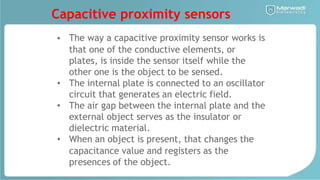
• The way a capacitive proximity sensor works is
that one of the conductive elements, or
plates, is inside the sensor itself while the
other one is the object to be sensed.
The internal plate is connected to an oscillator
circuit that generates an electric field.
The air gap between the internal plate and the
external object serves as the insulator or
dielectric material.
When an object is present, that changes the
capacitance value and registers as the
presences of the object.
•
•
•
Capacitive proximity sensors
• The other simplest method includes a capacitor
as part of an oscillator circuit designed so that
the oscillator starts only when the capacitance of
sensor exceeds a predefined threshold value.
The start of oscillation is then translated into an
output voltage which indicates the presence of
an object. This method provides a binary output
whose triggering sensitivity depends on the
threshold value
•
Fibre-optic scanning sensors
1.
2.
3.
Opposed configuration
Retro reflective configuration
Diffuse configuration
Fibre-optic scanning sensors
1.
•
Opposed-Mode (Through-Beam) Sensing
In opposed-mode sensing, also known as through-beam sensing,
the sensor's emitter and receiver are housed in two separate
units. The emitter is placed opposite the receiver so that the light
beam goes directly from the emitter to the receiver.
The opposed mode should be used whenever possible because it
is the most reliable sensing mode. This is because light passes
directly from the emitter to the receiver. An object is detected
when it breaks the effective beam, which is the column of light
directly between the emitter’s lens and the receiver’s lens.
It doesn't matter how shiny or dark your object is, or even what
color. The object physically passes between the emitter and
receiver and is detected when it blocks the beam of light.
Therefore, variables such as surface reflectivity, color, and finish
don't affect opposed-mode sensing.
•
•
Fibre-optic scanning sensors
2.
•
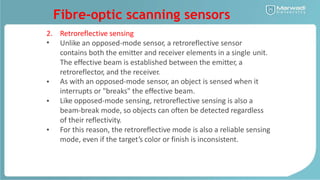
Retroreflective sensing
Unlike an opposed-mode sensor, a retroreflective sensor
contains both the emitter and receiver elements in a single
The effective beam is established between the emitter, a
retroreflector, and the receiver.
unit.
• As with an opposed-mode sensor, an object is sensed when it
interrupts or "breaks" the effective beam.
Like opposed-mode sensing, retroreflective sensing is also a
beam-break mode, so objects can often be detected regardless
of their reflectivity.
For this reason, the retroreflective mode is also a reliable sensing
mode, even if the target’s color or finish is inconsistent.
•
•
Fibre-optic scanning sensors
3.
•
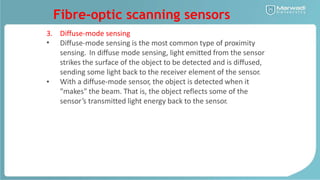
Diffuse-mode sensing
Diffuse-mode sensing is the most common type of proximity
sensing. In diffuse mode sensing, light emitted from the sensor
strikes the surface of the object to be detected and is diffused,
sending some light back to the receiver element of the sensor.
With a diffuse-mode sensor, the object is detected when it
"makes" the beam. That is, the object reflects some of the
sensor’s transmitted light energy back to the sensor.
•
Wrist sensors
Several different forces exist at the point where a robot
arm joins the end effector. This point is called the wrist. It
has one or more joints that move in various ways.
A wrist-force sensor can detect and measure these
•
•
forces. It consists of specialized pressure sensors known
strain gauges.
The strain gauges convert the wrist forces into electric
signals, which go to the robot controller.
as
•
• Thus the machine can determine what is happening at the
wrist, and act accordingly.
Compliance sensors
• Constant control of a pressing force of a tip of
robot hand with force sensor.
Stable operation on assembling, grinding and
other work by using this function.
The term compliance refers to flexibility and
suppleness.
A non-compliant (stiff) robot end effector is a
the
•
•
•
device which is designed to have predetermined
positions or trajectories.
Slip sensors
Slip sensor Slip sensors in robotics are used to
provide the robotic manipulator if the object that is
carried by the end effector is slipping.
Slip may be regarded as the relative movement of
one objects surface over another when in contact.
The slip of the industrial robot finger means the
relative motion of an object with respect to the
finger in the direction vertical to the grasping finger
force.
The traveling distance of the grasping point is
called the slip displacement. The slip
sensor detects the slip displacement
•
•
•
•
Sniff sensors
• Sniff sensors are similar to smoke detectors
T
aste sensors
• A taste sensor is a device that determines the
composition of particles in a medium
Image processing versus image
analysis
Image processing – preparation of an image for
later analysis and use
Image analysis – process by which a captured and
processed image is analysed to extract information
about the content
Two measures significantly affect the usefulness of
an image
•
•
•
1.
2.
Resolution
Quantization
Resolution
How often a signal is measured and read or
sampled
Higher number of samples at equally spaced
periodic time result in higher resolution
The resolution of an analog signal is a function of
sampling rate
The resolution of a digital signal is a function of pixels
•
•
•
•
Quantization
Quantization refers to how accurately the value of
the signal at any given point is converted to digital
form
This is a function of how many bits are used to
represent the digitized magnitude of the sampled
signal
•
•
2𝑛
• T
otal number of grey level possibilities is

DSR_Unit-5_Sensors.pptx

  • 1.
    Prof. Puneet Mathur AssistantProfessor, Marwadi University, Rajkot Design and Synthesis of Robots UNIT-5 SENSORS
  • 2.
    Sensors Sensor is adevice that acquires a physical parameter and changes it into a signal that can be processed by the system Eg., temperature, pH, velocity, rotational rate, flow rate, pressure and many others. Today, most sensors do not indicate a reading on an analog scale, but, rather, they produce a voltage or a digital signal that is indicative of the physical variable they measure. Those signals are often imported into computer programs, stored in files, plotted on computers and analyzed to depth.
  • 3.
    Need of Sensors •The significance of sensor technology is constantly growing. • Sensors allow us to monitor our surroundings in ways we could barely imagine a few years ago. • New sensor applications are being identified everyday which broadens the scope of the technology and expands its impact on everyday life.
  • 4.
    Need of Sensors In • Industry Onthe factory floor, networked vibration sensors warn that a bearing is beginning to fail. • Mechanics schedule overnight maintenance, preventing an expensive unplanned shutdown. Inside a refrigerated grocery truck, temperature and • humidity sensors monitor individual containers, reducing spoilage in fragile fish or produce.
  • 5.
    In • the Environment Networks ofwireless humidity sensors monitor fire danger in remote forests. • Nitrate sensors detect industrial and agricultural distributed runoff in rivers, streams and wells, while seismic monitors provide an early warning earthquakes. system for • Built-in integrity stress sensors report on the structural of bridges, buildings and roadways, and other man-made structures. Need of Sensors
  • 6.
    For Safety andSecurity • Fire fighters scatter wireless sensors spots throughout a burning building to map hot and flare-ups. Simultaneously, the sensors provide an emergency communications network. • Miniature hospitals, chemical and biological sensors in post offices, and transportation centres raise an alarm at the first sign of anthrax, smallpox or other terror agents. Need of Sensors
  • 7.
    Characteristics of asensor 1. Range: It is the minimum and maximum value of physical variable that the sensor can sense or measure. For example, a Resistance Temperature Detector (RTD) for the measurement of temperature has a range of -200 to 800oC. 2. Span: It is the difference between the maximum and minimum values of input. In above example, the span of RTD is 800 – (-200) = 1000oC. 3. Accuracy: The error in measurement is specified in terms of accuracy. It is defined as the difference between measured value and true value. It is defined in terms of % of full scale or % of reading. 4. Precision: It is defined as the closeness among set of values. It is different from accuracy 5. Sensitivity: It is the ratio of change in output to change in input. It should be as high as possible. 6. Linearity: Linearity is the maximum deviation between the measured values of a sensor from ideal curve. The sensory device should exhibit the same sensitivity over its entire operating range
  • 8.
    Characteristics of asensor 7. Hysteresis: It is the difference in output when input is varied in two ways- increasing and decreasing. 8. Resolution: It is the minimum change in input that can be sensed by the sensor. 9. Reproducibility: It is defined as the ability of sensor to produce the same output when same input is applied. 10. Repeatability: It is defined as the ability of sensor to produce the same output every time when the same input is applied and all the physical and measurement conditions kept the same including the operator, instrument, ambient conditions etc. 11. Response Time: It is generally expressed as the time at which the output reaches a certain percentage (for instance, 95%) of its final value, in response to a step change of the input.
  • 9.
    12.It should besuitable for the environment in which it is employed 13.It should have a suitable physical size, cost and ease of operation 14.It should not disturb or have any effect upon the quantity it senses or measures 15.It should include isolation from receiving excess signals or electrical noise that could give rise to the possibility of misconception or damage of the sensor, circuit or system Characteristics of a sensor
  • 10.
    Types of sensors •Internal state sensors • External state sensors • T actile sensors • Non-tactile sensors
  • 11.
    Internal state sensors •These sensors deals with the detection of variable such as arm joint position, which are used in robot control. • Internal sensors as the name explains it is used to measure the internal state of a robot. • It measures position, velocity, acceleration etc. of robot joints and/or end effectors • Potentiometers • LVDT or RVDT • Optical encoders • Tachometer • Accelerometer
  • 12.
    External state sensors Thesetype of sensors are used to monitor the robot’s geometric and /or dynamic relation to its task, environment of the objects that is handling. • Strain gauges • Pressure transducer • Proximity devices • Ultrasonic sensors • Electromagnetic sensors External state sensors may be further classified as • Tactile (Contact) sensors. • Non-tactile (Non-contact) sensors.
  • 13.
    Tactile sensors These arecontact sensors that must be brought in contact with the object to obtain signals to measure necessary quantities • Force sensors • Torque sensors • Touch sensors • Position sensors
  • 14.
    Non-tactile sensors These arecontactless sensors which sense signals remotely but only within the specified range of distance from the object Non-contact sensors rely on the response of variations in acoustic or electromagnetic radiation. • Proximity sensors • Range imaging sensors • Ultrasonic sensors • Electro-optical vision sensors • Magnetic sensors
  • 15.
    Position sensors • Asthe name implies, Position Sensors detect the position of something which means that they are referenced either to or from some fixed point or position. • These types of sensors provide a “positional” feedback. • One method of determining a position, is to use either “distance between two points such as the distance travelled or moved away from some fixed point, or by “rotation” (angular movement). • Determine its distance travelled along the ground. Either way, Position Sensors can detect the movement of an object in a straight line using Linear Sensors or by its angular movement using Rotational Sensors.
  • 16.
    Proximity Sensors • Thistype of sensor is capable of pointing out the availability of a component. • The proximity sensor will be placed in the robot moving part such as end effector. This sensor will be turned ON at a specified distance, which will be measured by means of feet or millimeters. • It is also used to find the presence of a human being in the work volume so that the accidents can be reduced.
  • 17.
    Range Sensors • Thedistance between the object and the robot hand is measured using sensors, within it is range of operation. • The calculation of the distance is by visual processing Range sensors find use in robot navigation and avoidance of the obstacles in the path. • The location and the general shape characteristics of the part in the work envelope of the robot is done by special applications for the range sensors. .
  • 18.
    Sensors Tactile Sensors: A sensingdevice that requires the contact between an object, and sensor is considered as the Tactile Sensor. This Sensor can be sorted into two key types namely: • Touch Sensor, and • Force Sensor.
  • 19.
    T ouch Sensors • Thetouch sensor has got the ability to sense and detect the touching of a sensor and object. Some of the commonly used simple devices as touch sensors are micro – switches, limit switches, etc. • If the end effector gets some contact with any solid part, then this sensor will be handy one to stop the movement of the robot. • In addition, it can be used as an inspection device, which has a probe to measure the size of a component.
  • 20.
    Force Sensors • Theforce sensor is included for calculating the forces of several functions like the machine loading & unloading, material handling, and so on that are performed by a robot. • This sensor will also be a better one in the assembly process for checking the problems. • There are several techniques used in this sensor like Joint Sensing, Robot – Wrist Force Sensing, and TactileArray Sensing.
  • 21.
    Position Sensors (LVDT) •The LVDT full form is “Linear Variable Differential Transformer” is LVDT. • Generally, LVDT is a normal type of transducer. The main function of this is to convert the rectilinear movement of object to the equivalent electrical signal. • LVDT is used to calculate displacement and works on the transformer principle. • The working principle of the linear variable differential transformer or LVDT working theory is mutual induction.
  • 22.
  • 23.
    Position Sensors (LVDT) •Linear Variable Differential Transformer (LVDT) is an Electromechanical type Inductive Transducer that converts rectilinear displacement into the Electrical Signal. • Since LVDT is a secondary transducer, hence physical quantities such as Force, Weight, Tension, Pressure, etc are first converted into displacement by a primary transducer and then LVDT is used to measure it in terms of corresponding Electrical signal. • As LVDT is an AC controlled device, so there is no electronics component inside it. It is the most widely used Inductive Sensor due to its high accuracy level. • Its electrical output is obtained because of the difference of secondary voltages, hence it is called Differential Transformer.
  • 24.
    Position Sensors (LVDT) LVDTConstruction: • LVDT consists of one primary winding P and two secondary windings S1 cylindrical former. & S2 mounted on a • Both the secondary windings (S1 & S2) has an equal number of turns and placed either side of the primary winding identically on in such a way of the that the net output will be the difference voltage of both secondary windings. There is a movable soft iron core placed the former. • inside
  • 25.
  • 26.
    Position Sensors (LVDT) LVDTworking principle: • The working principle of LVDT is based on the mutual induction principle. When AC excitation of 5-15 V at a frequency of 50-400Hz is applied to the primary winding, then a magnetic field is produced. This magnetic field induces a mutual current in secondary windings. Due to this, the induced voltages in secondary windings (S1 & S2) are E1 & E2 respectively. Since both the secondary windings are connected in series opposition, So the net output voltage will be the difference of both induced voltages (E1 & E2) in secondary windings. • • • • Hence Differential Output of LVDT will be E0 = E1 – E2
  • 27.
    Position Sensors (LVDT) Case1: When the core moves towards S1 (Max Left). • When the core of LVDT moves toward Secondary winding S1. Then, in this case, the flux linkage with S1 will be more as compared to S2. This means the emf induced in S1 will be more than induced emf in S2. Hence E1>E2 and Net differential output voltage E0 = E1 – E2 will be positive. This means the output voltage E0 will be in phase with the primary voltage. • • • •
  • 28.
    Position Sensors (LVDT) Case2: When the core is at Null position. • When the core is at the null position then the flux linkage with both the secondary windings will be the same. So the induced emf (E1 & E2) in both the windings will be the same. Hence the Net differential output voltage E0 = E1 – E2 will be zero (E0 = E1 – E2 = 0). It shows that no displacement of the core. • • •
  • 29.
    Position Sensors (LVDT) Case3: When the core moves towards S2 (Max Right). • When the core of LVDT moves toward Secondary winding S2. Then, in this case, the flux linkage with S2 will be more as compared to S1. This means the emf induced in S2 will be more than induced emf in S1. Hence E2>E1 and Net differential output voltage E0 = E1 – E2 will be negative. This means the output voltage E0 will be in phase opposition (180 degrees out of phase) with the primary voltage. • • • •
  • 30.
    Position Sensors (LVDT) 1.The direction of the movement of an object can with the help of the differential output voltage of output voltage E0 is positive then this means moving towards Left from the Null position. be identified LVDT. If the an object is 2. Similarly, If the output voltage E0 is negative then this means the object is moving towards the Right of the Null position. The amount or magnitude of displacement is proportional to the differential output of LVDT. The more the output voltage, the more will be the displacement of the object. If we take the core out of the former then the net differential the output of LVDT will be zero. In fact corresponding to both the cases, whether the core is moving either Left or Right to the Null position. Then the output voltage will be increased linearly up to 5mm from the Null position and after 5 mm output E0 will be non-linear. 3. 4. 5.
  • 31.
    Advantages of LVDT 1.Smoothand Wide Range of Operation :- 1.25mm to 250 mm. 2. High Sensitivity:- 40V/mm. 3.Low Hysteresis Losses:- LVDT gives low hysteresis losses hence repeatability is excellent under all the conditions. 4.Low Friction Losses:- As the core moves in a hollow Former, So there is no concept of friction losses. Hence it gives accurate output value. 5.Rugged Operation:- It can tolerate a high degree of shock and variation, especially when the core is loaded with spring. 6.Low Power consumption:- LVDT consume very low power of approx 1W during its operation. 7.Direct conversion to Electrical Signal:- They convert linear displacement directly to the corresponding electrical voltage signal which are easy to process further. 8.Fast dynamic Response:- Due to the absence of Friction, Its dynamic response becomes very fast to change in a core position.
  • 32.
    Disadvantages of LVDT 1.Since LVDT is Inductive Transducer, so it is sensitive to Stray Magnetic Field. Hence an extra setup is required to protect it from Stray Magnetic Field. Since it is an electromagnetic device, so it also 2. gets affected by the vibrations and temperature variation.
  • 33.
    Application of LVDT 1.LVDT is used to measure the physical quantities such as Force, Tension, Pressure, Weight, etc. These quantities are first converted into displacement by the use of primary transducers and then it is used convert the displacement to the corresponding Electrical voltage signal. It is mostly used in industries as well as a servomechanism. It is also used in Industrial Automation, Aircraft. Turbine, Satellite, hydraulics, etc. to 2. 3.
  • 34.
  • 35.
    Position Sensors (RVDT) •RVDT full form stands for a Rotary variable differential transformer. It is an electro-mechanical type of inductive transducer that converts angular displacement into the corresponding electrical signal. As RVDT is an AC controlled device, so there is no electronics component inside it. It is the most widely used inductive sensor due to its high accuracy level. Since the coil of RVDT is designed to measure an angular position, so it is also known as an angular position sensor. The electrical output of RVDT is obtained by the • • • • difference in secondary voltages of the transformer, is called a Differential Transformer. so it
  • 36.
    Position Sensors (RVDT) RVDTConstruction: • The design and construction of RVDT is similar to LVDT . • The only difference is the shape of the core in transformer windings. LVDT uses the soft iron core to measure the linear displacement whereas RVDT uses the Cam-shaped • core (Rotating core) for measuring the angular displacement.
  • 37.
    Position Sensors (RVDT) RVDTworking principle: • The working principle of RVDT and LVDT both are the same and based on the mutual induction principle. When AC excitation of 5-15V at a frequency of 50-400 • Hz is applied to magnetic field is the primary windings of RVDT then a produced inside the core. • This magnetic field induces a mutual current in secondary windings. Then due to transformer action, the induced voltages • in secondary windings (S1 and S2) are Es1 and Es2 respectively. • Hence the net output voltage will be the difference between both the induced secondary voltages. Hence Output will be E0 = Es1 – Es2
  • 38.
    Position Sensors (RVDT) Case1: When the core is at Null position. • When the core is at the null position then the flux linkage with both the secondary windings will be the same. • So the induced emf (Es1 & Es2) in both the windings will be the same. Hence the Net differential • output voltage E0 = Es1 – Es2 will be zero (E0 = Es1 – Es2 = 0). It shows that no displacement of the core. •
  • 39.
    Position Sensors (RVDT) Case2: When the core rotates in the clockwise direction. • When the core of RVDT rotates in the clockwise direction. Then, in this case, the flux linkage with more as compared to S2. This means the emf induced in S1 will be induced emf in S2. • S1 will be • more than • Hence Es1>Es2 and Net differential output voltage E0 = Es1 – Es2 will be positive. This means the output voltage E0 will be in phase with the primary voltage. •
  • 40.
    Position Sensors (RVDT) Case3: When the core rotates in the anti- clockwise direction. • When the core of RVDT rotates in the anti-clockwise direction. • Then, in this case, the flux linkage with S2 will be more as compared to S1. This means the emf induced in S2 will be more than induced emf in S1. • • Hence Es2>Es1 and Net differential output voltage E0 = Es1 – Es2 will be negative. • This means the output voltage E0 will be in phase opposition (180 degrees out of phase) with the primary voltage.
  • 41.
    Position Sensors (RVDT) Advantagesof RVDT • • • • • • • • • • High Accuracy. Compact and strong construction. The consistency of RVDT Long life span. Very high Resolution. Low cost. High durability Linearity is excellent. is high. The performance is repeatable. Easy to handle
  • 42.
    Position Sensors Applications ofRVDT (RVDT) • • • • • • • • • • Actuators for controlling flight as Fuel valve as well as hydraulics. Brake with a cable system. Modern machine tools. Nose wheel steering systems. Weapon and T orpedo system. Engine fuel control system Aircraft and avionics. Engines bleed air systems. Robotics. well as engine.
  • 43.
  • 44.
    Potentiometer • The instrumentis designed for measuring the unknown voltage by comparing it with the known voltage, such type of instrument is known as the potentiometer . In other words, the potentiometer is the • three terminal device used for by measuring manually the potential differences varying the resistances. • The known voltage is drawn by the cell or any other supply sources.
  • 45.
    Potentiometer • The potentiometeruses the comparative method which is more accurate than the deflection method. • So, it is mostly used in the places where higher accuracy is required or where no current flows from the source under test. The potentiometer is used in the • electronic circuit, especially for controlling the volume.
  • 46.
    Potentiometer The following arethe important characteristics of 1. the potentiometer . The potentiometer is very accurate because it works on the comparing method rather than the deflection pointer method for determining the unknown voltages. It measures the null or balance point which does not require power for the measurement. The working of the potentiometer is free from the source resistance because no current flows through the potentiometer when it is balanced. 2. 3.
  • 47.
    Potentiometer The construction ofthe potentiometer is categorised into two parts. • ➢ They are the sliding and non-sliding parts. The sliding contact is a called wiper . The motion of the sliding contacts is either translatory or rotational. Some potentiometer uses both the translatory and rotational motions. Such type of potentiometer uses the resistor in the form of a helix, and hence they are called heliports. • • •
  • 48.
    Potentiometer • The two and potentiometer hasthree terminals, the terminals are connected to the resistor , the third terminal is connected to the wiper which is movable with the wire. Because of this moving wire, the variable potential is tapped off. The third terminal is used for controlling the variable resistor . • • • The potential controlled by at the end of of the third terminal is changing the applying potential the resistor . • The body of the potentiometer is made up of resistive material, and the wire is wound on it.
  • 49.
  • 50.
    Potentiometer (working principle) • The working principle of the potentiometer is explained through the circuit shown below. Consider S is the switch used for connecting or disconnecting the galvanometer from the potentiometer . The battery through the rheostat and slide wire supply the working current. The working current may vary by changing the setting of the rheostat. • • •
  • 51.
    Potentiometer (working principle) • The method of findings the unknown voltage depends on the sliding position of the contact at which the galvanometer shows the zero deflection. The zero or null deflection of galvanometer shows that the potential of the unknown source E and the voltage drops E1 across the sliding wires are equal. Thus, the potential of the unknown voltage is evaluated by knowing the voltage drop across the ac portion of the sliding wire. • •
  • 52.
    Potentiometer (working principle) • The slide wire has the uniform cross-section and resistance across the entire length. As the resistance of the sliding wire is known, then it is easily controlled by adjusting the working current. The process of equalising the working • • voltage as that of voltage drop is known the standardisation. as
  • 53.
  • 54.
    Optical encoder • Theoptical encoder is a transducer commonly used for measuring rotational motion. It consists of a shaft connected to a circular disc, containing one or more tracks of alternating transparent and opaque areas. A light source and an optical sensor are mounted on opposite sides of each track. As the shaft rotates, the light sensor emits a series of pulses as the light source is interrupted by the pattern on the disc. • • •
  • 55.
    Optical encoder • Thisoutput signal can digital circuitry. be directly compatible with • The number of output pulses per rotation of the disc is a known quantity, so the number of output pulses per second can be directly converted to the rotational speed (or rotations per second) of the shaft. Encoders are commonly used in motor speed control applications. •
  • 56.
    Incremental optical encoder Anincremental optical encoder has two tracks, 90° out of phase with each other, producing two outputs. The relative phase between the two channels • • indicates whether the encoder is rotating clockwise counterclockwise. Often there is a third track that produces a single index pulse, to indicate an absolute position reference. Otherwise, an incremental encoder produces only relative position information. or • •
  • 57.
  • 58.
    Pneumatic proximity sensor •Low pressure air is allowed to escape through a port in front of the sensor
  • 59.
  • 60.
    Piezoelectric sensor • Apiezoelectric sensor, also known as a piezoelectric transducer, is a device that uses the piezoelectric effect to measure changes in pressure, acceleration, temperature, strain or force by converting these into an electrical charge. The prefix piezo is Greek for press or squeeze. The ability of piezoelectric material to convert mechanical stress into electrical charge is called a piezoelectric effect. Generated piezoelectricity is proportional to the pressure applied to solid piezoelectric crystal materials. • •
  • 61.
    Piezoelectric sensor • Inthe pressure sensor, a thin membrane is placed on a massive base to transfer the applied force to the piezoelectric element. Upon application of pressure on this thin membrane, the piezoelectric material gets loaded and starts generating electrical voltages. The produced voltage is proportional to the amount of pressure applied. • In accelerometers, seismic mass is attached to the crystal element to transfer the applied force to piezoelectric materials. When motion is applied, material seismic according mass load’s the piezoelectric to law of motion. The Newton’s material second piezoelectric generates charge used for calibration of motion.
  • 62.
    68 of 43 Position sensors • Piezoelectric sensor • LVDT • RVDT or Resolver • potentiometer • Optical encoders • Pneumatic position sensors
  • 63.
    Range sensors • Thefunction of range sensor is to measure the distance from a reference point (normally on the sensor itself)to the objects in the field of the sensor Range sensos are employed for robot and obstacle avoidance The following techniques are used for sensing of operation navigation • • range 1. 2. 3. triangulation method, structured lighting approach and time-of flight range finders
  • 64.
  • 65.
    T riangulation technique • Theobject is illuminated by a narrow beam of light which is swept over the surface The sweeping motion is in the plane defined by the line from the object to the detector and the line from the detector to the source. If the detector is focused on a small portion of the surface then, when the detector sees the light spot, its distance D to the illuminated portion of the surface can be calculated from the geometry of the Figure, since θ is the angle of the source with the base line and B is the distance between the source and the detector are known. • • •
  • 66.
    T riangulation technique • • The abovemethod yields a point measurement. However, if the source-detector arrangement is moved in a fixed plane, then it is possible to obtain a set of points whose distance from the detectors are known. Then these distances are easily transformed to three-dimensional co-ordinates by keeping tract of the location and orientation of the detector as objects are scanned. •
  • 67.
  • 68.
    Structured lighting approach •This approach consists of projecting a light pattern onto a set of objects and using the distortion of the pattern to calculate the range. Figure shows the structure light approach. Specific range values are computed by first calibrating the system. The figure shows the arrangement of top view • • •
  • 69.
    Time of flight(lapsed time rangers)
  • 70.
    Time of flight(lapsed time rangers) • These methods involve the use of a lase and ultrasonics Time of flight ranging consists of sending a signal from a transmitter that bounces back from an object and is received by a receiver. The distance between the object and the sensor is half the distance traveled by the signal, which can be calculated by measuring the time of flight of the signal by knowing its speed of travel. Time of flight Range finder uses laser to determine the range and to measure the time it takes for an emitted pulse of light to return coaxially (along the same path) from the reflecting surface. • • • •
  • 71.
    Proximity sensors • Proximitysensor (sometimes referred to as external state sensors) generally have a binary output which indicates the presence of an object within a specified distance interval Range sensors in contrast yield an estimate of the distance between a sensor and a reflecting object •
  • 72.
    Types of Proximitysensors • • Contact proximity sensors Non-contact proximity sensors i. ii. iii. iv. v. vi. vii. Optical proximity Ultrasonic Eddy current Inductive Hall-effect Capacitive Pneumatic sensors viii.Fire optic scanning ix. Scanning laser
  • 73.
    Contact proximity sensors •T ouch sensors are classified into two types 1. 2. Binary Analog
  • 74.
  • 75.
    Contact proximity sensors •Binary sensors are basically switches respond to the presence or absence object. Switches are always microswitches. which of an • • It is constructed in such a way that, a switch is placed on the inner surface of each finger of a manipulator hand. Multiple binary touch sensors can be used on the inside surface of each finger to provide further tactile information. •
  • 76.
  • 77.
    Contact proximity sensors •Analog sensors will give a signal as output proportional to the local force. The simplest form of these devices consist of a spring loaded rod, which is mechanically linked to a rotating shaft in such a way that the displacement of the rod due to a lateral force results in a proportional rotation of the shaft. The rotation is then measured continuously using a potentiometer or digitally using a code wheel. The spring constant yields the force corresponding to a given displacement. • • •
  • 78.
  • 79.
    Optical proximity sensors •Optical proximity sensor consists of a light source called an emitter and a receiver, which senses the presence or the absence of the light. The receiver is usually a photo transistor, and the emitter is usually LED. The combination of these two creates a light sensor and is used in many application including optical encoder. The sensor is set up in such a way that the light emitted by the emitter, is not received by the receiver, unless an object is close by. Unless a reflective object is within range of the switch, the light is not seen by the receiver, therefore there will be no signal. • • • •
  • 80.
  • 81.
    Ultrasonic proximity sensors •An ultrasonic range finder uses an ultrasonic chirp which is transmitted over a short time period and since the speed of sound is known for a specified medium, a simple calculation involving the time interval between the outgoing pulse and return echo yields an estimate of the distance to the reflecting surface. The basic element is an electro acoustic transducer, often of the piezoelectric ceramic type. The resin layer protects the transducer against humidity, dust and other environmental factors. • •
  • 82.
    Ultrasonic proximity sensors • • Italso acts as an acoustical impedance matcher. The same-transducer is generally used for both transmitting and receiving, and fast damping of the acoustic energy is necessary to detect the object at closest range. This is accomplished by providing acoustic absorbers and by decoupling the transducer from its housing. • • The housing is acoustic beam directionality. The previously designed so that it produces a narrow for efficient energy transfer and signal • discussed proximity sensors are useful for detection of ferro-magnetic matter only. If the robot has to handle other type of materials ultrasonic sensors find the application. •
  • 83.
  • 84.
    Eddy current sensors •Eddy current sensor operates based on the inductive eddy-current principle. When the sensing coil is supplied with an alternating current, it causes a magnetic field to form around the coil. If an electrically conducting material is placed in this field, eddy current field is induced according to the Faraday’s induction law. When the object moves, it causes the change in the impedance of the coil, which is proportional to the change in the distance between the sensor and the target. • • •
  • 85.
    Eddy current sensors •Eddy current sensors have resistance superior towards (sensors temperature stability and pressure, temperature, dirt and oil. do not recognize non-conductive materials.) Capable of operating at pressure up to 4000 bar, they are one of the best wear-free, non- • contact sensors for measuring displacement and The and position in harsh industrial environment. • sensors are generally miniature in size therefore, are suitable for measuring in an area where access is restricted. These sensors are also low-cost. •
  • 86.
    Applications - Eddycurrent sensors • Measure vibrations of actuators in steel galvanising plants Cylinder movements in an internal combustion engine Measure thickness of sheet metals in roller gap Measure movement of hydraulic cylinders Used in airplanes to measure movement of door lock switches and landing gear flaps • • • •
  • 87.
  • 88.
    Inductive proximity sensors •This sensor is based on a change of inductance due to the presence of a metallic object The inductive sensor basically consists of a wound coil located next to a permanent magnet packaged in a simple, rugged housing. The effect of bringing the sensor in close proximity to a ferromagnetic material causes a change in the position of the flux lines of the permanent magnet. Under static condition, there is no movement of the flux lines and no current is induced in the coil. As ferromagnetic object enters or leaves the field of magnet, the resulting change in flux line induces a current pulse whose amplitudes and shape are proportional to the rate of change of flux. • • • •
  • 89.
    Inductive proximity sensors •The voltage waveform observed at the output of the coil provides an effective means for proximity sensing The polarity of the voltage output of the sensor depends whether the object is entering or leaving the field It has been observed that the sensitivity falls off rapidly with increasing distance, and that the sensor is effective only for fractions of a millimetre • •
  • 90.
  • 91.
    Hall effect sensors •If we have thin conductive plate, and if we set current to flow through it, the charge carriers would flow in a straight line from one to the other side of the plate. • Now if we bring some magnetic field we would disturb the straight flow of carriers due to a force, called Lorentz near the plate the charge Force. • In such a case the electrons would deflect to one side side This of the plate and the positive holes to the other of the plate. means if we put a meter now between the • other two sides we will get some voltage (Hall Voltage, VH) which can be measured.
  • 92.
    Hall effect sensors • • Thesesensors can only detect magnetised objects However when used in conjunction with a permanent magnet, they are capable of detecting all ferromagnetic materials
  • 93.
  • 94.
    Capacitive proximity sensors •Inductive and Hall-effect sensor will detect only ferromagnetic materials, whereas, capacitive sensor is capable of detecting all solids and liquid materials. capacitive proximity sensors operate by noting change in the capacitance read by the sensor. A typical capacitor consists of two conductive elements (sometimes called plates) separated by some kind of insulating material that can be one of many different types including ceramic, plastic, paper, or other materials. • a •
  • 95.
    Capacitive proximity sensors •The way a capacitive proximity sensor works is that one of the conductive elements, or plates, is inside the sensor itself while the other one is the object to be sensed. The internal plate is connected to an oscillator circuit that generates an electric field. The air gap between the internal plate and the external object serves as the insulator or dielectric material. When an object is present, that changes the capacitance value and registers as the presences of the object. • • •
  • 96.
    Capacitive proximity sensors •The other simplest method includes a capacitor as part of an oscillator circuit designed so that the oscillator starts only when the capacitance of sensor exceeds a predefined threshold value. The start of oscillation is then translated into an output voltage which indicates the presence of an object. This method provides a binary output whose triggering sensitivity depends on the threshold value •
  • 97.
    Fibre-optic scanning sensors 1. 2. 3. Opposedconfiguration Retro reflective configuration Diffuse configuration
  • 98.
    Fibre-optic scanning sensors 1. • Opposed-Mode(Through-Beam) Sensing In opposed-mode sensing, also known as through-beam sensing, the sensor's emitter and receiver are housed in two separate units. The emitter is placed opposite the receiver so that the light beam goes directly from the emitter to the receiver. The opposed mode should be used whenever possible because it is the most reliable sensing mode. This is because light passes directly from the emitter to the receiver. An object is detected when it breaks the effective beam, which is the column of light directly between the emitter’s lens and the receiver’s lens. It doesn't matter how shiny or dark your object is, or even what color. The object physically passes between the emitter and receiver and is detected when it blocks the beam of light. Therefore, variables such as surface reflectivity, color, and finish don't affect opposed-mode sensing. • •
  • 99.
    Fibre-optic scanning sensors 2. • Retroreflectivesensing Unlike an opposed-mode sensor, a retroreflective sensor contains both the emitter and receiver elements in a single The effective beam is established between the emitter, a retroreflector, and the receiver. unit. • As with an opposed-mode sensor, an object is sensed when it interrupts or "breaks" the effective beam. Like opposed-mode sensing, retroreflective sensing is also a beam-break mode, so objects can often be detected regardless of their reflectivity. For this reason, the retroreflective mode is also a reliable sensing mode, even if the target’s color or finish is inconsistent. • •
  • 100.
    Fibre-optic scanning sensors 3. • Diffuse-modesensing Diffuse-mode sensing is the most common type of proximity sensing. In diffuse mode sensing, light emitted from the sensor strikes the surface of the object to be detected and is diffused, sending some light back to the receiver element of the sensor. With a diffuse-mode sensor, the object is detected when it "makes" the beam. That is, the object reflects some of the sensor’s transmitted light energy back to the sensor. •
  • 101.
    Wrist sensors Several differentforces exist at the point where a robot arm joins the end effector. This point is called the wrist. It has one or more joints that move in various ways. A wrist-force sensor can detect and measure these • • forces. It consists of specialized pressure sensors known strain gauges. The strain gauges convert the wrist forces into electric signals, which go to the robot controller. as • • Thus the machine can determine what is happening at the wrist, and act accordingly.
  • 102.
    Compliance sensors • Constantcontrol of a pressing force of a tip of robot hand with force sensor. Stable operation on assembling, grinding and other work by using this function. The term compliance refers to flexibility and suppleness. A non-compliant (stiff) robot end effector is a the • • • device which is designed to have predetermined positions or trajectories.
  • 103.
    Slip sensors Slip sensorSlip sensors in robotics are used to provide the robotic manipulator if the object that is carried by the end effector is slipping. Slip may be regarded as the relative movement of one objects surface over another when in contact. The slip of the industrial robot finger means the relative motion of an object with respect to the finger in the direction vertical to the grasping finger force. The traveling distance of the grasping point is called the slip displacement. The slip sensor detects the slip displacement • • • •
  • 104.
    Sniff sensors • Sniffsensors are similar to smoke detectors
  • 105.
    T aste sensors • Ataste sensor is a device that determines the composition of particles in a medium
  • 106.
    Image processing versusimage analysis Image processing – preparation of an image for later analysis and use Image analysis – process by which a captured and processed image is analysed to extract information about the content Two measures significantly affect the usefulness of an image • • • 1. 2. Resolution Quantization
  • 107.
    Resolution How often asignal is measured and read or sampled Higher number of samples at equally spaced periodic time result in higher resolution The resolution of an analog signal is a function of sampling rate The resolution of a digital signal is a function of pixels • • • •
  • 108.
    Quantization Quantization refers tohow accurately the value of the signal at any given point is converted to digital form This is a function of how many bits are used to represent the digitized magnitude of the sampled signal • • 2𝑛 • T otal number of grey level possibilities is