DESIGN & DEVELOPMENT OF SENSOR
CONTROLLED TROLLEY
PRESENTED BY :
CHARMIN PARMAR 92010101001
YASH BASIDA 91900101007
UNDER THE SUPERVISION
Prof. PUNEET MATHUR
INTRODUCTION
• Trolley is built in a way to carry industrial raw materials, unfinished
goods, and other components which are large in size and heavy in weight.
Industrial Observation/Survey
 In the begining of work, we visited the two industry in Rajkot which
manufactures the mini tractors, in both the company we seen almost
same problem arise in their manufacturing unit.
 We observe that in manufacturing unit there are many difficulties are
arise like loading and unloading of the material, cleanliness,
maintenance, etc..
 The assembly line of both the companys are using the rail-track based
trolley while assembling their products. Following are the two companys
at where we visited and found the problem are:
1. Captain Tractors
2. ADICO Escorts Agri Equipments
TOP PROBLEMS
Diesel Engine Assembly Line
Credit : Corbis via Getty Images
Creator : Rykoff Collection
Cleaning
of Tracks
Free
working
Space
Loading &
Unloading
of product
Movement
of
Workers
PLANT LAYOUT
Component - 1
Component - 3
Component - 5
Component - 7
Component - 9
Component - 2
Component - 4
Component - 6
Component - 8
Component - 10 Paint Section
Test Section
Dispatch
EXISTING CONDITION
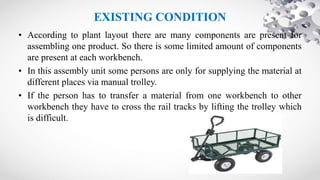
• According to plant layout there are many components are present for
assembling one product. So there is some limited amount of components
are present at each workbench.
• In this assembly unit some persons are only for supplying the material at
different places via manual trolley.
• If the person has to transfer a material from one workbench to other
workbench they have to cross the rail tracks by lifting the trolley which
is difficult.
LITERATURE SURVEY - 1
Research Paper : Oyejide, O.J. and Okwu, M.O. (2020) “Development of Sensor
Controlled Convertible Cart-Trolley,” Procedia CIRP, 91(2020), pp. 71–79
Purpose Design/Methodology Findings
To development a flexible
and intelligent sensor
controlled convertible cart-
trolley to support physical
distribution of goods.
The unique design consists
of three mechanisms,
designed such that: when
stretched, the system turns
to a cart; when tilted it turns
to incline cart with flat plate
attached to make payloads
stable and when folded it
turns to a trolley
Handling and transporting
of materials are usually
done using manually
operated trolleys. Such
practice could be time
consuming and laborious.
LITERATURE SURVEY - 2
Research Paper : Varghesea, B.B. (2020) “SARGoT:Smart Autonomous Robotic
Goods Transporter,” Materials Today: Proceedings 24, pp. 2030–2035.
Purpose Design/Methodology Findings
Robots are being developed
for various purposes to
accomplish many tasks which
seem to be too complex for
humans. Using robots, for
industrial purpose have been
excellent in terms of speed
and efficiency of doing
required tasks compared to
that of humans.
This robot has got mainly
three features and they are:
Path-Tracking, Avoiding
Collision, Loading and
Unloading heavy industrial
goods.
Building an industrial
robot with moderate
Speed, good efficiency in
loading and unloading
purpose within a short
time to ease human
suffering has been the
main objective of this
paper.
LITERATURE SURVEY - 3
Research Paper : Gunawana, A.S. (2019) “Development of Smart Trolley System
Based on Android Smartphone Sensors,” Procedia Computer Science 157 , pp. 629–
637.
Purpose Design/Methodology Findings
Our goal is to develop an
automatic moving trolley
with smart shopping devices
to solve the problem of
inconvenience and time
wasted for customers who
want to find the desired
product in the store by using
the traditional shopping
trolley.
This paper presents the
hardware and software design
of a smart trolley system.
Our smart trolley used
microcontroller and Android
smartphone as sensors and
controller. The trolley is
modeled as a two-wheeled
mobile robot.
Our smart trolley system
based on Navisens
framework can move and
show its location to the
user.
OBJECTIVES
To achieve the mobility & free working space in the plant for
workers
To reduce the man power
Obstacles on the track are efficiently identified.
To Increase the Flexibilty of plant in terms of material handling
INTRODUCTION TO SENSOR CONTROLLED
TROLLEY
• A sensor controlled trolley which follows a certain path with
the help of sensors.
• A basic sensor controlled trolley can consist of a base structure,
4 wheels, sensors, controller, drives & battery.
• As shown in layout, if we remove the rail-tracks from the
assembly line and implement the Path tracking trolley then lots
of difficulty will solve & it will lead to increase free working
space in plant.
• To reduce the human effort, by using the sensor controlled
trolley.
• Instead of railtracks, put the path (which is sense by the
sensors) so the brooming and cleaning is done easily.
• Operater of material handling device can easily transfer the
material no need to lift up the cart/wagon.
• Free working space is obtained, and heavy objects like Engines,
Engines heads, etc... can be transfer in bulk and even the
vehicle can easily work for transfering the heavy objects.
COMPONENTS
 Wheels
 Base frame/structure
 Sensors
 Controller
 Battery/Cell
 Gear Motor
 Colour Tap
Sensors
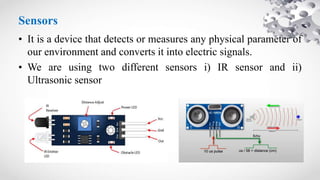
• It is a device that detects or measures any physical parameter of
our environment and converts it into electric signals.
• We are using two different sensors i) IR sensor and ii)
Ultrasonic sensor
CONTROLLER
• Arduino Uno is a micro-controller.
It has 14 digital input/output pins, 6
analog inputs, a USB connection, a
power jack, and a reset button. It
contains everything needed to
support the micro-controller; simply
connect it to a computer with a USB
cable or power it with a AC-to-DC
adapter or battery to get started.
DRIVERS
• This Arduino compatible motor
Driver shield is a full-featured
products that it can be used to
drive 4 DC motor or two 4-wire
stepper and two 5v servo. It
drive the DC motor and stepper
with the L293D,and it drive the
servo with Arduino pin9 and
pin10.
BATTERY
• An electric battery is a source of electric power consisting of
one or more electrochemical cells with external connections for
powering electrical devices. When a battery is supplying power,
its positive terminal is the cathode and its negative terminal is
the anode.
GEAR MOTORS
• 200 RPM Single Shaft L- Shaped Motor
• Shaft length: 7 mm
• Motor Design: L-Shaped
• Shaft Diameter: 5.5 mm
• Size: 55 x 48 x 23 mm.
• Operating Voltage: 3 to 12V
• Current: 40-180mA
• RPM: 200 rpm
• Output Torque: 0.55 kg cm.
DESIGN CONSIDERATION OF TROLLEY
STRUCTURE
• As seen in the problem type of railtrack used is narrow gauge.
• The standard dimensions of narrow gauge is 0.762m or 762mm
in width
• For making the prototype we reduce the dimension by scale of
1:4 ( 762/4 = 190.5mm or 19cm width of trolley )
• Length of the trolley is design on basis of maximum length of
assembly.
• As from the product list the maximum dimensions of assembly
is 2884mm.
• To get the prototype length we reduce the dimension by scale of
1:9 ( 2884/9 = 300mm or 30cm length of trolley )
30 cm
19 cm
Product List
Sr No. LENGTH
(mm)
WIDTH
(mm)
WEIGHT
(kg)
1. 2565 1040 940
2. 2600 1240 980
3. 2625 1040 890
4. 2650 1510 1025
5. 2884 1080 910
6. 2674 1167 956
TYPES OF STRUCTURE
 TEE Bar
 C - Channel
 I - Channel
 L - Angle
 Square
SELECTION OF STRUCTURE
 It can sustain the maximum static load
 It can clamp or fix Properly
 Deformation of structure should be minimum
 I - Channel is most suitable for holding the assembly
PROTOTYPE OF TROLLEY
Project Presentation.pptx

Project Presentation.pptx

  • 1.
    DESIGN & DEVELOPMENTOF SENSOR CONTROLLED TROLLEY PRESENTED BY : CHARMIN PARMAR 92010101001 YASH BASIDA 91900101007 UNDER THE SUPERVISION Prof. PUNEET MATHUR
  • 2.
    INTRODUCTION • Trolley isbuilt in a way to carry industrial raw materials, unfinished goods, and other components which are large in size and heavy in weight.
  • 3.
    Industrial Observation/Survey  Inthe begining of work, we visited the two industry in Rajkot which manufactures the mini tractors, in both the company we seen almost same problem arise in their manufacturing unit.  We observe that in manufacturing unit there are many difficulties are arise like loading and unloading of the material, cleanliness, maintenance, etc..  The assembly line of both the companys are using the rail-track based trolley while assembling their products. Following are the two companys at where we visited and found the problem are: 1. Captain Tractors 2. ADICO Escorts Agri Equipments
  • 4.
    TOP PROBLEMS Diesel EngineAssembly Line Credit : Corbis via Getty Images Creator : Rykoff Collection Cleaning of Tracks Free working Space Loading & Unloading of product Movement of Workers
  • 5.
    PLANT LAYOUT Component -1 Component - 3 Component - 5 Component - 7 Component - 9 Component - 2 Component - 4 Component - 6 Component - 8 Component - 10 Paint Section Test Section Dispatch
  • 6.
    EXISTING CONDITION • Accordingto plant layout there are many components are present for assembling one product. So there is some limited amount of components are present at each workbench. • In this assembly unit some persons are only for supplying the material at different places via manual trolley. • If the person has to transfer a material from one workbench to other workbench they have to cross the rail tracks by lifting the trolley which is difficult.
  • 7.
    LITERATURE SURVEY -1 Research Paper : Oyejide, O.J. and Okwu, M.O. (2020) “Development of Sensor Controlled Convertible Cart-Trolley,” Procedia CIRP, 91(2020), pp. 71–79 Purpose Design/Methodology Findings To development a flexible and intelligent sensor controlled convertible cart- trolley to support physical distribution of goods. The unique design consists of three mechanisms, designed such that: when stretched, the system turns to a cart; when tilted it turns to incline cart with flat plate attached to make payloads stable and when folded it turns to a trolley Handling and transporting of materials are usually done using manually operated trolleys. Such practice could be time consuming and laborious.
  • 8.
    LITERATURE SURVEY -2 Research Paper : Varghesea, B.B. (2020) “SARGoT:Smart Autonomous Robotic Goods Transporter,” Materials Today: Proceedings 24, pp. 2030–2035. Purpose Design/Methodology Findings Robots are being developed for various purposes to accomplish many tasks which seem to be too complex for humans. Using robots, for industrial purpose have been excellent in terms of speed and efficiency of doing required tasks compared to that of humans. This robot has got mainly three features and they are: Path-Tracking, Avoiding Collision, Loading and Unloading heavy industrial goods. Building an industrial robot with moderate Speed, good efficiency in loading and unloading purpose within a short time to ease human suffering has been the main objective of this paper.
  • 9.
    LITERATURE SURVEY -3 Research Paper : Gunawana, A.S. (2019) “Development of Smart Trolley System Based on Android Smartphone Sensors,” Procedia Computer Science 157 , pp. 629– 637. Purpose Design/Methodology Findings Our goal is to develop an automatic moving trolley with smart shopping devices to solve the problem of inconvenience and time wasted for customers who want to find the desired product in the store by using the traditional shopping trolley. This paper presents the hardware and software design of a smart trolley system. Our smart trolley used microcontroller and Android smartphone as sensors and controller. The trolley is modeled as a two-wheeled mobile robot. Our smart trolley system based on Navisens framework can move and show its location to the user.
  • 10.
    OBJECTIVES To achieve themobility & free working space in the plant for workers To reduce the man power Obstacles on the track are efficiently identified. To Increase the Flexibilty of plant in terms of material handling
  • 11.
    INTRODUCTION TO SENSORCONTROLLED TROLLEY • A sensor controlled trolley which follows a certain path with the help of sensors. • A basic sensor controlled trolley can consist of a base structure, 4 wheels, sensors, controller, drives & battery. • As shown in layout, if we remove the rail-tracks from the assembly line and implement the Path tracking trolley then lots of difficulty will solve & it will lead to increase free working space in plant.
  • 12.
    • To reducethe human effort, by using the sensor controlled trolley. • Instead of railtracks, put the path (which is sense by the sensors) so the brooming and cleaning is done easily. • Operater of material handling device can easily transfer the material no need to lift up the cart/wagon. • Free working space is obtained, and heavy objects like Engines, Engines heads, etc... can be transfer in bulk and even the vehicle can easily work for transfering the heavy objects.
  • 13.
    COMPONENTS  Wheels  Baseframe/structure  Sensors  Controller  Battery/Cell  Gear Motor  Colour Tap
  • 14.
    Sensors • It isa device that detects or measures any physical parameter of our environment and converts it into electric signals. • We are using two different sensors i) IR sensor and ii) Ultrasonic sensor
  • 15.
    CONTROLLER • Arduino Unois a micro-controller. It has 14 digital input/output pins, 6 analog inputs, a USB connection, a power jack, and a reset button. It contains everything needed to support the micro-controller; simply connect it to a computer with a USB cable or power it with a AC-to-DC adapter or battery to get started.
  • 16.
    DRIVERS • This Arduinocompatible motor Driver shield is a full-featured products that it can be used to drive 4 DC motor or two 4-wire stepper and two 5v servo. It drive the DC motor and stepper with the L293D,and it drive the servo with Arduino pin9 and pin10.
  • 17.
    BATTERY • An electricbattery is a source of electric power consisting of one or more electrochemical cells with external connections for powering electrical devices. When a battery is supplying power, its positive terminal is the cathode and its negative terminal is the anode.
  • 18.
    GEAR MOTORS • 200RPM Single Shaft L- Shaped Motor • Shaft length: 7 mm • Motor Design: L-Shaped • Shaft Diameter: 5.5 mm • Size: 55 x 48 x 23 mm. • Operating Voltage: 3 to 12V • Current: 40-180mA • RPM: 200 rpm • Output Torque: 0.55 kg cm.
  • 19.
    DESIGN CONSIDERATION OFTROLLEY STRUCTURE • As seen in the problem type of railtrack used is narrow gauge. • The standard dimensions of narrow gauge is 0.762m or 762mm in width • For making the prototype we reduce the dimension by scale of 1:4 ( 762/4 = 190.5mm or 19cm width of trolley ) • Length of the trolley is design on basis of maximum length of assembly. • As from the product list the maximum dimensions of assembly is 2884mm.
  • 20.
    • To getthe prototype length we reduce the dimension by scale of 1:9 ( 2884/9 = 300mm or 30cm length of trolley ) 30 cm 19 cm
  • 21.
    Product List Sr No.LENGTH (mm) WIDTH (mm) WEIGHT (kg) 1. 2565 1040 940 2. 2600 1240 980 3. 2625 1040 890 4. 2650 1510 1025 5. 2884 1080 910 6. 2674 1167 956
  • 22.
    TYPES OF STRUCTURE TEE Bar  C - Channel  I - Channel  L - Angle  Square
  • 23.
    SELECTION OF STRUCTURE It can sustain the maximum static load  It can clamp or fix Properly  Deformation of structure should be minimum  I - Channel is most suitable for holding the assembly
  • 24.