Using DSpace to store digital artifacts Gavin Henrick  Solutions Consultant
What is DSpace? Captures Digital research material in  any formats Directly from creators Large-scale, stable, managed long-term storage Describes Descriptive, technical, rights metadata Persistent identifiers Distributes Via WWW, with necessary access control Preserves Bitstream guaranteed
Some Use Cases Institutional research repository Learning object storage (OER) Archiving of documentation and publications Global reach through search engines Persistent URL for each item for reference
History Project began in 2000 with HP-MIT Alliance Version 1 released  Nov 2002 DSpace foundation formed 2007 July 2009 merged with Fedora Foundation to form Duraspace Foundation Version 1.6 released Feb 2010 Version 1.7 planned end 2010
Community ~830 registered live sites World-wide adoption >1m digital assets and growing fast, largest sites several hundred thousand items Profile Primarily research and higher education institutions Cultural heritage organizations, state libraries/archives Some commercial users and service providers  Goals Open Access/Content sharing Long-term archiving and preservation Branding and promotion through aggregation
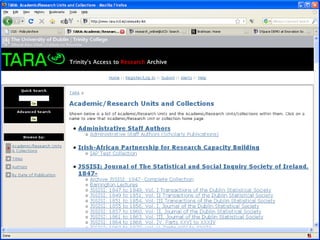
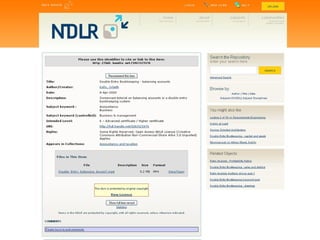
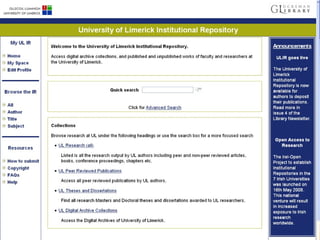
Sample installations Over 250 organizations worldwide
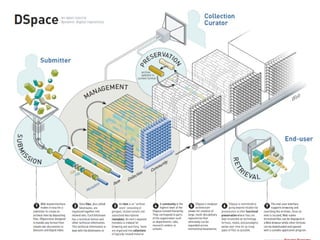
DSpace Information Model Communities Units of the organization Collections (in communities) Distinct groupings of like items Items (in collections) Logical content objects Receive persistent identifier Bitstreams (in items) Individual files Receive preservation treatment
Possible DSpace Content Articles Preprints, e-prints Technical Reports Working Papers Conference Papers E-theses Audio/Video Datasets Statistical, geospatial Images Visual, scientific Teaching material Lecture notes, visualizations, simulations Digitized library collections
Communities Departments, Labs, Research Centers, Programs, Schools, etc. Localized policy decisions Who can contribute, access material Submission workflow Submitters, approvers, reviewers, editors Collections definition, management Communities supply metadata Or contract with library
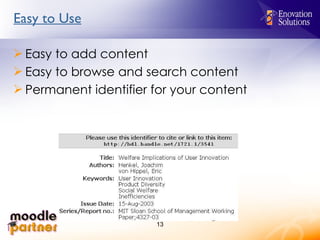
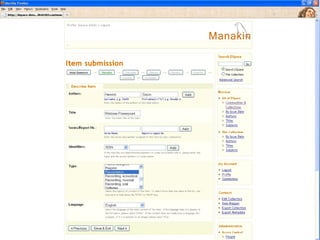
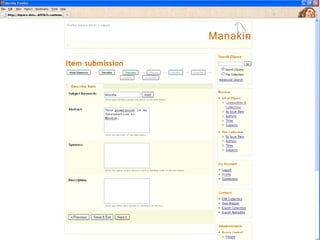
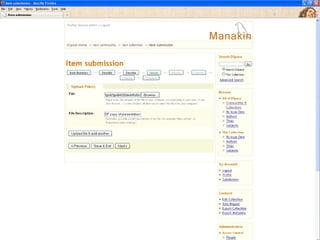
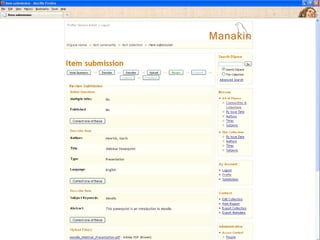
Easy to Use Easy to add content Easy to browse and search content Permanent identifier for your content
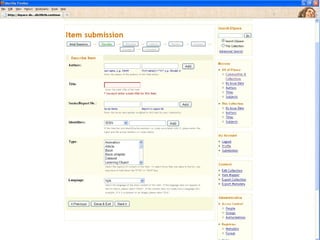
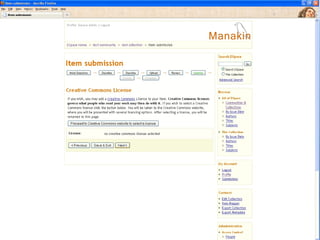
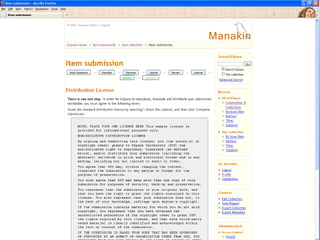
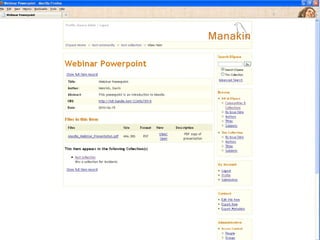
Submitting Content
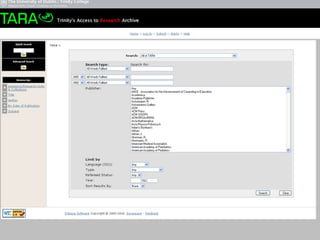
Search All metadata and text is indexed and fully searchable Can customize which fields you want to enable browsing Can choose what fields and text you want to index for search
Rights management Can assign creative commons license to your work to allow others to share, remix or reuse if you wish Creativecommons.org
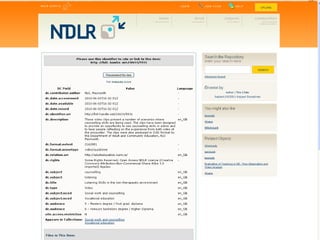
Metadata Currently uses standard Dublin core Possible to extend fields as you wish Possible to import MARC and MODs Supports any named space flat non-hierarchal metadata schema
Other areas you can customize Submission process Browse and search terms Extend DSpace to work with other web services User interface
Why DSpace? Open source, freely available Large community of users world wide Easy to use out of the box Can handle all types of digital formats Initially developed by leading institutions Completely customisable interface Harvest-ready OAI-PMH compatible
Questions?
Contacts Gavin Henrick [email_address] Enovation Solutions www.enovation.ie
As this presentation uses some extracts and abstracts of content from presentations on  www.dspace.org Creative Commons Attribution-ShareAlike 3.0 Unported License

Dspace Webinar

  • 1.
    Using DSpace tostore digital artifacts Gavin Henrick Solutions Consultant
  • 2.
    What is DSpace?Captures Digital research material in any formats Directly from creators Large-scale, stable, managed long-term storage Describes Descriptive, technical, rights metadata Persistent identifiers Distributes Via WWW, with necessary access control Preserves Bitstream guaranteed
  • 3.
    Some Use CasesInstitutional research repository Learning object storage (OER) Archiving of documentation and publications Global reach through search engines Persistent URL for each item for reference
  • 4.
    History Project beganin 2000 with HP-MIT Alliance Version 1 released Nov 2002 DSpace foundation formed 2007 July 2009 merged with Fedora Foundation to form Duraspace Foundation Version 1.6 released Feb 2010 Version 1.7 planned end 2010
  • 5.
    Community ~830 registeredlive sites World-wide adoption >1m digital assets and growing fast, largest sites several hundred thousand items Profile Primarily research and higher education institutions Cultural heritage organizations, state libraries/archives Some commercial users and service providers Goals Open Access/Content sharing Long-term archiving and preservation Branding and promotion through aggregation
  • 7.
    Sample installations Over250 organizations worldwide
  • 10.
    DSpace Information ModelCommunities Units of the organization Collections (in communities) Distinct groupings of like items Items (in collections) Logical content objects Receive persistent identifier Bitstreams (in items) Individual files Receive preservation treatment
  • 11.
    Possible DSpace ContentArticles Preprints, e-prints Technical Reports Working Papers Conference Papers E-theses Audio/Video Datasets Statistical, geospatial Images Visual, scientific Teaching material Lecture notes, visualizations, simulations Digitized library collections
  • 12.
    Communities Departments, Labs,Research Centers, Programs, Schools, etc. Localized policy decisions Who can contribute, access material Submission workflow Submitters, approvers, reviewers, editors Collections definition, management Communities supply metadata Or contract with library
  • 13.
    Easy to UseEasy to add content Easy to browse and search content Permanent identifier for your content
  • 14.
  • 23.
    Search All metadataand text is indexed and fully searchable Can customize which fields you want to enable browsing Can choose what fields and text you want to index for search
  • 25.
    Rights management Canassign creative commons license to your work to allow others to share, remix or reuse if you wish Creativecommons.org
  • 26.
    Metadata Currently usesstandard Dublin core Possible to extend fields as you wish Possible to import MARC and MODs Supports any named space flat non-hierarchal metadata schema
  • 28.
    Other areas youcan customize Submission process Browse and search terms Extend DSpace to work with other web services User interface
  • 29.
    Why DSpace? Opensource, freely available Large community of users world wide Easy to use out of the box Can handle all types of digital formats Initially developed by leading institutions Completely customisable interface Harvest-ready OAI-PMH compatible
  • 30.
  • 31.
    Contacts Gavin Henrick[email_address] Enovation Solutions www.enovation.ie
  • 32.
    As this presentationuses some extracts and abstracts of content from presentations on www.dspace.org Creative Commons Attribution-ShareAlike 3.0 Unported License