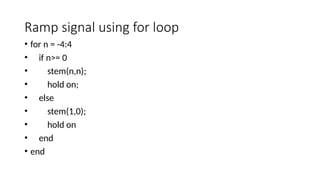
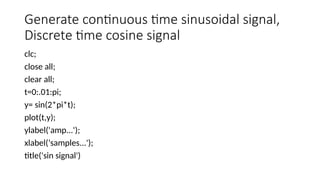
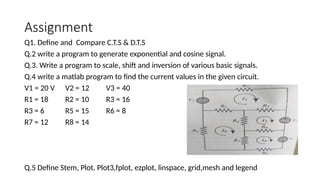
The document outlines a digital signal processing experiment focused on generating basic signals, including unit impulse, unit step, and unit ramp signals, using MATLAB programs. It details the coding steps and provides instructions for plotting these signals, along with exercises related to continuous and discrete signal generation. Additionally, it includes assignment questions that cover topics such as signal definitions, programming tasks for exponential and cosine signals, and circuit analysis.
![GENERATION OF BASIC SIGNALS
(a). Program for the generation of UNIT impulse signal
clc;
close all;
clear all;
t=-2:1:2; % defining time axis and samples
y=[zeros(1,2),ones(1,1),zeros(1,2)] %defining magnitude at different
samples
stem(t,y); %plot discrete signal
xlabel('samples----')
Ylabel(‘magnitude’) % assigning labels to x and y axis
title('unit impulse'); %giving title](https://image.slidesharecdn.com/dspexp-250119171635-119990c8/85/DSP_EXP-digital-signal-processing-pptx-2-320.jpg)
![n = [-5:5];
imp = zeros(1,length(n));
imp(n==0) = 1;
stem(n,imp) %plot discrete signal
axis([-5 5 -2 2])
xlabel('samples----')
Ylabel(‘magnitude’) % assigning labels to x and y axis
title('unit impulse');](https://image.slidesharecdn.com/dspexp-250119171635-119990c8/85/DSP_EXP-digital-signal-processing-pptx-3-320.jpg)
![(b) Program for the generation of UNIT step signal
clc;
close all;
clear all;
n=input('enter the n value = ');
t=0:1:n-1;
y= ones(1,n);
stem(t,y);
axis([-5 5 -5 5])
xlabel('samples----')
ylabel('Magnitude')
title('unit step')](https://image.slidesharecdn.com/dspexp-250119171635-119990c8/85/DSP_EXP-digital-signal-processing-pptx-4-320.jpg)
![(b) Program for the generation of UNIT step signal
clc;
close all;
clear all;
n=[-5:5];
ramp = (n>=0).*n;
stem(n,ramp);
xlabel('samples----')
ylabel('Magnitude')
title('unit ramp');](https://image.slidesharecdn.com/dspexp-250119171635-119990c8/85/DSP_EXP-digital-signal-processing-pptx-5-320.jpg)