Data Structures and
Algorithms on
Linked Lists
Linked lists are fundamental data structures in computer science. They
are dynamic, allowing for efficient insertion and deletion of elements.
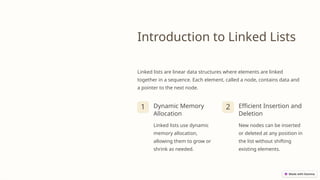
Introduction to Linked Lists
Linked lists are linear data structures where elements are linked
together in a sequence. Each element, called a node, contains data and
a pointer to the next node.
1 Dynamic Memory
Allocation
Linked lists use dynamic
memory allocation,
allowing them to grow or
shrink as needed.
2 Efficient Insertion and
Deletion
New nodes can be inserted
or deleted at any position in
the list without shifting
existing elements.
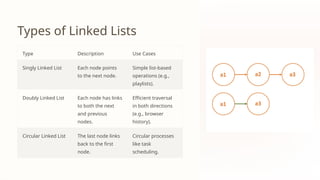
Types of Linked Lists
Type Description Use Cases
Singly Linked List Each node points
to the next node.
Simple list-based
operations (e.g.,
playlists).
Doubly Linked List Each node has links
to both the next
and previous
nodes.
Efficient traversal
in both directions
(e.g., browser
history).
Circular Linked List The last node links
back to the first
node.
Circular processes
like task
scheduling.
Singly Linked Lists
Singly linked lists are the simplest type of linked list. Each node contains data and a pointer to the next node in the sequence.
Advantages
• Easy to implement
• Efficient insertion and deletion at the beginning
Disadvantages
• Traversal in reverse order is not efficient
• Deletion of a specific node requires searching from the
beginning
Doubly Linked Lists
Doubly linked lists provide more flexibility than singly linked lists. Each node
has pointers to both the next and previous nodes.
Bidirectional Traversal
Allows for efficient traversal in both directions.
Efficient Deletion
Deletion of a node can be done by updating the pointers of its
neighbors.
Insertion
Insertion of a new node involves updating the pointers of its
neighbors.
Basic Operations on Linked
Lists
Common operations on linked lists include insertion, deletion,
searching, and traversal.
Insertion
Adding a new node at a specific
position.
Deletion
Removing a node from the list.
Searching
Finding a specific node in the
list.
Traversal
Visiting each node in the list
sequentially.
Complexity Analysis of Linked List Operations
The time complexity of linked list operations depends on the specific operation and the position of the node being accessed.
Operation Time Complexity
Insertion at the beginning O(1)
Insertion at the end O(n)
Deletion at the beginning O(1)
Deletion at the end O(n)
Search O(n)
Traversal O(n)
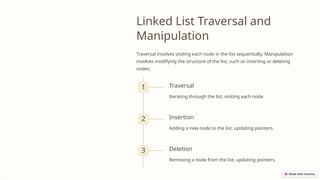
Linked List Traversal and
Manipulation
Traversal involves visiting each node in the list sequentially. Manipulation
involves modifying the structure of the list, such as inserting or deleting
nodes.
1 Traversal
Iterating through the list, visiting each node.
2 Insertion
Adding a new node to the list, updating pointers.
3 Deletion
Removing a node from the list, updating pointers.
Applications of Linked Lists
Linked lists are used in various applications, including implementing data structures like stacks,
queues, and graphs.
Music Players
Linked lists are used to represent playlists, allowing for efficient insertion and deletion of songs.
Browser History
Doubly linked lists are used to store browser history, allowing for efficient navigation back and
forth.
Task Scheduling
Circular linked lists are used to implement task schedulers, where tasks are processed in a circular
manner.

Data-Structures-and-Algorithms-on-Linked-Lists (1).pptx

  • 1.
    Data Structures and Algorithmson Linked Lists Linked lists are fundamental data structures in computer science. They are dynamic, allowing for efficient insertion and deletion of elements.
  • 2.
    Introduction to LinkedLists Linked lists are linear data structures where elements are linked together in a sequence. Each element, called a node, contains data and a pointer to the next node. 1 Dynamic Memory Allocation Linked lists use dynamic memory allocation, allowing them to grow or shrink as needed. 2 Efficient Insertion and Deletion New nodes can be inserted or deleted at any position in the list without shifting existing elements.
  • 3.
    Types of LinkedLists Type Description Use Cases Singly Linked List Each node points to the next node. Simple list-based operations (e.g., playlists). Doubly Linked List Each node has links to both the next and previous nodes. Efficient traversal in both directions (e.g., browser history). Circular Linked List The last node links back to the first node. Circular processes like task scheduling.
  • 4.
    Singly Linked Lists Singlylinked lists are the simplest type of linked list. Each node contains data and a pointer to the next node in the sequence. Advantages • Easy to implement • Efficient insertion and deletion at the beginning Disadvantages • Traversal in reverse order is not efficient • Deletion of a specific node requires searching from the beginning
  • 5.
    Doubly Linked Lists Doublylinked lists provide more flexibility than singly linked lists. Each node has pointers to both the next and previous nodes. Bidirectional Traversal Allows for efficient traversal in both directions. Efficient Deletion Deletion of a node can be done by updating the pointers of its neighbors. Insertion Insertion of a new node involves updating the pointers of its neighbors.
  • 6.
    Basic Operations onLinked Lists Common operations on linked lists include insertion, deletion, searching, and traversal. Insertion Adding a new node at a specific position. Deletion Removing a node from the list. Searching Finding a specific node in the list. Traversal Visiting each node in the list sequentially.
  • 7.
    Complexity Analysis ofLinked List Operations The time complexity of linked list operations depends on the specific operation and the position of the node being accessed. Operation Time Complexity Insertion at the beginning O(1) Insertion at the end O(n) Deletion at the beginning O(1) Deletion at the end O(n) Search O(n) Traversal O(n)
  • 8.
    Linked List Traversaland Manipulation Traversal involves visiting each node in the list sequentially. Manipulation involves modifying the structure of the list, such as inserting or deleting nodes. 1 Traversal Iterating through the list, visiting each node. 2 Insertion Adding a new node to the list, updating pointers. 3 Deletion Removing a node from the list, updating pointers.
  • 9.
    Applications of LinkedLists Linked lists are used in various applications, including implementing data structures like stacks, queues, and graphs. Music Players Linked lists are used to represent playlists, allowing for efficient insertion and deletion of songs. Browser History Doubly linked lists are used to store browser history, allowing for efficient navigation back and forth. Task Scheduling Circular linked lists are used to implement task schedulers, where tasks are processed in a circular manner.