DIGITAL SIGNAL
PROCESSING
TASK-1
(a)
OBJECTIVE:
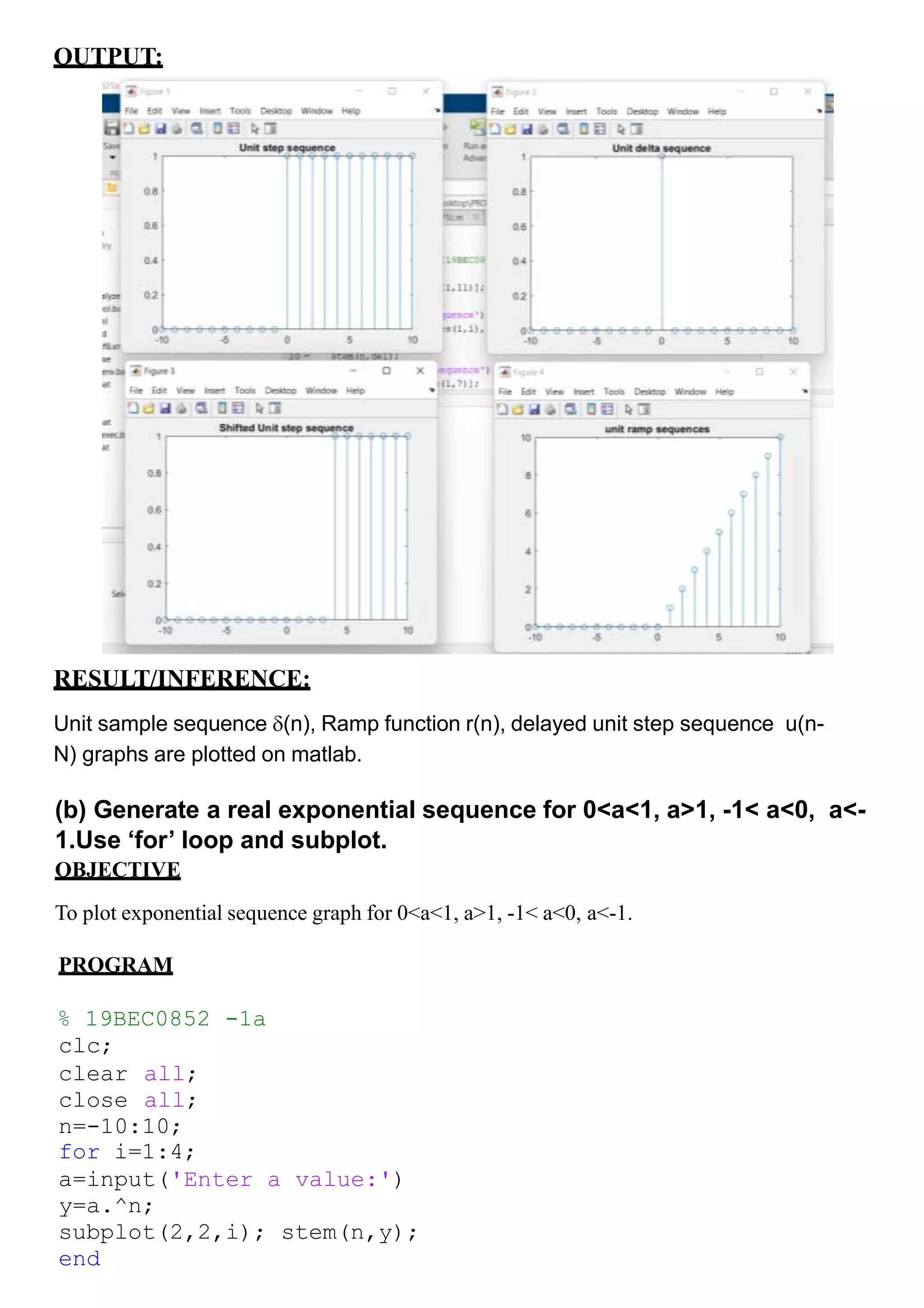
To generate unit sample sequence delta(n), unit step sequence u(n), delayed
unit step sequence u(n-N) where N=4, unit ramp sequence r(n).
PROGRAM:
% 19BEC0852 -1a
clc
clear all;
close all;
n=-10:1:10;
u=[zeros(1,10),ones(1,11)];
stem(n,u);
title('Unit step sequence')
del=[zeros(1,10),ones(1,1),zeros(
1,10)];
figure
stem(n,del);
title('Unit delta sequence')
u=[zeros(1,14),ones(1,7)];
figure
stem(n,u);
title('Shifted Unit step
sequence')
r=n.*(n>=0);
figure;
stem(n,r);
title('unit ramp sequences')
Name:- Naragam.Kiran Ganesh
Reg no:- 19BEC0852
Lab slot:L45+l46
OUTPUT:
RESULT/INFERENCE:
Unit sample sequence (n), Ramp function r(n), delayed unit step sequence u(n-
N) graphs are plotted on matlab.
(b) Generate a real exponential sequence for 0<a<1, a>1, -1< a<0, a<-
1.Use ‘for’ loop and subplot.
OBJECTIVE
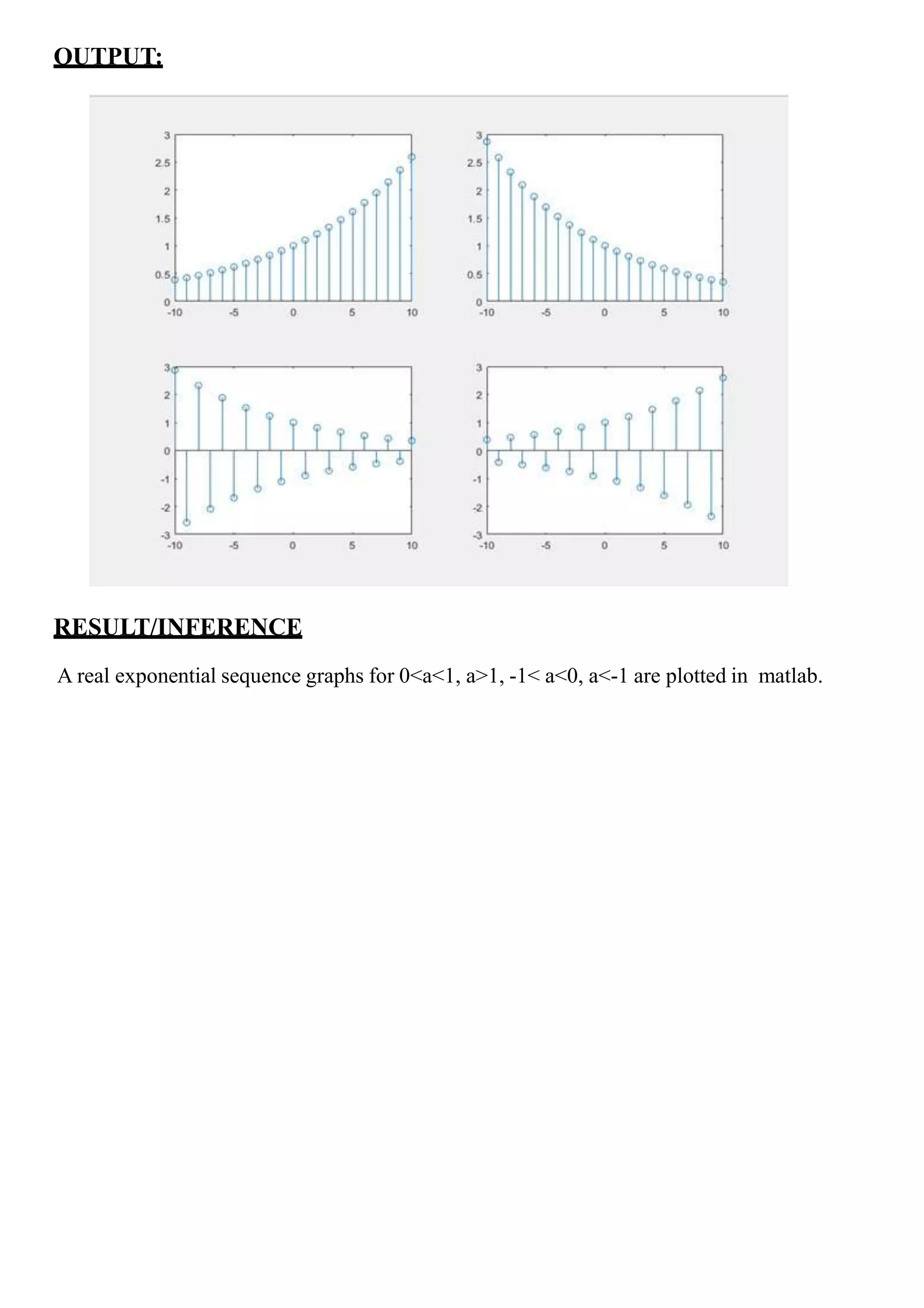
To plot exponential sequence graph for 0<a<1, a>1, -1< a<0, a<-1.
PROGRAM
% 19BEC0852 -1a
clc;
clear all;
close all;
n=-10:10;
for i=1:4;
a=input('Enter a value:')
y=a.^n;
subplot(2,2,i); stem(n,y);
end
OUTPUT:
RESULT/INFERENCE
A real exponential sequence graphs for 0<a<1, a>1, -1< a<0, a<-1 are plotted in matlab.
(c) Generate a 5Hz continuous sinusoid plot of amplitude
1.2 and 15Hz continuous sinusoid plot of amplitude 0.7. Comment
on the sampling frequency.
OBJECTIVE:
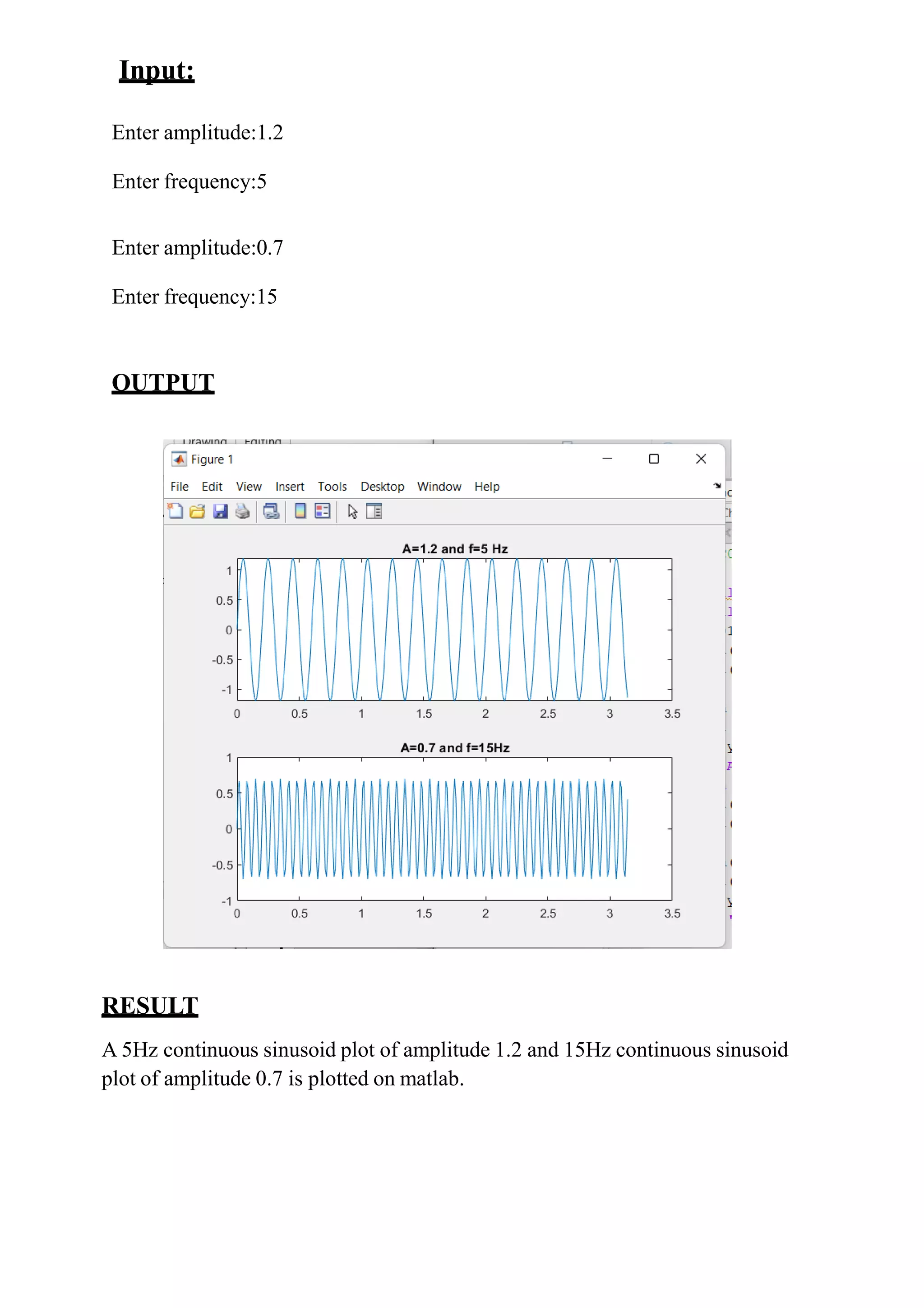
To generate a 5Hz continuous sinusoid plot of amplitude 1.2 and 15Hz
continuous sinusoid plot of amplitude 0.7 .
PROGRAM:
% 19BEC0852 -1c
clc
clear all
close all
t=0:0.01:pi;
a=input('Enter amplitude:');
f=input('Enter frequency:');
T=1/f;
y=a*sin (2*pi*f*t);
subplot (2,1,1);
plot(t,y)
title('A=1.2 and f=5 Hz')
hold on
a=input('Enter amplitude:');
f=input('Enter frequency:');
T=1/f;
y=a*sin(2*pi*f*t);
subplot(2,1,2);
plot(t,y)
title ('A=0.7 and f=15Hz')
Input:
Enter amplitude:1.2
Enter frequency:5
Enter amplitude:0.7
Enter frequency:15
OUTPUT
RESULT
A 5Hz continuous sinusoid plot of amplitude 1.2 and 15Hz continuous sinusoid
plot of amplitude 0.7 is plotted on matlab.
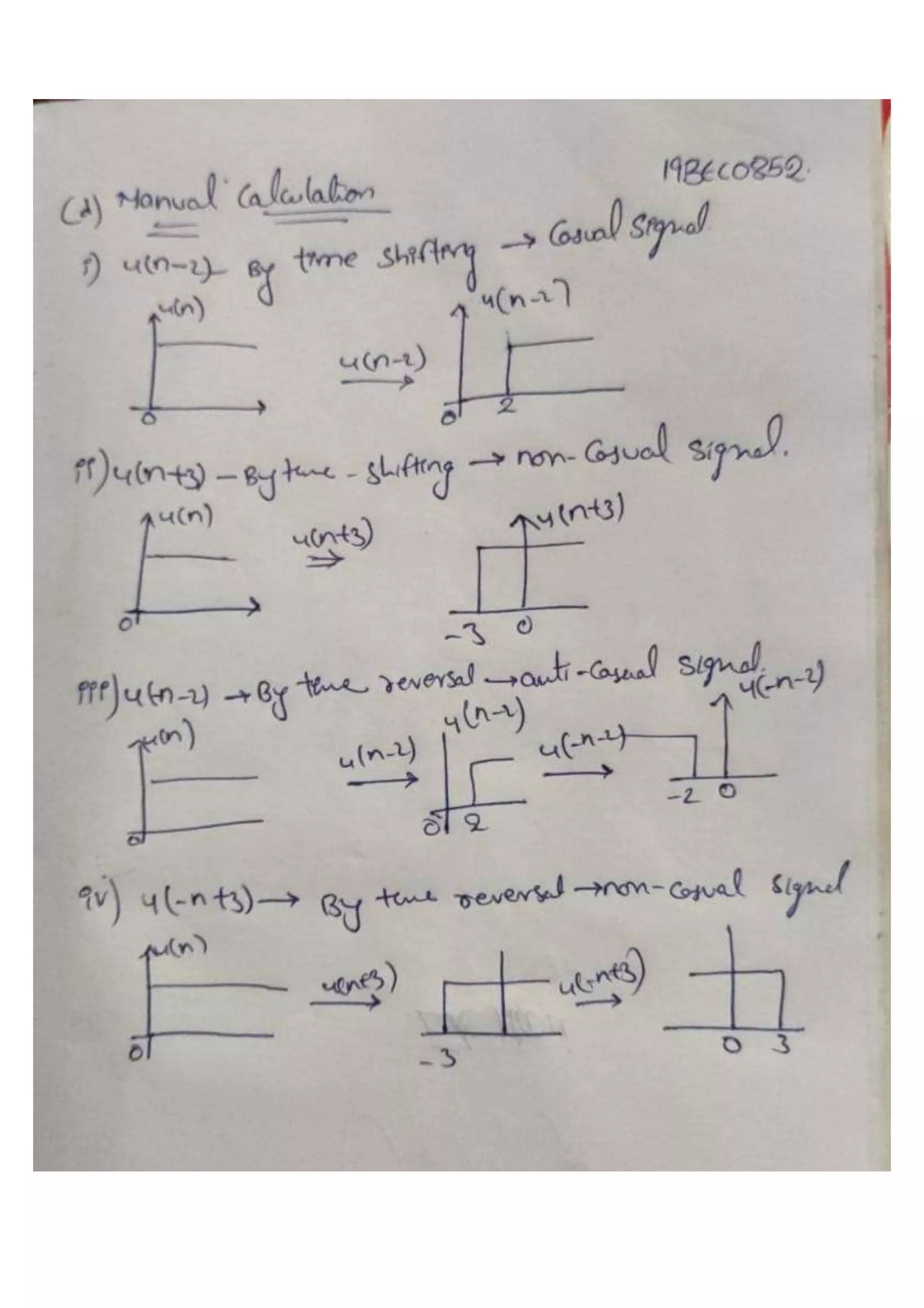
(d) Plot 𝑢(𝑛− 2), 𝑢(𝑛+ 3), 𝑢(−𝑛− 2), 𝑢(−𝑛+ 3) from -10 to 10 time
indices. Indicate which signal is causal, anti-causal and non-
causal.
OBJECTIVE
To plot (𝑛− 2),𝑢(𝑛+ 3),𝑢(−𝑛− 2),𝑢(−𝑛+ 3) from -10 to 10 time indices and to
check whether it is causal, anti-causal and non-causal.
% 19BEC0852-1d
clc;
clear all;
close all;
n=-10:10;
u1=[zeros(1,12),ones(1,9)];
u2=[zeros(1,7),ones(1,14)];
u3=[ones(1,9),zeros(1,12)];
u4=[ones(1,14),zeros(1,7)];
subplot(2,2,1);
stem(n,u1);
subplot(2,2,2);
stem(n,u2);
subplot(2,2,3);
stem(n,u3);
subplot(2,2,4);
stem(n,u4);
PROGRAM:
OUTPUT
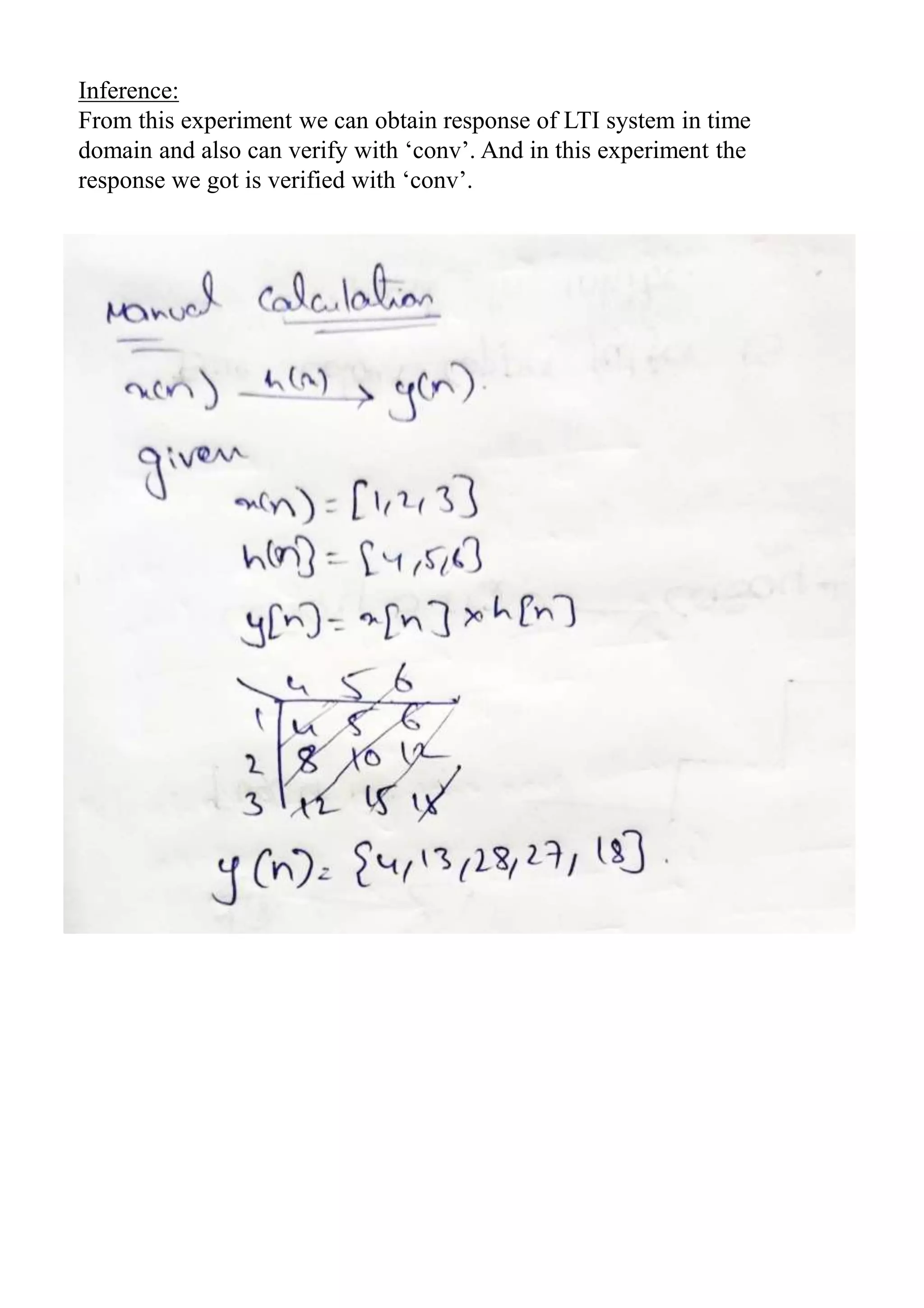
2. Using MATLAB perform the linear convolution between input
x(n) and impulse response h(n) to obtain the response of LTI
system y(n) in the time domain without using the inbuilt function
‘conv’. Verify the result using ‘conv’.
OBJECTIVE
Using matlab perform the linear convolution b/w input x(n) and impulse
response h(n).
PROGRAM
clc;
clear all;
close all;
x=input('samples of x(n): ');
h=input('samples of h(n): ');
xlen= length(x);
hlen=length(h);
k=0;
for i=1:xlen;
for j=1:hlen;
y(i,j+k) = x(i)*h(j);
end
k=k+1;
end;
disp('conv');
z=sum(y);
disp(z);
stem(z);
disp('Verification Using conv(x,h)');
disp(conv(x,h));
INPUT
samples of x(n): [1 2 3]
samples of h(n): [4 5 6]
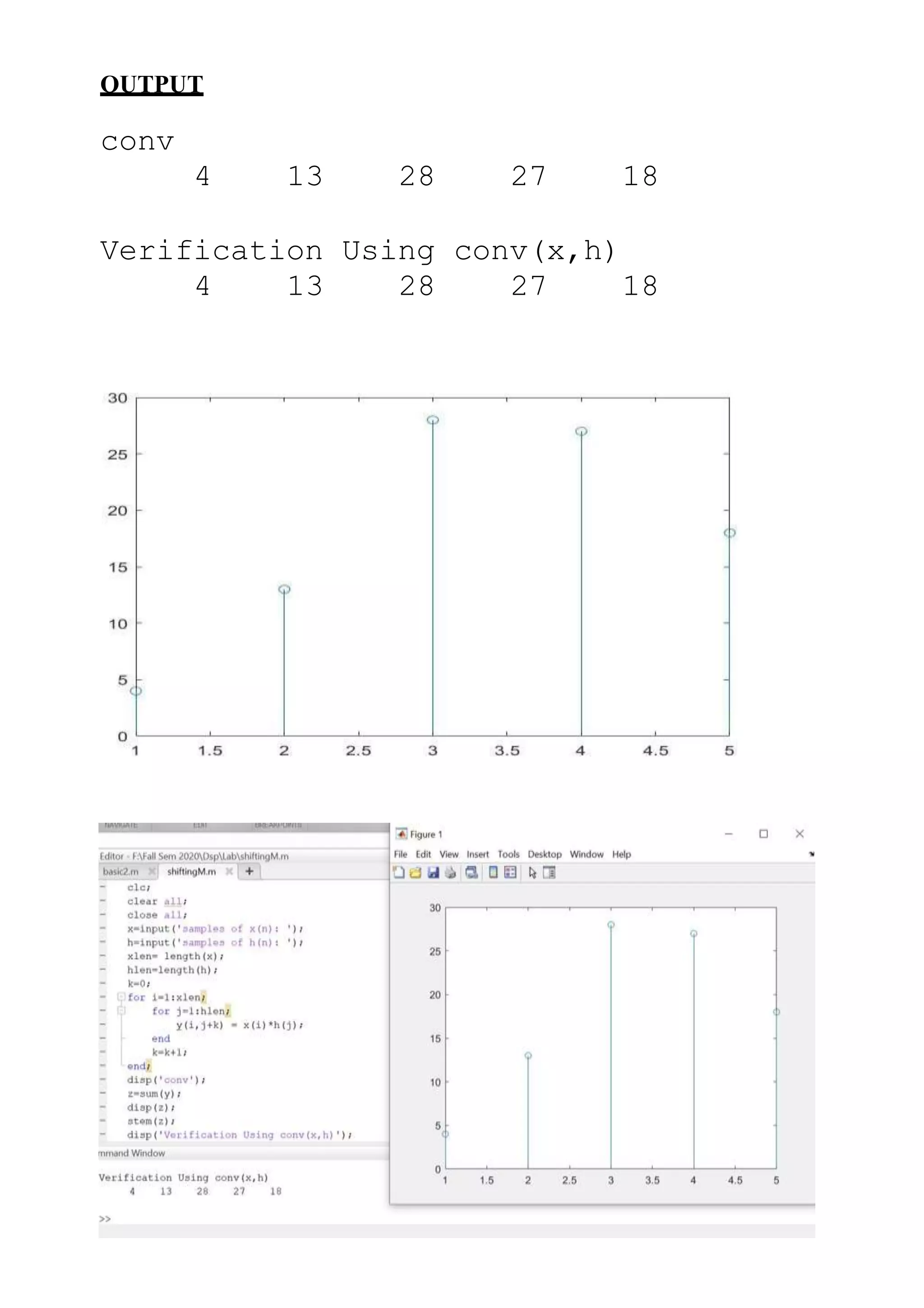
OUTPUT
conv
4 13 28 27 18
Verification Using conv(x,h)
4 13 28 27 18
Inference:
From this experiment we can obtain response of LTI system in time
domain and also can verify with ‘conv’. And in this experiment the
response we got is verified with ‘conv’.

Dsp lab task1 ganesh

  • 1.
    DIGITAL SIGNAL PROCESSING TASK-1 (a) OBJECTIVE: To generateunit sample sequence delta(n), unit step sequence u(n), delayed unit step sequence u(n-N) where N=4, unit ramp sequence r(n). PROGRAM: % 19BEC0852 -1a clc clear all; close all; n=-10:1:10; u=[zeros(1,10),ones(1,11)]; stem(n,u); title('Unit step sequence') del=[zeros(1,10),ones(1,1),zeros( 1,10)]; figure stem(n,del); title('Unit delta sequence') u=[zeros(1,14),ones(1,7)]; figure stem(n,u); title('Shifted Unit step sequence') r=n.*(n>=0); figure; stem(n,r); title('unit ramp sequences') Name:- Naragam.Kiran Ganesh Reg no:- 19BEC0852 Lab slot:L45+l46
  • 2.
    OUTPUT: RESULT/INFERENCE: Unit sample sequence(n), Ramp function r(n), delayed unit step sequence u(n- N) graphs are plotted on matlab. (b) Generate a real exponential sequence for 0<a<1, a>1, -1< a<0, a<- 1.Use ‘for’ loop and subplot. OBJECTIVE To plot exponential sequence graph for 0<a<1, a>1, -1< a<0, a<-1. PROGRAM % 19BEC0852 -1a clc; clear all; close all; n=-10:10; for i=1:4; a=input('Enter a value:') y=a.^n; subplot(2,2,i); stem(n,y); end
  • 3.
    OUTPUT: RESULT/INFERENCE A real exponentialsequence graphs for 0<a<1, a>1, -1< a<0, a<-1 are plotted in matlab.
  • 4.
    (c) Generate a5Hz continuous sinusoid plot of amplitude 1.2 and 15Hz continuous sinusoid plot of amplitude 0.7. Comment on the sampling frequency. OBJECTIVE: To generate a 5Hz continuous sinusoid plot of amplitude 1.2 and 15Hz continuous sinusoid plot of amplitude 0.7 . PROGRAM: % 19BEC0852 -1c clc clear all close all t=0:0.01:pi; a=input('Enter amplitude:'); f=input('Enter frequency:'); T=1/f; y=a*sin (2*pi*f*t); subplot (2,1,1); plot(t,y) title('A=1.2 and f=5 Hz') hold on a=input('Enter amplitude:'); f=input('Enter frequency:'); T=1/f; y=a*sin(2*pi*f*t); subplot(2,1,2); plot(t,y) title ('A=0.7 and f=15Hz')
  • 5.
    Input: Enter amplitude:1.2 Enter frequency:5 Enteramplitude:0.7 Enter frequency:15 OUTPUT RESULT A 5Hz continuous sinusoid plot of amplitude 1.2 and 15Hz continuous sinusoid plot of amplitude 0.7 is plotted on matlab.
  • 6.
    (d) Plot 𝑢(𝑛−2), 𝑢(𝑛+ 3), 𝑢(−𝑛− 2), 𝑢(−𝑛+ 3) from -10 to 10 time indices. Indicate which signal is causal, anti-causal and non- causal. OBJECTIVE To plot (𝑛− 2),𝑢(𝑛+ 3),𝑢(−𝑛− 2),𝑢(−𝑛+ 3) from -10 to 10 time indices and to check whether it is causal, anti-causal and non-causal. % 19BEC0852-1d clc; clear all; close all; n=-10:10; u1=[zeros(1,12),ones(1,9)]; u2=[zeros(1,7),ones(1,14)]; u3=[ones(1,9),zeros(1,12)]; u4=[ones(1,14),zeros(1,7)]; subplot(2,2,1); stem(n,u1); subplot(2,2,2); stem(n,u2); subplot(2,2,3); stem(n,u3); subplot(2,2,4); stem(n,u4); PROGRAM: OUTPUT
  • 8.
    2. Using MATLABperform the linear convolution between input x(n) and impulse response h(n) to obtain the response of LTI system y(n) in the time domain without using the inbuilt function ‘conv’. Verify the result using ‘conv’. OBJECTIVE Using matlab perform the linear convolution b/w input x(n) and impulse response h(n). PROGRAM clc; clear all; close all; x=input('samples of x(n): '); h=input('samples of h(n): '); xlen= length(x); hlen=length(h); k=0; for i=1:xlen; for j=1:hlen; y(i,j+k) = x(i)*h(j); end k=k+1; end; disp('conv'); z=sum(y); disp(z); stem(z); disp('Verification Using conv(x,h)'); disp(conv(x,h)); INPUT samples of x(n): [1 2 3] samples of h(n): [4 5 6]
  • 9.
    OUTPUT conv 4 13 2827 18 Verification Using conv(x,h) 4 13 28 27 18
  • 10.
    Inference: From this experimentwe can obtain response of LTI system in time domain and also can verify with ‘conv’. And in this experiment the response we got is verified with ‘conv’.