DR ABDUL SAMI
MPHIL EASTERN MEDICINE
The Islamia University of Bahawalpur
Pakistan
DRYING & STORAGE
DRYING
• DEFINITION
It is the process by which excessive moisture is removed
from any article to ensure good keeping qualities.
The duration of dying process varies from a few hours to
many weeks
EXPLANAION
If enzymatic action occurred, then slowly drying at moderate temperature is
necessary
i.e ; examples are found under Cocca Seeds, Orris Rhizome & Vanilla Pods
If enzymatic action is not desired, drying should take place as soon as
possible
Drugs containing volatile oils that are responsible to lose their aroma, if not
dried or oil not distilled immediately, all moist drugs are liable to mould
For this reason drying applied
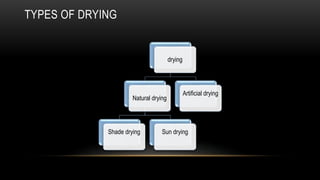
TYPES OF DRYING
drying
Natural drying
Shade drying Sun drying
Artificial drying
NATURAL DRYING
• Shade drying:-
is employed when it is desirable to retain natural colour of the drug.
For drying in shed the drugs may be suspended in bundles from the roof , threads
on strings
Such as Chinese Rhubarb
• Sun drying:-
is adaptable to such drugs that are not favorably affected by direct
action of sunlight. It is depends on weather. In suitable climate it is used for drying
the drugs such as Clove & Cinnamon
ARTIFICIAL DRYING
• Is most acceptable method when temperature control and
ventilation can be regulated.
• It is more rapid than natural drying. It is necessary in
tropical countries such as West Africa
• In this method heat is applied by means of open fire or
through hot water pipes
e.i: Drying of Tobbaco Barn
RULES IN DRYING CRUDE DRUGS
CRUDE DRUG METHOD
Leaves and over ground part : Dried at moderate temperatures i.e.40-60℃
provided that the active principles are not destroyed at elevated temperatures.
Roots and rhizomes: Usually sun dried and process takes several weeks
Barks: Based on constituents nature any of three methods(sun drying, shade drying, artificial drying) can be adapted.
Flowers: Usually air dried or dried in mechanical dryers at very low heat.
Fruit and seed: Usually sun or shade dried.
ADVANTAGES
• Bulk of drug is lost due to loss of moisture
• Handling and transportation become easy
• Cost of transportation is reduced
• Packaging become easier
STORAGE
• Small lots of drugs are stored in containers that are
• Air tight
• Moisture proof
• Light resistant
Tins cans covered with metal bins are usually preferred.Drugs should not be stored in
 Wooden box
 Paper bags
 Drawers
Warehouses ,for ultimate storage of drugs should have
 Fire proof system
 Steel construction
 Concrete construction
 Brick construction
STORAGE TEMPERATURES
High temperatures accelerate rate of chemical reation, including those involving
deterioration.so drug must be stored at low temperatures.
Certain drugs such as biologics shall be stored at temperatures ranging between
2℃ to 10℃
Drying

Drying

  • 2.
    DR ABDUL SAMI MPHILEASTERN MEDICINE The Islamia University of Bahawalpur Pakistan DRYING & STORAGE
  • 3.
    DRYING • DEFINITION It isthe process by which excessive moisture is removed from any article to ensure good keeping qualities. The duration of dying process varies from a few hours to many weeks
  • 4.
    EXPLANAION If enzymatic actionoccurred, then slowly drying at moderate temperature is necessary i.e ; examples are found under Cocca Seeds, Orris Rhizome & Vanilla Pods If enzymatic action is not desired, drying should take place as soon as possible Drugs containing volatile oils that are responsible to lose their aroma, if not dried or oil not distilled immediately, all moist drugs are liable to mould For this reason drying applied
  • 5.
    TYPES OF DRYING drying Naturaldrying Shade drying Sun drying Artificial drying
  • 6.
    NATURAL DRYING • Shadedrying:- is employed when it is desirable to retain natural colour of the drug. For drying in shed the drugs may be suspended in bundles from the roof , threads on strings Such as Chinese Rhubarb • Sun drying:- is adaptable to such drugs that are not favorably affected by direct action of sunlight. It is depends on weather. In suitable climate it is used for drying the drugs such as Clove & Cinnamon
  • 7.
    ARTIFICIAL DRYING • Ismost acceptable method when temperature control and ventilation can be regulated. • It is more rapid than natural drying. It is necessary in tropical countries such as West Africa • In this method heat is applied by means of open fire or through hot water pipes e.i: Drying of Tobbaco Barn
  • 8.
    RULES IN DRYINGCRUDE DRUGS CRUDE DRUG METHOD Leaves and over ground part : Dried at moderate temperatures i.e.40-60℃ provided that the active principles are not destroyed at elevated temperatures. Roots and rhizomes: Usually sun dried and process takes several weeks Barks: Based on constituents nature any of three methods(sun drying, shade drying, artificial drying) can be adapted. Flowers: Usually air dried or dried in mechanical dryers at very low heat. Fruit and seed: Usually sun or shade dried.
  • 9.
    ADVANTAGES • Bulk ofdrug is lost due to loss of moisture • Handling and transportation become easy • Cost of transportation is reduced • Packaging become easier
  • 10.
    STORAGE • Small lotsof drugs are stored in containers that are • Air tight • Moisture proof • Light resistant
  • 11.
    Tins cans coveredwith metal bins are usually preferred.Drugs should not be stored in  Wooden box  Paper bags  Drawers
  • 12.
    Warehouses ,for ultimatestorage of drugs should have  Fire proof system  Steel construction  Concrete construction  Brick construction
  • 13.
    STORAGE TEMPERATURES High temperaturesaccelerate rate of chemical reation, including those involving deterioration.so drug must be stored at low temperatures. Certain drugs such as biologics shall be stored at temperatures ranging between 2℃ to 10℃