DRUG DEVELOPMENT AND
DISCOVERY
BY : GROUP FOUR
OBJECTIVES
Learn the processes involved in drug discovery and development
Define the phases involved in FDA drug approval
be aware of why/how new drugs are discovered
know the processes involved in drug discovery and development
see where pharmacologists/bioscientists may contribute
know about the difficulties and dangers inherent in the drug development
process.
WOLYITA UNIVERSITY DEPT. OF
PHARMACY
A substance used in the diagnosis, treatment, or prevention
of a disease or as a component of a medication recognized
or defined by the U.S. Food, Drug, and Cosmetic Act.
A drug is any chemical or biological substance, synthetic or
non-synthetic that can alter the structure and function of an
organism.
09/07/2007 DEPT. OF PHARMACEUTICS 3
drug
Introduction
The discovery and development of new medicines is along,
complicated process. Each success is built on many, many
prior failures.
Advances in understanding human biology and disease are
opening up exciting new possibilities for break through
medicines. At the same time, researchers face great
challenges in understanding and applying These advances
to the treatment of disease.
These possibilities will grow as our scientific knowledge
expands and becomes increasingly complex. Research-
based pharmaceutical companies are committed to
advancing science and bringing in new medicines to patients
THE CHANGED CONTEXT
OF DRUG DISCOVERY
AND DEVELOPMENT
The 1800s: natural sources; limited possibilities;
prepared by individuals; small scale; not purified,
standardized or tested; limited administration; no
controls; no idea of mechanisms.
The 1990s: synthetic source; unlimited possibilities;
prepared by companies; massive scale; highly
purified, standardized and tested; world-wide
administration; tight legislative control; mechanisms
partly understood.
SOURCES OF DRUGS
Animal insulin (pig, cow)
growth hormone (man)
Plant digitalis (digitalis purpurea - foxglove)
morphine (papaver somniferum)
Inorganic arsenic mercury
lithium
Synthetic chemical (propranolol)
biological (penicillin)
biotechnology (human insulin)
DRUG
DISCOVERY/DEVELOPME
NT PROCESS
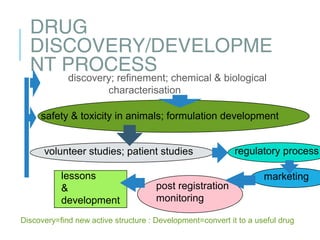
discovery; refinement; chemical & biological
characterisation
safety & toxicity in animals; formulation development
volunteer studies; patient studies regulatory process
marketing
post registration
monitoring
lessons
&
development
Discovery=find new active structure : Development=convert it to a useful drug
RESEARCH AND
DEVELOPMENT
PROCESS (R&D)
Development of new drugs is a complex and costly process
It takes an average of 12 years and about $350 million to get a
new drug from the laboratory to the pharmacy shelf
R&D involves discovery (preclinical studies) and development
(clinical studies)
Only one in 1000 compounds which begin laboratory testing
will make it to human testing
ROLE OF FDA
The Food and Drug Administration (FDA) is required to review
and approve all new drugs in the United States
The FDA reviews and evaluates new drugs based on the
evidence presented from the clinical research studies
performed by the drug sponsor-typically a pharmaceutical
company
PRECLINICAL STUDIES
Synthesis and purification of the new drug
Pharmacology of the new drug:
 Pharmacokinetics: absorption, distribution, metabolism, excretion,
half-life
 Pharmacodynamics: mechanism of action and estimates of
therapeutic effects
 Toxicology including carcinogenicity, mutagenicity, and
teratogenicity
Efficacy studies on animals
IND
Investigational New Drug (IND): Application for permission to
administer a new drug to humans
Outlines the proposal to use the new drug for human testing in
clinical trials
Studies in humans can only begin after IND is reviewed and
approved by the FDA and an institutional review board (IRB)
CLINICAL STUDIES
Phase 1: Efficacy studies on healthy volunteers
Phase 2: Clinical studies on a limited scale
Phase 3: Comparative studies on large number of patients
Phase 4: Continued comparative studies. Registration and
market introduction
PHASE 1
Typically involves 20-80 healthy volunteers (no women of
childbearing potential)
Emphasis is on drug safety
Goal is to identify major side effects, metabolism and routes of
excretion
Lasts about 1 year
About 70% of drugs will pass this phase
PHASE 2
Typically involves 100-300 individuals who have the target
disease
Emphasis is on effectiveness
Patients receiving the drug are compared to similar patients
receiving a placebo or another drug
Lasts about 2 years
About 33% of drugs will pass this phase
PHASE 3
Typically involves 1000-3000 patients
Emphasis is on safety and effectiveness
Investigates through well-controlled studies different
populations and different dosages as well as uses new drug in
combination with other drugs
Lasts about 3 years
25-30% of drugs will pass this phase
NDA
Pre-NDA period: FDA and drug sponsors meet
Submission of NDA: Formal step asking the FDA to consider
approving a drug for marketing
FDA has 60 days to decide whether it will file it for approval
consideration
If filed, a review team is assigned to evaluate the new drug
FDA ROLE
The review team evaluates the research on the safety of the
drug and its effectiveness
The FDA reviews the information to go on the drug label
It inspects the facilities where the drug will be manufactured
The application will be classified as “approvable” or “not
approvable”
FDA ROLE
If approvable, the FDA requests additional information from the
sponsor
The NDA is again reviewed
Following drug approval, sponsors of the drug will be required
to continually assess the safety of the drug
PHASE 4
Post-market surveillance of the drug to continually assess the
safety of the drug
May include incidence and severity of rare adverse reactions,
cost-effectiveness analyses, comparative trials, and quality of
life studies
SUMMARY OF DRUG
DEVELOPMENT AND
EVALUATION
22
QUESTIONS?
Drug development and discovery

Drug development and discovery

  • 1.
  • 2.
    OBJECTIVES Learn the processesinvolved in drug discovery and development Define the phases involved in FDA drug approval be aware of why/how new drugs are discovered know the processes involved in drug discovery and development see where pharmacologists/bioscientists may contribute know about the difficulties and dangers inherent in the drug development process. WOLYITA UNIVERSITY DEPT. OF PHARMACY
  • 3.
    A substance usedin the diagnosis, treatment, or prevention of a disease or as a component of a medication recognized or defined by the U.S. Food, Drug, and Cosmetic Act. A drug is any chemical or biological substance, synthetic or non-synthetic that can alter the structure and function of an organism. 09/07/2007 DEPT. OF PHARMACEUTICS 3 drug Introduction
  • 4.
    The discovery anddevelopment of new medicines is along, complicated process. Each success is built on many, many prior failures. Advances in understanding human biology and disease are opening up exciting new possibilities for break through medicines. At the same time, researchers face great challenges in understanding and applying These advances to the treatment of disease. These possibilities will grow as our scientific knowledge expands and becomes increasingly complex. Research- based pharmaceutical companies are committed to advancing science and bringing in new medicines to patients
  • 5.
    THE CHANGED CONTEXT OFDRUG DISCOVERY AND DEVELOPMENT The 1800s: natural sources; limited possibilities; prepared by individuals; small scale; not purified, standardized or tested; limited administration; no controls; no idea of mechanisms. The 1990s: synthetic source; unlimited possibilities; prepared by companies; massive scale; highly purified, standardized and tested; world-wide administration; tight legislative control; mechanisms partly understood.
  • 6.
    SOURCES OF DRUGS Animalinsulin (pig, cow) growth hormone (man) Plant digitalis (digitalis purpurea - foxglove) morphine (papaver somniferum) Inorganic arsenic mercury lithium Synthetic chemical (propranolol) biological (penicillin) biotechnology (human insulin)
  • 7.
    DRUG DISCOVERY/DEVELOPME NT PROCESS discovery; refinement;chemical & biological characterisation safety & toxicity in animals; formulation development volunteer studies; patient studies regulatory process marketing post registration monitoring lessons & development Discovery=find new active structure : Development=convert it to a useful drug
  • 8.
    RESEARCH AND DEVELOPMENT PROCESS (R&D) Developmentof new drugs is a complex and costly process It takes an average of 12 years and about $350 million to get a new drug from the laboratory to the pharmacy shelf R&D involves discovery (preclinical studies) and development (clinical studies) Only one in 1000 compounds which begin laboratory testing will make it to human testing
  • 9.
    ROLE OF FDA TheFood and Drug Administration (FDA) is required to review and approve all new drugs in the United States The FDA reviews and evaluates new drugs based on the evidence presented from the clinical research studies performed by the drug sponsor-typically a pharmaceutical company
  • 10.
    PRECLINICAL STUDIES Synthesis andpurification of the new drug Pharmacology of the new drug:  Pharmacokinetics: absorption, distribution, metabolism, excretion, half-life  Pharmacodynamics: mechanism of action and estimates of therapeutic effects  Toxicology including carcinogenicity, mutagenicity, and teratogenicity Efficacy studies on animals
  • 11.
    IND Investigational New Drug(IND): Application for permission to administer a new drug to humans Outlines the proposal to use the new drug for human testing in clinical trials Studies in humans can only begin after IND is reviewed and approved by the FDA and an institutional review board (IRB)
  • 12.
    CLINICAL STUDIES Phase 1:Efficacy studies on healthy volunteers Phase 2: Clinical studies on a limited scale Phase 3: Comparative studies on large number of patients Phase 4: Continued comparative studies. Registration and market introduction
  • 13.
    PHASE 1 Typically involves20-80 healthy volunteers (no women of childbearing potential) Emphasis is on drug safety Goal is to identify major side effects, metabolism and routes of excretion Lasts about 1 year About 70% of drugs will pass this phase
  • 14.
    PHASE 2 Typically involves100-300 individuals who have the target disease Emphasis is on effectiveness Patients receiving the drug are compared to similar patients receiving a placebo or another drug Lasts about 2 years About 33% of drugs will pass this phase
  • 15.
    PHASE 3 Typically involves1000-3000 patients Emphasis is on safety and effectiveness Investigates through well-controlled studies different populations and different dosages as well as uses new drug in combination with other drugs Lasts about 3 years 25-30% of drugs will pass this phase
  • 16.
    NDA Pre-NDA period: FDAand drug sponsors meet Submission of NDA: Formal step asking the FDA to consider approving a drug for marketing FDA has 60 days to decide whether it will file it for approval consideration If filed, a review team is assigned to evaluate the new drug
  • 17.
    FDA ROLE The reviewteam evaluates the research on the safety of the drug and its effectiveness The FDA reviews the information to go on the drug label It inspects the facilities where the drug will be manufactured The application will be classified as “approvable” or “not approvable”
  • 18.
    FDA ROLE If approvable,the FDA requests additional information from the sponsor The NDA is again reviewed Following drug approval, sponsors of the drug will be required to continually assess the safety of the drug
  • 19.
    PHASE 4 Post-market surveillanceof the drug to continually assess the safety of the drug May include incidence and severity of rare adverse reactions, cost-effectiveness analyses, comparative trials, and quality of life studies
  • 20.
  • 22.