JICA and Japan experience in
Disaster Risk Reduction and financing,
what we have done and lessons learned
4 Oct 2018
Kota Katsumata, Representative
JICA Turkey Office
0
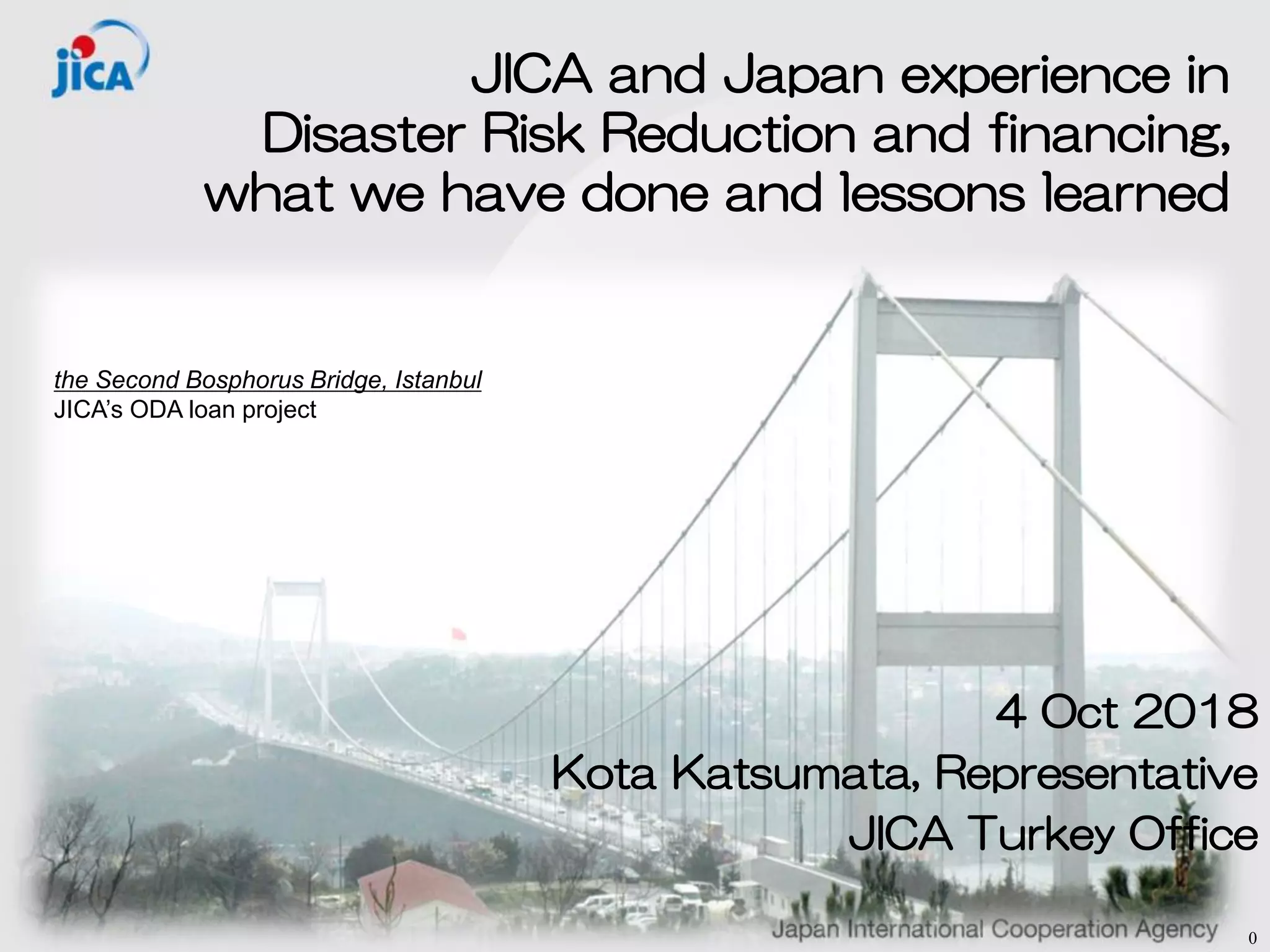
the Second Bosphorus Bridge, Istanbul
JICA’s ODA loan project
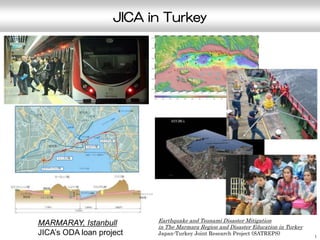
JICA in Turkey
1
MARMARAY, Istanbull
JICA’s ODA loan project
Earthquake and Tsunami Disaster Mitigation
in The Marmara Region and Disaster Education in Turkey
Japan-Turkey Joint Research Project (SATREPS)
➢ Disaster Risk Reduction requires a tailor-made
combination of Structural Measures and Non-structural
Measures
➢ Insurances and risk transfer/ sharing are effective in
some cases, however should not come as first priority
in most Countries, due to the amount of unprotected
risks.
2
Key Messages of this Presentation
• Applicable
• Non-Applicable
• Applicable but should be avoided:
causes moral hazard
3
Applicability of Insurance---3 types
➢ Risk sharing in terms of location and time
➢ Size of Total risk to be reduced
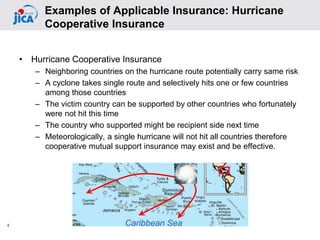
• Hurricane Cooperative Insurance
– Neighboring countries on the hurricane route potentially carry same risk
– A cyclone takes single route and selectively hits one or few countries
among those countries
– The victim country can be supported by other countries who fortunately
were not hit this time
– The country who supported might be recipient side next time
– Meteorologically, a single hurricane will not hit all countries therefore
cooperative mutual support insurance may exist and be effective.
4
Examples of Applicable Insurance: Hurricane
Cooperative Insurance
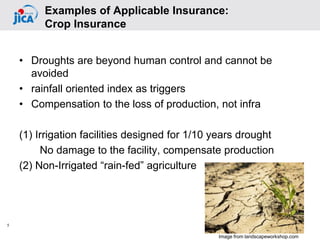
• Droughts are beyond human control and cannot be
avoided
• rainfall oriented index as triggers
• Compensation to the loss of production, not infra
(1) Irrigation facilities designed for 1/10 years drought
No damage to the facility, compensate production
(2) Non-Irrigated “rain-fed” agriculture
5
Examples of Applicable Insurance:
Crop Insurance
Image from landscapeworkshop.com
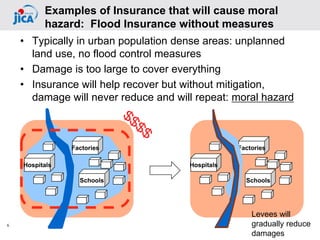
Hospitals
Schools
Factories
• Typically in urban population dense areas: unplanned
land use, no flood control measures
• Damage is too large to cover everything
• Insurance will help recover but without mitigation,
damage will never reduce and will repeat: moral hazard
6
Examples of Insurance that will cause moral
hazard: Flood Insurance without measures
Hospitals
Schools
Factories
Levees will
gradually reduce
damages
7
Applicability of Risk Sharing and Insurance
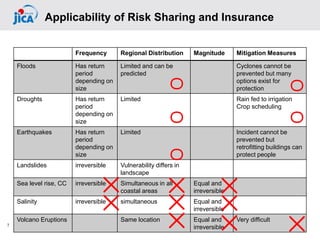
Frequency Regional Distribution Magnitude Mitigation Measures
Floods Has return
period
depending on
size
Limited and can be
predicted
Cyclones cannot be
prevented but many
options exist for
protection
Droughts Has return
period
depending on
size
Limited Rain fed to irrigation
Crop scheduling
Earthquakes Has return
period
depending on
size
Limited Incident cannot be
prevented but
retrofitting buildings can
protect people
Landslides irreversible Vulnerability differs in
landscape
Sea level rise, CC irreversible Simultaneous in all
coastal areas
Equal and
irreversible
Salinity irreversible simultaneous Equal and
irreversible
Volcano Eruptions Same location Equal and
irreversible
Very difficult
×
×
×
×
×
×
×
×
×
〇
〇
〇〇
〇
• Once a flood occurs and the house is destroyed, the
insurance will cover the same location
• Rate defers depending on risk assessment
• Insurance fees work as a guide for land use plan, and to
Build Back Better
• The people can avoid to face the same disaster and
damage repeatedly
8
Insurance as a guide to Build Back Better
Cannot Live
High rate of insurance
Medium high rate of insurance
Lower rate of insurance
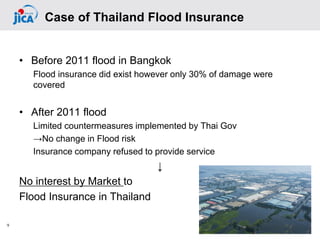
• Before 2011 flood in Bangkok
Flood insurance did exist however only 30% of damage were
covered
• After 2011 flood
Limited countermeasures implemented by Thai Gov
→No change in Flood risk
Insurance company refused to provide service
↓
No interest by Market to
Flood Insurance in Thailand
9
Case of Thailand Flood Insurance
10
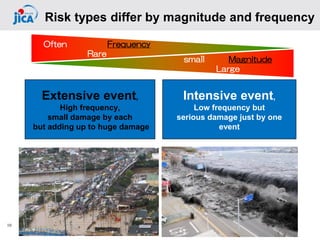
Risk types differ by magnitude and frequency
Intensive event,
Low frequency but
serious damage just by one
event
Extensive event,
High frequency,
small damage by each
but adding up to huge damage
Often Frequency
Rare
small Magnitude
Large
11
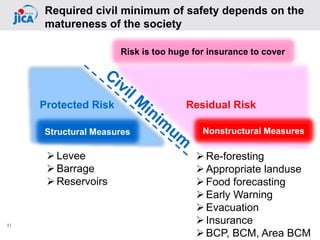
Required civil minimum of safety depends on the
matureness of the society
Protected Risk Residual Risk
Structural Measures
Risk is too huge for insurance to cover
Nonstructural Measures
➢Re-foresting
➢Appropriate landuse
➢Food forecasting
➢Early Warning
➢Evacuation
➢Insurance
➢BCP, BCM, Area BCM
➢Levee
➢Barrage
➢Reservoirs
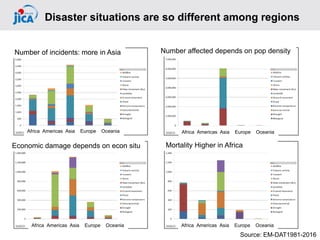
Disaster situations are so different among regions
Number of incidents: more in Asia Number affected depends on pop density
Economic damage depends on econ situ Mortality Higher in Africa
Source: EM-DAT1981-2016
Africa Americas Asia Europe Oceania Africa Americas Asia Europe Oceania
13
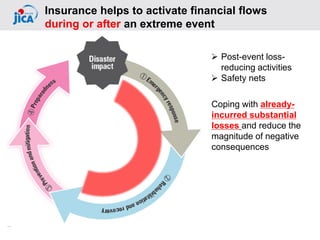
Insurance helps to activate financial flows
during or after an extreme event
➢ Post-event loss-
reducing activities
➢ Safety nets
Coping with already-
incurred substantial
losses and reduce the
magnitude of negative
consequences
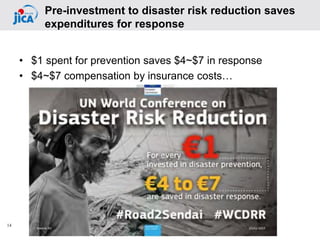
• $1 spent for prevention saves $4~$7 in response
• $4~$7 compensation by insurance costs…
14
Pre-investment to disaster risk reduction saves
expenditures for response
15
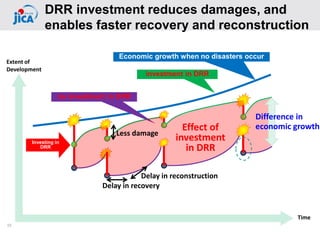
DRR investment reduces damages, and
enables faster recovery and reconstruction
Extent of
Development
Time
Economic growth when no disasters occur
investment in DRR
no investment in DRR
Effect of
investment
in DRR
Investing in
DRR
Difference in
economic growth
Less damage
Delay in recovery
Delay in reconstruction
16
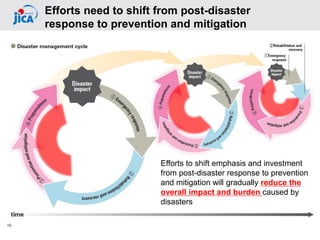
Efforts need to shift from post-disaster
response to prevention and mitigation
Efforts to shift emphasis and investment
from post-disaster response to prevention
and mitigation will gradually reduce the
overall impact and burden caused by
disasters
17
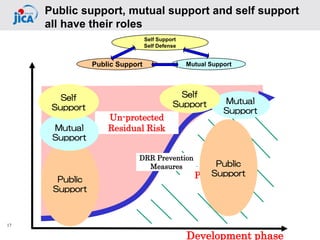
Public support, mutual support and self support
all have their roles
Development phase
Un-protected
Residual Risk
Protected
Risk
DRR Prevention
Measures
Public
Support
Mutual
Support
Self
Support
Public
Support
Mutual
Support
Self
Support
Self Support
Self Defense
Mutual SupportPublic Support
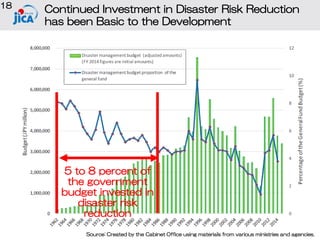
Continued Investment in Disaster Risk Reduction
has been Basic to the Development
18
5 to 8 percent of
the government
budget invested in
disaster risk
reduction
Source: Created by the Cabinet Office using materials from various ministries and agencies.
19
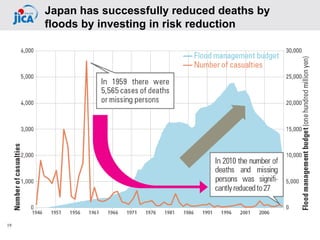
Japan has successfully reduced deaths by
floods by investing in risk reduction
20
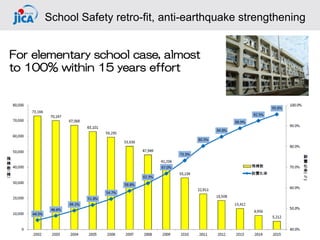
School Safety retro-fit, anti-earthquake strengthening
For elementary school case, almost
to 100% within 15 years effort
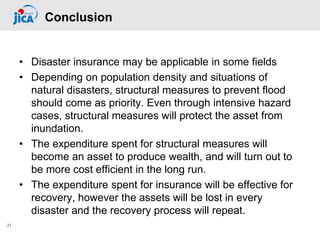
• Disaster insurance may be applicable in some fields
• Depending on population density and situations of
natural disasters, structural measures to prevent flood
should come as priority. Even through intensive hazard
cases, structural measures will protect the asset from
inundation.
• The expenditure spent for structural measures will
become an asset to produce wealth, and will turn out to
be more cost efficient in the long run.
• The expenditure spent for insurance will be effective for
recovery, however the assets will be lost in every
disaster and the recovery process will repeat.
21
Conclusion

2018 DRR Financing 1.6 Kota Katsumata

  • 1.
    JICA and Japanexperience in Disaster Risk Reduction and financing, what we have done and lessons learned 4 Oct 2018 Kota Katsumata, Representative JICA Turkey Office 0 the Second Bosphorus Bridge, Istanbul JICA’s ODA loan project
  • 2.
    JICA in Turkey 1 MARMARAY,Istanbull JICA’s ODA loan project Earthquake and Tsunami Disaster Mitigation in The Marmara Region and Disaster Education in Turkey Japan-Turkey Joint Research Project (SATREPS)
  • 3.
    ➢ Disaster RiskReduction requires a tailor-made combination of Structural Measures and Non-structural Measures ➢ Insurances and risk transfer/ sharing are effective in some cases, however should not come as first priority in most Countries, due to the amount of unprotected risks. 2 Key Messages of this Presentation
  • 4.
    • Applicable • Non-Applicable •Applicable but should be avoided: causes moral hazard 3 Applicability of Insurance---3 types ➢ Risk sharing in terms of location and time ➢ Size of Total risk to be reduced
  • 5.
    • Hurricane CooperativeInsurance – Neighboring countries on the hurricane route potentially carry same risk – A cyclone takes single route and selectively hits one or few countries among those countries – The victim country can be supported by other countries who fortunately were not hit this time – The country who supported might be recipient side next time – Meteorologically, a single hurricane will not hit all countries therefore cooperative mutual support insurance may exist and be effective. 4 Examples of Applicable Insurance: Hurricane Cooperative Insurance
  • 6.
    • Droughts arebeyond human control and cannot be avoided • rainfall oriented index as triggers • Compensation to the loss of production, not infra (1) Irrigation facilities designed for 1/10 years drought No damage to the facility, compensate production (2) Non-Irrigated “rain-fed” agriculture 5 Examples of Applicable Insurance: Crop Insurance Image from landscapeworkshop.com
  • 7.
    Hospitals Schools Factories • Typically inurban population dense areas: unplanned land use, no flood control measures • Damage is too large to cover everything • Insurance will help recover but without mitigation, damage will never reduce and will repeat: moral hazard 6 Examples of Insurance that will cause moral hazard: Flood Insurance without measures Hospitals Schools Factories Levees will gradually reduce damages
  • 8.
    7 Applicability of RiskSharing and Insurance Frequency Regional Distribution Magnitude Mitigation Measures Floods Has return period depending on size Limited and can be predicted Cyclones cannot be prevented but many options exist for protection Droughts Has return period depending on size Limited Rain fed to irrigation Crop scheduling Earthquakes Has return period depending on size Limited Incident cannot be prevented but retrofitting buildings can protect people Landslides irreversible Vulnerability differs in landscape Sea level rise, CC irreversible Simultaneous in all coastal areas Equal and irreversible Salinity irreversible simultaneous Equal and irreversible Volcano Eruptions Same location Equal and irreversible Very difficult × × × × × × × × × 〇 〇 〇〇 〇
  • 9.
    • Once aflood occurs and the house is destroyed, the insurance will cover the same location • Rate defers depending on risk assessment • Insurance fees work as a guide for land use plan, and to Build Back Better • The people can avoid to face the same disaster and damage repeatedly 8 Insurance as a guide to Build Back Better Cannot Live High rate of insurance Medium high rate of insurance Lower rate of insurance
  • 10.
    • Before 2011flood in Bangkok Flood insurance did exist however only 30% of damage were covered • After 2011 flood Limited countermeasures implemented by Thai Gov →No change in Flood risk Insurance company refused to provide service ↓ No interest by Market to Flood Insurance in Thailand 9 Case of Thailand Flood Insurance
  • 11.
    10 Risk types differby magnitude and frequency Intensive event, Low frequency but serious damage just by one event Extensive event, High frequency, small damage by each but adding up to huge damage Often Frequency Rare small Magnitude Large
  • 12.
    11 Required civil minimumof safety depends on the matureness of the society Protected Risk Residual Risk Structural Measures Risk is too huge for insurance to cover Nonstructural Measures ➢Re-foresting ➢Appropriate landuse ➢Food forecasting ➢Early Warning ➢Evacuation ➢Insurance ➢BCP, BCM, Area BCM ➢Levee ➢Barrage ➢Reservoirs
  • 13.
    Disaster situations areso different among regions Number of incidents: more in Asia Number affected depends on pop density Economic damage depends on econ situ Mortality Higher in Africa Source: EM-DAT1981-2016 Africa Americas Asia Europe Oceania Africa Americas Asia Europe Oceania Africa Americas Asia Europe Oceania Africa Americas Asia Europe Oceania
  • 14.
    13 Insurance helps toactivate financial flows during or after an extreme event ➢ Post-event loss- reducing activities ➢ Safety nets Coping with already- incurred substantial losses and reduce the magnitude of negative consequences
  • 15.
    • $1 spentfor prevention saves $4~$7 in response • $4~$7 compensation by insurance costs… 14 Pre-investment to disaster risk reduction saves expenditures for response
  • 16.
    15 DRR investment reducesdamages, and enables faster recovery and reconstruction Extent of Development Time Economic growth when no disasters occur investment in DRR no investment in DRR Effect of investment in DRR Investing in DRR Difference in economic growth Less damage Delay in recovery Delay in reconstruction
  • 17.
    16 Efforts need toshift from post-disaster response to prevention and mitigation Efforts to shift emphasis and investment from post-disaster response to prevention and mitigation will gradually reduce the overall impact and burden caused by disasters
  • 18.
    17 Public support, mutualsupport and self support all have their roles Development phase Un-protected Residual Risk Protected Risk DRR Prevention Measures Public Support Mutual Support Self Support Public Support Mutual Support Self Support Self Support Self Defense Mutual SupportPublic Support
  • 19.
    Continued Investment inDisaster Risk Reduction has been Basic to the Development 18 5 to 8 percent of the government budget invested in disaster risk reduction Source: Created by the Cabinet Office using materials from various ministries and agencies.
  • 20.
    19 Japan has successfullyreduced deaths by floods by investing in risk reduction
  • 21.
    20 School Safety retro-fit,anti-earthquake strengthening For elementary school case, almost to 100% within 15 years effort
  • 22.
    • Disaster insurancemay be applicable in some fields • Depending on population density and situations of natural disasters, structural measures to prevent flood should come as priority. Even through intensive hazard cases, structural measures will protect the asset from inundation. • The expenditure spent for structural measures will become an asset to produce wealth, and will turn out to be more cost efficient in the long run. • The expenditure spent for insurance will be effective for recovery, however the assets will be lost in every disaster and the recovery process will repeat. 21 Conclusion