Welcome to Driver’s Education! Objectives: Ms. Hall’s Class Requirements & Grading  Overview of the Graduated License Program
Grading System  Tests & Quizzes 25%: Multiple choice, matching, or essay. Based upon  Responsible Driving  book and  Driver’s Manual  Class work & Homework 25%: Must be kept in a notebook. If you are absent must submit it to me next class period or points will be deducted.  Projects 25%: Select a topic that pertains to Driver’s Education. May be in 3-D, poster, PowerPoint, DVD or Video
Grading System Continued State Driver’s Examination- NJ State Driver’s Permit Test will be administered towards the end of the marking period. Test will be worth two test grades. If you pass with 80% or better you will be able to fill out the BLUE PERMIT CARD. If you fail, you may retake the test one week later after school. Must be on time to the retake. After one retake you are on your own to get your permit.
Responsibilities! Students are responsible for reading the DVD Manual on their own. We will cover a majority of the material in class but it is important you study on your own in preparation for the NJ State Permit Test.  Whatever we are going over in class. PAY ATTENTION. You might see a similar question on your exam.
Graduated Drivers License INSTRUCTION + EXPERIENCE =SAFER DRIVERS Main goal of the GDL is to protect the lives of young drivers- and the lives of their passengers and other motorists What do you think the leading cause of death is for young people ages 16-24?
Quick Fact  Leading Cause of Death is MV crashes (44%)  Most dangerous situations include driving with other teens and driving at night. More than half of all deaths involving 16-17 year old drivers occur when passengers are under age 20- and no adults are in vehicle.  Studies show that a young drivers risk of being involved in a car crash is highest within the first 12-24 months of driving
Early Bird Road Special Learner’s Permit Provisional Driver’s License Basic Driver’s License
Student Permit No driving in between 11:01-5:00 am Must be accompanied by a driver over the age of 21 and who has had their license for at least three years No cell Phones or wireless devices Must be 16, have parent consent, enrolled in an approved training course, pass knowledge and vision test and pay a fee Must practice for 6 months!
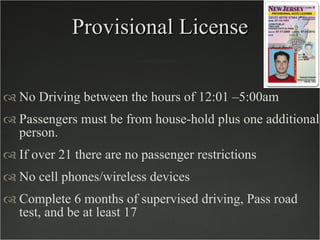
Provisional License No Driving between the hours of 12:01 –5:00am Passengers must be from house-hold plus one additional person. If over 21 there are no passenger restrictions No cell phones/wireless devices Complete 6 months of supervised driving, Pass road test, and be at least 17
Basic Driver’s License Must be 18 Must have one year of unsupervised driving with examination permit restrictions. Must pay fee
 
What can you gain from this Driver’s Education Course?  Useful Knowledge:  Factors that Affect Your Driving  Managing Visibility, Time & Space:  Awareness of your surroundings  Awareness of Limiting Factors:  Affects of Drugs and Alcohol, Driving when you are tired or in an emotional state
True or False Since young driver’s usually drive fewer miles than older driver’s they have less accidents. T or F  FALSE. Lack of Experience causes accidents.
True or False Cont. Young driver’s drive differently than older driver’s. True or False TRUE. 15-17 Are better at avoiding alcohol impaired driving than 18-40 year olds. Young driver’s tend to speed & not pay attention to their driving
Highway Transportation System Highway Transportation System (HTS) is regulated by federal, state and local government agencies. Parts-motor vehicle, streets and highway, drivers, cyclists, and pedestrians. Goal is to enable people and goods to move from 1 place to another safely. More than 230 Million registered vehicles travel the HTS 194 Million Licensed Driver’s & 55 Million Pedestrians & Bicyclists travel HTS
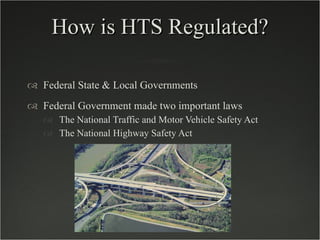
How is HTS Regulated? Federal State & Local Governments  Federal Government made two important laws The National Traffic and Motor Vehicle Safety Act The National Highway Safety Act
The National Traffic and Motor Vehicle Safety Act Requires automakers to build safety features i.e. safety belts, shatterproof windows etc.
The National Highway Safety Act  Establishes guidelines for state motor vehicle safety programs. Each state sets its own statutes.
RISK IS REAL!!  The chances of you being involved in a collision are 1 in 9.  Seriously disabled 1 in 83.. 38% of deaths(15-20)occur through motor vehicle crashes. Involved in 14% of crashes 85% of deaths occur in first collision
How to Reduce Risks! Keep your vehicle in top condition Anticipate actions of others Take steps to protect yourself and others Drive only when you are in good physical and mental condition. Develop your skills better
3 Key components for Safe and Responsible Driving 1.  Visibility : What you see, how well you see it and others see you. 2.  Time : Speeding and stopping 3.  Space : Distance between cars and preventing collisions
Mobility The basic costs are grouped into two categories 1 Crash-MV hits another vehicle, pedestrian, animal, cyclist or fixed object. 2. Non-Crash costs a) Operating costs-maintain vehicle ex. gas or oil b) Fixed costs-purchase price, insurance and licensing fees. c) Environmental costs-car pollution $230 Billion dollars are spent in motor-vehicle crashes.
Ch. 1: Vocabulary Words Mobility Crash  HTS Collision  Risk  Visibility
Vocabulary Continued Time  Space  Cost Cost Benefit Ratio
STUDY :  Ch. 1 Quiz  GDL Requirements and Restrictions

Drivers Education Ch.1

  • 1.
    Welcome to Driver’sEducation! Objectives: Ms. Hall’s Class Requirements & Grading Overview of the Graduated License Program
  • 2.
    Grading System Tests & Quizzes 25%: Multiple choice, matching, or essay. Based upon Responsible Driving book and Driver’s Manual Class work & Homework 25%: Must be kept in a notebook. If you are absent must submit it to me next class period or points will be deducted. Projects 25%: Select a topic that pertains to Driver’s Education. May be in 3-D, poster, PowerPoint, DVD or Video
  • 3.
    Grading System ContinuedState Driver’s Examination- NJ State Driver’s Permit Test will be administered towards the end of the marking period. Test will be worth two test grades. If you pass with 80% or better you will be able to fill out the BLUE PERMIT CARD. If you fail, you may retake the test one week later after school. Must be on time to the retake. After one retake you are on your own to get your permit.
  • 4.
    Responsibilities! Students areresponsible for reading the DVD Manual on their own. We will cover a majority of the material in class but it is important you study on your own in preparation for the NJ State Permit Test. Whatever we are going over in class. PAY ATTENTION. You might see a similar question on your exam.
  • 5.
    Graduated Drivers LicenseINSTRUCTION + EXPERIENCE =SAFER DRIVERS Main goal of the GDL is to protect the lives of young drivers- and the lives of their passengers and other motorists What do you think the leading cause of death is for young people ages 16-24?
  • 6.
    Quick Fact Leading Cause of Death is MV crashes (44%) Most dangerous situations include driving with other teens and driving at night. More than half of all deaths involving 16-17 year old drivers occur when passengers are under age 20- and no adults are in vehicle. Studies show that a young drivers risk of being involved in a car crash is highest within the first 12-24 months of driving
  • 7.
    Early Bird RoadSpecial Learner’s Permit Provisional Driver’s License Basic Driver’s License
  • 8.
    Student Permit Nodriving in between 11:01-5:00 am Must be accompanied by a driver over the age of 21 and who has had their license for at least three years No cell Phones or wireless devices Must be 16, have parent consent, enrolled in an approved training course, pass knowledge and vision test and pay a fee Must practice for 6 months!
  • 9.
    Provisional License NoDriving between the hours of 12:01 –5:00am Passengers must be from house-hold plus one additional person. If over 21 there are no passenger restrictions No cell phones/wireless devices Complete 6 months of supervised driving, Pass road test, and be at least 17
  • 10.
    Basic Driver’s LicenseMust be 18 Must have one year of unsupervised driving with examination permit restrictions. Must pay fee
  • 11.
  • 12.
    What can yougain from this Driver’s Education Course? Useful Knowledge: Factors that Affect Your Driving Managing Visibility, Time & Space: Awareness of your surroundings Awareness of Limiting Factors: Affects of Drugs and Alcohol, Driving when you are tired or in an emotional state
  • 13.
    True or FalseSince young driver’s usually drive fewer miles than older driver’s they have less accidents. T or F FALSE. Lack of Experience causes accidents.
  • 14.
    True or FalseCont. Young driver’s drive differently than older driver’s. True or False TRUE. 15-17 Are better at avoiding alcohol impaired driving than 18-40 year olds. Young driver’s tend to speed & not pay attention to their driving
  • 15.
    Highway Transportation SystemHighway Transportation System (HTS) is regulated by federal, state and local government agencies. Parts-motor vehicle, streets and highway, drivers, cyclists, and pedestrians. Goal is to enable people and goods to move from 1 place to another safely. More than 230 Million registered vehicles travel the HTS 194 Million Licensed Driver’s & 55 Million Pedestrians & Bicyclists travel HTS
  • 16.
    How is HTSRegulated? Federal State & Local Governments Federal Government made two important laws The National Traffic and Motor Vehicle Safety Act The National Highway Safety Act
  • 17.
    The National Trafficand Motor Vehicle Safety Act Requires automakers to build safety features i.e. safety belts, shatterproof windows etc.
  • 18.
    The National HighwaySafety Act Establishes guidelines for state motor vehicle safety programs. Each state sets its own statutes.
  • 19.
    RISK IS REAL!! The chances of you being involved in a collision are 1 in 9. Seriously disabled 1 in 83.. 38% of deaths(15-20)occur through motor vehicle crashes. Involved in 14% of crashes 85% of deaths occur in first collision
  • 20.
    How to ReduceRisks! Keep your vehicle in top condition Anticipate actions of others Take steps to protect yourself and others Drive only when you are in good physical and mental condition. Develop your skills better
  • 21.
    3 Key componentsfor Safe and Responsible Driving 1. Visibility : What you see, how well you see it and others see you. 2. Time : Speeding and stopping 3. Space : Distance between cars and preventing collisions
  • 22.
    Mobility The basiccosts are grouped into two categories 1 Crash-MV hits another vehicle, pedestrian, animal, cyclist or fixed object. 2. Non-Crash costs a) Operating costs-maintain vehicle ex. gas or oil b) Fixed costs-purchase price, insurance and licensing fees. c) Environmental costs-car pollution $230 Billion dollars are spent in motor-vehicle crashes.
  • 23.
    Ch. 1: VocabularyWords Mobility Crash HTS Collision Risk Visibility
  • 24.
    Vocabulary Continued Time Space Cost Cost Benefit Ratio
  • 25.
    STUDY : Ch. 1 Quiz GDL Requirements and Restrictions