STATE OF UTAH


 DEPARTMENT OF PUBLIC SAFETY
    DRIVER LICENSE DIVISION
        Post Office Box 144501
   Salt Lake City, Utah 84114-4501


      D. LANCE DAVENPORT
          Commissioner
    Department of Public Safety


          Nannette Rolfe
              Director
      Driver License Division

    For Driver License Assistance
     Telephone: 801-965-4437
Help conserve our natural resources.
                  When you are finished with this book, please pass it on to a
                     friend or return it to your local Driver License office.
                                           THANK YOU


                      UTAH DRIVER
                       HANDBOOK
                         http://driverlicense.utah.gov


This manual contains the rules which should be followed when operating any vehicle on Utah
roads. The operator of a bicycle must obey the same rules of the road, and has the same rights
and duties as the operator of a motor vehicle or other vehicle.

NOTE: This handbook condenses or paraphrases the actual language of the Utah Code.
Officers of the courts are guided by the full text and exact language of the law, rather than the
Utah Driver Handbook.

A new law will be effective January 1, 2010, Lawful Presence Verification
for Issuance of a Driver License or Identification Card. An addendum to
this handbook will be available this fall on our website
www.driverlicense.utah.gov or at any Driver License Office


                                    Issued by the
                       UTAH DEPARTMENT OF PUBLIC SAFETY
                               Driver License Division
                                   P.O. Box 144501
                           Salt Lake City, Utah 84114-4501


Rev. 08-09                                                          Front Cover photo courtesy of:
DLD-42                                                              Jody Stromberg
THE TOP FIVE REASONS PEOPLE DIE ON UTAH HIGHWAYS BASED ON 2007 STATISTICS
PROVIDED BY THE UTAH DEPARTMENT OF PUBLIC SAFETY’S HIGHWAY SAFETY OFFICE:

Speed too fast 35%
Reckless or aggressive driving 34%
Driving under the influence 22%
Fatigue or asleep 14%
Failed to yield right-of-way 12%

THE TOP FIVE REASONS PEOPLE CRASH ON UTAH HIGHWAYS BASED ON 2007 STATISTICS
PROVIDED BY THE UTAH DEPARTMENT OF PUBLIC SAFETY’S HIGHWAY SAFETY OFFICE:

Following too closely 23%
Failure to yield right-of-way 19%
Speed too fast 14%
Driver distraction 10%
Failed to keep proper lane 9%

THE TOP FIVE REASONS TEENAGERS DIE ON UTAH HIGHWAYS BASED ON 2007 STATISTICS
PROVIDED BY THE UTAH DEPARTMENT OF PUBLIC SAFETY’S HIGHWAY SAFETY OFFICE:

Speed too fast 43%
Reckless or aggressive driving 30%
Fatigue or asleep 17%
Driving under the influence 11%
Failed to keep proper lane 9%
Wrong side/wrong way 9%

THE TOP FIVE REASONS TEENAGERS CRASH ON UTAH HIGHWAYS BASED ON 2007
STATISTICS PROVIDED BY THE UTAH DEPARTMENT OF PUBLIC SAFETY’S HIGHWAY SAFETY
OFFICE:

Following too closely 20%
Failed to yield right-of-way 16%
Speed too fast 12%
Driver distraction 10%
Failed to keep in proper lane 6%
TABLEOFCONTENTS                                                  CHAPTER 6-HOW CRASHES MAY AFFECT
                                                                              YOU
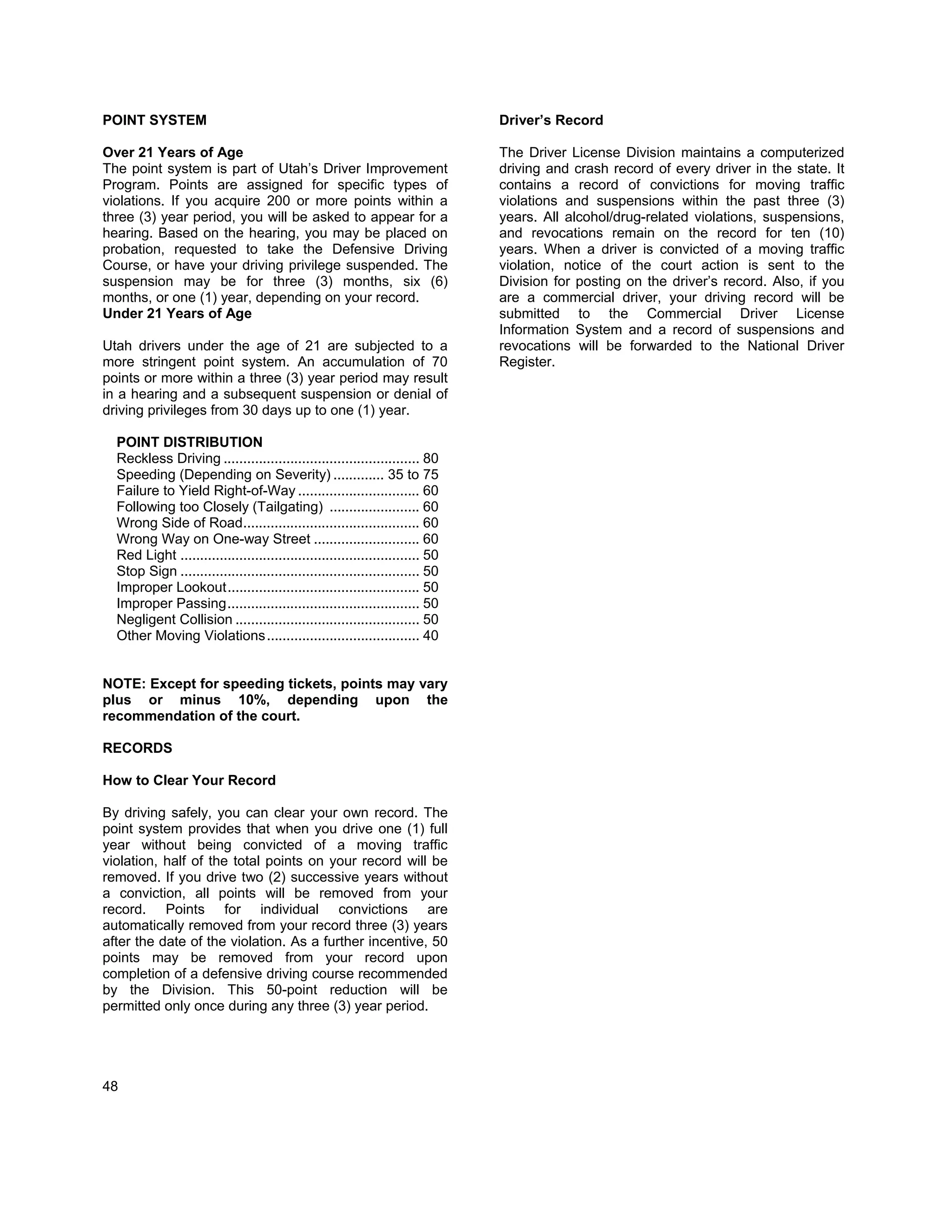
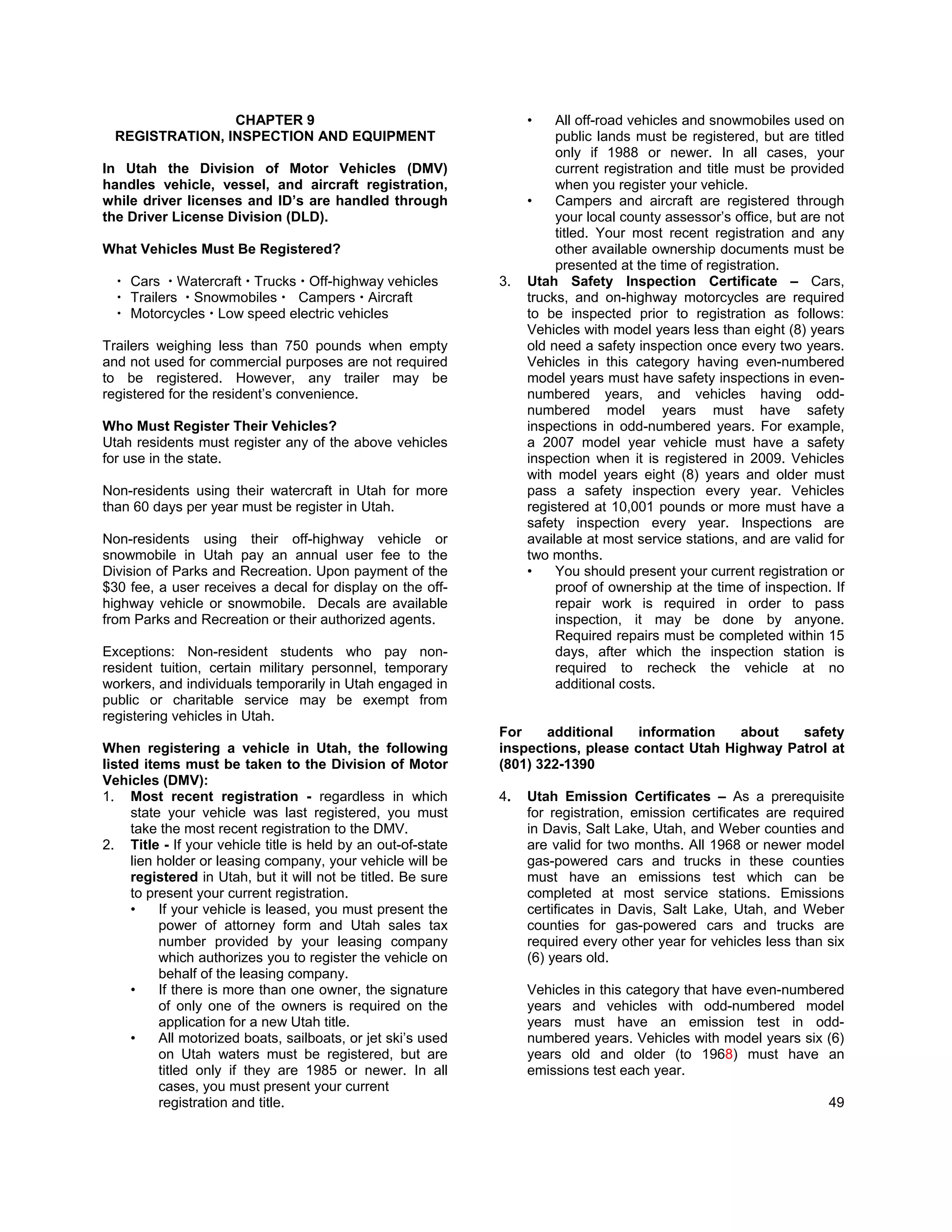
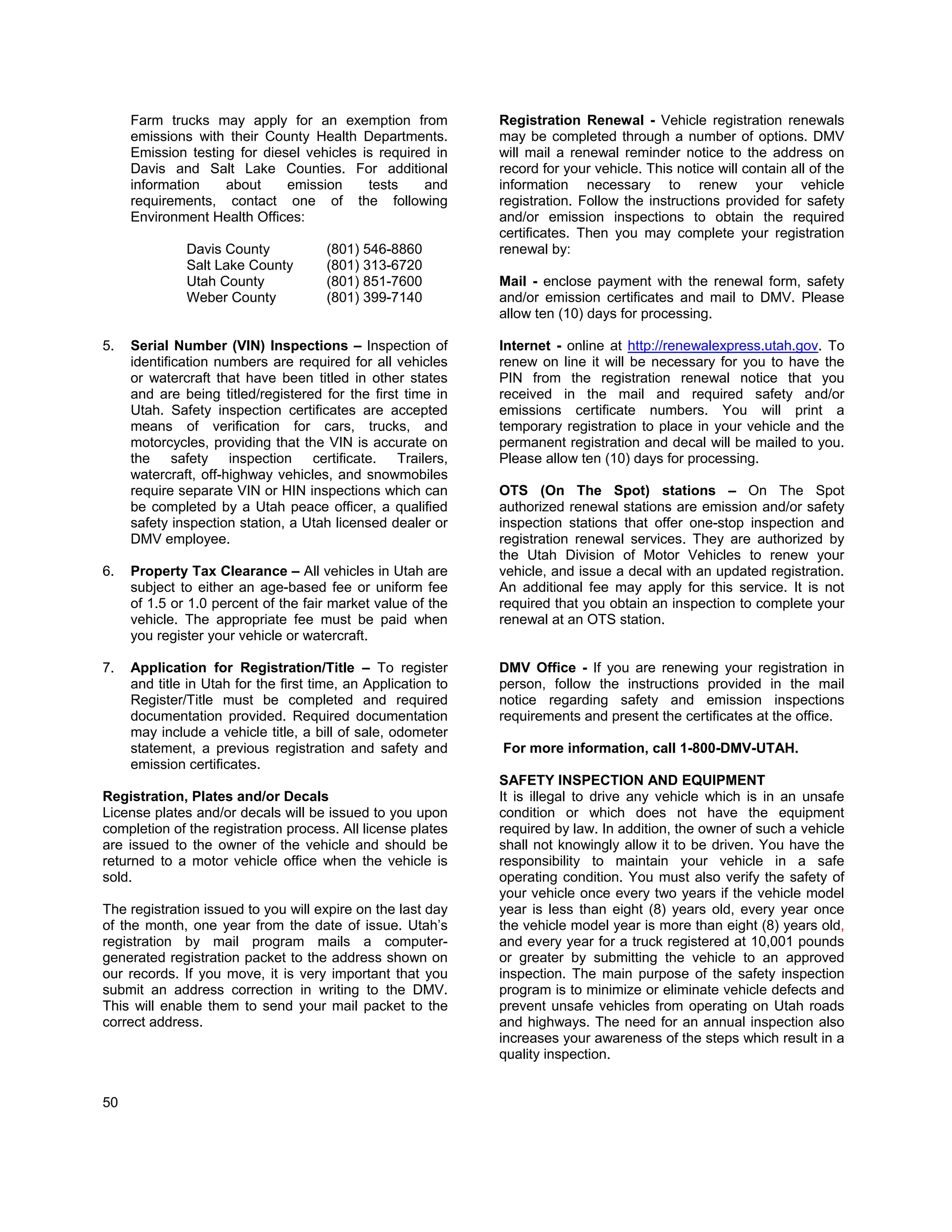
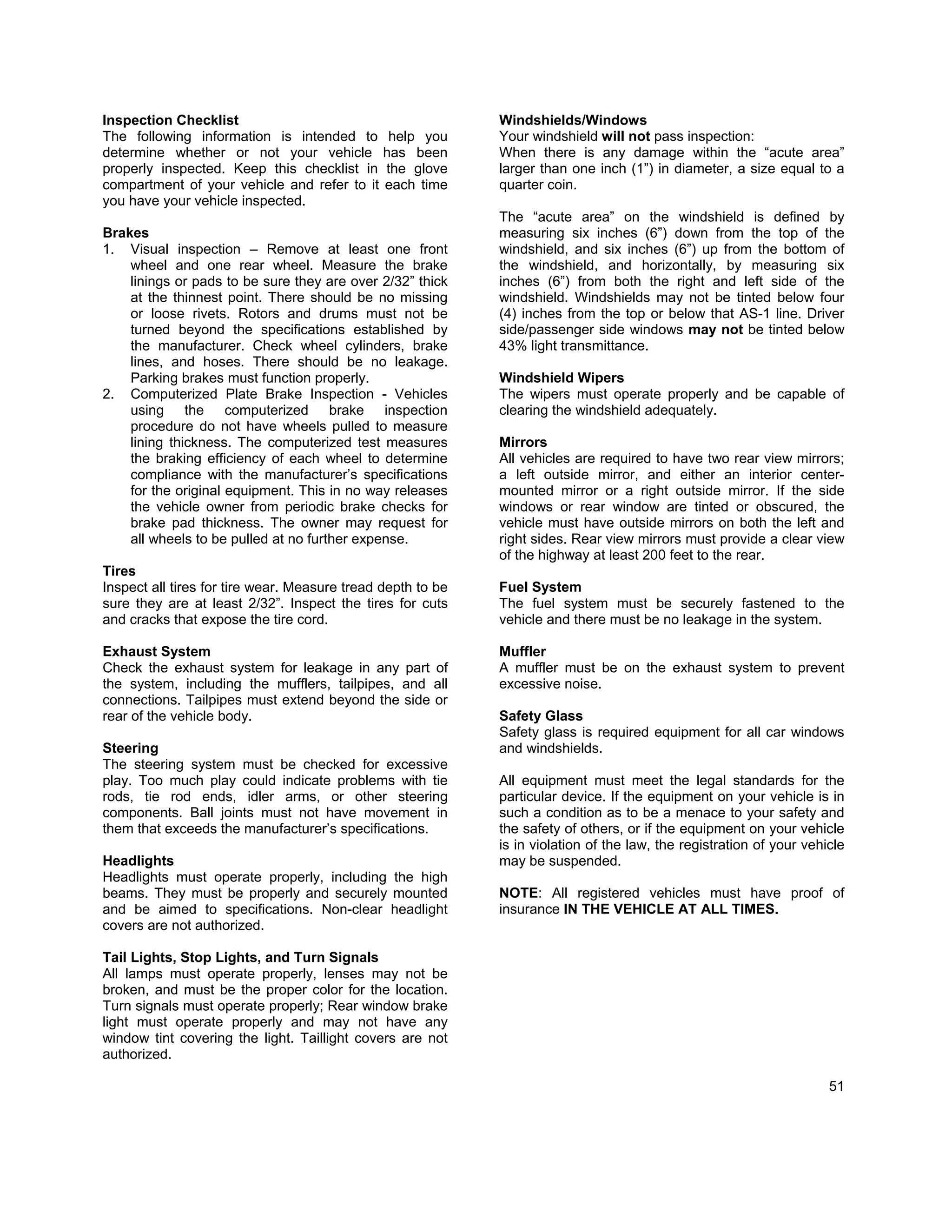
DEFINITIONS...................................................... i           Motor Vehicle Insurance Coverage ................. 40
                                                                              If You Are Involved in an Crash ....................... 40
UTAH’S CLASSIFIED LICENSE SYSTEM ....... ii                                   Financial Responsibility ................................... 40

CHAPTER 1-DRIVER LICENSE REGULATION                                           CHAPTER 7-SPECIAL SUBJECTS AND
Persons Who Do Not Need a Utah Driver                                         INTERESTS FOR DRIVERS
License ............................................................... 1     Physical Health problems and Driving Safety . 42
The Driver License Compact.............................. 1                    Mental and Emotional Conditions .................... 42
Persons Who May Not Have A Driver License .. 1                                Driving and Using Alcohol or Drugs ................ 43
Types of Licenses .............................................. 2
                                                                              CHAPTER 8-LICENSE REVOCATIONS AND
CHAPTER 2-OBTAINING A DRIVER LICENSE                                          SUSPENSION, ALCOHOL, POINT SYSTEM,
Driver Education ................................................. 4          DRIVING RECORDS
Assumption of Financial Responsibility .............. 4                       When Your Privilege to Drive Must be Revoked ..... 45
Positive Identification ......................................... 4           When Your Privilege to Drive May Be
Change of Name ................................................ 5             Suspended....................................................... 45
Tests ................................................................... 5   The Drinking Driver .......................................... 45
Donor Program ................................................... 6           Driving While Denied, Suspended, or Revoked .. 47
Licenses ............................................................. 6      Altered or Fictitious License ............................ 47
Driver License Fee ............................................. 7            Point System.................................................... 48
                                                                              Records ........................................................... 48
CHAPTER 3-RULES OF THE ROAD
Speed ................................................................. 8     CHAPTER 9-REGISTRATION, INSPECTION,
Signaling............................................................. 8      AND EQUIPMENT
Backing............................................................... 8      Registration...................................................... 49
Proper Use of Lanes .......................................... 8              Safety Inspection and Equipment .................... 50
Overtaking and Passing ................................... 11                 Equipment Your Vehicle Must Have ................ 52
Right-of-Way .................................................... 13          Equipment Your Vehicle Must Not Have ......... 52
Stopping ........................................................... 14
Parking ............................................................. 14      CHAPTER 10-INFORMATION FOR RV’S AND
Highway Work Zones ....................................... 15                 LARGE VEHICLES
                                                                              Sharing the Road ............................................. 53
CHAPTER 4-TRAFFIC SIGNS, SIGNALS, AND                                         Size and Weight .............................................. 53
ROAD MARKINGS                                                                 Equipment........................................................ 54
Signs ................................................................ 17     Driving Rules ................................................... 56
Traffic Signals................................................... 19
Pavement Markings ......................................... 20                SAMPLE TEST QUESTIONS ......................... 58

CHAPTER 5-BASIC DRIVING SKILLS                                                DRIVER LICENSE FIELD OFFICES .............. 59
Freeway Driving ............................................... 22
Ramp Metering ................................................. 23
Night Driving ..................................................... 24
Staying Awake/No Drowsy Driving................... 25
Emergency Measures ...................................... 25
Railroad Crossing ............................................. 26
Light Rail .......................................................... 28
Motorcycles: Sharing the Road ....................... 29
Bicycles ............................................................ 33
Pedestrians and Joggers ................................. 36
Pedestrian Vehicles ......................................... 37
Safety Belts and Car Safety Seats ................... 38
Air Bags ............................................................ 38
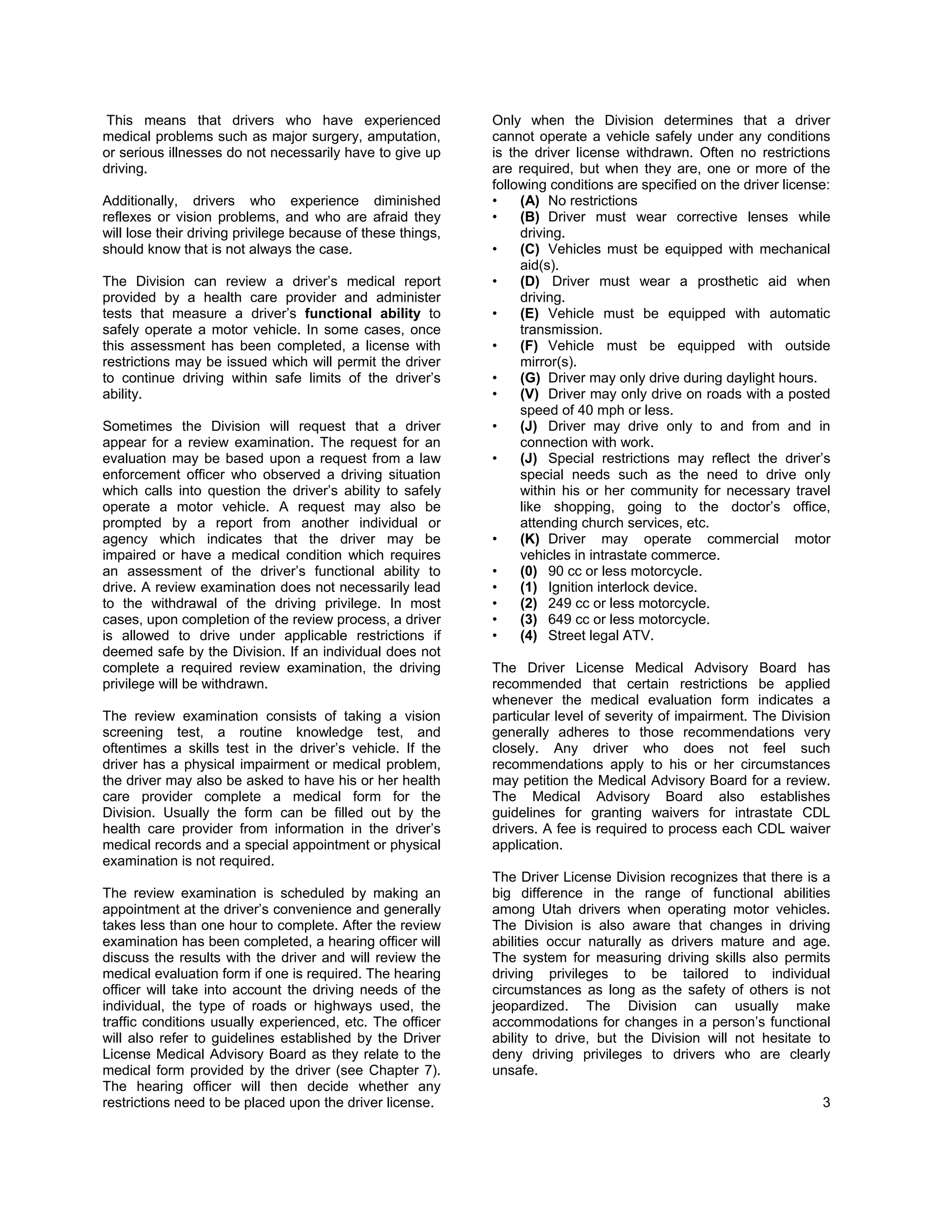
SOME DEFINITIONS IN OUR LAWS                        12. Motor Vehicle – every self-propelled vehicle,
       YOU SHOULD KNOW AS A DRIVER                             except motorized wheelchairs and vehicles
                                                               moved solely by human power.
1.   Cancellation – termination of a license issued
     through error or fraud or for which necessary         13. Motorcycle – every motor vehicle, except farm
     consent has been withdrawn.                               tractors, having a seat or saddle for the use of
                                                               the rider, and designed to travel with not more
2.   Careless Driving - a person operating a motor             than three wheels in contact with the ground.
     vehicle is guilty of careless driving if the person
     commits two or more moving traffic violations         14. Operator – a person who is in actual physical
     within a single continuous period of driving or           control of a motor vehicle.
     commits a moving traffic violation while being
     distracted by one or more activities taking           15. Pedestrian Vehicle – any self-propelled
     place within the vehicle that are not related to          conveyance designed, manufactured, and
     the operation of a motor vehicle, including               intended for the exclusive use of persons with
     using a wireless telephone, or other electronic           a physical disability. The vehicle must not
     device unless the person is using hands-free              exceed 48 inches in width, have an engine in
     talking and listening features while operating            excess of 300 cubic centimeters (more than 12
     the motor vehicle, or searching for an item in            brake horsepower), or be capable of exceeding
     the vehicle or attending to personal hygiene, or          speeds of more than 30 m.p.h.
     grooming.
                                                           16. Personal Motorized Mobility Device – a self-
3.   Commercial Driver License - a license which               propelled device with two non-tandem wheels
     allows the holder to operate any vehicle with a           in contact with the ground, a system of steering
     GVWR of 26,001 lbs. or more, or to transport              and stopping the unit under typical operating
     more than 15 passengers, hazardous                        conditions, a motor not exceeding one horse
     materials,     doubles/triples, bulk     liquids          power of 750 watts, and a deck design for a
     (tankers), or school buses.                               person to stand while operating the device.

4.   Denied - withdrawal of driving privilege              17. Provisional License – an original Utah license
     pending compliance with a rule or request.                issued to any person under 21 years of age.

5.   Disqualification - a temporary or permanent           18. Revocation – termination of the privilege to
     withdrawal of a commercial driver license.                drive a motor vehicle.

6.   Division – the Driver License Division of the         19. School Bus – commercial motor vehicle used
     Department of Public Safety.                              to transport pre-primary, primary, or secondary
                                                               school students to and from home and school,
7.   Farm Tractor – every self-propelled vehicle               or to and from school- sponsored events.
     designed and used primarily as a farm
     implement of husbandry.                               20. Street-legal all-terrain - means an all-terrain
                                                               type I or utility type vehicle, modified to operate
8.   Highway – the entire width between property               on highways.
     lines of every way or place as a matter of right
     for vehicular travel.                                 20. Suspension – temporary withdrawal of the
                                                               privilege to drive.
9.   License - the privilege to operate a motor
     vehicle.                                              21. Taxicab – a Class D motor vehicle transporting
                                                               any number of passengers for hire and which
10. License Certificate/Driving Privilege Card -               is subject to state or federal regulations as a
    the evidence of the privilege to operate a motor           taxi.
    vehicle.
                                                           22. Vehicle – every device by which any person or
11. Low Speed Vehicle - a four-wheeled electric                property may be transported upon a highway
    motor vehicle designed to be operated at                   except devices used exclusively on stationary
    speeds of not more than 25 miles per hour and              rails or tracks.
    that has a capacity of not more than four
    passengers, including the driver.
                                                                                                                 i
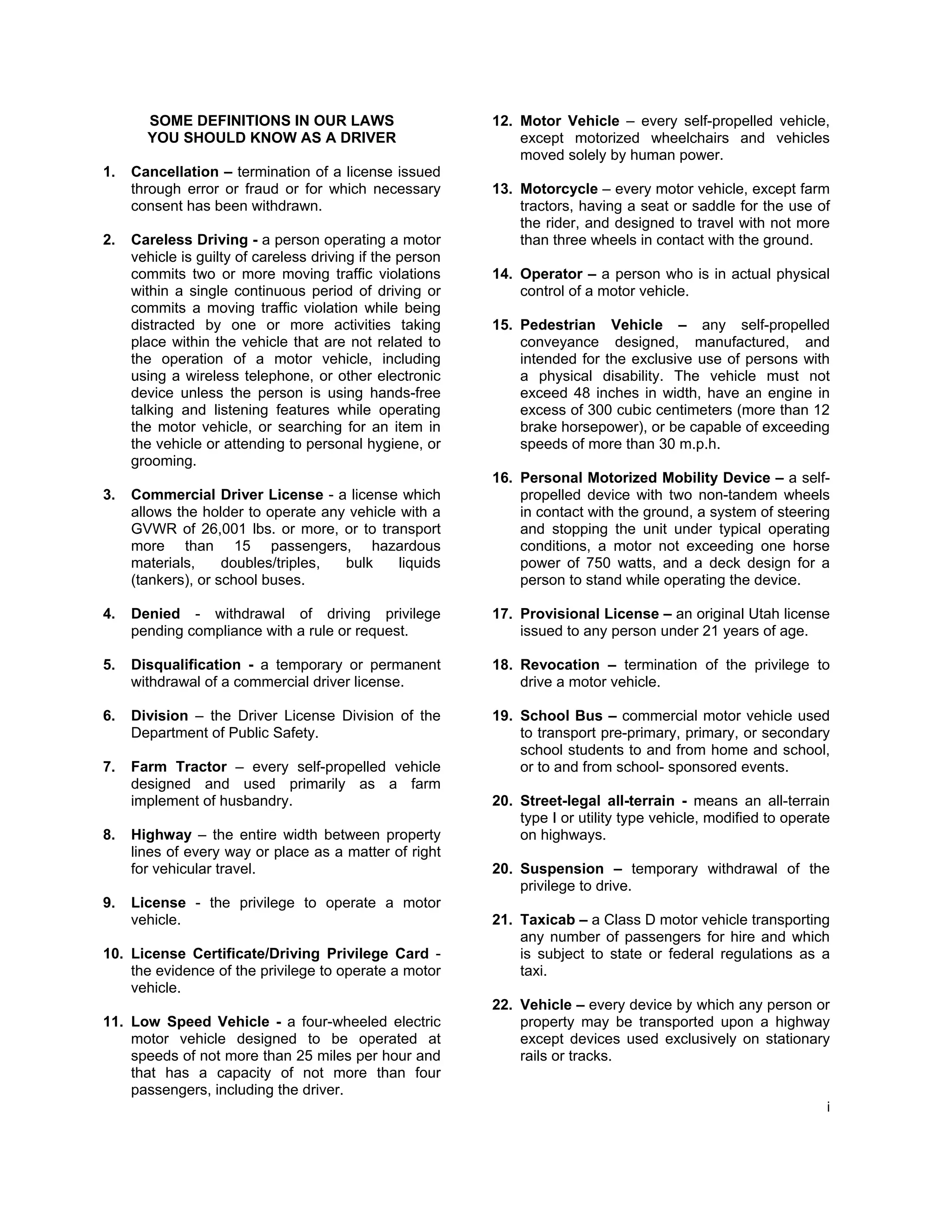
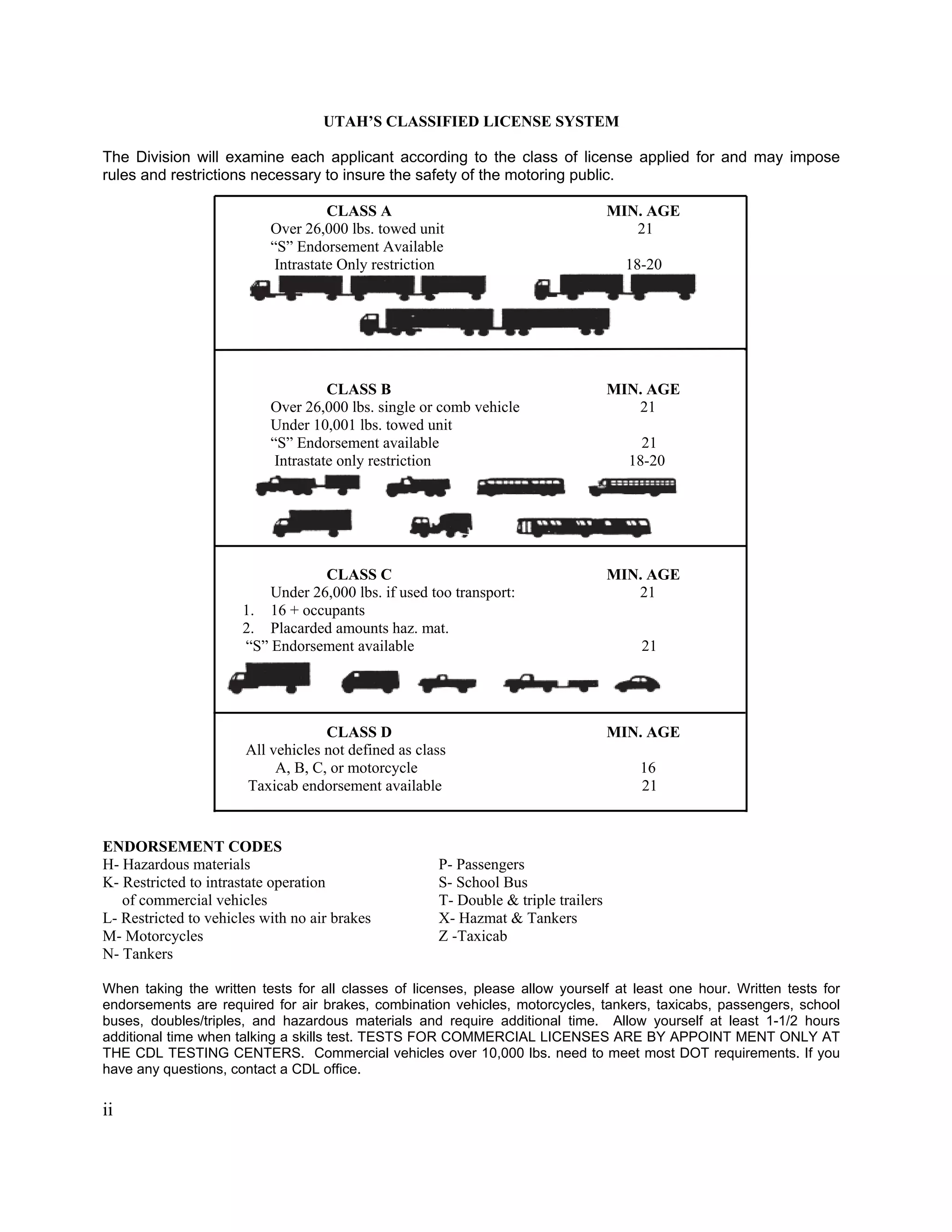
UTAH’S CLASSIFIED LICENSE SYSTEM

The Division will examine each applicant according to the class of license applied for and may impose
rules and restrictions necessary to insure the safety of the motoring public.

                                     CLASS A                                        MIN. AGE
                           Over 26,000 lbs. towed unit                                 21
                           “S” Endorsement Available
                            Intrastate Only restriction                               18-20


                                     CLASS B                                        MIN. AGE
                           Over 26,000 lbs. single or comb vehicle                     21
                           Under 10,001 lbs. towed unit
                           “S” Endorsement available                                    21
                            Intrastate only restriction                               18-20


                                  CLASS C                                           MIN. AGE
                          Under 26,000 lbs. if used too transport:                     21
                      1. 16 + occupants
                      2. Placarded amounts haz. mat.
                      “S” Endorsement available                                         21


                                    CLASS D                                         MIN. AGE
                       All vehicles not defined as class
                            A, B, C, or motorcycle                                      16
                       Taxicab endorsement available                                    21


ENDORSEMENT CODES
H- Hazardous materials                                P- Passengers
K- Restricted to intrastate operation                 S- School Bus
   of commercial vehicles                             T- Double & triple trailers
L- Restricted to vehicles with no air brakes          X- Hazmat & Tankers
M- Motorcycles                                        Z -Taxicab
N- Tankers

When taking the written tests for all classes of licenses, please allow yourself at least one hour. Written tests for
endorsements are required for air brakes, combination vehicles, motorcycles, tankers, taxicabs, passengers, school
buses, doubles/triples, and hazardous materials and require additional time. Allow yourself at least 1-1/2 hours
additional time when talking a skills test. TESTS FOR COMMERCIAL LICENSES ARE BY APPOINT MENT ONLY AT
THE CDL TESTING CENTERS. Commercial vehicles over 10,000 lbs. need to meet most DOT requirements. If you
have any questions, contact a CDL office.

ii
CHAPTER 1                                to comply with the terms of a traffic citation. The
         DRIVER LICENSE REGULATIONS                        driver’s home state will suspend the driver’s privilege
                                                           to drive until it receives satisfactory evidence that the
EVERY RESIDENT OF UTAH WHO DRIVES A                        driver has complied with the terms of the citation in the
MOTOR VEHICLE ON THE HIGHWAYS (ANY                         member’s state.
PUBLIC ROADWAY) MUST HAVE A VALID UTAH
DRIVER LICENSE OR LEARNER PERMIT.                          This Compact also facilitates release of out-of-state
                                                           drivers who are cited by law enforcement, instead of
Persons become residents if they:                          incarcerating them or requiring posting of bond. Forty-
1. Enter the state with intention of making Utah their     four states, plus the District of Columbia (Washington
    home.                                                  D.C.), are members of the NRVC. States that are NOT
2. Are gainfully employed in Utah. (Does not apply if      members are:
    you are on temporary assignment in the state.)          • Alaska • California • Michigan • Montana • Oregon
                                                                                 • Wisconsin
PERSONS WHO DO NOT NEED A UTAH LICENSE
                                                           PERSONS      WHO      MAY    NOT     HAVE     A   UTAH
Nonresident Drivers                                        LICENSE

Nonresidents licensed by another state or country          The following list outlines conditions under which you
may drive in Utah:                                         may not be issued a Utah driver license:
1. If they are at least 16 years old.                      1. If you are under the required age of 16.
2. If they are temporary assigned by an employer,          2. If your driving privilege is denied, suspended,
    religious or private organization, or governmental         revoked, or disqualified.
    entity.                                                3. If you are unable to understand highway signs in
                                                               the English language.
Visitors with a valid out-of-state or out-of-country       4. If you are physically or mentally unable to drive
license may drive in Utah for up to six months.                safely.
                                                           5. If you have not passed the required examinations.
Nonresident     Military   Service   Personnel     and     6. If you have a traffic ticket or other warrant which
Dependents                                                     has not been settled.
                                                           7. If you are not a resident of the state.
Nonresident military personnel (including dependents)      8. If you are under 18 years of age, and have not
who are temporarily assigned in Utah may drive if they         held a learner permit issued for six months.
have a valid out-of-state or out-of-country license.
                                                           DRIVING BY MINORS
Other Exceptions                                           A person younger than 17 years of age may not
                                                           operate a motor vehicle upon any highway (ANY
Persons are not required to get a driver license to        public roadway) between the hours of 12:00 a.m. and
drive road rollers, road machinery, or farm tractors on    5:00 a.m. except for the following:
Utah highways.                                             1. When accompanied by a licensed driver at least
                                                                21 years of age who is occupying a seat next to
NOTE: YOUR OUT-OF-STATE LICENSE MUST                            the driver;
BE SURRENDERED UPON APPLICATION FOR                        2. Driving is in connection with the driver’s
A UTAH LICENSE                                                  employment, including the trip to and from the
                                                                driver’s residence to the driver’s employment;
THE DRIVER LICENSE COMPACT                                 3. The driver drives directly to the driver’s residence
                                                                from a school-sponsored activity if transportation
Utah is a member of both the Driver License Compact             to the activity is provided by a school or school
(DLC) and the Non-Resident Violator Compact                     district, and the provided transportation
(NRVC). The DLC provides guidelines for greater                 commenced from and returns to the school
cooperation among members in driver license matters.            property where the driver is enrolled.
Among other things, member jurisdictions exchange          4. The driver is on assignment of a farmer or
driver records and forward convictions for traffic              rancher and the driver is engaged in an
offenses to the driver’s home state. Forty-five states,         agricultural operation; or
plus the District of Columbia (Washington D.C.), are       5. In an emergency.
members of the DLC. States that are NOT members
are:                                                       A person may not operate a motor vehicle upon any
 • Georgia • Massachusetts • Wisconsin • Michigan          highway (ANY public roadway) with any passenger
                      • Tennessee                          who is not an immediate family member of the driver
                                                           until:
The NRVC provides for members to forward notices
from their courts that an out-of-state driver has failed                                                          1
1.   Six months from the date the person’s driver          This license allows you to drive all personal vehicles
     license was issued; or                                (up to 26,000 pounds) with the exception of
2.   The person reaches 18 years of age.                   motorcycles. To drive a taxicab, you must have a
                                                           taxicab endorsement.
Exceptions to this rule are:
   a. If accompanied by a licensed driver at least         Driving Privilege Card
        21 years of age;                                   A Driving Privilege Card may be issued to an
   b. On assignment of a farmer or rancher and             applicant who does not qualify for a Social Security
        the driver is engaged in an agricultural           Number, but who has received an Individual Tax
        operation;                                         Identification Number (ITIN). The Driving Privilege
   c. In an emergency.                                     Card may also be issued to a foreign visitor who is
                                                           here legally, but does not qualify for either a Social
TYPES OF LICENSES                                          Security or ITIN Number. The Driving Privilege Card
                                                           may be used for driving, but not for identification or
Learner Permit                                             proof of a person’s age.
If you are at least 15 years old, you may apply for a
learner permit, if desired/needed. This permit will be     Larger Class License
issued when you have successfully passed the               Other class licenses are required if you drive certain
written, eye, physical, and mental fitness tests. The      types of vehicles. You must be at least 18 years old
permit is valid for one (1) year from date of issue. The   before applying for any of these licenses and, if under
nonrefundable fee for the learner permit is $15. When      21 years old, you will be restricted to intrastate
you have completed an approved driver education            operation only. For commercial interstate classes, you
course, either through a commercial driver school or       must be at least 21 years old. Each class or
by driver education approved by the State Board of         endorsement requires special tests. For further
Education or the Division, you will be required to pay a   details, see the Commercial Driver License manual.
nonrefundable original license fee, and pass a driving     You must also have one year driving experience to
skills test.                                               qualify for the Commercial Driver License (CDL).

NOTE: all nonrefundable application fees allow for         Motorcycle Endorsement
no more than three (3) attempts to pass the test(s).       To operate a motorcycle on Utah highways, your
                                                           driver license must have a motorcycle endorsement.
18 Years Or Older                                          The requirements for this endorsement are the same
An applicant older than 18 years of age, with a learner    as for obtaining an operator license except that the
permit, may operate a Class D motor vehicle if a           tests are different. If you have not been licensed to
person who is 21 years old or older and is a licensed      operate a motorcycle previously, you may be issued a
driver is occupying a seat beside the applicant, and       motorcycle learner permit, if necessary. For further
the learner permit is in the applicant’s immediate         information on the motorcycle learner permit see
possession.                                                the Motorcycle Operator Manual. The Division may
                                                           waive the skills portion of the test upon successful
Younger Than 18 Years Old                                  completion of a Division-approved motorcycle
An applicant younger than 18 years of age, with a          education course. (Contact any Driver License office
learner permit, may operate a Class D motor vehicle if     or call 1-800-532-7691 for details.) Any motorcycle
an approved driving instructor is occupying a seat         operator or passenger who is under 18 years of
beside the applicant; or the applicant’s parent or legal   age must wear approved DOT helmet. Also, all
guardian is a licensed driver and is occupying the seat    motorcycles licensed for street use must have liability
beside the applicant; or the responsible adult who has     insurance coverage. The signature of a parent or
signed for financial responsibility and is a licensed      guardian is required for motorcycle applicants under
driver and is occupying the seat beside the applicant.     18 years of age, if the applicant has not been
                                                           previously issued a driver license.
The learner permit must be in the applicant’s
immediate possession.                                      NOTE: Utah has a tired licensing system for all
                                                           motorcycle operators. You will be restricted
NOTE: An applicant who is under 18 years of age is         depending on the cc size of the motorcycle upon
required to hold a learners permit for six (6) months      which you are tested. (For more information see
before applying for a provisional Class D license.         the Utah Motorcycle Operators Manual).

Operator License (Class D)                                 Restricted and/or Limited Licenses
To get an original operator license, you must be at        The Driver License Division can issue driver licenses
least 16 years old and have completed an approved          to individuals who have disabilities or reduced
driver education course or have proof of a license         capacity to drive safely in all types of traffic conditions.
from another state or country.
2
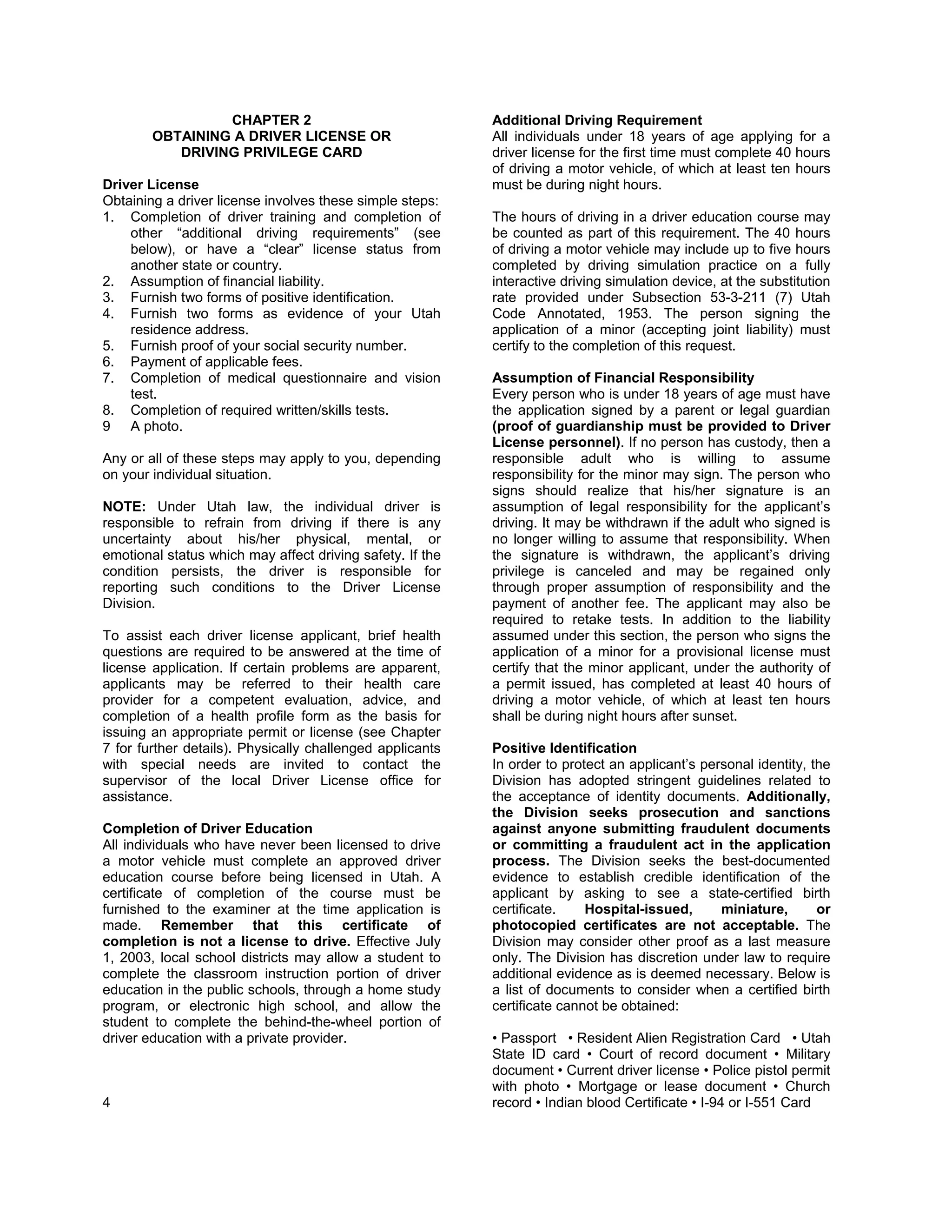
This means that drivers who have experienced                 Only when the Division determines that a driver
medical problems such as major surgery, amputation,          cannot operate a vehicle safely under any conditions
or serious illnesses do not necessarily have to give up      is the driver license withdrawn. Often no restrictions
driving.                                                     are required, but when they are, one or more of the
                                                             following conditions are specified on the driver license:
Additionally, drivers who experience diminished              •    (A) No restrictions
reflexes or vision problems, and who are afraid they         •    (B) Driver must wear corrective lenses while
will lose their driving privilege because of these things,        driving.
should know that is not always the case.                     •    (C) Vehicles must be equipped with mechanical
                                                                  aid(s).
The Division can review a driver’s medical report            •    (D) Driver must wear a prosthetic aid when
provided by a health care provider and administer                 driving.
tests that measure a driver’s functional ability to          •    (E) Vehicle must be equipped with automatic
safely operate a motor vehicle. In some cases, once               transmission.
this assessment has been completed, a license with           •    (F) Vehicle must be equipped with outside
restrictions may be issued which will permit the driver           mirror(s).
to continue driving within safe limits of the driver’s       •    (G) Driver may only drive during daylight hours.
ability.                                                     •    (V) Driver may only drive on roads with a posted
                                                                  speed of 40 mph or less.
Sometimes the Division will request that a driver            •    (J) Driver may drive only to and from and in
appear for a review examination. The request for an               connection with work.
evaluation may be based upon a request from a law            •    (J) Special restrictions may reflect the driver’s
enforcement officer who observed a driving situation              special needs such as the need to drive only
which calls into question the driver’s ability to safely          within his or her community for necessary travel
operate a motor vehicle. A request may also be                    like shopping, going to the doctor’s office,
prompted by a report from another individual or                   attending church services, etc.
agency which indicates that the driver may be                •    (K) Driver may operate commercial motor
impaired or have a medical condition which requires               vehicles in intrastate commerce.
an assessment of the driver’s functional ability to          •    (0) 90 cc or less motorcycle.
drive. A review examination does not necessarily lead        •    (1) Ignition interlock device.
to the withdrawal of the driving privilege. In most          •    (2) 249 cc or less motorcycle.
cases, upon completion of the review process, a driver       •    (3) 649 cc or less motorcycle.
is allowed to drive under applicable restrictions if         •    (4) Street legal ATV.
deemed safe by the Division. If an individual does not
complete a required review examination, the driving          The Driver License Medical Advisory Board has
privilege will be withdrawn.                                 recommended that certain restrictions be applied
                                                             whenever the medical evaluation form indicates a
The review examination consists of taking a vision           particular level of severity of impairment. The Division
screening test, a routine knowledge test, and                generally adheres to those recommendations very
oftentimes a skills test in the driver’s vehicle. If the     closely. Any driver who does not feel such
driver has a physical impairment or medical problem,         recommendations apply to his or her circumstances
the driver may also be asked to have his or her health       may petition the Medical Advisory Board for a review.
care provider complete a medical form for the                The Medical Advisory Board also establishes
Division. Usually the form can be filled out by the          guidelines for granting waivers for intrastate CDL
health care provider from information in the driver’s        drivers. A fee is required to process each CDL waiver
medical records and a special appointment or physical        application.
examination is not required.
                                                             The Driver License Division recognizes that there is a
The review examination is scheduled by making an             big difference in the range of functional abilities
appointment at the driver’s convenience and generally        among Utah drivers when operating motor vehicles.
takes less than one hour to complete. After the review       The Division is also aware that changes in driving
examination has been completed, a hearing officer will       abilities occur naturally as drivers mature and age.
discuss the results with the driver and will review the      The system for measuring driving skills also permits
medical evaluation form if one is required. The hearing      driving privileges to be tailored to individual
officer will take into account the driving needs of the      circumstances as long as the safety of others is not
individual, the type of roads or highways used, the          jeopardized. The Division can usually make
traffic conditions usually experienced, etc. The officer     accommodations for changes in a person’s functional
will also refer to guidelines established by the Driver      ability to drive, but the Division will not hesitate to
License Medical Advisory Board as they relate to the         deny driving privileges to drivers who are clearly
medical form provided by the driver (see Chapter 7).         unsafe.
The hearing officer will then decide whether any
restrictions need to be placed upon the driver license.                                                             3
CHAPTER 2                                 Additional Driving Requirement
        OBTAINING A DRIVER LICENSE OR                      All individuals under 18 years of age applying for a
           DRIVING PRIVILEGE CARD                          driver license for the first time must complete 40 hours
                                                           of driving a motor vehicle, of which at least ten hours
Driver License                                             must be during night hours.
Obtaining a driver license involves these simple steps:
1. Completion of driver training and completion of         The hours of driving in a driver education course may
    other “additional driving requirements” (see           be counted as part of this requirement. The 40 hours
    below), or have a “clear” license status from          of driving a motor vehicle may include up to five hours
    another state or country.                              completed by driving simulation practice on a fully
2. Assumption of financial liability.                      interactive driving simulation device, at the substitution
3. Furnish two forms of positive identification.           rate provided under Subsection 53-3-211 (7) Utah
4. Furnish two forms as evidence of your Utah              Code Annotated, 1953. The person signing the
    residence address.                                     application of a minor (accepting joint liability) must
5. Furnish proof of your social security number.           certify to the completion of this request.
6. Payment of applicable fees.
7. Completion of medical questionnaire and vision          Assumption of Financial Responsibility
    test.                                                  Every person who is under 18 years of age must have
8. Completion of required written/skills tests.            the application signed by a parent or legal guardian
9 A photo.                                                 (proof of guardianship must be provided to Driver
                                                           License personnel). If no person has custody, then a
Any or all of these steps may apply to you, depending      responsible adult who is willing to assume
on your individual situation.                              responsibility for the minor may sign. The person who
                                                           signs should realize that his/her signature is an
NOTE: Under Utah law, the individual driver is             assumption of legal responsibility for the applicant’s
responsible to refrain from driving if there is any        driving. It may be withdrawn if the adult who signed is
uncertainty about his/her physical, mental, or             no longer willing to assume that responsibility. When
emotional status which may affect driving safety. If the   the signature is withdrawn, the applicant’s driving
condition persists, the driver is responsible for          privilege is canceled and may be regained only
reporting such conditions to the Driver License            through proper assumption of responsibility and the
Division.                                                  payment of another fee. The applicant may also be
                                                           required to retake tests. In addition to the liability
To assist each driver license applicant, brief health      assumed under this section, the person who signs the
questions are required to be answered at the time of       application of a minor for a provisional license must
license application. If certain problems are apparent,     certify that the minor applicant, under the authority of
applicants may be referred to their health care            a permit issued, has completed at least 40 hours of
provider for a competent evaluation, advice, and           driving a motor vehicle, of which at least ten hours
completion of a health profile form as the basis for       shall be during night hours after sunset.
issuing an appropriate permit or license (see Chapter
7 for further details). Physically challenged applicants   Positive Identification
with special needs are invited to contact the              In order to protect an applicant’s personal identity, the
supervisor of the local Driver License office for          Division has adopted stringent guidelines related to
assistance.                                                the acceptance of identity documents. Additionally,
                                                           the Division seeks prosecution and sanctions
Completion of Driver Education                             against anyone submitting fraudulent documents
All individuals who have never been licensed to drive      or committing a fraudulent act in the application
a motor vehicle must complete an approved driver           process. The Division seeks the best-documented
education course before being licensed in Utah. A          evidence to establish credible identification of the
certificate of completion of the course must be            applicant by asking to see a state-certified birth
furnished to the examiner at the time application is       certificate.    Hospital-issued,      miniature,       or
made. Remember that this certificate of                    photocopied certificates are not acceptable. The
completion is not a license to drive. Effective July       Division may consider other proof as a last measure
1, 2003, local school districts may allow a student to     only. The Division has discretion under law to require
complete the classroom instruction portion of driver       additional evidence as is deemed necessary. Below is
education in the public schools, through a home study      a list of documents to consider when a certified birth
program, or electronic high school, and allow the          certificate cannot be obtained:
student to complete the behind-the-wheel portion of
driver education with a private provider.                  • Passport • Resident Alien Registration Card • Utah
                                                           State ID card • Court of record document • Military
                                                           document • Current driver license • Police pistol permit
                                                           with photo • Mortgage or lease document • Church
4                                                          record • Indian blood Certificate • I-94 or I-551 Card
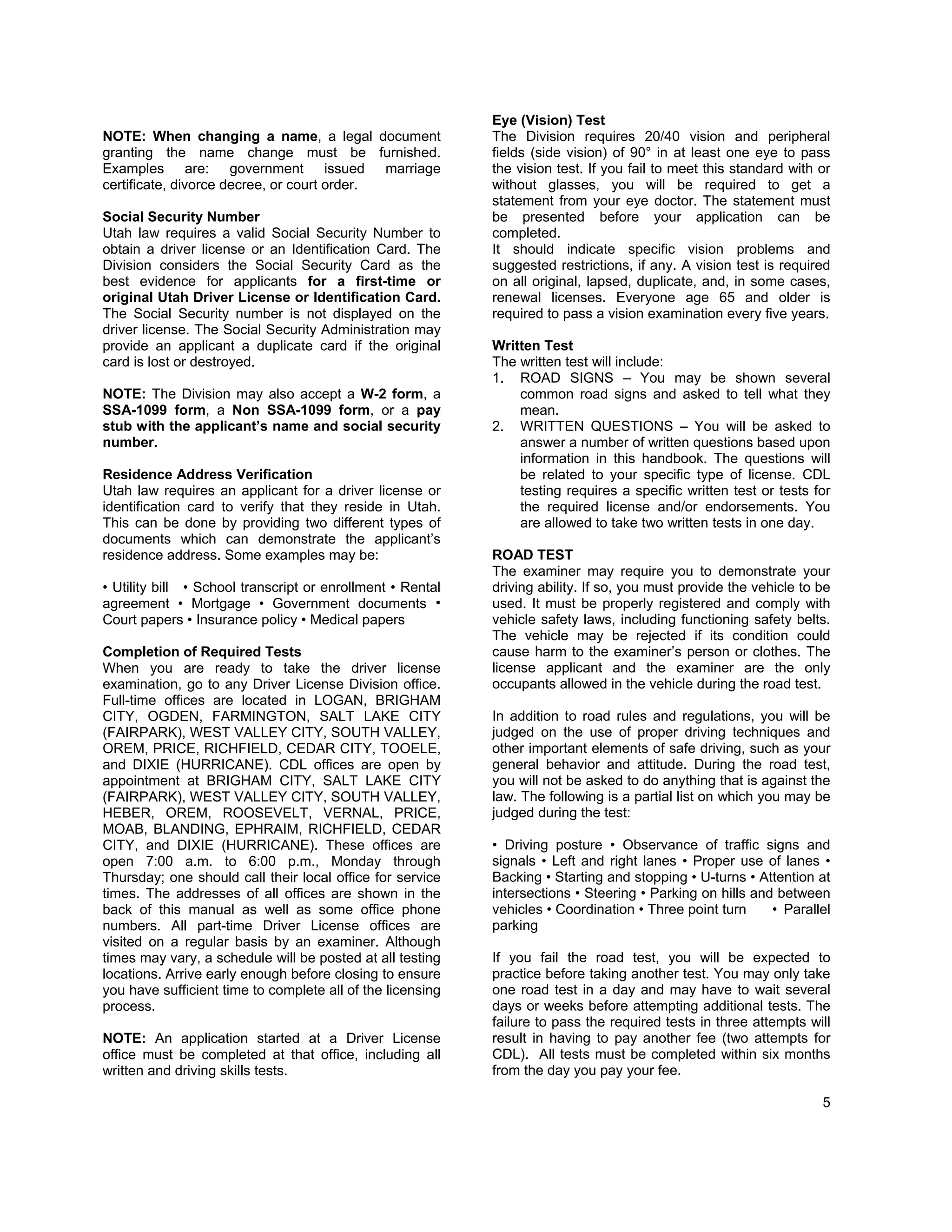
Eye (Vision) Test
NOTE: When changing a name, a legal document                The Division requires 20/40 vision and peripheral
granting the name change must be furnished.                 fields (side vision) of 90° in at least one eye to pass
Examples are: government issued marriage                    the vision test. If you fail to meet this standard with or
certificate, divorce decree, or court order.                without glasses, you will be required to get a
                                                            statement from your eye doctor. The statement must
Social Security Number                                      be presented before your application can be
Utah law requires a valid Social Security Number to         completed.
obtain a driver license or an Identification Card. The      It should indicate specific vision problems and
Division considers the Social Security Card as the          suggested restrictions, if any. A vision test is required
best evidence for applicants for a first-time or            on all original, lapsed, duplicate, and, in some cases,
original Utah Driver License or Identification Card.        renewal licenses. Everyone age 65 and older is
The Social Security number is not displayed on the          required to pass a vision examination every five years.
driver license. The Social Security Administration may
provide an applicant a duplicate card if the original       Written Test
card is lost or destroyed.                                  The written test will include:
                                                            1. ROAD SIGNS – You may be shown several
NOTE: The Division may also accept a W-2 form, a                common road signs and asked to tell what they
SSA-1099 form, a Non SSA-1099 form, or a pay                    mean.
stub with the applicant’s name and social security          2. WRITTEN QUESTIONS – You will be asked to
number.                                                         answer a number of written questions based upon
                                                                information in this handbook. The questions will
Residence Address Verification                                  be related to your specific type of license. CDL
Utah law requires an applicant for a driver license or          testing requires a specific written test or tests for
identification card to verify that they reside in Utah.         the required license and/or endorsements. You
This can be done by providing two different types of            are allowed to take two written tests in one day.
documents which can demonstrate the applicant’s
residence address. Some examples may be:                    ROAD TEST
                                                            The examiner may require you to demonstrate your
• Utility bill • School transcript or enrollment • Rental   driving ability. If so, you must provide the vehicle to be
agreement • Mortgage • Government documents                 used. It must be properly registered and comply with
Court papers • Insurance policy • Medical papers            vehicle safety laws, including functioning safety belts.
                                                            The vehicle may be rejected if its condition could
Completion of Required Tests                                cause harm to the examiner’s person or clothes. The
When you are ready to take the driver license               license applicant and the examiner are the only
examination, go to any Driver License Division office.      occupants allowed in the vehicle during the road test.
Full-time offices are located in LOGAN, BRIGHAM
CITY, OGDEN, FARMINGTON, SALT LAKE CITY                     In addition to road rules and regulations, you will be
(FAIRPARK), WEST VALLEY CITY, SOUTH VALLEY,                 judged on the use of proper driving techniques and
OREM, PRICE, RICHFIELD, CEDAR CITY, TOOELE,                 other important elements of safe driving, such as your
and DIXIE (HURRICANE). CDL offices are open by              general behavior and attitude. During the road test,
appointment at BRIGHAM CITY, SALT LAKE CITY                 you will not be asked to do anything that is against the
(FAIRPARK), WEST VALLEY CITY, SOUTH VALLEY,                 law. The following is a partial list on which you may be
HEBER, OREM, ROOSEVELT, VERNAL, PRICE,                      judged during the test:
MOAB, BLANDING, EPHRAIM, RICHFIELD, CEDAR
CITY, and DIXIE (HURRICANE). These offices are              • Driving posture • Observance of traffic signs and
open 7:00 a.m. to 6:00 p.m., Monday through                 signals • Left and right lanes • Proper use of lanes •
Thursday; one should call their local office for service    Backing • Starting and stopping • U-turns • Attention at
times. The addresses of all offices are shown in the        intersections • Steering • Parking on hills and between
back of this manual as well as some office phone            vehicles • Coordination • Three point turn     • Parallel
numbers. All part-time Driver License offices are           parking
visited on a regular basis by an examiner. Although
times may vary, a schedule will be posted at all testing    If you fail the road test, you will be expected to
locations. Arrive early enough before closing to ensure     practice before taking another test. You may only take
you have sufficient time to complete all of the licensing   one road test in a day and may have to wait several
process.                                                    days or weeks before attempting additional tests. The
                                                            failure to pass the required tests in three attempts will
NOTE: An application started at a Driver License            result in having to pay another fee (two attempts for
office must be completed at that office, including all      CDL). All tests must be completed within six months
written and driving skills tests.                           from the day you pay your fee.

                                                                                                                    5
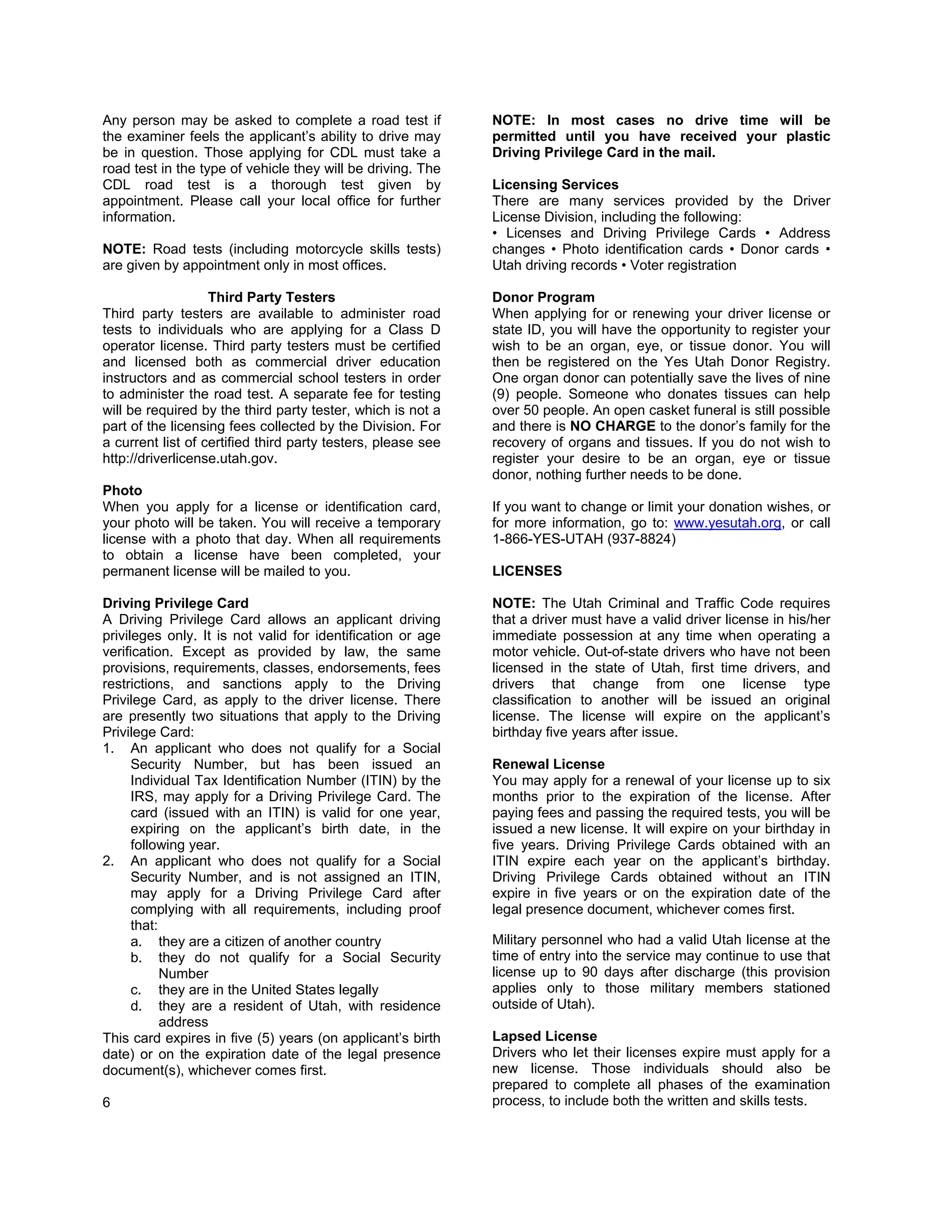
Any person may be asked to complete a road test if            NOTE: In most cases no drive time will be
the examiner feels the applicant’s ability to drive may       permitted until you have received your plastic
be in question. Those applying for CDL must take a            Driving Privilege Card in the mail.
road test in the type of vehicle they will be driving. The
CDL road test is a thorough test given by                     Licensing Services
appointment. Please call your local office for further        There are many services provided by the Driver
information.                                                  License Division, including the following:
                                                              • Licenses and Driving Privilege Cards • Address
NOTE: Road tests (including motorcycle skills tests)          changes • Photo identification cards • Donor cards
are given by appointment only in most offices.                Utah driving records • Voter registration

                   Third Party Testers                        Donor Program
Third party testers are available to administer road          When applying for or renewing your driver license or
tests to individuals who are applying for a Class D           state ID, you will have the opportunity to register your
operator license. Third party testers must be certified       wish to be an organ, eye, or tissue donor. You will
and licensed both as commercial driver education              then be registered on the Yes Utah Donor Registry.
instructors and as commercial school testers in order         One organ donor can potentially save the lives of nine
to administer the road test. A separate fee for testing       (9) people. Someone who donates tissues can help
will be required by the third party tester, which is not a    over 50 people. An open casket funeral is still possible
part of the licensing fees collected by the Division. For     and there is NO CHARGE to the donor’s family for the
a current list of certified third party testers, please see   recovery of organs and tissues. If you do not wish to
http://driverlicense.utah.gov.                                register your desire to be an organ, eye or tissue
                                                              donor, nothing further needs to be done.
Photo
When you apply for a license or identification card,          If you want to change or limit your donation wishes, or
your photo will be taken. You will receive a temporary        for more information, go to: www.yesutah.org, or call
license with a photo that day. When all requirements          1-866-YES-UTAH (937-8824)
to obtain a license have been completed, your
permanent license will be mailed to you.                      LICENSES

Driving Privilege Card                                        NOTE: The Utah Criminal and Traffic Code requires
A Driving Privilege Card allows an applicant driving          that a driver must have a valid driver license in his/her
privileges only. It is not valid for identification or age    immediate possession at any time when operating a
verification. Except as provided by law, the same             motor vehicle. Out-of-state drivers who have not been
provisions, requirements, classes, endorsements, fees         licensed in the state of Utah, first time drivers, and
restrictions, and sanctions apply to the Driving              drivers that change from one license type
Privilege Card, as apply to the driver license. There         classification to another will be issued an original
are presently two situations that apply to the Driving        license. The license will expire on the applicant’s
Privilege Card:                                               birthday five years after issue.
1. An applicant who does not qualify for a Social
      Security Number, but has been issued an                 Renewal License
      Individual Tax Identification Number (ITIN) by the      You may apply for a renewal of your license up to six
      IRS, may apply for a Driving Privilege Card. The        months prior to the expiration of the license. After
      card (issued with an ITIN) is valid for one year,       paying fees and passing the required tests, you will be
      expiring on the applicant’s birth date, in the          issued a new license. It will expire on your birthday in
      following year.                                         five years. Driving Privilege Cards obtained with an
2. An applicant who does not qualify for a Social             ITIN expire each year on the applicant’s birthday.
      Security Number, and is not assigned an ITIN,           Driving Privilege Cards obtained without an ITIN
      may apply for a Driving Privilege Card after            expire in five years or on the expiration date of the
      complying with all requirements, including proof        legal presence document, whichever comes first.
      that:
      a. they are a citizen of another country                Military personnel who had a valid Utah license at the
      b. they do not qualify for a Social Security            time of entry into the service may continue to use that
            Number                                            license up to 90 days after discharge (this provision
      c. they are in the United States legally                applies only to those military members stationed
      d. they are a resident of Utah, with residence          outside of Utah).
            address
This card expires in five (5) years (on applicant’s birth     Lapsed License
date) or on the expiration date of the legal presence         Drivers who let their licenses expire must apply for a
document(s), whichever comes first.                           new license. Those individuals should also be
                                                              prepared to complete all phases of the examination
6                                                             process, to include both the written and skills tests.
Duplicate License                                                 checks must be made payable to the Department
When you apply for a duplicate license, you must                  of Public Safety and must be in the correct
provide proof of your identity. At least TWO forms of             amount. If your check is returned by the bank
identification such as those already listed will be               without payment, you will be required to pay a
required. In addition, an eye test must be passed and             $20 service charge, if you wish to keep your
a new photograph taken. The expiration date of a                  driving privilege.
duplicate license will be the same date as the license      4.    All learners who wish to take a driving test must
it replaces.                                                      be accompanied by a licensed driver.

Address Change                                              Driver License Fees
If you have a change of address, you are required by        As of 7/01/08 (Non-Refundable)
law to furnish the new address and your license             Original Utah license (under 21)........................ $30.00
number to a Driver License office within TEN DAYS.          Original Utah license (over 21) .......................... $25.00
This may be done by mail, online at                         Learner permit application fee ........................... $15.00
http://driverlicense.utah.gov, or in person. This is very   Taxicab endorsement .......................................... $7.00
important, especially if you are eligible for the           Renewal of license ............................................ $25.00
“Extension/Renewal By Mail” program, because the            Renewal of license (65 years and older) ........... $13.00
post office will not forward mail from the Driver           Extension of license by mail .............................. $20.00
License Division.                                           Extension of license by mail (65 years and older) ....... $11.00
NOTE: Address changes for a CDL, Driving                    Duplicate license ............................................... $18.00
Privilege card, or registered sex offender must be          Utah identification cards .................................... $18.00
made in person at a Driver License office                   Commercial Driver License
(verification of the new address is required).                       Written test.......................................... $40.00
                                                                     Skills (driving) test ............................... $60.00
Utah Photo Identification Card                              Endorsements
Only a Utah resident may obtain a Utah Identification                Taxicab, tanker, hazardous materials,
Card. Proof of full legal name, date and place of birth,    passengers, school bus,
resident address, and Social Security Number must                    DBL/TPL, hazmat & tanker ................... $7.00
be provided. The Social Security Number cannot                       Motorcycle ............................................ $9.50
appear on the identification card, but must appear          Reinstatement fee after revocation (in addition to other
on the application. Photostatic copies of verification      required fees) .................................................... $30.00
documents are not acceptable. If an applicant is under      Reinstatement fee – alcohol/drug related .......... $65.00
16 years of age, a parent or legal guardian must sign       Alcohol/drug administrative fee ....................... $170.00
the application.                                            Check collection fee .......................................... $20.00

NOTE: The identity, resident address and social             Note: Fees are subject to change
security documents required for obtaining a Utah
Driver License are the same for obtaining a Utah
Identification Card.

!!!Save your time and gas!!!

It is always unfortunate when people spend time and
gas to come to one of our offices only to find out that
they cannot be helped for some reason. Here are
some hints to avoid having that happen to you:
1. Arrive early enough to be able to complete
      processing, including taking a written test. More
      time may be required if you need to take a road
      test. We cannot guarantee completion of required
      processing after closing time.
2. Road tests (including motorcycle skills tests) are
      given by appointment only at most offices. Road
      tests will not be given when conditions exists that
      could create unsafe driving. Those conditions
      include bad weather and vehicles that are not
      registered or are unsafe, i.e., broken windshields
      or no seat belts.
3. Although you may pay for your license by check,
      credit card, or cash, there are a few things you
      should know to prevent inconvenience. We
      cannot cash payroll or two-party checks. The                                                                                  7
CHAPTER 3                             SIGNALING
               RULES OF THE ROAD                         Signals shall be given by the use of turn signals,
                                                         stoplights, or your hand and arm. Good drivers always
SPEED                                                    signal their intentions well in advance. Signals are
In Utah, there is the “Basic Speed Law” which states     required:
that you may never drive faster than is reasonably       1. For two seconds before turning.
safe. However, when there is no sign, and where no       2. For two seconds before beginning any lane
special hazards exist, the following speeds are               change.
permitted:                                               3. Any time you pull away from a curb.
                                                         4. When you intend to slow down or stop. Your
20 miles per hour                                             brake lights will accomplish this if they are
1. When passing a school building or grounds                  operating properly and can readily be seen.
     during school recess.                               5. In addition, most cars have an emergency flasher
2. While children are going to or leaving school              system for use when your car is disabled on the
     during opening or closing hours or when flashing         highway. Use it.
     lights are operating.
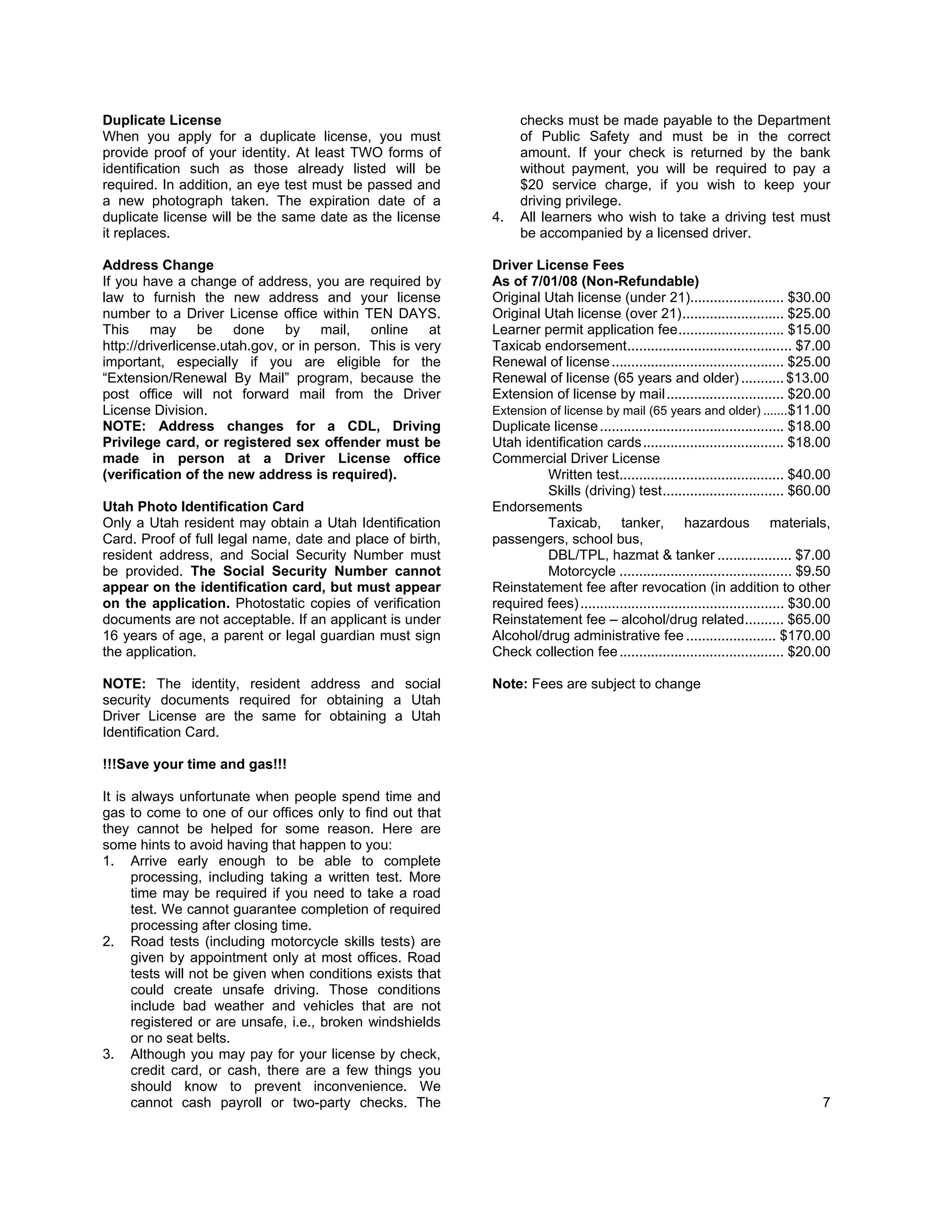
25 miles per hour – In any business or residential                   Signals for Stops and Turns
area.
45 miles per hour – MINIMUM SPEED on a freeway
under normal conditions.
55 miles per hour – On major highways, as posted.
65/75 miles per hour – On rural interstate highways.
Because “rural” interstate is defined by census                 Left Turn      Slow or Stop        Right Turn
boundaries, it may be confusing to know which areas
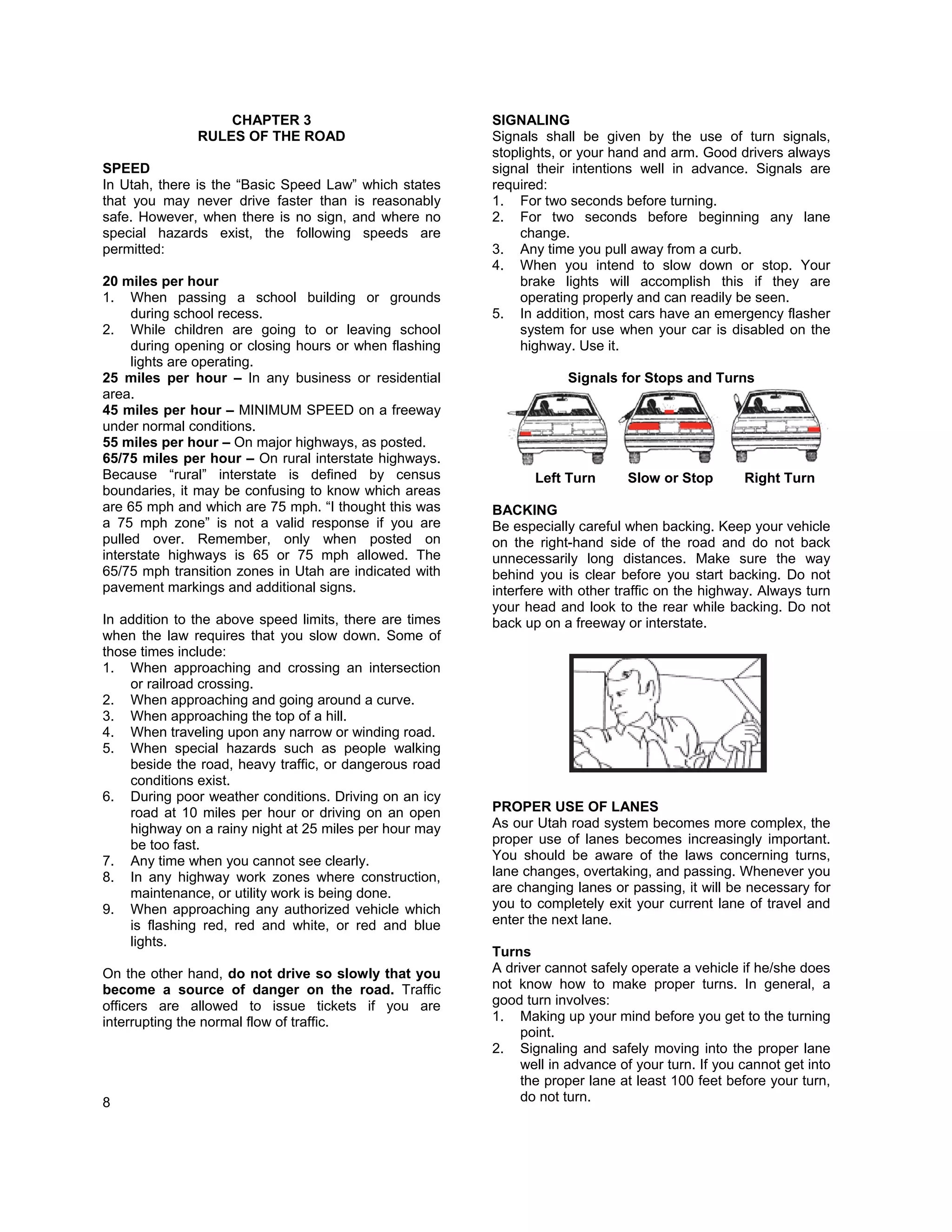
are 65 mph and which are 75 mph. “I thought this was     BACKING
a 75 mph zone” is not a valid response if you are        Be especially careful when backing. Keep your vehicle
pulled over. Remember, only when posted on               on the right-hand side of the road and do not back
interstate highways is 65 or 75 mph allowed. The         unnecessarily long distances. Make sure the way
65/75 mph transition zones in Utah are indicated with    behind you is clear before you start backing. Do not
pavement markings and additional signs.                  interfere with other traffic on the highway. Always turn
                                                         your head and look to the rear while backing. Do not
In addition to the above speed limits, there are times   back up on a freeway or interstate.
when the law requires that you slow down. Some of
those times include:
1. When approaching and crossing an intersection
    or railroad crossing.
2. When approaching and going around a curve.
3. When approaching the top of a hill.
4. When traveling upon any narrow or winding road.
5. When special hazards such as people walking
    beside the road, heavy traffic, or dangerous road
    conditions exist.
6. During poor weather conditions. Driving on an icy
    road at 10 miles per hour or driving on an open      PROPER USE OF LANES
    highway on a rainy night at 25 miles per hour may    As our Utah road system becomes more complex, the
    be too fast.                                         proper use of lanes becomes increasingly important.
7. Any time when you cannot see clearly.                 You should be aware of the laws concerning turns,
8. In any highway work zones where construction,         lane changes, overtaking, and passing. Whenever you
    maintenance, or utility work is being done.          are changing lanes or passing, it will be necessary for
9. When approaching any authorized vehicle which         you to completely exit your current lane of travel and
    is flashing red, red and white, or red and blue      enter the next lane.
    lights.
                                                         Turns
On the other hand, do not drive so slowly that you       A driver cannot safely operate a vehicle if he/she does
become a source of danger on the road. Traffic           not know how to make proper turns. In general, a
officers are allowed to issue tickets if you are         good turn involves:
interrupting the normal flow of traffic.                 1. Making up your mind before you get to the turning
                                                              point.
                                                         2. Signaling and safely moving into the proper lane
                                                              well in advance of your turn. If you cannot get into
                                                              the proper lane at least 100 feet before your turn,
8                                                             do not turn.
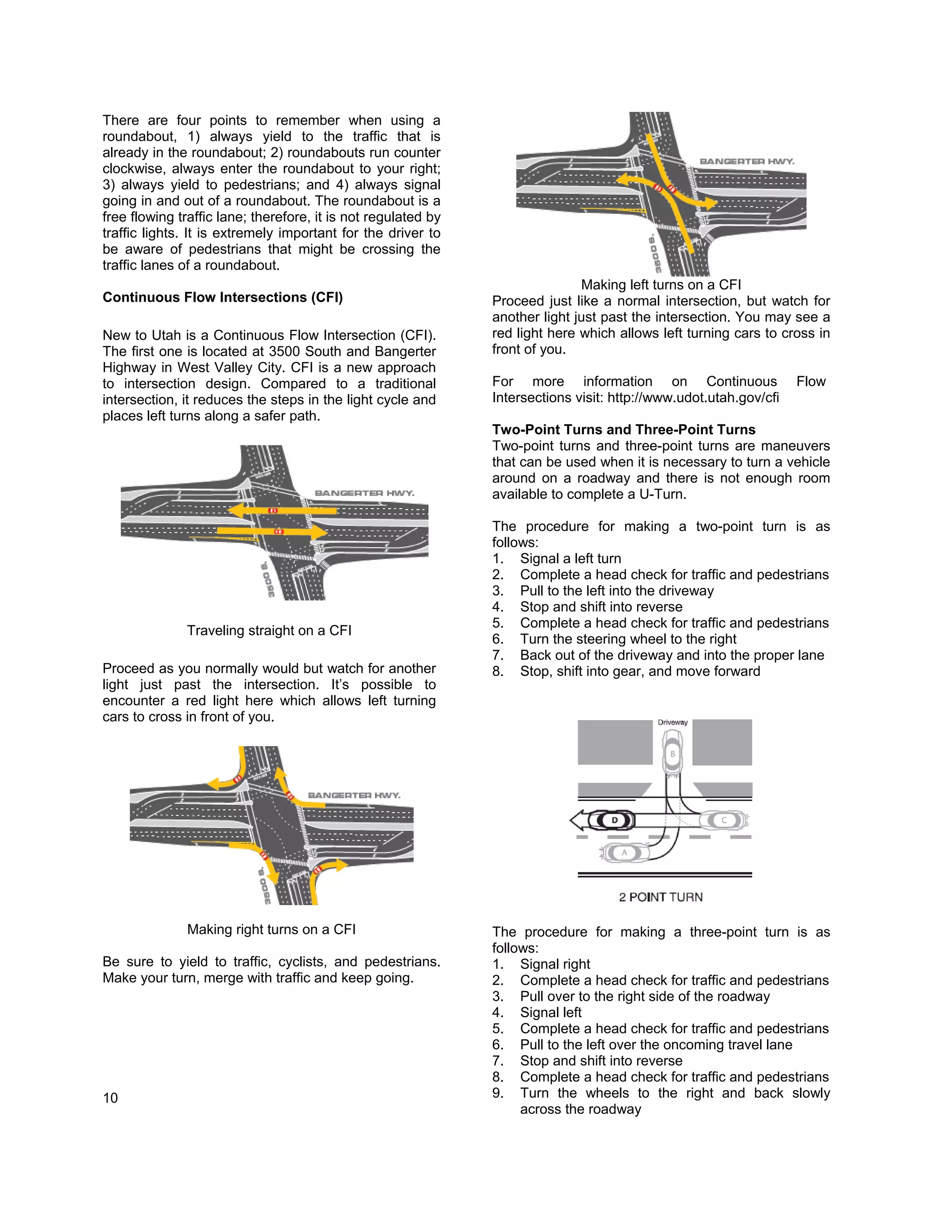
3.   Giving the proper turn signal at least two seconds   Turn From a Two-way Street onto a One-way
     before reaching the point where you plan to turn.    Street and From a One-way Street onto a Two-way
4.   Slowing down to a reasonable turning speed.          Street
5.   Making the turn properly. The following
     instructions and illustrations will help you make    You may turn left onto a one-way street from a one-
     proper turns. (Remember, a person may not            way street on a red light after first coming to a
     operate a vehicle over, across, or within any part   complete stop.
     of an island).

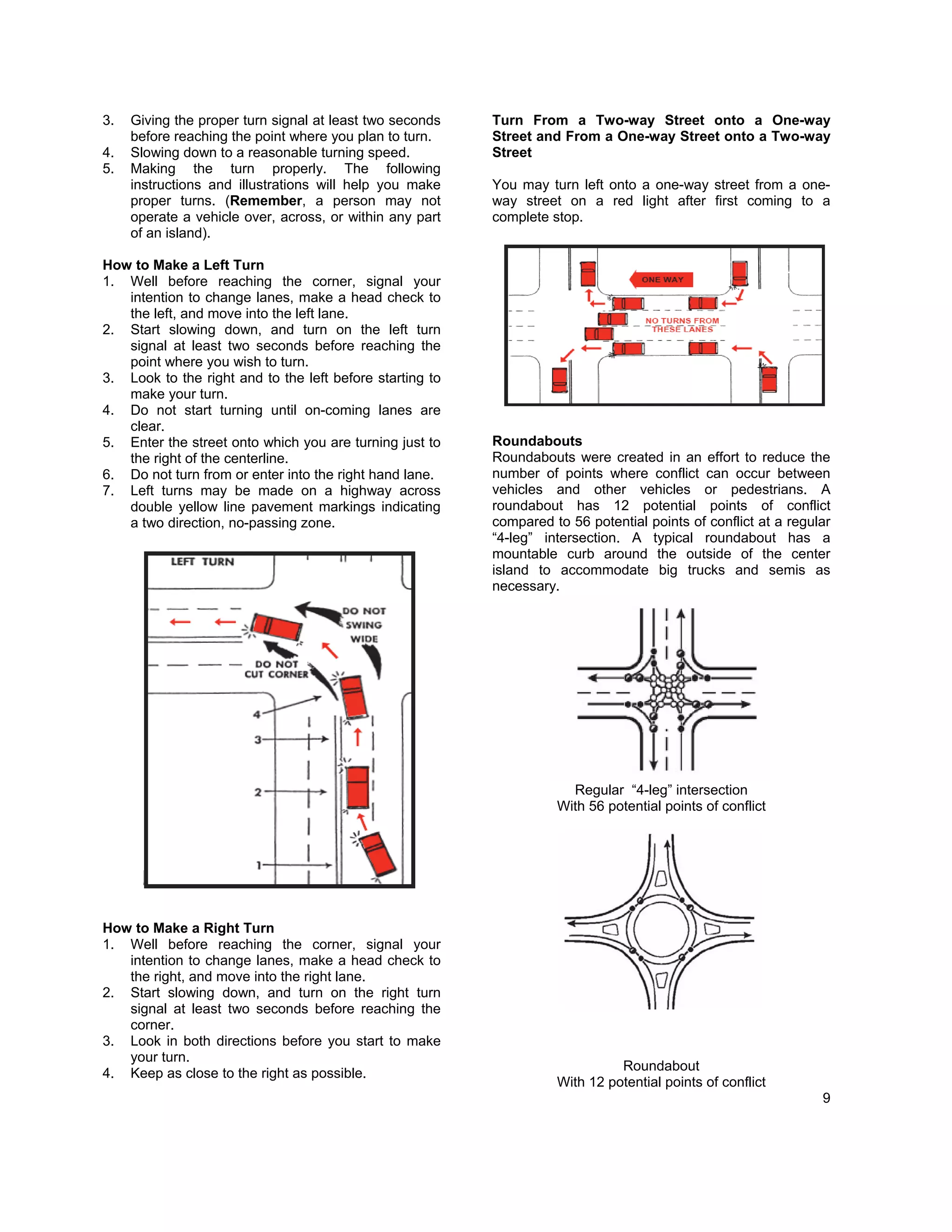
How to Make a Left Turn
1. Well before reaching the corner, signal your
   intention to change lanes, make a head check to
   the left, and move into the left lane.
2. Start slowing down, and turn on the left turn
   signal at least two seconds before reaching the
   point where you wish to turn.
3. Look to the right and to the left before starting to
   make your turn.
4. Do not start turning until on-coming lanes are
   clear.
5. Enter the street onto which you are turning just to    Roundabouts
   the right of the centerline.                           Roundabouts were created in an effort to reduce the
6. Do not turn from or enter into the right hand lane.    number of points where conflict can occur between
7. Left turns may be made on a highway across             vehicles and other vehicles or pedestrians. A
   double yellow line pavement markings indicating        roundabout has 12 potential points of conflict
   a two direction, no-passing zone.                      compared to 56 potential points of conflict at a regular
                                                          “4-leg” intersection. A typical roundabout has a
                                                          mountable curb around the outside of the center
                                                          island to accommodate big trucks and semis as
                                                          necessary.


                                                                      Regular “4-leg” intersection
                                                                    With 56 potential points of conflict


How to Make a Right Turn
1. Well before reaching the corner, signal your
   intention to change lanes, make a head check to
   the right, and move into the right lane.
2. Start slowing down, and turn on the right turn
   signal at least two seconds before reaching the
   corner.
3. Look in both directions before you start to make
   your turn.
                                                                              Roundabout
4. Keep as close to the right as possible.
                                                                    With 12 potential points of conflict
                                                                                                                9
There are four points to remember when using a
roundabout, 1) always yield to the traffic that is
already in the roundabout; 2) roundabouts run counter
clockwise, always enter the roundabout to your right;
3) always yield to pedestrians; and 4) always signal
going in and out of a roundabout. The roundabout is a
free flowing traffic lane; therefore, it is not regulated by
traffic lights. It is extremely important for the driver to
be aware of pedestrians that might be crossing the
traffic lanes of a roundabout.
                                                                              Making left turns on a CFI
Continuous Flow Intersections (CFI)                            Proceed just like a normal intersection, but watch for
                                                               another light just past the intersection. You may see a
New to Utah is a Continuous Flow Intersection (CFI).           red light here which allows left turning cars to cross in
The first one is located at 3500 South and Bangerter           front of you.
Highway in West Valley City. CFI is a new approach
to intersection design. Compared to a traditional              For more information on Continuous                  Flow
intersection, it reduces the steps in the light cycle and      Intersections visit: http://www.udot.utah.gov/cfi
places left turns along a safer path.
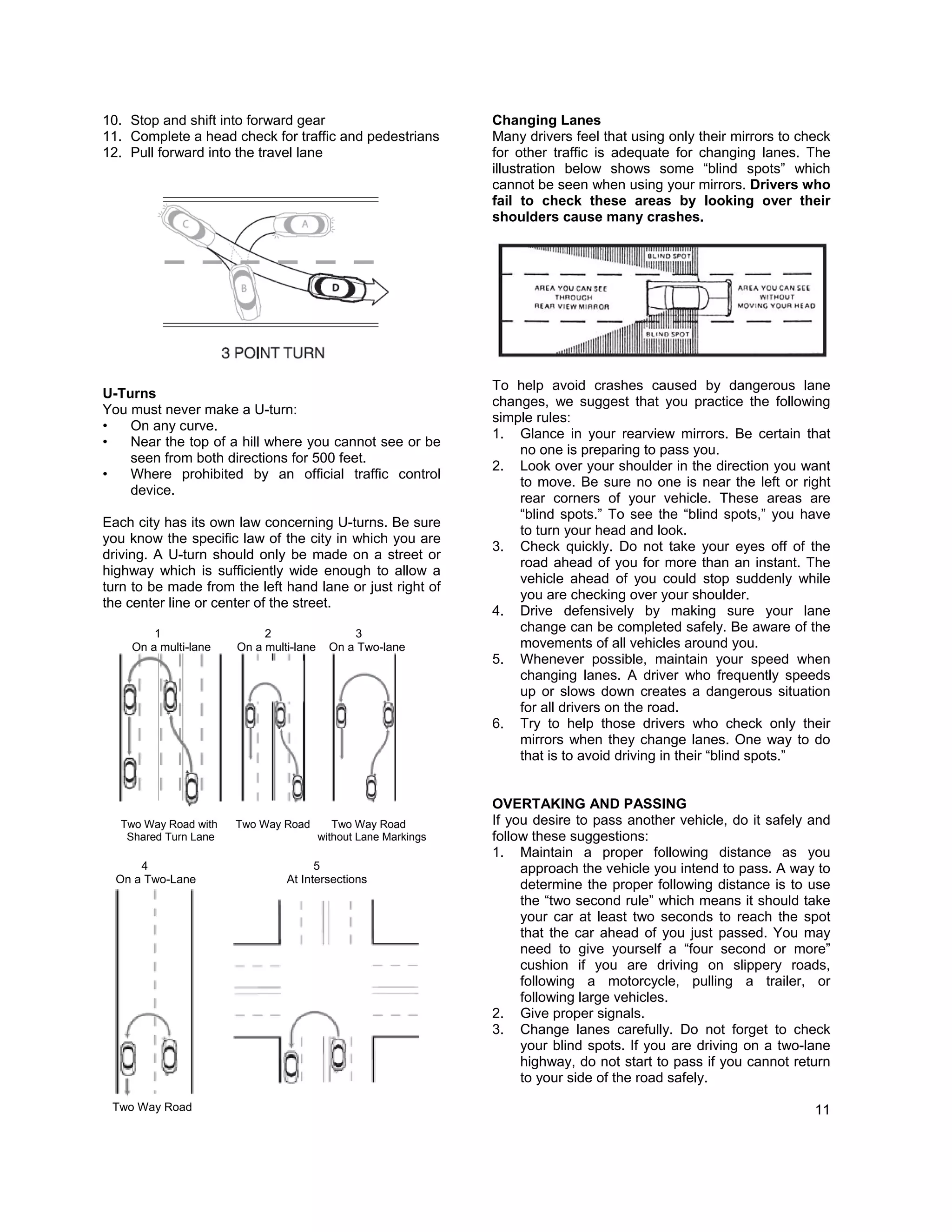
                                                               Two-Point Turns and Three-Point Turns
                                                               Two-point turns and three-point turns are maneuvers
                                                               that can be used when it is necessary to turn a vehicle
                                                               around on a roadway and there is not enough room
                                                               available to complete a U-Turn.

                                                               The procedure for making a two-point turn is as
                                                               follows:
                                                               1. Signal a left turn
                                                               2. Complete a head check for traffic and pedestrians
                                                               3. Pull to the left into the driveway
                                                               4. Stop and shift into reverse
                                                               5. Complete a head check for traffic and pedestrians
              Traveling straight on a CFI
                                                               6. Turn the steering wheel to the right
                                                               7. Back out of the driveway and into the proper lane
Proceed as you normally would but watch for another            8. Stop, shift into gear, and move forward
light just past the intersection. It’s possible to
encounter a red light here which allows left turning
cars to cross in front of you.


               Making right turns on a CFI                     The procedure for making a three-point turn is as
                                                               follows:
Be sure to yield to traffic, cyclists, and pedestrians.        1. Signal right
Make your turn, merge with traffic and keep going.             2. Complete a head check for traffic and pedestrians
                                                               3. Pull over to the right side of the roadway
                                                               4. Signal left
                                                               5. Complete a head check for traffic and pedestrians
                                                               6. Pull to the left over the oncoming travel lane
                                                               7. Stop and shift into reverse
                                                               8. Complete a head check for traffic and pedestrians
10                                                             9. Turn the wheels to the right and back slowly
                                                                    across the roadway
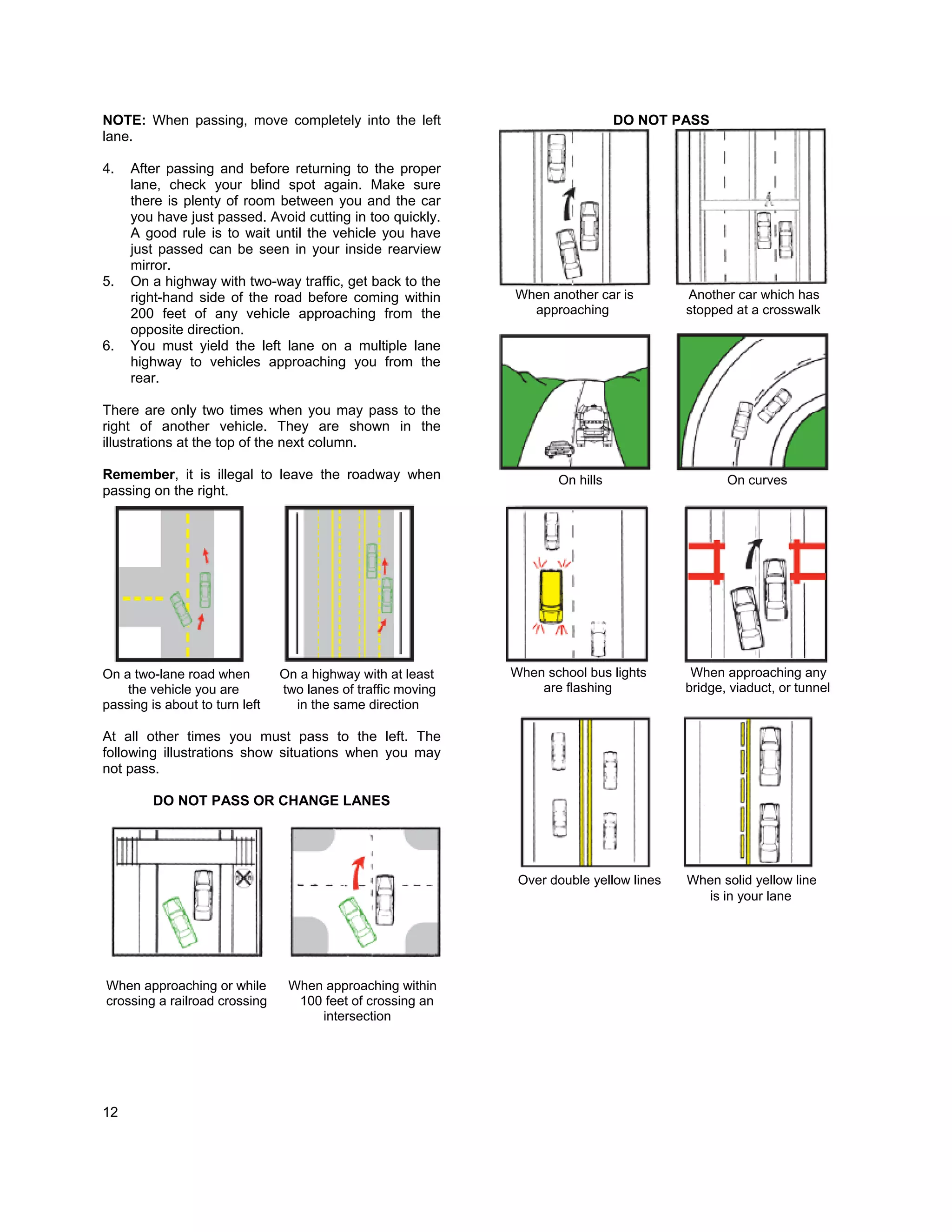
10. Stop and shift into forward gear                             Changing Lanes
11. Complete a head check for traffic and pedestrians            Many drivers feel that using only their mirrors to check
12. Pull forward into the travel lane                            for other traffic is adequate for changing lanes. The
                                                                 illustration below shows some “blind spots” which
                                                                 cannot be seen when using your mirrors. Drivers who
                                                                 fail to check these areas by looking over their
                                                                 shoulders cause many crashes.


                                                                 To help avoid crashes caused by dangerous lane
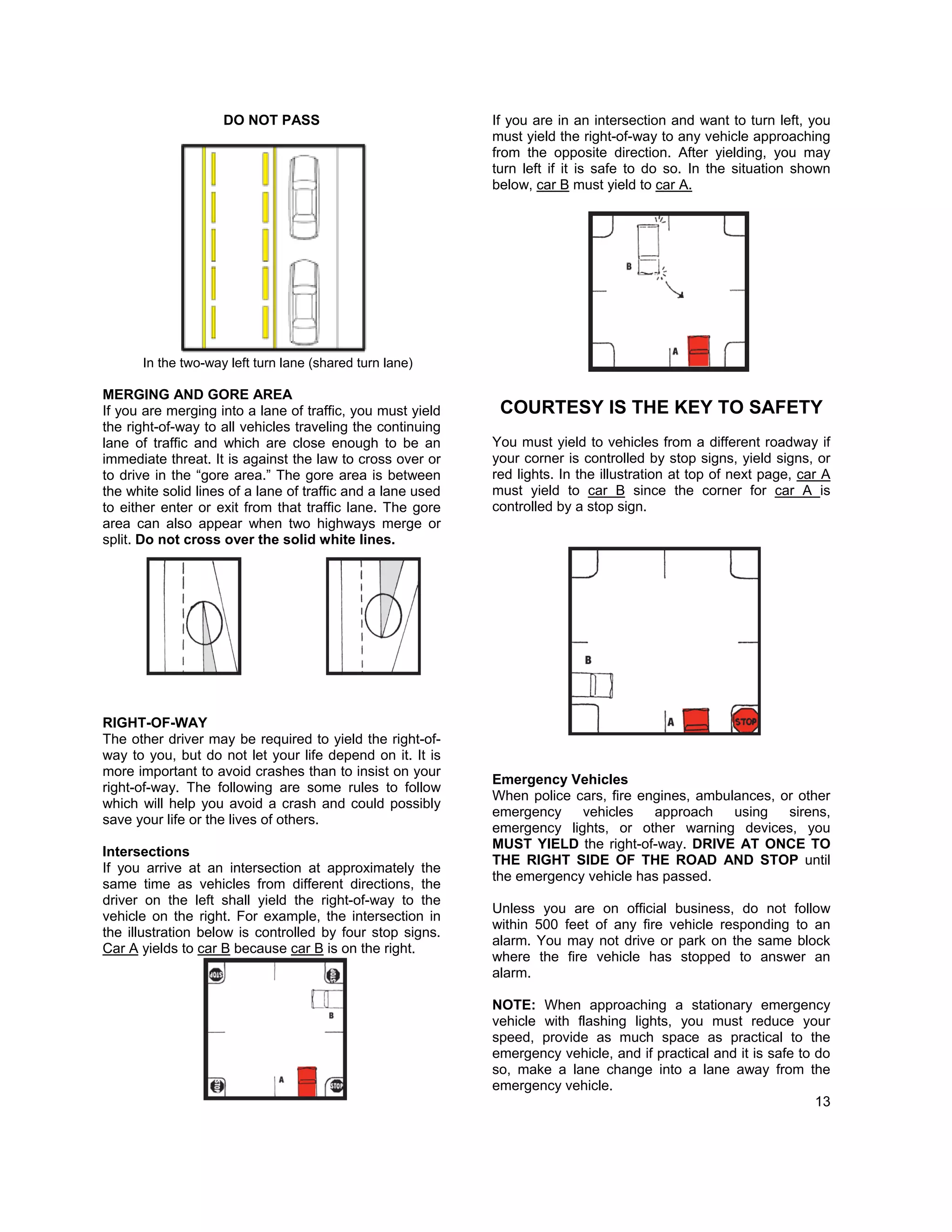
U-Turns
                                                                 changes, we suggest that you practice the following
You must never make a U-turn:
                                                                 simple rules:
•   On any curve.
                                                                 1. Glance in your rearview mirrors. Be certain that
•   Near the top of a hill where you cannot see or be
                                                                     no one is preparing to pass you.
    seen from both directions for 500 feet.
                                                                 2. Look over your shoulder in the direction you want
•   Where prohibited by an official traffic control
                                                                     to move. Be sure no one is near the left or right
    device.
                                                                     rear corners of your vehicle. These areas are
                                                                     “blind spots.” To see the “blind spots,” you have
Each city has its own law concerning U-turns. Be sure
                                                                     to turn your head and look.
you know the specific law of the city in which you are
                                                                 3. Check quickly. Do not take your eyes off of the
driving. A U-turn should only be made on a street or
                                                                     road ahead of you for more than an instant. The
highway which is sufficiently wide enough to allow a
                                                                     vehicle ahead of you could stop suddenly while
turn to be made from the left hand lane or just right of
                                                                     you are checking over your shoulder.
the center line or center of the street.
                                                                 4. Drive defensively by making sure your lane
        1                   2                  3
                                                                     change can be completed safely. Be aware of the
    On a multi-lane    On a multi-lane     On a Two-lane             movements of all vehicles around you.
                                                                 5. Whenever possible, maintain your speed when
                                                                     changing lanes. A driver who frequently speeds
                                                                     up or slows down creates a dangerous situation
                                                                     for all drivers on the road.
                                                                 6. Try to help those drivers who check only their
                                                                     mirrors when they change lanes. One way to do
                                                                     that is to avoid driving in their “blind spots.”


                                                                 OVERTAKING AND PASSING
   Two Way Road with   Two Way Road         Two Way Road         If you desire to pass another vehicle, do it safely and
    Shared Turn Lane                     without Lane Markings   follow these suggestions:
                                                                 1. Maintain a proper following distance as you
      4                               5                               approach the vehicle you intend to pass. A way to
  On a Two-Lane                 At Intersections
                                                                      determine the proper following distance is to use
                                                                      the “two second rule” which means it should take
                                                                      your car at least two seconds to reach the spot
                                                                      that the car ahead of you just passed. You may
                                                                      need to give yourself a “four second or more”
                                                                      cushion if you are driving on slippery roads,
                                                                      following a motorcycle, pulling a trailer, or
                                                                      following large vehicles.
                                                                 2. Give proper signals.
                                                                 3. Change lanes carefully. Do not forget to check
                                                                      your blind spots. If you are driving on a two-lane
                                                                      highway, do not start to pass if you cannot return
                                                                      to your side of the road safely.

 Two Way Road                                                                                                         11
NOTE: When passing, move completely into the left                               DO NOT PASS
lane.

4.   After passing and before returning to the proper
     lane, check your blind spot again. Make sure
     there is plenty of room between you and the car
     you have just passed. Avoid cutting in too quickly.
     A good rule is to wait until the vehicle you have
     just passed can be seen in your inside rearview
     mirror.
5.   On a highway with two-way traffic, get back to the
     right-hand side of the road before coming within         When another car is         Another car which has
     200 feet of any vehicle approaching from the               approaching               stopped at a crosswalk
     opposite direction.
6.   You must yield the left lane on a multiple lane
     highway to vehicles approaching you from the
     rear.

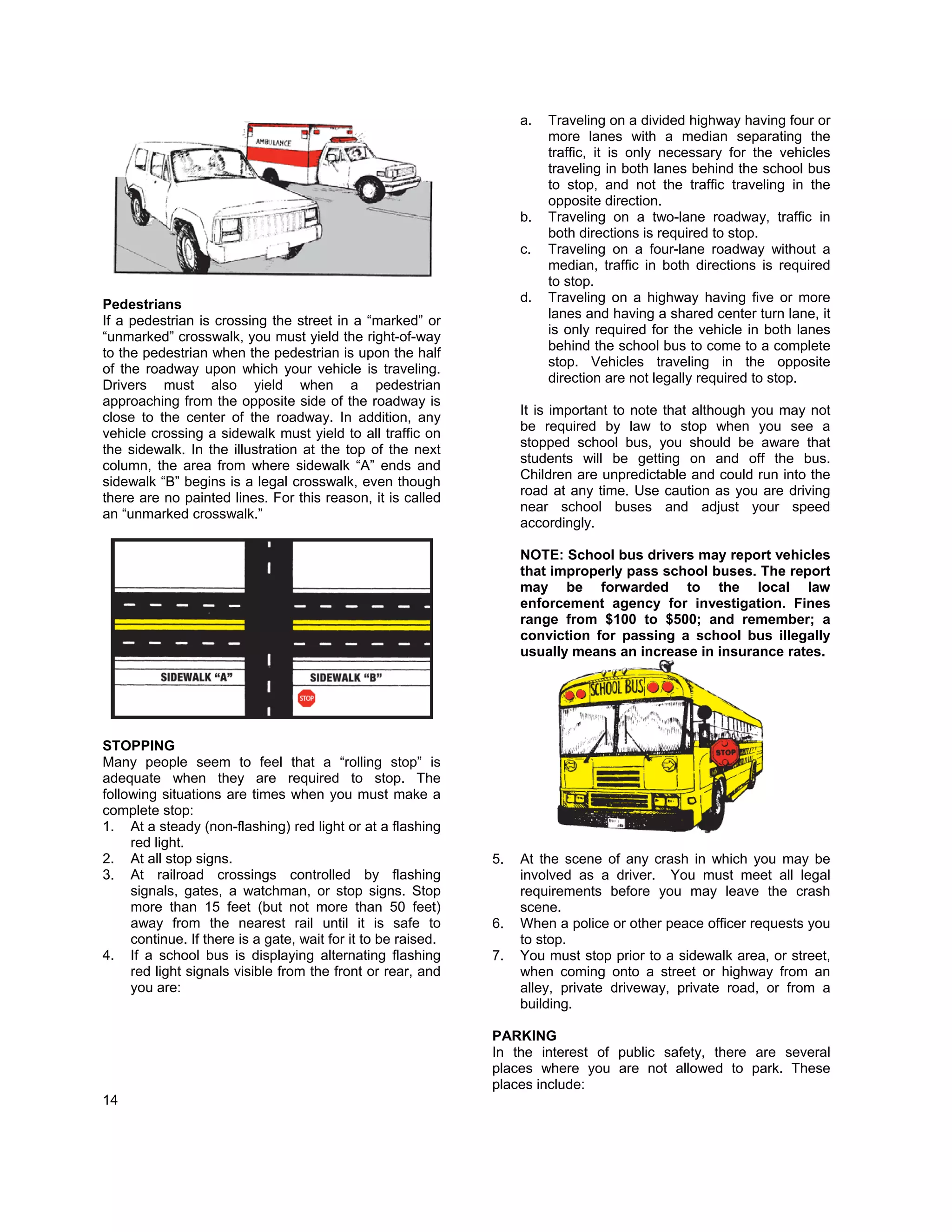
There are only two times when you may pass to the
right of another vehicle. They are shown in the
illustrations at the top of the next column.

Remember, it is illegal to leave the roadway when                    On hills                    On curves
passing on the right.


On a two-lane road when         On a highway with at least    When school bus lights       When approaching any
    the vehicle you are         two lanes of traffic moving       are flashing            bridge, viaduct, or tunnel
passing is about to turn left     in the same direction

At all other times you must pass to the left. The
following illustrations show situations when you may
not pass.

         DO NOT PASS OR CHANGE LANES


                                                               Over double yellow lines   When solid yellow line
                                                                                            is in your lane


When approaching or while        When approaching within
crossing a railroad crossing      100 feet of crossing an
                                     intersection


12
DO NOT PASS                              If you are in an intersection and want to turn left, you
                                                             must yield the right-of-way to any vehicle approaching
                                                             from the opposite direction. After yielding, you may
                                                             turn left if it is safe to do so. In the situation shown
                                                             below, car B must yield to car A.


      In the two-way left turn lane (shared turn lane)

MERGING AND GORE AREA
If you are merging into a lane of traffic, you must yield     COURTESY IS THE KEY TO SAFETY
the right-of-way to all vehicles traveling the continuing
lane of traffic and which are close enough to be an          You must yield to vehicles from a different roadway if
immediate threat. It is against the law to cross over or     your corner is controlled by stop signs, yield signs, or
to drive in the “gore area.” The gore area is between        red lights. In the illustration at top of next page, car A
the white solid lines of a lane of traffic and a lane used   must yield to car B since the corner for car A is
to either enter or exit from that traffic lane. The gore     controlled by a stop sign.
area can also appear when two highways merge or
split. Do not cross over the solid white lines.


RIGHT-OF-WAY
The other driver may be required to yield the right-of-
way to you, but do not let your life depend on it. It is
more important to avoid crashes than to insist on your
                                                             Emergency Vehicles
right-of-way. The following are some rules to follow
                                                             When police cars, fire engines, ambulances, or other
which will help you avoid a crash and could possibly
                                                             emergency    vehicles    approach    using   sirens,
save your life or the lives of others.
                                                             emergency lights, or other warning devices, you
                                                             MUST YIELD the right-of-way. DRIVE AT ONCE TO
Intersections
                                                             THE RIGHT SIDE OF THE ROAD AND STOP until
If you arrive at an intersection at approximately the
                                                             the emergency vehicle has passed.
same time as vehicles from different directions, the
driver on the left shall yield the right-of-way to the
                                                             Unless you are on official business, do not follow
vehicle on the right. For example, the intersection in
                                                             within 500 feet of any fire vehicle responding to an
the illustration below is controlled by four stop signs.
                                                             alarm. You may not drive or park on the same block
Car A yields to car B because car B is on the right.
                                                             where the fire vehicle has stopped to answer an
                                                             alarm.

                                                             NOTE: When approaching a stationary emergency
                                                             vehicle with flashing lights, you must reduce your
                                                             speed, provide as much space as practical to the
                                                             emergency vehicle, and if practical and it is safe to do
                                                             so, make a lane change into a lane away from the
                                                             emergency vehicle.
                                                                                                                   13
a.   Traveling on a divided highway having four or
                                                                         more lanes with a median separating the
                                                                         traffic, it is only necessary for the vehicles
                                                                         traveling in both lanes behind the school bus
                                                                         to stop, and not the traffic traveling in the
                                                                         opposite direction.
                                                                    b.   Traveling on a two-lane roadway, traffic in
                                                                         both directions is required to stop.
                                                                    c.   Traveling on a four-lane roadway without a
                                                                         median, traffic in both directions is required
                                                                         to stop.
                                                                    d.   Traveling on a highway having five or more
Pedestrians
                                                                         lanes and having a shared center turn lane, it
If a pedestrian is crossing the street in a “marked” or
                                                                         is only required for the vehicle in both lanes
“unmarked” crosswalk, you must yield the right-of-way
                                                                         behind the school bus to come to a complete
to the pedestrian when the pedestrian is upon the half
                                                                         stop. Vehicles traveling in the opposite
of the roadway upon which your vehicle is traveling.
                                                                         direction are not legally required to stop.
Drivers must also yield when a pedestrian
approaching from the opposite side of the roadway is
                                                                    It is important to note that although you may not
close to the center of the roadway. In addition, any
                                                                    be required by law to stop when you see a
vehicle crossing a sidewalk must yield to all traffic on
                                                                    stopped school bus, you should be aware that
the sidewalk. In the illustration at the top of the next
                                                                    students will be getting on and off the bus.
column, the area from where sidewalk “A” ends and
                                                                    Children are unpredictable and could run into the
sidewalk “B” begins is a legal crosswalk, even though
                                                                    road at any time. Use caution as you are driving
there are no painted lines. For this reason, it is called
                                                                    near school buses and adjust your speed
an “unmarked crosswalk.”
                                                                    accordingly.

                                                                    NOTE: School bus drivers may report vehicles
                                                                    that improperly pass school buses. The report
                                                                    may be forwarded to the local law
                                                                    enforcement agency for investigation. Fines
                                                                    range from $100 to $500; and remember; a
                                                                    conviction for passing a school bus illegally
                                                                    usually means an increase in insurance rates.


STOPPING
Many people seem to feel that a “rolling stop” is
adequate when they are required to stop. The
following situations are times when you must make a
complete stop:
1. At a steady (non-flashing) red light or at a flashing
     red light.
2. At all stop signs.                                          5.   At the scene of any crash in which you may be
3. At railroad crossings controlled by flashing                     involved as a driver. You must meet all legal
     signals, gates, a watchman, or stop signs. Stop                requirements before you may leave the crash
     more than 15 feet (but not more than 50 feet)                  scene.
     away from the nearest rail until it is safe to            6.   When a police or other peace officer requests you
     continue. If there is a gate, wait for it to be raised.        to stop.
4. If a school bus is displaying alternating flashing          7.   You must stop prior to a sidewalk area, or street,
     red light signals visible from the front or rear, and          when coming onto a street or highway from an
     you are:                                                       alley, private driveway, private road, or from a
                                                                    building.

                                                               PARKING
                                                               In the interest of public safety, there are several
                                                               places where you are not allowed to park. These
                                                               places include:
14
1.    On a sidewalk.                                          5.   If you are parked outside a business or residential
2.    In front of a public or private driveway.                    area, your vehicle must be clearly seen from 200
3.    In an intersection.                                          feet in each direction.
4.    Within 15 feet of a fire hydrant.                       6.   A courteous driver never parks too close to
5.    On a crosswalk.                                              another car. Parking too close to another car
6.    Within 20 feet of a crosswalk at an intersection.            could result in damage to your car.
7.    Within 30 feet of any flashing beacon, stop sign,
      yield sign, or traffic control signal.                                        PARALLEL
8.    In an area which is posted for pedestrian use or                               PARKING
      within 30 feet of the edges of that area.
9.    On any railroad tracks or within 50 feet of the
      nearest rail of a railroad crossing.
10.   Within 20 feet of the driveway entrance to any fire
      station. Also, if signs are posted, you may not
      park on the opposite side of the road if you are
      within 75 feet of the fire station entrance.
11.   Alongside or opposite any street excavation or
      obstruction when stopping or parking would block
      traffic.
12.   On the roadway side of any vehicle stopped or
      parked at the edge or curb of a street (this means
      that you cannot double park).
13.   On any bridge or other elevated highway
      structure or in a highway tunnel.
14.   At any place where official signs prohibit stopping.
15.   On the shoulder of any interstate highway. These
      areas may be used only if your vehicle breaks
      down or you are in physical distress.
16.   Red painted curbs or red zones.                         HIGHWAY WORK ZONES
                                                              Highway work zones are those portions of a street or
Many drivers avoid parallel parking or parking on a           highway where construction, maintenance or utility
hill. You can increase your driving abilities and             work is being done to the road, its shoulders, or any
convenience by learning those skills.                         other items related to the roadway. This includes work
                                                              such as underground and overhead utility work, tree
PARKING ON A HILL                                             trimming, and surveying activities. Highway work
1. If you are parking uphill beside a curb, turn your         zones are easily recognized by the presence of
   front wheels away from the curb and let your car           orange signing and other orange traffic control
   roll back so that the front tire touches the curb.         devices, flashing lights on equipment, and workers
                                                              dressed in highly visible clothing.

                                                              Each year nearly a thousand people are killed and
                                                              thousands are injured as a result of crashes in
                                                              highway work zones. Some of these are highway
                                                              workers, flaggers, or law enforcement officials.
                                                              However, over 80% of the fatalities and injuries are
                                                              suffered by drivers, passengers, and pedestrians.
                                                              Many of these work zone crashes are preventable.

                                                              Highway workers are trained on how to set up safe
                                                              work zones with directional traffic signs and devices.
                                                              Motorists and pedestrians are responsible for knowing
                                                              how to read and react to these directions. Paying
                                                              attention, and driving cautiously and courteously are
2.    Never leave your vehicle until you have set the         the most important steps in preventing crashes while
      emergency brake, stopped the motor, removed             driving through highway work zones.
      the ignition key, and locked the doors.
3.    Pull as far off the road as reasonable to park. If      NOTE: Double Fines: The courts are required to fine
      parking next to a curb, the back wheel of your car      a driver who speeds in a highway construction zone at
      must be no further than 12 inches away from the         least twice the amount of the regular fine for
      curb.                                                   speeding.
4.    If your parking would block the flow of traffic, find
      another place to park.                                                                                       15
Driving Tips                                                 Road Work Signs
Signing, traffic control devices, roadway markings,          Construction signs are used to notify drivers of
flaggers, and law enforcement officers are used to           unusual or potentially dangerous conditions on or near
protect highway workers and direct drivers safely            the traveled way. All temporary signs in work zones
through work zones or along carefully marked detours.        have an orange background and black letters or
In many work zone situations, normal speed limits            symbols. Most of these signs are diamond shaped,
may be reduced for safety reasons. These reduced             although some are rectangular.
speed limits are clearly posted within the work zone. If
there are no reduced speed limit postings, drivers
should obey the normal posted speed limit, but
continue to be alert and prepared for the unexpected.

When you travel through a work zone, remember
these three tips:
•   Adjust your speed to conditions.
•   Adjust your lane position away from workers and
    equipment.
•   Prepare for the unexpected.

Because of their traveling speed and size,
construction and repair equipment can present an
unusual condition to motorists and pedestrians. It is
important to note that equipment operators do not
have the same ability to see around their vehicles
as most drivers do. This makes it important for
drivers and pedestrians to give them extra room and
be prepared for the unexpected.

Night Work Zones
More and more roadway work is being completed after
dark. In many situations, night work is the better
alternative to restricting daytime use of the roadway,
primarily to relieve traffic congestion for motorists. The
hazards of driving through highway work zones are
increased at night. Use extreme caution when driving
through night work zones.

Flaggers Instructions
Flaggers and law enforcement officers are often used
to give specific directions in work zones. Drivers
should slow down and use extreme caution when
approaching a flagger or officer. Follow all directions
given by the flagger or officer.

Work Zone Traffic Control Devices
Highway work zones are set up according to the type
of road and the work to be done on the road. Various
traffic control devices are used in construction,
maintenance and work areas to direct drivers and
pedestrians safely through or around the work zone
and provide for the safety of the highway workers.

The most commonly used traffic control devices are
signs, barricades, drums, cones, tubes, and flashing
arrow panels. The basic color used for most of these
devices is orange.


16
CHAPTER 4
TRAFFIC SIGNS, SIGNALS AND ROAD MARKINGS

The use of signs, signals and pavement markings is
an effective method of indicating right-of-way,
direction of flow, and warnings of dangerous
conditions.

SIGNS
In this country, widespread changes in highway and
street traffic signs have occurred which affect every
motorist and pedestrian. The United States has
adopted an international-type system of traffic control
devices which uses pictures rather than written
messages. Understanding these signs is required for        Below are some examples of the various types of
you to take advantage of necessary road information.       signs used on the streets and highways of Utah. Being
All signs in Utah are placed in accordance with the        familiar with them and knowing what they mean can
manual on uniform traffic control devices.                 help you be a safer driver.

              Some International Signs                     STOP SIGNS
                                                           The STOP sign is the only 8-sided traffic sign. It
                                                           means that you must COME TO A COMPLETE STOP
                                                           before entering the intersection ahead and yield to
                                                           traffic close enough to be an immediate hazard. If
                                                           there is a crosswalk, stop BEFORE entering the
                                                           crosswalk.


Color and Shape of Signs
If you can readily recognize the general type of a sign,
you will be a better-prepared driver. One indication of
the meaning of an upcoming sign is its color.
Some of the colors used on traffic signs are:
1. Red - can mean two things. It can indicate times
     when you must stop and it can also show times                      REGULATORY SIGNS
     when certain traffic movements are not allowed.            Regulatory signs are used to control the
2. Black on White - used for signs involving specific               movement and flow of traffic.
     traffic laws. Speed limits and parking signs are
     good examples of how this regulatory color
     combination is used.
3. Yellow - indicates conditions under which extra
     caution must be used.
4. Orange - for highway construction and
     maintenance. Workers are usually present. Be
     alert and expect delays and possible sudden
     stops.
5. Blue - indicates services available.
6. Brown - indicates state or federal parks.
7. Green - indicates guidance such as exits or
     business loops.

The shape of a sign is another valuable aid for the
attentive driver. Learn what the following signs are by
their shape.


                                                                                                             17
School Warnings
                                                       School signs are located near schools for a good
                                                       reason. Children are often not careful around traffic
                                                       and do not understand the dangers of moving
                                                       vehicles. These signs can help you avoid a possible
                                                       tragic situation. Do not forget, the school speed law
                                                       is 20 mph.
All animal-drawn vehicles            This sign is
and all vehicles designed         displayed on the
for operation at 25 mph or            rear of all
less. Must display the          pedestrian vehicles.
standard triangular ”Slow
Moving Vehicle” emblem.

                    Warning Signs


                                                                        Railroad Warnings


                                                                            Railroad
                                                                        Advance Crossing

                                                                        Construction Signs

                                                       There are three types of barricades. Those with one or
                                                       two bars indicate a hazard in the road and will indicate
                                                       the direction you should go to avoid the hazard.
                                                       Barricades with three bars (as shown in the illustration
                                                       on top of next page) indicate the road is closed and
                                                       the stripes indicate the direction you should go.

18
Route Markers

                                                            The illustrations below depict signs which you will see
                                                            often. They are used to indicate the route on which
                                                            you are traveling and routes that connect with the
                                                            highway on which you are driving.


(If the stripes slant down to the right, go to the right
If the stripes slant to the left, go to the left )

Drivers must comply with official hand signal devices       NOTE: Vandalism and destruction of road signs cost
(flags, stop-and-go paddles, etc.) displayed by adult       taxpayers thousands of dollars each year and cause
flag persons wearing appropriate uniforms and               confusion and unsafe conditions for you and other
badges or insignia.                                         travelers.

                                                            TRAFFIC SIGNALS
                                                            Traffic signals are placed at intersections where the
                                                            volume of intersecting traffic is high. Their purpose is
                                                            to promote the orderly flow of traffic by assigning right-
                                                            of-way and to reduce crashes. Remember, traffic
                                                            signals are effective only when drivers are alert and
Below are six additional construction signs you may         attentive to their driving.
see while driving along our streets and highways.
                                                            A traffic signal preemption device is an instrument or
                                                            mechanism designed to interfere with the operation or
                                                            cycle of a traffic signal. You may not use or possess a
                                                            preemption device. You may not alter, deface,
                                                            damage, knock down, or remove any official traffic-
                                                            control device, official traffic-monitoring device, or
                                                            official railroad traffic-control device.

                                                            Protected/Permitted Signals
                                                            A driver turning left may see either the green arrow
                                                            (protected), or the solid green light (permitted) signal.


                       Services
A few of the most frequently seen signs indicating
services available are shown below.


                                                            Solid Green - Treat the same as any other
                                                            intersection. Turn left if there are no oncoming cars.
                                Mileposts                   The left arrow will not always come on.
                Mileposts are erected along most state
                highways to assist you in pinpointing       Solid Yellow - If you are in the intersection making a
                your location, to provide a means of        left turn when the yellow light appears, proceed as
                identifying the location of accidents and   soon as traffic allows and it is safe.
                other emergency situations and to aid
                in highway maintenance and servicing.       Yellow Arrow - Vehicles making left turns should
                Zero mileage begins at the south and        clear the intersection. The protected phase is about to
                west state boundaries or at junctions       end.
                where routes begin. The mileage
                numbers increase as you travel north        Green Arrow & Solid Red - Vehicles turning left have
                and east.                                   the right-of-way and may make a “protected” turn. Do
                                                            not go straight.
                                                                                                              19
Green Arrow & Solid Green - Left turn is “protected.”        RED ARROW LIGHT
Vehicles moving straight and turning right may               Right turns are prohibited. You must stop and remain
proceed.                                                     stopped until an indication to proceed is shown.

                                                             Special Situations at Traffic Lights
                                                             Regardless of what the traffic lights may indicate, you
                                                             must always obey the instructions of a police or other
                                                             peace officer at an intersection. For example, if the
                                                             light is green and an officer tells you to stop, YOU
                                                             MUST STOP. Also, even if you want to go straight and
                                                             an officer indicates that you must turn, you are
                                                             required to turn.

                                                             If you approach an intersection at which the traffic
                                                             lights are not working, you must first COME TO A
                                                             COMPLETE STOP before entering the intersection
                                                             and yield the right-of-way to any vehicle on the right
                                                             unless otherwise directed by a peace officer.

                                                             NOTE: “Not working,” means that the traffic lights
                                                             do not light up.

                                                             PAVEMENT MARKINGS
                                                             Pavement markings are useful aids to the driver. They
                                                             must be understood if you are to drive legally and
                                                             safely.

                                                             Stop Lines and Crosswalks
                                                             Stop lines and crosswalks are shown with white lines.
                                                             The illustration below shows these markings and
RED You must bring your vehicle to a stop at a clearly       where you must stop in various situations.
marked stop line, at the nearest crosswalk or before
entering the intersection. Remain stopped until the
light turns green. You may make a right turn on a red
light after coming to a FULL AND COMPLETE STOP,
unless posted otherwise.

YELLOW
Clear the intersection. It is an indication that the light
is about to turn red.

GREEN
Proceed if the intersection is clear. Yield to
pedestrians and vehicles that are still in the
intersection at the time of the light change.

GREEN ARROW LIGHT
Vehicles may proceed only in the direction of the
arrow after yielding to vehicles and pedestrians still in
the intersection at the time of the light change.            After stopping at the stop line, you may need to slowly
                                                             move your vehicle forward to a position which
FLASHING RED                                                 provides clear vision in both directions before entering
COME TO A COMPLETE STOP! Look both ways,                     the intersection.
yield to traffic and pedestrians and proceed when it is
safe to do so.                                               Color of Pavement Markings
                                                             The color of lane markings will give you an indication
FLASHING YELLOW                                              of what type of traffic you can expect to have on the
Reduce your speed, exercise caution at the                   roadway on which you are traveling.
intersection and proceed through the intersection at a
reduced speed.

20
Multi-Lane            One-Way                   NOTE: In the above three illustrations, there is a white
                                                            line painted on each side of the road. The area to the
                                                            right of these lines is not meant for normal traffic use.

                                                            The single broken line, as shown below, means that
                                                            traffic going in both directions may pass, but only if it
                                                            is safe to do so.

Lanes of traffic going in the same direction are divided                  Two-Lane Two-Way Road
with WHITE lane dividers. Examples would be multi-
lane and one-way streets.


                       Two-Way


                                                            Painted Islands
                                                            The solid double yellow median is a pavement
                                                            marking that does not designate a lane. These
                                                            markings show a painted island. DO NOT DRIVE OR
                                                            STOP IN THIS AREA FOR ANY REASON.


Lanes of traffic going in opposite directions are divided
with YELLOW lane dividers

Pavement Markings to Regulate Passing
Remember, in both of the below illustrated situations,
you may NEVER CROSS A SOLID YELLOW LINE to
pass.
                                                            Pavement Markings Indicating Turn Lanes
                                                            The two illustrations shown below are examples of
                                                            how pavement markings are used to indicate turn
                                                            lanes. The picture on the left shows typical left and
                                                            right turn lanes. Notice the use of painted arrows to
                                                            show which way traffic may travel. The picture on the
                                                            right shows a special purpose left turn lane. It is
              Multi-Lane Two-Way Road
                                                            reserved for vehicles turning left off of or onto the
                                                            roadway. You may not use this lane for passing or
                                                            extended travel. When making a left turn from the two
                                                            way left turn lane, you may not enter the lane more
                                                            than 500 ft. prior to making the turn, unless the last
                                                            car is more than 500 feet from the intersection.

              Two-Lane Two-Way Road

In the illustration below, vehicles in the bottom lane
may pass because there is a broken line in their lane.
However, vehicles traveling in the top lane may not
pass because the solid yellow line is in that lane.

              Two-Lane Two-Way Road


                                                                                                                  21
CHAPTER 5                                       a blinding snow storm, but you would get a ticket
               BASIC DRIVING SKILLS                                 for going over 45 mph if the conditions are
                                                                    unsafe.
As a driver, you must always be alert and use good             5.   Do Not Drive So Slowly That You Block
driving habits. A national study revealed that driver               Traffic - Slow driving is not always safe driving.
error is a factor in 75% of all car crashes. You might              If your speed is so slow that cars are piling up
be surprised to know that in Utah, the time of day                  behind your car, you are unsafe, discourteous,
when most crashes happen is between 2 P.M. and 6                    and breaking the law. In general, you should
P.M. Even though Utah has many roads and                            drive at a speed similar to that which the other
highways, the highest rate of reported car crashes                  cars around you are driving. However, you may
occur in shopping and business areas. When you are                  not legally drive faster than the posted speed
driving, it is very important to pay attention to the road          limit. This also applies to getting off the freeway.
and other cars and objects around you. You never                    There is a lane which is part of the exit ramp and
know when something unexpected is going to happen.                  which is meant for slowing down. You should not
In America, motor vehicle crashes are the leading                   start slowing down while still in freeway traffic.
cause of death for ages 1 to 24 years of age.
                                                                    NOTE: You can be issued a citation for
Just knowing the rules of the road is not enough. You               impeding traffic if a vehicle is following
need to develop special skills for special situations.              behind you in the left lane of travel on a multi
One skill that is useful in all situations, however, is             lane highway and you do not change lanes
defensive driving. Defensive driving involves looking               and allow for the other vehicle to pass.
out for possible crashes and mistakes other drivers
may make. It is important to learn how to be aware of          6.   Do Not Use an Entrance Ramp to Exit the
everything that happens around you. Over half the                   Freeway - It is illegal, even in a traffic jam.
drivers killed in two-car crashes in Utah were not at          7.   Do Not Insist on the Right-of-Way - Don’t let
fault. A lot of people think that crashes happen only to            getting onto the freeway be a battle to the death.
the other guy. Remember that one person in four will                It doesn’t have to be that way. If you are on the
be in some type of crash in the next four years. There              freeway and can safely allow a car on the
are ways to reduce your chances of being that person.               entrance ramp to enter traffic in front of you, do it.
Studies show your chances of being in a crash will be               Common courtesy is not a painful experience. If
much less if you take a defensive driving course. Even              you are entering a freeway, you should:
a defensive driver needs to have some special skills.               •    Look for an opening while you are on the
These skills include freeway driving, night driving and                  entrance ramp.
emergency measures.                                                 •    Speed up to freeway speed while you are in
                                                                         the acceleration lane.
FREEWAY DRIVING                                                     •    Merge into the right-hand lane without
A freeway gets us where we are going faster and                          disrupting the flow of traffic on the freeway.
safer than ever before. However, freeway driving is a                    Do not force yourself into traffic. You must
skill in itself. People drive faster and conditions are not              wait until it is safe to enter the traffic flow on
the same as in normal driving. We suggest some “DO                       the freeway.
NOTS” for freeway driving.                                          •    Do not cross over the solid white line to
1. Do Not Tailgate - You must remain at a proper                         enter a traffic lane.
      following distance and allow enough space in
      front of your vehicle to let any other vehicle safely
      enter and occupy that space. You should always
      remain at least two seconds in following distance
      behind the vehicle ahead of you. Under adverse
      conditions, the time needs to be increased.
2. Do Not Make U-Turns on the Freeway - It is
      illegal.
3. Do Not Drive in the Emergency Lane - The
      area of the freeway on the outside of the solid
      white line is for emergency use only. It is illegal to
      pass another vehicle or to stop to pick up               8.   Do Not Pass Unless it is Safe - Drivers who
      passengers in this lane.                                      force their way back and forth in traffic and do not
4. Do Not Insist on Going the Minimum Speed                         signal or look where they are going are a danger
      Limit During Bad Weather - The minimum                        not only to themselves, but to other drivers as
      speed limit on the freeway is 45 mph. However,                well. To pass safely you should:
      you must always consider the road conditions.
      You will not get a ticket for going under 45 mph in
22
•   Change lanes only to pass, get off the               off when you enter the freeway and find that traffic is
         freeway, or to enter the correct lane for an         moving quicker and smoother through areas where
         upcoming route separation in the freeway.            you previously experienced “stop-and-go” driving
     •   Never force your way between cars. If                because of the number of vehicles trying to enter the
         everyone maintained a safe following                 freeway at the same time. If you travel only 3 to 5
         distance, our freeways would run more                miles on the freeway, it is possible that taking surface
         smoothly.                                            streets rather than the freeway will actually take less
     •   Signal for two seconds before you change             time, even if you do have to stop at some
         lanes.                                               intersections.
     •   Always check your blind spots before starting
         to move into another lane.

9.   Do Not Drive in the Left Lane - The left lane on
     freeways is for passing only, unless there is
     heavy traffic. If another vehicle wants to pass you,
     you must move safely to the right, and you may
     not increase your speed until the other vehicle
     has passed you.

RAMP METERING

WHY? The population growth in Utah has resulted in
an increase in the number of vehicles using our
freeways. The result has been more frequent
congestion and unpredictable travel times on our
freeways. RAMP METERS help prevent slowdowns
and “stop-and-go” conditions that freeway travelers
frequently encounter at certain times of the day. There
are currently some ramp meters along the Wasatch
Front.

What are Ramp Meters? Ramp meters look almost
like traffic signals you see at intersections, except they
have only red and green lights. Ramp meters are
placed on freeway on-ramps and allow only one
(unless posted differently) vehicle to pass each time
the green light comes on.

How Does Ramp Metering Help? Ramp metering
occurs only when many vehicles are attempting to
enter the freeway. A lighted “METER ON” sign at the
entrance to an on-ramp will indicate when ramp
metering is in effect. If the “METER ON” sign is not
illuminated, drivers are allowed to enter the freeway
as usual. Because the “METER ON” sign is at the
entrance to a freeway on-ramp, drivers will be able to
decide whether to enter the on-ramp or take an
alternate route and avoid having to stop for the ramp
meter.

The ramp meter alternates between red and green
every few seconds, allowing one (unless posted
differently) vehicle to enter the freeway for each green
light. If the line of vehicles waiting to enter the freeway
gets too long, the ramp meter will automatically allow
vehicles to enter the freeway more frequently.

What are the Benefits? Waiting on the on-ramp may
take a few extra minutes, but that wait will usually pay


                                                                                                                     23
Utah’s Express Lanes/High-Occupancy Vehicle                   If a power outage occurs, the single point urban
Lane (HOV)                                                    interchange is not handled the same way as a four-way
Utah’s Express Lanes/HOV will entail 38 miles of I-15         stop. It is important to proceed with extreme caution
from 600 North in Salt Lake City to University Parkway        and courtesy. Most single point urban interchanges will
in Orem. A limited number of drivers will be allowed to       be supported by battery back-up. However, if a
use the carpool lanes without any passengers for a            situation occurs where there is not a battery back-up,
monthly fee. A motorcycle, a bus, or a vehicle with two       an officer will be dispatched to the scene for the
or more occupants may travel in the carpool lane              purpose of traffic control as soon as possible.
without the monthly fee. The Express Lanes will be
marked with two eight-inch white lines separated by
eight inches of space, offering a two-foot buffer zone
between the Express Lanes and the General Purpose
lanes.

Because it is illegal to cross a double white line,
permissive movements in and out of the carpool lane
will no longer be allowed except in 19 specific locations
that will have white dotted striping rather than the solid
lines. For more information on Utah’s Express Lanes,
please go to www.dot.utah.gov.
                                                              NIGHT DRIVING
                                                              When you drive at night, you are in an entirely new
                                                              environment. It is easy to become disoriented because
                                                              you no longer can use trees, houses or other objects to
                                                              help judge your location or distances. Glaring
                                                              headlights also hinder your judgment. Bicyclists and
                                                              pedestrians may dart in front of your car without
                                                              warning. You are more likely to become sleepy and
                                                              cause a crash. For these and other reasons, night
                                                              driving is an important skill you should develop. The
                                                              following are some rules everyone should follow:
                                                              1. If a car is coming toward you, dim your lights
                                                                   before you get within 500 feet of the oncoming car.
                                                                   If you are following a car, dim your lights when you
                                                                   are within 300 feet of the vehicle ahead of you.
Single Point Urban Interchange                                2. Use your lights any time conditions keep you from
Single point urban interchanges are becoming more                  seeing 1,000 feet ahead. These conditions include
common in the construction of freeway interchanges                 fog, stormy weather or dust.
today. It is a type of interchange that is located either     3. Turn on your headlights no later than half an hour
above or underneath the freeway and is designed in                 after sunset and keep them on until half an hour
such a way that the intersecting off-ramps and on-                 before sunrise.
ramps are diagonally adjacent to each other.                  4. If another driver does not dim his/her lights, dim
                                                                   yours anyway. Blinding the other driver to “get
These interchanges can be confusing. However, there                even” only results in two drivers not being able to
are some things that may help drivers when passing                 see. If you do not look at the lights of the oncoming
through a single point urban interchange. Dash lines               car, you should be able to maintain proper control
have been added to these interchanges in an effort to              of your vehicle and be able to continue your driving
guide drivers into the proper lanes. There are also                without mishap.
“wrong way” signs placed on the off-ramps and on-             5. It is wise to slow down a little at night. The law
ramps to help drivers avoid entering a ramp against                requires that you drive at a “reasonable and
traffic.                                                           prudent” speed. That means, especially at night, if
                                                                   you drive the posted speed limit, it may be too fast.
It is legal to make a U-turn from the off-ramp at a single    6. Be sure that you can stop within the distance that
point urban interchange and re-enter the freeway, as               is lighted by your headlights.
long as you are facing a green arrow at the time you          7. Do not drive at night with a dirty, foggy, or icy
begin the maneuver. When you re-enter the freeway on               windshield. Although not safe at any time,
the on-ramp, you will be facing a red arrow. The red               windshields that are not clear at night will cause
arrow is intended for the traffic adjacent to the light. Do        headlights and other lights to glare, which may
not stop your vehicle in the middle of the intersection;           result in the driver being blinded.
complete the maneuver once it is initiated.
24
8.   You should check all of your lights often to see         Some warning signs you may experience that signify
     whether any of the lights or signals are not             drowsiness while driving are:
     functioning properly.                                    1. You can't remember the last few miles driven.
9.   A person younger than 17 years of age, whether           2. You hit a rumble strip or drift from your lane.
     resident or nonresident of this state, may not           3. You keep pulling your vehicle back into the lane.
     operate a motor vehicle upon any highway of this         4. Your thoughts are wandering and disconnected.
     state between the hours of 12:00 a.m. and 5:00           5. You yawn repeatedly.
     a.m.     unless one of the following exceptions          6. You have difficulty focusing or keeping your eyes
     applies:                                                     open and your head up.
     a. the driver is accompanied by a licensed driver        7. You tailgate or miss traffic signs.
          at least 21 years of age who is occupying a         8. You have narrowly missed crashing.
          seat next to the driver;
     b. driving is in connection with a driver’s              NOTE: If you feel tired the best decision is to find a
          employment, including the trip to and from the      safe place to stop and get some sleep for at least
          driver’s    residence      and    the    driver’s   twenty (20) minutes, no matter the time of day
          employment;                                         especially if all passengers in the vehicle are
     c. the driver drives to the driver’s residence from      sleeping.
          a driver’s school-sponsored activity if:
          transportation to the activity is provided by a     EMERGENCY MEASURES
          school or school district, and the provided         If you think about emergencies and plan for them
          transportation commences from and returns to        before they happen, you will be less likely to panic and
          the school property where the driver is             will know what to do if they do occur.
          enrolled.
     d. The driver is on assignment of a farmer or            NOTE: Motorists have been seriously injured or even
          rancher and the driver is engaged in an             killed when attending to vehicle malfunctions such as
          agricultural operation; or                          flat tires, out of gas and other equipment problems on
     e. In an emergency.                                      and off of roadways. However, the majority of these
                                                              incidents are preventable. In an effort to minimize
STAYING AWAKE / NO DROWSY DRIVING                             death or injury the following simple rules for the road
When you are tired, your ability to drive is affected. You    should be followed.
will probably not be able to make decisions as quickly,
your reaction time will be increased and you may                  Please ensure that your vehicle is properly
become upset more easily. You may even fall asleep at             maintained, including the internal engine
the wheel. The following are some tips that may help              components.
you drive more safely at night:                                   Maintain adequate tire pressure and tread.
1. Get a good night’s sleep before you start a trip at            Be sure your vehicle has a sufficient amount of
     least seven (7) to nine (9) hours.                           fuel.
2. Do not take any medications that can make you                  If you do experience a vehicle malfunction, please
     sleepy. Medications taken the night before a trip            pull off the road as far as possible or exit the
     can remain in your body and cause you to be less             freeway completely if possible. A shredded tire or
     alert the next day.                                          bent rim is better than putting your life in danger.
3. Do not drive for long hours or distances - 300 to              If you are off to the side of the road and need
     400 miles a day is plenty. The time you save is not          help, please stay in your vehicle as much as
     worth the risk of driving when your reaction time is         possible and keep walking on the road to a
     slower and your power of concentration is less.              minimum. This opens the door of opportunity for
4. Try not to drive late at night. Your body is probably          injury or even death.
     used to going to sleep at that time and your                 Use your cell phone to call the local dispatch if
     reaction time will become slower. Travel at times            you need assistance. If you do not have access
     you are normally awake.                                      to a cell phone, please leave the hood of your car
5. Take rest breaks regularly, even if you don’t feel             up and your hazard lights on. This will advise the
     tired. Let someone else drive part of the time. Stop         traveling public that you need assistance.
     for a bit of refreshment every 100 miles or every            Inform family members or other persons when to
     two hours of driving time.                                   expect you at your destination.
6. Plan for stops in cities where you may stay for the            Have an emergency kit in the trunk of your vehicle
     night.                                                       with blankets, extra food and water, to sustain you
7. Shift your eyes from one part of the road to                   and your family.
     another. Try to enjoy the scenery without
     neglecting your driving. Look at objects near and        Tire Blowout
     far, left and right.                                     Do not slam on the brakes. Let your car roll so that you
                                                              can steer more easily. Hold the wheel tightly and slowly
                                                              apply your brakes.
                                                                                                                    25
When you have slowed down enough, pull all the way              Gas Pedal Sticks
off the road. Pick a level spot if possible, turn on your       Put your car into neutral or push in the clutch. Pull off
emergency flashers and change the tire.                         the road and turn off the engine.

Brake Failure                                                   Steering Wheel Locking Device
Try to get some brake pressure by pumping the brake             It is dangerous to turn your vehicle’s ignition to the lock
pedal. Shift to a lower gear to help slow down the car.         position while it is in motion. If this happens and you try
Try to slow down and stop by using your parking brake.          to turn the steering wheel, it will lock and you will lose
If you still cannot stop and are going downhill, try to         control of the vehicle.
drive into heavy bushes, snow, or a sandbank.
                                                                Car Coming Towards You in Your Lane
Skidding                                                        Honk your horn or blink your lights. The other driver
Most of us think of ice and sand when we think of               may be asleep. If this does not work, swerve to the
skidding. Remember that skidding can also happen on             RIGHT, if possible. Avoid swerving into the oncoming
roads that are wet. Your car may start to “hydroplane”          lane or traffic. If the other driver wakes up, he/she will
at speeds over 35 mph. Hydroplaning occurs when                 probably try to move the car back into the original lane
your front tires start to ride on water instead of the road.    of travel. If you are in that lane because you swerved
As you go faster, the problem becomes worse and you             the wrong direction, you may end up in a head-on
will lose control of your steering.                             collision.

In Utah, we also have a special problem with “black
ice.” Black ice is very difficult to see on the roadway
and appears more like a wet spot than a patch of ice.
Unfortunately, many crashes occur each year from
skids caused by black ice.

The best policy is to keep a skid from happening. Slow
down to a speed at which you can control the car. If
you do skid, slowly take your foot off the gas pedal. If
your rear wheels skid to the right, turn your front wheels
to the right. If the rear wheels skid to the left, turn left.   Distracting Situations
Do not steer too far though, as that will make the car          Sometimes while driving you may drop something, lose
skid in the other direction. Do not slam on your brakes.        a contact lens, be stung by a bee, or be distracted in
Once your car regains traction, straighten out your             some other way. Some people panic when something
wheels.                                                         like this happens. They become more concerned with
                                                                the problem than about their driving and often run off
                                                                the road or into the car in front of them. Don’t let this
                                                                happen to you. If you have a problem or there is a
                                                                distraction, pull over to the side of the road immediately
                                                                and then take care of the problem.

                                                                NOTE: A New law effective May 12, 2009, prohibits the
                                                                use of a handheld wireless communication device for
                                                                text messaging or electronic mail communication while
                                                                operating a moving motor vehicle on a highway in this
                                                                state.

Car Stalling on the Highway                                     If You Need Help
Turn on your emergency flashers immediately and                 Pull to the side of the road, turn on your emergency
move your car off the road as soon as you can. If your          flashers, raise your hood, and tie something white or
car is near a traffic lane or where it is hard to be seen,      orange on the antenna or left door handle.
get everyone out and away from the car. If you have
them, use flares to warn other drivers. (It is a good idea      RAILROAD CROSSINGS
to always have flares in your trunk.)                           As the number of driver’s increases, more and more
                                                                people die at railroad crossings. In a car-train collision,
Headlight Failure                                               the odds that those in the car will live are not very
Slow down and get off the road. Use your flares or              good. Learn what to do at railroad crossings so that you
other emergency warning devices to warn other drivers.          do not have a collision. Use extreme caution at all
Check the terminals on the battery to see if they are           railroad crossings and remember:
loose. NEVER drive at night without lights.

26
Pavement Markings
•   Always slow down when you come to a railroad            A stop line, an “X” and the letters “RR” may be painted
    crossing.                                               on the pavement in front of railroad crossings. These
•   Never pass a car that is going your direction at a      markings warn you to be aware of the crossing ahead
    railroad crossing.                                      and to pay particular attention to the possible approach
•   Do not park closer than 50 feet from a railroad         of a train.
    crossing unless signs indicate that you may or it is
    allowed by local law.                                   Railroad Crossbuck Signs
•   When you stop at a crossing, you must be                Crossbuck signs are found at all public crossings. If
    between 15 and 50 feet from the nearest rail.           there are more than one set of tracks, a sign below the
•   Trains sound their horns as they approach a             crossbuck indicates the number of tracks. Be prepared
    crossing; therefore, turning down the car radio is a    to stop at the tracks if a train is coming. You must
    good safety measure.                                    yield to train traffic.
•   Every railroad crossing should be taken seriously.
•   At night, do not assume that a train is not coming
    just because you do not see any light. Slow down
    or stop and look before crossing the tracks.
•   If lights are flashing, you must come to a complete
    stop. You may not proceed while the lights are
    flashing. After coming to a complete stop, if you
    suspect the flashing lights are not working
    properly, you may drive through the railroad
    crossing only if you have a clear line of sight of at
    least one mile down the tracks in both directions,
    there is not evidence of an approaching train, and
    you can cross the tracks safely.
•   You may not drive through, around, or under any
    crossing gate or barrier at a railroad crossing while
    they are down or being opened or closed.
                                                            Flashing Lights
                                                            Flashing lights and bells are used with crossbuck signs
Warning Devices
                                                            at many railroad crossings. Always STOP when lights
Public railroad crossings have been marked with
                                                            begin to flash or bells begin to ring, which means a
warning devices for your safety by highway
                                                            train is coming. If there are more than one set of tracks,
departments and the railroad companies. Learn what
                                                            make sure all tracks are clear before starting to cross.
the warning devices are and watch for them. With these
warning devices and caution on your part, railroad-
crossing crashes may never happen.

Advance Warning Signs
Advance warning signs are posted before you reach
the crossing and tell you to slow down, look, listen, and
be prepared to stop at the crossing ahead.


                                                                                                                   27
Gates                                                      Notify local authorities immediately. If a train is coming,
Gates are used with flashing light signals at some         stay clear of the tracks and RUN TOWARD THE
railroad crossings. Stop when the lights begin to flash    APPROACHING TRAIN at an angle away from the
and before the gates begin to lower across your lane of    train. By moving in the direction of the approaching
traffic. Remain stopped until the gates are raised and     train, you will be less likely to be hit by flying debris. If
the lights stop flashing. DO NOT DRIVE AROUND THE          no train is in sight, post lookouts and try to start or
GATES.                                                     move the vehicle.

                                                           Watch Out for Second Trains
                                                           When the last car of a train passes the crossing, do not
                                                           proceed until you are sure no train is coming on
                                                           another track, especially from the other direction.

                                                           Never Drive Around Gates
                                                           If the gates are down, stay in place and do not cross
                                                           the tracks until the gates are raised and the lights stop
                                                           flashing. It is against the law to drive around gates.
                                                           Never Race a Train
                                                           Racing a train to the crossing is foolish. You will never
                                                           have another chance if you lose.

Special Vehicles
                                                           Watch for Vehicles That Must Stop at Railroad
1. Motorcycles and Bicycles - Riders should
                                                           Crossings
   approach a railroad crossing with caution. Do not
                                                           Be prepared to stop when you are following buses or
   swerve to get a better angle for crossing.
                                                           trucks which are required to stop at railroad crossings.
2.   School Buses - Drivers are required to stop at all
                                                           Don’t Misjudge the Speed and Distance of the Train
     railroad crossings. The driver must check both
                                                           The large size of engines and trains make them appear
     directions and listen for approaching trains,
                                                           to be moving much slower than they really are. If there
     proceed only when it is clearly safe to do so and
                                                           is any doubt, stop and wait for the train to pass.
     never shift gears on the crossing.
3.   Trucks Carrying Hazardous Materials - Drivers
                                                           At Night Be Especially Alert at Railroad Crossings
     are required to stop at all railroad crossings.
                                                           Be sure you can stop within the distance illuminated by
     Drivers should make a safe, gradual stop to
                                                           your headlights. Also be aware that lights on trains can
     minimize the possibility of causing a crash. Do not
                                                           malfunction and you might not see an approaching train
     shift gears when crossing the tracks. When
                                                           until it is too late.
     possible, reroute away from railroad crossings or
     use a crossing which utilizes flashing red lights
                                                           Be Especially Careful and Reduce Speed for
     and/or gates.
                                                           Obstructions
                                                           Use common sense. If your view of the tracks is
SAFETY TIPS FOR USING RAILROAD CROSSINGS
                                                           blocked, slow down and proceed with more caution
                                                           than normal.
Expect a Train on Any Track at Any Time
Most trains do not run on a fixed schedule. Be cautious
                                                           LIGHT RAIL
at a railroad crossing any time of the day or night.
                                                           A light rail system is currently operating in Salt Lake
                                                           City and is being expanded. Light rail cars receive
Don’t Get Trapped on a Railroad Crossing
                                                           power from overhead electric lines. Each car is
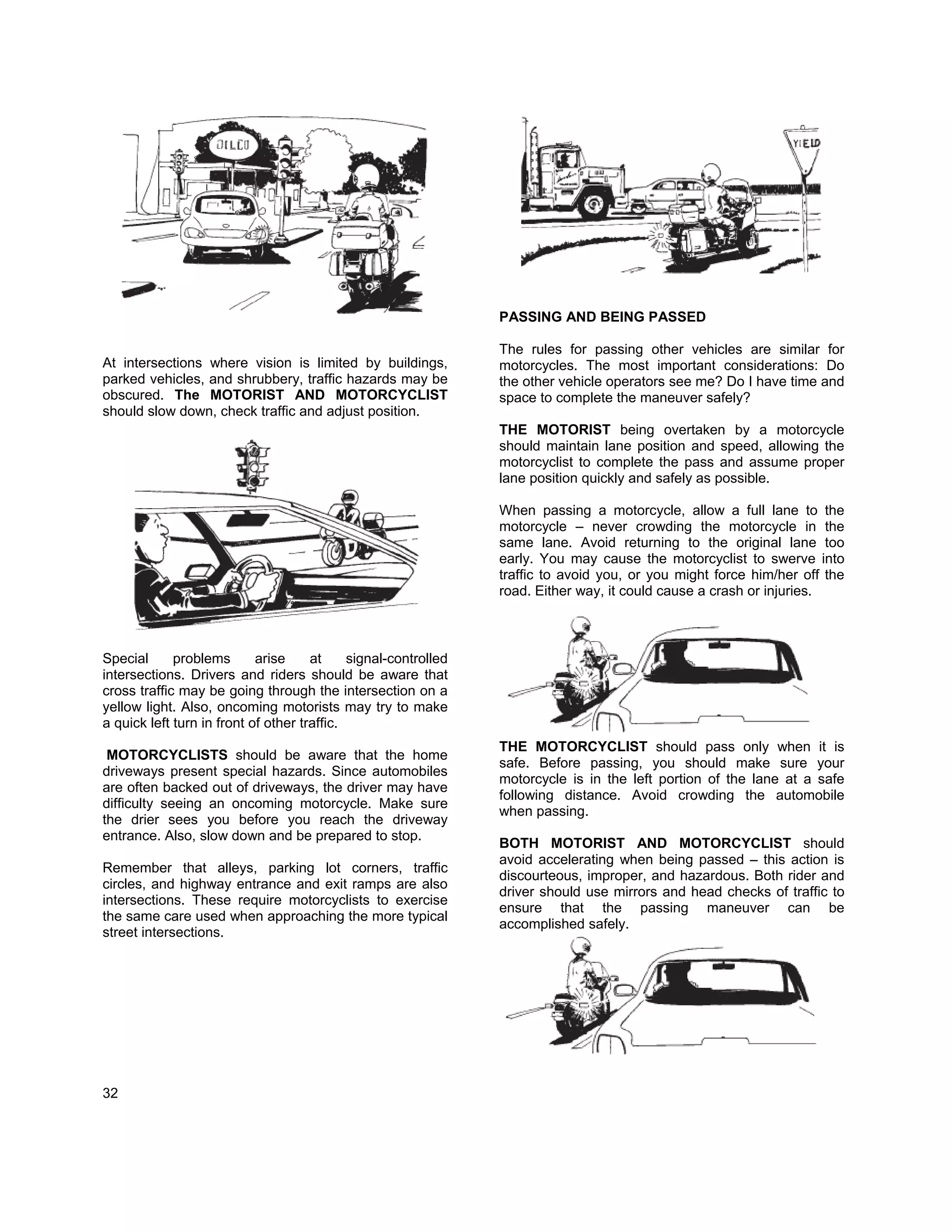
Don’t drive onto a railroad crossing until you are sure
                                                           approximately 88 feet long and weighs more than
you can clear all the tracks safely. Once you have
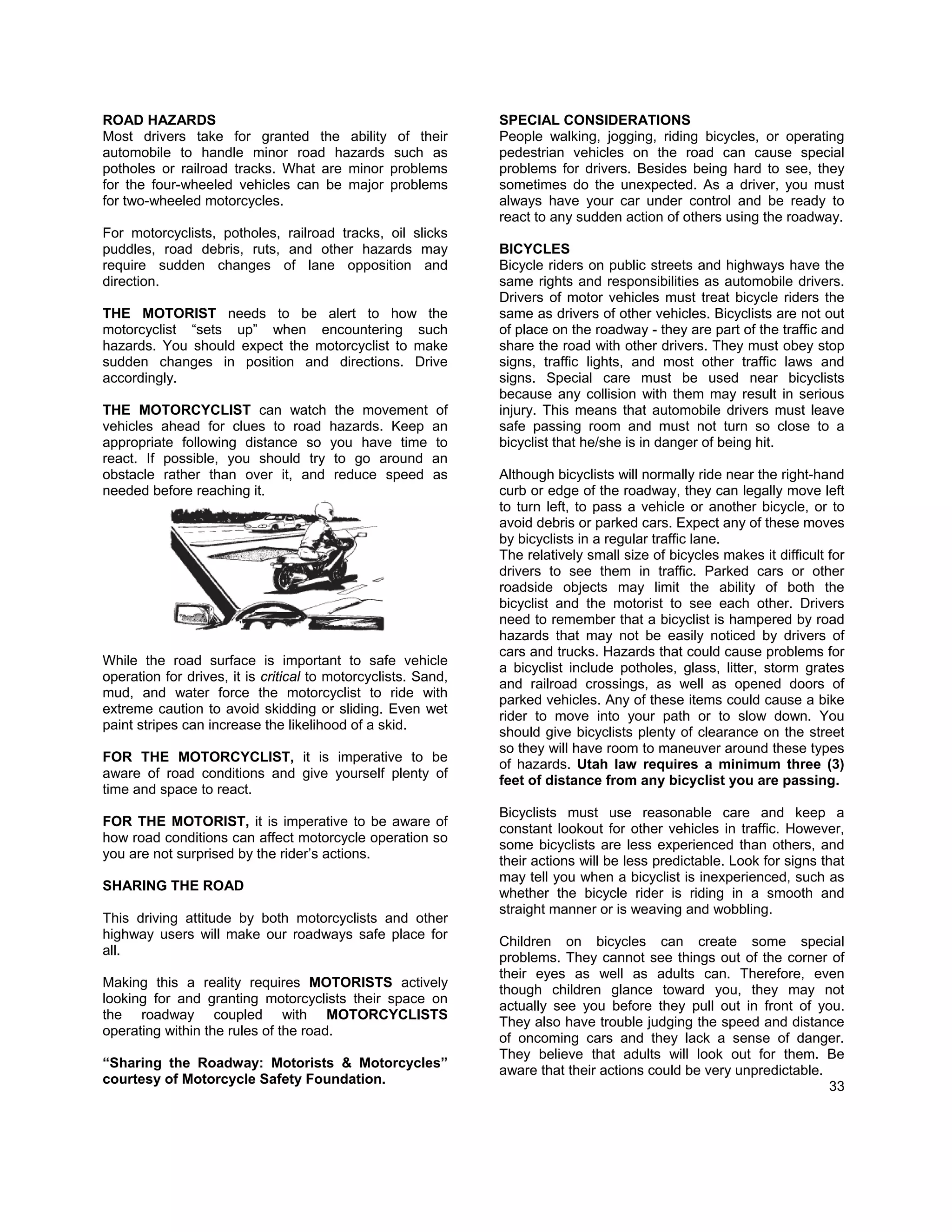
                                                           88,000 pounds. Trains may be from one to four cars
started across the tracks, keep going, even if you see a
                                                           long.
train coming. Do not shift gears while crossing tracks -
your car could stall.
                                                           Light Rail cars accelerate very quickly. A light rail
                                                           car can accelerate to 55 miles per hour in just 19
Get Out of Your Vehicle if it Stalls
                                                           seconds. Most light rail trains will operate at 55 miles
If your vehicle stalls on a crossing, immediately get
                                                           per hour within the railroad corridor. Trains will operate
everyone out of the car and off the tracks.
                                                           at 25 miles per hour on the streets in Salt Lake City. Do
                                                           not pull in front of light rail trains or drive on the
                                                           tracks in the Central Business District.
28
Once the flashing lights and crossing arms are                that motorists who don’t see him/her in traffic constantly
activated at grade crossings, the trains will pass            violate his/her right-of-way.
through intersections in just a matter of seconds.
Crossing arms will be down for only 30 to 40 seconds          It is vital for motorists to condition themselves to look
as the light rail passes.                                     for motorcyclist in traffic. The appearance of a
                                                              motorcycle in traffic situations when the motorist is not
Rail vehicles may use white lights in their traffic control   prepared can lead to a hazardous situation. A
signals.                                                      University of Southern California (USC) study showed
                                                              that motorists’ failure to detect and recognize
DO NOT TRY TO BEAT THE LIGHT RAIL TRAIN                       motorcycles in traffic is the predominant cause of
THROUGH A RAILROAD CROSSING.                                  motorcycle crashes. The driver of the vehicle did not
                                                              see the motorcycle before the collision, or did not see it
               Typical Light Rail Signs                       until it was too late to avoid the crash. Motorcyclists are
                                                              not difficult to see if the motorist expects to see them. “I
                                                              didn’t see him,” usually results from not looking for
                                                              a motorcyclist.

                                                              Both the motorist and the motorcyclist can benefit from
                                                              using a simple system to heighten awareness of
                                                              potential problems while on the roadway. It’s known as
                                                              SEE process and consists of the following steps:
MOTORCYCLES
                                                                       S- Search for factors in the area.
Sharing The Roadway: Motorists & Motorcycles in
Traffic                                                                E- Evaluate the potential risks and options.

Driving and Riding                                                     E- Execute with control and precision.

As vehicle patterns change, motorists are learning that       This process causes drivers to scan ahead for potential
other vehicles on the roadway are not operated in the         trouble spots. You learn not to fix your gaze on any one
same manner as an automobile. The motorcycle is               object for more than a moment. How and where to look
obviously different from a car in size and handling.          for hazards will become automatic. Safer highway
THE MOTORCYCLIST, for instance, uses his/her                  sharing will be the result.
hands to operate throttle, clutch, front brake, as well as
turn signals, light switches, and horn. In addition, the      Attitude plays an important part in creating a safe
motorcyclist maintains steering control with his/her          highway environment. Sharing the roadway is a good
hands.                                                        indication that motorists and motorcyclist both
                                                              recognize the importance of cooperation. By curbing
THE MOTORIST, by comparison, uses his/her hands               aggressive behavior and operating the vehicles in
only to operate turn signals, light switches, horn, and       accordance with common sense, courtesy, and the law,
steering wheel – and steering is frequently power             motorists and motorcyclists can rider together on the
assisted.                                                     road.

THE MOTORCYCLIST is exposed to all the elements.              DRIVING AND RIDING
The motorcyclist relies on all his/her senses, including
touch, in operating the motorcycle. Clothing is dictated      Today’s motorcycle riders are friends, relatives, and
by this exposure: motorcycle helmet manufactured to           neighbors. The motorcyclist has the same rights and
meet Department of Transportation (DOT) standards,            responsibilities on the roadway as drivers of other
eye protection, over–the–ankle boots, full-fingered           vehicles. Motorists should recognize this and not
gloves, long sleeved jacket, and long pants all protect       attempt to crowd motorcycles or take the right-of-way
the rider.                                                    from motorcyclists. Motorcyclists, on the other hand,
                                                              must operate as responsible road users and not take
THE MOTORIST, by contrast, is protected by lots of            unsafe advantage of the motorcycle’s narrow silhouette
steel in an enclosed compartment. Operation is within         and maneuverability.
the vehicle, and insulated from traffic noises and
weather. Four wheels and heavy weight offer stability.

THE MOTORCYCLIST must add skills of balance and
heightened awareness to the other skills necessary for
safe vehicle operation. The motorcyclist must be more
alert than the motorist because he/she is relatively
inconspicuous in traffic. He/she must ride assuming                                                                    29
Most motorcycle headlights come on automatically
                                                             when the engine is started.

                                                             FOLLOWING DISTANCE

                                                             Being able to judge distances accurately is one of the
                                                             most important abilities any motorist or motorcyclist can
                                                             have.

                                                             Tailgating- of autos by motorcyclists, or motorcyclists
LIGHTS AND SIGNALS                                           by autos – is a hazardous, unwise practice. Insufficient
                                                             stopping room and reduced ability to see conditions
Communication with other roadway users is an                 ahead may cause both riders and drivers to make
important part of vehicle operation. This is true for both   incorrect decisions. This leads to crashes.
motorists and motorcyclists.
                                                             THE MOTORIST can handle a tailgater in several
Hand signals are a fast-disappearing technique for           ways. Flash the brake lights or pull off the road when
communicating. Motorists should pay attention to the         conditions permit. Increasing your following distance
electric turn signals on motorcycles, and riders should      from the vehicle in front of you will give you more time
heed the turn signals of the vehicle ahead.                  to react so you will not be forced to brake suddenly, nor
                                                             cause the tailgater to do so as well.

                                                             THE MOTORCYCLIST can choose any of these
                                                             methods, but must also be conscious of riding in a
                                                             position to discourage lane sharing.

                                                             BOTH RIDE AND DRIVER should know what a safe
                                                             following distance is, and how to maintain it under
                                                             traffic conditions.

                                                                       Two-Second Following Distance
THE MOTORIST must be careful not to misinterpret a
rider’s intentions. You must remember that most
motorcycle turn signals are not self-canceling like those
of an automobile. The turn signals could be
inadvertently left on even after a turn is completed. Be
aware that a motorcyclist riding with his/her turn signal
on is not always going to turn.


                                                                                        Two Seconds

                                                             Using the two-second count is a simple way to
                                                             establish a safe following distance on a clear, sunny
                                                             day. The rider or driver should pick a fixed point
                                                             (shadow, pavement marker, pole) ahead of the lead
                                                             vehicle. Once the lead vehicle has passed the point,
                                                             the motorist or motorcyclist should be able to count off
                                                             two seconds (one-thousand, one-thousand two) before
                                                             passing the reference point.
THE MOTORCYCLIST must use signals and lane
position to communicate with other roadway users.            Following distance establishes time and space in which
Remember to cancel your signal after a turn so you do        to maneuver or respond. It is not enough space to stop.
not confuse other drivers. You can use hand signals to       Therefore, following distance should be adjusted
augment the electric turn signal, especially if you are      depending upon roadway conditions.
unsure others see the original signal.
                                                             Advantages of a safe following distance are:
One means of making the motorcycle more visible in
traffic is to use headlights during the daytime. Some            • Ability to be seen
states require headlight use at all times by law.
                                                                 • Ability to see around and over other vehicles
30
• Time and space to react to road-surface                THE MOTORCYCLIST can minimize the problem of
       changes covered by preceding vehicles                  blind spots by spending as little time as possible in the
                                                              blind spot of an automobile. Take a position that offers
    • Time and space to react to vehicles ahead               maximum visibility of your motorcycle to other traffic.
                                                              You should avoid riding too closely behind large trucks
                                                              or cans.

                                                              Like other motor vehicles, the motorcycle also has blind
                                                              spots to the left and right. A mirror and a head check is
                                                              required for motorcyclist making lane changes or
                                                              turning.


LANE POSITION

Because of a motorcycle’s size, its position within a
lane of traffic will change as traffic conditions change.

THE MOTORCYCLIST should choose a position in the
lane to be seen. This often means you will ride in the
left portion of a traffic lane. This position gives him/her
a better view of traffic and the road ahead, as well as
making the motorcycle more visible to other traffic in        INTERSECTIONS
most situations.
                                                              According to the USC study, intersections are the
                                                              most likely place for motorcycle crashes to occur.
As a motorcyclist, you should change position within          For crashes involving a motorcycle and another
your lane as needed to maximize distance from                 vehicle,   the    other    vehicle    violates    the
potential hazards. Lateral movements within a lane            motorcyclist’s right-of-way two-thirds of the time.
may be necessary at times to increase your chance of
being seen. Avoid riding for any length of time in a          THE MOTORIST should be prepared to yield the right-
driver’s blind spot. Experienced riders realize that the      of-way to oncoming vehicles, including motorcycles. A
best position within a lane of traffic is dictated by the     motorcycle’s small size (which makes it difficult to spot
situation.                                                    in traffic) requires you, as a driver, to aggressively and
                                                              consciously look for motorcycles in changing traffic
THE MOTORIST should respect the vehicle space of a            situations. Determining the speed of an oncoming
motorcycle and its position in traffic. Although there is     motorcycle in not easy. Whether it is a day or night,
often enough room, refrain from sharing a lane with a         when you spot a motorcycle, make sure you have
motorcyclist. The rider needs that space to maneuver          accurately judged its speed and distance. The small
for safety reasons.                                           silhouette and lack of accurate reference scale can
                                                              lead to misjudging the actual distance between the car
BLIND SPOTS                                                   and the motorcycle. Give the scene a second look-and
                                                              your decision a second thought.
The motorcycle, due to its relatively small size, is
sometimes difficult to see. Coupled with the fact that all    THE MOTORCYCLIST should approach intersections
automobiles have blind spots to the left and right rear,      with caution. Never assume the other vehicle drivers
problems can occur. This is especially true when              see you and will yield. Before riding thorough an
motorists do not expect motorcycles to appear in the          intersection, check traffic from the right, left, rear, and
traffic stream.                                               front. Especially check oncoming traffic for vehicles that
                                                              may be turning left. The USC study found that about 25
THE MOTORIST, in developing proper search patterns            percent of all motorcycle crashes studied were the
in traffic, should always be on the lookout for the           result of the other vehicle turning left across a
unexpected. Expect to see motorcycles in traffic at any       motorcyclist’s path.
time.


                                                                                                                      31
PASSING AND BEING PASSED

                                                                 The rules for passing other vehicles are similar for
At intersections where vision is limited by buildings,           motorcycles. The most important considerations: Do
parked vehicles, and shrubbery, traffic hazards may be           the other vehicle operators see me? Do I have time and
obscured. The MOTORIST AND MOTORCYCLIST                          space to complete the maneuver safely?
should slow down, check traffic and adjust position.
                                                                 THE MOTORIST being overtaken by a motorcycle
                                                                 should maintain lane position and speed, allowing the
                                                                 motorcyclist to complete the pass and assume proper
                                                                 lane position quickly and safely as possible.

                                                                 When passing a motorcycle, allow a full lane to the
                                                                 motorcycle – never crowding the motorcycle in the
                                                                 same lane. Avoid returning to the original lane too
                                                                 early. You may cause the motorcyclist to swerve into
                                                                 traffic to avoid you, or you might force him/her off the
                                                                 road. Either way, it could cause a crash or injuries.


Special      problems       arise     at     signal-controlled
intersections. Drivers and riders should be aware that
cross traffic may be going through the intersection on a
yellow light. Also, oncoming motorists may try to make
a quick left turn in front of other traffic.
                                                                 THE MOTORCYCLIST should pass only when it is
 MOTORCYCLISTS should be aware that the home
                                                                 safe. Before passing, you should make sure your
driveways present special hazards. Since automobiles
                                                                 motorcycle is in the left portion of the lane at a safe
are often backed out of driveways, the driver may have
                                                                 following distance. Avoid crowding the automobile
difficulty seeing an oncoming motorcycle. Make sure
                                                                 when passing.
the drier sees you before you reach the driveway
entrance. Also, slow down and be prepared to stop.
                                                                 BOTH MOTORIST AND MOTORCYCLIST should
                                                                 avoid accelerating when being passed – this action is
Remember that alleys, parking lot corners, traffic
                                                                 discourteous, improper, and hazardous. Both rider and
circles, and highway entrance and exit ramps are also
                                                                 driver should use mirrors and head checks of traffic to
intersections. These require motorcyclists to exercise
                                                                 ensure that the passing maneuver can be
the same care used when approaching the more typical
                                                                 accomplished safely.
street intersections.


32
ROAD HAZARDS                                                   SPECIAL CONSIDERATIONS
Most drivers take for granted the ability of their             People walking, jogging, riding bicycles, or operating
automobile to handle minor road hazards such as                pedestrian vehicles on the road can cause special
potholes or railroad tracks. What are minor problems           problems for drivers. Besides being hard to see, they
for the four-wheeled vehicles can be major problems            sometimes do the unexpected. As a driver, you must
for two-wheeled motorcycles.                                   always have your car under control and be ready to
                                                               react to any sudden action of others using the roadway.
For motorcyclists, potholes, railroad tracks, oil slicks
puddles, road debris, ruts, and other hazards may              BICYCLES
require sudden changes of lane opposition and                  Bicycle riders on public streets and highways have the
direction.                                                     same rights and responsibilities as automobile drivers.
                                                               Drivers of motor vehicles must treat bicycle riders the
THE MOTORIST needs to be alert to how the                      same as drivers of other vehicles. Bicyclists are not out
motorcyclist “sets up” when encountering such                  of place on the roadway - they are part of the traffic and
hazards. You should expect the motorcyclist to make            share the road with other drivers. They must obey stop
sudden changes in position and directions. Drive               signs, traffic lights, and most other traffic laws and
accordingly.                                                   signs. Special care must be used near bicyclists
                                                               because any collision with them may result in serious
THE MOTORCYCLIST can watch the movement                   of   injury. This means that automobile drivers must leave
vehicles ahead for clues to road hazards. Keep           an    safe passing room and must not turn so close to a
appropriate following distance so you have time           to   bicyclist that he/she is in danger of being hit.
react. If possible, you should try to go around          an
obstacle rather than over it, and reduce speed           as    Although bicyclists will normally ride near the right-hand
needed before reaching it.                                     curb or edge of the roadway, they can legally move left
                                                               to turn left, to pass a vehicle or another bicycle, or to
                                                               avoid debris or parked cars. Expect any of these moves
                                                               by bicyclists in a regular traffic lane.
                                                               The relatively small size of bicycles makes it difficult for
                                                               drivers to see them in traffic. Parked cars or other
                                                               roadside objects may limit the ability of both the
                                                               bicyclist and the motorist to see each other. Drivers
                                                               need to remember that a bicyclist is hampered by road
                                                               hazards that may not be easily noticed by drivers of
                                                               cars and trucks. Hazards that could cause problems for
While the road surface is important to safe vehicle
                                                               a bicyclist include potholes, glass, litter, storm grates
operation for drives, it is critical to motorcyclists. Sand,
                                                               and railroad crossings, as well as opened doors of
mud, and water force the motorcyclist to ride with
                                                               parked vehicles. Any of these items could cause a bike
extreme caution to avoid skidding or sliding. Even wet
                                                               rider to move into your path or to slow down. You
paint stripes can increase the likelihood of a skid.
                                                               should give bicyclists plenty of clearance on the street
                                                               so they will have room to maneuver around these types
FOR THE MOTORCYCLIST, it is imperative to be
                                                               of hazards. Utah law requires a minimum three (3)
aware of road conditions and give yourself plenty of
                                                               feet of distance from any bicyclist you are passing.
time and space to react.
                                                               Bicyclists must use reasonable care and keep a
FOR THE MOTORIST, it is imperative to be aware of
                                                               constant lookout for other vehicles in traffic. However,
how road conditions can affect motorcycle operation so
                                                               some bicyclists are less experienced than others, and
you are not surprised by the rider’s actions.
                                                               their actions will be less predictable. Look for signs that
                                                               may tell you when a bicyclist is inexperienced, such as
SHARING THE ROAD
                                                               whether the bicycle rider is riding in a smooth and
                                                               straight manner or is weaving and wobbling.
This driving attitude by both motorcyclists and other
highway users will make our roadways safe place for
                                                               Children on bicycles can create some special
all.
                                                               problems. They cannot see things out of the corner of
                                                               their eyes as well as adults can. Therefore, even
Making this a reality requires MOTORISTS actively
                                                               though children glance toward you, they may not
looking for and granting motorcyclists their space on
                                                               actually see you before they pull out in front of you.
the roadway coupled with MOTORCYCLISTS
                                                               They also have trouble judging the speed and distance
operating within the rules of the road.
                                                               of oncoming cars and they lack a sense of danger.
                                                               They believe that adults will look out for them. Be
“Sharing the Roadway: Motorists & Motorcycles”
                                                               aware that their actions could be very unpredictable.
courtesy of Motorcycle Safety Foundation.
                                                                                                                     33
Riding Rules
                                                             1. Bicyclists must ride with the flow of traffic and as
                                                                 near to the right side of the road or street as is safe
                                                                 and practical. On a one-way street in a city, a bike
                                                                 rider may ride as near as possible to either the
                                                                 right or left side of the street or roadway.
                                                             2. There are some exceptions to the above rule, such
                                                                 as when a bicyclist is overtaking and passing
                                                                 another bicycle or vehicle or when a bicyclist is
                                                                 getting ready to make a left turn. A bike rider
                                                                 should ride in the middle of the traffic lane if the
                                                                 lane is too narrow to let a bicycle and vehicle travel
Sharing the Road With Bicyclists                                 side-by-side or if riding close to the edge of the
Motorists should take the following precautions when             roadway is unsafe because of parked vehicles,
sharing the road with bicyclists:                                fixed or moving objects, animals, or road surface
1. Do not drive in a bicycle lane except when making             hazards. When lane width permits, bicyclists may
    a turn, entering or leaving an alley, private road or        ride two abreast.
    driveway, or when you need to cross the bicycle          3 When riding upon a sidewalk or in a crosswalk,
    lane to park near the curb. Do not park in a bicycle         bicyclists have all the rights and duties applicable
    lane. Dedicated bicycle lanes are marked with                to pedestrians under the same circumstances.
    solid white lines.                                           When riding a bicycle on a sidewalk or crosswalk,
2. When changing lanes or making turns, check for                bike riders must ride slowly, must yield the right-
    bicyclists in your blind spot.                               of-way to any pedestrian, and shall give an
3. You must yield to bicycles in a bicycle lane or on a          audible signal before overtaking and passing a
    sidewalk prior to turning across the lane or                 pedestrian.
    sidewalk.                                                4. Individuals riding a bicycle may not attach it or
4. At intersections, you must yield to bicycle riders on         themselves to any moving vehicle upon a street or
    the road, the same as for other types of vehicles.           highway.
5. Do not crowd bicyclists. When the lane is too             5. A bicycle may not be used to carry more persons
    narrow to pass a cyclist safely, wait until the next         at one time than the number for which it is
    lane is clear and give the bicycle all the rights of         designed or equipped, except that an adult rider
    any other slow moving vehicle.                               may carry a child securely attached to his/her
6. Pass a bicycle in the same manner you would a                 person in a backpack or sling. There are trailers
    car. The operator of a motor vehicle may not                 and child seats specifically designed for bicycles
    knowingly, intentionally, or recklessly operate a            which provide good security for the children and
    motor vehicle within three feet of a moving bicycle,         would be less cumbersome for the rider. The Utah
    unless the vehicle driver operates the motor                 Chapter of the American Academy of Pediatricians
    vehicle within a reasonable and safe distance of             STRONGLY recommends the use of approved
    the bicycle.                                                 bicycle carriers or trailers for young children when
7. Dim your headlights within 500 feet when                      they ride with adults. It is recommended that all
    approaching or overtaking bicyclists at night. The           children and adults always wear a helmet when on
    bike rider could be blinded by the glare.                    a bicycle. The force of impact of a person’s head
8. If parked at a curb, do not open a door on the                hitting the ground from a non-moving bicycle is 12
    traffic side of your vehicle without looking for other       mph.
    vehicles, including bicycles.                            6. Bicycle riders may not carry any package, bundle,
9. Do not honk or yell at a bicyclist except in an               or article which prevents the use of both hands in
    emergency. The loud noise could startle the                  the control and operation of the bicycle. Bicyclists
    bicycle rider and cause him/her to spill the bike.           MUST KEEP AT LEAST ONE HAND ON THE
    There may be good reason for the bicyclist to be             HANDLEBARS AT ALL TIMES.
    riding in the travel lane, such as roadway hazards       7. Bicyclists must observe all laws concerning right-
    not clear to motorists.                                      of-way and must not weave between cars (parked
10. BE       ESPECIALLY         CAREFUL         AROUND           or moving).
    CHILDREN RIDING BICYCLES.
11. Be aware that riders cannot always hear                  Turning
    approaching vehicles. Passing closely and rapidly        Bicyclists must signal at any time when turning right or
    can startle bicycle riders.                              left or when changing lanes. Signals are to be given
12. Over 39,000 bicyclists are killed or injured in the      using the standard hand and arm signals.
    United States every year. Bicyclists have the same
    rights on the road as cars. Be cautious and              The signal shall be given for at least the last 100 feet
    courteous when you approach someone on a                 before turning. A signal by hand and arm does not
    bicycle.                                                 need to be given continuously if the hand is needed to
34
control or operate the bike. However, the bicyclist must
let other drivers know what the bicyclist intends to do.


The illustration on top of the next column shows the
proper ways for bicyclists to make turns.                      Tips for Bicyclists
                                                               1. Obey traffic signs and signals - Bicyclists must
Note: When turning left, a bike rider can either turn              drive like other vehicles if they are to be taken
from the left lane or the left-turn lane, or can continue in       seriously by motorists.
the right lane across the intersection, stop, turn left,       2. Never ride against traffic - Motorists do not look
wait for the signal to turn green and then continue to             for or expect bicyclists riding on the wrong side of
travel with the normal flow of traffic.                            the roadway.
                                                               3. Use hand signals - Hand signals tell motorists
                                                                   what you intend to do. Signal as a matter of law, of
                                                                   courtesy, and of self-protection.
                                                               4. Ride in a straight line - Whenever possible, ride
                                                                   in a straight line and to the right of traffic but about
                                                                   the width of a car door away from parked cars.
                                                               5. Follow lane markings - Do not turn left from the
                                                                   right lane. Do not go straight in a lane marked for
                                                                   right turns only.
                                                               6. Do not pass on the right - Do not pass on the
                                                                   right side of vehicles in traffic at intersections.
                                                                   Motorists turning right may not look for or see a
                                                                   bicycle passing on the right.
                                                               7. Watch for cars pulling out - Even though you
                                                                   make eye contact with drivers, you must assume
                                                                   that they do not see you and may pull out in front
Equipment                                                          of you.
1. Sirens - A bicycle must not be equipped with any            8. Scan the road behind you - Learn to look back
   siren or whistle.                                               over your shoulder without losing your balance or
2. Brakes - Every bicycle will be equipped with a                  swerving left. Some riders use rear-view mirrors.
   brake or brake system which enables the rider to            9. Keep both hands ready to brake - You may not
   stop the bike within 25 feet from a speed of 10                 stop in time if you brake one-handed. Allow extra
   mph.                                                            distance for stopping in the rain or on wet surfaces
3. Lights - Every bicycle used upon the streets and                because brakes are less effective when wet.
   highways between the period one-half hour after
   sunset and one-half hour before sunrise must be
   equipped with a lamp on the front which emits a
   white light visible from a distance of at least 500
   feet to the front.
   •    Each bicycle operated on the streets and
        highways during the period one-half hour after
        sunset and one-half hour before sunrise must
        also be equipped with a red reflector and red
        bicycle tail light which is visible for 500 feet
        to the rear when directly in front of lower
        beams of headlights on a motor vehicle.                It is also important to know that there are steps that you
   •    Every bicycle, when used during the above              should take as a pedestrian or bicyclist to stay alive.
        period, must also be equipped with reflective
        material of sufficient size and reflectivity to be
        visible from both sides for 500 feet when
        directly in front of lower beams of headlights
        on a motor vehicle.
4 Helmets - Every bicyclist should always wear a
   CPSC (Consumer Product Safety Commission)
   approved bicycle helmet when riding, which greatly
   improves the chances of surviving a crash.                                                                           35
PEDESTRIANS                                                 Safety Tips for Pedestrians
Pedestrians (including joggers) are the highway users
most at risk in traffic. In any conflict between a motor    1.  When crossing or walking on a roadway at places
vehicle and a pedestrian, the pedestrian is going to be         which are not intersections or marked crosswalks,
the loser. Drivers and pedestrians both need to use             you must yield the right-of-way to vehicles.
great caution to avoid any collisions. Everyone benefits    2. You must not suddenly leave a curb or other safe
when a crash is avoided.                                        place and walk or run into the path of a vehicle
                                                                which is close enough to be a danger to you. This
Driving Safely Among Pedestrians                                is true even though you are in a crosswalk and the
Striking a pedestrian with a motor vehicle is a horrible        law says that a driver must be concerned with the
experience. Most drivers would tell you that they would         safety of pedestrians. If a driver cannot stop in
do anything to avoid this. The plain fact is that many do       time, the law will not help.
not do even the most elementary things, like looking        3. IF THERE ARE SIDEWALKS, YOU MUST USE
out and being careful. Drivers must remember:                   THEM. If there are no sidewalks, walk or jog on the
1. Pedestrians have the right-of-way at intersections,          left shoulder as far away as possible from the edge
     whether or not the crosswalks are marked by                of the roadway. Where neither a sidewalk nor
     painted white lines. You must yield when a                 shoulder is available, walk as near as possible to
     pedestrian is on or near the half of the roadway           the outside edge of the roadway. Always walk or
     you are traveling. The law requires that drivers do        jog FACING TRAFFIC; that is, on the left side of
     everything possible to keep from hitting                   the shoulder or road.
     pedestrians.                                           4. If you want to cross a street between intersections
2. Stop for the safety of anyone crossing the street on         where a traffic light or officer controls traffic, you
     foot. Do not pass any vehicle that has stopped at a        may cross only in marked crosswalks.
     crosswalk. A pedestrian hidden from your view          5. If traffic lights for vehicles are used with the
     may be crossing the street.                                pedestrian signals which show the words “WALK”
3. When driving across a sidewalk, you must yield to            or “DON’T WALK” (or the upraised hand or walker
     pedestrians. Pedestrians have the right-of-way on          sign), you must obey the pedestrian signals. If
     all sidewalks.                                             there are only signals for vehicles, you must obey
4. You must yield the right-of-way to any pedestrian            them. Check carefully for vehicle traffic before you
     using a guide dog or carrying a white cane. Only           step into the intersection, especially for turning
     blind or nearly blind persons are permitted to carry       vehicles, and during the entire time you are in the
     white canes.                                               intersection.
5. Vehicles turning right or left on a green light must     6. When a signal changes to green or “WALK” for
     yield the right-of-way to pedestrians who are in a         you, you must look left and right and yield the right-
     marked or unmarked crosswalk within the                    of-way to any vehicle which was in the intersection
     intersection. Every intersection has a crosswalk,          before the signal changes.
     whether marked or not.                                 7. If the signal changes to “DON’T WALK” (or
6. Vehicles shall stop at a clearly marked stop line,           upraised hand or walker sign) after you have gone
     not in the crosswalk.                                      part way across a divided street, proceed quickly
7. When turning right on red, look to your passenger            to a sidewalk or safety island and wait there until
     side before turning to make sure no one is walking         the signal permits you to continue.
     in front of your car.                                  8. At an intersection where traffic is not controlled by
8. Use caution where children may be present                    signals, drivers are required to yield the right-of-
     (schools, residential areas, playgrounds, parks,           way to you within the crosswalk, marked or
     bus stops, etc.).                                          unmarked; but you must give the driver a chance
9. When driving at night, be alert and watch for                to yield to you.
     pedestrians (60% of pedestrian fatalities occur        9. You must not pass through, around, or under
     between 6:00 PM – 6:00 AM.                                 railroad crossing gates.
10. Obey the speed limit, especially in areas where         10. You must yield the right-of-way to emergency
     pedestrians are likely to be. The risk of a                vehicles.
     pedestrian dying from a collision rises rapidly with   11. Wear reflective clothing or carry a flashlight at
     increasing speeds. Whereas, 5% of pedestrians              night.
     struck by a vehicle traveling 20 mph will die, 40%
     of pedestrians struck at 30 mph will die, 80% of       In-Line Skates, Scooters, Skateboards
     pedestrians struck at 40 mph will die.                 1. Follow the same rules as pedestrians.
11. Every year in the United States more than 70,000        2. Protect your head—wear a helmet. Do not ride at
     pedestrians are injured and 5,000 are killed by             dusk or at night.
     motor vehicles.                                        3. Never ride in traffic.
                                                            4. Ride on sidewalks, driveways, in parks, and in
                                                                 parking lots (where permitted).
                                                            5. Yield to other pedestrians on sidewalks.
36
Motor Assisted Scooters                                        Highway Use
1. Follow the same rules as a bicycle, moped, or               All-terrain type I or a utility type vehicle that meets the
   motorcycle.                                                 requirements may be operated as a street-legal
2. A person under the age of 16 may not operate a              ATV/UTV on a street or highway that is a highway with
   motor-assisted scooter unless the person is under           one lane in each direction.
   the direct supervision of the person’s parent or
   guardian.                                                   NOTE: The street-legal ATV/UTV operating on a
3. A person may not operate a motor assisted                   highway may not exceed the lesser of the posted
   scooter:                                                    speed limit or 45 miles per hour. If operating on a
   •    In a public parking structure                          highway with posted speed higher than 45 miles per
   •    On public property posted as an area                   hour the operator shall operate the street legal
        prohibiting skateboards                                ATV/UTV on the extreme right hand side of the
   •    On a highway with four (4) or more lanes, or           roadway, and shall equip the street-legal ATV/UTV
   •    On a highway with a posted speed limit                 with a reflector or reflective tape.
        greater than 25 miles per hour.                        Requirements
                                                               A street-legal ATV/UTV shall be equipped with:
Street-legal All-terrain ATV or Utility Type Vehicles               •    One or more headlamps
It is possible to register a ATV or a utility type vehicle          •    One or more tail lamps
(UTV) as a street-legal all-terrain vehicle when                    •    Either a tail lamp or a separate lamp to
certain conditions are met.                                              illuminate the rear license plate with a white
                                                                         light
All-terrain type I vehicle means any motor vehicle 50               •    One or more red reflectors on the rear
inches or less in width, having a unladen dry weight of             •    One or more stop lamps on the rear
800 pounds or less, traveling on three or more low                  •    Amber or red electric turn signals, one on
pressure tires, having a seat designed to be straddled                   each side front and rear
by the operator and designed for or capable of travel               •    A braking system, other than a parking brake
over unimproved terrain.                                            •    A horn or other warning device
                                                                    •    A muffler and emission control system which
A Utility Type Vehicle UTV is, any recreational vehicle                  complies with Utah requirements
designed for and capable of travel over unimproved                  •    Rearview mirrors on the left side of the driver
terrain. Traveling on four or more tires and having a               •    A windshield, unless the operator wears eye
width of 30 to 70 inches. An unladen dry weight of                       protection while operating the vehicle
2,200 pounds or less. Having a seat height of 25 to 40              •    A speedometer, illuminated for nighttime
inches when measured at the forward edge of the seat                     operation
bottom. Having side by side seating with a steering                 •    Tires that do not exceed 26 inches in height
wheel for control.                                                       and are not larger than the tires the
                                                                         manufacturer made available
Registration
A street-legal all-terrain type 1 or utility type vehicle is   REMEMBER: Anyone younger than18 years of age is
subject to a safety inspection the first time that a           required to wear a DOT approved helmet.
person registers an off-highway vehicle as a street-
legal all-terrain vehicle. A street-legal ATV/UTV will         For information regarding the usage of, or to register
also need to comply with county motor vehicle                  for the youth training courses, contact the Department
emissions inspections and maintenance programs.                of Natural Resources State Parks and Recreation at 1-
                                                               800-648-7433, or (801) 538-7220, or the web address
NOTE: A person operating an ATV/UTV shall have in              of www.stateparks.utah.gov.
his immediate possession a safety certificate or other
evidence of compliance with the requirement to obtain          PEDESTRIAN VEHICLES
a safety inspection.                                           A pedestrian vehicle is designed and manufactured for
                                                               the use of the disabled. It must be less than 48 inches
LICENSING                                                      wide, have an engine displacement of less than 300
The street-legal ATV/UTV shall comply with the same            cubic centimeters and less than 12 brake horsepower,
requirements as a motorcycle as to following traffic           and not be capable of exceeding 30 mph.
rules, registering, titling, odometer statement, vehicle
identification, license plates, and registration fees.         These vehicles may be used on the highways and are
                                                               exempt from registration, inspection and the usual
NOTE: If you have a class D or CDL, you are licensed           operator license requirements. Authority to operate
to drive a street-legal ATV/UTV.                               pedestrian vehicles is governed by the Commissioner
                                                               of Public Safety.


                                                                                                                        37
Although pedestrian vehicles are allowed on the              Child Safety
highways, the drivers must still obey all the highway        Approximately 1400 Utah children under the age of five
rules, regulations and laws. The vehicles must be            are injured and 15 to 20 are killed each year in motor
operated in a safe and courteous manner.                     vehicle crashes. One out of every 57 children born in
                                                             Utah will be seriously injured or killed in a motor vehicle
SAFETY BELTS AND CAR SAFETY SEATS                            crash before age five, unless he or she is using a car
                                                             safety seat or safety belt. Unfortunately, only about
Motor vehicle crashes are the major cause of death           44% of the children in Utah regularly ride in a safety
and injury to individuals up to the age of 24, which         seat. These facts constitute a major public health
creates a major health problem in Utah. The possibility      concern for the State of Utah. Compliance with child
of a serious crash on one of the many trips in your          passenger safety laws decreases the number of deaths
lifetime is greater than 50%. Ask your friends how           and injuries to young children.
many have never been in a crash - the percentage will
be low.

Safety Belts.
1. Buckle Up, It’s The Law. Utah law requires the
    driver and all passengers to be buckled if a seat
    belt is available.
2. Your chances of being killed are 23 times greater if      Infant Car Safety   Seat Infant/Toddler Seat Booster Seat
    you are thrown from a car. Safety belts help keep
    you in the car.                                          In an effort to increase child safety in motor vehicles,
3. Four out of five crashes occur at speeds under 40         laws have been enacted which require certain actions
    mph, with deaths occurring at speeds as low as 12        by all drivers in Utah. The laws provide that:
    mph. A safety belt should be worn at any speed,
    regardless of how slow you are moving.                   1.   Children under age EIGHT (8) must be properly
4. In a crash, your body weight is multiplied by the              restrained in an approved car safety seat.
    speed of the car. For example, if you weigh 150          2.   The driver must provide for the protection of each
    pounds and crash while traveling 30 mph, your                 person of EIGHT (8) years of age up to 16 years of
    body would hit with a force of 4,500 pounds. There            age by using an appropriate child restraint device
    is no way you can brace yourself against that                 or a properly adjusted and fastened safety belt.
    much force.                                              3.   Authorized emergency vehicles, mopeds, vehicles
5. Three out of four crashes resulting in death are               not equipped with safety belts by the manufacturer,
    within 25 miles of home. Not using a safety belt              motorcycles, school buses and vehicles that
    because you are just going to the store is a poor             provide transportation for hire are exempt from this
    excuse - and dangerous.                                       law.
6. Less than half of one percent of all injury-              4.   Car safety seats must be dynamically crash tested
    producing collisions involve fire or submersion. If           in order to be approved. Safety seats
    fire or submersion does occur, a safety belt may              manufactured after January 1, 1981, according to
    keep you from being injured or knocked                        the Federal Motor Vehicle Safety Standard
    unconscious, thus increasing your chances to                  (FMVSS), are the safest seats available.
    escape.
7. Drivers wearing safety belts have more control            NOTE: A child who is under EIGHT (8) years of age
    over their vehicles in emergency situations and are      and is 57 inches tall or taller is exempt from the
    more likely to avoid a crash.                            requirement to be in a child restraint device and shall
8. In Utah, approximately two out of three motor             use a properly adjusted and fastened safety belt.
    vehicle deaths would not happen if safety belts
    were worn.                                               Air Bags
9. Persons not complying with the safety belt law may        Air bags work! They save lives. But they do their job
    be required to pay a fine.                               best when everyone is buckled and children are
10. You may be stopped and cited if anyone under 19          properly restrained in the back seat.
    years is unrestrained.
11. Occupants of the vehicle 19 years and older may          An air bag is not a soft, billowy pillow. To do its
    be cited for a seat belt violation if stopped for some   important job, an air bag comes out of the dashboard at
    other reason.                                            up to 200 mph - faster than the blink of an eye. The
                                                             force of an air bag can hurt those who are too close to
                                                             it. Drivers can entirely eliminate any danger to children
                                                             from a deploying air bag by placing children properly
                                                             restrained in the back seat. With or without an air bag,
                                                             the back seat is the safest seat for children to ride.

38
It is a “Class B” misdemeanor if you remove, fail to
have repaired, or modify your vehicle’s air bag passive
restraint system with the intention of rendering the air
bag inoperable.

Air bag related injuries can be prevented by following
these critical safety points:

•   Children 12 and under should ride buckled up in a
    rear seat.
•   Infants should NEVER ride in the front seat of a
    vehicle with a passenger-side air bag.
•   Small children should ride in a rear seat in child
    safety seats approved for their age and size.
•   Everyone should buckle up with both lap AND
    shoulder belts on every trip.
•   Driver and front seat passengers should be moved
    as far back as practical.


                                                           39
CHAPTER 6                                   Render Aid
         HOW A CRASH MAY AFFECT YOU                          If possible, find someone trained in first aid. Until
                                                             medical help arrives, you should avoid moving anyone
The Utah Motor Vehicle Financial Responsibility              who appears to be seriously injured unless such action
Law requires that every resident owner of a motor            is necessary to avoid further injury. You are required to
vehicle, including motorcycles, shall maintain owner’s       render to any person injured in the crash reasonable
or operator’s security (proof of financial responsibility)   assistance,    including    transporting    or   making
in effect throughout the registration period of the          arrangements for transporting of the injured person to a
vehicle. Anyone who knowingly operates a motor               physician or hospital for medical treatment if:
vehicle, or permits one to be operated without owner’s
security, is guilty of a class C misdemeanor and may         •   it is apparent that treatment is necessary
have their driving privileges suspended or revoked and       •   or transportation is requested by the injured person
their vehicle impounded. Motor vehicle insurance is the
                                                                             rd
most convenient and least expensive way to comply            NOTE: It is a 3 degree felony for a person to fail to
with this law.                                               stop at the scene of an injury crash.

MOTOR VEHICLE INSURANCE COVERAGE                             TRAFFIC CLEARANCE
                                                             If the crash results in property damage only and there
The most important types of insurance “coverage” are:        are no injuries, the law allows for the operator of the
1. Bodily Injury and Property Damage Liability -             vehicle to move the vehicle as soon as possible off the
    Mandatory coverage that provides payment for             roadway or freeway main lines, shoulders, medians, or
    injuries or damages caused through your                  adjacent areas to a location on the exit ramp, shoulder,
    negligence to another person or another person’s         a frontage road, the nearest suitable cross street, or
    property. This coverage can be used to meet the          other suitable location that does not obstruct traffic, and
    requirements of the Utah Motor Vehicle Financial         requires that the operator remain at that location until
    Responsibility Law.                                      all other requirements are fulfilled.
2. Uninsured Motorist - Covers injuries to you and
    your passengers if you are in a crash that is            Contact the Police
    caused by another driver who does not have               If the crash results in injuries, death, or at least $1500
    insurance or by a “hit-and-run” driver. Property         in total property damage, you must notify the police,
    damage losses are not normally paid under this           sheriff, or Highway Patrol as soon as possible. This rule
    coverage.                                                applies to all types of crashes, regardless of whether
3. Personal Injury Protection (also known as “No-            another driver was involved. You may also be
    fault” or “PIP”) - Mandatory and provides some           requested to provide insurance information to the
    basic benefits and coverage for bodily injury to you     Financial Responsibility Section, Driver License
    and others without having to determine “fault” in a      Division.
    crash.
4. Collision - Covers repairs to your vehicle for            Exchange Information
    damage caused by a collision, subject to a               The following information must be exchanged between
    deductible, usually in a case when no other person       drivers or other persons involved in the crash:
    is at fault. This coverage is not required by law, but   • Your name and address •        Vehicle      registration
    is usually required by a lien holder.                    number • Your insurance information including agent
5. Comprehensive - Covers repairs to your vehicle            or provider’s name and phone number
    for damage caused by some reason other than
    collision, such as fire, theft, vandalism or glass       If the owner of an unattended vehicle is not available or
    breakage. This coverage is not required by law,          cannot be found, leave a note providing this
    but may be required by a lien holder.                    information:

IF YOU ARE INVOLVED IN A CRASH                               •   Name and address of the driver of your vehicle
                                                             •   Vehicle registration number of the vehicle that
Stop Immediately                                                 caused the crash
You may be penalized severely for not remaining at the
scene of a crash in which you are involved. Your driver      NOTE: The operator of a vehicle that provides the
license could be suspended or revoked for up to one          information required to a police officer at the scene of
year. In addition, you can receive a jail sentence of up     the crash is exempt from providing the information to
to one year, a fine of up to $2,500 or both.                 other persons involved.

                                                             THE FINANCIAL RESPONSIBILITY ACT
                                                             The Financial Responsibility Act is designed to protect
                                                             the public from losses due to motor vehicle crashes.
                                                             This law requires that you have your vehicle or
40                                                           yourself, as a driver, insured. Failure to obey this law
could result in the loss of your driver license, motor          Uninsured Motorist
vehicle registration, and license plates. To regain these       If a vehicle owner is convicted of driving without
items, you must provide proof of adequate financial             insurance, is suspended for driving without insurance,
security, pay required reinstatement fees, and fines up         or is identified in the computer files as having no
to $1,000.                                                      insurance, the Department of Motor Vehicles is
                                                                required to revoke the vehicle registration unless
Providing Security After a Crash                                insurance is purchased within 30 days.
There are two ways you can provide the required
security after a crash in which you were the at-fault           NOTE: The law states that ANY TIME anyone operates
driver:                                                         a motor vehicle, proof of insurance for the vehicle
1. Depositing money with the Financial Responsibility           and/or the operator MUST BE IN THE VEHICLE and
     Section in the amount of the loss suffered by the          must be shown to any peace officer that asks to see it.
     other parties involved.
                                                                RELEASE OF CRASH INFORMATION
2.   Showing that at the time of the crash you were             Crash reports are protected and may be released only
     covered by automobile liability insurance. If you          as provided by the law. A report may be released to
     were not covered by such insurance, you must file          persons involved in the crash, anyone they name as a
     one of the following:                                      representative, parents or legal guardians, their
     •   Evidence that you have been released from              attorney or insurance company, a licensed private
         liability by all parties involved in the crash.        investigator, or the media. Information released to the
     •   Evidence that you have agreed in writing to            news media is limited to name, age, sex, city of
         make payments for any damages or injuries              residence, make and model of vehicles, whether or not
         suffered by the other party or parties.                the vehicles were insured, and the location and
     •   Evidence that you have been found not liable           description of the crash.
         by a court of law.
     •   Evidence that the operator was in compliance
         with the operator’s security requirement.

If your driving privilege is suspended under this act, it
may be reinstated by complying with one of the above
listed procedures or one year following the effective
date of suspension, if no civil action arising out of the
accident has been instituted.

Unsatisfied Judgments
A court may render a judgment against you for
damages to other injured parties. If this judgment is not
satisfied within 60 days after the court decision, your
driving privilege will be taken away. This rule may apply
not only to drivers, but also to those who own or
maintain the vehicle. If your license is taken away, the
suspension will be in effect until the judgment is
satisfied and you have filed “future proof” of financial
responsibility in the form of an SR-22.

“Future proof” is evidence that you will be able to pay
for any damage to others if you are responsible for a
future accident. It is required if you have failed to satisfy
a judgment as explained above or if your driving
privilege is suspended or revoked for a violation of the
motor vehicle laws. This proof must be maintained for
THREE YEARS following the date of the suspension or
revocation or, in the case of an unsatisfied judgment,
three years from the date of reinstatement.

The most common way to file “future proof” is to furnish
evidence that you are covered by an SR-22 automobile
liability insurance policy. You may obtain additional
information on financial responsibility by contacting the
Customer Service Section, Driver License Division. The
telephone number is (801) 965-4437.                                                                                 41
CHAPTER 7                                    For example, if there is a vision problem and the
    SPECIAL SUBJECTS AND INTERESTS FOR                       person cannot read highway signs at a distance, the
                 DRIVERS                                     individual may be considered safe to drive, but at
                                                             reduced speeds, and a restricted license could then be
PHYSICAL HEALTH PROBLEMS AND DRIVING                         issued.
SAFETY
In 1979, the Utah State Legislature made provisions for      If you have a health problem, you should ask your
increasing highway safety and at the same time               physician about how it might affect your driving. Many
allowing many people with health concerns to drive           medications may cause drowsiness or other difficulties;
within appropriate safety limits.                            therefore, a physician may advise against driving until a
                                                             suitable dosage schedule has been worked out that will
The law states that individuals are personally               not impair driving. Abuse or excessive use of
responsible to be sure they are in reasonably good           prescription drugs has caused many serious accidents
health when they drive. If a person has a health             and should be avoided. Individual drivers have the final
condition which may affect their ability to safely operate   responsibility for knowing their abilities and for driving
a vehicle, they are responsible to report it to the Driver   safely.
License Division and are expected to seek competent
medical evaluation and advice. Their physicians are          The “Guidelines” require higher standards of fitness for
responsible to advise them about their health as it          drivers of commercial motor vehicles than for private
relates to driving safety. A physician does not have         vehicles, but the principles are the same.
authority to restrict anyone’s driving, but is responsible
to report accurately about a patient’s health status. This   MENTAL AND EMOTIONAL CONDITIONS
report may permit an unlimited license, one with             Mental and emotional conditions are just as important
restrictions or, in some cases, a denial of a license for    as physical health concerns. If your mind is not on your
safety reasons.                                              driving, you are probably not driving safely. Consider
                                                             the following four points:
The Legislature also set up a Driver License Medical         1. Some forms of behavior which often provide hints
Advisory Board to advise physicians and the Driver                about our emotional and mental health are:
License Division. The Board emphasizes functional                 a. Finding that you are always mad at other
ability to operate a vehicle safely, rather than stressing             drivers and sometimes try to “get even.”
impairments. It developed a form, “Functional Ability             b. Having a tendency to be excessively confused
Evaluation Medical Report,” to help physicians advise                  or frustrated when traffic becomes heavy.
their patients and simplify reporting.                            c. Being so depressed and worried about things
                                                                       that your attention is not always on the road.
The “Guidelines” include possible health concerns in              d. Finding that you are frequently getting traffic
the following twelve categories:                                       tickets.
1. A - Diabetes and Metabolic Condition                           e. Having trouble adjusting to an emotional
2. B - Cardiovascular (Heart)                                          shock such as the loss of a loved one.
3. C - Pulmonary (Lung)                                      2. If you are angry or excited, give yourself time to
4. D - Neurological (Nervous System)                              cool off. Take a walk or talk to a friend. Do
5. E - Epilepsy (Episodic Conditions)                             anything, but stay off the road until you have
6. F - Learning Memory                                            cooled down.
7. G - Psychiatric or Emotional Condition                    3. If you are worried about something, do something
8. H - Alcohol and Other Drugs                                    that will allow you to concentrate on your driving.
9. I - Vision                                                     Listen to the radio or sing to yourself.
10. J - Musculoskeletal/Chronic Debility                     4. If you are impatient, give yourself extra time. If you
11. K - Alertness or Sleep Disorders                              leave a few minutes early, you will not feel the
12. L - Hearing and Balance                                       need to speed, beat traffic signals, or do other
                                                                  things that can get you a traffic ticket or cause a
The “Guidelines” are designed to be the least restrictive         crash.
possible while at the same time maintaining safety on
our highways.                                                Remember, it is your responsibility to find out about
                                                             and report mental or emotional problems, just as you
Applicants for a driver license will be asked to answer      must for physical problems.
health-related questions. If there is a health concern,
they will be given a Functional Ability Evaluation form to   The Driver License Division staff will be happy to
take to their health care provider, who will complete a      provide information about the medical guidelines as
Functional Ability Profile. The form is then returned to     they apply to the licensing program. In some
the Driver License Division and, if appropriate, a           circumstances, it might be appropriate for the Medical
license to drive will be issued based upon previously        Advisory Board to review a case.
determined levels of driving risk.
42
DRIVING AND USING ALCOHOL OR DRUGS                               •    Are more likely to be bothered by headlight
                                                                      glare
Driving after even one drink is asking for trouble. The
bottom line is that when you drive after drinking, you       BOATING WHILE UNDER THE INFLUENCE
are driving with impairment. After alcohol reaches your
stomach, it enters your blood and goes to all parts of       If you operate a motorboat while under the influence of
your body and reaches your brain in 20 to 40 minutes.        alcohol, the same laws apply as if you were operating a
Alcohol affects those parts of your brain that control       motor vehicle while under the influence of alcohol. (See
your judgment and motor skills. The more you drink,          chapter 8 for more information regarding DUI laws.)
the more trouble you will have judging distances,            Your driver license will be suspended or revoked if you
speeds, and the movements of other vehicles. You will        are convicted of DUI or alcohol-related reckless driving
also have much more difficulty controlling your own car.     in a motorboat. If you are arrested for operating a
                                                             motorboat while under the influence of alcohol,
Remember, one of the most dangerous things about             administrative action may be taken against your
alcohol is that your judgment is the first thing to be       privilege to operate a motor vehicle, even if you are not
impaired. It is a fact that over half of all drivers have    convicted in court.
driven after they have been drinking. Whether you drink
all the time or never drink, you should know that            If you have been drinking any alcoholic beverages,
somewhere down the road you will meet a driver who           don’t take a chance. Let someone who has not been
has been drinking.                                           drinking alcoholic beverages do the driving.

In recent years, drugs have become a problem with            VOLUNTARY CONTRIBUTIONS
many drivers on the roads. The “drug addict” is not the      The following opportunities have been made available
only person causing a problem. Most of the drugs for         for Utah residents to make a voluntary contribution to
headaches, colds, hay fever, allergies, or nerves can        one or more organizations. The voluntary contributions
make you sleepy and affect your control of the vehicle.      are not part of the driver license, driving privilege card,
Be sure you know how any drugs or medication you             identification card, or vehicle registration fees.
take may affect your driving and ability to operate a
vehicle safely on our highways.                              Friends For Sight:
                                                             Utah residents may make a voluntary contribution of
Here are a few facts about drinking and the use of           $2.00 for vision screening when applying for a vehicle
drugs that you should know:                                  registration, a driver license, a driving privilege card, or
1. If your blood or breath alcohol concentration level       an identification card, or a renewal of any of the four.
    is .08 grams, the point of presumed intoxication in      The contribution will be forwarded to: Friends For Sight.
    Utah, you are six times more likely to have a crash
    than if you are sober.                                   Organ Donation:
2. Almost half of the crashes in which people are            Utah residents may make a voluntary contribution of
    killed nationally involve drinking. There are more       $2.00 to the Organ Donation Contribution Fund when
    than 16,000 of those crashes each year.                  applying for a vehicle registration, a driver license, a
3. The average person is likely to be legally                driving privilege card, or an identification card, or
    intoxicated after consuming three mixed drinks,          renewal of any of the four.         The funds will be
    three glasses of wine, or three cans of beer in one      administered by the Department of Health and
    hour, and will stay drunk by having only one             dispersed to organizations that promote and support
    additional drink every hour.                             organ donation, assist in maintaining and operating a
4. Drugs and alcohol should not be taken at the same         statewide organ donation registry and provide donor
    time. Alcohol can have an unpredictable effect on        awareness education.
    drugs, which in turn, will react much differently in
    your body.                                               Mobility Assistance:
5. If an officer requests you to take a test to see if you   Utah residents may make a voluntary contribution of
    have alcohol or drugs in your system (including          $1.00 to the “Out and About” Homebound
    prescription medication) and you refuse to be            Transportation Assistance Fund when applying for a
    tested, your license may be revoked for 18               driver license or identification card, or a renewal of
    months for the first offense, and 36 months for          either. The funds will be administered by the
    a second or subsequent offense. If you are               Department of Human Services, Division of Aging and
    under the age of 21, the license will be revoked         Adult Services, and will be used for public
    for either 18 months for a first offense, or 36          transportation assistance for seniors or people with
    months for a second offense; or until you                disabilities.
    reach the age of 21, whichever is longer. This is
    called the Utah Implied Consent Law.
6. Studies show that people who use marijuana:
    •     Make more driving mistakes
    •     Are arrested for more traffic violations                                                                    43
IDENTITY FRAUD PREVENTION AND DETECTION:

The Problem
The issue of preventing identity fraud has always been
a key concern for the Division. Nationally and locally,
the cases of identity fraud reported to the Federal
Trade Commission ID Theft Database show an
alarming trend. The Federal Trade Commission
estimates that as many as 9 million Americans have
their identities stolen each year.

Utah law states a person is guilty of identity fraud when
that person knowingly or intentionally:
     “Obtains personal identifying information of
     another person and uses, or attempts to use, that
     information with fraudulent intent, including
     obtaining, or attempting to obtain, credit, goods,
     services, any other thing of value, or medical
     information.”

Identity fraud is a felony.

What is the Driver License Division doing about it?
The Driver License Division has an ongoing program to
train its employees to identify fraudulent documents.
Technological advances are being utilized to both
identify fraudulent documents and safeguard the
documents issued by the Division. The Driver License
Division cooperates fully with all local, state, and
federal law enforcement agencies in identifying and
prosecuting cases of identity fraud.

What can you do to protect yourself?
Keep your personal identification documents such as
birth certificates, social security card, and marriage
certificates in a secure location. Carry with you only the
information and bankcards that you need. Guard your
mail and trash from theft. Don’t give out personal
information over the phone, through the mail, or over
the Internet unless you have initiated the contact or are
sure you know with whom you are dealing. Before
giving out any personal information ask how that
information will be used and secured. Annually review
your credit report and closely examine all your financial
statements. Stay informed. The Federal Trade
Commission has a great deal of information available in
printed form and on the Internet. Their web address is:
www.ftc.gov/idtheft .


44
CHAPTER 8                                        WHEN YOUR PRIVILEGE TO DRIVE MAY BE
    LICENSE REVOCATION & SUSPENSION                                        SUSPENDED
 ALCOHOL, POINT SYSTEM, DRIVING RECORDS
                                                            Your driver license may be suspended for as long as
Some drivers do not meet acceptable driving                 one year.
standards. The Driver Services Bureau, Driver License       Some reasons the Division may suspend your driving
Division, is here to help those drivers, if possible, and   privilege are:
to take corrective action, if necessary. They also deal     1. You have been convicted of an offense for which
with cases of license fraud and alteration.                       mandatory suspension is required.
                                                            2. By reckless or unlawful conduct, you have caused
The various driver control programs are designed to               or contributed to a crash in which someone was
result in improved driver attitude and performance. In            injured or killed or which resulted in serious
most cases, the treatment programs are successful.                property damage.
However, some drivers are unable or unwilling to            3. You are incompetent to drive, or have a mental or
correct their bad habits. Those drivers can expect                physical condition that would make you an unsafe
revocation, suspension, denial, or disqualification of            driver.
their driving privileges.                                   4. You have unlawfully or fraudulently used your
                                                                  license or permitted its use by someone else.
   WHEN YOUR PRIVILEGE TO DRIVE MUST BE                     5. You have refused to take or failed to pass a review
                REVOKED                                           examination as ordered by the Division.
                                                            6. You have been convicted of sufficient traffic
Your driver license will be revoked if a court finds you          violations to be subject to the Division Point
guilty of any of the following:                                   System.
1. Manslaughter or negligent homicide while driving.        7. You have been arrested for DUI or been found
2. A second or subsequent conviction for driving or               guilty of any drug offense.
     being in actual physical control of a motor vehicle    8. You operated or permitted to be operated a motor
     or a motorboat while intoxicated or while any                vehicle owned by you without the required security.
     measurable controlled substance or metabolite of       9. As a Utah driver, you failed to appear in court for a
     a controlled substance is in your body (including            traffic violation when it occurred in Utah or in a
     prescribed medications).                                     Non-Resident Violator Compact member state, or
3. Making a false statement under oath when                       that you failed to satisfy fees, fines, or restitution to
     applying for a driver license.                               the court on any criminal charge.
4. Using a motor vehicle to commit or facilitate a          10. Failure to show proof of no-fault insurance or other
     felony, including automobile homicide.                       security as required under the Utah Automobile
5. Failure to stop and give aid if you are involved in a          No-Fault Insurance Act.
     motor vehicle crash resulting in the death of, or      11. Operating a vehicle or allowing a vehicle registered
     personal injury to another.                                  to you to be operated without required insurance or
6. Two charges of reckless driving or impaired driving            proof of financial responsibility.
     in one year. (The court may recommend that your        12. Failure to pay child support.
     license be suspended for three months on the first     13. You have been convicted for a texting violation or
     conviction.) Reckless driving is defined as                  for stealing gas from a retail establishment and
     operating a vehicle in a willful and/or wanton               the judge has ordered suspension of your license.
     disregard for the safety of persons or property.       14. You are under the age of 21 and have used false
7. Attempting to flee or refusing to stop after receiving         or improper proof of age in order to obtain or
     a visual or audible signal from a police officer.            consume alcohol, or gain admittance to a bar.
8. Discharging or allowing the discharge of a firearm
     from a vehicle.                                        THE DRINKING DRIVER / DRUG USE
9. Using, allowing the use of, or causing to be used        Too many people are killed in alcohol-related crashes
     any explosive, chemical or incendiary device from      each year in Utah, and many more are seriously or
     a vehicle.                                             permanently injured. To help keep the drinking driver
10. Driving with a measurable or detectable amount of       off the road, various laws have been enacted. These
     alcohol in your system when you have an alcohol-       laws provide severe penalties for the intoxicated driver.
     restricted status.                                     A driver is considered to be intoxicated if his/her blood
11. Driving a vehicle without an ignition interlock         or breath alcohol concentration is .08 or higher (the
     device installed when you have an ignition             level is .04 for commercial motor vehicle operators –
     interlock restricted status.                           refer to the CDL manual for details regarding CDL
                                                            disqualifications). If you are convicted of, plead guilty
If you forfeit bail after being arrested for one of the     to, or forfeit bail for driving or being in actual physical
offenses mentioned above, your driver license will be       control of a motor vehicle or a motorboat while under
revoked/suspended as if you had appeared in court           the influence of alcohol or drugs, your punishment may
and been found guilty.                                      be as much as six (6) months in jail and a fine.
                                                                                                                    45
Your license will be suspended for 120 days or until            THE “NOT A DROP” ACT PROVIDES THAT A
you reach the age of 21, whichever is longer, on the            PERSON UNDER 21 YEARS OF AGE DRIVING WITH
first conviction. Second and subsequent convictions will        ANY MEASURABLE AMOUNT OF ALCOHOL IN
result in a two-year revocation or until you reach the          HIS/HER BODY WILL HAVE ALL DRIVING
age of 21, whichever is longer. A mandatory jail                PRIVILEGES DENIED FOR 120 DAYS OR UNTIL
sentence or requirement to perform community service            THEY REACH THE AGE OF 21, WHICHEVER IS
will be ordered upon conviction of driving under the            LONGER, FOR A FIRST OFFENSE. A SECOND OR
influence. You must also participate in an assessment           SUBSEQUENT OFFENSE WITHIN TEN (10) YEARS OF
and educational series at a state-approved alcohol or           A PRIOR DENIAL WILL RESULT IN LOSS OF DRIVING
drug dependency rehabilitation facility before you will         PRIVILEGES FOR TWO YEARS, OR UNTIL THEY
again be allowed driving privileges.                            REACH THE AGE OF 21, WHICHEVER IS LONGER. AN
                                                                INDIVIDUAL WHO HAS NOT YET BEEN ISSUED A
A plea of “guilty” or “no contest” for a criminal charge of     LICENSE WILL BE DENIED OR SUSPENDED EVEN
DUI that is held in abeyance by the court will not              THOUGH THEY HAVE NOT YET OBTAINED A LICENSE
                                                                FOR ONE YEAR OR UNTIL THEY REACH THE AGE OF
appear on the Motor Vehicle Report unless you hold a
                                                                21 FOR A FIRST OFFENSE, AND FOR TWO YEARS OR
CDL license or were operating a commercial motor
                                                                UNTIL THEY REACH THE AGE OF 21 FOR A SECOND
vehicle at the time you were cited. Although a plea held        OR SUBSEQUENT ARREST.
in abeyance for the DUI violation will not result in
suspension or revocation of your regular operator               Alcohol-Restricted Driver
privilege, it will result in the disqualification of your CDL
privilege. In addition, the abeyance will be considered         When action is taken against a driving privilege for an
a “first offense” for the purposes of enhancement of            alcohol-related offense, the driver is placed under an
penalties imposed by the court or the Driver License            alcohol-restricted status for two (2), three (3), five (5),
Division, including expungement. This law applies to            or ten (10) years depending on the number and type of
the following offenses: driving under the influence of          offenses.
alcohol or drugs, reckless driving, and automobile
homicide.                                                       A lifetime alcohol-restricted status will result when a
                                                                driver is convicted for automobile homicide or a felony
In addition to the criminal penalties, Utah’s Drunk             DUI.
Driving law also allows a peace officer to confiscate
your Utah driver license upon arrest for driving under          The alcohol-restricted status begins on the effective
the influence and allows the Division to suspend your           date of revocation or suspension for DUI, alcohol-
license for 120 days or until you reach the age of 21,          related reckless driving, impaired driving, automobile
whichever is longer, for a first arrest, and two years or       homicide, per se arrest, refusal to submit to a chemical
until you reach the age of 21, whichever is longer for a        test, driving with alcohol in the body while on an alcohol
                                                   th
second or subsequent arrest beginning on the 30 day             restricted status, or driving without an ignition interlock
after the date of arrest..                                      device installed in the vehicle while on an ignition
                                                                interlock restricted status. Once a driver has reinstated
You may receive similar fines and jail sentences for any        his driving privilege following an applicable alcohol
additional convictions for drunk driving or driving under       offense, the alcohol-restricted status remains in effect
the influence of drugs. A repeat offender may also be           for the two (2), three (3), five (5), or ten (10) year
found to be a habitual user of alcohol or drugs and be          period, or lifetime from the effective date of the original
refused a driver license indefinitely or for life.              suspension       or    revocation     action.    Following
                                                                reinstatement of the driving privilege, the driver will
Under Age Drinking                                              retain full driving privileges; however, if he/she is
An individual between the ages of 13 and 20 who is              convicted of driving with any measurable amount of
convicted in court for possession or consumption of             alcohol during the alcohol-restricted period, the driver
alcohol or for being in a bar and being under age will          license will be revoked for one (1) year.
have their driver license suspended for one year for a
first offense and two years for a second or subsequent          Ignition Interlock Restricted Driver
offense as ordered by the court. If the court orders            If you are convicted in court for an alcohol-related
suspension for a driver under the age of 16, the                offense, the court can issue a court order that requires
suspension time will begin on the date of conviction            that you have and ignition interlock device (IID)
and extend for one to two years from their 16th                 installed in your vehicle. This would require you to
birthday.                                                       breathe into the device before you would be able to
                                                                start the vehicle. The court would determine the time
                                                                frame for the interlock requirement under these
                                                                circumstances.

                                                                Effective May 1, 2006, the Interlock Restricted Driver
                                                                Law (IRD), 41-6a-518.2 UCA, became effective. When
46
an individual has been convicted of a first DUI, they         An additional $170 administration fee may be required
are automatically restricted to driving a vehicle that        in some cases. If a driver does not do everything the
has an IID installed for a period of eighteen (18)            court orders, the court will notify the Driver License
months from the date of conviction or effective date of       Division, which will suspend the driver license until the
the license suspension, or three (3) years if they are        driver has done all that the court ordered.
under the age of 21 when they are arrested.

                                                              Impound of Vehicle
When an individual has been convicted of a second or          If a driver is arrested for DUI, the officer may have the
subsequent DUI Impaired Driving, or Alcohol-Related           vehicle or motorboat impounded. If a vehicle is
Reckless Driving violation, or they have been revoked         impounded, the DMV will notify the owner of the vehicle
for refusal to submit to a chemical test after being          and provide information of what must be done to get
arrested for driving under the influence, they are            the vehicle out of impound. The impounded vehicle will
automatically restricted to driving a vehicle that has an     not be released to the owner until all requirements have
IID installed for a period of three (3) years from the        been met and all fees and charges paid. Fees the
date of conviction or effective date of the revocation.       owner must pay include towing, storage charges, and
                                                              administrative costs. If an impounded vehicle is not
Felony DUI carries a six (6) year IID restriction, and        claimed within the allowed time, it shall be sold.
automobile homicide carries a ten (10) year IID
restriction.                                                  NOTE: If a driver is convicted in court for a violation of
                                                              DUI, driving with a controlled substance in the body, or
If an individual operates a vehicle without an IID            automobile homicide, and was previously convicted for
installed when they are restricted, the vehicle may be        felony DUI, a felony drug related driving violation, or
impounded. In addition, the driver may be cited for           automobile homicide for a violation that occurred after
violating the IRD law. A conviction for violating the IRD     5-1-09, and had their license suspended or revoked in
law will result in a driver license revocation for a period   connection with the violation, their impounded vehicle
of one (1) year and an additional three (3) year IID          may be subject to criminal forfeiture, and may be sold.
restriction from the date of conviction.
                                                              DRIVING WHILE DENIED, SUSPENDED, OR
Utah Implied Consent Law                                      REVOKED
When you operate a vehicle or a motorboat in the State        If you drive while your license is denied, suspended, or
of Utah, it is implied that you will submit to a chemical     revoked you may be sentenced to jail for 90 days and
test of your breath, blood, urine, or oral fluids to          be required to pay a fine.
determine the alcohol or drug content, if asked to do so      Also, the length of time your license was originally
by a peace officer. This is called the IMPLIED                denied, suspended, or revoked will be increased by the
CONSENT LAW.                                                  amount of the original time period. For example, if your
                                                              license was originally suspended for three (3) months,
Utah accepts the results of chemical tests to help            an additional three (3) months would be added to your
determine whether an individual has been driving or in        suspension. If your original suspension or revocation is
actual physical control of a vehicle or a motorboat while     based upon an alcohol-related offense, the fine may be
under the influence of alcohol, drugs, or both. If an         up to $1000, and you may be imprisoned for up to six
officer arrests you for driving while in such a condition,    (6) months.
you must submit to the chemical tests selected or
designated by the officer.                                    ALTERED OR FICTITIOUS LICENSE

If you refuse to do so, your license may be revoked           It is unlawful to display a license which you know has
for 18 months on the first offense and 36 months              been canceled, suspended, or altered. It is also illegal
for second or subsequent offenses. If you are                 to alter a driver license. Either of these actions could
under the age of 21, the license will be revoked for          result in your licensed being suspended.
either 18 months for a first offense, or 36 months
for a second offense; or until you reach the age of
21, whichever is longer. If asked to take any chemical
tests, you may not:
     Choose which tests you will take,
     Consult with an attorney or doctor before agreeing
     to take such tests.

Any time your license is suspended/revoked for an
alcohol-related offense; you may apply for a new
license after the suspension/revocation period by
paying a $65 reinstatement fee and the regular license
fee and by taking the required examinations.                                                                          47
POINT SYSTEM                                                                   Driver’s Record

Over 21 Years of Age                                                           The Driver License Division maintains a computerized
The point system is part of Utah’s Driver Improvement                          driving and crash record of every driver in the state. It
Program. Points are assigned for specific types of                             contains a record of convictions for moving traffic
violations. If you acquire 200 or more points within a                         violations and suspensions within the past three (3)
three (3) year period, you will be asked to appear for a                       years. All alcohol/drug-related violations, suspensions,
hearing. Based on the hearing, you may be placed on                            and revocations remain on the record for ten (10)
probation, requested to take the Defensive Driving                             years. When a driver is convicted of a moving traffic
Course, or have your driving privilege suspended. The                          violation, notice of the court action is sent to the
suspension may be for three (3) months, six (6)                                Division for posting on the driver’s record. Also, if you
months, or one (1) year, depending on your record.                             are a commercial driver, your driving record will be
Under 21 Years of Age                                                          submitted to the Commercial Driver License
                                                                               Information System and a record of suspensions and
Utah drivers under the age of 21 are subjected to a                            revocations will be forwarded to the National Driver
more stringent point system. An accumulation of 70                             Register.
points or more within a three (3) year period may result
in a hearing and a subsequent suspension or denial of
driving privileges from 30 days up to one (1) year.

  POINT DISTRIBUTION
  Reckless Driving .................................................. 80
  Speeding (Depending on Severity) ............. 35 to 75
  Failure to Yield Right-of-Way ............................... 60
  Following too Closely (Tailgating) ....................... 60
  Wrong Side of Road............................................. 60
  Wrong Way on One-way Street ........................... 60
  Red Light ............................................................. 50
  Stop Sign ............................................................. 50
  Improper Lookout ................................................. 50
  Improper Passing ................................................. 50
  Negligent Collision ............................................... 50
  Other Moving Violations ....................................... 40


NOTE: Except for speeding tickets, points may vary
plus or minus 10%, depending upon the
recommendation of the court.

RECORDS

How to Clear Your Record

By driving safely, you can clear your own record. The
point system provides that when you drive one (1) full
year without being convicted of a moving traffic
violation, half of the total points on your record will be
removed. If you drive two (2) successive years without
a conviction, all points will be removed from your
record. Points for individual convictions are
automatically removed from your record three (3) years
after the date of the violation. As a further incentive, 50
points may be removed from your record upon
completion of a defensive driving course recommended
by the Division. This 50-point reduction will be
permitted only once during any three (3) year period.


48
CHAPTER 9                                         •    All off-road vehicles and snowmobiles used on
  REGISTRATION, INSPECTION AND EQUIPMENT                                public lands must be registered, but are titled
                                                                        only if 1988 or newer. In all cases, your
In Utah the Division of Motor Vehicles (DMV)                            current registration and title must be provided
handles vehicle, vessel, and aircraft registration,                     when you register your vehicle.
while driver licenses and ID’s are handled through                 •    Campers and aircraft are registered through
the Driver License Division (DLD).                                      your local county assessor’s office, but are not
                                                                        titled. Your most recent registration and any
What Vehicles Must Be Registered?                                       other available ownership documents must be
                                                                        presented at the time of registration.
    Cars Watercraft Trucks Off-highway vehicles               3.   Utah Safety Inspection Certificate – Cars,
    Trailers Snowmobiles   Campers Aircraft                        trucks, and on-highway motorcycles are required
    Motorcycles Low speed electric vehicles                        to be inspected prior to registration as follows:
                                                                   Vehicles with model years less than eight (8) years
Trailers weighing less than 750 pounds when empty                  old need a safety inspection once every two years.
and not used for commercial purposes are not required              Vehicles in this category having even-numbered
to be registered. However, any trailer may be                      model years must have safety inspections in even-
registered for the resident’s convenience.                         numbered years, and vehicles having odd-
                                                                   numbered model years must have safety
Who Must Register Their Vehicles?                                  inspections in odd-numbered years. For example,
Utah residents must register any of the above vehicles             a 2007 model year vehicle must have a safety
for use in the state.                                              inspection when it is registered in 2009. Vehicles
                                                                   with model years eight (8) years and older must
Non-residents using their watercraft in Utah for more              pass a safety inspection every year. Vehicles
than 60 days per year must be register in Utah.                    registered at 10,001 pounds or more must have a
                                                                   safety inspection every year. Inspections are
Non-residents using their off-highway vehicle or                   available at most service stations, and are valid for
snowmobile in Utah pay an annual user fee to the                   two months.
Division of Parks and Recreation. Upon payment of the              •    You should present your current registration or
$30 fee, a user receives a decal for display on the off-                proof of ownership at the time of inspection. If
highway vehicle or snowmobile. Decals are available                     repair work is required in order to pass
from Parks and Recreation or their authorized agents.                   inspection, it may be done by anyone.
                                                                        Required repairs must be completed within 15
Exceptions: Non-resident students who pay non-                          days, after which the inspection station is
resident tuition, certain military personnel, temporary                 required to recheck the vehicle at no
workers, and individuals temporarily in Utah engaged in                 additional costs.
public or charitable service may be exempt from
registering vehicles in Utah.
                                                              For    additional    information   about   safety
When registering a vehicle in Utah, the following             inspections, please contact Utah Highway Patrol at
listed items must be taken to the Division of Motor           (801) 322-1390
Vehicles (DMV):
1. Most recent registration - regardless in which             4.   Utah Emission Certificates – As a prerequisite
     state your vehicle was last registered, you must              for registration, emission certificates are required
     take the most recent registration to the DMV.                 in Davis, Salt Lake, Utah, and Weber counties and
2. Title - If your vehicle title is held by an out-of-state        are valid for two months. All 1968 or newer model
     lien holder or leasing company, your vehicle will be          gas-powered cars and trucks in these counties
     registered in Utah, but it will not be titled. Be sure        must have an emissions test which can be
     to present your current registration.                         completed at most service stations. Emissions
     •    If your vehicle is leased, you must present the          certificates in Davis, Salt Lake, Utah, and Weber
          power of attorney form and Utah sales tax                counties for gas-powered cars and trucks are
          number provided by your leasing company                  required every other year for vehicles less than six
          which authorizes you to register the vehicle on          (6) years old.
          behalf of the leasing company.
     •    If there is more than one owner, the signature           Vehicles in this category that have even-numbered
          of only one of the owners is required on the             years and vehicles with odd-numbered model
          application for a new Utah title.                        years must have an emission test in odd-
     •    All motorized boats, sailboats, or jet ski’s used        numbered years. Vehicles with model years six (6)
          on Utah waters must be registered, but are               years old and older (to 1968) must have an
          titled only if they are 1985 or newer. In all            emissions test each year.
          cases, you must present your current
          registration and title.                                                                                    49
Farm trucks may apply for an exemption from               Registration Renewal - Vehicle registration renewals
     emissions with their County Health Departments.           may be completed through a number of options. DMV
     Emission testing for diesel vehicles is required in       will mail a renewal reminder notice to the address on
     Davis and Salt Lake Counties. For additional              record for your vehicle. This notice will contain all of the
     information    about     emission     tests    and        information necessary to renew your vehicle
     requirements, contact one of the following                registration. Follow the instructions provided for safety
     Environment Health Offices:                               and/or emission inspections to obtain the required
                                                               certificates. Then you may complete your registration
              Davis County            (801) 546-8860           renewal by:
              Salt Lake County        (801) 313-6720
              Utah County             (801) 851-7600           Mail - enclose payment with the renewal form, safety
              Weber County            (801) 399-7140           and/or emission certificates and mail to DMV. Please
                                                               allow ten (10) days for processing.

5.   Serial Number (VIN) Inspections – Inspection of           Internet - online at http://renewalexpress.utah.gov. To
     identification numbers are required for all vehicles      renew on line it will be necessary for you to have the
     or watercraft that have been titled in other states       PIN from the registration renewal notice that you
     and are being titled/registered for the first time in     received in the mail and required safety and/or
     Utah. Safety inspection certificates are accepted         emissions certificate numbers. You will print a
     means of verification for cars, trucks, and               temporary registration to place in your vehicle and the
     motorcycles, providing that the VIN is accurate on        permanent registration and decal will be mailed to you.
     the safety inspection certificate. Trailers,              Please allow ten (10) days for processing.
     watercraft, off-highway vehicles, and snowmobiles
     require separate VIN or HIN inspections which can         OTS (On The Spot) stations – On The Spot
     be completed by a Utah peace officer, a qualified         authorized renewal stations are emission and/or safety
     safety inspection station, a Utah licensed dealer or      inspection stations that offer one-stop inspection and
     DMV employee.                                             registration renewal services. They are authorized by
                                                               the Utah Division of Motor Vehicles to renew your
6.   Property Tax Clearance – All vehicles in Utah are         vehicle, and issue a decal with an updated registration.
     subject to either an age-based fee or uniform fee         An additional fee may apply for this service. It is not
     of 1.5 or 1.0 percent of the fair market value of the     required that you obtain an inspection to complete your
     vehicle. The appropriate fee must be paid when            renewal at an OTS station.
     you register your vehicle or watercraft.

7.   Application for Registration/Title – To register          DMV Office - If you are renewing your registration in
     and title in Utah for the first time, an Application to   person, follow the instructions provided in the mail
     Register/Title must be completed and required             notice regarding safety and emission inspections
     documentation provided. Required documentation            requirements and present the certificates at the office.
     may include a vehicle title, a bill of sale, odometer
     statement, a previous registration and safety and         For more information, call 1-800-DMV-UTAH.
     emission certificates.
                                                               SAFETY INSPECTION AND EQUIPMENT
Registration, Plates and/or Decals                             It is illegal to drive any vehicle which is in an unsafe
License plates and/or decals will be issued to you upon        condition or which does not have the equipment
completion of the registration process. All license plates     required by law. In addition, the owner of such a vehicle
are issued to the owner of the vehicle and should be           shall not knowingly allow it to be driven. You have the
returned to a motor vehicle office when the vehicle is         responsibility to maintain your vehicle in a safe
sold.                                                          operating condition. You must also verify the safety of
                                                               your vehicle once every two years if the vehicle model
The registration issued to you will expire on the last day     year is less than eight (8) years old, every year once
of the month, one year from the date of issue. Utah’s          the vehicle model year is more than eight (8) years old,
registration by mail program mails a computer-                 and every year for a truck registered at 10,001 pounds
generated registration packet to the address shown on          or greater by submitting the vehicle to an approved
our records. If you move, it is very important that you        inspection. The main purpose of the safety inspection
submit an address correction in writing to the DMV.            program is to minimize or eliminate vehicle defects and
This will enable them to send your mail packet to the          prevent unsafe vehicles from operating on Utah roads
correct address.                                               and highways. The need for an annual inspection also
                                                               increases your awareness of the steps which result in a
                                                               quality inspection.


50
Inspection Checklist                                         Windshields/Windows
The following information is intended to help you            Your windshield will not pass inspection:
determine whether or not your vehicle has been               When there is any damage within the “acute area”
properly inspected. Keep this checklist in the glove         larger than one inch (1”) in diameter, a size equal to a
compartment of your vehicle and refer to it each time        quarter coin.
you have your vehicle inspected.
                                                             The “acute area” on the windshield is defined by
Brakes                                                       measuring six inches (6”) down from the top of the
1. Visual inspection – Remove at least one front             windshield, and six inches (6”) up from the bottom of
    wheel and one rear wheel. Measure the brake              the windshield, and horizontally, by measuring six
    linings or pads to be sure they are over 2/32” thick     inches (6”) from both the right and left side of the
    at the thinnest point. There should be no missing        windshield. Windshields may not be tinted below four
    or loose rivets. Rotors and drums must not be            (4) inches from the top or below that AS-1 line. Driver
    turned beyond the specifications established by          side/passenger side windows may not be tinted below
    the manufacturer. Check wheel cylinders, brake           43% light transmittance.
    lines, and hoses. There should be no leakage.
    Parking brakes must function properly.                   Windshield Wipers
2. Computerized Plate Brake Inspection - Vehicles            The wipers must operate properly and be capable of
    using the computerized brake inspection                  clearing the windshield adequately.
    procedure do not have wheels pulled to measure
    lining thickness. The computerized test measures         Mirrors
    the braking efficiency of each wheel to determine        All vehicles are required to have two rear view mirrors;
    compliance with the manufacturer’s specifications        a left outside mirror, and either an interior center-
    for the original equipment. This in no way releases      mounted mirror or a right outside mirror. If the side
    the vehicle owner from periodic brake checks for         windows or rear window are tinted or obscured, the
    brake pad thickness. The owner may request for           vehicle must have outside mirrors on both the left and
    all wheels to be pulled at no further expense.           right sides. Rear view mirrors must provide a clear view
                                                             of the highway at least 200 feet to the rear.
Tires
Inspect all tires for tire wear. Measure tread depth to be   Fuel System
sure they are at least 2/32”. Inspect the tires for cuts     The fuel system must be securely fastened to the
and cracks that expose the tire cord.                        vehicle and there must be no leakage in the system.

Exhaust System                                               Muffler
Check the exhaust system for leakage in any part of          A muffler must be on the exhaust system to prevent
the system, including the mufflers, tailpipes, and all       excessive noise.
connections. Tailpipes must extend beyond the side or
rear of the vehicle body.                                    Safety Glass
                                                             Safety glass is required equipment for all car windows
Steering                                                     and windshields.
The steering system must be checked for excessive
play. Too much play could indicate problems with tie         All equipment must meet the legal standards for the
rods, tie rod ends, idler arms, or other steering            particular device. If the equipment on your vehicle is in
components. Ball joints must not have movement in            such a condition as to be a menace to your safety and
them that exceeds the manufacturer’s specifications.         the safety of others, or if the equipment on your vehicle
                                                             is in violation of the law, the registration of your vehicle
Headlights                                                   may be suspended.
Headlights must operate properly, including the high
beams. They must be properly and securely mounted            NOTE: All registered vehicles must have proof of
and be aimed to specifications. Non-clear headlight          insurance IN THE VEHICLE AT ALL TIMES.
covers are not authorized.

Tail Lights, Stop Lights, and Turn Signals
All lamps must operate properly, lenses may not be
broken, and must be the proper color for the location.
Turn signals must operate properly; Rear window brake
light must operate properly and may not have any
window tint covering the light. Taillight covers are not
authorized.

                                                                                                                      51
EQUIPMENT YOUR VEHICLE MUST NOT HAVE                          i. THE LEVER SYSTEM – Park. Depress lever
The following items and equipment are not allowed to             located near the ignition, turn key to LOCK, and
be mounted on your vehicle:                                      remove.
1. Any red or blue light showing toward the front.           ii. ONE HAND BUTTON SYSTEM – Park. Depress
2. Any siren, bell, or whistle.                                  button located near the ignition. Turn key to LOCK
3. A muffler cutout.                                             and remove.
4. More than two fog lights.                                     THE PUSH IN SYSTEM – Park. Turn key to OFF,
5. More than two extra driving lights.                           push in, turn key to LOCK, and remove.
6. More than two fender lights.
7. After-market sun screening devices are not                      THE TURN AND REMOVE SYSTEM – Park. Turn
    approved for use in Utah. Window tint materials                key to LOCK, and remove.
    must comply with Utah law. The front windows to
    the immediate left and right of the driver must allow    “© 2002 Automobile Safety Foundation”
    no less than 43% light transmittance. All windows
    behind the driver do not have any window tint
    limits. No vehicle may have any windows covered
    by or treated with a material which presents a
    metallic or mirrored appearance when viewed from
    the outside of the vehicle. Vehicles with window
    tint on the rear window of the vehicle must be
    equipped with an outside mirror on each side of
    the vehicle. If the window tint is on the rear
    window, the center high mounted brake light
    cannot be covered.

In addition, no vehicle may be mechanically altered or
chassis changed up or down beyond state statute. For
additional information on Safety Inspections, visit
www.safetyinspections.utah.gov.

AUTOMOBILE THEFT PREVENTION
The Automobile Safety Foundation has made the
following recommendations to vehicle owners regarding
steering lock operation for automobile theft prevention:
     THE TRANSMISSION PARK SYSTEM – Park.
     Shift the transmission into the “park” position, turn
     key to LOCK, and remove.
     THE TWO HANDED BUTTON SYSTEM – Park.
     This system requires two hands, depress button
     below the steering column, turn key to LOCK, and
     remove.

52
CHAPTER 10                                      Trucks have longer stopping and accelerating
 INFORMATION FOR RV’S AND LARGE VEHICLES                       distances, wider turning area, and weigh more. On
                                                               multi-lane highways tractor-trailers stay in the center
SHARING THE ROAD WITH TRUCKS AND LARGE                         lane to help the flow of local traffic on and off the
VEHICLES                                                       highway. Staying in the middle lane also increases a
                                                               truck driver’s options if he or she has to switch lanes in
It may sound obvious, but trucks are not large cars. To        order to avoid a dangerous situation or a crash.
reduce the chance of a crash with a large tractor-trailer,
the so-called “18-wheeler,” motorists must be familiar         Listed below are common mistakes motorists must
with a truck’s physical capabilities and common                avoid when driving around trucks:
maneuvers. According to the National Highway and               •    Cutting off a truck in traffic or on the highway
Traffic Safety Administration (NHTSA), 71 percent of                to reach your exit or turn. Cutting into the open
fatal crashes involving two or more vehicles—in which               space in front of a truck removes the truck driver’s
one is a truck—are caused by the other vehicle, usually             cushion of safety. Trying to beat a truck to a single-
a car.                                                              lane construction zone represents a particularly
                                                                    dangerous situation. Take a moment to slow down
Braking                                                             and exit behind a truck—it takes only a few extra
Tractor-trailers take longer to stop than a car traveling           seconds and can avoid causing a crash.
at the same speed. The average passenger car                   •    Don’t linger alongside a truck when passing.
traveling at 55 mph can stop in about 130-140 feet, less            Always pass a tractor-trailer completely and
than half the length of a football field. A fully-loaded            always on the left side. If you linger when passing,
tractor-trailer may take more than 400 feet to come to a            your position makes it impossible for the trucker to
complete stop, or one-third more than the length of a               take evasive action if an obstacle appears in the
football field.                                                     road ahead.
                                                               •    Following too close or tailgating. When
Turning                                                             following behind a truck, if you can’t see the truck
With any turning vehicle, the rear wheels follow a                  driver’s rear view mirrors, there is no way the truck
shorter path than the front wheels. The longer the                  driver can see you. Tailgating a truck or car is
vehicle, the greater the difference. That’s why the                 dangerous because you take away your own
drivers of tractor-trailers must often swing out to the left        cushion of safety if the vehicle in front of you stops
as the first step in making a right turn. When following a          suddenly — and if the vehicle you are following
tractor-trailer, observe its turn signals before trying to          hits something in the road, you will have no time to
pass. If it appears to be starting a left turn, wait a              react before it hits your car.
moment to check and see which way the driver is going          •    Never underestimate the size and speed of an
to turn before passing on the right.                                approaching tractor-trailer. Because of its large
                                                                    size, a tractor-trailer often appears to be traveling
A Trucker’s Blind Spots                                             at a slower speed than it is. A substantial number
It is important to be seen whenever you are driving.                of car-truck collisions take place at intersections
Many motorists falsely assume that truckers can see                 because the driver of the car does not realize how
the road better because they sit twice as high as the               close the truck is or how quickly it is approaching.
driver of a car. While truckers do enjoy a better forward
view and have bigger mirrors, they still have SERIOUS          SIZE AND WEIGHT REGULATIONS
BLIND SPOTS into which a car can disappear from                It is illegal to move any vehicle which exceeds the legal
view — UP TO 20 FEET IN FRONT OF THE CAB, ON                   size, and weight limits on any highway, except with a
EITHER SIDE OF THE TRACTOR TRAILER,                            special permit. This chapter describes some of those
PARTICULARLY ALONGSIDE THE CAB, AND UP                         limits. Remember: no local authority has the power to
TO 200 FEET IN THE REAR.                                       alter these limitations.

Motorists lingering in blind spots on the sides or at the      Width
rear of large trucks hamper the truckers’ ability to take      No vehicle shall have a total outside width, including
evasive action to avoid dangerous situations — thus            load, of more than 8-1/2 feet. One exception to this rule
increasing the possibility of a crash. An excellent rule of    is farm tractors. Their width may not exceed 9 feet. In
thumb for motorists sharing the road with a tractor-           addition, farm machinery may move short distances
trailer is, “if you can’t see the truck driver in his side     upon the highway, regardless of their size, if they are
mirror, he can’t see you.”                                     actually engaged in farm operations.

Maneuverability                                                Height
Trucks are designed to carry products to and from              No vehicle shall exceed a height of 14 feet, including
towns and cities; they are not designed to be as               any load that may be carried.
maneuverable as cars.

                                                                                                                       53
Length                                                          Turn Signals
No single vehicle, except for fire-fighting equipment,       Two red, yellow or amber lights must be mounted on
shall exceed an overall length of 45 feet, including the     the rear of the vehicle and two white, yellow or amber
front and rear bumpers. A truck tractor coupled to a         lights must be mounted on the front of each vehicle.
semi-trailer or trailers is considered to be two vehicles.   These lights must be visible from 100 feet in normal
                                                             sunlight. Turn signals are not required on vehicles
Loads Projecting to the Front and Rear                       manufactured before 1953, if the vehicle is less than 80
No train of vehicles or single vehicle shall carry a load    inches wide.
extending more than three feet to the front, nor more
than six feet to the rear of the body of the vehicle.         Parking Lights
Requirements for placement of flags, if required, are        One or more white or amber colored lights are to be
listed later in this chapter.                                mounted on the front of each vehicle.

                                                               License Plate Light
                                                             All vehicles will have one white light mounted on the
                                                             rear of the vehicle so that the license number may be
                                                             clearly read at a distance of at least 50 feet. This light
                                                             may be part of the tail lamp assembly.

Loads Projecting to the Sides                                  Reflectors
No vehicle, including a passenger vehicle, may carry         Vehicles must have one amber reflector on each side
any load extending beyond the line of the fenders on         of the vehicle located at or near the front, and one red
the left side of the vehicle nor extending more than six     reflector on each side located at or near the rear of the
inches beyond the line of the fenders on the right side      vehicle. The reflectors must be visible from 500 feet at
of the vehicle. Requirements for lighting and flagging       night and must be placed not less than 15 inches nor
loads that project beyond the sides or ends of a vehicle     more than 60 inches above the ground. If the highest
are discussed later in this chapter.                         part of the permanent structure is less than 15 inches,
                                                             the reflectors must be mounted as high as possible.


Posting of Registered Gross Laden Weight
The Utah State Tax Commission requires that every
vehicle registered for 16,001 pounds or more have the
weight for which it is registered displayed upon both the
left and right sides of the vehicle. This can be done with
paint, stencil, or decals. The information must be in        Vehicles with an overall length of 30 feet or more must
letters not less than two inches high and placed in a        have one amber reflector on each side of the vehicle
location that is easily seen.                                located at or near the center of each side. The visibility
                                                             and height requirements are the same.
EQUIPMENT
The following list will serve as a handy guide to Utah’s     Clearance Lights
equipment regulations. (An          indicates equipment      Buses, R.V.s, and trailers 80 inches or more in width
required for ALL motor vehicles.)                            must have two amber lights on the front and one on
                                                             each side. Two red lights are required on the rear and
  Headlights                                                 one on each side at the rear. Lights must be visible
All vehicles, except motorcycles, must have at least two     from 500 feet at night.
operational headlights (one on each side) which are
white in color and can shine 350 feet on high beam and       Side Mark Lights
100 feet on low beam. All vehicles must have a high          Buses, recreational vehicles, and trailers 80 inches or
beam indicator light.                                        more in width must have two side markers on each side
                                                             (amber in front and red at the rear). The lights must be
   Tail & Stop Lights                                        visible at night from 500 feet to the side.
Vehicles must have two red tail/stop lights mounted on
the rear of the vehicle. The lights must be visible from
500 feet to the rear in normal sunlight. One tail/stop
light is permissible on motorcycles and certain vehicles
manufactured prior to 1956.
54
Flags and Lights for Extending Loads                     originally equipped with two windshield wipers, both
Each vehicle which carries a load extending four feet or   must function properly. A wiper system with two or
more beyond the bed or body of the vehicle must            more speeds is required on all vehicles manufactured
display two flags or lights located on the rear of the     after 1967.
load.
                                                           Sirens, Whistles, and Bells
The flags may be used during daytime only and must         Only authorized emergency vehicles may be equipped
be at least 12 inches square. Lights are for use during    with sirens, whistles, or bells.
nighttime and must be visible for at least 500 feet.
Some loads may also require red reflectors in addition     Safety Chains or Cables
to the lights.                                             All towed vehicles, in addition to regular hitches or
                                                           couplings, must have one chain or cable strong enough
Red or Blue Lights Visible From the Front                  to prevent the vehicles from separating.
Red or blue lights that are visible from the front of a
vehicle may not be used except by emergency, school,       Pollution Control Devices
snow removal, or other authorized vehicles.                Owners of vehicles equipped by the manufacturer with
                                                           pollution control devices are required to keep and
Slow-Moving Vehicle Emblem                                 maintain the equipment as effective as the original
All vehicles limited to speeds of 25 mph or less must      equipment.
display the approved red and orange emblem. The
emblem should be placed at least three feet above the      NOTE: This law does not apply to vehicles altered to
ground and as near as possible to the rear center of the   use propane, if the emissions meet all existing
vehicle.                                                   standards.

                                                           Mud Flaps or Guards
                                                           Any vehicle with a gross vehicle weight rating of 10,500
                                                           pounds or more, any vehicle with altered suspension or
                                                           tire size, or any trailer with an unladed weight of 750
                                                           pounds or more shall be equipped with wheel covers,
                                                           mudguards, flaps, or splash aprons behind the
                                                           rearmost wheels. The flaps or guards must be at least
                                                           as wide as the tires and made of metal or flexible
                                                           material which will prevent most road materials from
                                                           being thrown into the windshield of any following
   Brakes                                                  vehicle. The ground clearance must not be more than
All motor vehicles must have brakes which meet             50% of the diameter of the wheel that is on the
federal standards on all wheels. An exception to the       rearmost axle, nor more than one-fifth the distance
law is any truck or truck tractor with three or more       from the center of the diameter of the rearmost axle to
axles, which must have brakes on all wheels except the     the flaps (see illustration below).
front wheels.

NOTE: Consult the Utah Highway Patrol or the U.S.
Department of Transportation Federal Highway
Administration for brake requirements on trailers.

  Parking Brake
All vehicles, except motorcycles, must be equipped
with one functional parking brake.

  Horn
All motor vehicles must have one functioning horn          Flares, Reflectors, Electric Lights, and Flags
which must be heard under normal conditions from a         Trucks, truck tractors, and buses must have three
distance of not less than 200 feet.                        flares, portable red emergency reflectors, or red electric
                                                           lights and two red flags with standards. Emergency
 Windshield                                                flares, reflectors, and lights must be capable of being
A windshield is required on all vehicles except            seen and distinguished at a distance of not less than
motorcycles.                                               600 feet. Flares must be capable of burning for twelve
                                                           hours. Fusees must meet the New York Bureau of
  Windshield Wipers                                        Explosives Standards and burn for at least 15 minutes.
All vehicles with windshields must have at least one       Vehicles transporting explosive or flammable materials
wiper adequate enough to clean rain, snow, or other        may not use flares or fusees.
moisture from the windshield. If your vehicle was                                                                 55
Fire Extinguisher                                            REMEMBER: FLARES AND FUSEES MAY NOT BE
Although fire extinguishers are not required for all         CARRIED    IN   VEHICLES  TRANSPORTING
vehicles, it is recommended that all drivers carry at        EXPLOSIVES,   FLAMMABLE    LIQUIDS  OR
least one. By stopping a fire in its early stages, you can   COMPRESSED GAS.
avoid expensive property loss and prevent an
extremely hazardous condition. Fire extinguishers,           The following illustration summarizes placement of
however, are not effective unless handled properly.          warning devices.

DRIVING RULES


Towing Vehicles
On occasion, you may be called upon to tow another
vehicle. In this situation there are only three rules to     Listed below are a few additional points you need to
remember:                                                    know about the placement of warning devices:
1. The draw-bar or other connections between any             1. On a one-way street, the rear flag should be
    tow vehicles may not exceed 15 feet in length from            placed 200 feet to the rear.
    one vehicle to the other.                                2. Warning devices need not be displayed if there is
2. When a connection consists of a chain, rope, or                sufficient light to reveal persons or vehicles from
    cable, there shall be a red flag or other signal              1,000 feet.
    attached to the connecting device. The flag shall        3. If your vehicle breaks down within 500 feet of a
    be no smaller than 12 inches square (one foot                 curve, hilltop, or something else that obstructs a
    square).                                                      clear view, the warning device in that direction
3. No person shall operate a train of vehicles when               shall be placed far enough away to give ample
    any trailer or other vehicle being towed whips or             warning to approaching motorists. The warning
    swerves dangerously or unreasonably from side to              device, however, may not be placed more than
    side.                                                         500 feet away from the vehicle nor closer than 100
                                                                  feet to the vehicle.

                                                             NOTE: All warning devices must be placed in the
                                                             center of the lane in which your vehicle is stopped.
                                                             If your vehicle is entirely off the road, place the
                                                             devices on the shoulder of the road as close as
Placement of Warning Devices                                 possible to the road surface.
On occasion, your vehicle may break down on the
road. It is important to know when and how to place the      Safe Use of Flares and Fusees
flares, flags, lights, etc. Warning devices must be          Warning devices such as flares and fusees are meant
displayed any time your vehicle is at least 80 inches        as safety aids. Do not let them become a safety liability.
wide or 30 feet long, and is disabled or stopped along       Careful and safe use of these devices involves:
the road for more than ten minutes. The warning              1. Keeping the lighted end well away from your face
devices are not required if you are:                             and eyes. Fusees, especially, can cause bad
1. Legally parked in an urban district.                          burns.
2. Lawfully picking up or letting off passengers.            2. Not attaching any flare or fusee to your vehicle.
3. Stopped to avoid conflict with other traffic.                 Not only is this a very dangerous action, but it is
4. Complying with directions from a police officer or            also illegal.
     an official traffic control device.                     3. Keeping the burning flares or fusees away from
                                                                 fuel leakages and spills.
Two simple steps for placing warning devices in
emergency situations are:                                    Convoys, Caravans, and Motorcades
1. Immediately place a flare, lighted fusee, electric        If you are part of a convoy, caravan, or motorcade, you
   lantern, or emergency reflector to the side of the        must allow sufficient space between your vehicle and
   vehicle (in the direction of the nearest oncoming         the vehicle ahead of you for an overtaking vehicle to
   traffic).                                                 pass you and safely occupy that space.
2. Next, place flares, electric lights, or reflectors 100
   feet to the front and rear of the vehicle. Also place     You should always maintain a safe following distance,
   a warning device on the traffic side of, and not less     whether you are part of a procession or not.
   than 10 feet from, the rear of your vehicle.

56
Tire Fires                                                      1.   Knowing the dimensions of your vehicle.
Tire fires can be a serious problem for drivers. The best            Squeezing through a tight place is risky. In those
way to avoid this problem is to prevent it in the first              instances in which your clearance is less than six
place. The following hints are a few things you can do               inches, be safe and slow down. Hazards such as
to decrease the chance of having a tire fire:                        rough roads might cause you to bounce into a low
1. Check tires and brakes frequently for unusual heat.               ceiling or swerve into a close wall.
     If any tires are soft or flat, change them.                2.   Being aware that some bridges and tunnels are not
2. Never drive for an extended period of time on a                   made for a car and a truck to pass through at the
     soft or flat tire or with a brake that is dragging.             same time. If you have any doubts, let the other
     These situations can result in heat buildup and                 vehicle go through first.
     cause a tire fire.                                         3.   Keeping an eye out for fire escapes, low hanging
3. Never ignore a tire that is hot. Either stay with the             tree limbs, and filing station canopies. Be
     vehicle until the tire is cool or change it.                    especially alert when you bring your vehicle in for a
4. Remember to always release your parking brake                     test drive. A few of the driver license offices have
     before moving the vehicle.                                      canopies that are prime targets for unaware
5. Remain alert for potential problems from:                         drivers.
     •    Brakes that are dragging or overheated.
     •    Leaking oil seals that may splash oil on a hot        Cold Weather and Your Brakes
          tire.                                                 In freezing weather a number of things can happen to
     •    Dual tires that are partially deflated. When this     your brakes.
          condition exists, your odds for a fire are very       1. They may be completely ineffective for several
          high.                                                      hundred feet, then suddenly grab as the friction
                                                                     dries out the brakes.
If a tire fire does occur, the following actions will help:     2. All moving parts can freeze solid resulting in the
1. A large supply of water is probably the best                      complete loss of brakes.
      remedy for a tire fire. If possible, get to a fire        3. The brakes may not release once they are applied.
      station for assistance.
2. Fire extinguishers are usually not very effective for        To help prevent problems from occurring, lightly touch
      this type of fire. Shoveling dirt on the tire can         your brakes occasionally.
      sometimes retard the fire enough for you to get the
      tire off.                                                 Backing
3. If you cannot get the tire off, try driving until the tire   One final safety tip involves backing. When backing,
      burns off of the rim or until you reach a good            you should use a guide if at all possible. Even if a guide
      source of water. This alternative is certainly better     is available, you should get out of your vehicle and look
      than just waiting. If you just sit and wait, your         the area over before you begin to back. Never back an
      vehicle will probably burn up.                            RV or any large vehicle into traffic. Rather, make sure
4. As a last resort, drop your trailer. By doing that,          that you initially park as shown below.
      you will at least save one of the units.

General Fire Information
Not all fires will be tire fires and you need to be
prepared for them when they do occur. Some general
hints include:
1. Do not waste the contents of your fire extinguisher.
     The contents are limited, so take careful aim and
     make every burst count.
2. Fight fires with the wind at your back. If you are
     using an extinguisher, your efforts will be more
     effective and you will avoid having poisonous or
     caustic gases blown into your face.
3. Be familiar with different types of fires. For
     example, fighting a gasoline or oil fire with water
     will only spread the fire.

Clearances
As you drive, you need to be aware of the increased
height, width, and length of your vehicle. Bridges,
tunnels, and overhanging trees that were no problems
when you were driving your car can be a definite safety
hazard when driving a larger vehicle. Some precautions
you can take include:
                                                                                                                       57
SAMPLE TEST QUESTIONS
                                                              7.   Use your lights anytime conditions keep you from
1.   During school hours, when children are going to               seeing ahead: A. 1,000 feet. B. 500 feet. C. 300
     (or leaving) school, the speed limit in a school              feet. D. 200 feet.
     zone is: A. 15 mph B. 20 mph C. 25 mph D. 30
     mph                                                      8.   Unless otherwise posted, the speed limit in a
                                                                   residential area is: A.15 mph. B. 20 mph. C. 25
2.   If you arrive at an uncontrolled intersection at the          mph. D.30 mph.
     same time as another vehicle: A. The largest
     vehicle has the right-of-way. B. The car on the left     8.   What are the maximum posted speed limits on the
     has the right-of-way. C. The car on the left shall            freeway? A. 45 mph or 55 mph. B. 50 mph or 60
     yield to the car on the right. D. The car on the right        mph. C. 55 mph or 70 mph. D. 65 mph or 75 mph.
     shall yield to the car on the left.
                                                              9.   When approached by an emergency vehicle, the
3.   It is permissible to drive on the left half of the            driver must immediately: A. Pull over to the right
     roadway: A. To reach a parking place on the                   and stop. B. Pull over to the right and slow down.
     other side of the road. B. When Crossing a                    C. Pull to the right and put on your emergency
     railroad track. C. When passing a car going the               flashers. D. Stop and let the emergency vehicle
     same direction on a two-lane road with sufficient             go around.
     Clearance. D. On hills and curves.
                                                              10. When following a vehicle at night, dim your lights
4.   On a two-way street, uphill curb parking requires:           when you are within ______ of the vehicle. A. 100
     A. Your steering wheel to be turned to the left. B.          feet. B. 200 feet. C. 300 feet. D. 500 feet.
     Your steering wheel to be turned to the right. C.
     Your right rear tire to be resting on the curb. D.       12. You are required to signal any time you pull away
     That you leave six (6) inches between your car               from the curb. A. True B. False
     and curb.
                                                              13. Do not pass a school bus when its red lights are
5.   The recommended technique for parallel parking               flashing. A. True B. False
     between two cars is too first: A. Turn your wheels
     to the left. B. Turn your wheels to the right. C. Pull   14. Do not pass: A. On hills or curves. B. When school
     up even with the front car. D. Back slowly.                  bus lights are flashing. C. When approaching an
                                                                  intersection. D. All of the above.
6.   There may be times when driving 10 miles per
     hour is too fast for existing conditions. A. True B.
     False


                                                              1. B: 2. C: 3. C: 4. A: 5. C: 6. A: 7. A: 8. C: 9. D: 10. A: 11. C:
                                                              12. A: 13. A: 14. D.
58
FIELD OFFICES WHERE YOU MAY APPLY AND
TAKE EXAMINATIONS FOR A DRIVER LICENSE
                                                                               Heber
                                                                       69 North 600 West
Full-time office - Monday through Thursday                               (full time office)
Part-time office - Schedules of days and hours are
posted at courthouses or other locations where                               Kanab
examinations are given. Due to reorganization within            Courthouse, 76 North Main Street
the Division, it is possible that some part-time locations              (part time office)
will be closing in the near future; or that office hours or
days of operation may be adjusted. We recommend                                Loa
that an individual contact our Customer Service Section               18 South Main Street
at 801-965-4437 regarding office hours or closures or                   (part time office)
visit our website at www.driverlicense.utah.gov
                                                                             Logan
                                                                      110 East 700 South
                                                                        (full time office)
          FOR INFORMATION CALL THE
     DRIVER LICENSE OFFICE NEAREST YOU:                                     Moab
       (Driving Tests by Appointment only)                       1165 South HWY 191, Suite 8
                                                                       (part time office)
                        Beaver
                 105 East Center Street                                      Nephi
                   ((part time office)                             146 North Main, Basement
                                                                        (part time office)
                        Blanding
                   151 East 500 North                                         Ogden
                     (part time office)                               615 East 5300 South
                                                                         (full time office)
                    Brigham City
                 285 West 1100 South                                          Orem
                    (full time office)                               759 North 1370 West
                                                                        (full time office)
                     Cedar City
         91 East Canyon Commercial Avenue                                 Panguitch
                   (full time office)                           Courthouse, 55 South Main Street
                                                                        (part time office)
                          Delta
                  #58 East Main St #2                                         Price
                    (part time office)                         940 South Carbon Avenue, Suite B
                                                                        (full time office)
                           Dixie
            102 South 5300 West, Hurricane                                 Richfield
                    (full time office)                              1160 South Highway 118
                                                                        (full time office)
                       Ephraim
                   #10 West 1st South                                     Roosevelt
                    (part time office)                             30 West 425 South 330-10
                                                                       (part time office)
                       Fairpark
               1095 West Motor Avenue                                    South Valley
                    (full time office)                        14555 South Minuteman Drive, Draper
                                                                        (full time office)
                      Farmington
                631 North Lagoon Drive                                       Tooele
                    (full time office)                          1929 North Aaron Drive, Suite G
                                                                        (full time office)
                        Fillmore
             Library, 75 West Center Street
                     (part time office)

                                                                                                    59
Vernal
                  152 East 100 North
                    (part time office)

                    West Valley
                2780 West 4700 South
                   (full time office)


EXPRESS OFFICE
Small office which handle identification cards and driver
license renewals requiring no tests or reinstatement
fees.

PROVO Utah Community Credit Union Bldg
1503 South 40 West Suite 250
Provo, Utah


                                 DEPARTMENT OF PUBLIC SAFETY
                                    DRIVER LICENSE DIVISION
                                                P.O. BOX 144501
                                         SALT LAKE CITY, UT 84114-4501
                                                 (801) 965-4437

                                           www.driverlicense.utah.gov


60

2009 dl handbookprintercopy_000

  • 1.
    STATE OF UTAH DEPARTMENT OF PUBLIC SAFETY DRIVER LICENSE DIVISION Post Office Box 144501 Salt Lake City, Utah 84114-4501 D. LANCE DAVENPORT Commissioner Department of Public Safety Nannette Rolfe Director Driver License Division For Driver License Assistance Telephone: 801-965-4437
  • 2.
    Help conserve ournatural resources. When you are finished with this book, please pass it on to a friend or return it to your local Driver License office. THANK YOU UTAH DRIVER HANDBOOK http://driverlicense.utah.gov This manual contains the rules which should be followed when operating any vehicle on Utah roads. The operator of a bicycle must obey the same rules of the road, and has the same rights and duties as the operator of a motor vehicle or other vehicle. NOTE: This handbook condenses or paraphrases the actual language of the Utah Code. Officers of the courts are guided by the full text and exact language of the law, rather than the Utah Driver Handbook. A new law will be effective January 1, 2010, Lawful Presence Verification for Issuance of a Driver License or Identification Card. An addendum to this handbook will be available this fall on our website www.driverlicense.utah.gov or at any Driver License Office Issued by the UTAH DEPARTMENT OF PUBLIC SAFETY Driver License Division P.O. Box 144501 Salt Lake City, Utah 84114-4501 Rev. 08-09 Front Cover photo courtesy of: DLD-42 Jody Stromberg
  • 3.
    THE TOP FIVEREASONS PEOPLE DIE ON UTAH HIGHWAYS BASED ON 2007 STATISTICS PROVIDED BY THE UTAH DEPARTMENT OF PUBLIC SAFETY’S HIGHWAY SAFETY OFFICE: Speed too fast 35% Reckless or aggressive driving 34% Driving under the influence 22% Fatigue or asleep 14% Failed to yield right-of-way 12% THE TOP FIVE REASONS PEOPLE CRASH ON UTAH HIGHWAYS BASED ON 2007 STATISTICS PROVIDED BY THE UTAH DEPARTMENT OF PUBLIC SAFETY’S HIGHWAY SAFETY OFFICE: Following too closely 23% Failure to yield right-of-way 19% Speed too fast 14% Driver distraction 10% Failed to keep proper lane 9% THE TOP FIVE REASONS TEENAGERS DIE ON UTAH HIGHWAYS BASED ON 2007 STATISTICS PROVIDED BY THE UTAH DEPARTMENT OF PUBLIC SAFETY’S HIGHWAY SAFETY OFFICE: Speed too fast 43% Reckless or aggressive driving 30% Fatigue or asleep 17% Driving under the influence 11% Failed to keep proper lane 9% Wrong side/wrong way 9% THE TOP FIVE REASONS TEENAGERS CRASH ON UTAH HIGHWAYS BASED ON 2007 STATISTICS PROVIDED BY THE UTAH DEPARTMENT OF PUBLIC SAFETY’S HIGHWAY SAFETY OFFICE: Following too closely 20% Failed to yield right-of-way 16% Speed too fast 12% Driver distraction 10% Failed to keep in proper lane 6%
  • 4.
    TABLEOFCONTENTS CHAPTER 6-HOW CRASHES MAY AFFECT YOU DEFINITIONS...................................................... i Motor Vehicle Insurance Coverage ................. 40 If You Are Involved in an Crash ....................... 40 UTAH’S CLASSIFIED LICENSE SYSTEM ....... ii Financial Responsibility ................................... 40 CHAPTER 1-DRIVER LICENSE REGULATION CHAPTER 7-SPECIAL SUBJECTS AND Persons Who Do Not Need a Utah Driver INTERESTS FOR DRIVERS License ............................................................... 1 Physical Health problems and Driving Safety . 42 The Driver License Compact.............................. 1 Mental and Emotional Conditions .................... 42 Persons Who May Not Have A Driver License .. 1 Driving and Using Alcohol or Drugs ................ 43 Types of Licenses .............................................. 2 CHAPTER 8-LICENSE REVOCATIONS AND CHAPTER 2-OBTAINING A DRIVER LICENSE SUSPENSION, ALCOHOL, POINT SYSTEM, Driver Education ................................................. 4 DRIVING RECORDS Assumption of Financial Responsibility .............. 4 When Your Privilege to Drive Must be Revoked ..... 45 Positive Identification ......................................... 4 When Your Privilege to Drive May Be Change of Name ................................................ 5 Suspended....................................................... 45 Tests ................................................................... 5 The Drinking Driver .......................................... 45 Donor Program ................................................... 6 Driving While Denied, Suspended, or Revoked .. 47 Licenses ............................................................. 6 Altered or Fictitious License ............................ 47 Driver License Fee ............................................. 7 Point System.................................................... 48 Records ........................................................... 48 CHAPTER 3-RULES OF THE ROAD Speed ................................................................. 8 CHAPTER 9-REGISTRATION, INSPECTION, Signaling............................................................. 8 AND EQUIPMENT Backing............................................................... 8 Registration...................................................... 49 Proper Use of Lanes .......................................... 8 Safety Inspection and Equipment .................... 50 Overtaking and Passing ................................... 11 Equipment Your Vehicle Must Have ................ 52 Right-of-Way .................................................... 13 Equipment Your Vehicle Must Not Have ......... 52 Stopping ........................................................... 14 Parking ............................................................. 14 CHAPTER 10-INFORMATION FOR RV’S AND Highway Work Zones ....................................... 15 LARGE VEHICLES Sharing the Road ............................................. 53 CHAPTER 4-TRAFFIC SIGNS, SIGNALS, AND Size and Weight .............................................. 53 ROAD MARKINGS Equipment........................................................ 54 Signs ................................................................ 17 Driving Rules ................................................... 56 Traffic Signals................................................... 19 Pavement Markings ......................................... 20 SAMPLE TEST QUESTIONS ......................... 58 CHAPTER 5-BASIC DRIVING SKILLS DRIVER LICENSE FIELD OFFICES .............. 59 Freeway Driving ............................................... 22 Ramp Metering ................................................. 23 Night Driving ..................................................... 24 Staying Awake/No Drowsy Driving................... 25 Emergency Measures ...................................... 25 Railroad Crossing ............................................. 26 Light Rail .......................................................... 28 Motorcycles: Sharing the Road ....................... 29 Bicycles ............................................................ 33 Pedestrians and Joggers ................................. 36 Pedestrian Vehicles ......................................... 37 Safety Belts and Car Safety Seats ................... 38 Air Bags ............................................................ 38
  • 5.
    SOME DEFINITIONS INOUR LAWS 12. Motor Vehicle – every self-propelled vehicle, YOU SHOULD KNOW AS A DRIVER except motorized wheelchairs and vehicles moved solely by human power. 1. Cancellation – termination of a license issued through error or fraud or for which necessary 13. Motorcycle – every motor vehicle, except farm consent has been withdrawn. tractors, having a seat or saddle for the use of the rider, and designed to travel with not more 2. Careless Driving - a person operating a motor than three wheels in contact with the ground. vehicle is guilty of careless driving if the person commits two or more moving traffic violations 14. Operator – a person who is in actual physical within a single continuous period of driving or control of a motor vehicle. commits a moving traffic violation while being distracted by one or more activities taking 15. Pedestrian Vehicle – any self-propelled place within the vehicle that are not related to conveyance designed, manufactured, and the operation of a motor vehicle, including intended for the exclusive use of persons with using a wireless telephone, or other electronic a physical disability. The vehicle must not device unless the person is using hands-free exceed 48 inches in width, have an engine in talking and listening features while operating excess of 300 cubic centimeters (more than 12 the motor vehicle, or searching for an item in brake horsepower), or be capable of exceeding the vehicle or attending to personal hygiene, or speeds of more than 30 m.p.h. grooming. 16. Personal Motorized Mobility Device – a self- 3. Commercial Driver License - a license which propelled device with two non-tandem wheels allows the holder to operate any vehicle with a in contact with the ground, a system of steering GVWR of 26,001 lbs. or more, or to transport and stopping the unit under typical operating more than 15 passengers, hazardous conditions, a motor not exceeding one horse materials, doubles/triples, bulk liquids power of 750 watts, and a deck design for a (tankers), or school buses. person to stand while operating the device. 4. Denied - withdrawal of driving privilege 17. Provisional License – an original Utah license pending compliance with a rule or request. issued to any person under 21 years of age. 5. Disqualification - a temporary or permanent 18. Revocation – termination of the privilege to withdrawal of a commercial driver license. drive a motor vehicle. 6. Division – the Driver License Division of the 19. School Bus – commercial motor vehicle used Department of Public Safety. to transport pre-primary, primary, or secondary school students to and from home and school, 7. Farm Tractor – every self-propelled vehicle or to and from school- sponsored events. designed and used primarily as a farm implement of husbandry. 20. Street-legal all-terrain - means an all-terrain type I or utility type vehicle, modified to operate 8. Highway – the entire width between property on highways. lines of every way or place as a matter of right for vehicular travel. 20. Suspension – temporary withdrawal of the privilege to drive. 9. License - the privilege to operate a motor vehicle. 21. Taxicab – a Class D motor vehicle transporting any number of passengers for hire and which 10. License Certificate/Driving Privilege Card - is subject to state or federal regulations as a the evidence of the privilege to operate a motor taxi. vehicle. 22. Vehicle – every device by which any person or 11. Low Speed Vehicle - a four-wheeled electric property may be transported upon a highway motor vehicle designed to be operated at except devices used exclusively on stationary speeds of not more than 25 miles per hour and rails or tracks. that has a capacity of not more than four passengers, including the driver. i
  • 6.
    UTAH’S CLASSIFIED LICENSESYSTEM The Division will examine each applicant according to the class of license applied for and may impose rules and restrictions necessary to insure the safety of the motoring public. CLASS A MIN. AGE Over 26,000 lbs. towed unit 21 “S” Endorsement Available Intrastate Only restriction 18-20 CLASS B MIN. AGE Over 26,000 lbs. single or comb vehicle 21 Under 10,001 lbs. towed unit “S” Endorsement available 21 Intrastate only restriction 18-20 CLASS C MIN. AGE Under 26,000 lbs. if used too transport: 21 1. 16 + occupants 2. Placarded amounts haz. mat. “S” Endorsement available 21 CLASS D MIN. AGE All vehicles not defined as class A, B, C, or motorcycle 16 Taxicab endorsement available 21 ENDORSEMENT CODES H- Hazardous materials P- Passengers K- Restricted to intrastate operation S- School Bus of commercial vehicles T- Double & triple trailers L- Restricted to vehicles with no air brakes X- Hazmat & Tankers M- Motorcycles Z -Taxicab N- Tankers When taking the written tests for all classes of licenses, please allow yourself at least one hour. Written tests for endorsements are required for air brakes, combination vehicles, motorcycles, tankers, taxicabs, passengers, school buses, doubles/triples, and hazardous materials and require additional time. Allow yourself at least 1-1/2 hours additional time when talking a skills test. TESTS FOR COMMERCIAL LICENSES ARE BY APPOINT MENT ONLY AT THE CDL TESTING CENTERS. Commercial vehicles over 10,000 lbs. need to meet most DOT requirements. If you have any questions, contact a CDL office. ii
  • 7.
    CHAPTER 1 to comply with the terms of a traffic citation. The DRIVER LICENSE REGULATIONS driver’s home state will suspend the driver’s privilege to drive until it receives satisfactory evidence that the EVERY RESIDENT OF UTAH WHO DRIVES A driver has complied with the terms of the citation in the MOTOR VEHICLE ON THE HIGHWAYS (ANY member’s state. PUBLIC ROADWAY) MUST HAVE A VALID UTAH DRIVER LICENSE OR LEARNER PERMIT. This Compact also facilitates release of out-of-state drivers who are cited by law enforcement, instead of Persons become residents if they: incarcerating them or requiring posting of bond. Forty- 1. Enter the state with intention of making Utah their four states, plus the District of Columbia (Washington home. D.C.), are members of the NRVC. States that are NOT 2. Are gainfully employed in Utah. (Does not apply if members are: you are on temporary assignment in the state.) • Alaska • California • Michigan • Montana • Oregon • Wisconsin PERSONS WHO DO NOT NEED A UTAH LICENSE PERSONS WHO MAY NOT HAVE A UTAH Nonresident Drivers LICENSE Nonresidents licensed by another state or country The following list outlines conditions under which you may drive in Utah: may not be issued a Utah driver license: 1. If they are at least 16 years old. 1. If you are under the required age of 16. 2. If they are temporary assigned by an employer, 2. If your driving privilege is denied, suspended, religious or private organization, or governmental revoked, or disqualified. entity. 3. If you are unable to understand highway signs in the English language. Visitors with a valid out-of-state or out-of-country 4. If you are physically or mentally unable to drive license may drive in Utah for up to six months. safely. 5. If you have not passed the required examinations. Nonresident Military Service Personnel and 6. If you have a traffic ticket or other warrant which Dependents has not been settled. 7. If you are not a resident of the state. Nonresident military personnel (including dependents) 8. If you are under 18 years of age, and have not who are temporarily assigned in Utah may drive if they held a learner permit issued for six months. have a valid out-of-state or out-of-country license. DRIVING BY MINORS Other Exceptions A person younger than 17 years of age may not operate a motor vehicle upon any highway (ANY Persons are not required to get a driver license to public roadway) between the hours of 12:00 a.m. and drive road rollers, road machinery, or farm tractors on 5:00 a.m. except for the following: Utah highways. 1. When accompanied by a licensed driver at least 21 years of age who is occupying a seat next to NOTE: YOUR OUT-OF-STATE LICENSE MUST the driver; BE SURRENDERED UPON APPLICATION FOR 2. Driving is in connection with the driver’s A UTAH LICENSE employment, including the trip to and from the driver’s residence to the driver’s employment; THE DRIVER LICENSE COMPACT 3. The driver drives directly to the driver’s residence from a school-sponsored activity if transportation Utah is a member of both the Driver License Compact to the activity is provided by a school or school (DLC) and the Non-Resident Violator Compact district, and the provided transportation (NRVC). The DLC provides guidelines for greater commenced from and returns to the school cooperation among members in driver license matters. property where the driver is enrolled. Among other things, member jurisdictions exchange 4. The driver is on assignment of a farmer or driver records and forward convictions for traffic rancher and the driver is engaged in an offenses to the driver’s home state. Forty-five states, agricultural operation; or plus the District of Columbia (Washington D.C.), are 5. In an emergency. members of the DLC. States that are NOT members are: A person may not operate a motor vehicle upon any • Georgia • Massachusetts • Wisconsin • Michigan highway (ANY public roadway) with any passenger • Tennessee who is not an immediate family member of the driver until: The NRVC provides for members to forward notices from their courts that an out-of-state driver has failed 1
  • 8.
    1. Six months from the date the person’s driver This license allows you to drive all personal vehicles license was issued; or (up to 26,000 pounds) with the exception of 2. The person reaches 18 years of age. motorcycles. To drive a taxicab, you must have a taxicab endorsement. Exceptions to this rule are: a. If accompanied by a licensed driver at least Driving Privilege Card 21 years of age; A Driving Privilege Card may be issued to an b. On assignment of a farmer or rancher and applicant who does not qualify for a Social Security the driver is engaged in an agricultural Number, but who has received an Individual Tax operation; Identification Number (ITIN). The Driving Privilege c. In an emergency. Card may also be issued to a foreign visitor who is here legally, but does not qualify for either a Social TYPES OF LICENSES Security or ITIN Number. The Driving Privilege Card may be used for driving, but not for identification or Learner Permit proof of a person’s age. If you are at least 15 years old, you may apply for a learner permit, if desired/needed. This permit will be Larger Class License issued when you have successfully passed the Other class licenses are required if you drive certain written, eye, physical, and mental fitness tests. The types of vehicles. You must be at least 18 years old permit is valid for one (1) year from date of issue. The before applying for any of these licenses and, if under nonrefundable fee for the learner permit is $15. When 21 years old, you will be restricted to intrastate you have completed an approved driver education operation only. For commercial interstate classes, you course, either through a commercial driver school or must be at least 21 years old. Each class or by driver education approved by the State Board of endorsement requires special tests. For further Education or the Division, you will be required to pay a details, see the Commercial Driver License manual. nonrefundable original license fee, and pass a driving You must also have one year driving experience to skills test. qualify for the Commercial Driver License (CDL). NOTE: all nonrefundable application fees allow for Motorcycle Endorsement no more than three (3) attempts to pass the test(s). To operate a motorcycle on Utah highways, your driver license must have a motorcycle endorsement. 18 Years Or Older The requirements for this endorsement are the same An applicant older than 18 years of age, with a learner as for obtaining an operator license except that the permit, may operate a Class D motor vehicle if a tests are different. If you have not been licensed to person who is 21 years old or older and is a licensed operate a motorcycle previously, you may be issued a driver is occupying a seat beside the applicant, and motorcycle learner permit, if necessary. For further the learner permit is in the applicant’s immediate information on the motorcycle learner permit see possession. the Motorcycle Operator Manual. The Division may waive the skills portion of the test upon successful Younger Than 18 Years Old completion of a Division-approved motorcycle An applicant younger than 18 years of age, with a education course. (Contact any Driver License office learner permit, may operate a Class D motor vehicle if or call 1-800-532-7691 for details.) Any motorcycle an approved driving instructor is occupying a seat operator or passenger who is under 18 years of beside the applicant; or the applicant’s parent or legal age must wear approved DOT helmet. Also, all guardian is a licensed driver and is occupying the seat motorcycles licensed for street use must have liability beside the applicant; or the responsible adult who has insurance coverage. The signature of a parent or signed for financial responsibility and is a licensed guardian is required for motorcycle applicants under driver and is occupying the seat beside the applicant. 18 years of age, if the applicant has not been previously issued a driver license. The learner permit must be in the applicant’s immediate possession. NOTE: Utah has a tired licensing system for all motorcycle operators. You will be restricted NOTE: An applicant who is under 18 years of age is depending on the cc size of the motorcycle upon required to hold a learners permit for six (6) months which you are tested. (For more information see before applying for a provisional Class D license. the Utah Motorcycle Operators Manual). Operator License (Class D) Restricted and/or Limited Licenses To get an original operator license, you must be at The Driver License Division can issue driver licenses least 16 years old and have completed an approved to individuals who have disabilities or reduced driver education course or have proof of a license capacity to drive safely in all types of traffic conditions. from another state or country. 2
  • 9.
    This means thatdrivers who have experienced Only when the Division determines that a driver medical problems such as major surgery, amputation, cannot operate a vehicle safely under any conditions or serious illnesses do not necessarily have to give up is the driver license withdrawn. Often no restrictions driving. are required, but when they are, one or more of the following conditions are specified on the driver license: Additionally, drivers who experience diminished • (A) No restrictions reflexes or vision problems, and who are afraid they • (B) Driver must wear corrective lenses while will lose their driving privilege because of these things, driving. should know that is not always the case. • (C) Vehicles must be equipped with mechanical aid(s). The Division can review a driver’s medical report • (D) Driver must wear a prosthetic aid when provided by a health care provider and administer driving. tests that measure a driver’s functional ability to • (E) Vehicle must be equipped with automatic safely operate a motor vehicle. In some cases, once transmission. this assessment has been completed, a license with • (F) Vehicle must be equipped with outside restrictions may be issued which will permit the driver mirror(s). to continue driving within safe limits of the driver’s • (G) Driver may only drive during daylight hours. ability. • (V) Driver may only drive on roads with a posted speed of 40 mph or less. Sometimes the Division will request that a driver • (J) Driver may drive only to and from and in appear for a review examination. The request for an connection with work. evaluation may be based upon a request from a law • (J) Special restrictions may reflect the driver’s enforcement officer who observed a driving situation special needs such as the need to drive only which calls into question the driver’s ability to safely within his or her community for necessary travel operate a motor vehicle. A request may also be like shopping, going to the doctor’s office, prompted by a report from another individual or attending church services, etc. agency which indicates that the driver may be • (K) Driver may operate commercial motor impaired or have a medical condition which requires vehicles in intrastate commerce. an assessment of the driver’s functional ability to • (0) 90 cc or less motorcycle. drive. A review examination does not necessarily lead • (1) Ignition interlock device. to the withdrawal of the driving privilege. In most • (2) 249 cc or less motorcycle. cases, upon completion of the review process, a driver • (3) 649 cc or less motorcycle. is allowed to drive under applicable restrictions if • (4) Street legal ATV. deemed safe by the Division. If an individual does not complete a required review examination, the driving The Driver License Medical Advisory Board has privilege will be withdrawn. recommended that certain restrictions be applied whenever the medical evaluation form indicates a The review examination consists of taking a vision particular level of severity of impairment. The Division screening test, a routine knowledge test, and generally adheres to those recommendations very oftentimes a skills test in the driver’s vehicle. If the closely. Any driver who does not feel such driver has a physical impairment or medical problem, recommendations apply to his or her circumstances the driver may also be asked to have his or her health may petition the Medical Advisory Board for a review. care provider complete a medical form for the The Medical Advisory Board also establishes Division. Usually the form can be filled out by the guidelines for granting waivers for intrastate CDL health care provider from information in the driver’s drivers. A fee is required to process each CDL waiver medical records and a special appointment or physical application. examination is not required. The Driver License Division recognizes that there is a The review examination is scheduled by making an big difference in the range of functional abilities appointment at the driver’s convenience and generally among Utah drivers when operating motor vehicles. takes less than one hour to complete. After the review The Division is also aware that changes in driving examination has been completed, a hearing officer will abilities occur naturally as drivers mature and age. discuss the results with the driver and will review the The system for measuring driving skills also permits medical evaluation form if one is required. The hearing driving privileges to be tailored to individual officer will take into account the driving needs of the circumstances as long as the safety of others is not individual, the type of roads or highways used, the jeopardized. The Division can usually make traffic conditions usually experienced, etc. The officer accommodations for changes in a person’s functional will also refer to guidelines established by the Driver ability to drive, but the Division will not hesitate to License Medical Advisory Board as they relate to the deny driving privileges to drivers who are clearly medical form provided by the driver (see Chapter 7). unsafe. The hearing officer will then decide whether any restrictions need to be placed upon the driver license. 3
  • 10.
    CHAPTER 2 Additional Driving Requirement OBTAINING A DRIVER LICENSE OR All individuals under 18 years of age applying for a DRIVING PRIVILEGE CARD driver license for the first time must complete 40 hours of driving a motor vehicle, of which at least ten hours Driver License must be during night hours. Obtaining a driver license involves these simple steps: 1. Completion of driver training and completion of The hours of driving in a driver education course may other “additional driving requirements” (see be counted as part of this requirement. The 40 hours below), or have a “clear” license status from of driving a motor vehicle may include up to five hours another state or country. completed by driving simulation practice on a fully 2. Assumption of financial liability. interactive driving simulation device, at the substitution 3. Furnish two forms of positive identification. rate provided under Subsection 53-3-211 (7) Utah 4. Furnish two forms as evidence of your Utah Code Annotated, 1953. The person signing the residence address. application of a minor (accepting joint liability) must 5. Furnish proof of your social security number. certify to the completion of this request. 6. Payment of applicable fees. 7. Completion of medical questionnaire and vision Assumption of Financial Responsibility test. Every person who is under 18 years of age must have 8. Completion of required written/skills tests. the application signed by a parent or legal guardian 9 A photo. (proof of guardianship must be provided to Driver License personnel). If no person has custody, then a Any or all of these steps may apply to you, depending responsible adult who is willing to assume on your individual situation. responsibility for the minor may sign. The person who signs should realize that his/her signature is an NOTE: Under Utah law, the individual driver is assumption of legal responsibility for the applicant’s responsible to refrain from driving if there is any driving. It may be withdrawn if the adult who signed is uncertainty about his/her physical, mental, or no longer willing to assume that responsibility. When emotional status which may affect driving safety. If the the signature is withdrawn, the applicant’s driving condition persists, the driver is responsible for privilege is canceled and may be regained only reporting such conditions to the Driver License through proper assumption of responsibility and the Division. payment of another fee. The applicant may also be required to retake tests. In addition to the liability To assist each driver license applicant, brief health assumed under this section, the person who signs the questions are required to be answered at the time of application of a minor for a provisional license must license application. If certain problems are apparent, certify that the minor applicant, under the authority of applicants may be referred to their health care a permit issued, has completed at least 40 hours of provider for a competent evaluation, advice, and driving a motor vehicle, of which at least ten hours completion of a health profile form as the basis for shall be during night hours after sunset. issuing an appropriate permit or license (see Chapter 7 for further details). Physically challenged applicants Positive Identification with special needs are invited to contact the In order to protect an applicant’s personal identity, the supervisor of the local Driver License office for Division has adopted stringent guidelines related to assistance. the acceptance of identity documents. Additionally, the Division seeks prosecution and sanctions Completion of Driver Education against anyone submitting fraudulent documents All individuals who have never been licensed to drive or committing a fraudulent act in the application a motor vehicle must complete an approved driver process. The Division seeks the best-documented education course before being licensed in Utah. A evidence to establish credible identification of the certificate of completion of the course must be applicant by asking to see a state-certified birth furnished to the examiner at the time application is certificate. Hospital-issued, miniature, or made. Remember that this certificate of photocopied certificates are not acceptable. The completion is not a license to drive. Effective July Division may consider other proof as a last measure 1, 2003, local school districts may allow a student to only. The Division has discretion under law to require complete the classroom instruction portion of driver additional evidence as is deemed necessary. Below is education in the public schools, through a home study a list of documents to consider when a certified birth program, or electronic high school, and allow the certificate cannot be obtained: student to complete the behind-the-wheel portion of driver education with a private provider. • Passport • Resident Alien Registration Card • Utah State ID card • Court of record document • Military document • Current driver license • Police pistol permit with photo • Mortgage or lease document • Church 4 record • Indian blood Certificate • I-94 or I-551 Card
  • 11.
    Eye (Vision) Test NOTE:When changing a name, a legal document The Division requires 20/40 vision and peripheral granting the name change must be furnished. fields (side vision) of 90° in at least one eye to pass Examples are: government issued marriage the vision test. If you fail to meet this standard with or certificate, divorce decree, or court order. without glasses, you will be required to get a statement from your eye doctor. The statement must Social Security Number be presented before your application can be Utah law requires a valid Social Security Number to completed. obtain a driver license or an Identification Card. The It should indicate specific vision problems and Division considers the Social Security Card as the suggested restrictions, if any. A vision test is required best evidence for applicants for a first-time or on all original, lapsed, duplicate, and, in some cases, original Utah Driver License or Identification Card. renewal licenses. Everyone age 65 and older is The Social Security number is not displayed on the required to pass a vision examination every five years. driver license. The Social Security Administration may provide an applicant a duplicate card if the original Written Test card is lost or destroyed. The written test will include: 1. ROAD SIGNS – You may be shown several NOTE: The Division may also accept a W-2 form, a common road signs and asked to tell what they SSA-1099 form, a Non SSA-1099 form, or a pay mean. stub with the applicant’s name and social security 2. WRITTEN QUESTIONS – You will be asked to number. answer a number of written questions based upon information in this handbook. The questions will Residence Address Verification be related to your specific type of license. CDL Utah law requires an applicant for a driver license or testing requires a specific written test or tests for identification card to verify that they reside in Utah. the required license and/or endorsements. You This can be done by providing two different types of are allowed to take two written tests in one day. documents which can demonstrate the applicant’s residence address. Some examples may be: ROAD TEST The examiner may require you to demonstrate your • Utility bill • School transcript or enrollment • Rental driving ability. If so, you must provide the vehicle to be agreement • Mortgage • Government documents used. It must be properly registered and comply with Court papers • Insurance policy • Medical papers vehicle safety laws, including functioning safety belts. The vehicle may be rejected if its condition could Completion of Required Tests cause harm to the examiner’s person or clothes. The When you are ready to take the driver license license applicant and the examiner are the only examination, go to any Driver License Division office. occupants allowed in the vehicle during the road test. Full-time offices are located in LOGAN, BRIGHAM CITY, OGDEN, FARMINGTON, SALT LAKE CITY In addition to road rules and regulations, you will be (FAIRPARK), WEST VALLEY CITY, SOUTH VALLEY, judged on the use of proper driving techniques and OREM, PRICE, RICHFIELD, CEDAR CITY, TOOELE, other important elements of safe driving, such as your and DIXIE (HURRICANE). CDL offices are open by general behavior and attitude. During the road test, appointment at BRIGHAM CITY, SALT LAKE CITY you will not be asked to do anything that is against the (FAIRPARK), WEST VALLEY CITY, SOUTH VALLEY, law. The following is a partial list on which you may be HEBER, OREM, ROOSEVELT, VERNAL, PRICE, judged during the test: MOAB, BLANDING, EPHRAIM, RICHFIELD, CEDAR CITY, and DIXIE (HURRICANE). These offices are • Driving posture • Observance of traffic signs and open 7:00 a.m. to 6:00 p.m., Monday through signals • Left and right lanes • Proper use of lanes • Thursday; one should call their local office for service Backing • Starting and stopping • U-turns • Attention at times. The addresses of all offices are shown in the intersections • Steering • Parking on hills and between back of this manual as well as some office phone vehicles • Coordination • Three point turn • Parallel numbers. All part-time Driver License offices are parking visited on a regular basis by an examiner. Although times may vary, a schedule will be posted at all testing If you fail the road test, you will be expected to locations. Arrive early enough before closing to ensure practice before taking another test. You may only take you have sufficient time to complete all of the licensing one road test in a day and may have to wait several process. days or weeks before attempting additional tests. The failure to pass the required tests in three attempts will NOTE: An application started at a Driver License result in having to pay another fee (two attempts for office must be completed at that office, including all CDL). All tests must be completed within six months written and driving skills tests. from the day you pay your fee. 5
  • 12.
    Any person maybe asked to complete a road test if NOTE: In most cases no drive time will be the examiner feels the applicant’s ability to drive may permitted until you have received your plastic be in question. Those applying for CDL must take a Driving Privilege Card in the mail. road test in the type of vehicle they will be driving. The CDL road test is a thorough test given by Licensing Services appointment. Please call your local office for further There are many services provided by the Driver information. License Division, including the following: • Licenses and Driving Privilege Cards • Address NOTE: Road tests (including motorcycle skills tests) changes • Photo identification cards • Donor cards are given by appointment only in most offices. Utah driving records • Voter registration Third Party Testers Donor Program Third party testers are available to administer road When applying for or renewing your driver license or tests to individuals who are applying for a Class D state ID, you will have the opportunity to register your operator license. Third party testers must be certified wish to be an organ, eye, or tissue donor. You will and licensed both as commercial driver education then be registered on the Yes Utah Donor Registry. instructors and as commercial school testers in order One organ donor can potentially save the lives of nine to administer the road test. A separate fee for testing (9) people. Someone who donates tissues can help will be required by the third party tester, which is not a over 50 people. An open casket funeral is still possible part of the licensing fees collected by the Division. For and there is NO CHARGE to the donor’s family for the a current list of certified third party testers, please see recovery of organs and tissues. If you do not wish to http://driverlicense.utah.gov. register your desire to be an organ, eye or tissue donor, nothing further needs to be done. Photo When you apply for a license or identification card, If you want to change or limit your donation wishes, or your photo will be taken. You will receive a temporary for more information, go to: www.yesutah.org, or call license with a photo that day. When all requirements 1-866-YES-UTAH (937-8824) to obtain a license have been completed, your permanent license will be mailed to you. LICENSES Driving Privilege Card NOTE: The Utah Criminal and Traffic Code requires A Driving Privilege Card allows an applicant driving that a driver must have a valid driver license in his/her privileges only. It is not valid for identification or age immediate possession at any time when operating a verification. Except as provided by law, the same motor vehicle. Out-of-state drivers who have not been provisions, requirements, classes, endorsements, fees licensed in the state of Utah, first time drivers, and restrictions, and sanctions apply to the Driving drivers that change from one license type Privilege Card, as apply to the driver license. There classification to another will be issued an original are presently two situations that apply to the Driving license. The license will expire on the applicant’s Privilege Card: birthday five years after issue. 1. An applicant who does not qualify for a Social Security Number, but has been issued an Renewal License Individual Tax Identification Number (ITIN) by the You may apply for a renewal of your license up to six IRS, may apply for a Driving Privilege Card. The months prior to the expiration of the license. After card (issued with an ITIN) is valid for one year, paying fees and passing the required tests, you will be expiring on the applicant’s birth date, in the issued a new license. It will expire on your birthday in following year. five years. Driving Privilege Cards obtained with an 2. An applicant who does not qualify for a Social ITIN expire each year on the applicant’s birthday. Security Number, and is not assigned an ITIN, Driving Privilege Cards obtained without an ITIN may apply for a Driving Privilege Card after expire in five years or on the expiration date of the complying with all requirements, including proof legal presence document, whichever comes first. that: a. they are a citizen of another country Military personnel who had a valid Utah license at the b. they do not qualify for a Social Security time of entry into the service may continue to use that Number license up to 90 days after discharge (this provision c. they are in the United States legally applies only to those military members stationed d. they are a resident of Utah, with residence outside of Utah). address This card expires in five (5) years (on applicant’s birth Lapsed License date) or on the expiration date of the legal presence Drivers who let their licenses expire must apply for a document(s), whichever comes first. new license. Those individuals should also be prepared to complete all phases of the examination 6 process, to include both the written and skills tests.
  • 13.
    Duplicate License checks must be made payable to the Department When you apply for a duplicate license, you must of Public Safety and must be in the correct provide proof of your identity. At least TWO forms of amount. If your check is returned by the bank identification such as those already listed will be without payment, you will be required to pay a required. In addition, an eye test must be passed and $20 service charge, if you wish to keep your a new photograph taken. The expiration date of a driving privilege. duplicate license will be the same date as the license 4. All learners who wish to take a driving test must it replaces. be accompanied by a licensed driver. Address Change Driver License Fees If you have a change of address, you are required by As of 7/01/08 (Non-Refundable) law to furnish the new address and your license Original Utah license (under 21)........................ $30.00 number to a Driver License office within TEN DAYS. Original Utah license (over 21) .......................... $25.00 This may be done by mail, online at Learner permit application fee ........................... $15.00 http://driverlicense.utah.gov, or in person. This is very Taxicab endorsement .......................................... $7.00 important, especially if you are eligible for the Renewal of license ............................................ $25.00 “Extension/Renewal By Mail” program, because the Renewal of license (65 years and older) ........... $13.00 post office will not forward mail from the Driver Extension of license by mail .............................. $20.00 License Division. Extension of license by mail (65 years and older) ....... $11.00 NOTE: Address changes for a CDL, Driving Duplicate license ............................................... $18.00 Privilege card, or registered sex offender must be Utah identification cards .................................... $18.00 made in person at a Driver License office Commercial Driver License (verification of the new address is required). Written test.......................................... $40.00 Skills (driving) test ............................... $60.00 Utah Photo Identification Card Endorsements Only a Utah resident may obtain a Utah Identification Taxicab, tanker, hazardous materials, Card. Proof of full legal name, date and place of birth, passengers, school bus, resident address, and Social Security Number must DBL/TPL, hazmat & tanker ................... $7.00 be provided. The Social Security Number cannot Motorcycle ............................................ $9.50 appear on the identification card, but must appear Reinstatement fee after revocation (in addition to other on the application. Photostatic copies of verification required fees) .................................................... $30.00 documents are not acceptable. If an applicant is under Reinstatement fee – alcohol/drug related .......... $65.00 16 years of age, a parent or legal guardian must sign Alcohol/drug administrative fee ....................... $170.00 the application. Check collection fee .......................................... $20.00 NOTE: The identity, resident address and social Note: Fees are subject to change security documents required for obtaining a Utah Driver License are the same for obtaining a Utah Identification Card. !!!Save your time and gas!!! It is always unfortunate when people spend time and gas to come to one of our offices only to find out that they cannot be helped for some reason. Here are some hints to avoid having that happen to you: 1. Arrive early enough to be able to complete processing, including taking a written test. More time may be required if you need to take a road test. We cannot guarantee completion of required processing after closing time. 2. Road tests (including motorcycle skills tests) are given by appointment only at most offices. Road tests will not be given when conditions exists that could create unsafe driving. Those conditions include bad weather and vehicles that are not registered or are unsafe, i.e., broken windshields or no seat belts. 3. Although you may pay for your license by check, credit card, or cash, there are a few things you should know to prevent inconvenience. We cannot cash payroll or two-party checks. The 7
  • 14.
    CHAPTER 3 SIGNALING RULES OF THE ROAD Signals shall be given by the use of turn signals, stoplights, or your hand and arm. Good drivers always SPEED signal their intentions well in advance. Signals are In Utah, there is the “Basic Speed Law” which states required: that you may never drive faster than is reasonably 1. For two seconds before turning. safe. However, when there is no sign, and where no 2. For two seconds before beginning any lane special hazards exist, the following speeds are change. permitted: 3. Any time you pull away from a curb. 4. When you intend to slow down or stop. Your 20 miles per hour brake lights will accomplish this if they are 1. When passing a school building or grounds operating properly and can readily be seen. during school recess. 5. In addition, most cars have an emergency flasher 2. While children are going to or leaving school system for use when your car is disabled on the during opening or closing hours or when flashing highway. Use it. lights are operating. 25 miles per hour – In any business or residential Signals for Stops and Turns area. 45 miles per hour – MINIMUM SPEED on a freeway under normal conditions. 55 miles per hour – On major highways, as posted. 65/75 miles per hour – On rural interstate highways. Because “rural” interstate is defined by census Left Turn Slow or Stop Right Turn boundaries, it may be confusing to know which areas are 65 mph and which are 75 mph. “I thought this was BACKING a 75 mph zone” is not a valid response if you are Be especially careful when backing. Keep your vehicle pulled over. Remember, only when posted on on the right-hand side of the road and do not back interstate highways is 65 or 75 mph allowed. The unnecessarily long distances. Make sure the way 65/75 mph transition zones in Utah are indicated with behind you is clear before you start backing. Do not pavement markings and additional signs. interfere with other traffic on the highway. Always turn your head and look to the rear while backing. Do not In addition to the above speed limits, there are times back up on a freeway or interstate. when the law requires that you slow down. Some of those times include: 1. When approaching and crossing an intersection or railroad crossing. 2. When approaching and going around a curve. 3. When approaching the top of a hill. 4. When traveling upon any narrow or winding road. 5. When special hazards such as people walking beside the road, heavy traffic, or dangerous road conditions exist. 6. During poor weather conditions. Driving on an icy road at 10 miles per hour or driving on an open PROPER USE OF LANES highway on a rainy night at 25 miles per hour may As our Utah road system becomes more complex, the be too fast. proper use of lanes becomes increasingly important. 7. Any time when you cannot see clearly. You should be aware of the laws concerning turns, 8. In any highway work zones where construction, lane changes, overtaking, and passing. Whenever you maintenance, or utility work is being done. are changing lanes or passing, it will be necessary for 9. When approaching any authorized vehicle which you to completely exit your current lane of travel and is flashing red, red and white, or red and blue enter the next lane. lights. Turns On the other hand, do not drive so slowly that you A driver cannot safely operate a vehicle if he/she does become a source of danger on the road. Traffic not know how to make proper turns. In general, a officers are allowed to issue tickets if you are good turn involves: interrupting the normal flow of traffic. 1. Making up your mind before you get to the turning point. 2. Signaling and safely moving into the proper lane well in advance of your turn. If you cannot get into the proper lane at least 100 feet before your turn, 8 do not turn.
  • 15.
    3. Giving the proper turn signal at least two seconds Turn From a Two-way Street onto a One-way before reaching the point where you plan to turn. Street and From a One-way Street onto a Two-way 4. Slowing down to a reasonable turning speed. Street 5. Making the turn properly. The following instructions and illustrations will help you make You may turn left onto a one-way street from a one- proper turns. (Remember, a person may not way street on a red light after first coming to a operate a vehicle over, across, or within any part complete stop. of an island). How to Make a Left Turn 1. Well before reaching the corner, signal your intention to change lanes, make a head check to the left, and move into the left lane. 2. Start slowing down, and turn on the left turn signal at least two seconds before reaching the point where you wish to turn. 3. Look to the right and to the left before starting to make your turn. 4. Do not start turning until on-coming lanes are clear. 5. Enter the street onto which you are turning just to Roundabouts the right of the centerline. Roundabouts were created in an effort to reduce the 6. Do not turn from or enter into the right hand lane. number of points where conflict can occur between 7. Left turns may be made on a highway across vehicles and other vehicles or pedestrians. A double yellow line pavement markings indicating roundabout has 12 potential points of conflict a two direction, no-passing zone. compared to 56 potential points of conflict at a regular “4-leg” intersection. A typical roundabout has a mountable curb around the outside of the center island to accommodate big trucks and semis as necessary. Regular “4-leg” intersection With 56 potential points of conflict How to Make a Right Turn 1. Well before reaching the corner, signal your intention to change lanes, make a head check to the right, and move into the right lane. 2. Start slowing down, and turn on the right turn signal at least two seconds before reaching the corner. 3. Look in both directions before you start to make your turn. Roundabout 4. Keep as close to the right as possible. With 12 potential points of conflict 9
  • 16.
    There are fourpoints to remember when using a roundabout, 1) always yield to the traffic that is already in the roundabout; 2) roundabouts run counter clockwise, always enter the roundabout to your right; 3) always yield to pedestrians; and 4) always signal going in and out of a roundabout. The roundabout is a free flowing traffic lane; therefore, it is not regulated by traffic lights. It is extremely important for the driver to be aware of pedestrians that might be crossing the traffic lanes of a roundabout. Making left turns on a CFI Continuous Flow Intersections (CFI) Proceed just like a normal intersection, but watch for another light just past the intersection. You may see a New to Utah is a Continuous Flow Intersection (CFI). red light here which allows left turning cars to cross in The first one is located at 3500 South and Bangerter front of you. Highway in West Valley City. CFI is a new approach to intersection design. Compared to a traditional For more information on Continuous Flow intersection, it reduces the steps in the light cycle and Intersections visit: http://www.udot.utah.gov/cfi places left turns along a safer path. Two-Point Turns and Three-Point Turns Two-point turns and three-point turns are maneuvers that can be used when it is necessary to turn a vehicle around on a roadway and there is not enough room available to complete a U-Turn. The procedure for making a two-point turn is as follows: 1. Signal a left turn 2. Complete a head check for traffic and pedestrians 3. Pull to the left into the driveway 4. Stop and shift into reverse 5. Complete a head check for traffic and pedestrians Traveling straight on a CFI 6. Turn the steering wheel to the right 7. Back out of the driveway and into the proper lane Proceed as you normally would but watch for another 8. Stop, shift into gear, and move forward light just past the intersection. It’s possible to encounter a red light here which allows left turning cars to cross in front of you. Making right turns on a CFI The procedure for making a three-point turn is as follows: Be sure to yield to traffic, cyclists, and pedestrians. 1. Signal right Make your turn, merge with traffic and keep going. 2. Complete a head check for traffic and pedestrians 3. Pull over to the right side of the roadway 4. Signal left 5. Complete a head check for traffic and pedestrians 6. Pull to the left over the oncoming travel lane 7. Stop and shift into reverse 8. Complete a head check for traffic and pedestrians 10 9. Turn the wheels to the right and back slowly across the roadway
  • 17.
    10. Stop andshift into forward gear Changing Lanes 11. Complete a head check for traffic and pedestrians Many drivers feel that using only their mirrors to check 12. Pull forward into the travel lane for other traffic is adequate for changing lanes. The illustration below shows some “blind spots” which cannot be seen when using your mirrors. Drivers who fail to check these areas by looking over their shoulders cause many crashes. To help avoid crashes caused by dangerous lane U-Turns changes, we suggest that you practice the following You must never make a U-turn: simple rules: • On any curve. 1. Glance in your rearview mirrors. Be certain that • Near the top of a hill where you cannot see or be no one is preparing to pass you. seen from both directions for 500 feet. 2. Look over your shoulder in the direction you want • Where prohibited by an official traffic control to move. Be sure no one is near the left or right device. rear corners of your vehicle. These areas are “blind spots.” To see the “blind spots,” you have Each city has its own law concerning U-turns. Be sure to turn your head and look. you know the specific law of the city in which you are 3. Check quickly. Do not take your eyes off of the driving. A U-turn should only be made on a street or road ahead of you for more than an instant. The highway which is sufficiently wide enough to allow a vehicle ahead of you could stop suddenly while turn to be made from the left hand lane or just right of you are checking over your shoulder. the center line or center of the street. 4. Drive defensively by making sure your lane 1 2 3 change can be completed safely. Be aware of the On a multi-lane On a multi-lane On a Two-lane movements of all vehicles around you. 5. Whenever possible, maintain your speed when changing lanes. A driver who frequently speeds up or slows down creates a dangerous situation for all drivers on the road. 6. Try to help those drivers who check only their mirrors when they change lanes. One way to do that is to avoid driving in their “blind spots.” OVERTAKING AND PASSING Two Way Road with Two Way Road Two Way Road If you desire to pass another vehicle, do it safely and Shared Turn Lane without Lane Markings follow these suggestions: 1. Maintain a proper following distance as you 4 5 approach the vehicle you intend to pass. A way to On a Two-Lane At Intersections determine the proper following distance is to use the “two second rule” which means it should take your car at least two seconds to reach the spot that the car ahead of you just passed. You may need to give yourself a “four second or more” cushion if you are driving on slippery roads, following a motorcycle, pulling a trailer, or following large vehicles. 2. Give proper signals. 3. Change lanes carefully. Do not forget to check your blind spots. If you are driving on a two-lane highway, do not start to pass if you cannot return to your side of the road safely. Two Way Road 11
  • 18.
    NOTE: When passing,move completely into the left DO NOT PASS lane. 4. After passing and before returning to the proper lane, check your blind spot again. Make sure there is plenty of room between you and the car you have just passed. Avoid cutting in too quickly. A good rule is to wait until the vehicle you have just passed can be seen in your inside rearview mirror. 5. On a highway with two-way traffic, get back to the right-hand side of the road before coming within When another car is Another car which has 200 feet of any vehicle approaching from the approaching stopped at a crosswalk opposite direction. 6. You must yield the left lane on a multiple lane highway to vehicles approaching you from the rear. There are only two times when you may pass to the right of another vehicle. They are shown in the illustrations at the top of the next column. Remember, it is illegal to leave the roadway when On hills On curves passing on the right. On a two-lane road when On a highway with at least When school bus lights When approaching any the vehicle you are two lanes of traffic moving are flashing bridge, viaduct, or tunnel passing is about to turn left in the same direction At all other times you must pass to the left. The following illustrations show situations when you may not pass. DO NOT PASS OR CHANGE LANES Over double yellow lines When solid yellow line is in your lane When approaching or while When approaching within crossing a railroad crossing 100 feet of crossing an intersection 12
  • 19.
    DO NOT PASS If you are in an intersection and want to turn left, you must yield the right-of-way to any vehicle approaching from the opposite direction. After yielding, you may turn left if it is safe to do so. In the situation shown below, car B must yield to car A. In the two-way left turn lane (shared turn lane) MERGING AND GORE AREA If you are merging into a lane of traffic, you must yield COURTESY IS THE KEY TO SAFETY the right-of-way to all vehicles traveling the continuing lane of traffic and which are close enough to be an You must yield to vehicles from a different roadway if immediate threat. It is against the law to cross over or your corner is controlled by stop signs, yield signs, or to drive in the “gore area.” The gore area is between red lights. In the illustration at top of next page, car A the white solid lines of a lane of traffic and a lane used must yield to car B since the corner for car A is to either enter or exit from that traffic lane. The gore controlled by a stop sign. area can also appear when two highways merge or split. Do not cross over the solid white lines. RIGHT-OF-WAY The other driver may be required to yield the right-of- way to you, but do not let your life depend on it. It is more important to avoid crashes than to insist on your Emergency Vehicles right-of-way. The following are some rules to follow When police cars, fire engines, ambulances, or other which will help you avoid a crash and could possibly emergency vehicles approach using sirens, save your life or the lives of others. emergency lights, or other warning devices, you MUST YIELD the right-of-way. DRIVE AT ONCE TO Intersections THE RIGHT SIDE OF THE ROAD AND STOP until If you arrive at an intersection at approximately the the emergency vehicle has passed. same time as vehicles from different directions, the driver on the left shall yield the right-of-way to the Unless you are on official business, do not follow vehicle on the right. For example, the intersection in within 500 feet of any fire vehicle responding to an the illustration below is controlled by four stop signs. alarm. You may not drive or park on the same block Car A yields to car B because car B is on the right. where the fire vehicle has stopped to answer an alarm. NOTE: When approaching a stationary emergency vehicle with flashing lights, you must reduce your speed, provide as much space as practical to the emergency vehicle, and if practical and it is safe to do so, make a lane change into a lane away from the emergency vehicle. 13
  • 20.
    a. Traveling on a divided highway having four or more lanes with a median separating the traffic, it is only necessary for the vehicles traveling in both lanes behind the school bus to stop, and not the traffic traveling in the opposite direction. b. Traveling on a two-lane roadway, traffic in both directions is required to stop. c. Traveling on a four-lane roadway without a median, traffic in both directions is required to stop. d. Traveling on a highway having five or more Pedestrians lanes and having a shared center turn lane, it If a pedestrian is crossing the street in a “marked” or is only required for the vehicle in both lanes “unmarked” crosswalk, you must yield the right-of-way behind the school bus to come to a complete to the pedestrian when the pedestrian is upon the half stop. Vehicles traveling in the opposite of the roadway upon which your vehicle is traveling. direction are not legally required to stop. Drivers must also yield when a pedestrian approaching from the opposite side of the roadway is It is important to note that although you may not close to the center of the roadway. In addition, any be required by law to stop when you see a vehicle crossing a sidewalk must yield to all traffic on stopped school bus, you should be aware that the sidewalk. In the illustration at the top of the next students will be getting on and off the bus. column, the area from where sidewalk “A” ends and Children are unpredictable and could run into the sidewalk “B” begins is a legal crosswalk, even though road at any time. Use caution as you are driving there are no painted lines. For this reason, it is called near school buses and adjust your speed an “unmarked crosswalk.” accordingly. NOTE: School bus drivers may report vehicles that improperly pass school buses. The report may be forwarded to the local law enforcement agency for investigation. Fines range from $100 to $500; and remember; a conviction for passing a school bus illegally usually means an increase in insurance rates. STOPPING Many people seem to feel that a “rolling stop” is adequate when they are required to stop. The following situations are times when you must make a complete stop: 1. At a steady (non-flashing) red light or at a flashing red light. 2. At all stop signs. 5. At the scene of any crash in which you may be 3. At railroad crossings controlled by flashing involved as a driver. You must meet all legal signals, gates, a watchman, or stop signs. Stop requirements before you may leave the crash more than 15 feet (but not more than 50 feet) scene. away from the nearest rail until it is safe to 6. When a police or other peace officer requests you continue. If there is a gate, wait for it to be raised. to stop. 4. If a school bus is displaying alternating flashing 7. You must stop prior to a sidewalk area, or street, red light signals visible from the front or rear, and when coming onto a street or highway from an you are: alley, private driveway, private road, or from a building. PARKING In the interest of public safety, there are several places where you are not allowed to park. These places include: 14
  • 21.
    1. On a sidewalk. 5. If you are parked outside a business or residential 2. In front of a public or private driveway. area, your vehicle must be clearly seen from 200 3. In an intersection. feet in each direction. 4. Within 15 feet of a fire hydrant. 6. A courteous driver never parks too close to 5. On a crosswalk. another car. Parking too close to another car 6. Within 20 feet of a crosswalk at an intersection. could result in damage to your car. 7. Within 30 feet of any flashing beacon, stop sign, yield sign, or traffic control signal. PARALLEL 8. In an area which is posted for pedestrian use or PARKING within 30 feet of the edges of that area. 9. On any railroad tracks or within 50 feet of the nearest rail of a railroad crossing. 10. Within 20 feet of the driveway entrance to any fire station. Also, if signs are posted, you may not park on the opposite side of the road if you are within 75 feet of the fire station entrance. 11. Alongside or opposite any street excavation or obstruction when stopping or parking would block traffic. 12. On the roadway side of any vehicle stopped or parked at the edge or curb of a street (this means that you cannot double park). 13. On any bridge or other elevated highway structure or in a highway tunnel. 14. At any place where official signs prohibit stopping. 15. On the shoulder of any interstate highway. These areas may be used only if your vehicle breaks down or you are in physical distress. 16. Red painted curbs or red zones. HIGHWAY WORK ZONES Highway work zones are those portions of a street or Many drivers avoid parallel parking or parking on a highway where construction, maintenance or utility hill. You can increase your driving abilities and work is being done to the road, its shoulders, or any convenience by learning those skills. other items related to the roadway. This includes work such as underground and overhead utility work, tree PARKING ON A HILL trimming, and surveying activities. Highway work 1. If you are parking uphill beside a curb, turn your zones are easily recognized by the presence of front wheels away from the curb and let your car orange signing and other orange traffic control roll back so that the front tire touches the curb. devices, flashing lights on equipment, and workers dressed in highly visible clothing. Each year nearly a thousand people are killed and thousands are injured as a result of crashes in highway work zones. Some of these are highway workers, flaggers, or law enforcement officials. However, over 80% of the fatalities and injuries are suffered by drivers, passengers, and pedestrians. Many of these work zone crashes are preventable. Highway workers are trained on how to set up safe work zones with directional traffic signs and devices. Motorists and pedestrians are responsible for knowing how to read and react to these directions. Paying attention, and driving cautiously and courteously are 2. Never leave your vehicle until you have set the the most important steps in preventing crashes while emergency brake, stopped the motor, removed driving through highway work zones. the ignition key, and locked the doors. 3. Pull as far off the road as reasonable to park. If NOTE: Double Fines: The courts are required to fine parking next to a curb, the back wheel of your car a driver who speeds in a highway construction zone at must be no further than 12 inches away from the least twice the amount of the regular fine for curb. speeding. 4. If your parking would block the flow of traffic, find another place to park. 15
  • 22.
    Driving Tips Road Work Signs Signing, traffic control devices, roadway markings, Construction signs are used to notify drivers of flaggers, and law enforcement officers are used to unusual or potentially dangerous conditions on or near protect highway workers and direct drivers safely the traveled way. All temporary signs in work zones through work zones or along carefully marked detours. have an orange background and black letters or In many work zone situations, normal speed limits symbols. Most of these signs are diamond shaped, may be reduced for safety reasons. These reduced although some are rectangular. speed limits are clearly posted within the work zone. If there are no reduced speed limit postings, drivers should obey the normal posted speed limit, but continue to be alert and prepared for the unexpected. When you travel through a work zone, remember these three tips: • Adjust your speed to conditions. • Adjust your lane position away from workers and equipment. • Prepare for the unexpected. Because of their traveling speed and size, construction and repair equipment can present an unusual condition to motorists and pedestrians. It is important to note that equipment operators do not have the same ability to see around their vehicles as most drivers do. This makes it important for drivers and pedestrians to give them extra room and be prepared for the unexpected. Night Work Zones More and more roadway work is being completed after dark. In many situations, night work is the better alternative to restricting daytime use of the roadway, primarily to relieve traffic congestion for motorists. The hazards of driving through highway work zones are increased at night. Use extreme caution when driving through night work zones. Flaggers Instructions Flaggers and law enforcement officers are often used to give specific directions in work zones. Drivers should slow down and use extreme caution when approaching a flagger or officer. Follow all directions given by the flagger or officer. Work Zone Traffic Control Devices Highway work zones are set up according to the type of road and the work to be done on the road. Various traffic control devices are used in construction, maintenance and work areas to direct drivers and pedestrians safely through or around the work zone and provide for the safety of the highway workers. The most commonly used traffic control devices are signs, barricades, drums, cones, tubes, and flashing arrow panels. The basic color used for most of these devices is orange. 16
  • 23.
    CHAPTER 4 TRAFFIC SIGNS,SIGNALS AND ROAD MARKINGS The use of signs, signals and pavement markings is an effective method of indicating right-of-way, direction of flow, and warnings of dangerous conditions. SIGNS In this country, widespread changes in highway and street traffic signs have occurred which affect every motorist and pedestrian. The United States has adopted an international-type system of traffic control devices which uses pictures rather than written messages. Understanding these signs is required for Below are some examples of the various types of you to take advantage of necessary road information. signs used on the streets and highways of Utah. Being All signs in Utah are placed in accordance with the familiar with them and knowing what they mean can manual on uniform traffic control devices. help you be a safer driver. Some International Signs STOP SIGNS The STOP sign is the only 8-sided traffic sign. It means that you must COME TO A COMPLETE STOP before entering the intersection ahead and yield to traffic close enough to be an immediate hazard. If there is a crosswalk, stop BEFORE entering the crosswalk. Color and Shape of Signs If you can readily recognize the general type of a sign, you will be a better-prepared driver. One indication of the meaning of an upcoming sign is its color. Some of the colors used on traffic signs are: 1. Red - can mean two things. It can indicate times when you must stop and it can also show times REGULATORY SIGNS when certain traffic movements are not allowed. Regulatory signs are used to control the 2. Black on White - used for signs involving specific movement and flow of traffic. traffic laws. Speed limits and parking signs are good examples of how this regulatory color combination is used. 3. Yellow - indicates conditions under which extra caution must be used. 4. Orange - for highway construction and maintenance. Workers are usually present. Be alert and expect delays and possible sudden stops. 5. Blue - indicates services available. 6. Brown - indicates state or federal parks. 7. Green - indicates guidance such as exits or business loops. The shape of a sign is another valuable aid for the attentive driver. Learn what the following signs are by their shape. 17
  • 24.
    School Warnings School signs are located near schools for a good reason. Children are often not careful around traffic and do not understand the dangers of moving vehicles. These signs can help you avoid a possible tragic situation. Do not forget, the school speed law is 20 mph. All animal-drawn vehicles This sign is and all vehicles designed displayed on the for operation at 25 mph or rear of all less. Must display the pedestrian vehicles. standard triangular ”Slow Moving Vehicle” emblem. Warning Signs Railroad Warnings Railroad Advance Crossing Construction Signs There are three types of barricades. Those with one or two bars indicate a hazard in the road and will indicate the direction you should go to avoid the hazard. Barricades with three bars (as shown in the illustration on top of next page) indicate the road is closed and the stripes indicate the direction you should go. 18
  • 25.
    Route Markers The illustrations below depict signs which you will see often. They are used to indicate the route on which you are traveling and routes that connect with the highway on which you are driving. (If the stripes slant down to the right, go to the right If the stripes slant to the left, go to the left ) Drivers must comply with official hand signal devices NOTE: Vandalism and destruction of road signs cost (flags, stop-and-go paddles, etc.) displayed by adult taxpayers thousands of dollars each year and cause flag persons wearing appropriate uniforms and confusion and unsafe conditions for you and other badges or insignia. travelers. TRAFFIC SIGNALS Traffic signals are placed at intersections where the volume of intersecting traffic is high. Their purpose is to promote the orderly flow of traffic by assigning right- of-way and to reduce crashes. Remember, traffic signals are effective only when drivers are alert and Below are six additional construction signs you may attentive to their driving. see while driving along our streets and highways. A traffic signal preemption device is an instrument or mechanism designed to interfere with the operation or cycle of a traffic signal. You may not use or possess a preemption device. You may not alter, deface, damage, knock down, or remove any official traffic- control device, official traffic-monitoring device, or official railroad traffic-control device. Protected/Permitted Signals A driver turning left may see either the green arrow (protected), or the solid green light (permitted) signal. Services A few of the most frequently seen signs indicating services available are shown below. Solid Green - Treat the same as any other intersection. Turn left if there are no oncoming cars. Mileposts The left arrow will not always come on. Mileposts are erected along most state highways to assist you in pinpointing Solid Yellow - If you are in the intersection making a your location, to provide a means of left turn when the yellow light appears, proceed as identifying the location of accidents and soon as traffic allows and it is safe. other emergency situations and to aid in highway maintenance and servicing. Yellow Arrow - Vehicles making left turns should Zero mileage begins at the south and clear the intersection. The protected phase is about to west state boundaries or at junctions end. where routes begin. The mileage numbers increase as you travel north Green Arrow & Solid Red - Vehicles turning left have and east. the right-of-way and may make a “protected” turn. Do not go straight. 19
  • 26.
    Green Arrow &Solid Green - Left turn is “protected.” RED ARROW LIGHT Vehicles moving straight and turning right may Right turns are prohibited. You must stop and remain proceed. stopped until an indication to proceed is shown. Special Situations at Traffic Lights Regardless of what the traffic lights may indicate, you must always obey the instructions of a police or other peace officer at an intersection. For example, if the light is green and an officer tells you to stop, YOU MUST STOP. Also, even if you want to go straight and an officer indicates that you must turn, you are required to turn. If you approach an intersection at which the traffic lights are not working, you must first COME TO A COMPLETE STOP before entering the intersection and yield the right-of-way to any vehicle on the right unless otherwise directed by a peace officer. NOTE: “Not working,” means that the traffic lights do not light up. PAVEMENT MARKINGS Pavement markings are useful aids to the driver. They must be understood if you are to drive legally and safely. Stop Lines and Crosswalks Stop lines and crosswalks are shown with white lines. The illustration below shows these markings and RED You must bring your vehicle to a stop at a clearly where you must stop in various situations. marked stop line, at the nearest crosswalk or before entering the intersection. Remain stopped until the light turns green. You may make a right turn on a red light after coming to a FULL AND COMPLETE STOP, unless posted otherwise. YELLOW Clear the intersection. It is an indication that the light is about to turn red. GREEN Proceed if the intersection is clear. Yield to pedestrians and vehicles that are still in the intersection at the time of the light change. GREEN ARROW LIGHT Vehicles may proceed only in the direction of the arrow after yielding to vehicles and pedestrians still in the intersection at the time of the light change. After stopping at the stop line, you may need to slowly move your vehicle forward to a position which FLASHING RED provides clear vision in both directions before entering COME TO A COMPLETE STOP! Look both ways, the intersection. yield to traffic and pedestrians and proceed when it is safe to do so. Color of Pavement Markings The color of lane markings will give you an indication FLASHING YELLOW of what type of traffic you can expect to have on the Reduce your speed, exercise caution at the roadway on which you are traveling. intersection and proceed through the intersection at a reduced speed. 20
  • 27.
    Multi-Lane One-Way NOTE: In the above three illustrations, there is a white line painted on each side of the road. The area to the right of these lines is not meant for normal traffic use. The single broken line, as shown below, means that traffic going in both directions may pass, but only if it is safe to do so. Lanes of traffic going in the same direction are divided Two-Lane Two-Way Road with WHITE lane dividers. Examples would be multi- lane and one-way streets. Two-Way Painted Islands The solid double yellow median is a pavement marking that does not designate a lane. These markings show a painted island. DO NOT DRIVE OR STOP IN THIS AREA FOR ANY REASON. Lanes of traffic going in opposite directions are divided with YELLOW lane dividers Pavement Markings to Regulate Passing Remember, in both of the below illustrated situations, you may NEVER CROSS A SOLID YELLOW LINE to pass. Pavement Markings Indicating Turn Lanes The two illustrations shown below are examples of how pavement markings are used to indicate turn lanes. The picture on the left shows typical left and right turn lanes. Notice the use of painted arrows to show which way traffic may travel. The picture on the right shows a special purpose left turn lane. It is Multi-Lane Two-Way Road reserved for vehicles turning left off of or onto the roadway. You may not use this lane for passing or extended travel. When making a left turn from the two way left turn lane, you may not enter the lane more than 500 ft. prior to making the turn, unless the last car is more than 500 feet from the intersection. Two-Lane Two-Way Road In the illustration below, vehicles in the bottom lane may pass because there is a broken line in their lane. However, vehicles traveling in the top lane may not pass because the solid yellow line is in that lane. Two-Lane Two-Way Road 21
  • 28.
    CHAPTER 5 a blinding snow storm, but you would get a ticket BASIC DRIVING SKILLS for going over 45 mph if the conditions are unsafe. As a driver, you must always be alert and use good 5. Do Not Drive So Slowly That You Block driving habits. A national study revealed that driver Traffic - Slow driving is not always safe driving. error is a factor in 75% of all car crashes. You might If your speed is so slow that cars are piling up be surprised to know that in Utah, the time of day behind your car, you are unsafe, discourteous, when most crashes happen is between 2 P.M. and 6 and breaking the law. In general, you should P.M. Even though Utah has many roads and drive at a speed similar to that which the other highways, the highest rate of reported car crashes cars around you are driving. However, you may occur in shopping and business areas. When you are not legally drive faster than the posted speed driving, it is very important to pay attention to the road limit. This also applies to getting off the freeway. and other cars and objects around you. You never There is a lane which is part of the exit ramp and know when something unexpected is going to happen. which is meant for slowing down. You should not In America, motor vehicle crashes are the leading start slowing down while still in freeway traffic. cause of death for ages 1 to 24 years of age. NOTE: You can be issued a citation for Just knowing the rules of the road is not enough. You impeding traffic if a vehicle is following need to develop special skills for special situations. behind you in the left lane of travel on a multi One skill that is useful in all situations, however, is lane highway and you do not change lanes defensive driving. Defensive driving involves looking and allow for the other vehicle to pass. out for possible crashes and mistakes other drivers may make. It is important to learn how to be aware of 6. Do Not Use an Entrance Ramp to Exit the everything that happens around you. Over half the Freeway - It is illegal, even in a traffic jam. drivers killed in two-car crashes in Utah were not at 7. Do Not Insist on the Right-of-Way - Don’t let fault. A lot of people think that crashes happen only to getting onto the freeway be a battle to the death. the other guy. Remember that one person in four will It doesn’t have to be that way. If you are on the be in some type of crash in the next four years. There freeway and can safely allow a car on the are ways to reduce your chances of being that person. entrance ramp to enter traffic in front of you, do it. Studies show your chances of being in a crash will be Common courtesy is not a painful experience. If much less if you take a defensive driving course. Even you are entering a freeway, you should: a defensive driver needs to have some special skills. • Look for an opening while you are on the These skills include freeway driving, night driving and entrance ramp. emergency measures. • Speed up to freeway speed while you are in the acceleration lane. FREEWAY DRIVING • Merge into the right-hand lane without A freeway gets us where we are going faster and disrupting the flow of traffic on the freeway. safer than ever before. However, freeway driving is a Do not force yourself into traffic. You must skill in itself. People drive faster and conditions are not wait until it is safe to enter the traffic flow on the same as in normal driving. We suggest some “DO the freeway. NOTS” for freeway driving. • Do not cross over the solid white line to 1. Do Not Tailgate - You must remain at a proper enter a traffic lane. following distance and allow enough space in front of your vehicle to let any other vehicle safely enter and occupy that space. You should always remain at least two seconds in following distance behind the vehicle ahead of you. Under adverse conditions, the time needs to be increased. 2. Do Not Make U-Turns on the Freeway - It is illegal. 3. Do Not Drive in the Emergency Lane - The area of the freeway on the outside of the solid white line is for emergency use only. It is illegal to pass another vehicle or to stop to pick up 8. Do Not Pass Unless it is Safe - Drivers who passengers in this lane. force their way back and forth in traffic and do not 4. Do Not Insist on Going the Minimum Speed signal or look where they are going are a danger Limit During Bad Weather - The minimum not only to themselves, but to other drivers as speed limit on the freeway is 45 mph. However, well. To pass safely you should: you must always consider the road conditions. You will not get a ticket for going under 45 mph in 22
  • 29.
    Change lanes only to pass, get off the off when you enter the freeway and find that traffic is freeway, or to enter the correct lane for an moving quicker and smoother through areas where upcoming route separation in the freeway. you previously experienced “stop-and-go” driving • Never force your way between cars. If because of the number of vehicles trying to enter the everyone maintained a safe following freeway at the same time. If you travel only 3 to 5 distance, our freeways would run more miles on the freeway, it is possible that taking surface smoothly. streets rather than the freeway will actually take less • Signal for two seconds before you change time, even if you do have to stop at some lanes. intersections. • Always check your blind spots before starting to move into another lane. 9. Do Not Drive in the Left Lane - The left lane on freeways is for passing only, unless there is heavy traffic. If another vehicle wants to pass you, you must move safely to the right, and you may not increase your speed until the other vehicle has passed you. RAMP METERING WHY? The population growth in Utah has resulted in an increase in the number of vehicles using our freeways. The result has been more frequent congestion and unpredictable travel times on our freeways. RAMP METERS help prevent slowdowns and “stop-and-go” conditions that freeway travelers frequently encounter at certain times of the day. There are currently some ramp meters along the Wasatch Front. What are Ramp Meters? Ramp meters look almost like traffic signals you see at intersections, except they have only red and green lights. Ramp meters are placed on freeway on-ramps and allow only one (unless posted differently) vehicle to pass each time the green light comes on. How Does Ramp Metering Help? Ramp metering occurs only when many vehicles are attempting to enter the freeway. A lighted “METER ON” sign at the entrance to an on-ramp will indicate when ramp metering is in effect. If the “METER ON” sign is not illuminated, drivers are allowed to enter the freeway as usual. Because the “METER ON” sign is at the entrance to a freeway on-ramp, drivers will be able to decide whether to enter the on-ramp or take an alternate route and avoid having to stop for the ramp meter. The ramp meter alternates between red and green every few seconds, allowing one (unless posted differently) vehicle to enter the freeway for each green light. If the line of vehicles waiting to enter the freeway gets too long, the ramp meter will automatically allow vehicles to enter the freeway more frequently. What are the Benefits? Waiting on the on-ramp may take a few extra minutes, but that wait will usually pay 23
  • 30.
    Utah’s Express Lanes/High-OccupancyVehicle If a power outage occurs, the single point urban Lane (HOV) interchange is not handled the same way as a four-way Utah’s Express Lanes/HOV will entail 38 miles of I-15 stop. It is important to proceed with extreme caution from 600 North in Salt Lake City to University Parkway and courtesy. Most single point urban interchanges will in Orem. A limited number of drivers will be allowed to be supported by battery back-up. However, if a use the carpool lanes without any passengers for a situation occurs where there is not a battery back-up, monthly fee. A motorcycle, a bus, or a vehicle with two an officer will be dispatched to the scene for the or more occupants may travel in the carpool lane purpose of traffic control as soon as possible. without the monthly fee. The Express Lanes will be marked with two eight-inch white lines separated by eight inches of space, offering a two-foot buffer zone between the Express Lanes and the General Purpose lanes. Because it is illegal to cross a double white line, permissive movements in and out of the carpool lane will no longer be allowed except in 19 specific locations that will have white dotted striping rather than the solid lines. For more information on Utah’s Express Lanes, please go to www.dot.utah.gov. NIGHT DRIVING When you drive at night, you are in an entirely new environment. It is easy to become disoriented because you no longer can use trees, houses or other objects to help judge your location or distances. Glaring headlights also hinder your judgment. Bicyclists and pedestrians may dart in front of your car without warning. You are more likely to become sleepy and cause a crash. For these and other reasons, night driving is an important skill you should develop. The following are some rules everyone should follow: 1. If a car is coming toward you, dim your lights before you get within 500 feet of the oncoming car. If you are following a car, dim your lights when you are within 300 feet of the vehicle ahead of you. Single Point Urban Interchange 2. Use your lights any time conditions keep you from Single point urban interchanges are becoming more seeing 1,000 feet ahead. These conditions include common in the construction of freeway interchanges fog, stormy weather or dust. today. It is a type of interchange that is located either 3. Turn on your headlights no later than half an hour above or underneath the freeway and is designed in after sunset and keep them on until half an hour such a way that the intersecting off-ramps and on- before sunrise. ramps are diagonally adjacent to each other. 4. If another driver does not dim his/her lights, dim yours anyway. Blinding the other driver to “get These interchanges can be confusing. However, there even” only results in two drivers not being able to are some things that may help drivers when passing see. If you do not look at the lights of the oncoming through a single point urban interchange. Dash lines car, you should be able to maintain proper control have been added to these interchanges in an effort to of your vehicle and be able to continue your driving guide drivers into the proper lanes. There are also without mishap. “wrong way” signs placed on the off-ramps and on- 5. It is wise to slow down a little at night. The law ramps to help drivers avoid entering a ramp against requires that you drive at a “reasonable and traffic. prudent” speed. That means, especially at night, if you drive the posted speed limit, it may be too fast. It is legal to make a U-turn from the off-ramp at a single 6. Be sure that you can stop within the distance that point urban interchange and re-enter the freeway, as is lighted by your headlights. long as you are facing a green arrow at the time you 7. Do not drive at night with a dirty, foggy, or icy begin the maneuver. When you re-enter the freeway on windshield. Although not safe at any time, the on-ramp, you will be facing a red arrow. The red windshields that are not clear at night will cause arrow is intended for the traffic adjacent to the light. Do headlights and other lights to glare, which may not stop your vehicle in the middle of the intersection; result in the driver being blinded. complete the maneuver once it is initiated. 24
  • 31.
    8. You should check all of your lights often to see Some warning signs you may experience that signify whether any of the lights or signals are not drowsiness while driving are: functioning properly. 1. You can't remember the last few miles driven. 9. A person younger than 17 years of age, whether 2. You hit a rumble strip or drift from your lane. resident or nonresident of this state, may not 3. You keep pulling your vehicle back into the lane. operate a motor vehicle upon any highway of this 4. Your thoughts are wandering and disconnected. state between the hours of 12:00 a.m. and 5:00 5. You yawn repeatedly. a.m. unless one of the following exceptions 6. You have difficulty focusing or keeping your eyes applies: open and your head up. a. the driver is accompanied by a licensed driver 7. You tailgate or miss traffic signs. at least 21 years of age who is occupying a 8. You have narrowly missed crashing. seat next to the driver; b. driving is in connection with a driver’s NOTE: If you feel tired the best decision is to find a employment, including the trip to and from the safe place to stop and get some sleep for at least driver’s residence and the driver’s twenty (20) minutes, no matter the time of day employment; especially if all passengers in the vehicle are c. the driver drives to the driver’s residence from sleeping. a driver’s school-sponsored activity if: transportation to the activity is provided by a EMERGENCY MEASURES school or school district, and the provided If you think about emergencies and plan for them transportation commences from and returns to before they happen, you will be less likely to panic and the school property where the driver is will know what to do if they do occur. enrolled. d. The driver is on assignment of a farmer or NOTE: Motorists have been seriously injured or even rancher and the driver is engaged in an killed when attending to vehicle malfunctions such as agricultural operation; or flat tires, out of gas and other equipment problems on e. In an emergency. and off of roadways. However, the majority of these incidents are preventable. In an effort to minimize STAYING AWAKE / NO DROWSY DRIVING death or injury the following simple rules for the road When you are tired, your ability to drive is affected. You should be followed. will probably not be able to make decisions as quickly, your reaction time will be increased and you may Please ensure that your vehicle is properly become upset more easily. You may even fall asleep at maintained, including the internal engine the wheel. The following are some tips that may help components. you drive more safely at night: Maintain adequate tire pressure and tread. 1. Get a good night’s sleep before you start a trip at Be sure your vehicle has a sufficient amount of least seven (7) to nine (9) hours. fuel. 2. Do not take any medications that can make you If you do experience a vehicle malfunction, please sleepy. Medications taken the night before a trip pull off the road as far as possible or exit the can remain in your body and cause you to be less freeway completely if possible. A shredded tire or alert the next day. bent rim is better than putting your life in danger. 3. Do not drive for long hours or distances - 300 to If you are off to the side of the road and need 400 miles a day is plenty. The time you save is not help, please stay in your vehicle as much as worth the risk of driving when your reaction time is possible and keep walking on the road to a slower and your power of concentration is less. minimum. This opens the door of opportunity for 4. Try not to drive late at night. Your body is probably injury or even death. used to going to sleep at that time and your Use your cell phone to call the local dispatch if reaction time will become slower. Travel at times you need assistance. If you do not have access you are normally awake. to a cell phone, please leave the hood of your car 5. Take rest breaks regularly, even if you don’t feel up and your hazard lights on. This will advise the tired. Let someone else drive part of the time. Stop traveling public that you need assistance. for a bit of refreshment every 100 miles or every Inform family members or other persons when to two hours of driving time. expect you at your destination. 6. Plan for stops in cities where you may stay for the Have an emergency kit in the trunk of your vehicle night. with blankets, extra food and water, to sustain you 7. Shift your eyes from one part of the road to and your family. another. Try to enjoy the scenery without neglecting your driving. Look at objects near and Tire Blowout far, left and right. Do not slam on the brakes. Let your car roll so that you can steer more easily. Hold the wheel tightly and slowly apply your brakes. 25
  • 32.
    When you haveslowed down enough, pull all the way Gas Pedal Sticks off the road. Pick a level spot if possible, turn on your Put your car into neutral or push in the clutch. Pull off emergency flashers and change the tire. the road and turn off the engine. Brake Failure Steering Wheel Locking Device Try to get some brake pressure by pumping the brake It is dangerous to turn your vehicle’s ignition to the lock pedal. Shift to a lower gear to help slow down the car. position while it is in motion. If this happens and you try Try to slow down and stop by using your parking brake. to turn the steering wheel, it will lock and you will lose If you still cannot stop and are going downhill, try to control of the vehicle. drive into heavy bushes, snow, or a sandbank. Car Coming Towards You in Your Lane Skidding Honk your horn or blink your lights. The other driver Most of us think of ice and sand when we think of may be asleep. If this does not work, swerve to the skidding. Remember that skidding can also happen on RIGHT, if possible. Avoid swerving into the oncoming roads that are wet. Your car may start to “hydroplane” lane or traffic. If the other driver wakes up, he/she will at speeds over 35 mph. Hydroplaning occurs when probably try to move the car back into the original lane your front tires start to ride on water instead of the road. of travel. If you are in that lane because you swerved As you go faster, the problem becomes worse and you the wrong direction, you may end up in a head-on will lose control of your steering. collision. In Utah, we also have a special problem with “black ice.” Black ice is very difficult to see on the roadway and appears more like a wet spot than a patch of ice. Unfortunately, many crashes occur each year from skids caused by black ice. The best policy is to keep a skid from happening. Slow down to a speed at which you can control the car. If you do skid, slowly take your foot off the gas pedal. If your rear wheels skid to the right, turn your front wheels to the right. If the rear wheels skid to the left, turn left. Distracting Situations Do not steer too far though, as that will make the car Sometimes while driving you may drop something, lose skid in the other direction. Do not slam on your brakes. a contact lens, be stung by a bee, or be distracted in Once your car regains traction, straighten out your some other way. Some people panic when something wheels. like this happens. They become more concerned with the problem than about their driving and often run off the road or into the car in front of them. Don’t let this happen to you. If you have a problem or there is a distraction, pull over to the side of the road immediately and then take care of the problem. NOTE: A New law effective May 12, 2009, prohibits the use of a handheld wireless communication device for text messaging or electronic mail communication while operating a moving motor vehicle on a highway in this state. Car Stalling on the Highway If You Need Help Turn on your emergency flashers immediately and Pull to the side of the road, turn on your emergency move your car off the road as soon as you can. If your flashers, raise your hood, and tie something white or car is near a traffic lane or where it is hard to be seen, orange on the antenna or left door handle. get everyone out and away from the car. If you have them, use flares to warn other drivers. (It is a good idea RAILROAD CROSSINGS to always have flares in your trunk.) As the number of driver’s increases, more and more people die at railroad crossings. In a car-train collision, Headlight Failure the odds that those in the car will live are not very Slow down and get off the road. Use your flares or good. Learn what to do at railroad crossings so that you other emergency warning devices to warn other drivers. do not have a collision. Use extreme caution at all Check the terminals on the battery to see if they are railroad crossings and remember: loose. NEVER drive at night without lights. 26
  • 33.
    Pavement Markings • Always slow down when you come to a railroad A stop line, an “X” and the letters “RR” may be painted crossing. on the pavement in front of railroad crossings. These • Never pass a car that is going your direction at a markings warn you to be aware of the crossing ahead railroad crossing. and to pay particular attention to the possible approach • Do not park closer than 50 feet from a railroad of a train. crossing unless signs indicate that you may or it is allowed by local law. Railroad Crossbuck Signs • When you stop at a crossing, you must be Crossbuck signs are found at all public crossings. If between 15 and 50 feet from the nearest rail. there are more than one set of tracks, a sign below the • Trains sound their horns as they approach a crossbuck indicates the number of tracks. Be prepared crossing; therefore, turning down the car radio is a to stop at the tracks if a train is coming. You must good safety measure. yield to train traffic. • Every railroad crossing should be taken seriously. • At night, do not assume that a train is not coming just because you do not see any light. Slow down or stop and look before crossing the tracks. • If lights are flashing, you must come to a complete stop. You may not proceed while the lights are flashing. After coming to a complete stop, if you suspect the flashing lights are not working properly, you may drive through the railroad crossing only if you have a clear line of sight of at least one mile down the tracks in both directions, there is not evidence of an approaching train, and you can cross the tracks safely. • You may not drive through, around, or under any crossing gate or barrier at a railroad crossing while they are down or being opened or closed. Flashing Lights Flashing lights and bells are used with crossbuck signs Warning Devices at many railroad crossings. Always STOP when lights Public railroad crossings have been marked with begin to flash or bells begin to ring, which means a warning devices for your safety by highway train is coming. If there are more than one set of tracks, departments and the railroad companies. Learn what make sure all tracks are clear before starting to cross. the warning devices are and watch for them. With these warning devices and caution on your part, railroad- crossing crashes may never happen. Advance Warning Signs Advance warning signs are posted before you reach the crossing and tell you to slow down, look, listen, and be prepared to stop at the crossing ahead. 27
  • 34.
    Gates Notify local authorities immediately. If a train is coming, Gates are used with flashing light signals at some stay clear of the tracks and RUN TOWARD THE railroad crossings. Stop when the lights begin to flash APPROACHING TRAIN at an angle away from the and before the gates begin to lower across your lane of train. By moving in the direction of the approaching traffic. Remain stopped until the gates are raised and train, you will be less likely to be hit by flying debris. If the lights stop flashing. DO NOT DRIVE AROUND THE no train is in sight, post lookouts and try to start or GATES. move the vehicle. Watch Out for Second Trains When the last car of a train passes the crossing, do not proceed until you are sure no train is coming on another track, especially from the other direction. Never Drive Around Gates If the gates are down, stay in place and do not cross the tracks until the gates are raised and the lights stop flashing. It is against the law to drive around gates. Never Race a Train Racing a train to the crossing is foolish. You will never have another chance if you lose. Special Vehicles Watch for Vehicles That Must Stop at Railroad 1. Motorcycles and Bicycles - Riders should Crossings approach a railroad crossing with caution. Do not Be prepared to stop when you are following buses or swerve to get a better angle for crossing. trucks which are required to stop at railroad crossings. 2. School Buses - Drivers are required to stop at all Don’t Misjudge the Speed and Distance of the Train railroad crossings. The driver must check both The large size of engines and trains make them appear directions and listen for approaching trains, to be moving much slower than they really are. If there proceed only when it is clearly safe to do so and is any doubt, stop and wait for the train to pass. never shift gears on the crossing. 3. Trucks Carrying Hazardous Materials - Drivers At Night Be Especially Alert at Railroad Crossings are required to stop at all railroad crossings. Be sure you can stop within the distance illuminated by Drivers should make a safe, gradual stop to your headlights. Also be aware that lights on trains can minimize the possibility of causing a crash. Do not malfunction and you might not see an approaching train shift gears when crossing the tracks. When until it is too late. possible, reroute away from railroad crossings or use a crossing which utilizes flashing red lights Be Especially Careful and Reduce Speed for and/or gates. Obstructions Use common sense. If your view of the tracks is SAFETY TIPS FOR USING RAILROAD CROSSINGS blocked, slow down and proceed with more caution than normal. Expect a Train on Any Track at Any Time Most trains do not run on a fixed schedule. Be cautious LIGHT RAIL at a railroad crossing any time of the day or night. A light rail system is currently operating in Salt Lake City and is being expanded. Light rail cars receive Don’t Get Trapped on a Railroad Crossing power from overhead electric lines. Each car is Don’t drive onto a railroad crossing until you are sure approximately 88 feet long and weighs more than you can clear all the tracks safely. Once you have 88,000 pounds. Trains may be from one to four cars started across the tracks, keep going, even if you see a long. train coming. Do not shift gears while crossing tracks - your car could stall. Light Rail cars accelerate very quickly. A light rail car can accelerate to 55 miles per hour in just 19 Get Out of Your Vehicle if it Stalls seconds. Most light rail trains will operate at 55 miles If your vehicle stalls on a crossing, immediately get per hour within the railroad corridor. Trains will operate everyone out of the car and off the tracks. at 25 miles per hour on the streets in Salt Lake City. Do not pull in front of light rail trains or drive on the tracks in the Central Business District. 28
  • 35.
    Once the flashinglights and crossing arms are that motorists who don’t see him/her in traffic constantly activated at grade crossings, the trains will pass violate his/her right-of-way. through intersections in just a matter of seconds. Crossing arms will be down for only 30 to 40 seconds It is vital for motorists to condition themselves to look as the light rail passes. for motorcyclist in traffic. The appearance of a motorcycle in traffic situations when the motorist is not Rail vehicles may use white lights in their traffic control prepared can lead to a hazardous situation. A signals. University of Southern California (USC) study showed that motorists’ failure to detect and recognize DO NOT TRY TO BEAT THE LIGHT RAIL TRAIN motorcycles in traffic is the predominant cause of THROUGH A RAILROAD CROSSING. motorcycle crashes. The driver of the vehicle did not see the motorcycle before the collision, or did not see it Typical Light Rail Signs until it was too late to avoid the crash. Motorcyclists are not difficult to see if the motorist expects to see them. “I didn’t see him,” usually results from not looking for a motorcyclist. Both the motorist and the motorcyclist can benefit from using a simple system to heighten awareness of potential problems while on the roadway. It’s known as SEE process and consists of the following steps: MOTORCYCLES S- Search for factors in the area. Sharing The Roadway: Motorists & Motorcycles in Traffic E- Evaluate the potential risks and options. Driving and Riding E- Execute with control and precision. As vehicle patterns change, motorists are learning that This process causes drivers to scan ahead for potential other vehicles on the roadway are not operated in the trouble spots. You learn not to fix your gaze on any one same manner as an automobile. The motorcycle is object for more than a moment. How and where to look obviously different from a car in size and handling. for hazards will become automatic. Safer highway THE MOTORCYCLIST, for instance, uses his/her sharing will be the result. hands to operate throttle, clutch, front brake, as well as turn signals, light switches, and horn. In addition, the Attitude plays an important part in creating a safe motorcyclist maintains steering control with his/her highway environment. Sharing the roadway is a good hands. indication that motorists and motorcyclist both recognize the importance of cooperation. By curbing THE MOTORIST, by comparison, uses his/her hands aggressive behavior and operating the vehicles in only to operate turn signals, light switches, horn, and accordance with common sense, courtesy, and the law, steering wheel – and steering is frequently power motorists and motorcyclists can rider together on the assisted. road. THE MOTORCYCLIST is exposed to all the elements. DRIVING AND RIDING The motorcyclist relies on all his/her senses, including touch, in operating the motorcycle. Clothing is dictated Today’s motorcycle riders are friends, relatives, and by this exposure: motorcycle helmet manufactured to neighbors. The motorcyclist has the same rights and meet Department of Transportation (DOT) standards, responsibilities on the roadway as drivers of other eye protection, over–the–ankle boots, full-fingered vehicles. Motorists should recognize this and not gloves, long sleeved jacket, and long pants all protect attempt to crowd motorcycles or take the right-of-way the rider. from motorcyclists. Motorcyclists, on the other hand, must operate as responsible road users and not take THE MOTORIST, by contrast, is protected by lots of unsafe advantage of the motorcycle’s narrow silhouette steel in an enclosed compartment. Operation is within and maneuverability. the vehicle, and insulated from traffic noises and weather. Four wheels and heavy weight offer stability. THE MOTORCYCLIST must add skills of balance and heightened awareness to the other skills necessary for safe vehicle operation. The motorcyclist must be more alert than the motorist because he/she is relatively inconspicuous in traffic. He/she must ride assuming 29
  • 36.
    Most motorcycle headlightscome on automatically when the engine is started. FOLLOWING DISTANCE Being able to judge distances accurately is one of the most important abilities any motorist or motorcyclist can have. Tailgating- of autos by motorcyclists, or motorcyclists LIGHTS AND SIGNALS by autos – is a hazardous, unwise practice. Insufficient stopping room and reduced ability to see conditions Communication with other roadway users is an ahead may cause both riders and drivers to make important part of vehicle operation. This is true for both incorrect decisions. This leads to crashes. motorists and motorcyclists. THE MOTORIST can handle a tailgater in several Hand signals are a fast-disappearing technique for ways. Flash the brake lights or pull off the road when communicating. Motorists should pay attention to the conditions permit. Increasing your following distance electric turn signals on motorcycles, and riders should from the vehicle in front of you will give you more time heed the turn signals of the vehicle ahead. to react so you will not be forced to brake suddenly, nor cause the tailgater to do so as well. THE MOTORCYCLIST can choose any of these methods, but must also be conscious of riding in a position to discourage lane sharing. BOTH RIDE AND DRIVER should know what a safe following distance is, and how to maintain it under traffic conditions. Two-Second Following Distance THE MOTORIST must be careful not to misinterpret a rider’s intentions. You must remember that most motorcycle turn signals are not self-canceling like those of an automobile. The turn signals could be inadvertently left on even after a turn is completed. Be aware that a motorcyclist riding with his/her turn signal on is not always going to turn. Two Seconds Using the two-second count is a simple way to establish a safe following distance on a clear, sunny day. The rider or driver should pick a fixed point (shadow, pavement marker, pole) ahead of the lead vehicle. Once the lead vehicle has passed the point, the motorist or motorcyclist should be able to count off two seconds (one-thousand, one-thousand two) before passing the reference point. THE MOTORCYCLIST must use signals and lane position to communicate with other roadway users. Following distance establishes time and space in which Remember to cancel your signal after a turn so you do to maneuver or respond. It is not enough space to stop. not confuse other drivers. You can use hand signals to Therefore, following distance should be adjusted augment the electric turn signal, especially if you are depending upon roadway conditions. unsure others see the original signal. Advantages of a safe following distance are: One means of making the motorcycle more visible in traffic is to use headlights during the daytime. Some • Ability to be seen states require headlight use at all times by law. • Ability to see around and over other vehicles 30
  • 37.
    • Time andspace to react to road-surface THE MOTORCYCLIST can minimize the problem of changes covered by preceding vehicles blind spots by spending as little time as possible in the blind spot of an automobile. Take a position that offers • Time and space to react to vehicles ahead maximum visibility of your motorcycle to other traffic. You should avoid riding too closely behind large trucks or cans. Like other motor vehicles, the motorcycle also has blind spots to the left and right. A mirror and a head check is required for motorcyclist making lane changes or turning. LANE POSITION Because of a motorcycle’s size, its position within a lane of traffic will change as traffic conditions change. THE MOTORCYCLIST should choose a position in the lane to be seen. This often means you will ride in the left portion of a traffic lane. This position gives him/her a better view of traffic and the road ahead, as well as making the motorcycle more visible to other traffic in INTERSECTIONS most situations. According to the USC study, intersections are the most likely place for motorcycle crashes to occur. As a motorcyclist, you should change position within For crashes involving a motorcycle and another your lane as needed to maximize distance from vehicle, the other vehicle violates the potential hazards. Lateral movements within a lane motorcyclist’s right-of-way two-thirds of the time. may be necessary at times to increase your chance of being seen. Avoid riding for any length of time in a THE MOTORIST should be prepared to yield the right- driver’s blind spot. Experienced riders realize that the of-way to oncoming vehicles, including motorcycles. A best position within a lane of traffic is dictated by the motorcycle’s small size (which makes it difficult to spot situation. in traffic) requires you, as a driver, to aggressively and consciously look for motorcycles in changing traffic THE MOTORIST should respect the vehicle space of a situations. Determining the speed of an oncoming motorcycle and its position in traffic. Although there is motorcycle in not easy. Whether it is a day or night, often enough room, refrain from sharing a lane with a when you spot a motorcycle, make sure you have motorcyclist. The rider needs that space to maneuver accurately judged its speed and distance. The small for safety reasons. silhouette and lack of accurate reference scale can lead to misjudging the actual distance between the car BLIND SPOTS and the motorcycle. Give the scene a second look-and your decision a second thought. The motorcycle, due to its relatively small size, is sometimes difficult to see. Coupled with the fact that all THE MOTORCYCLIST should approach intersections automobiles have blind spots to the left and right rear, with caution. Never assume the other vehicle drivers problems can occur. This is especially true when see you and will yield. Before riding thorough an motorists do not expect motorcycles to appear in the intersection, check traffic from the right, left, rear, and traffic stream. front. Especially check oncoming traffic for vehicles that may be turning left. The USC study found that about 25 THE MOTORIST, in developing proper search patterns percent of all motorcycle crashes studied were the in traffic, should always be on the lookout for the result of the other vehicle turning left across a unexpected. Expect to see motorcycles in traffic at any motorcyclist’s path. time. 31
  • 38.
    PASSING AND BEINGPASSED The rules for passing other vehicles are similar for At intersections where vision is limited by buildings, motorcycles. The most important considerations: Do parked vehicles, and shrubbery, traffic hazards may be the other vehicle operators see me? Do I have time and obscured. The MOTORIST AND MOTORCYCLIST space to complete the maneuver safely? should slow down, check traffic and adjust position. THE MOTORIST being overtaken by a motorcycle should maintain lane position and speed, allowing the motorcyclist to complete the pass and assume proper lane position quickly and safely as possible. When passing a motorcycle, allow a full lane to the motorcycle – never crowding the motorcycle in the same lane. Avoid returning to the original lane too early. You may cause the motorcyclist to swerve into traffic to avoid you, or you might force him/her off the road. Either way, it could cause a crash or injuries. Special problems arise at signal-controlled intersections. Drivers and riders should be aware that cross traffic may be going through the intersection on a yellow light. Also, oncoming motorists may try to make a quick left turn in front of other traffic. THE MOTORCYCLIST should pass only when it is MOTORCYCLISTS should be aware that the home safe. Before passing, you should make sure your driveways present special hazards. Since automobiles motorcycle is in the left portion of the lane at a safe are often backed out of driveways, the driver may have following distance. Avoid crowding the automobile difficulty seeing an oncoming motorcycle. Make sure when passing. the drier sees you before you reach the driveway entrance. Also, slow down and be prepared to stop. BOTH MOTORIST AND MOTORCYCLIST should avoid accelerating when being passed – this action is Remember that alleys, parking lot corners, traffic discourteous, improper, and hazardous. Both rider and circles, and highway entrance and exit ramps are also driver should use mirrors and head checks of traffic to intersections. These require motorcyclists to exercise ensure that the passing maneuver can be the same care used when approaching the more typical accomplished safely. street intersections. 32
  • 39.
    ROAD HAZARDS SPECIAL CONSIDERATIONS Most drivers take for granted the ability of their People walking, jogging, riding bicycles, or operating automobile to handle minor road hazards such as pedestrian vehicles on the road can cause special potholes or railroad tracks. What are minor problems problems for drivers. Besides being hard to see, they for the four-wheeled vehicles can be major problems sometimes do the unexpected. As a driver, you must for two-wheeled motorcycles. always have your car under control and be ready to react to any sudden action of others using the roadway. For motorcyclists, potholes, railroad tracks, oil slicks puddles, road debris, ruts, and other hazards may BICYCLES require sudden changes of lane opposition and Bicycle riders on public streets and highways have the direction. same rights and responsibilities as automobile drivers. Drivers of motor vehicles must treat bicycle riders the THE MOTORIST needs to be alert to how the same as drivers of other vehicles. Bicyclists are not out motorcyclist “sets up” when encountering such of place on the roadway - they are part of the traffic and hazards. You should expect the motorcyclist to make share the road with other drivers. They must obey stop sudden changes in position and directions. Drive signs, traffic lights, and most other traffic laws and accordingly. signs. Special care must be used near bicyclists because any collision with them may result in serious THE MOTORCYCLIST can watch the movement of injury. This means that automobile drivers must leave vehicles ahead for clues to road hazards. Keep an safe passing room and must not turn so close to a appropriate following distance so you have time to bicyclist that he/she is in danger of being hit. react. If possible, you should try to go around an obstacle rather than over it, and reduce speed as Although bicyclists will normally ride near the right-hand needed before reaching it. curb or edge of the roadway, they can legally move left to turn left, to pass a vehicle or another bicycle, or to avoid debris or parked cars. Expect any of these moves by bicyclists in a regular traffic lane. The relatively small size of bicycles makes it difficult for drivers to see them in traffic. Parked cars or other roadside objects may limit the ability of both the bicyclist and the motorist to see each other. Drivers need to remember that a bicyclist is hampered by road hazards that may not be easily noticed by drivers of cars and trucks. Hazards that could cause problems for While the road surface is important to safe vehicle a bicyclist include potholes, glass, litter, storm grates operation for drives, it is critical to motorcyclists. Sand, and railroad crossings, as well as opened doors of mud, and water force the motorcyclist to ride with parked vehicles. Any of these items could cause a bike extreme caution to avoid skidding or sliding. Even wet rider to move into your path or to slow down. You paint stripes can increase the likelihood of a skid. should give bicyclists plenty of clearance on the street so they will have room to maneuver around these types FOR THE MOTORCYCLIST, it is imperative to be of hazards. Utah law requires a minimum three (3) aware of road conditions and give yourself plenty of feet of distance from any bicyclist you are passing. time and space to react. Bicyclists must use reasonable care and keep a FOR THE MOTORIST, it is imperative to be aware of constant lookout for other vehicles in traffic. However, how road conditions can affect motorcycle operation so some bicyclists are less experienced than others, and you are not surprised by the rider’s actions. their actions will be less predictable. Look for signs that may tell you when a bicyclist is inexperienced, such as SHARING THE ROAD whether the bicycle rider is riding in a smooth and straight manner or is weaving and wobbling. This driving attitude by both motorcyclists and other highway users will make our roadways safe place for Children on bicycles can create some special all. problems. They cannot see things out of the corner of their eyes as well as adults can. Therefore, even Making this a reality requires MOTORISTS actively though children glance toward you, they may not looking for and granting motorcyclists their space on actually see you before they pull out in front of you. the roadway coupled with MOTORCYCLISTS They also have trouble judging the speed and distance operating within the rules of the road. of oncoming cars and they lack a sense of danger. They believe that adults will look out for them. Be “Sharing the Roadway: Motorists & Motorcycles” aware that their actions could be very unpredictable. courtesy of Motorcycle Safety Foundation. 33
  • 40.
    Riding Rules 1. Bicyclists must ride with the flow of traffic and as near to the right side of the road or street as is safe and practical. On a one-way street in a city, a bike rider may ride as near as possible to either the right or left side of the street or roadway. 2. There are some exceptions to the above rule, such as when a bicyclist is overtaking and passing another bicycle or vehicle or when a bicyclist is getting ready to make a left turn. A bike rider should ride in the middle of the traffic lane if the lane is too narrow to let a bicycle and vehicle travel Sharing the Road With Bicyclists side-by-side or if riding close to the edge of the Motorists should take the following precautions when roadway is unsafe because of parked vehicles, sharing the road with bicyclists: fixed or moving objects, animals, or road surface 1. Do not drive in a bicycle lane except when making hazards. When lane width permits, bicyclists may a turn, entering or leaving an alley, private road or ride two abreast. driveway, or when you need to cross the bicycle 3 When riding upon a sidewalk or in a crosswalk, lane to park near the curb. Do not park in a bicycle bicyclists have all the rights and duties applicable lane. Dedicated bicycle lanes are marked with to pedestrians under the same circumstances. solid white lines. When riding a bicycle on a sidewalk or crosswalk, 2. When changing lanes or making turns, check for bike riders must ride slowly, must yield the right- bicyclists in your blind spot. of-way to any pedestrian, and shall give an 3. You must yield to bicycles in a bicycle lane or on a audible signal before overtaking and passing a sidewalk prior to turning across the lane or pedestrian. sidewalk. 4. Individuals riding a bicycle may not attach it or 4. At intersections, you must yield to bicycle riders on themselves to any moving vehicle upon a street or the road, the same as for other types of vehicles. highway. 5. Do not crowd bicyclists. When the lane is too 5. A bicycle may not be used to carry more persons narrow to pass a cyclist safely, wait until the next at one time than the number for which it is lane is clear and give the bicycle all the rights of designed or equipped, except that an adult rider any other slow moving vehicle. may carry a child securely attached to his/her 6. Pass a bicycle in the same manner you would a person in a backpack or sling. There are trailers car. The operator of a motor vehicle may not and child seats specifically designed for bicycles knowingly, intentionally, or recklessly operate a which provide good security for the children and motor vehicle within three feet of a moving bicycle, would be less cumbersome for the rider. The Utah unless the vehicle driver operates the motor Chapter of the American Academy of Pediatricians vehicle within a reasonable and safe distance of STRONGLY recommends the use of approved the bicycle. bicycle carriers or trailers for young children when 7. Dim your headlights within 500 feet when they ride with adults. It is recommended that all approaching or overtaking bicyclists at night. The children and adults always wear a helmet when on bike rider could be blinded by the glare. a bicycle. The force of impact of a person’s head 8. If parked at a curb, do not open a door on the hitting the ground from a non-moving bicycle is 12 traffic side of your vehicle without looking for other mph. vehicles, including bicycles. 6. Bicycle riders may not carry any package, bundle, 9. Do not honk or yell at a bicyclist except in an or article which prevents the use of both hands in emergency. The loud noise could startle the the control and operation of the bicycle. Bicyclists bicycle rider and cause him/her to spill the bike. MUST KEEP AT LEAST ONE HAND ON THE There may be good reason for the bicyclist to be HANDLEBARS AT ALL TIMES. riding in the travel lane, such as roadway hazards 7. Bicyclists must observe all laws concerning right- not clear to motorists. of-way and must not weave between cars (parked 10. BE ESPECIALLY CAREFUL AROUND or moving). CHILDREN RIDING BICYCLES. 11. Be aware that riders cannot always hear Turning approaching vehicles. Passing closely and rapidly Bicyclists must signal at any time when turning right or can startle bicycle riders. left or when changing lanes. Signals are to be given 12. Over 39,000 bicyclists are killed or injured in the using the standard hand and arm signals. United States every year. Bicyclists have the same rights on the road as cars. Be cautious and The signal shall be given for at least the last 100 feet courteous when you approach someone on a before turning. A signal by hand and arm does not bicycle. need to be given continuously if the hand is needed to 34
  • 41.
    control or operatethe bike. However, the bicyclist must let other drivers know what the bicyclist intends to do. The illustration on top of the next column shows the proper ways for bicyclists to make turns. Tips for Bicyclists 1. Obey traffic signs and signals - Bicyclists must Note: When turning left, a bike rider can either turn drive like other vehicles if they are to be taken from the left lane or the left-turn lane, or can continue in seriously by motorists. the right lane across the intersection, stop, turn left, 2. Never ride against traffic - Motorists do not look wait for the signal to turn green and then continue to for or expect bicyclists riding on the wrong side of travel with the normal flow of traffic. the roadway. 3. Use hand signals - Hand signals tell motorists what you intend to do. Signal as a matter of law, of courtesy, and of self-protection. 4. Ride in a straight line - Whenever possible, ride in a straight line and to the right of traffic but about the width of a car door away from parked cars. 5. Follow lane markings - Do not turn left from the right lane. Do not go straight in a lane marked for right turns only. 6. Do not pass on the right - Do not pass on the right side of vehicles in traffic at intersections. Motorists turning right may not look for or see a bicycle passing on the right. 7. Watch for cars pulling out - Even though you make eye contact with drivers, you must assume that they do not see you and may pull out in front Equipment of you. 1. Sirens - A bicycle must not be equipped with any 8. Scan the road behind you - Learn to look back siren or whistle. over your shoulder without losing your balance or 2. Brakes - Every bicycle will be equipped with a swerving left. Some riders use rear-view mirrors. brake or brake system which enables the rider to 9. Keep both hands ready to brake - You may not stop the bike within 25 feet from a speed of 10 stop in time if you brake one-handed. Allow extra mph. distance for stopping in the rain or on wet surfaces 3. Lights - Every bicycle used upon the streets and because brakes are less effective when wet. highways between the period one-half hour after sunset and one-half hour before sunrise must be equipped with a lamp on the front which emits a white light visible from a distance of at least 500 feet to the front. • Each bicycle operated on the streets and highways during the period one-half hour after sunset and one-half hour before sunrise must also be equipped with a red reflector and red bicycle tail light which is visible for 500 feet to the rear when directly in front of lower beams of headlights on a motor vehicle. It is also important to know that there are steps that you • Every bicycle, when used during the above should take as a pedestrian or bicyclist to stay alive. period, must also be equipped with reflective material of sufficient size and reflectivity to be visible from both sides for 500 feet when directly in front of lower beams of headlights on a motor vehicle. 4 Helmets - Every bicyclist should always wear a CPSC (Consumer Product Safety Commission) approved bicycle helmet when riding, which greatly improves the chances of surviving a crash. 35
  • 42.
    PEDESTRIANS Safety Tips for Pedestrians Pedestrians (including joggers) are the highway users most at risk in traffic. In any conflict between a motor 1. When crossing or walking on a roadway at places vehicle and a pedestrian, the pedestrian is going to be which are not intersections or marked crosswalks, the loser. Drivers and pedestrians both need to use you must yield the right-of-way to vehicles. great caution to avoid any collisions. Everyone benefits 2. You must not suddenly leave a curb or other safe when a crash is avoided. place and walk or run into the path of a vehicle which is close enough to be a danger to you. This Driving Safely Among Pedestrians is true even though you are in a crosswalk and the Striking a pedestrian with a motor vehicle is a horrible law says that a driver must be concerned with the experience. Most drivers would tell you that they would safety of pedestrians. If a driver cannot stop in do anything to avoid this. The plain fact is that many do time, the law will not help. not do even the most elementary things, like looking 3. IF THERE ARE SIDEWALKS, YOU MUST USE out and being careful. Drivers must remember: THEM. If there are no sidewalks, walk or jog on the 1. Pedestrians have the right-of-way at intersections, left shoulder as far away as possible from the edge whether or not the crosswalks are marked by of the roadway. Where neither a sidewalk nor painted white lines. You must yield when a shoulder is available, walk as near as possible to pedestrian is on or near the half of the roadway the outside edge of the roadway. Always walk or you are traveling. The law requires that drivers do jog FACING TRAFFIC; that is, on the left side of everything possible to keep from hitting the shoulder or road. pedestrians. 4. If you want to cross a street between intersections 2. Stop for the safety of anyone crossing the street on where a traffic light or officer controls traffic, you foot. Do not pass any vehicle that has stopped at a may cross only in marked crosswalks. crosswalk. A pedestrian hidden from your view 5. If traffic lights for vehicles are used with the may be crossing the street. pedestrian signals which show the words “WALK” 3. When driving across a sidewalk, you must yield to or “DON’T WALK” (or the upraised hand or walker pedestrians. Pedestrians have the right-of-way on sign), you must obey the pedestrian signals. If all sidewalks. there are only signals for vehicles, you must obey 4. You must yield the right-of-way to any pedestrian them. Check carefully for vehicle traffic before you using a guide dog or carrying a white cane. Only step into the intersection, especially for turning blind or nearly blind persons are permitted to carry vehicles, and during the entire time you are in the white canes. intersection. 5. Vehicles turning right or left on a green light must 6. When a signal changes to green or “WALK” for yield the right-of-way to pedestrians who are in a you, you must look left and right and yield the right- marked or unmarked crosswalk within the of-way to any vehicle which was in the intersection intersection. Every intersection has a crosswalk, before the signal changes. whether marked or not. 7. If the signal changes to “DON’T WALK” (or 6. Vehicles shall stop at a clearly marked stop line, upraised hand or walker sign) after you have gone not in the crosswalk. part way across a divided street, proceed quickly 7. When turning right on red, look to your passenger to a sidewalk or safety island and wait there until side before turning to make sure no one is walking the signal permits you to continue. in front of your car. 8. At an intersection where traffic is not controlled by 8. Use caution where children may be present signals, drivers are required to yield the right-of- (schools, residential areas, playgrounds, parks, way to you within the crosswalk, marked or bus stops, etc.). unmarked; but you must give the driver a chance 9. When driving at night, be alert and watch for to yield to you. pedestrians (60% of pedestrian fatalities occur 9. You must not pass through, around, or under between 6:00 PM – 6:00 AM. railroad crossing gates. 10. Obey the speed limit, especially in areas where 10. You must yield the right-of-way to emergency pedestrians are likely to be. The risk of a vehicles. pedestrian dying from a collision rises rapidly with 11. Wear reflective clothing or carry a flashlight at increasing speeds. Whereas, 5% of pedestrians night. struck by a vehicle traveling 20 mph will die, 40% of pedestrians struck at 30 mph will die, 80% of In-Line Skates, Scooters, Skateboards pedestrians struck at 40 mph will die. 1. Follow the same rules as pedestrians. 11. Every year in the United States more than 70,000 2. Protect your head—wear a helmet. Do not ride at pedestrians are injured and 5,000 are killed by dusk or at night. motor vehicles. 3. Never ride in traffic. 4. Ride on sidewalks, driveways, in parks, and in parking lots (where permitted). 5. Yield to other pedestrians on sidewalks. 36
  • 43.
    Motor Assisted Scooters Highway Use 1. Follow the same rules as a bicycle, moped, or All-terrain type I or a utility type vehicle that meets the motorcycle. requirements may be operated as a street-legal 2. A person under the age of 16 may not operate a ATV/UTV on a street or highway that is a highway with motor-assisted scooter unless the person is under one lane in each direction. the direct supervision of the person’s parent or guardian. NOTE: The street-legal ATV/UTV operating on a 3. A person may not operate a motor assisted highway may not exceed the lesser of the posted scooter: speed limit or 45 miles per hour. If operating on a • In a public parking structure highway with posted speed higher than 45 miles per • On public property posted as an area hour the operator shall operate the street legal prohibiting skateboards ATV/UTV on the extreme right hand side of the • On a highway with four (4) or more lanes, or roadway, and shall equip the street-legal ATV/UTV • On a highway with a posted speed limit with a reflector or reflective tape. greater than 25 miles per hour. Requirements A street-legal ATV/UTV shall be equipped with: Street-legal All-terrain ATV or Utility Type Vehicles • One or more headlamps It is possible to register a ATV or a utility type vehicle • One or more tail lamps (UTV) as a street-legal all-terrain vehicle when • Either a tail lamp or a separate lamp to certain conditions are met. illuminate the rear license plate with a white light All-terrain type I vehicle means any motor vehicle 50 • One or more red reflectors on the rear inches or less in width, having a unladen dry weight of • One or more stop lamps on the rear 800 pounds or less, traveling on three or more low • Amber or red electric turn signals, one on pressure tires, having a seat designed to be straddled each side front and rear by the operator and designed for or capable of travel • A braking system, other than a parking brake over unimproved terrain. • A horn or other warning device • A muffler and emission control system which A Utility Type Vehicle UTV is, any recreational vehicle complies with Utah requirements designed for and capable of travel over unimproved • Rearview mirrors on the left side of the driver terrain. Traveling on four or more tires and having a • A windshield, unless the operator wears eye width of 30 to 70 inches. An unladen dry weight of protection while operating the vehicle 2,200 pounds or less. Having a seat height of 25 to 40 • A speedometer, illuminated for nighttime inches when measured at the forward edge of the seat operation bottom. Having side by side seating with a steering • Tires that do not exceed 26 inches in height wheel for control. and are not larger than the tires the manufacturer made available Registration A street-legal all-terrain type 1 or utility type vehicle is REMEMBER: Anyone younger than18 years of age is subject to a safety inspection the first time that a required to wear a DOT approved helmet. person registers an off-highway vehicle as a street- legal all-terrain vehicle. A street-legal ATV/UTV will For information regarding the usage of, or to register also need to comply with county motor vehicle for the youth training courses, contact the Department emissions inspections and maintenance programs. of Natural Resources State Parks and Recreation at 1- 800-648-7433, or (801) 538-7220, or the web address NOTE: A person operating an ATV/UTV shall have in of www.stateparks.utah.gov. his immediate possession a safety certificate or other evidence of compliance with the requirement to obtain PEDESTRIAN VEHICLES a safety inspection. A pedestrian vehicle is designed and manufactured for the use of the disabled. It must be less than 48 inches LICENSING wide, have an engine displacement of less than 300 The street-legal ATV/UTV shall comply with the same cubic centimeters and less than 12 brake horsepower, requirements as a motorcycle as to following traffic and not be capable of exceeding 30 mph. rules, registering, titling, odometer statement, vehicle identification, license plates, and registration fees. These vehicles may be used on the highways and are exempt from registration, inspection and the usual NOTE: If you have a class D or CDL, you are licensed operator license requirements. Authority to operate to drive a street-legal ATV/UTV. pedestrian vehicles is governed by the Commissioner of Public Safety. 37
  • 44.
    Although pedestrian vehiclesare allowed on the Child Safety highways, the drivers must still obey all the highway Approximately 1400 Utah children under the age of five rules, regulations and laws. The vehicles must be are injured and 15 to 20 are killed each year in motor operated in a safe and courteous manner. vehicle crashes. One out of every 57 children born in Utah will be seriously injured or killed in a motor vehicle SAFETY BELTS AND CAR SAFETY SEATS crash before age five, unless he or she is using a car safety seat or safety belt. Unfortunately, only about Motor vehicle crashes are the major cause of death 44% of the children in Utah regularly ride in a safety and injury to individuals up to the age of 24, which seat. These facts constitute a major public health creates a major health problem in Utah. The possibility concern for the State of Utah. Compliance with child of a serious crash on one of the many trips in your passenger safety laws decreases the number of deaths lifetime is greater than 50%. Ask your friends how and injuries to young children. many have never been in a crash - the percentage will be low. Safety Belts. 1. Buckle Up, It’s The Law. Utah law requires the driver and all passengers to be buckled if a seat belt is available. 2. Your chances of being killed are 23 times greater if Infant Car Safety Seat Infant/Toddler Seat Booster Seat you are thrown from a car. Safety belts help keep you in the car. In an effort to increase child safety in motor vehicles, 3. Four out of five crashes occur at speeds under 40 laws have been enacted which require certain actions mph, with deaths occurring at speeds as low as 12 by all drivers in Utah. The laws provide that: mph. A safety belt should be worn at any speed, regardless of how slow you are moving. 1. Children under age EIGHT (8) must be properly 4. In a crash, your body weight is multiplied by the restrained in an approved car safety seat. speed of the car. For example, if you weigh 150 2. The driver must provide for the protection of each pounds and crash while traveling 30 mph, your person of EIGHT (8) years of age up to 16 years of body would hit with a force of 4,500 pounds. There age by using an appropriate child restraint device is no way you can brace yourself against that or a properly adjusted and fastened safety belt. much force. 3. Authorized emergency vehicles, mopeds, vehicles 5. Three out of four crashes resulting in death are not equipped with safety belts by the manufacturer, within 25 miles of home. Not using a safety belt motorcycles, school buses and vehicles that because you are just going to the store is a poor provide transportation for hire are exempt from this excuse - and dangerous. law. 6. Less than half of one percent of all injury- 4. Car safety seats must be dynamically crash tested producing collisions involve fire or submersion. If in order to be approved. Safety seats fire or submersion does occur, a safety belt may manufactured after January 1, 1981, according to keep you from being injured or knocked the Federal Motor Vehicle Safety Standard unconscious, thus increasing your chances to (FMVSS), are the safest seats available. escape. 7. Drivers wearing safety belts have more control NOTE: A child who is under EIGHT (8) years of age over their vehicles in emergency situations and are and is 57 inches tall or taller is exempt from the more likely to avoid a crash. requirement to be in a child restraint device and shall 8. In Utah, approximately two out of three motor use a properly adjusted and fastened safety belt. vehicle deaths would not happen if safety belts were worn. Air Bags 9. Persons not complying with the safety belt law may Air bags work! They save lives. But they do their job be required to pay a fine. best when everyone is buckled and children are 10. You may be stopped and cited if anyone under 19 properly restrained in the back seat. years is unrestrained. 11. Occupants of the vehicle 19 years and older may An air bag is not a soft, billowy pillow. To do its be cited for a seat belt violation if stopped for some important job, an air bag comes out of the dashboard at other reason. up to 200 mph - faster than the blink of an eye. The force of an air bag can hurt those who are too close to it. Drivers can entirely eliminate any danger to children from a deploying air bag by placing children properly restrained in the back seat. With or without an air bag, the back seat is the safest seat for children to ride. 38
  • 45.
    It is a“Class B” misdemeanor if you remove, fail to have repaired, or modify your vehicle’s air bag passive restraint system with the intention of rendering the air bag inoperable. Air bag related injuries can be prevented by following these critical safety points: • Children 12 and under should ride buckled up in a rear seat. • Infants should NEVER ride in the front seat of a vehicle with a passenger-side air bag. • Small children should ride in a rear seat in child safety seats approved for their age and size. • Everyone should buckle up with both lap AND shoulder belts on every trip. • Driver and front seat passengers should be moved as far back as practical. 39
  • 46.
    CHAPTER 6 Render Aid HOW A CRASH MAY AFFECT YOU If possible, find someone trained in first aid. Until medical help arrives, you should avoid moving anyone The Utah Motor Vehicle Financial Responsibility who appears to be seriously injured unless such action Law requires that every resident owner of a motor is necessary to avoid further injury. You are required to vehicle, including motorcycles, shall maintain owner’s render to any person injured in the crash reasonable or operator’s security (proof of financial responsibility) assistance, including transporting or making in effect throughout the registration period of the arrangements for transporting of the injured person to a vehicle. Anyone who knowingly operates a motor physician or hospital for medical treatment if: vehicle, or permits one to be operated without owner’s security, is guilty of a class C misdemeanor and may • it is apparent that treatment is necessary have their driving privileges suspended or revoked and • or transportation is requested by the injured person their vehicle impounded. Motor vehicle insurance is the rd most convenient and least expensive way to comply NOTE: It is a 3 degree felony for a person to fail to with this law. stop at the scene of an injury crash. MOTOR VEHICLE INSURANCE COVERAGE TRAFFIC CLEARANCE If the crash results in property damage only and there The most important types of insurance “coverage” are: are no injuries, the law allows for the operator of the 1. Bodily Injury and Property Damage Liability - vehicle to move the vehicle as soon as possible off the Mandatory coverage that provides payment for roadway or freeway main lines, shoulders, medians, or injuries or damages caused through your adjacent areas to a location on the exit ramp, shoulder, negligence to another person or another person’s a frontage road, the nearest suitable cross street, or property. This coverage can be used to meet the other suitable location that does not obstruct traffic, and requirements of the Utah Motor Vehicle Financial requires that the operator remain at that location until Responsibility Law. all other requirements are fulfilled. 2. Uninsured Motorist - Covers injuries to you and your passengers if you are in a crash that is Contact the Police caused by another driver who does not have If the crash results in injuries, death, or at least $1500 insurance or by a “hit-and-run” driver. Property in total property damage, you must notify the police, damage losses are not normally paid under this sheriff, or Highway Patrol as soon as possible. This rule coverage. applies to all types of crashes, regardless of whether 3. Personal Injury Protection (also known as “No- another driver was involved. You may also be fault” or “PIP”) - Mandatory and provides some requested to provide insurance information to the basic benefits and coverage for bodily injury to you Financial Responsibility Section, Driver License and others without having to determine “fault” in a Division. crash. 4. Collision - Covers repairs to your vehicle for Exchange Information damage caused by a collision, subject to a The following information must be exchanged between deductible, usually in a case when no other person drivers or other persons involved in the crash: is at fault. This coverage is not required by law, but • Your name and address • Vehicle registration is usually required by a lien holder. number • Your insurance information including agent 5. Comprehensive - Covers repairs to your vehicle or provider’s name and phone number for damage caused by some reason other than collision, such as fire, theft, vandalism or glass If the owner of an unattended vehicle is not available or breakage. This coverage is not required by law, cannot be found, leave a note providing this but may be required by a lien holder. information: IF YOU ARE INVOLVED IN A CRASH • Name and address of the driver of your vehicle • Vehicle registration number of the vehicle that Stop Immediately caused the crash You may be penalized severely for not remaining at the scene of a crash in which you are involved. Your driver NOTE: The operator of a vehicle that provides the license could be suspended or revoked for up to one information required to a police officer at the scene of year. In addition, you can receive a jail sentence of up the crash is exempt from providing the information to to one year, a fine of up to $2,500 or both. other persons involved. THE FINANCIAL RESPONSIBILITY ACT The Financial Responsibility Act is designed to protect the public from losses due to motor vehicle crashes. This law requires that you have your vehicle or 40 yourself, as a driver, insured. Failure to obey this law
  • 47.
    could result inthe loss of your driver license, motor Uninsured Motorist vehicle registration, and license plates. To regain these If a vehicle owner is convicted of driving without items, you must provide proof of adequate financial insurance, is suspended for driving without insurance, security, pay required reinstatement fees, and fines up or is identified in the computer files as having no to $1,000. insurance, the Department of Motor Vehicles is required to revoke the vehicle registration unless Providing Security After a Crash insurance is purchased within 30 days. There are two ways you can provide the required security after a crash in which you were the at-fault NOTE: The law states that ANY TIME anyone operates driver: a motor vehicle, proof of insurance for the vehicle 1. Depositing money with the Financial Responsibility and/or the operator MUST BE IN THE VEHICLE and Section in the amount of the loss suffered by the must be shown to any peace officer that asks to see it. other parties involved. RELEASE OF CRASH INFORMATION 2. Showing that at the time of the crash you were Crash reports are protected and may be released only covered by automobile liability insurance. If you as provided by the law. A report may be released to were not covered by such insurance, you must file persons involved in the crash, anyone they name as a one of the following: representative, parents or legal guardians, their • Evidence that you have been released from attorney or insurance company, a licensed private liability by all parties involved in the crash. investigator, or the media. Information released to the • Evidence that you have agreed in writing to news media is limited to name, age, sex, city of make payments for any damages or injuries residence, make and model of vehicles, whether or not suffered by the other party or parties. the vehicles were insured, and the location and • Evidence that you have been found not liable description of the crash. by a court of law. • Evidence that the operator was in compliance with the operator’s security requirement. If your driving privilege is suspended under this act, it may be reinstated by complying with one of the above listed procedures or one year following the effective date of suspension, if no civil action arising out of the accident has been instituted. Unsatisfied Judgments A court may render a judgment against you for damages to other injured parties. If this judgment is not satisfied within 60 days after the court decision, your driving privilege will be taken away. This rule may apply not only to drivers, but also to those who own or maintain the vehicle. If your license is taken away, the suspension will be in effect until the judgment is satisfied and you have filed “future proof” of financial responsibility in the form of an SR-22. “Future proof” is evidence that you will be able to pay for any damage to others if you are responsible for a future accident. It is required if you have failed to satisfy a judgment as explained above or if your driving privilege is suspended or revoked for a violation of the motor vehicle laws. This proof must be maintained for THREE YEARS following the date of the suspension or revocation or, in the case of an unsatisfied judgment, three years from the date of reinstatement. The most common way to file “future proof” is to furnish evidence that you are covered by an SR-22 automobile liability insurance policy. You may obtain additional information on financial responsibility by contacting the Customer Service Section, Driver License Division. The telephone number is (801) 965-4437. 41
  • 48.
    CHAPTER 7 For example, if there is a vision problem and the SPECIAL SUBJECTS AND INTERESTS FOR person cannot read highway signs at a distance, the DRIVERS individual may be considered safe to drive, but at reduced speeds, and a restricted license could then be PHYSICAL HEALTH PROBLEMS AND DRIVING issued. SAFETY In 1979, the Utah State Legislature made provisions for If you have a health problem, you should ask your increasing highway safety and at the same time physician about how it might affect your driving. Many allowing many people with health concerns to drive medications may cause drowsiness or other difficulties; within appropriate safety limits. therefore, a physician may advise against driving until a suitable dosage schedule has been worked out that will The law states that individuals are personally not impair driving. Abuse or excessive use of responsible to be sure they are in reasonably good prescription drugs has caused many serious accidents health when they drive. If a person has a health and should be avoided. Individual drivers have the final condition which may affect their ability to safely operate responsibility for knowing their abilities and for driving a vehicle, they are responsible to report it to the Driver safely. License Division and are expected to seek competent medical evaluation and advice. Their physicians are The “Guidelines” require higher standards of fitness for responsible to advise them about their health as it drivers of commercial motor vehicles than for private relates to driving safety. A physician does not have vehicles, but the principles are the same. authority to restrict anyone’s driving, but is responsible to report accurately about a patient’s health status. This MENTAL AND EMOTIONAL CONDITIONS report may permit an unlimited license, one with Mental and emotional conditions are just as important restrictions or, in some cases, a denial of a license for as physical health concerns. If your mind is not on your safety reasons. driving, you are probably not driving safely. Consider the following four points: The Legislature also set up a Driver License Medical 1. Some forms of behavior which often provide hints Advisory Board to advise physicians and the Driver about our emotional and mental health are: License Division. The Board emphasizes functional a. Finding that you are always mad at other ability to operate a vehicle safely, rather than stressing drivers and sometimes try to “get even.” impairments. It developed a form, “Functional Ability b. Having a tendency to be excessively confused Evaluation Medical Report,” to help physicians advise or frustrated when traffic becomes heavy. their patients and simplify reporting. c. Being so depressed and worried about things that your attention is not always on the road. The “Guidelines” include possible health concerns in d. Finding that you are frequently getting traffic the following twelve categories: tickets. 1. A - Diabetes and Metabolic Condition e. Having trouble adjusting to an emotional 2. B - Cardiovascular (Heart) shock such as the loss of a loved one. 3. C - Pulmonary (Lung) 2. If you are angry or excited, give yourself time to 4. D - Neurological (Nervous System) cool off. Take a walk or talk to a friend. Do 5. E - Epilepsy (Episodic Conditions) anything, but stay off the road until you have 6. F - Learning Memory cooled down. 7. G - Psychiatric or Emotional Condition 3. If you are worried about something, do something 8. H - Alcohol and Other Drugs that will allow you to concentrate on your driving. 9. I - Vision Listen to the radio or sing to yourself. 10. J - Musculoskeletal/Chronic Debility 4. If you are impatient, give yourself extra time. If you 11. K - Alertness or Sleep Disorders leave a few minutes early, you will not feel the 12. L - Hearing and Balance need to speed, beat traffic signals, or do other things that can get you a traffic ticket or cause a The “Guidelines” are designed to be the least restrictive crash. possible while at the same time maintaining safety on our highways. Remember, it is your responsibility to find out about and report mental or emotional problems, just as you Applicants for a driver license will be asked to answer must for physical problems. health-related questions. If there is a health concern, they will be given a Functional Ability Evaluation form to The Driver License Division staff will be happy to take to their health care provider, who will complete a provide information about the medical guidelines as Functional Ability Profile. The form is then returned to they apply to the licensing program. In some the Driver License Division and, if appropriate, a circumstances, it might be appropriate for the Medical license to drive will be issued based upon previously Advisory Board to review a case. determined levels of driving risk. 42
  • 49.
    DRIVING AND USINGALCOHOL OR DRUGS • Are more likely to be bothered by headlight glare Driving after even one drink is asking for trouble. The bottom line is that when you drive after drinking, you BOATING WHILE UNDER THE INFLUENCE are driving with impairment. After alcohol reaches your stomach, it enters your blood and goes to all parts of If you operate a motorboat while under the influence of your body and reaches your brain in 20 to 40 minutes. alcohol, the same laws apply as if you were operating a Alcohol affects those parts of your brain that control motor vehicle while under the influence of alcohol. (See your judgment and motor skills. The more you drink, chapter 8 for more information regarding DUI laws.) the more trouble you will have judging distances, Your driver license will be suspended or revoked if you speeds, and the movements of other vehicles. You will are convicted of DUI or alcohol-related reckless driving also have much more difficulty controlling your own car. in a motorboat. If you are arrested for operating a motorboat while under the influence of alcohol, Remember, one of the most dangerous things about administrative action may be taken against your alcohol is that your judgment is the first thing to be privilege to operate a motor vehicle, even if you are not impaired. It is a fact that over half of all drivers have convicted in court. driven after they have been drinking. Whether you drink all the time or never drink, you should know that If you have been drinking any alcoholic beverages, somewhere down the road you will meet a driver who don’t take a chance. Let someone who has not been has been drinking. drinking alcoholic beverages do the driving. In recent years, drugs have become a problem with VOLUNTARY CONTRIBUTIONS many drivers on the roads. The “drug addict” is not the The following opportunities have been made available only person causing a problem. Most of the drugs for for Utah residents to make a voluntary contribution to headaches, colds, hay fever, allergies, or nerves can one or more organizations. The voluntary contributions make you sleepy and affect your control of the vehicle. are not part of the driver license, driving privilege card, Be sure you know how any drugs or medication you identification card, or vehicle registration fees. take may affect your driving and ability to operate a vehicle safely on our highways. Friends For Sight: Utah residents may make a voluntary contribution of Here are a few facts about drinking and the use of $2.00 for vision screening when applying for a vehicle drugs that you should know: registration, a driver license, a driving privilege card, or 1. If your blood or breath alcohol concentration level an identification card, or a renewal of any of the four. is .08 grams, the point of presumed intoxication in The contribution will be forwarded to: Friends For Sight. Utah, you are six times more likely to have a crash than if you are sober. Organ Donation: 2. Almost half of the crashes in which people are Utah residents may make a voluntary contribution of killed nationally involve drinking. There are more $2.00 to the Organ Donation Contribution Fund when than 16,000 of those crashes each year. applying for a vehicle registration, a driver license, a 3. The average person is likely to be legally driving privilege card, or an identification card, or intoxicated after consuming three mixed drinks, renewal of any of the four. The funds will be three glasses of wine, or three cans of beer in one administered by the Department of Health and hour, and will stay drunk by having only one dispersed to organizations that promote and support additional drink every hour. organ donation, assist in maintaining and operating a 4. Drugs and alcohol should not be taken at the same statewide organ donation registry and provide donor time. Alcohol can have an unpredictable effect on awareness education. drugs, which in turn, will react much differently in your body. Mobility Assistance: 5. If an officer requests you to take a test to see if you Utah residents may make a voluntary contribution of have alcohol or drugs in your system (including $1.00 to the “Out and About” Homebound prescription medication) and you refuse to be Transportation Assistance Fund when applying for a tested, your license may be revoked for 18 driver license or identification card, or a renewal of months for the first offense, and 36 months for either. The funds will be administered by the a second or subsequent offense. If you are Department of Human Services, Division of Aging and under the age of 21, the license will be revoked Adult Services, and will be used for public for either 18 months for a first offense, or 36 transportation assistance for seniors or people with months for a second offense; or until you disabilities. reach the age of 21, whichever is longer. This is called the Utah Implied Consent Law. 6. Studies show that people who use marijuana: • Make more driving mistakes • Are arrested for more traffic violations 43
  • 50.
    IDENTITY FRAUD PREVENTIONAND DETECTION: The Problem The issue of preventing identity fraud has always been a key concern for the Division. Nationally and locally, the cases of identity fraud reported to the Federal Trade Commission ID Theft Database show an alarming trend. The Federal Trade Commission estimates that as many as 9 million Americans have their identities stolen each year. Utah law states a person is guilty of identity fraud when that person knowingly or intentionally: “Obtains personal identifying information of another person and uses, or attempts to use, that information with fraudulent intent, including obtaining, or attempting to obtain, credit, goods, services, any other thing of value, or medical information.” Identity fraud is a felony. What is the Driver License Division doing about it? The Driver License Division has an ongoing program to train its employees to identify fraudulent documents. Technological advances are being utilized to both identify fraudulent documents and safeguard the documents issued by the Division. The Driver License Division cooperates fully with all local, state, and federal law enforcement agencies in identifying and prosecuting cases of identity fraud. What can you do to protect yourself? Keep your personal identification documents such as birth certificates, social security card, and marriage certificates in a secure location. Carry with you only the information and bankcards that you need. Guard your mail and trash from theft. Don’t give out personal information over the phone, through the mail, or over the Internet unless you have initiated the contact or are sure you know with whom you are dealing. Before giving out any personal information ask how that information will be used and secured. Annually review your credit report and closely examine all your financial statements. Stay informed. The Federal Trade Commission has a great deal of information available in printed form and on the Internet. Their web address is: www.ftc.gov/idtheft . 44
  • 51.
    CHAPTER 8 WHEN YOUR PRIVILEGE TO DRIVE MAY BE LICENSE REVOCATION & SUSPENSION SUSPENDED ALCOHOL, POINT SYSTEM, DRIVING RECORDS Your driver license may be suspended for as long as Some drivers do not meet acceptable driving one year. standards. The Driver Services Bureau, Driver License Some reasons the Division may suspend your driving Division, is here to help those drivers, if possible, and privilege are: to take corrective action, if necessary. They also deal 1. You have been convicted of an offense for which with cases of license fraud and alteration. mandatory suspension is required. 2. By reckless or unlawful conduct, you have caused The various driver control programs are designed to or contributed to a crash in which someone was result in improved driver attitude and performance. In injured or killed or which resulted in serious most cases, the treatment programs are successful. property damage. However, some drivers are unable or unwilling to 3. You are incompetent to drive, or have a mental or correct their bad habits. Those drivers can expect physical condition that would make you an unsafe revocation, suspension, denial, or disqualification of driver. their driving privileges. 4. You have unlawfully or fraudulently used your license or permitted its use by someone else. WHEN YOUR PRIVILEGE TO DRIVE MUST BE 5. You have refused to take or failed to pass a review REVOKED examination as ordered by the Division. 6. You have been convicted of sufficient traffic Your driver license will be revoked if a court finds you violations to be subject to the Division Point guilty of any of the following: System. 1. Manslaughter or negligent homicide while driving. 7. You have been arrested for DUI or been found 2. A second or subsequent conviction for driving or guilty of any drug offense. being in actual physical control of a motor vehicle 8. You operated or permitted to be operated a motor or a motorboat while intoxicated or while any vehicle owned by you without the required security. measurable controlled substance or metabolite of 9. As a Utah driver, you failed to appear in court for a a controlled substance is in your body (including traffic violation when it occurred in Utah or in a prescribed medications). Non-Resident Violator Compact member state, or 3. Making a false statement under oath when that you failed to satisfy fees, fines, or restitution to applying for a driver license. the court on any criminal charge. 4. Using a motor vehicle to commit or facilitate a 10. Failure to show proof of no-fault insurance or other felony, including automobile homicide. security as required under the Utah Automobile 5. Failure to stop and give aid if you are involved in a No-Fault Insurance Act. motor vehicle crash resulting in the death of, or 11. Operating a vehicle or allowing a vehicle registered personal injury to another. to you to be operated without required insurance or 6. Two charges of reckless driving or impaired driving proof of financial responsibility. in one year. (The court may recommend that your 12. Failure to pay child support. license be suspended for three months on the first 13. You have been convicted for a texting violation or conviction.) Reckless driving is defined as for stealing gas from a retail establishment and operating a vehicle in a willful and/or wanton the judge has ordered suspension of your license. disregard for the safety of persons or property. 14. You are under the age of 21 and have used false 7. Attempting to flee or refusing to stop after receiving or improper proof of age in order to obtain or a visual or audible signal from a police officer. consume alcohol, or gain admittance to a bar. 8. Discharging or allowing the discharge of a firearm from a vehicle. THE DRINKING DRIVER / DRUG USE 9. Using, allowing the use of, or causing to be used Too many people are killed in alcohol-related crashes any explosive, chemical or incendiary device from each year in Utah, and many more are seriously or a vehicle. permanently injured. To help keep the drinking driver 10. Driving with a measurable or detectable amount of off the road, various laws have been enacted. These alcohol in your system when you have an alcohol- laws provide severe penalties for the intoxicated driver. restricted status. A driver is considered to be intoxicated if his/her blood 11. Driving a vehicle without an ignition interlock or breath alcohol concentration is .08 or higher (the device installed when you have an ignition level is .04 for commercial motor vehicle operators – interlock restricted status. refer to the CDL manual for details regarding CDL disqualifications). If you are convicted of, plead guilty If you forfeit bail after being arrested for one of the to, or forfeit bail for driving or being in actual physical offenses mentioned above, your driver license will be control of a motor vehicle or a motorboat while under revoked/suspended as if you had appeared in court the influence of alcohol or drugs, your punishment may and been found guilty. be as much as six (6) months in jail and a fine. 45
  • 52.
    Your license willbe suspended for 120 days or until THE “NOT A DROP” ACT PROVIDES THAT A you reach the age of 21, whichever is longer, on the PERSON UNDER 21 YEARS OF AGE DRIVING WITH first conviction. Second and subsequent convictions will ANY MEASURABLE AMOUNT OF ALCOHOL IN result in a two-year revocation or until you reach the HIS/HER BODY WILL HAVE ALL DRIVING age of 21, whichever is longer. A mandatory jail PRIVILEGES DENIED FOR 120 DAYS OR UNTIL sentence or requirement to perform community service THEY REACH THE AGE OF 21, WHICHEVER IS will be ordered upon conviction of driving under the LONGER, FOR A FIRST OFFENSE. A SECOND OR influence. You must also participate in an assessment SUBSEQUENT OFFENSE WITHIN TEN (10) YEARS OF and educational series at a state-approved alcohol or A PRIOR DENIAL WILL RESULT IN LOSS OF DRIVING drug dependency rehabilitation facility before you will PRIVILEGES FOR TWO YEARS, OR UNTIL THEY again be allowed driving privileges. REACH THE AGE OF 21, WHICHEVER IS LONGER. AN INDIVIDUAL WHO HAS NOT YET BEEN ISSUED A A plea of “guilty” or “no contest” for a criminal charge of LICENSE WILL BE DENIED OR SUSPENDED EVEN DUI that is held in abeyance by the court will not THOUGH THEY HAVE NOT YET OBTAINED A LICENSE FOR ONE YEAR OR UNTIL THEY REACH THE AGE OF appear on the Motor Vehicle Report unless you hold a 21 FOR A FIRST OFFENSE, AND FOR TWO YEARS OR CDL license or were operating a commercial motor UNTIL THEY REACH THE AGE OF 21 FOR A SECOND vehicle at the time you were cited. Although a plea held OR SUBSEQUENT ARREST. in abeyance for the DUI violation will not result in suspension or revocation of your regular operator Alcohol-Restricted Driver privilege, it will result in the disqualification of your CDL privilege. In addition, the abeyance will be considered When action is taken against a driving privilege for an a “first offense” for the purposes of enhancement of alcohol-related offense, the driver is placed under an penalties imposed by the court or the Driver License alcohol-restricted status for two (2), three (3), five (5), Division, including expungement. This law applies to or ten (10) years depending on the number and type of the following offenses: driving under the influence of offenses. alcohol or drugs, reckless driving, and automobile homicide. A lifetime alcohol-restricted status will result when a driver is convicted for automobile homicide or a felony In addition to the criminal penalties, Utah’s Drunk DUI. Driving law also allows a peace officer to confiscate your Utah driver license upon arrest for driving under The alcohol-restricted status begins on the effective the influence and allows the Division to suspend your date of revocation or suspension for DUI, alcohol- license for 120 days or until you reach the age of 21, related reckless driving, impaired driving, automobile whichever is longer, for a first arrest, and two years or homicide, per se arrest, refusal to submit to a chemical until you reach the age of 21, whichever is longer for a test, driving with alcohol in the body while on an alcohol th second or subsequent arrest beginning on the 30 day restricted status, or driving without an ignition interlock after the date of arrest.. device installed in the vehicle while on an ignition interlock restricted status. Once a driver has reinstated You may receive similar fines and jail sentences for any his driving privilege following an applicable alcohol additional convictions for drunk driving or driving under offense, the alcohol-restricted status remains in effect the influence of drugs. A repeat offender may also be for the two (2), three (3), five (5), or ten (10) year found to be a habitual user of alcohol or drugs and be period, or lifetime from the effective date of the original refused a driver license indefinitely or for life. suspension or revocation action. Following reinstatement of the driving privilege, the driver will Under Age Drinking retain full driving privileges; however, if he/she is An individual between the ages of 13 and 20 who is convicted of driving with any measurable amount of convicted in court for possession or consumption of alcohol during the alcohol-restricted period, the driver alcohol or for being in a bar and being under age will license will be revoked for one (1) year. have their driver license suspended for one year for a first offense and two years for a second or subsequent Ignition Interlock Restricted Driver offense as ordered by the court. If the court orders If you are convicted in court for an alcohol-related suspension for a driver under the age of 16, the offense, the court can issue a court order that requires suspension time will begin on the date of conviction that you have and ignition interlock device (IID) and extend for one to two years from their 16th installed in your vehicle. This would require you to birthday. breathe into the device before you would be able to start the vehicle. The court would determine the time frame for the interlock requirement under these circumstances. Effective May 1, 2006, the Interlock Restricted Driver Law (IRD), 41-6a-518.2 UCA, became effective. When 46
  • 53.
    an individual hasbeen convicted of a first DUI, they An additional $170 administration fee may be required are automatically restricted to driving a vehicle that in some cases. If a driver does not do everything the has an IID installed for a period of eighteen (18) court orders, the court will notify the Driver License months from the date of conviction or effective date of Division, which will suspend the driver license until the the license suspension, or three (3) years if they are driver has done all that the court ordered. under the age of 21 when they are arrested. Impound of Vehicle When an individual has been convicted of a second or If a driver is arrested for DUI, the officer may have the subsequent DUI Impaired Driving, or Alcohol-Related vehicle or motorboat impounded. If a vehicle is Reckless Driving violation, or they have been revoked impounded, the DMV will notify the owner of the vehicle for refusal to submit to a chemical test after being and provide information of what must be done to get arrested for driving under the influence, they are the vehicle out of impound. The impounded vehicle will automatically restricted to driving a vehicle that has an not be released to the owner until all requirements have IID installed for a period of three (3) years from the been met and all fees and charges paid. Fees the date of conviction or effective date of the revocation. owner must pay include towing, storage charges, and administrative costs. If an impounded vehicle is not Felony DUI carries a six (6) year IID restriction, and claimed within the allowed time, it shall be sold. automobile homicide carries a ten (10) year IID restriction. NOTE: If a driver is convicted in court for a violation of DUI, driving with a controlled substance in the body, or If an individual operates a vehicle without an IID automobile homicide, and was previously convicted for installed when they are restricted, the vehicle may be felony DUI, a felony drug related driving violation, or impounded. In addition, the driver may be cited for automobile homicide for a violation that occurred after violating the IRD law. A conviction for violating the IRD 5-1-09, and had their license suspended or revoked in law will result in a driver license revocation for a period connection with the violation, their impounded vehicle of one (1) year and an additional three (3) year IID may be subject to criminal forfeiture, and may be sold. restriction from the date of conviction. DRIVING WHILE DENIED, SUSPENDED, OR Utah Implied Consent Law REVOKED When you operate a vehicle or a motorboat in the State If you drive while your license is denied, suspended, or of Utah, it is implied that you will submit to a chemical revoked you may be sentenced to jail for 90 days and test of your breath, blood, urine, or oral fluids to be required to pay a fine. determine the alcohol or drug content, if asked to do so Also, the length of time your license was originally by a peace officer. This is called the IMPLIED denied, suspended, or revoked will be increased by the CONSENT LAW. amount of the original time period. For example, if your license was originally suspended for three (3) months, Utah accepts the results of chemical tests to help an additional three (3) months would be added to your determine whether an individual has been driving or in suspension. If your original suspension or revocation is actual physical control of a vehicle or a motorboat while based upon an alcohol-related offense, the fine may be under the influence of alcohol, drugs, or both. If an up to $1000, and you may be imprisoned for up to six officer arrests you for driving while in such a condition, (6) months. you must submit to the chemical tests selected or designated by the officer. ALTERED OR FICTITIOUS LICENSE If you refuse to do so, your license may be revoked It is unlawful to display a license which you know has for 18 months on the first offense and 36 months been canceled, suspended, or altered. It is also illegal for second or subsequent offenses. If you are to alter a driver license. Either of these actions could under the age of 21, the license will be revoked for result in your licensed being suspended. either 18 months for a first offense, or 36 months for a second offense; or until you reach the age of 21, whichever is longer. If asked to take any chemical tests, you may not: Choose which tests you will take, Consult with an attorney or doctor before agreeing to take such tests. Any time your license is suspended/revoked for an alcohol-related offense; you may apply for a new license after the suspension/revocation period by paying a $65 reinstatement fee and the regular license fee and by taking the required examinations. 47
  • 54.
    POINT SYSTEM Driver’s Record Over 21 Years of Age The Driver License Division maintains a computerized The point system is part of Utah’s Driver Improvement driving and crash record of every driver in the state. It Program. Points are assigned for specific types of contains a record of convictions for moving traffic violations. If you acquire 200 or more points within a violations and suspensions within the past three (3) three (3) year period, you will be asked to appear for a years. All alcohol/drug-related violations, suspensions, hearing. Based on the hearing, you may be placed on and revocations remain on the record for ten (10) probation, requested to take the Defensive Driving years. When a driver is convicted of a moving traffic Course, or have your driving privilege suspended. The violation, notice of the court action is sent to the suspension may be for three (3) months, six (6) Division for posting on the driver’s record. Also, if you months, or one (1) year, depending on your record. are a commercial driver, your driving record will be Under 21 Years of Age submitted to the Commercial Driver License Information System and a record of suspensions and Utah drivers under the age of 21 are subjected to a revocations will be forwarded to the National Driver more stringent point system. An accumulation of 70 Register. points or more within a three (3) year period may result in a hearing and a subsequent suspension or denial of driving privileges from 30 days up to one (1) year. POINT DISTRIBUTION Reckless Driving .................................................. 80 Speeding (Depending on Severity) ............. 35 to 75 Failure to Yield Right-of-Way ............................... 60 Following too Closely (Tailgating) ....................... 60 Wrong Side of Road............................................. 60 Wrong Way on One-way Street ........................... 60 Red Light ............................................................. 50 Stop Sign ............................................................. 50 Improper Lookout ................................................. 50 Improper Passing ................................................. 50 Negligent Collision ............................................... 50 Other Moving Violations ....................................... 40 NOTE: Except for speeding tickets, points may vary plus or minus 10%, depending upon the recommendation of the court. RECORDS How to Clear Your Record By driving safely, you can clear your own record. The point system provides that when you drive one (1) full year without being convicted of a moving traffic violation, half of the total points on your record will be removed. If you drive two (2) successive years without a conviction, all points will be removed from your record. Points for individual convictions are automatically removed from your record three (3) years after the date of the violation. As a further incentive, 50 points may be removed from your record upon completion of a defensive driving course recommended by the Division. This 50-point reduction will be permitted only once during any three (3) year period. 48
  • 55.
    CHAPTER 9 • All off-road vehicles and snowmobiles used on REGISTRATION, INSPECTION AND EQUIPMENT public lands must be registered, but are titled only if 1988 or newer. In all cases, your In Utah the Division of Motor Vehicles (DMV) current registration and title must be provided handles vehicle, vessel, and aircraft registration, when you register your vehicle. while driver licenses and ID’s are handled through • Campers and aircraft are registered through the Driver License Division (DLD). your local county assessor’s office, but are not titled. Your most recent registration and any What Vehicles Must Be Registered? other available ownership documents must be presented at the time of registration. Cars Watercraft Trucks Off-highway vehicles 3. Utah Safety Inspection Certificate – Cars, Trailers Snowmobiles Campers Aircraft trucks, and on-highway motorcycles are required Motorcycles Low speed electric vehicles to be inspected prior to registration as follows: Vehicles with model years less than eight (8) years Trailers weighing less than 750 pounds when empty old need a safety inspection once every two years. and not used for commercial purposes are not required Vehicles in this category having even-numbered to be registered. However, any trailer may be model years must have safety inspections in even- registered for the resident’s convenience. numbered years, and vehicles having odd- numbered model years must have safety Who Must Register Their Vehicles? inspections in odd-numbered years. For example, Utah residents must register any of the above vehicles a 2007 model year vehicle must have a safety for use in the state. inspection when it is registered in 2009. Vehicles with model years eight (8) years and older must Non-residents using their watercraft in Utah for more pass a safety inspection every year. Vehicles than 60 days per year must be register in Utah. registered at 10,001 pounds or more must have a safety inspection every year. Inspections are Non-residents using their off-highway vehicle or available at most service stations, and are valid for snowmobile in Utah pay an annual user fee to the two months. Division of Parks and Recreation. Upon payment of the • You should present your current registration or $30 fee, a user receives a decal for display on the off- proof of ownership at the time of inspection. If highway vehicle or snowmobile. Decals are available repair work is required in order to pass from Parks and Recreation or their authorized agents. inspection, it may be done by anyone. Required repairs must be completed within 15 Exceptions: Non-resident students who pay non- days, after which the inspection station is resident tuition, certain military personnel, temporary required to recheck the vehicle at no workers, and individuals temporarily in Utah engaged in additional costs. public or charitable service may be exempt from registering vehicles in Utah. For additional information about safety When registering a vehicle in Utah, the following inspections, please contact Utah Highway Patrol at listed items must be taken to the Division of Motor (801) 322-1390 Vehicles (DMV): 1. Most recent registration - regardless in which 4. Utah Emission Certificates – As a prerequisite state your vehicle was last registered, you must for registration, emission certificates are required take the most recent registration to the DMV. in Davis, Salt Lake, Utah, and Weber counties and 2. Title - If your vehicle title is held by an out-of-state are valid for two months. All 1968 or newer model lien holder or leasing company, your vehicle will be gas-powered cars and trucks in these counties registered in Utah, but it will not be titled. Be sure must have an emissions test which can be to present your current registration. completed at most service stations. Emissions • If your vehicle is leased, you must present the certificates in Davis, Salt Lake, Utah, and Weber power of attorney form and Utah sales tax counties for gas-powered cars and trucks are number provided by your leasing company required every other year for vehicles less than six which authorizes you to register the vehicle on (6) years old. behalf of the leasing company. • If there is more than one owner, the signature Vehicles in this category that have even-numbered of only one of the owners is required on the years and vehicles with odd-numbered model application for a new Utah title. years must have an emission test in odd- • All motorized boats, sailboats, or jet ski’s used numbered years. Vehicles with model years six (6) on Utah waters must be registered, but are years old and older (to 1968) must have an titled only if they are 1985 or newer. In all emissions test each year. cases, you must present your current registration and title. 49
  • 56.
    Farm trucks mayapply for an exemption from Registration Renewal - Vehicle registration renewals emissions with their County Health Departments. may be completed through a number of options. DMV Emission testing for diesel vehicles is required in will mail a renewal reminder notice to the address on Davis and Salt Lake Counties. For additional record for your vehicle. This notice will contain all of the information about emission tests and information necessary to renew your vehicle requirements, contact one of the following registration. Follow the instructions provided for safety Environment Health Offices: and/or emission inspections to obtain the required certificates. Then you may complete your registration Davis County (801) 546-8860 renewal by: Salt Lake County (801) 313-6720 Utah County (801) 851-7600 Mail - enclose payment with the renewal form, safety Weber County (801) 399-7140 and/or emission certificates and mail to DMV. Please allow ten (10) days for processing. 5. Serial Number (VIN) Inspections – Inspection of Internet - online at http://renewalexpress.utah.gov. To identification numbers are required for all vehicles renew on line it will be necessary for you to have the or watercraft that have been titled in other states PIN from the registration renewal notice that you and are being titled/registered for the first time in received in the mail and required safety and/or Utah. Safety inspection certificates are accepted emissions certificate numbers. You will print a means of verification for cars, trucks, and temporary registration to place in your vehicle and the motorcycles, providing that the VIN is accurate on permanent registration and decal will be mailed to you. the safety inspection certificate. Trailers, Please allow ten (10) days for processing. watercraft, off-highway vehicles, and snowmobiles require separate VIN or HIN inspections which can OTS (On The Spot) stations – On The Spot be completed by a Utah peace officer, a qualified authorized renewal stations are emission and/or safety safety inspection station, a Utah licensed dealer or inspection stations that offer one-stop inspection and DMV employee. registration renewal services. They are authorized by the Utah Division of Motor Vehicles to renew your 6. Property Tax Clearance – All vehicles in Utah are vehicle, and issue a decal with an updated registration. subject to either an age-based fee or uniform fee An additional fee may apply for this service. It is not of 1.5 or 1.0 percent of the fair market value of the required that you obtain an inspection to complete your vehicle. The appropriate fee must be paid when renewal at an OTS station. you register your vehicle or watercraft. 7. Application for Registration/Title – To register DMV Office - If you are renewing your registration in and title in Utah for the first time, an Application to person, follow the instructions provided in the mail Register/Title must be completed and required notice regarding safety and emission inspections documentation provided. Required documentation requirements and present the certificates at the office. may include a vehicle title, a bill of sale, odometer statement, a previous registration and safety and For more information, call 1-800-DMV-UTAH. emission certificates. SAFETY INSPECTION AND EQUIPMENT Registration, Plates and/or Decals It is illegal to drive any vehicle which is in an unsafe License plates and/or decals will be issued to you upon condition or which does not have the equipment completion of the registration process. All license plates required by law. In addition, the owner of such a vehicle are issued to the owner of the vehicle and should be shall not knowingly allow it to be driven. You have the returned to a motor vehicle office when the vehicle is responsibility to maintain your vehicle in a safe sold. operating condition. You must also verify the safety of your vehicle once every two years if the vehicle model The registration issued to you will expire on the last day year is less than eight (8) years old, every year once of the month, one year from the date of issue. Utah’s the vehicle model year is more than eight (8) years old, registration by mail program mails a computer- and every year for a truck registered at 10,001 pounds generated registration packet to the address shown on or greater by submitting the vehicle to an approved our records. If you move, it is very important that you inspection. The main purpose of the safety inspection submit an address correction in writing to the DMV. program is to minimize or eliminate vehicle defects and This will enable them to send your mail packet to the prevent unsafe vehicles from operating on Utah roads correct address. and highways. The need for an annual inspection also increases your awareness of the steps which result in a quality inspection. 50
  • 57.
    Inspection Checklist Windshields/Windows The following information is intended to help you Your windshield will not pass inspection: determine whether or not your vehicle has been When there is any damage within the “acute area” properly inspected. Keep this checklist in the glove larger than one inch (1”) in diameter, a size equal to a compartment of your vehicle and refer to it each time quarter coin. you have your vehicle inspected. The “acute area” on the windshield is defined by Brakes measuring six inches (6”) down from the top of the 1. Visual inspection – Remove at least one front windshield, and six inches (6”) up from the bottom of wheel and one rear wheel. Measure the brake the windshield, and horizontally, by measuring six linings or pads to be sure they are over 2/32” thick inches (6”) from both the right and left side of the at the thinnest point. There should be no missing windshield. Windshields may not be tinted below four or loose rivets. Rotors and drums must not be (4) inches from the top or below that AS-1 line. Driver turned beyond the specifications established by side/passenger side windows may not be tinted below the manufacturer. Check wheel cylinders, brake 43% light transmittance. lines, and hoses. There should be no leakage. Parking brakes must function properly. Windshield Wipers 2. Computerized Plate Brake Inspection - Vehicles The wipers must operate properly and be capable of using the computerized brake inspection clearing the windshield adequately. procedure do not have wheels pulled to measure lining thickness. The computerized test measures Mirrors the braking efficiency of each wheel to determine All vehicles are required to have two rear view mirrors; compliance with the manufacturer’s specifications a left outside mirror, and either an interior center- for the original equipment. This in no way releases mounted mirror or a right outside mirror. If the side the vehicle owner from periodic brake checks for windows or rear window are tinted or obscured, the brake pad thickness. The owner may request for vehicle must have outside mirrors on both the left and all wheels to be pulled at no further expense. right sides. Rear view mirrors must provide a clear view of the highway at least 200 feet to the rear. Tires Inspect all tires for tire wear. Measure tread depth to be Fuel System sure they are at least 2/32”. Inspect the tires for cuts The fuel system must be securely fastened to the and cracks that expose the tire cord. vehicle and there must be no leakage in the system. Exhaust System Muffler Check the exhaust system for leakage in any part of A muffler must be on the exhaust system to prevent the system, including the mufflers, tailpipes, and all excessive noise. connections. Tailpipes must extend beyond the side or rear of the vehicle body. Safety Glass Safety glass is required equipment for all car windows Steering and windshields. The steering system must be checked for excessive play. Too much play could indicate problems with tie All equipment must meet the legal standards for the rods, tie rod ends, idler arms, or other steering particular device. If the equipment on your vehicle is in components. Ball joints must not have movement in such a condition as to be a menace to your safety and them that exceeds the manufacturer’s specifications. the safety of others, or if the equipment on your vehicle is in violation of the law, the registration of your vehicle Headlights may be suspended. Headlights must operate properly, including the high beams. They must be properly and securely mounted NOTE: All registered vehicles must have proof of and be aimed to specifications. Non-clear headlight insurance IN THE VEHICLE AT ALL TIMES. covers are not authorized. Tail Lights, Stop Lights, and Turn Signals All lamps must operate properly, lenses may not be broken, and must be the proper color for the location. Turn signals must operate properly; Rear window brake light must operate properly and may not have any window tint covering the light. Taillight covers are not authorized. 51
  • 58.
    EQUIPMENT YOUR VEHICLEMUST NOT HAVE i. THE LEVER SYSTEM – Park. Depress lever The following items and equipment are not allowed to located near the ignition, turn key to LOCK, and be mounted on your vehicle: remove. 1. Any red or blue light showing toward the front. ii. ONE HAND BUTTON SYSTEM – Park. Depress 2. Any siren, bell, or whistle. button located near the ignition. Turn key to LOCK 3. A muffler cutout. and remove. 4. More than two fog lights. THE PUSH IN SYSTEM – Park. Turn key to OFF, 5. More than two extra driving lights. push in, turn key to LOCK, and remove. 6. More than two fender lights. 7. After-market sun screening devices are not THE TURN AND REMOVE SYSTEM – Park. Turn approved for use in Utah. Window tint materials key to LOCK, and remove. must comply with Utah law. The front windows to the immediate left and right of the driver must allow “© 2002 Automobile Safety Foundation” no less than 43% light transmittance. All windows behind the driver do not have any window tint limits. No vehicle may have any windows covered by or treated with a material which presents a metallic or mirrored appearance when viewed from the outside of the vehicle. Vehicles with window tint on the rear window of the vehicle must be equipped with an outside mirror on each side of the vehicle. If the window tint is on the rear window, the center high mounted brake light cannot be covered. In addition, no vehicle may be mechanically altered or chassis changed up or down beyond state statute. For additional information on Safety Inspections, visit www.safetyinspections.utah.gov. AUTOMOBILE THEFT PREVENTION The Automobile Safety Foundation has made the following recommendations to vehicle owners regarding steering lock operation for automobile theft prevention: THE TRANSMISSION PARK SYSTEM – Park. Shift the transmission into the “park” position, turn key to LOCK, and remove. THE TWO HANDED BUTTON SYSTEM – Park. This system requires two hands, depress button below the steering column, turn key to LOCK, and remove. 52
  • 59.
    CHAPTER 10 Trucks have longer stopping and accelerating INFORMATION FOR RV’S AND LARGE VEHICLES distances, wider turning area, and weigh more. On multi-lane highways tractor-trailers stay in the center SHARING THE ROAD WITH TRUCKS AND LARGE lane to help the flow of local traffic on and off the VEHICLES highway. Staying in the middle lane also increases a truck driver’s options if he or she has to switch lanes in It may sound obvious, but trucks are not large cars. To order to avoid a dangerous situation or a crash. reduce the chance of a crash with a large tractor-trailer, the so-called “18-wheeler,” motorists must be familiar Listed below are common mistakes motorists must with a truck’s physical capabilities and common avoid when driving around trucks: maneuvers. According to the National Highway and • Cutting off a truck in traffic or on the highway Traffic Safety Administration (NHTSA), 71 percent of to reach your exit or turn. Cutting into the open fatal crashes involving two or more vehicles—in which space in front of a truck removes the truck driver’s one is a truck—are caused by the other vehicle, usually cushion of safety. Trying to beat a truck to a single- a car. lane construction zone represents a particularly dangerous situation. Take a moment to slow down Braking and exit behind a truck—it takes only a few extra Tractor-trailers take longer to stop than a car traveling seconds and can avoid causing a crash. at the same speed. The average passenger car • Don’t linger alongside a truck when passing. traveling at 55 mph can stop in about 130-140 feet, less Always pass a tractor-trailer completely and than half the length of a football field. A fully-loaded always on the left side. If you linger when passing, tractor-trailer may take more than 400 feet to come to a your position makes it impossible for the trucker to complete stop, or one-third more than the length of a take evasive action if an obstacle appears in the football field. road ahead. • Following too close or tailgating. When Turning following behind a truck, if you can’t see the truck With any turning vehicle, the rear wheels follow a driver’s rear view mirrors, there is no way the truck shorter path than the front wheels. The longer the driver can see you. Tailgating a truck or car is vehicle, the greater the difference. That’s why the dangerous because you take away your own drivers of tractor-trailers must often swing out to the left cushion of safety if the vehicle in front of you stops as the first step in making a right turn. When following a suddenly — and if the vehicle you are following tractor-trailer, observe its turn signals before trying to hits something in the road, you will have no time to pass. If it appears to be starting a left turn, wait a react before it hits your car. moment to check and see which way the driver is going • Never underestimate the size and speed of an to turn before passing on the right. approaching tractor-trailer. Because of its large size, a tractor-trailer often appears to be traveling A Trucker’s Blind Spots at a slower speed than it is. A substantial number It is important to be seen whenever you are driving. of car-truck collisions take place at intersections Many motorists falsely assume that truckers can see because the driver of the car does not realize how the road better because they sit twice as high as the close the truck is or how quickly it is approaching. driver of a car. While truckers do enjoy a better forward view and have bigger mirrors, they still have SERIOUS SIZE AND WEIGHT REGULATIONS BLIND SPOTS into which a car can disappear from It is illegal to move any vehicle which exceeds the legal view — UP TO 20 FEET IN FRONT OF THE CAB, ON size, and weight limits on any highway, except with a EITHER SIDE OF THE TRACTOR TRAILER, special permit. This chapter describes some of those PARTICULARLY ALONGSIDE THE CAB, AND UP limits. Remember: no local authority has the power to TO 200 FEET IN THE REAR. alter these limitations. Motorists lingering in blind spots on the sides or at the Width rear of large trucks hamper the truckers’ ability to take No vehicle shall have a total outside width, including evasive action to avoid dangerous situations — thus load, of more than 8-1/2 feet. One exception to this rule increasing the possibility of a crash. An excellent rule of is farm tractors. Their width may not exceed 9 feet. In thumb for motorists sharing the road with a tractor- addition, farm machinery may move short distances trailer is, “if you can’t see the truck driver in his side upon the highway, regardless of their size, if they are mirror, he can’t see you.” actually engaged in farm operations. Maneuverability Height Trucks are designed to carry products to and from No vehicle shall exceed a height of 14 feet, including towns and cities; they are not designed to be as any load that may be carried. maneuverable as cars. 53
  • 60.
    Length Turn Signals No single vehicle, except for fire-fighting equipment, Two red, yellow or amber lights must be mounted on shall exceed an overall length of 45 feet, including the the rear of the vehicle and two white, yellow or amber front and rear bumpers. A truck tractor coupled to a lights must be mounted on the front of each vehicle. semi-trailer or trailers is considered to be two vehicles. These lights must be visible from 100 feet in normal sunlight. Turn signals are not required on vehicles Loads Projecting to the Front and Rear manufactured before 1953, if the vehicle is less than 80 No train of vehicles or single vehicle shall carry a load inches wide. extending more than three feet to the front, nor more than six feet to the rear of the body of the vehicle. Parking Lights Requirements for placement of flags, if required, are One or more white or amber colored lights are to be listed later in this chapter. mounted on the front of each vehicle. License Plate Light All vehicles will have one white light mounted on the rear of the vehicle so that the license number may be clearly read at a distance of at least 50 feet. This light may be part of the tail lamp assembly. Loads Projecting to the Sides Reflectors No vehicle, including a passenger vehicle, may carry Vehicles must have one amber reflector on each side any load extending beyond the line of the fenders on of the vehicle located at or near the front, and one red the left side of the vehicle nor extending more than six reflector on each side located at or near the rear of the inches beyond the line of the fenders on the right side vehicle. The reflectors must be visible from 500 feet at of the vehicle. Requirements for lighting and flagging night and must be placed not less than 15 inches nor loads that project beyond the sides or ends of a vehicle more than 60 inches above the ground. If the highest are discussed later in this chapter. part of the permanent structure is less than 15 inches, the reflectors must be mounted as high as possible. Posting of Registered Gross Laden Weight The Utah State Tax Commission requires that every vehicle registered for 16,001 pounds or more have the weight for which it is registered displayed upon both the left and right sides of the vehicle. This can be done with paint, stencil, or decals. The information must be in Vehicles with an overall length of 30 feet or more must letters not less than two inches high and placed in a have one amber reflector on each side of the vehicle location that is easily seen. located at or near the center of each side. The visibility and height requirements are the same. EQUIPMENT The following list will serve as a handy guide to Utah’s Clearance Lights equipment regulations. (An indicates equipment Buses, R.V.s, and trailers 80 inches or more in width required for ALL motor vehicles.) must have two amber lights on the front and one on each side. Two red lights are required on the rear and Headlights one on each side at the rear. Lights must be visible All vehicles, except motorcycles, must have at least two from 500 feet at night. operational headlights (one on each side) which are white in color and can shine 350 feet on high beam and Side Mark Lights 100 feet on low beam. All vehicles must have a high Buses, recreational vehicles, and trailers 80 inches or beam indicator light. more in width must have two side markers on each side (amber in front and red at the rear). The lights must be Tail & Stop Lights visible at night from 500 feet to the side. Vehicles must have two red tail/stop lights mounted on the rear of the vehicle. The lights must be visible from 500 feet to the rear in normal sunlight. One tail/stop light is permissible on motorcycles and certain vehicles manufactured prior to 1956. 54
  • 61.
    Flags and Lightsfor Extending Loads originally equipped with two windshield wipers, both Each vehicle which carries a load extending four feet or must function properly. A wiper system with two or more beyond the bed or body of the vehicle must more speeds is required on all vehicles manufactured display two flags or lights located on the rear of the after 1967. load. Sirens, Whistles, and Bells The flags may be used during daytime only and must Only authorized emergency vehicles may be equipped be at least 12 inches square. Lights are for use during with sirens, whistles, or bells. nighttime and must be visible for at least 500 feet. Some loads may also require red reflectors in addition Safety Chains or Cables to the lights. All towed vehicles, in addition to regular hitches or couplings, must have one chain or cable strong enough Red or Blue Lights Visible From the Front to prevent the vehicles from separating. Red or blue lights that are visible from the front of a vehicle may not be used except by emergency, school, Pollution Control Devices snow removal, or other authorized vehicles. Owners of vehicles equipped by the manufacturer with pollution control devices are required to keep and Slow-Moving Vehicle Emblem maintain the equipment as effective as the original All vehicles limited to speeds of 25 mph or less must equipment. display the approved red and orange emblem. The emblem should be placed at least three feet above the NOTE: This law does not apply to vehicles altered to ground and as near as possible to the rear center of the use propane, if the emissions meet all existing vehicle. standards. Mud Flaps or Guards Any vehicle with a gross vehicle weight rating of 10,500 pounds or more, any vehicle with altered suspension or tire size, or any trailer with an unladed weight of 750 pounds or more shall be equipped with wheel covers, mudguards, flaps, or splash aprons behind the rearmost wheels. The flaps or guards must be at least as wide as the tires and made of metal or flexible material which will prevent most road materials from being thrown into the windshield of any following Brakes vehicle. The ground clearance must not be more than All motor vehicles must have brakes which meet 50% of the diameter of the wheel that is on the federal standards on all wheels. An exception to the rearmost axle, nor more than one-fifth the distance law is any truck or truck tractor with three or more from the center of the diameter of the rearmost axle to axles, which must have brakes on all wheels except the the flaps (see illustration below). front wheels. NOTE: Consult the Utah Highway Patrol or the U.S. Department of Transportation Federal Highway Administration for brake requirements on trailers. Parking Brake All vehicles, except motorcycles, must be equipped with one functional parking brake. Horn All motor vehicles must have one functioning horn Flares, Reflectors, Electric Lights, and Flags which must be heard under normal conditions from a Trucks, truck tractors, and buses must have three distance of not less than 200 feet. flares, portable red emergency reflectors, or red electric lights and two red flags with standards. Emergency Windshield flares, reflectors, and lights must be capable of being A windshield is required on all vehicles except seen and distinguished at a distance of not less than motorcycles. 600 feet. Flares must be capable of burning for twelve hours. Fusees must meet the New York Bureau of Windshield Wipers Explosives Standards and burn for at least 15 minutes. All vehicles with windshields must have at least one Vehicles transporting explosive or flammable materials wiper adequate enough to clean rain, snow, or other may not use flares or fusees. moisture from the windshield. If your vehicle was 55
  • 62.
    Fire Extinguisher REMEMBER: FLARES AND FUSEES MAY NOT BE Although fire extinguishers are not required for all CARRIED IN VEHICLES TRANSPORTING vehicles, it is recommended that all drivers carry at EXPLOSIVES, FLAMMABLE LIQUIDS OR least one. By stopping a fire in its early stages, you can COMPRESSED GAS. avoid expensive property loss and prevent an extremely hazardous condition. Fire extinguishers, The following illustration summarizes placement of however, are not effective unless handled properly. warning devices. DRIVING RULES Towing Vehicles On occasion, you may be called upon to tow another vehicle. In this situation there are only three rules to Listed below are a few additional points you need to remember: know about the placement of warning devices: 1. The draw-bar or other connections between any 1. On a one-way street, the rear flag should be tow vehicles may not exceed 15 feet in length from placed 200 feet to the rear. one vehicle to the other. 2. Warning devices need not be displayed if there is 2. When a connection consists of a chain, rope, or sufficient light to reveal persons or vehicles from cable, there shall be a red flag or other signal 1,000 feet. attached to the connecting device. The flag shall 3. If your vehicle breaks down within 500 feet of a be no smaller than 12 inches square (one foot curve, hilltop, or something else that obstructs a square). clear view, the warning device in that direction 3. No person shall operate a train of vehicles when shall be placed far enough away to give ample any trailer or other vehicle being towed whips or warning to approaching motorists. The warning swerves dangerously or unreasonably from side to device, however, may not be placed more than side. 500 feet away from the vehicle nor closer than 100 feet to the vehicle. NOTE: All warning devices must be placed in the center of the lane in which your vehicle is stopped. If your vehicle is entirely off the road, place the devices on the shoulder of the road as close as Placement of Warning Devices possible to the road surface. On occasion, your vehicle may break down on the road. It is important to know when and how to place the Safe Use of Flares and Fusees flares, flags, lights, etc. Warning devices must be Warning devices such as flares and fusees are meant displayed any time your vehicle is at least 80 inches as safety aids. Do not let them become a safety liability. wide or 30 feet long, and is disabled or stopped along Careful and safe use of these devices involves: the road for more than ten minutes. The warning 1. Keeping the lighted end well away from your face devices are not required if you are: and eyes. Fusees, especially, can cause bad 1. Legally parked in an urban district. burns. 2. Lawfully picking up or letting off passengers. 2. Not attaching any flare or fusee to your vehicle. 3. Stopped to avoid conflict with other traffic. Not only is this a very dangerous action, but it is 4. Complying with directions from a police officer or also illegal. an official traffic control device. 3. Keeping the burning flares or fusees away from fuel leakages and spills. Two simple steps for placing warning devices in emergency situations are: Convoys, Caravans, and Motorcades 1. Immediately place a flare, lighted fusee, electric If you are part of a convoy, caravan, or motorcade, you lantern, or emergency reflector to the side of the must allow sufficient space between your vehicle and vehicle (in the direction of the nearest oncoming the vehicle ahead of you for an overtaking vehicle to traffic). pass you and safely occupy that space. 2. Next, place flares, electric lights, or reflectors 100 feet to the front and rear of the vehicle. Also place You should always maintain a safe following distance, a warning device on the traffic side of, and not less whether you are part of a procession or not. than 10 feet from, the rear of your vehicle. 56
  • 63.
    Tire Fires 1. Knowing the dimensions of your vehicle. Tire fires can be a serious problem for drivers. The best Squeezing through a tight place is risky. In those way to avoid this problem is to prevent it in the first instances in which your clearance is less than six place. The following hints are a few things you can do inches, be safe and slow down. Hazards such as to decrease the chance of having a tire fire: rough roads might cause you to bounce into a low 1. Check tires and brakes frequently for unusual heat. ceiling or swerve into a close wall. If any tires are soft or flat, change them. 2. Being aware that some bridges and tunnels are not 2. Never drive for an extended period of time on a made for a car and a truck to pass through at the soft or flat tire or with a brake that is dragging. same time. If you have any doubts, let the other These situations can result in heat buildup and vehicle go through first. cause a tire fire. 3. Keeping an eye out for fire escapes, low hanging 3. Never ignore a tire that is hot. Either stay with the tree limbs, and filing station canopies. Be vehicle until the tire is cool or change it. especially alert when you bring your vehicle in for a 4. Remember to always release your parking brake test drive. A few of the driver license offices have before moving the vehicle. canopies that are prime targets for unaware 5. Remain alert for potential problems from: drivers. • Brakes that are dragging or overheated. • Leaking oil seals that may splash oil on a hot Cold Weather and Your Brakes tire. In freezing weather a number of things can happen to • Dual tires that are partially deflated. When this your brakes. condition exists, your odds for a fire are very 1. They may be completely ineffective for several high. hundred feet, then suddenly grab as the friction dries out the brakes. If a tire fire does occur, the following actions will help: 2. All moving parts can freeze solid resulting in the 1. A large supply of water is probably the best complete loss of brakes. remedy for a tire fire. If possible, get to a fire 3. The brakes may not release once they are applied. station for assistance. 2. Fire extinguishers are usually not very effective for To help prevent problems from occurring, lightly touch this type of fire. Shoveling dirt on the tire can your brakes occasionally. sometimes retard the fire enough for you to get the tire off. Backing 3. If you cannot get the tire off, try driving until the tire One final safety tip involves backing. When backing, burns off of the rim or until you reach a good you should use a guide if at all possible. Even if a guide source of water. This alternative is certainly better is available, you should get out of your vehicle and look than just waiting. If you just sit and wait, your the area over before you begin to back. Never back an vehicle will probably burn up. RV or any large vehicle into traffic. Rather, make sure 4. As a last resort, drop your trailer. By doing that, that you initially park as shown below. you will at least save one of the units. General Fire Information Not all fires will be tire fires and you need to be prepared for them when they do occur. Some general hints include: 1. Do not waste the contents of your fire extinguisher. The contents are limited, so take careful aim and make every burst count. 2. Fight fires with the wind at your back. If you are using an extinguisher, your efforts will be more effective and you will avoid having poisonous or caustic gases blown into your face. 3. Be familiar with different types of fires. For example, fighting a gasoline or oil fire with water will only spread the fire. Clearances As you drive, you need to be aware of the increased height, width, and length of your vehicle. Bridges, tunnels, and overhanging trees that were no problems when you were driving your car can be a definite safety hazard when driving a larger vehicle. Some precautions you can take include: 57
  • 64.
    SAMPLE TEST QUESTIONS 7. Use your lights anytime conditions keep you from 1. During school hours, when children are going to seeing ahead: A. 1,000 feet. B. 500 feet. C. 300 (or leaving) school, the speed limit in a school feet. D. 200 feet. zone is: A. 15 mph B. 20 mph C. 25 mph D. 30 mph 8. Unless otherwise posted, the speed limit in a residential area is: A.15 mph. B. 20 mph. C. 25 2. If you arrive at an uncontrolled intersection at the mph. D.30 mph. same time as another vehicle: A. The largest vehicle has the right-of-way. B. The car on the left 8. What are the maximum posted speed limits on the has the right-of-way. C. The car on the left shall freeway? A. 45 mph or 55 mph. B. 50 mph or 60 yield to the car on the right. D. The car on the right mph. C. 55 mph or 70 mph. D. 65 mph or 75 mph. shall yield to the car on the left. 9. When approached by an emergency vehicle, the 3. It is permissible to drive on the left half of the driver must immediately: A. Pull over to the right roadway: A. To reach a parking place on the and stop. B. Pull over to the right and slow down. other side of the road. B. When Crossing a C. Pull to the right and put on your emergency railroad track. C. When passing a car going the flashers. D. Stop and let the emergency vehicle same direction on a two-lane road with sufficient go around. Clearance. D. On hills and curves. 10. When following a vehicle at night, dim your lights 4. On a two-way street, uphill curb parking requires: when you are within ______ of the vehicle. A. 100 A. Your steering wheel to be turned to the left. B. feet. B. 200 feet. C. 300 feet. D. 500 feet. Your steering wheel to be turned to the right. C. Your right rear tire to be resting on the curb. D. 12. You are required to signal any time you pull away That you leave six (6) inches between your car from the curb. A. True B. False and curb. 13. Do not pass a school bus when its red lights are 5. The recommended technique for parallel parking flashing. A. True B. False between two cars is too first: A. Turn your wheels to the left. B. Turn your wheels to the right. C. Pull 14. Do not pass: A. On hills or curves. B. When school up even with the front car. D. Back slowly. bus lights are flashing. C. When approaching an intersection. D. All of the above. 6. There may be times when driving 10 miles per hour is too fast for existing conditions. A. True B. False 1. B: 2. C: 3. C: 4. A: 5. C: 6. A: 7. A: 8. C: 9. D: 10. A: 11. C: 12. A: 13. A: 14. D. 58
  • 65.
    FIELD OFFICES WHEREYOU MAY APPLY AND TAKE EXAMINATIONS FOR A DRIVER LICENSE Heber 69 North 600 West Full-time office - Monday through Thursday (full time office) Part-time office - Schedules of days and hours are posted at courthouses or other locations where Kanab examinations are given. Due to reorganization within Courthouse, 76 North Main Street the Division, it is possible that some part-time locations (part time office) will be closing in the near future; or that office hours or days of operation may be adjusted. We recommend Loa that an individual contact our Customer Service Section 18 South Main Street at 801-965-4437 regarding office hours or closures or (part time office) visit our website at www.driverlicense.utah.gov Logan 110 East 700 South (full time office) FOR INFORMATION CALL THE DRIVER LICENSE OFFICE NEAREST YOU: Moab (Driving Tests by Appointment only) 1165 South HWY 191, Suite 8 (part time office) Beaver 105 East Center Street Nephi ((part time office) 146 North Main, Basement (part time office) Blanding 151 East 500 North Ogden (part time office) 615 East 5300 South (full time office) Brigham City 285 West 1100 South Orem (full time office) 759 North 1370 West (full time office) Cedar City 91 East Canyon Commercial Avenue Panguitch (full time office) Courthouse, 55 South Main Street (part time office) Delta #58 East Main St #2 Price (part time office) 940 South Carbon Avenue, Suite B (full time office) Dixie 102 South 5300 West, Hurricane Richfield (full time office) 1160 South Highway 118 (full time office) Ephraim #10 West 1st South Roosevelt (part time office) 30 West 425 South 330-10 (part time office) Fairpark 1095 West Motor Avenue South Valley (full time office) 14555 South Minuteman Drive, Draper (full time office) Farmington 631 North Lagoon Drive Tooele (full time office) 1929 North Aaron Drive, Suite G (full time office) Fillmore Library, 75 West Center Street (part time office) 59
  • 66.
    Vernal 152 East 100 North (part time office) West Valley 2780 West 4700 South (full time office) EXPRESS OFFICE Small office which handle identification cards and driver license renewals requiring no tests or reinstatement fees. PROVO Utah Community Credit Union Bldg 1503 South 40 West Suite 250 Provo, Utah DEPARTMENT OF PUBLIC SAFETY DRIVER LICENSE DIVISION P.O. BOX 144501 SALT LAKE CITY, UT 84114-4501 (801) 965-4437 www.driverlicense.utah.gov 60