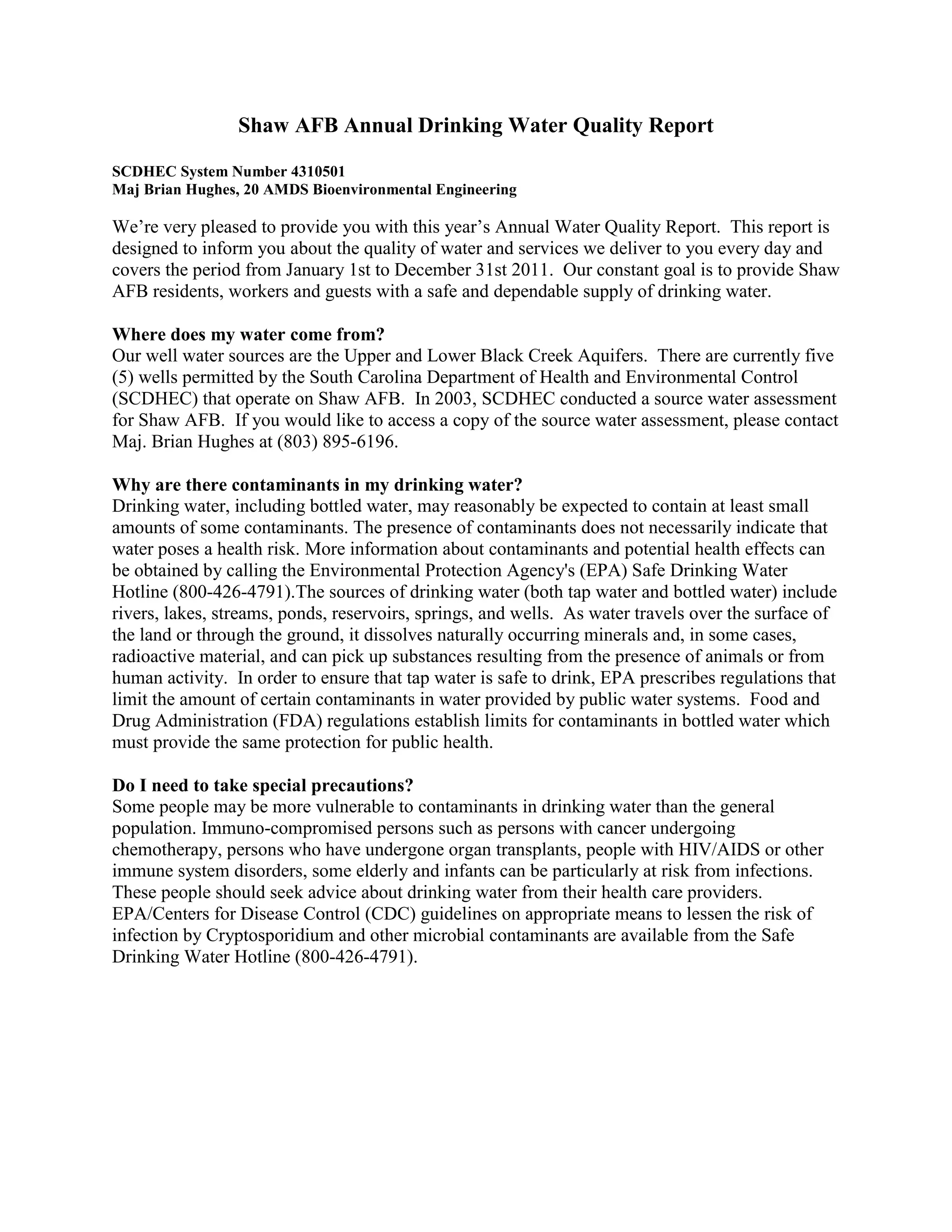
Shaw AFB Annual Drinking Water Quality Report

SCDHEC System Number 4310501
Maj Brian Hughes, 20 AMDS Bioenvironmental Engineering

We’re very pleased to provide you with this year’s Annual Water Quality Report. This report is
designed to inform you about the quality of water and services we deliver to you every day and
covers the period from January 1st to December 31st 2011. Our constant goal is to provide Shaw
AFB residents, workers and guests with a safe and dependable supply of drinking water.

Where does my water come from?
Our well water sources are the Upper and Lower Black Creek Aquifers. There are currently five
(5) wells permitted by the South Carolina Department of Health and Environmental Control
(SCDHEC) that operate on Shaw AFB. In 2003, SCDHEC conducted a source water assessment
for Shaw AFB. If you would like to access a copy of the source water assessment, please contact
Maj. Brian Hughes at (803) 895-6196.

Why are there contaminants in my drinking water?
Drinking water, including bottled water, may reasonably be expected to contain at least small
amounts of some contaminants. The presence of contaminants does not necessarily indicate that
water poses a health risk. More information about contaminants and potential health effects can
be obtained by calling the Environmental Protection Agency's (EPA) Safe Drinking Water
Hotline (800-426-4791).The sources of drinking water (both tap water and bottled water) include
rivers, lakes, streams, ponds, reservoirs, springs, and wells. As water travels over the surface of
the land or through the ground, it dissolves naturally occurring minerals and, in some cases,
radioactive material, and can pick up substances resulting from the presence of animals or from
human activity. In order to ensure that tap water is safe to drink, EPA prescribes regulations that
limit the amount of certain contaminants in water provided by public water systems. Food and
Drug Administration (FDA) regulations establish limits for contaminants in bottled water which
must provide the same protection for public health.

Do I need to take special precautions?
Some people may be more vulnerable to contaminants in drinking water than the general
population. Immuno-compromised persons such as persons with cancer undergoing
chemotherapy, persons who have undergone organ transplants, people with HIV/AIDS or other
immune system disorders, some elderly and infants can be particularly at risk from infections.
These people should seek advice about drinking water from their health care providers.
EPA/Centers for Disease Control (CDC) guidelines on appropriate means to lessen the risk of
infection by Cryptosporidium and other microbial contaminants are available from the Safe
Drinking Water Hotline (800-426-4791).
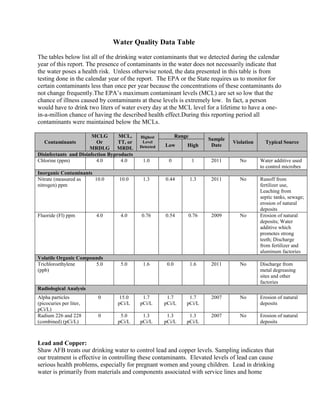
Water Quality Data Table
The tables below list all of the drinking water contaminants that we detected during the calendar
year of this report. The presence of contaminants in the water does not necessarily indicate that
the water poses a health risk. Unless otherwise noted, the data presented in this table is from
testing done in the calendar year of the report. The EPA or the State requires us to monitor for
certain contaminants less than once per year because the concentrations of these contaminants do
not change frequently.The EPA’s maximum contaminant levels (MCL) are set so low that the
chance of illness caused by contaminants at these levels is extremely low. In fact, a person
would have to drink two liters of water every day at the MCL level for a lifetime to have a one-
in-a-million chance of having the described health effect.During this reporting period all
contaminants were maintained below the MCLs.

                        MCLG       MCL,     Highest           Range
                                                                             Sample
   Contaminants           Or       TT, or    Level                                    Violation     Typical Source
                                            Detected   Low        High        Date
                       MRDLG MRDL
Disinfectants and Disinfection Byproducts
Chlorine (ppm)            4.0       4.0      1.0        0              1      2011       No       Water additive used
                                                                                                  to control microbes
Inorganic Contaminants
Nitrate (measured as   10.0        10.0      1.3       0.44           1.3     2011       No       Runoff from
nitrogen) ppm                                                                                     fertilizer use,
                                                                                                  Leaching from
                                                                                                  septic tanks, sewage;
                                                                                                  erosion of natural
                                                                                                  deposits
Fluoride (Fl) ppm        4.0       4.0      0.76       0.54           0.76    2009       No       Erosion of natural
                                                                                                  deposits; Water
                                                                                                  additive which
                                                                                                  promotes strong
                                                                                                  teeth; Discharge
                                                                                                  from fertilizer and
                                                                                                  aluminum factories
Volatile Organic Compounds
Trichloroethylene      5.0         5.0       1.6        0.0           1.6     2011       No       Discharge from
(ppb)                                                                                             metal degreasing
                                                                                                  sites and other
                                                                                                  factories
Radiological Analysis
Alpha particles           0        15.0      1.7        1.7        1.7        2007       No       Erosion of natural
(picocuries per liter,            pCi/L     pCi/L      pCi/L      pCi/L                           deposits
pCi/L)
Radium 226 and 228        0        5.0       1.3        1.3        1.3        2007       No       Erosion of natural
(combined) (pCi/L)                pCi/L     pCi/L      pCi/L      pCi/L                           deposits


Lead and Copper:
Shaw AFB treats our drinking water to control lead and copper levels. Sampling indicates that
our treatment is effective in controlling these contaminants. Elevated levels of lead can cause
serious health problems, especially for pregnant women and young children. Lead in drinking
water is primarily from materials and components associated with service lines and home
plumbing. In 2011,we performed water sampling for lead and found it to be below detectable
limits. Shaw AFB is responsible for providing high quality drinking water, but cannot control
devices connected by housing residents to their individual water taps (i.e filters/purification
devices). When your water has been sitting for several hours, you can minimize the potential for
lead exposure by flushing your tap for 30 seconds to 2 minutes before using water for drinking or
cooking. If you are concerned about lead in your drinking water, you may wish to have your
water tested. Information on lead in drinking water, testing methods, and steps you can take to
minimize exposure is available from the Safe Drinking Water Hotline or at
http://www.epa.gov/safewater/lead.


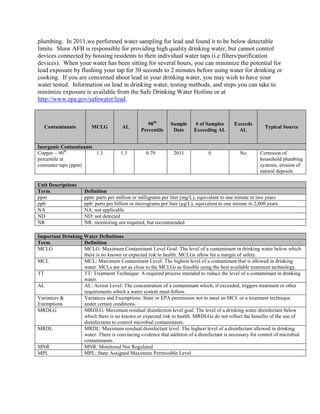
                                                   90th       Sample      # of Samples       Exceeds
   Contaminants          MCLG          AL                                                                   Typical Source
                                                Percentile     Date       Exceeding AL         AL


Inorganic Contaminants
Copper – 90th          1.3             1.3        0.79          2011             0              No        Corrosion of
percentile at                                                                                             household plumbing
consumer taps (ppm)                                                                                       systems, erosion of
                                                                                                          natural deposits

Unit Descriptions
Term                 Definition
ppm                  ppm: parts per million or milligrams per liter (mg/L), equivalent to one minute in two years
ppb                  ppb: parts per billion or micrograms per liter (µg/L), equivalent to one minute in 2,000 years
NA                   NA: not applicable
ND                   ND: not detected
NR                   NR: monitoring not required, but recommended

Important Drinking Water Definitions
Term               Definition
MCLG               MCLG: Maximum Contaminant Level Goal: The level of a contaminant in drinking water below which
                   there is no known or expected risk to health. MCLGs allow for a margin of safety.
MCL                MCL: Maximum Contaminant Level: The highest level of a contaminant that is allowed in drinking
                   water. MCLs are set as close to the MCLGs as feasible using the best available treatment technology.
TT                 TT: Treatment Technique: A required process intended to reduce the level of a contaminant in drinking
                   water.
AL                 AL: Action Level: The concentration of a contaminant which, if exceeded, triggers treatment or other
                   requirements which a water system must follow.
Variances &        Variances and Exemptions: State or EPA permission not to meet an MCL or a treatment technique
Exemptions         under certain conditions.
MRDLG              MRDLG: Maximum residual disinfection level goal. The level of a drinking water disinfectant below
                   which there is no known or expected risk to health. MRDLGs do not reflect the benefits of the use of
                   disinfectants to control microbial contaminants.
MRDL               MRDL: Maximum residual disinfectant level. The highest level of a disinfectant allowed in drinking
                   water. There is convincing evidence that addition of a disinfectant is necessary for control of microbial
                   contaminants.
MNR                MNR: Monitored Not Regulated
MPL                MPL: State Assigned Maximum Permissible Level
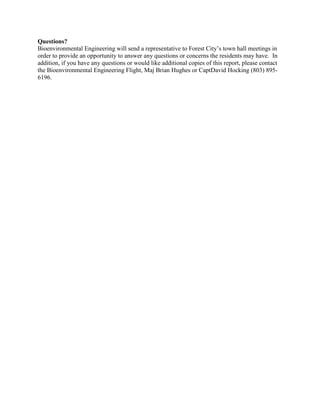
Questions?
Bioenvironmental Engineering will send a representative to Forest City’s town hall meetings in
order to provide an opportunity to answer any questions or concerns the residents may have. In
addition, if you have any questions or would like additional copies of this report, please contact
the Bioenvironmental Engineering Flight, Maj Brian Hughes or CaptDavid Hocking (803) 895-
6196.

2011 Consumer Confidence Report

  • 1.
    Shaw AFB AnnualDrinking Water Quality Report SCDHEC System Number 4310501 Maj Brian Hughes, 20 AMDS Bioenvironmental Engineering We’re very pleased to provide you with this year’s Annual Water Quality Report. This report is designed to inform you about the quality of water and services we deliver to you every day and covers the period from January 1st to December 31st 2011. Our constant goal is to provide Shaw AFB residents, workers and guests with a safe and dependable supply of drinking water. Where does my water come from? Our well water sources are the Upper and Lower Black Creek Aquifers. There are currently five (5) wells permitted by the South Carolina Department of Health and Environmental Control (SCDHEC) that operate on Shaw AFB. In 2003, SCDHEC conducted a source water assessment for Shaw AFB. If you would like to access a copy of the source water assessment, please contact Maj. Brian Hughes at (803) 895-6196. Why are there contaminants in my drinking water? Drinking water, including bottled water, may reasonably be expected to contain at least small amounts of some contaminants. The presence of contaminants does not necessarily indicate that water poses a health risk. More information about contaminants and potential health effects can be obtained by calling the Environmental Protection Agency's (EPA) Safe Drinking Water Hotline (800-426-4791).The sources of drinking water (both tap water and bottled water) include rivers, lakes, streams, ponds, reservoirs, springs, and wells. As water travels over the surface of the land or through the ground, it dissolves naturally occurring minerals and, in some cases, radioactive material, and can pick up substances resulting from the presence of animals or from human activity. In order to ensure that tap water is safe to drink, EPA prescribes regulations that limit the amount of certain contaminants in water provided by public water systems. Food and Drug Administration (FDA) regulations establish limits for contaminants in bottled water which must provide the same protection for public health. Do I need to take special precautions? Some people may be more vulnerable to contaminants in drinking water than the general population. Immuno-compromised persons such as persons with cancer undergoing chemotherapy, persons who have undergone organ transplants, people with HIV/AIDS or other immune system disorders, some elderly and infants can be particularly at risk from infections. These people should seek advice about drinking water from their health care providers. EPA/Centers for Disease Control (CDC) guidelines on appropriate means to lessen the risk of infection by Cryptosporidium and other microbial contaminants are available from the Safe Drinking Water Hotline (800-426-4791).
  • 2.
    Water Quality DataTable The tables below list all of the drinking water contaminants that we detected during the calendar year of this report. The presence of contaminants in the water does not necessarily indicate that the water poses a health risk. Unless otherwise noted, the data presented in this table is from testing done in the calendar year of the report. The EPA or the State requires us to monitor for certain contaminants less than once per year because the concentrations of these contaminants do not change frequently.The EPA’s maximum contaminant levels (MCL) are set so low that the chance of illness caused by contaminants at these levels is extremely low. In fact, a person would have to drink two liters of water every day at the MCL level for a lifetime to have a one- in-a-million chance of having the described health effect.During this reporting period all contaminants were maintained below the MCLs. MCLG MCL, Highest Range Sample Contaminants Or TT, or Level Violation Typical Source Detected Low High Date MRDLG MRDL Disinfectants and Disinfection Byproducts Chlorine (ppm) 4.0 4.0 1.0 0 1 2011 No Water additive used to control microbes Inorganic Contaminants Nitrate (measured as 10.0 10.0 1.3 0.44 1.3 2011 No Runoff from nitrogen) ppm fertilizer use, Leaching from septic tanks, sewage; erosion of natural deposits Fluoride (Fl) ppm 4.0 4.0 0.76 0.54 0.76 2009 No Erosion of natural deposits; Water additive which promotes strong teeth; Discharge from fertilizer and aluminum factories Volatile Organic Compounds Trichloroethylene 5.0 5.0 1.6 0.0 1.6 2011 No Discharge from (ppb) metal degreasing sites and other factories Radiological Analysis Alpha particles 0 15.0 1.7 1.7 1.7 2007 No Erosion of natural (picocuries per liter, pCi/L pCi/L pCi/L pCi/L deposits pCi/L) Radium 226 and 228 0 5.0 1.3 1.3 1.3 2007 No Erosion of natural (combined) (pCi/L) pCi/L pCi/L pCi/L pCi/L deposits Lead and Copper: Shaw AFB treats our drinking water to control lead and copper levels. Sampling indicates that our treatment is effective in controlling these contaminants. Elevated levels of lead can cause serious health problems, especially for pregnant women and young children. Lead in drinking water is primarily from materials and components associated with service lines and home
  • 3.
    plumbing. In 2011,weperformed water sampling for lead and found it to be below detectable limits. Shaw AFB is responsible for providing high quality drinking water, but cannot control devices connected by housing residents to their individual water taps (i.e filters/purification devices). When your water has been sitting for several hours, you can minimize the potential for lead exposure by flushing your tap for 30 seconds to 2 minutes before using water for drinking or cooking. If you are concerned about lead in your drinking water, you may wish to have your water tested. Information on lead in drinking water, testing methods, and steps you can take to minimize exposure is available from the Safe Drinking Water Hotline or at http://www.epa.gov/safewater/lead. 90th Sample # of Samples Exceeds Contaminants MCLG AL Typical Source Percentile Date Exceeding AL AL Inorganic Contaminants Copper – 90th 1.3 1.3 0.79 2011 0 No Corrosion of percentile at household plumbing consumer taps (ppm) systems, erosion of natural deposits Unit Descriptions Term Definition ppm ppm: parts per million or milligrams per liter (mg/L), equivalent to one minute in two years ppb ppb: parts per billion or micrograms per liter (µg/L), equivalent to one minute in 2,000 years NA NA: not applicable ND ND: not detected NR NR: monitoring not required, but recommended Important Drinking Water Definitions Term Definition MCLG MCLG: Maximum Contaminant Level Goal: The level of a contaminant in drinking water below which there is no known or expected risk to health. MCLGs allow for a margin of safety. MCL MCL: Maximum Contaminant Level: The highest level of a contaminant that is allowed in drinking water. MCLs are set as close to the MCLGs as feasible using the best available treatment technology. TT TT: Treatment Technique: A required process intended to reduce the level of a contaminant in drinking water. AL AL: Action Level: The concentration of a contaminant which, if exceeded, triggers treatment or other requirements which a water system must follow. Variances & Variances and Exemptions: State or EPA permission not to meet an MCL or a treatment technique Exemptions under certain conditions. MRDLG MRDLG: Maximum residual disinfection level goal. The level of a drinking water disinfectant below which there is no known or expected risk to health. MRDLGs do not reflect the benefits of the use of disinfectants to control microbial contaminants. MRDL MRDL: Maximum residual disinfectant level. The highest level of a disinfectant allowed in drinking water. There is convincing evidence that addition of a disinfectant is necessary for control of microbial contaminants. MNR MNR: Monitored Not Regulated MPL MPL: State Assigned Maximum Permissible Level
  • 4.
    Questions? Bioenvironmental Engineering willsend a representative to Forest City’s town hall meetings in order to provide an opportunity to answer any questions or concerns the residents may have. In addition, if you have any questions or would like additional copies of this report, please contact the Bioenvironmental Engineering Flight, Maj Brian Hughes or CaptDavid Hocking (803) 895- 6196.