Julie Letterhos
Ohio Environmental Protection Agency
                       March 12, 2010
Lake Erie Pollution History
 Causes have varied over the years
   Sediment
   Raw sewage/disease
   Overfishing
   Chemical contamination
   Nutrients
   Exotic species
   Loss of habitat
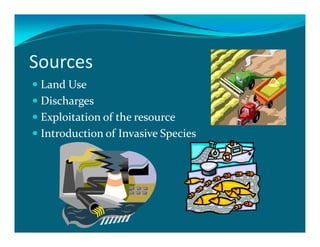
Sources
 Land Use
 Discharges
 Exploitation of the resource
 Introduction of Invasive Species
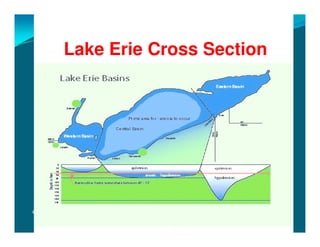
Lake Erie Cross Section


4
Nutrients
 Phosphorus identified as the limiting nutrient
 Lake Erie Wastewater Management Study (LEWMS)
 Pollution from Land Use Activities Reference Group
 (PLUARG)
 Great Lakes Water Quality Agreement
 Clean Water Act
 Phosphorus Reduction Strategies
Phosphorus Bioavailability
 Total Phosphorus varies with source

 Dissolved Reactive Phosphorus
   ~100% bioavailable

 Particulate Phosphorus
   10 - 30% bioavailable
Point vs. Nonpoint Source
 Typically, TP from point sources 85% DRP and is
 considered to be 100% bioavailable

 TP from nonpoint sources, or the tributary load, was
 largely particulate and considered about 30%
 bioavailable, but that seems to be changing
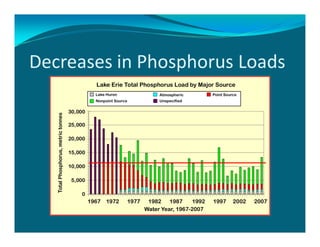
Decreases in Phosphorus Loads
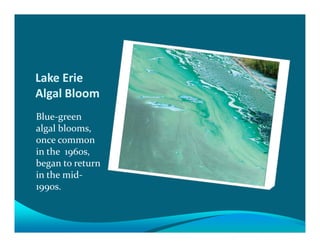
Lake Erie
Algal Bloom
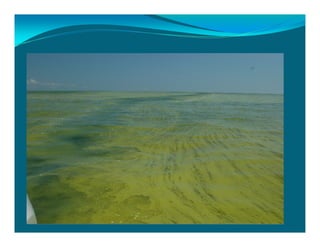
Blue-green
algal blooms,
once common
in the 1960s,
began to return
in the mid-
1990s.
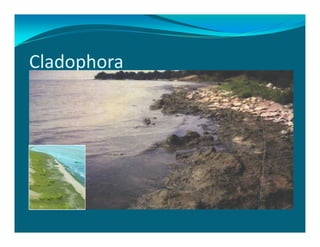
Cladophora
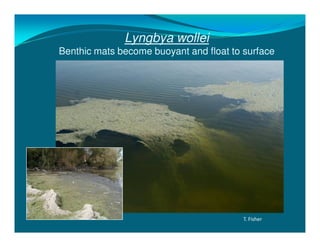
Lyngbya wollei
Benthic mats become buoyant and float to surface


                                         T. Fisher
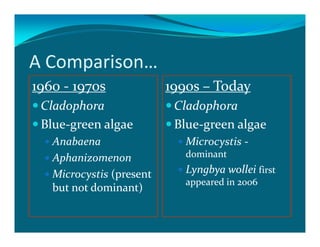
A Comparison…
1960 - 1970s              1990s – Today
 Cladophora                Cladophora
 Blue-green algae          Blue-green algae
   Anabaena                  Microcystis -
   Aphanizomenon             dominant

   Microcystis (present      Lyngbya wollei first
                             appeared in 2006
   but not dominant)
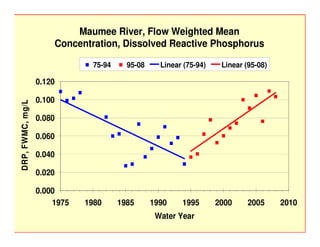
Maumee River, Flow Weighted Mean
                      Concentration, Dissolved Reactive Phosphorus

                              75-94     95-08     Linear (75-94)    Linear (95-08)

                  0.120

                  0.100
DRP, FWMC, mg/L


                  0.080

                  0.060

                  0.040

                  0.020

                  0.000
                      1975   1980     1985      1990    1995       2000     2005     2010
                                                 Water Year
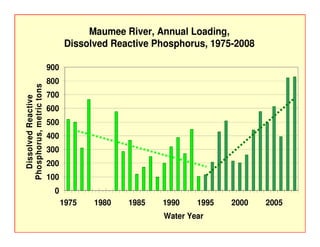
Maumee River, Annual Loading,
                                 Dissolved Reactive Phosphorus, 1975-2008

                          900
                          800
Phosphorus, metric tons


                          700
  Dissolved Reactive


                          600
                          500
                          400
                          300
                          200
                          100
                           0
                                1975   1980   1985   1990    1995   2000    2005
                                                     Water Year
Ohio Lake Erie Phosphorus Task Force Members
  State program personnel from OEPA, ODNR and ODA
  Academia/Researchers
  Agricultural agencies and organizations at the federal,
  state and local level (NRCS, ARS, OSU Extension,
  Ohio Farm Bureau, Conservation Action Program)
  USEPA-Great Lakes National Program Office
  USGS
  Wastewater Treatment Plant personnel
  Ohio Lake Erie Office
  Ohio Fractured Flow Work Group
Task Force Goals (Ohio Focus)
 Identify and evaluate all potential sources
 Identify changes since 1995
 Examine aspects of agriculture that might
 influence increase in DRP loads
 Review relationship between increased DRP and
 the returning eutrophication in the lake
 Consider dreissenids and internal cycling
 Identify research and monitoring needs
 Make short and long term recommendations
P Task Force Approach
 Identify all possible sources of DRP
 Quantify what we can with existing data sources
 Consult with outside topical experts
 Consult peer-reviewed publications
 Identify relative contributions from possible sources
 Develop recommendations
List of Possible Sources
 Point sources
    Wastewater treatment plants, Industrial, CSOs, HSTS
 Agriculture
 Urban/residential
    Lawn care fertilizers, storm water, orthophosphate in
    treated water, dishwasher detergent
 Other
    In lake loads/recycling
    Streambank erosion
    Detroit River/upper lake loads
 Transport mechanisms
    Subsurface drainage, surface runoff
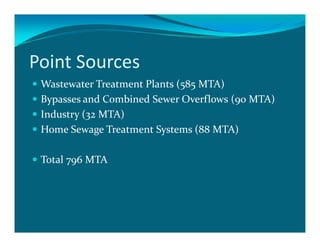
Point Sources
 Wastewater Treatment Plants (585 MTA)
 Bypasses and Combined Sewer Overflows (90 MTA)
 Industry (32 MTA)
 Home Sewage Treatment Systems (88 MTA)

 Total 796 MTA
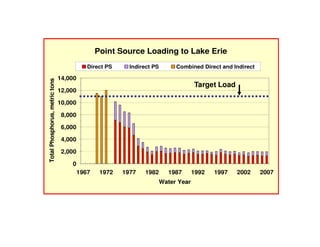
Point Source Loading to Lake Erie
                                            Direct PS     Indirect PS        Combined Direct and Indirect

                                14,000
Total Phosphorus, metric tons


                                                                                     Target Load
                                12,000

                                10,000

                                 8,000

                                 6,000

                                 4,000

                                 2,000

                                    0
                                         1967    1972   1977   1982       1987       1992   1997   2002     2007
                                                                        Water Year
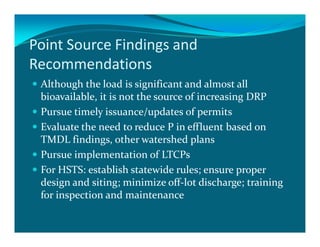
Point Source Findings and
Recommendations
 Although the load is significant and almost all
 bioavailable, it is not the source of increasing DRP
 Pursue timely issuance/updates of permits
 Evaluate the need to reduce P in effluent based on
 TMDL findings, other watershed plans
 Pursue implementation of LTCPs
 For HSTS: establish statewide rules; ensure proper
 design and siting; minimize off-lot discharge; training
 for inspection and maintenance
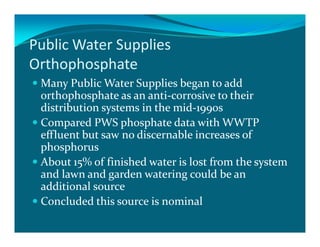
Public Water Supplies
Orthophosphate
 Many Public Water Supplies began to add
 orthophosphate as an anti-corrosive to their
 distribution systems in the mid-1990s
 Compared PWS phosphate data with WWTP
 effluent but saw no discernable increases of
 phosphorus
 About 15% of finished water is lost from the system
 and lawn and garden watering could be an
 additional source
 Concluded this source is nominal
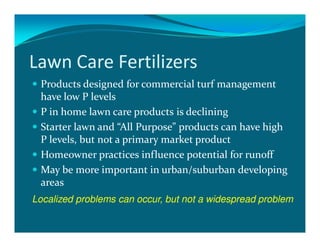
Lawn Care Fertilizers
 Products designed for commercial turf management
 have low P levels
 P in home lawn care products is declining
 Starter lawn and “All Purpose” products can have high
 P levels, but not a primary market product
 Homeowner practices influence potential for runoff
 May be more important in urban/suburban developing
 areas
Localized problems can occur, but not a widespread problem
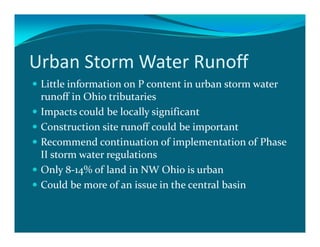
Urban Storm Water Runoff
 Little information on P content in urban storm water
 runoff in Ohio tributaries
 Impacts could be locally significant
 Construction site runoff could be important
 Recommend continuation of implementation of Phase
 II storm water regulations
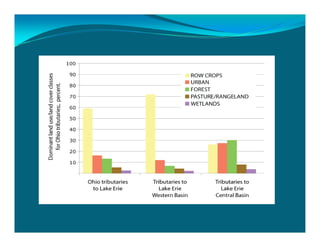
 Only 8-14% of land in NW Ohio is urban
 Could be more of an issue in the central basin
Agricultural Nonpoint Sources
Issues examined
    Cropping history, acres, rotations, yields
    Production practices
    Fertilizer use
    Livestock production
    Biosolids use
    Drainage
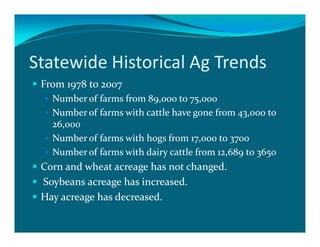
Statewide Historical Ag Trends
 From 1978 to 2007
   Number of farms from 89,000 to 75,000
   Number of farms with cattle have gone from 43,000 to
   26,000
   Number of farms with hogs from 17,000 to 3700
   Number of farms with dairy cattle from 12,689 to 3650
 Corn and wheat acreage has not changed.
 Soybeans acreage has increased.
 Hay acreage has decreased.
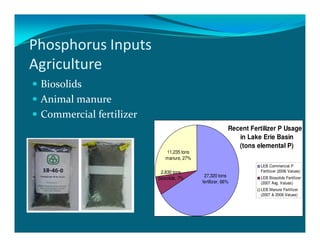
Phosphorus Inputs
Agriculture
 Biosolids
 Animal manure
 Commercial fertilizer
                                                        Recent Fertilizer P Usage
                                                           in Lake Erie Basin
                                                           (tons elemental P)
                            11,235 tons
                            manure, 27%
                                                                   LEB Commercial P
                          2,830 tons                               Fertilizer (2006 Values)
                                           27,320 tons             LEB Biosolids Fertilizer
                         biosolids, 7%
                                          fertilizer, 66%          (2007 Avg. Values)
                                                                   LEB Manure Fertilizer
                                                                   (2007 & 2008 Values)
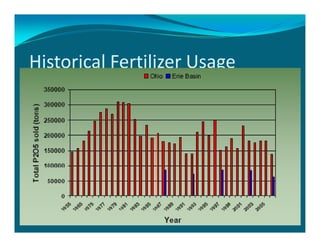
Historical Fertilizer Usage
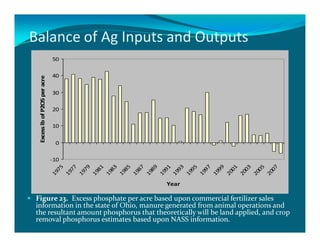
Balance of Ag Inputs and Outputs
                              50

                              40
 Excess lb of P2O5 per acre


                              30

                              20

                              10


                               0

                              -10
                                75

                                77

                                79

                                81

                                83

                                85

                                87

                                89

                                91

                                93

                                95

                                97

                                99

                                01

                                03

                                05

                                07
                              19

                              19

                              19

                              19

                              19

                              19

                              19

                              19

                              19

                              19

                              19

                              19

                              19

                              20

                              20

                              20

                              20
                                         Year

Figure 23. Excess phosphate per acre based upon commercial fertilizer sales
information in the state of Ohio, manure generated from animal operations and
the resultant amount phosphorus that theoretically will be land applied, and crop
removal phosphorus estimates based upon NASS information.
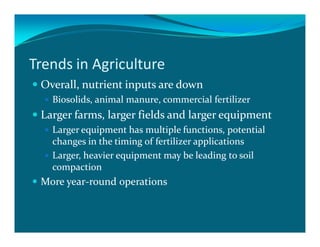
Trends in Agriculture
 Overall, nutrient inputs are down
   Biosolids, animal manure, commercial fertilizer
 Larger farms, larger fields and larger equipment
   Larger equipment has multiple functions, potential
   changes in the timing of fertilizer applications
   Larger, heavier equipment may be leading to soil
   compaction
 More year-round operations
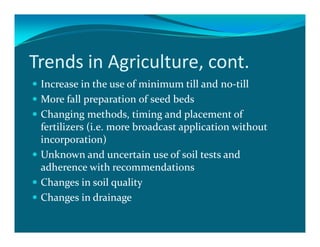
Trends in Agriculture, cont.
 Increase in the use of minimum till and no-till
 More fall preparation of seed beds
 Changing methods, timing and placement of
 fertilizers (i.e. more broadcast application without
 incorporation)
 Unknown and uncertain use of soil tests and
 adherence with recommendations
 Changes in soil quality
 Changes in drainage
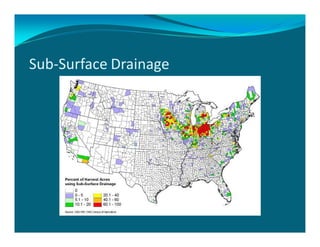
Sub-Surface Drainage
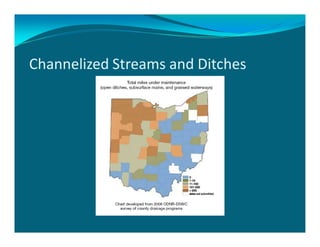
Channelized Streams and Ditches
Findings: Overview
 Soil nutrient interactions are key to understanding
 nutrient movement
 Soil Phosphorus naturally fluctuates between
 dissolved and solid forms
 Soil mineralogy influences solubility
 Soils in the Maumee and Sandusky watersheds are
 unique, old lake bed tight clays
 Phosphorus export from the Maumee and Sandusky
 watersheds are the highest to Lake Erie and also
 among the highest in the Midwest
Findings
 Point sources have remained relatively consistent
 Lawn care – can have localized impact, practice BMPs
 Mussels have altered P internal cycling
   Extent unknown
   Processing P from external sources
 Transport mechanisms – surface and subsurface
 drainage
   Relative contribution unknown
Findings
 DRP tributary loadings are driven by runoff events
 Weather trend changes: higher intensity storms, less
 snowfall, high winter runoff events
 Multiple contributors; agriculture is key
 Need to look at how we manage our P inputs
 Other factors, including nitrogen, may be affecting
 algal blooms
Recommendations
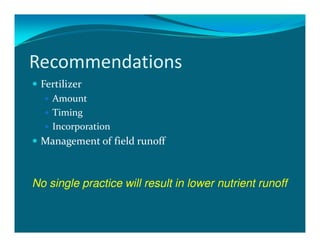
 Fertilizer
    Amount
    Timing
    Incorporation
 Management of field runoff


No single practice will result in lower nutrient runoff
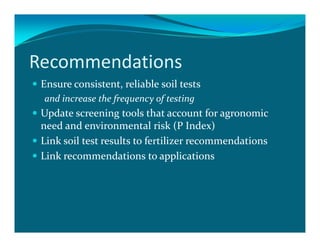
Recommendations
 Ensure consistent, reliable soil tests
 and increase the frequency of testing
 Update screening tools that account for agronomic
 need and environmental risk (P Index)
 Link soil test results to fertilizer recommendations
 Link recommendations to applications
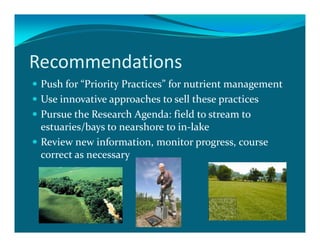
Recommendations
 Push for “Priority Practices” for nutrient management
 Use innovative approaches to sell these practices
 Pursue the Research Agenda: field to stream to
 estuaries/bays to nearshore to in-lake
 Review new information, monitor progress, course
 correct as necessary
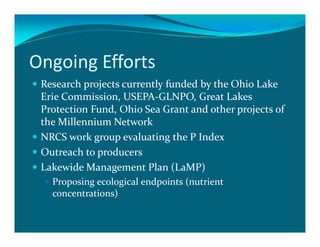
Ongoing Efforts
 Research projects currently funded by the Ohio Lake
 Erie Commission, USEPA-GLNPO, Great Lakes
 Protection Fund, Ohio Sea Grant and other projects of
 the Millennium Network
 NRCS work group evaluating the P Index
 Outreach to producers
 Lakewide Management Plan (LaMP)
   Proposing ecological endpoints (nutrient
   concentrations)
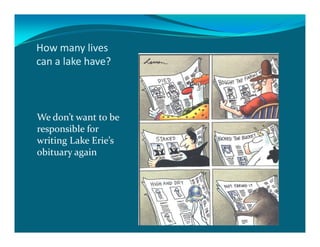
How many lives
can a lake have?


We don’t want to be
responsible for
writing Lake Erie’s
obituary again
www.epa.state.oh.us/dsw

Click: Phosphorus Task Force

Lake Erie Phosphorus Task Force Results

  • 1.
    Julie Letterhos Ohio EnvironmentalProtection Agency March 12, 2010
  • 2.
    Lake Erie PollutionHistory Causes have varied over the years Sediment Raw sewage/disease Overfishing Chemical contamination Nutrients Exotic species Loss of habitat
  • 3.
    Sources Land Use Discharges Exploitation of the resource Introduction of Invasive Species
  • 4.
    Lake Erie CrossSection 4
  • 5.
    Nutrients Phosphorus identifiedas the limiting nutrient Lake Erie Wastewater Management Study (LEWMS) Pollution from Land Use Activities Reference Group (PLUARG) Great Lakes Water Quality Agreement Clean Water Act Phosphorus Reduction Strategies
  • 6.
    Phosphorus Bioavailability TotalPhosphorus varies with source Dissolved Reactive Phosphorus ~100% bioavailable Particulate Phosphorus 10 - 30% bioavailable
  • 7.
    Point vs. NonpointSource Typically, TP from point sources 85% DRP and is considered to be 100% bioavailable TP from nonpoint sources, or the tributary load, was largely particulate and considered about 30% bioavailable, but that seems to be changing
  • 8.
  • 9.
    Lake Erie Algal Bloom Blue-green algalblooms, once common in the 1960s, began to return in the mid- 1990s.
  • 11.
  • 12.
    Lyngbya wollei Benthic matsbecome buoyant and float to surface T. Fisher
  • 13.
    A Comparison… 1960 -1970s 1990s – Today Cladophora Cladophora Blue-green algae Blue-green algae Anabaena Microcystis - Aphanizomenon dominant Microcystis (present Lyngbya wollei first appeared in 2006 but not dominant)
  • 14.
    Maumee River, FlowWeighted Mean Concentration, Dissolved Reactive Phosphorus 75-94 95-08 Linear (75-94) Linear (95-08) 0.120 0.100 DRP, FWMC, mg/L 0.080 0.060 0.040 0.020 0.000 1975 1980 1985 1990 1995 2000 2005 2010 Water Year
  • 15.
    Maumee River, AnnualLoading, Dissolved Reactive Phosphorus, 1975-2008 900 800 Phosphorus, metric tons 700 Dissolved Reactive 600 500 400 300 200 100 0 1975 1980 1985 1990 1995 2000 2005 Water Year
  • 16.
    Ohio Lake EriePhosphorus Task Force Members State program personnel from OEPA, ODNR and ODA Academia/Researchers Agricultural agencies and organizations at the federal, state and local level (NRCS, ARS, OSU Extension, Ohio Farm Bureau, Conservation Action Program) USEPA-Great Lakes National Program Office USGS Wastewater Treatment Plant personnel Ohio Lake Erie Office Ohio Fractured Flow Work Group
  • 17.
    Task Force Goals(Ohio Focus) Identify and evaluate all potential sources Identify changes since 1995 Examine aspects of agriculture that might influence increase in DRP loads Review relationship between increased DRP and the returning eutrophication in the lake Consider dreissenids and internal cycling Identify research and monitoring needs Make short and long term recommendations
  • 18.
    P Task ForceApproach Identify all possible sources of DRP Quantify what we can with existing data sources Consult with outside topical experts Consult peer-reviewed publications Identify relative contributions from possible sources Develop recommendations
  • 19.
    List of PossibleSources Point sources Wastewater treatment plants, Industrial, CSOs, HSTS Agriculture Urban/residential Lawn care fertilizers, storm water, orthophosphate in treated water, dishwasher detergent Other In lake loads/recycling Streambank erosion Detroit River/upper lake loads Transport mechanisms Subsurface drainage, surface runoff
  • 20.
    Point Sources WastewaterTreatment Plants (585 MTA) Bypasses and Combined Sewer Overflows (90 MTA) Industry (32 MTA) Home Sewage Treatment Systems (88 MTA) Total 796 MTA
  • 21.
    Point Source Loadingto Lake Erie Direct PS Indirect PS Combined Direct and Indirect 14,000 Total Phosphorus, metric tons Target Load 12,000 10,000 8,000 6,000 4,000 2,000 0 1967 1972 1977 1982 1987 1992 1997 2002 2007 Water Year
  • 22.
    Point Source Findingsand Recommendations Although the load is significant and almost all bioavailable, it is not the source of increasing DRP Pursue timely issuance/updates of permits Evaluate the need to reduce P in effluent based on TMDL findings, other watershed plans Pursue implementation of LTCPs For HSTS: establish statewide rules; ensure proper design and siting; minimize off-lot discharge; training for inspection and maintenance
  • 23.
    Public Water Supplies Orthophosphate Many Public Water Supplies began to add orthophosphate as an anti-corrosive to their distribution systems in the mid-1990s Compared PWS phosphate data with WWTP effluent but saw no discernable increases of phosphorus About 15% of finished water is lost from the system and lawn and garden watering could be an additional source Concluded this source is nominal
  • 25.
    Lawn Care Fertilizers Products designed for commercial turf management have low P levels P in home lawn care products is declining Starter lawn and “All Purpose” products can have high P levels, but not a primary market product Homeowner practices influence potential for runoff May be more important in urban/suburban developing areas Localized problems can occur, but not a widespread problem
  • 26.
    Urban Storm WaterRunoff Little information on P content in urban storm water runoff in Ohio tributaries Impacts could be locally significant Construction site runoff could be important Recommend continuation of implementation of Phase II storm water regulations Only 8-14% of land in NW Ohio is urban Could be more of an issue in the central basin
  • 28.
    Agricultural Nonpoint Sources Issuesexamined Cropping history, acres, rotations, yields Production practices Fertilizer use Livestock production Biosolids use Drainage
  • 29.
    Statewide Historical AgTrends From 1978 to 2007 Number of farms from 89,000 to 75,000 Number of farms with cattle have gone from 43,000 to 26,000 Number of farms with hogs from 17,000 to 3700 Number of farms with dairy cattle from 12,689 to 3650 Corn and wheat acreage has not changed. Soybeans acreage has increased. Hay acreage has decreased.
  • 30.
    Phosphorus Inputs Agriculture Biosolids Animal manure Commercial fertilizer Recent Fertilizer P Usage in Lake Erie Basin (tons elemental P) 11,235 tons manure, 27% LEB Commercial P 2,830 tons Fertilizer (2006 Values) 27,320 tons LEB Biosolids Fertilizer biosolids, 7% fertilizer, 66% (2007 Avg. Values) LEB Manure Fertilizer (2007 & 2008 Values)
  • 31.
  • 32.
    Balance of AgInputs and Outputs 50 40 Excess lb of P2O5 per acre 30 20 10 0 -10 75 77 79 81 83 85 87 89 91 93 95 97 99 01 03 05 07 19 19 19 19 19 19 19 19 19 19 19 19 19 20 20 20 20 Year Figure 23. Excess phosphate per acre based upon commercial fertilizer sales information in the state of Ohio, manure generated from animal operations and the resultant amount phosphorus that theoretically will be land applied, and crop removal phosphorus estimates based upon NASS information.
  • 33.
    Trends in Agriculture Overall, nutrient inputs are down Biosolids, animal manure, commercial fertilizer Larger farms, larger fields and larger equipment Larger equipment has multiple functions, potential changes in the timing of fertilizer applications Larger, heavier equipment may be leading to soil compaction More year-round operations
  • 34.
    Trends in Agriculture,cont. Increase in the use of minimum till and no-till More fall preparation of seed beds Changing methods, timing and placement of fertilizers (i.e. more broadcast application without incorporation) Unknown and uncertain use of soil tests and adherence with recommendations Changes in soil quality Changes in drainage
  • 35.
  • 36.
  • 37.
    Findings: Overview Soilnutrient interactions are key to understanding nutrient movement Soil Phosphorus naturally fluctuates between dissolved and solid forms Soil mineralogy influences solubility Soils in the Maumee and Sandusky watersheds are unique, old lake bed tight clays Phosphorus export from the Maumee and Sandusky watersheds are the highest to Lake Erie and also among the highest in the Midwest
  • 38.
    Findings Point sourceshave remained relatively consistent Lawn care – can have localized impact, practice BMPs Mussels have altered P internal cycling Extent unknown Processing P from external sources Transport mechanisms – surface and subsurface drainage Relative contribution unknown
  • 39.
    Findings DRP tributaryloadings are driven by runoff events Weather trend changes: higher intensity storms, less snowfall, high winter runoff events Multiple contributors; agriculture is key Need to look at how we manage our P inputs Other factors, including nitrogen, may be affecting algal blooms
  • 40.
    Recommendations Fertilizer Amount Timing Incorporation Management of field runoff No single practice will result in lower nutrient runoff
  • 41.
    Recommendations Ensure consistent,reliable soil tests and increase the frequency of testing Update screening tools that account for agronomic need and environmental risk (P Index) Link soil test results to fertilizer recommendations Link recommendations to applications
  • 42.
    Recommendations Push for“Priority Practices” for nutrient management Use innovative approaches to sell these practices Pursue the Research Agenda: field to stream to estuaries/bays to nearshore to in-lake Review new information, monitor progress, course correct as necessary
  • 43.
    Ongoing Efforts Researchprojects currently funded by the Ohio Lake Erie Commission, USEPA-GLNPO, Great Lakes Protection Fund, Ohio Sea Grant and other projects of the Millennium Network NRCS work group evaluating the P Index Outreach to producers Lakewide Management Plan (LaMP) Proposing ecological endpoints (nutrient concentrations)
  • 45.
    How many lives cana lake have? We don’t want to be responsible for writing Lake Erie’s obituary again
  • 46.