imagery
symbolisms
ABDUL GHAFFAR JAT
2K16-BLENG-4
USINDH LAAR CAMPUS BADIN
WHO IS Godot?
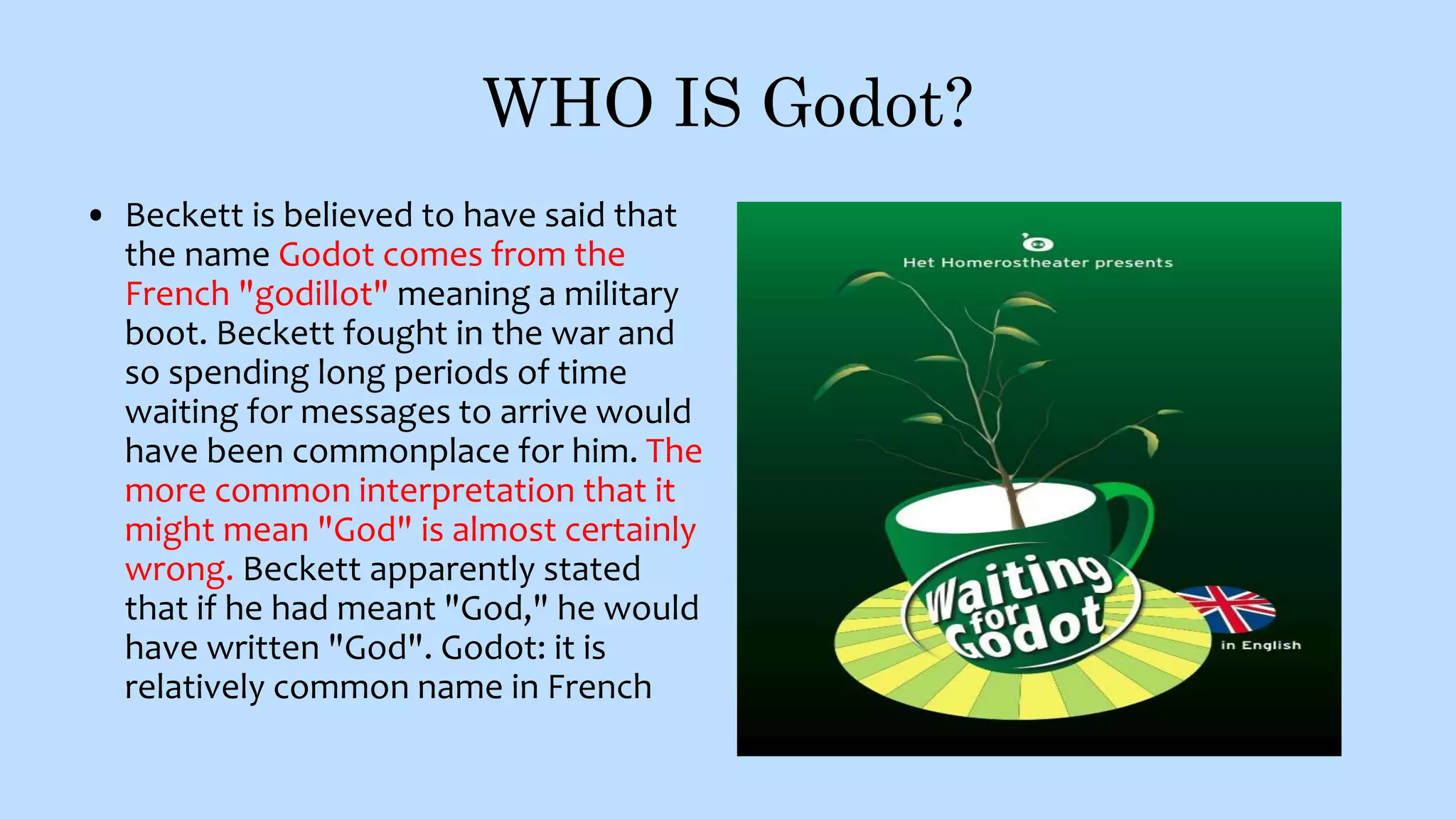
• Beckett is believed to have said that
the name Godot comes from the
French "godillot" meaning a military
boot. Beckett fought in the war and
so spending long periods of time
waiting for messages to arrive would
have been commonplace for him. The
more common interpretation that it
might mean "God" is almost certainly
wrong. Beckett apparently stated
that if he had meant "God," he would
have written "God". Godot: it is
relatively common name in French
Vladimir and Estrogan
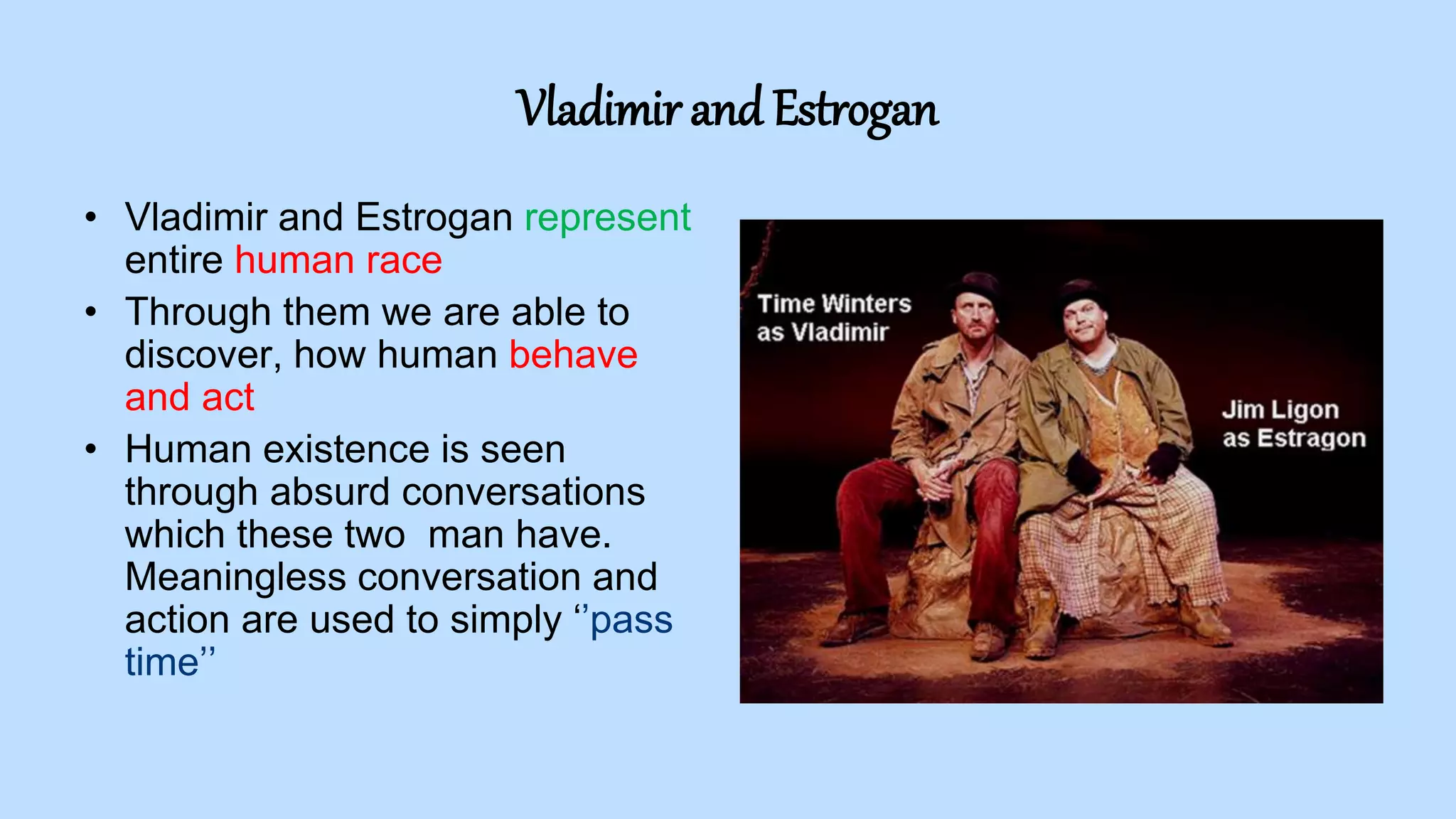
• Vladimir and Estrogan represent
entire human race
• Through them we are able to
discover, how human behave
and act
• Human existence is seen
through absurd conversations
which these two man have.
Meaningless conversation and
action are used to simply ‘’pass
time’’
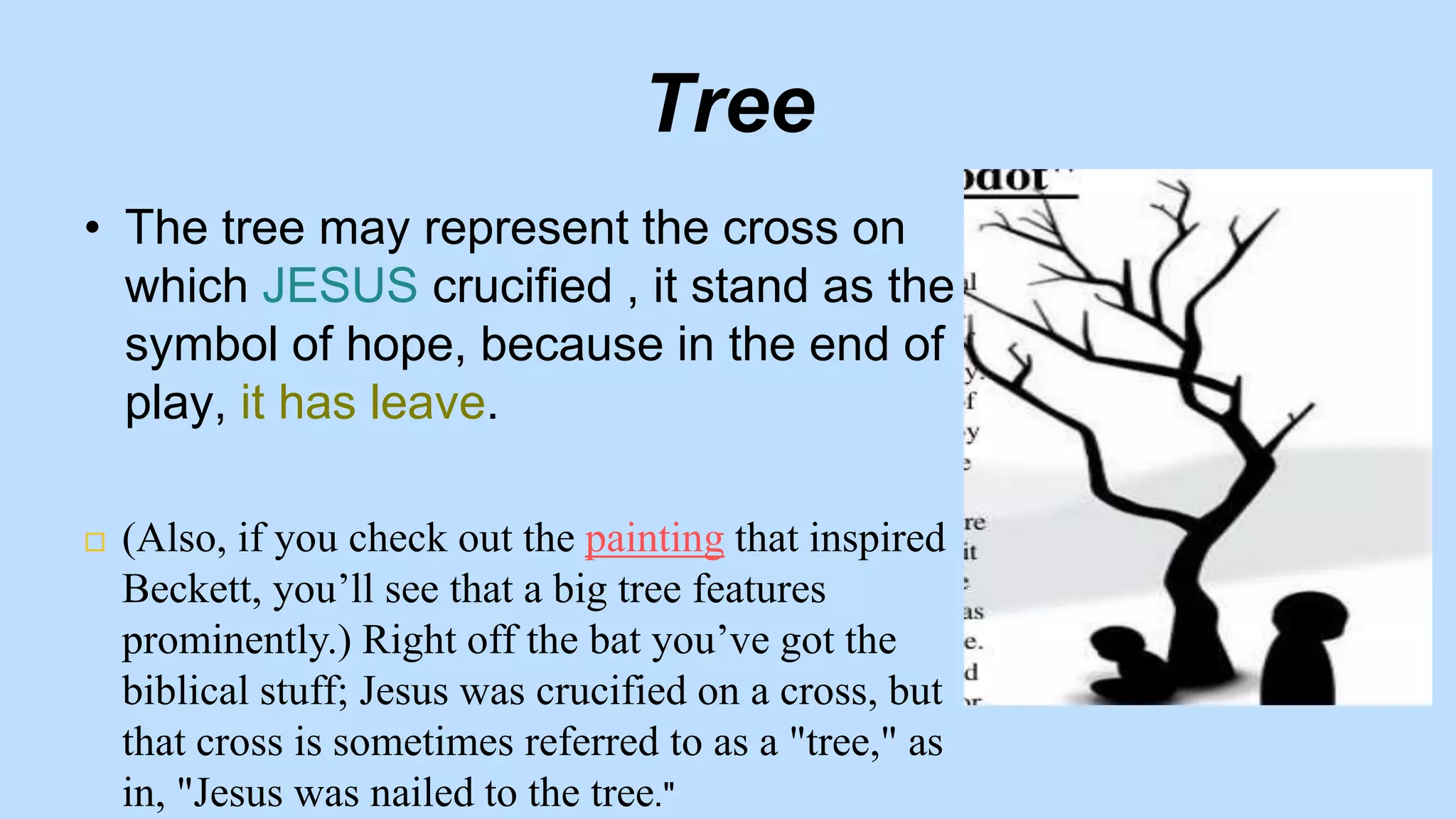
Tree
• The tree may represent the cross on
which JESUS crucified , it stand as the
symbol of hope, because in the end of
play, it has leave.
 (Also, if you check out the painting that inspired
Beckett, you’ll see that a big tree features
prominently.) Right off the bat you’ve got the
biblical stuff; Jesus was crucified on a cross, but
that cross is sometimes referred to as a "tree," as
in, "Jesus was nailed to the tree."
Hanging
• Both character , Vladimir
and Estrogan, consider
hanging themselves as
way out of their situation.
They decide against it
eventually as they wait in
hopes that Godot will
resolve their problem.
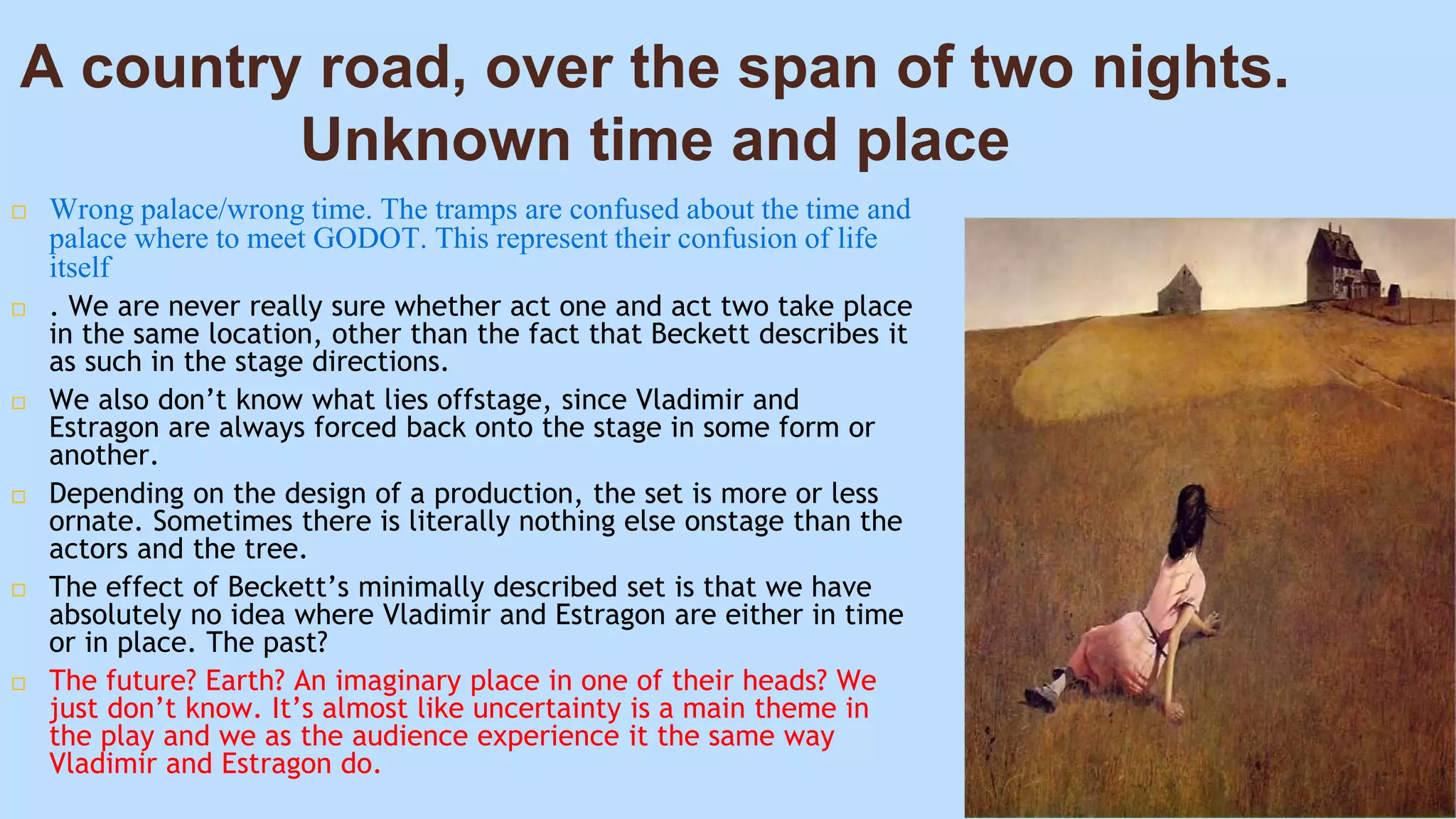
A country road, over the span of two nights.
Unknown time and place
 Wrong palace/wrong time. The tramps are confused about the time and
palace where to meet GODOT. This represent their confusion of life
itself
 . We are never really sure whether act one and act two take place
in the same location, other than the fact that Beckett describes it
as such in the stage directions.
 We also don’t know what lies offstage, since Vladimir and
Estragon are always forced back onto the stage in some form or
another.
 Depending on the design of a production, the set is more or less
ornate. Sometimes there is literally nothing else onstage than the
actors and the tree.
 The effect of Beckett’s minimally described set is that we have
absolutely no idea where Vladimir and Estragon are either in time
or in place. The past?
 The future? Earth? An imaginary place in one of their heads? We
just don’t know. It’s almost like uncertainty is a main theme in
the play and we as the audience experience it the same way
Vladimir and Estragon do.
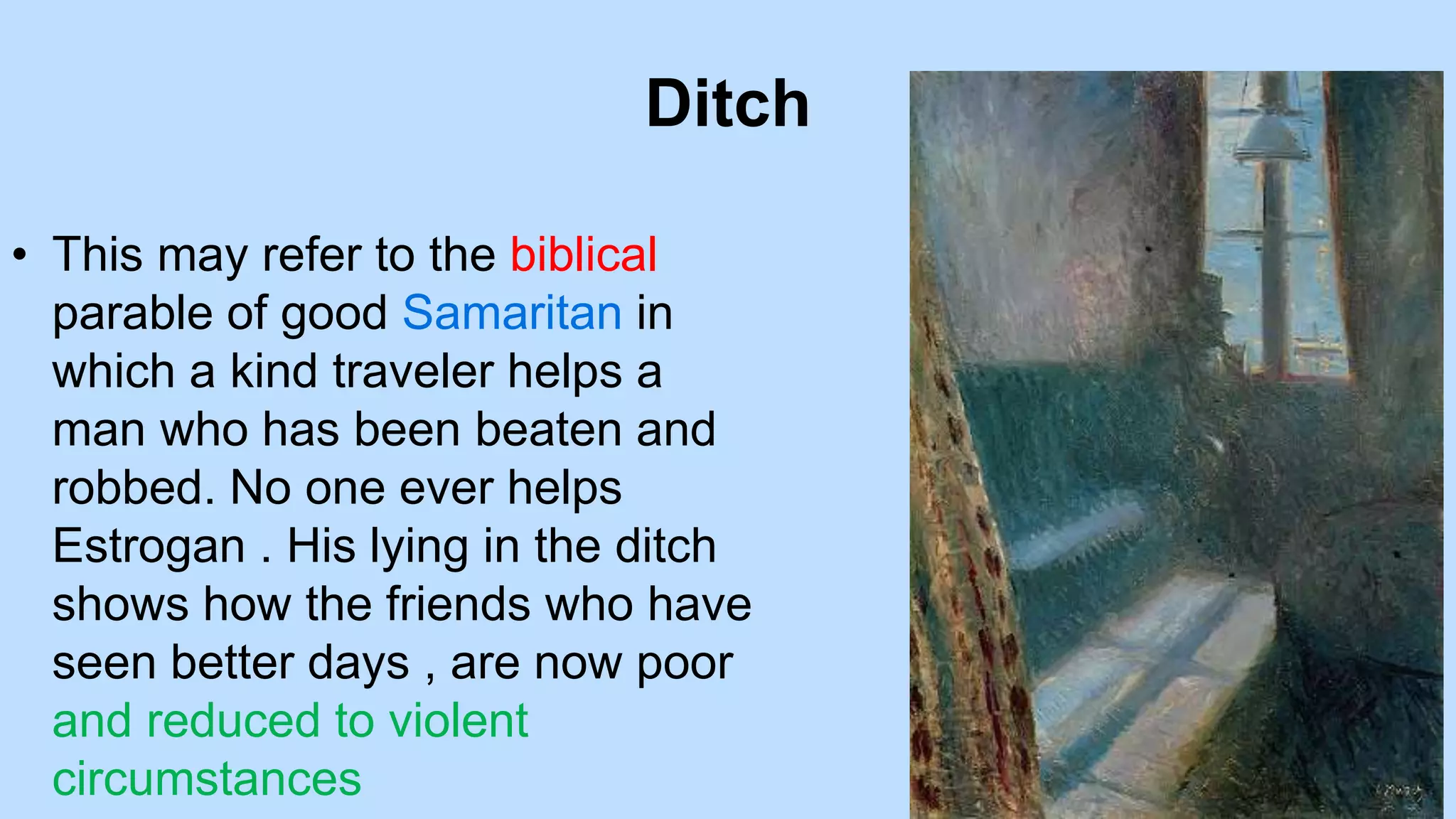
Ditch
• This may refer to the biblical
parable of good Samaritan in
which a kind traveler helps a
man who has been beaten and
robbed. No one ever helps
Estrogan . His lying in the ditch
shows how the friends who have
seen better days , are now poor
and reduced to violent
circumstances
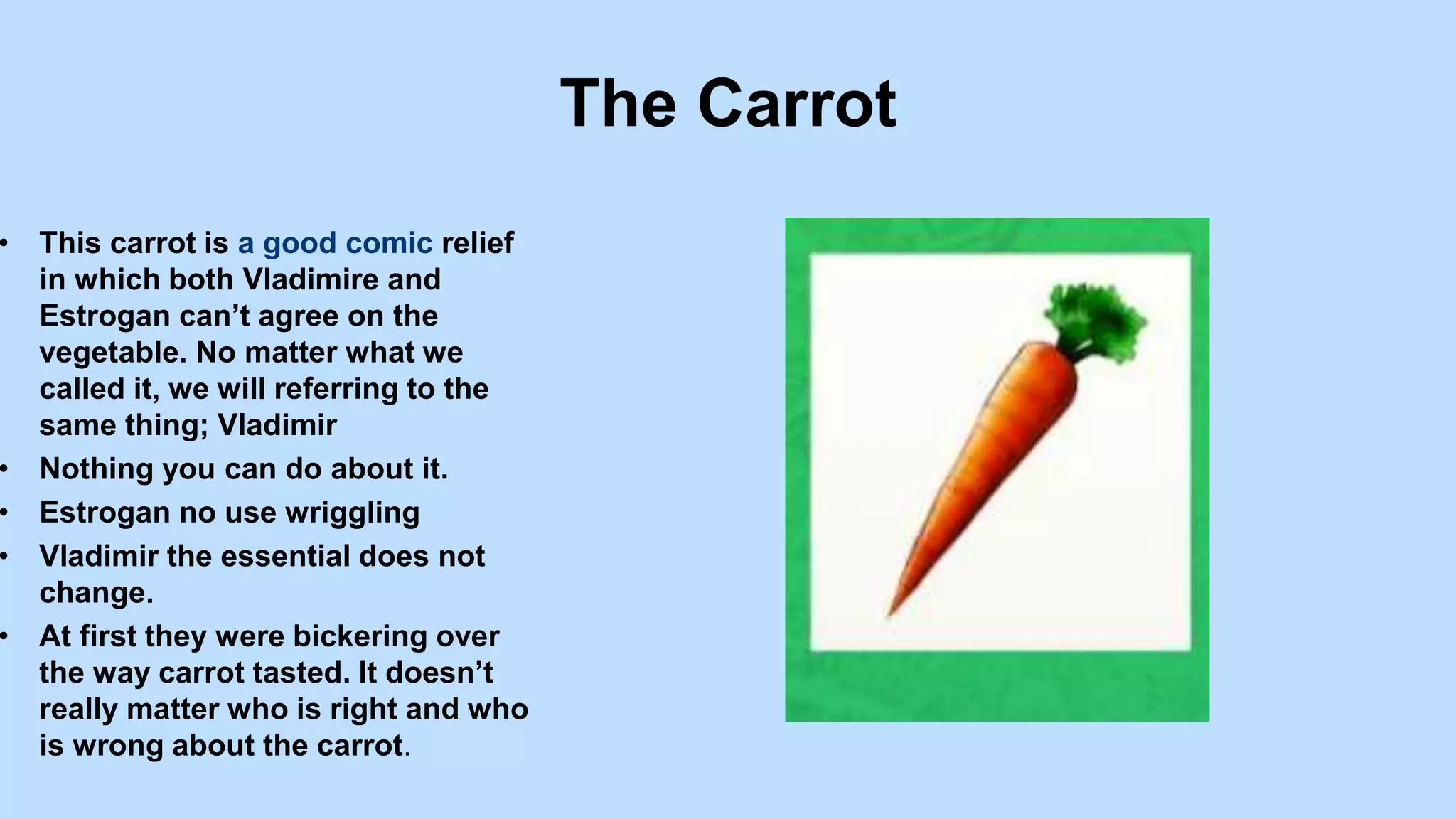
The Carrot
• This carrot is a good comic relief
in which both Vladimire and
Estrogan can’t agree on the
vegetable. No matter what we
called it, we will referring to the
same thing; Vladimir
• Nothing you can do about it.
• Estrogan no use wriggling
• Vladimir the essential does not
change.
• At first they were bickering over
the way carrot tasted. It doesn’t
really matter who is right and who
is wrong about the carrot.
• This symbolizes our questions
of reality. We put label on
things, but that is not really the
way things really are.
• We want to see the absolute
truth but we can’t.
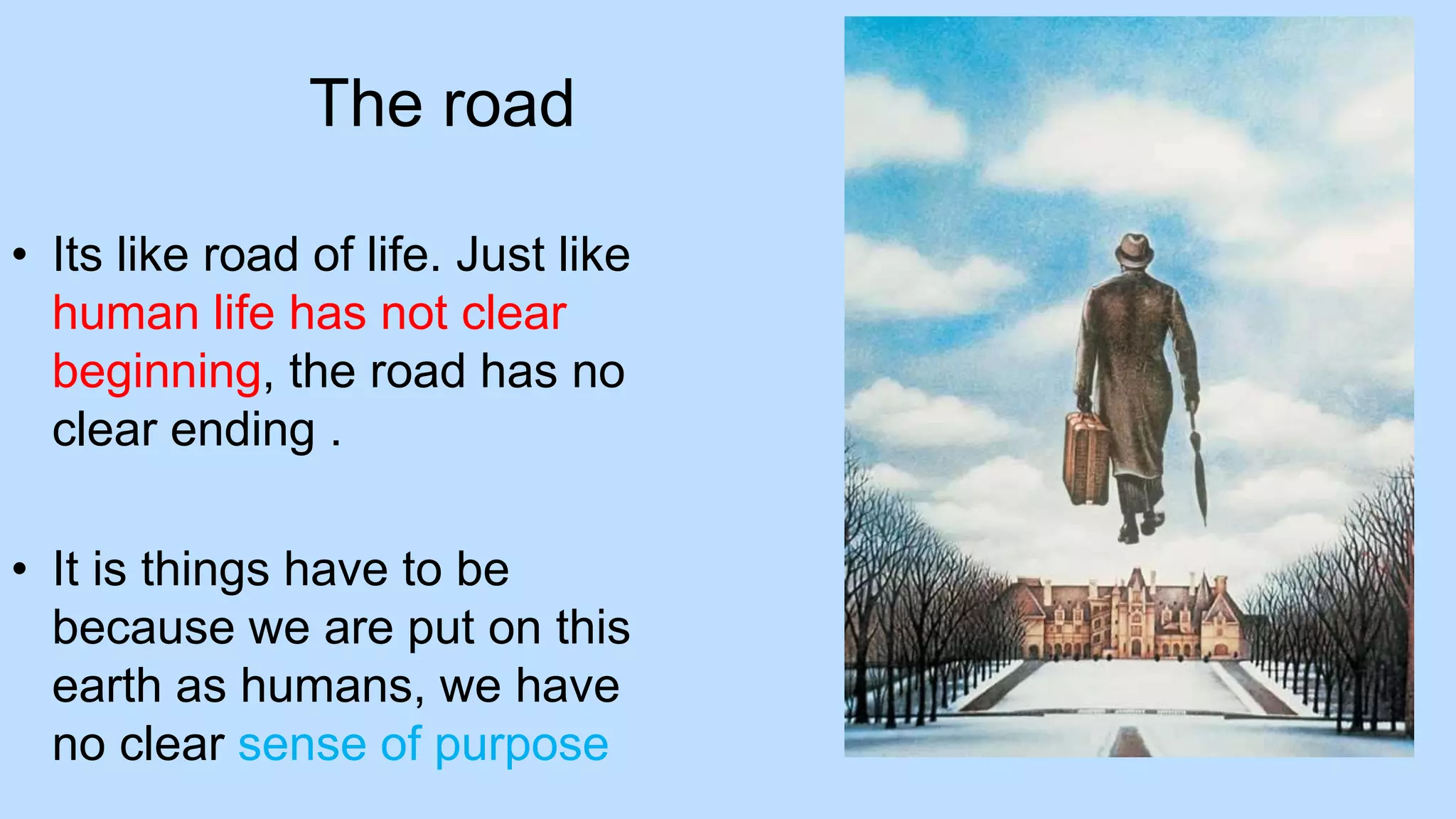
The road
• Its like road of life. Just like
human life has not clear
beginning, the road has no
clear ending .
• It is things have to be
because we are put on this
earth as humans, we have
no clear sense of purpose
Vladimir’s song
• Vladimir song: its reflection of
how all the action in the play
repeat themselves and circular in
nature so is this song.
• Song in act two, death is a theme
Pozzo
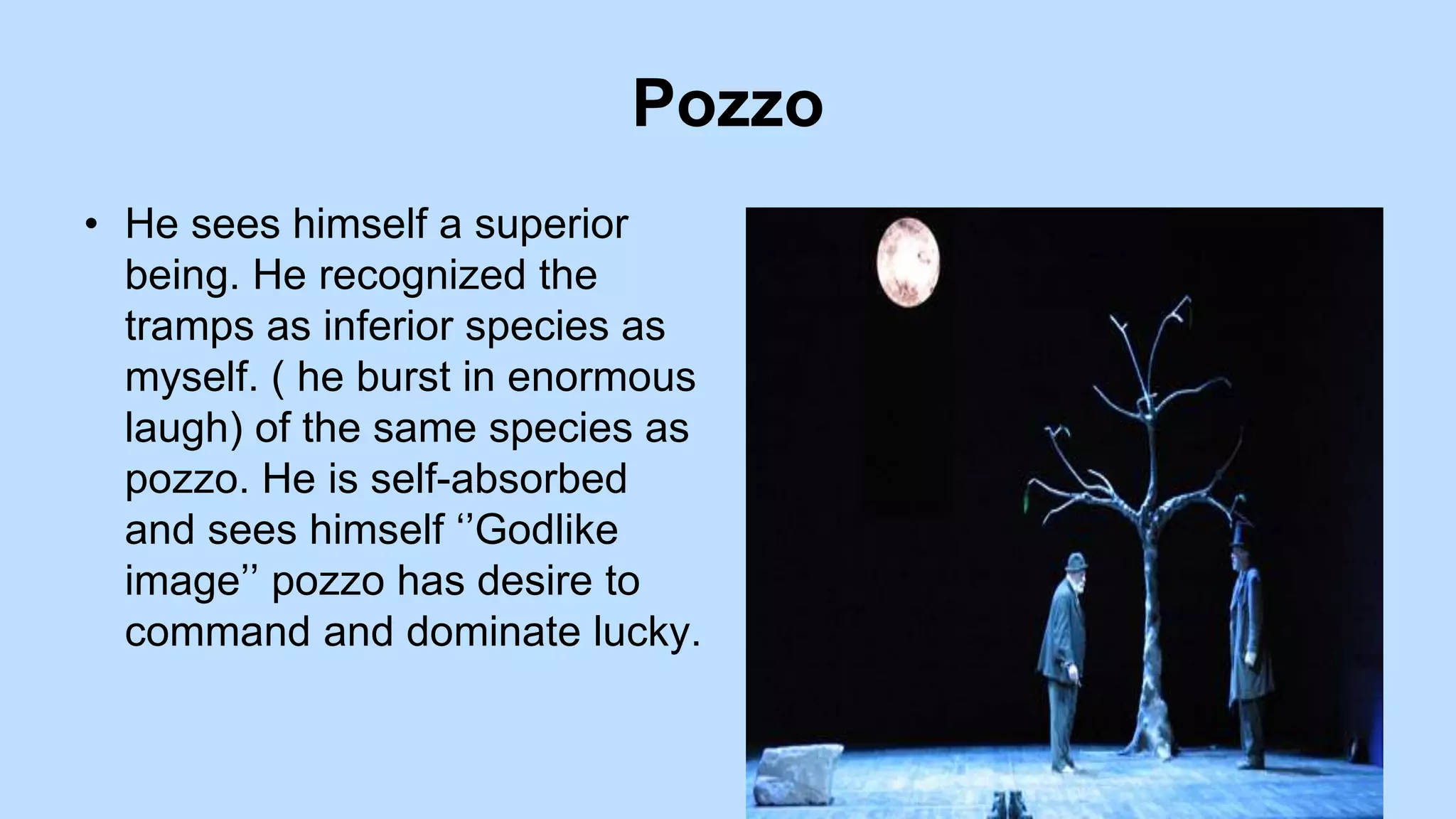
• He sees himself a superior
being. He recognized the
tramps as inferior species as
myself. ( he burst in enormous
laugh) of the same species as
pozzo. He is self-absorbed
and sees himself ‘’Godlike
image’’ pozzo has desire to
command and dominate lucky.
Smell
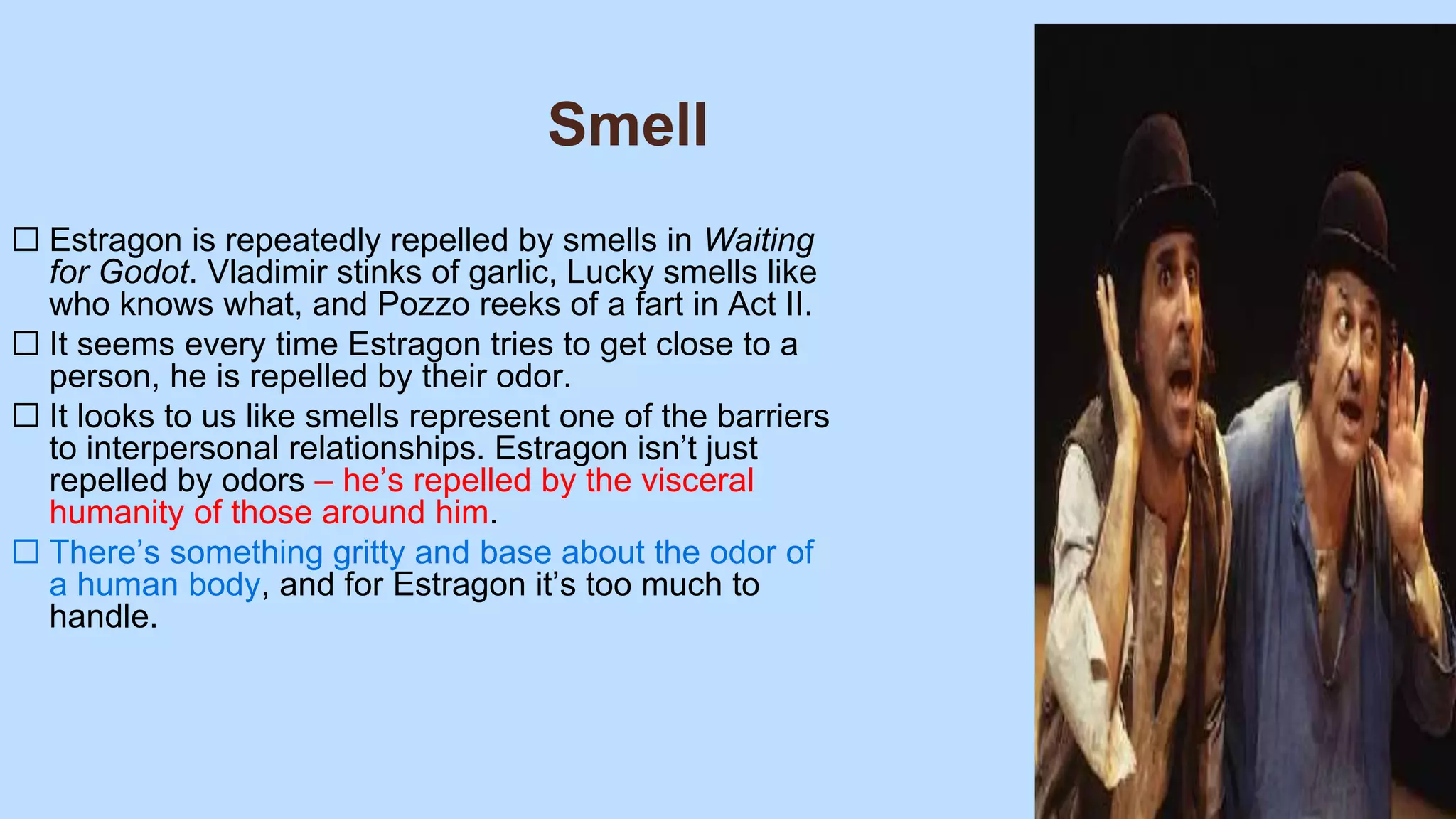
 Estragon is repeatedly repelled by smells in Waiting
for Godot. Vladimir stinks of garlic, Lucky smells like
who knows what, and Pozzo reeks of a fart in Act II.
 It seems every time Estragon tries to get close to a
person, he is repelled by their odor.
 It looks to us like smells represent one of the barriers
to interpersonal relationships. Estragon isn’t just
repelled by odors – he’s repelled by the visceral
humanity of those around him.
 There’s something gritty and base about the odor of
a human body, and for Estragon it’s too much to
handle.
Lucky
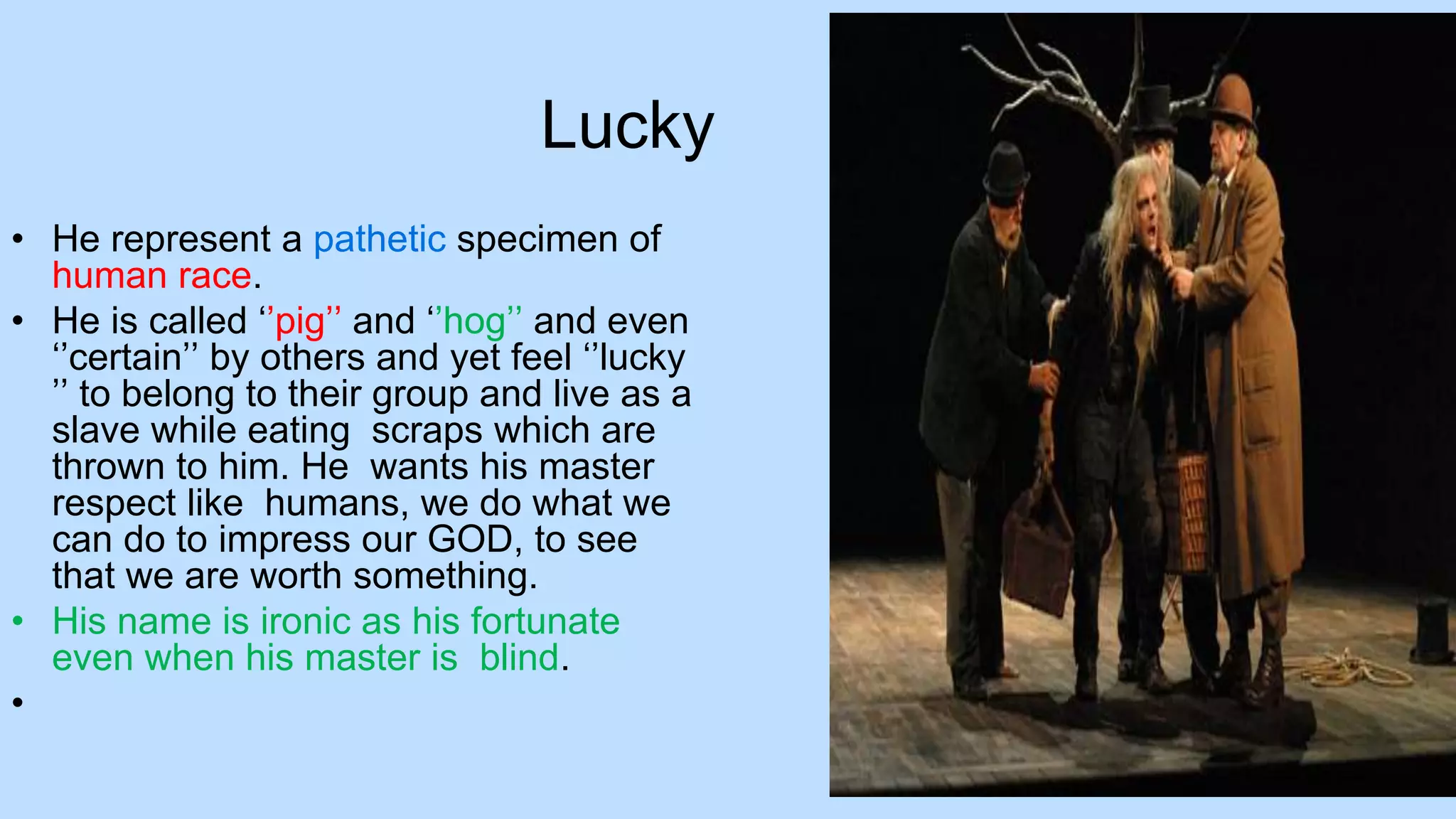
• He represent a pathetic specimen of
human race.
• He is called ‘’pig’’ and ‘’hog’’ and even
‘’certain’’ by others and yet feel ‘’lucky
’’ to belong to their group and live as a
slave while eating scraps which are
thrown to him. He wants his master
respect like humans, we do what we
can do to impress our GOD, to see
that we are worth something.
• His name is ironic as his fortunate
even when his master is blind.
•
Nightfall and the Rising Moon
 While Vladimir and Estragon wait for Godot, they
also wait for nightfall. For some reason (again,
arbitrary and uncertain), they don’t have to wait
for him once the night has fallen.
 The classic interpretation is that night = dark =
death. The falling of night is as much a reprieve
from daily suffering as death is from the suffering
of a lifetime.
There’s also the issue of the moon, as its
appearance in the sky is the real signal that night
has come and the men can stop waiting for Godot.
 Estragon, in one of his "wicked smart" moments,
comments the moon is "pale for weariness […] of
climbing heaven and gazing on the likes of us."
Though the man remembers nothing of yesterday,
he does in this moment seem to comprehend the
endless repetition of his life.
 And if the moon is weary just from watching,
imagine what that says about the predicament of
the men themselves.
Gogo’s nightmare
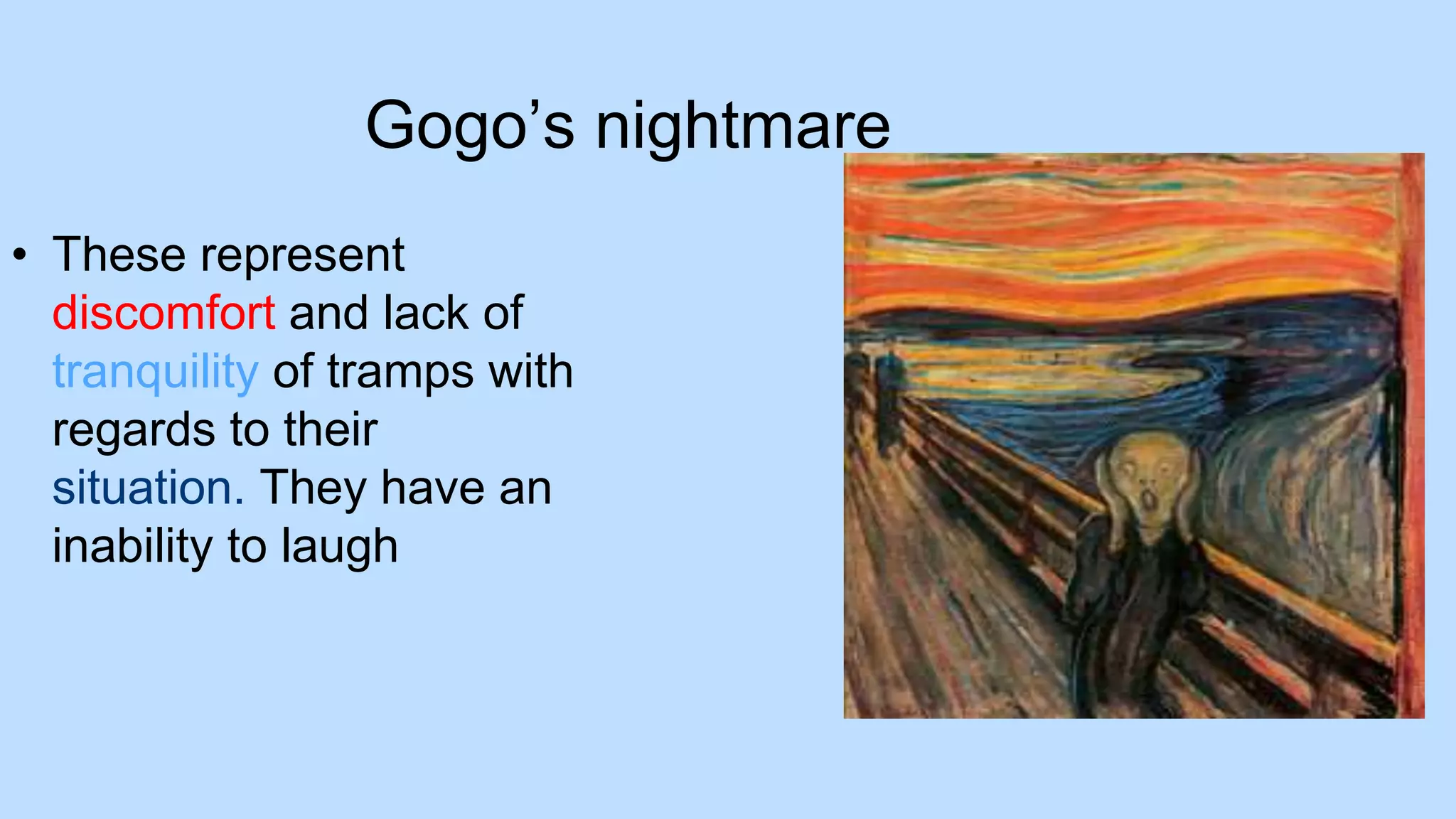
• These represent
discomfort and lack of
tranquility of tramps with
regards to their
situation. They have an
inability to laugh
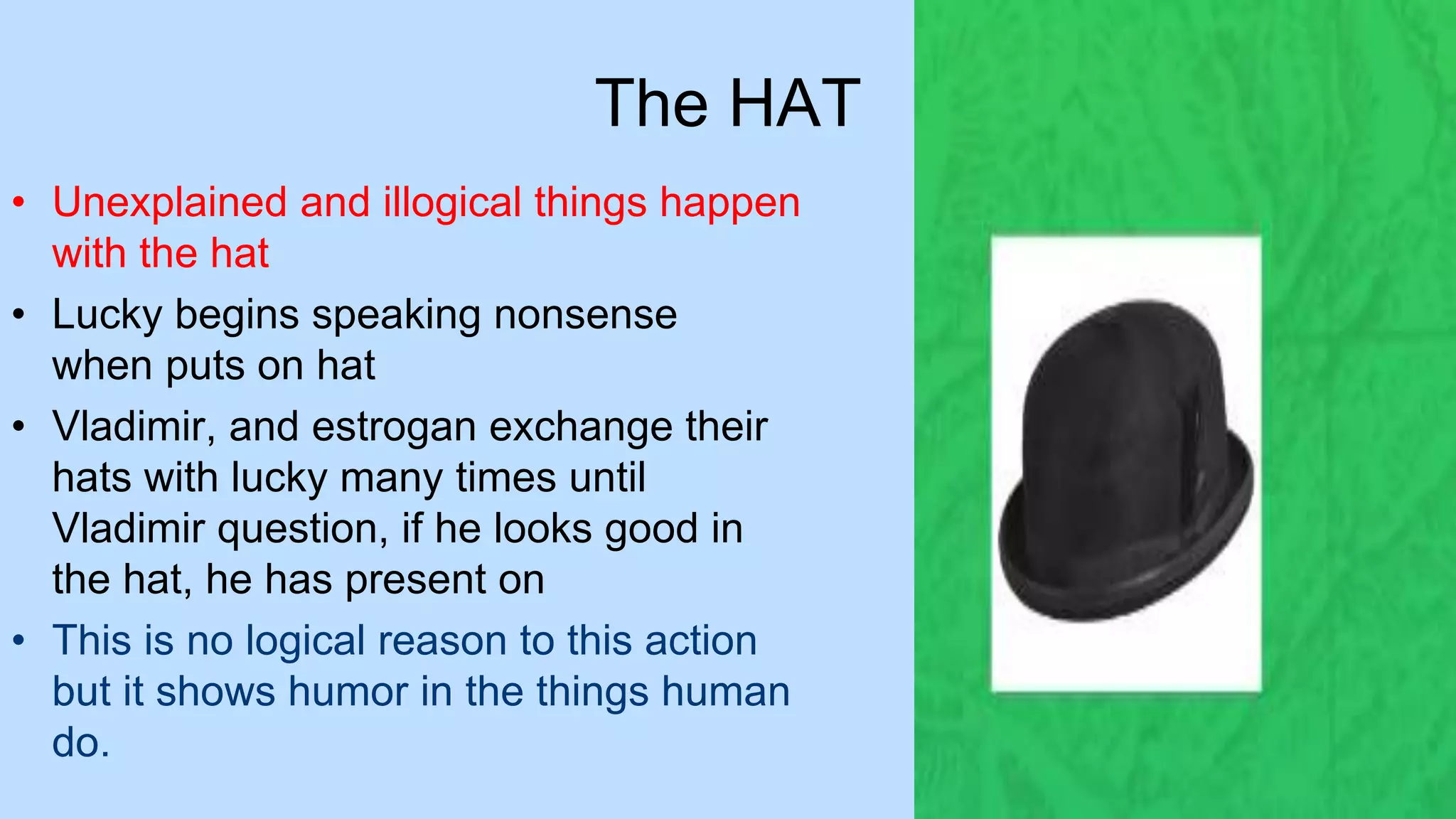
The HAT
• Unexplained and illogical things happen
with the hat
• Lucky begins speaking nonsense
when puts on hat
• Vladimir, and estrogan exchange their
hats with lucky many times until
Vladimir question, if he looks good in
the hat, he has present on
• This is no logical reason to this action
but it shows humor in the things human
do.
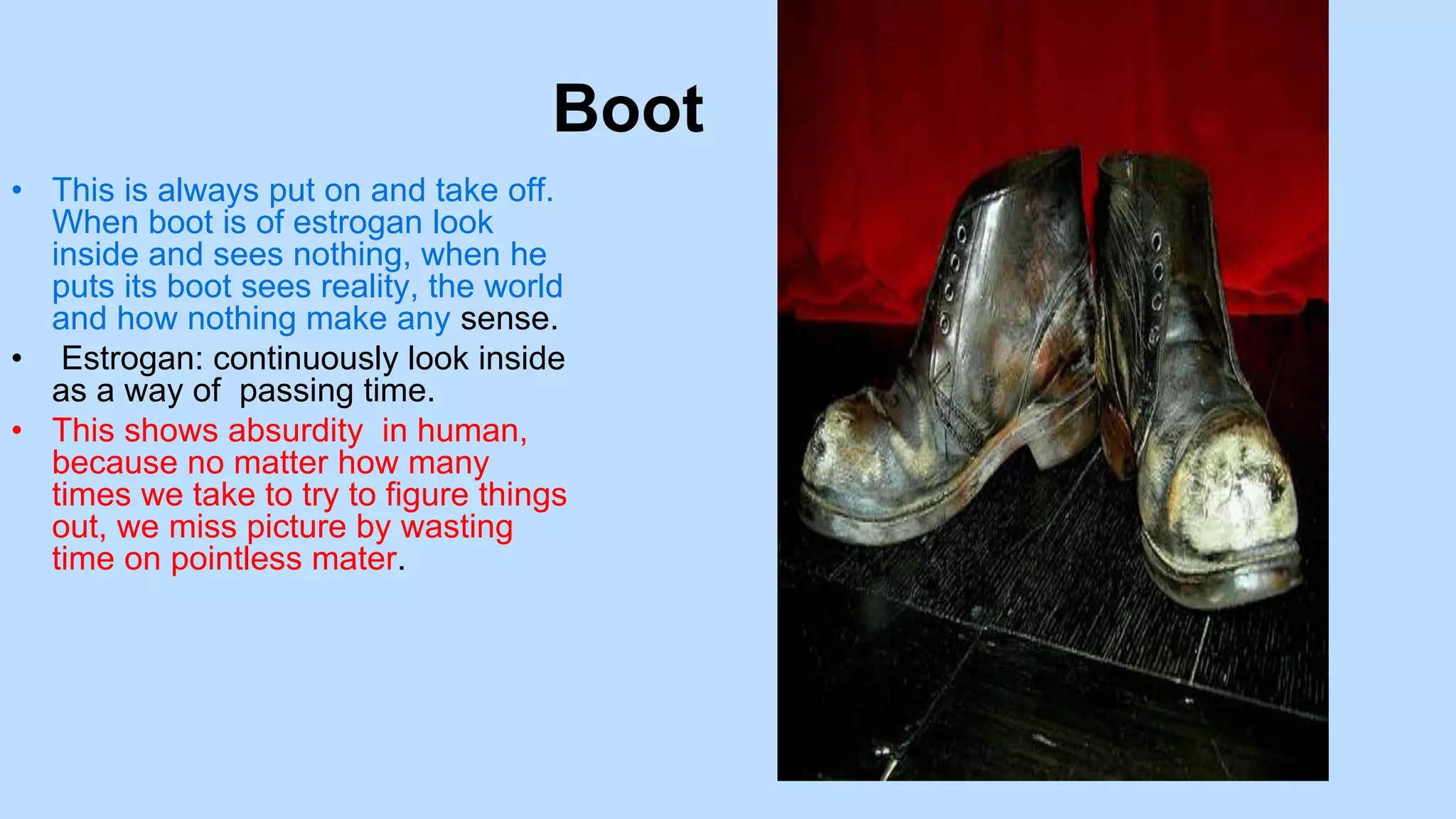
Boot
• This is always put on and take off.
When boot is of estrogan look
inside and sees nothing, when he
puts its boot sees reality, the world
and how nothing make any sense.
• Estrogan: continuously look inside
as a way of passing time.
• This shows absurdity in human,
because no matter how many
times we take to try to figure things
out, we miss picture by wasting
time on pointless mater.
The Bone
• This symbolizes poverty, they
do not have enough for
themselves to eat. They beg
to survive, estrogan and lucky
are through order to survive.
Estrogan and lucky are
deprived of food for while so
they are willing to eat
anything
The Bag
• Lucky carries bag he never
stop to trying to carry. Pozzo
doesn’t force lucky this bag
but lucky prove himself to his
master. He feels as if he
carries it around to show his
determination and devotion to
making pozzo happy.
The Rope
• Lucky is a slave tied to his master .
• Pozzo is healthy and o lucky could think the rope
try the two together was long, when pozzo was
blind and needed lucky who was dumb to guide
him rope was short.
• This symbolizes how the distance between the god
and his slave is great, when god is powerful and
healthy.
• However, when rope is short the distance between
to is smaller, because their greatness is not in
contrast as much.
•
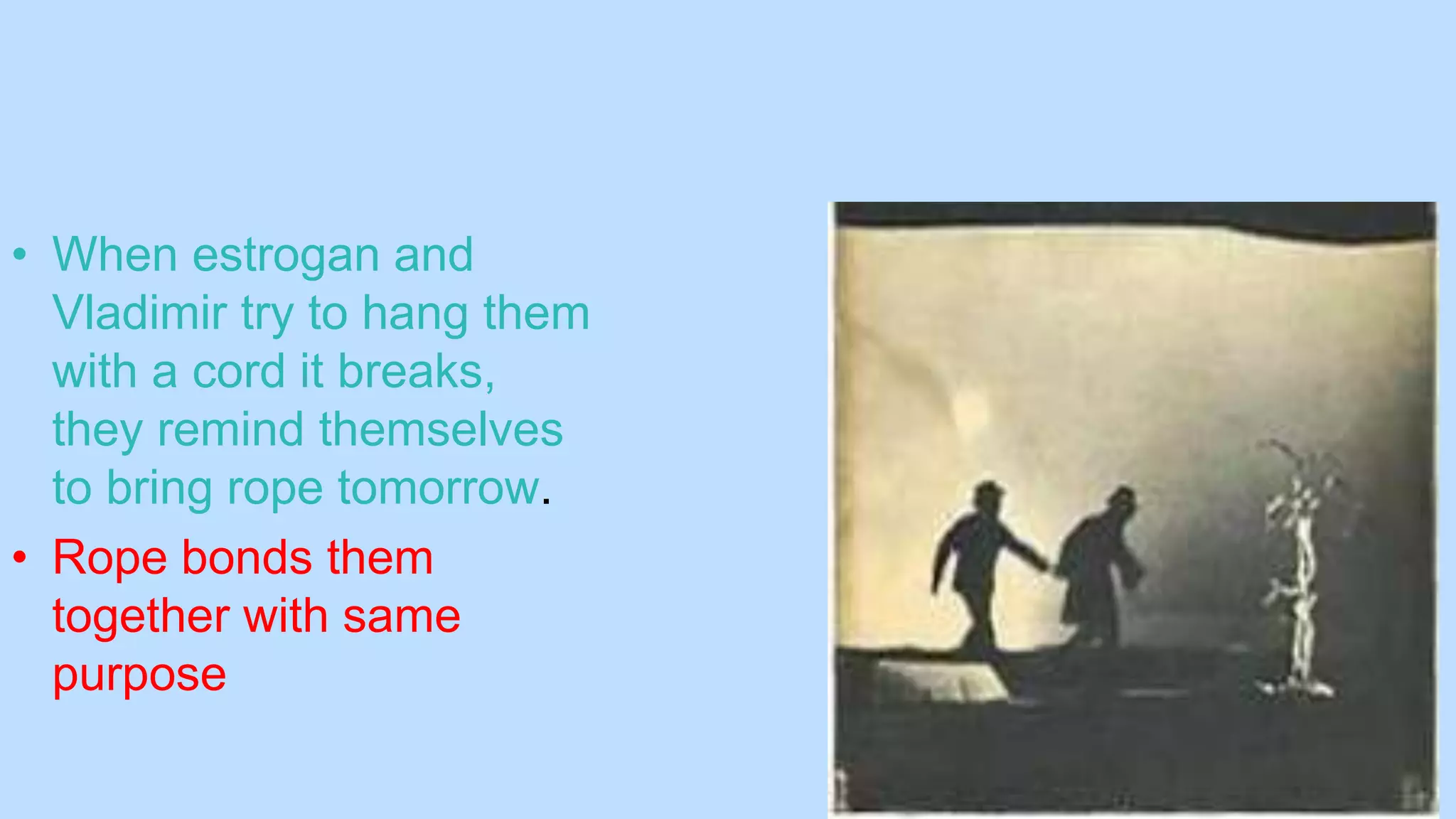
• When estrogan and
Vladimir try to hang them
with a cord it breaks,
they remind themselves
to bring rope tomorrow.
• Rope bonds them
together with same
purpose
Waiting for Godot, use of imagery and symbolims

Waiting for Godot, use of imagery and symbolims

  • 1.
  • 2.
  • 3.
    WHO IS Godot? •Beckett is believed to have said that the name Godot comes from the French "godillot" meaning a military boot. Beckett fought in the war and so spending long periods of time waiting for messages to arrive would have been commonplace for him. The more common interpretation that it might mean "God" is almost certainly wrong. Beckett apparently stated that if he had meant "God," he would have written "God". Godot: it is relatively common name in French
  • 4.
    Vladimir and Estrogan •Vladimir and Estrogan represent entire human race • Through them we are able to discover, how human behave and act • Human existence is seen through absurd conversations which these two man have. Meaningless conversation and action are used to simply ‘’pass time’’
  • 5.
    Tree • The treemay represent the cross on which JESUS crucified , it stand as the symbol of hope, because in the end of play, it has leave.  (Also, if you check out the painting that inspired Beckett, you’ll see that a big tree features prominently.) Right off the bat you’ve got the biblical stuff; Jesus was crucified on a cross, but that cross is sometimes referred to as a "tree," as in, "Jesus was nailed to the tree."
  • 6.
    Hanging • Both character, Vladimir and Estrogan, consider hanging themselves as way out of their situation. They decide against it eventually as they wait in hopes that Godot will resolve their problem.
  • 7.
    A country road,over the span of two nights. Unknown time and place  Wrong palace/wrong time. The tramps are confused about the time and palace where to meet GODOT. This represent their confusion of life itself  . We are never really sure whether act one and act two take place in the same location, other than the fact that Beckett describes it as such in the stage directions.  We also don’t know what lies offstage, since Vladimir and Estragon are always forced back onto the stage in some form or another.  Depending on the design of a production, the set is more or less ornate. Sometimes there is literally nothing else onstage than the actors and the tree.  The effect of Beckett’s minimally described set is that we have absolutely no idea where Vladimir and Estragon are either in time or in place. The past?  The future? Earth? An imaginary place in one of their heads? We just don’t know. It’s almost like uncertainty is a main theme in the play and we as the audience experience it the same way Vladimir and Estragon do.
  • 8.
    Ditch • This mayrefer to the biblical parable of good Samaritan in which a kind traveler helps a man who has been beaten and robbed. No one ever helps Estrogan . His lying in the ditch shows how the friends who have seen better days , are now poor and reduced to violent circumstances
  • 9.
    The Carrot • Thiscarrot is a good comic relief in which both Vladimire and Estrogan can’t agree on the vegetable. No matter what we called it, we will referring to the same thing; Vladimir • Nothing you can do about it. • Estrogan no use wriggling • Vladimir the essential does not change. • At first they were bickering over the way carrot tasted. It doesn’t really matter who is right and who is wrong about the carrot.
  • 10.
    • This symbolizesour questions of reality. We put label on things, but that is not really the way things really are. • We want to see the absolute truth but we can’t.
  • 11.
    The road • Itslike road of life. Just like human life has not clear beginning, the road has no clear ending . • It is things have to be because we are put on this earth as humans, we have no clear sense of purpose
  • 12.
    Vladimir’s song • Vladimirsong: its reflection of how all the action in the play repeat themselves and circular in nature so is this song. • Song in act two, death is a theme
  • 13.
    Pozzo • He seeshimself a superior being. He recognized the tramps as inferior species as myself. ( he burst in enormous laugh) of the same species as pozzo. He is self-absorbed and sees himself ‘’Godlike image’’ pozzo has desire to command and dominate lucky.
  • 14.
    Smell  Estragon isrepeatedly repelled by smells in Waiting for Godot. Vladimir stinks of garlic, Lucky smells like who knows what, and Pozzo reeks of a fart in Act II.  It seems every time Estragon tries to get close to a person, he is repelled by their odor.  It looks to us like smells represent one of the barriers to interpersonal relationships. Estragon isn’t just repelled by odors – he’s repelled by the visceral humanity of those around him.  There’s something gritty and base about the odor of a human body, and for Estragon it’s too much to handle.
  • 15.
    Lucky • He representa pathetic specimen of human race. • He is called ‘’pig’’ and ‘’hog’’ and even ‘’certain’’ by others and yet feel ‘’lucky ’’ to belong to their group and live as a slave while eating scraps which are thrown to him. He wants his master respect like humans, we do what we can do to impress our GOD, to see that we are worth something. • His name is ironic as his fortunate even when his master is blind. •
  • 16.
    Nightfall and theRising Moon  While Vladimir and Estragon wait for Godot, they also wait for nightfall. For some reason (again, arbitrary and uncertain), they don’t have to wait for him once the night has fallen.  The classic interpretation is that night = dark = death. The falling of night is as much a reprieve from daily suffering as death is from the suffering of a lifetime. There’s also the issue of the moon, as its appearance in the sky is the real signal that night has come and the men can stop waiting for Godot.  Estragon, in one of his "wicked smart" moments, comments the moon is "pale for weariness […] of climbing heaven and gazing on the likes of us." Though the man remembers nothing of yesterday, he does in this moment seem to comprehend the endless repetition of his life.  And if the moon is weary just from watching, imagine what that says about the predicament of the men themselves.
  • 17.
    Gogo’s nightmare • Theserepresent discomfort and lack of tranquility of tramps with regards to their situation. They have an inability to laugh
  • 18.
    The HAT • Unexplainedand illogical things happen with the hat • Lucky begins speaking nonsense when puts on hat • Vladimir, and estrogan exchange their hats with lucky many times until Vladimir question, if he looks good in the hat, he has present on • This is no logical reason to this action but it shows humor in the things human do.
  • 19.
    Boot • This isalways put on and take off. When boot is of estrogan look inside and sees nothing, when he puts its boot sees reality, the world and how nothing make any sense. • Estrogan: continuously look inside as a way of passing time. • This shows absurdity in human, because no matter how many times we take to try to figure things out, we miss picture by wasting time on pointless mater.
  • 20.
    The Bone • Thissymbolizes poverty, they do not have enough for themselves to eat. They beg to survive, estrogan and lucky are through order to survive. Estrogan and lucky are deprived of food for while so they are willing to eat anything
  • 21.
    The Bag • Luckycarries bag he never stop to trying to carry. Pozzo doesn’t force lucky this bag but lucky prove himself to his master. He feels as if he carries it around to show his determination and devotion to making pozzo happy.
  • 22.
    The Rope • Luckyis a slave tied to his master . • Pozzo is healthy and o lucky could think the rope try the two together was long, when pozzo was blind and needed lucky who was dumb to guide him rope was short. • This symbolizes how the distance between the god and his slave is great, when god is powerful and healthy. • However, when rope is short the distance between to is smaller, because their greatness is not in contrast as much. •
  • 23.
    • When estroganand Vladimir try to hang them with a cord it breaks, they remind themselves to bring rope tomorrow. • Rope bonds them together with same purpose