Martin Stopford, President
Clarkson Research
RUSI International Sea Power
Conference 1st July 2014
Tanker in convoy Arabian Gulf 1980s
Operation Ocean Shield, Horn of Africa 2013
1. The Trend in Maritime Trade
2. Merchant Shipping’s Economic Relevance
3. Merchant Shipping’s Structure
4. Conclusions
• What makes the business climate so difficult today is that shipping investors must
deal with several major changes taking place simultaneously. What are the
changes, how will they interact and where they might lead?
What is the
Economic
Relevance of
maritime
power?
1
Source: Naval Power in India’s Geopolotics, Humberto Santos Rocha, Rio Jan 2013
The Growth of Sea Trade 1850-2013
0.0
1.0
2.0
3.0
4.0
5.0
6.0
7.0
8.0
9.0
10.0
1850
1860
1870
1880
1890
1900
1910
1920
1930
1940
1950
1960
1970
1980
1990
2000
2010
Billiontonnesseaimports
1950-2013
Sea trade
Grew at
4.3% pa
Source: "Will the next 50 years be as Chaotic in Shipping as
the Last?“ Dr Martin Stopford, Hong Kong Shipowners 50th
Anniversary Jan 2007
Almost all the growth of sea trade has occurred since 1840
First steamships
viable on deep sea
routes appeared in
the 1860s
First steamships in 1830s
(mainly tugs & packets)
Colonial era of sea trade Free trade era of sea trade
1850-1950
Sea trade
Grew at
3.2%pa
Martin Stopford
The Colonial Shipping Era 1850-1950
7/23/2014
Colonies in 1800
Colonies in 1914
•Between 1850 and 1950 the European network of colonies spread
across almost the entire globe
•Colonial trade dominated shipping. It was protective & nationalistic.
•Colonial shipping used ships which were small, interchangeable &
versatile in terms of cargo . It was not very efficient
Martin Stopford
7/23/2014 6
The Global Free Era 1950-2050?
• In the post WW2 era
shipping got much more
efficient
• At Bretton Woods in 1944
US Treasury Secretary Henry
Morgenthau outlined the
objective of creating "a
dynamic world economy ".
• The method was to establish
a new free trade regime
• To assist in achieving this
the World Bank, the IMF
and GATT were founded.
• Multinationals were free to
develop global trade and
they built a maritime
transport system using big,
specialized ships
Delegates at the Bretton Woods
Conference in 1944
“The objective,
gentlemen, is to
create a dynamic
world economy”
Martin Stopford
7/23/2014
Sea Trade Grew Faster Than GDP 1950-2013
0
200
400
600
800
1,000
1,200
1,400
1,600
1,800
2,000
1950
1952
1954
1956
1958
1960
1962
1964
1966
1968
1970
1972
1974
1976
1978
1980
1982
1984
1986
1988
1990
1992
1994
1996
1998
2000
2002
2004
2006
2008
2010
2012
Sea Trade World GDP
Index 1950=100
2013
Sea trade
was 18 times
as big as in
1950
Sea trade grew at
4.3% per annum
World GDP
Grew at average of
3.6% per annum
Figure 3 Sea trade growth followed a different path from GDP
2013
World GDP
was 10 times
as big as in
1950
Martin Stopford
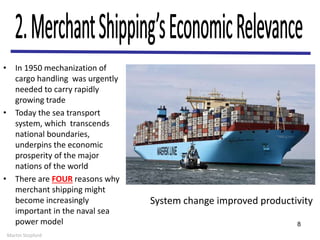
• In 1950 mechanization of
cargo handling was urgently
needed to carry rapidly
growing trade
• Today the sea transport
system, which transcends
national boundaries,
underpins the economic
prosperity of the major
nations of the world
• There are FOUR reasons why
merchant shipping might
become increasingly
important in the naval sea
power model 8
System change improved productivity
Martin Stopford
Reason 1: Unequal Sea Trade Volume
0.20
0.6
0.8
3.80
6.30
7.50
0 1 2 3 4 5 6 7 8 9 10 11 12
Tonnes of sea imports per person a year in
2010
Japan
Europe
N. America
China
S America
Africa
OECD Countries
1.3 billion
Population import
about 5 tonnes per
person
Non OECD Countries
6 billion Non-OECD
population import less
than 1 tonne per person
Martin Stopford
Reason 2: Sea Cargoes Are Indispensable
0 1000 2000 3000 4000 5000
Energy
Metal Industry
Agricultural
Container
Other cargo
Million tonnes of cargo 2012
Crude Oil
Products
Steam Coal
Gas
Iron ore
Coking Coal
Other ores
Agribulks
Containerised
Other2Manufactures & semi-
manufactures
Martin Stopford
0%
10%
20%
30%
40%
50%
60%
70%
80%
90%
100%
1950 1960 1970 1980 1990 2000 2010
Atlantic
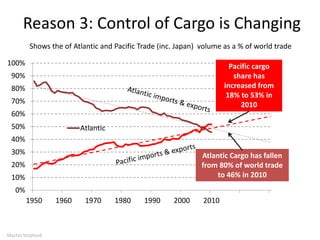
Shows the of Atlantic and Pacific Trade (inc. Japan) volume as a % of world trade
Atlantic Cargo has fallen
from 80% of world trade
to 46% in 2010
Pacific cargo
share has
increased from
18% to 53% in
2010
Reason 3: Control of Cargo is Changing
Martin Stopford
Reason 4: Growth Will Pressure Resources
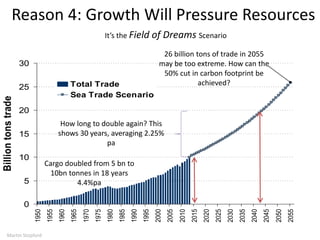
It’s the Field of Dreams Scenario
0
5
10
15
20
25
30
1950
1955
1960
1965
1970
1975
1980
1985
1990
1995
2000
2005
2010
2015
2020
2025
2030
2035
2040
2045
2050
2055
Billiontonstrade
Total Trade
Sea Trade Scenario
26 billion tons of trade in 2055
may be too extreme. How can the
50% cut in carbon footprint be
achieved?
How long to double again? This
shows 30 years, averaging 2.25%
pa
Cargo doubled from 5 bn to
10bn tonnes in 18 years
4.4%pa
Martin Stopford
13
• Containerisation
introduced in 1965
revolutionised the
transport of general
cargo
• Specialised Shipping:
ships designed to
optimise transport of a
specific cargo
• Bulk shipping,
introduced in the 1950s,
revolutionised the
transport of raw
materials
Liner
shipping
Bulk
shipping
Specialized
shipping
Martin Stopford
0 100 200 300 400 500
Dry bulk carriers
Oil Tankers
Combined carrier
Containerships
Ro-Ro
Multipurpose
General cargo
Reefer
Chemical tanker
Vehicle carrier
Liquified Gas
Cruise
Ferries
Offshore
Tugs
Dredgers
Million Gross Tons
Specialised
cargo fleet
(Chapter 12)
Bulk cargo
Fleet
(Chapter 11)
General cargo fleet
(Chapter 13)
Non cargo fleet
(Chapter 12)
Special-
ised
10%
Non
cargo
53%
Bulk
cargo
28%
General
cargo
7%
World fleet by type May 14
(numbers of vessels)
Merchant Fleet 2014 1.1 billion GT, Worth $1 trillion
Source: Maritime Economics 3rd Ed, Martin Stopford, page 68
In June 2014 there are 57,967 cargo ships and 30,668 non-cargo ships
Many Small Shipping Companies
World Fleet by Company Size : For vessels >2,000 GT
Company Size**
Number of
Companies
Number of
Vessels m.GT
% of fleet
(no. ships)
Over 100 ships 22 2,899 141 7%
51-100 ships 101 5,196 184 13%
21-50 ships 373 8,326 300 21%
Medium (11-20) 657 7,405 192 19%
Small (6-10) 999 5,878 125 15%
Small (1-5) 5,577 9,818 167 25%
Total 7,729 39,522 1,109
*Based on Beneficial Owner, excludes unknown owners
**Company size based on full fleet >100 GT
Martin Stopford
77% of Tonnage is “Flagged Out”
• 1.2 billion DWT of
“flagged out” tonnage
• 77% of the merchant
fleet is now registered
offshore
• Up from 42% at the end
of the 1980s (see chart)
• Shipping now a global
business
National & Foreign Flag Fleets M DWT
0
200
400
600
800
1,000
1,200
1,400
1989
1991
1993
1995
1997
1999
2001
2003
2005
2007
2009
2011
2013
National Flag
Foreign Flag
Move to offshore
flag accelerates
in 2000s boom
National flag registrations pretty static
Martin Stopford
0 50 100 150 200 250 300
Panama
Liberia
Marshall Is
Hong Kong
Singapore
Bahamas
China PR
Malta
Greece
Cyprus
Million Gross Tons
Top 10 Flag States – Not Many Navies!
Top 10
Flags
73%
The rest
27%
World Fleet M GT
Martin Stopford
Top 10 Fleets By Owner Nationality
-
20
40
60
80
100
120
140
160
180
1996
1997
1998
1999
2000
2001
2002
2003
2004
2005
2006
2007
2008
2009
2010
2011
2012
2013
2014
Greece Japan China P.R.
Germany South Korea United States
Norway Singapore Italy
Denmark
Based on the nationality of the shipowner, not the flag of the ship
1. Greece
2. Japan
3. China
4. Germany
5. S Korea
6. USA
Martin Stopford
Piracy Activity 2008-2014
0
5
10
15
20
25
30
35
Jan-08
Jan-09
Jan-10
Jan-11
Jan-12
Jan-13
Jan-14
Numberofvesselsinmonth
Vessels captured
Escaped
Vessels held (end month)
5 ships
captured
by pirates
in 2014
62
unsuccessful
attempts
So far in
2014
Updated June 2014 from Piracy stats June 2014 spreadsheet
Unaudited data collected by Clarkson Research – only a rough guide to activity levels
Martin Stopford
1. Since 1950 merchant shipping has built a highly efficient
sea transport system.
2. The trade in fuel, minerals, food, intermediates and
manufactures is so integrated that the world economy
cannot operate for long without it.
3. To carry this trade merchant shipping depends on open
seaways and safe passage.
4. Over the last 50 years this has not been a problem
because the trading environment has been stable.
5. Today the framework of trade is changing as the
epicentre moves to the Non-OECD countries and more
pressure on resources, leading to new trade scenarios.
6. Recent piracy activity has raised legal & security issues
which are still unresolved.
7. Bottom line – I believe sea transport belongs in the big
league of strategic risks, alongside the global financial
system and climate change.
Today there is
one global
economy &
sea trade is at
its core
Martin Stopford

Dr Martin Stopford

  • 1.
    Martin Stopford, President ClarksonResearch RUSI International Sea Power Conference 1st July 2014 Tanker in convoy Arabian Gulf 1980s Operation Ocean Shield, Horn of Africa 2013
  • 2.
    1. The Trendin Maritime Trade 2. Merchant Shipping’s Economic Relevance 3. Merchant Shipping’s Structure 4. Conclusions • What makes the business climate so difficult today is that shipping investors must deal with several major changes taking place simultaneously. What are the changes, how will they interact and where they might lead? What is the Economic Relevance of maritime power? 1
  • 3.
    Source: Naval Powerin India’s Geopolotics, Humberto Santos Rocha, Rio Jan 2013
  • 4.
    The Growth ofSea Trade 1850-2013 0.0 1.0 2.0 3.0 4.0 5.0 6.0 7.0 8.0 9.0 10.0 1850 1860 1870 1880 1890 1900 1910 1920 1930 1940 1950 1960 1970 1980 1990 2000 2010 Billiontonnesseaimports 1950-2013 Sea trade Grew at 4.3% pa Source: "Will the next 50 years be as Chaotic in Shipping as the Last?“ Dr Martin Stopford, Hong Kong Shipowners 50th Anniversary Jan 2007 Almost all the growth of sea trade has occurred since 1840 First steamships viable on deep sea routes appeared in the 1860s First steamships in 1830s (mainly tugs & packets) Colonial era of sea trade Free trade era of sea trade 1850-1950 Sea trade Grew at 3.2%pa Martin Stopford
  • 5.
    The Colonial ShippingEra 1850-1950 7/23/2014 Colonies in 1800 Colonies in 1914 •Between 1850 and 1950 the European network of colonies spread across almost the entire globe •Colonial trade dominated shipping. It was protective & nationalistic. •Colonial shipping used ships which were small, interchangeable & versatile in terms of cargo . It was not very efficient Martin Stopford
  • 6.
    7/23/2014 6 The GlobalFree Era 1950-2050? • In the post WW2 era shipping got much more efficient • At Bretton Woods in 1944 US Treasury Secretary Henry Morgenthau outlined the objective of creating "a dynamic world economy ". • The method was to establish a new free trade regime • To assist in achieving this the World Bank, the IMF and GATT were founded. • Multinationals were free to develop global trade and they built a maritime transport system using big, specialized ships Delegates at the Bretton Woods Conference in 1944 “The objective, gentlemen, is to create a dynamic world economy” Martin Stopford
  • 7.
    7/23/2014 Sea Trade GrewFaster Than GDP 1950-2013 0 200 400 600 800 1,000 1,200 1,400 1,600 1,800 2,000 1950 1952 1954 1956 1958 1960 1962 1964 1966 1968 1970 1972 1974 1976 1978 1980 1982 1984 1986 1988 1990 1992 1994 1996 1998 2000 2002 2004 2006 2008 2010 2012 Sea Trade World GDP Index 1950=100 2013 Sea trade was 18 times as big as in 1950 Sea trade grew at 4.3% per annum World GDP Grew at average of 3.6% per annum Figure 3 Sea trade growth followed a different path from GDP 2013 World GDP was 10 times as big as in 1950 Martin Stopford
  • 8.
    • In 1950mechanization of cargo handling was urgently needed to carry rapidly growing trade • Today the sea transport system, which transcends national boundaries, underpins the economic prosperity of the major nations of the world • There are FOUR reasons why merchant shipping might become increasingly important in the naval sea power model 8 System change improved productivity Martin Stopford
  • 9.
    Reason 1: UnequalSea Trade Volume 0.20 0.6 0.8 3.80 6.30 7.50 0 1 2 3 4 5 6 7 8 9 10 11 12 Tonnes of sea imports per person a year in 2010 Japan Europe N. America China S America Africa OECD Countries 1.3 billion Population import about 5 tonnes per person Non OECD Countries 6 billion Non-OECD population import less than 1 tonne per person Martin Stopford
  • 10.
    Reason 2: SeaCargoes Are Indispensable 0 1000 2000 3000 4000 5000 Energy Metal Industry Agricultural Container Other cargo Million tonnes of cargo 2012 Crude Oil Products Steam Coal Gas Iron ore Coking Coal Other ores Agribulks Containerised Other2Manufactures & semi- manufactures Martin Stopford
  • 11.
    0% 10% 20% 30% 40% 50% 60% 70% 80% 90% 100% 1950 1960 19701980 1990 2000 2010 Atlantic Shows the of Atlantic and Pacific Trade (inc. Japan) volume as a % of world trade Atlantic Cargo has fallen from 80% of world trade to 46% in 2010 Pacific cargo share has increased from 18% to 53% in 2010 Reason 3: Control of Cargo is Changing Martin Stopford
  • 12.
    Reason 4: GrowthWill Pressure Resources It’s the Field of Dreams Scenario 0 5 10 15 20 25 30 1950 1955 1960 1965 1970 1975 1980 1985 1990 1995 2000 2005 2010 2015 2020 2025 2030 2035 2040 2045 2050 2055 Billiontonstrade Total Trade Sea Trade Scenario 26 billion tons of trade in 2055 may be too extreme. How can the 50% cut in carbon footprint be achieved? How long to double again? This shows 30 years, averaging 2.25% pa Cargo doubled from 5 bn to 10bn tonnes in 18 years 4.4%pa Martin Stopford
  • 13.
    13 • Containerisation introduced in1965 revolutionised the transport of general cargo • Specialised Shipping: ships designed to optimise transport of a specific cargo • Bulk shipping, introduced in the 1950s, revolutionised the transport of raw materials Liner shipping Bulk shipping Specialized shipping Martin Stopford
  • 14.
    0 100 200300 400 500 Dry bulk carriers Oil Tankers Combined carrier Containerships Ro-Ro Multipurpose General cargo Reefer Chemical tanker Vehicle carrier Liquified Gas Cruise Ferries Offshore Tugs Dredgers Million Gross Tons Specialised cargo fleet (Chapter 12) Bulk cargo Fleet (Chapter 11) General cargo fleet (Chapter 13) Non cargo fleet (Chapter 12) Special- ised 10% Non cargo 53% Bulk cargo 28% General cargo 7% World fleet by type May 14 (numbers of vessels) Merchant Fleet 2014 1.1 billion GT, Worth $1 trillion Source: Maritime Economics 3rd Ed, Martin Stopford, page 68 In June 2014 there are 57,967 cargo ships and 30,668 non-cargo ships
  • 15.
    Many Small ShippingCompanies World Fleet by Company Size : For vessels >2,000 GT Company Size** Number of Companies Number of Vessels m.GT % of fleet (no. ships) Over 100 ships 22 2,899 141 7% 51-100 ships 101 5,196 184 13% 21-50 ships 373 8,326 300 21% Medium (11-20) 657 7,405 192 19% Small (6-10) 999 5,878 125 15% Small (1-5) 5,577 9,818 167 25% Total 7,729 39,522 1,109 *Based on Beneficial Owner, excludes unknown owners **Company size based on full fleet >100 GT Martin Stopford
  • 16.
    77% of Tonnageis “Flagged Out” • 1.2 billion DWT of “flagged out” tonnage • 77% of the merchant fleet is now registered offshore • Up from 42% at the end of the 1980s (see chart) • Shipping now a global business National & Foreign Flag Fleets M DWT 0 200 400 600 800 1,000 1,200 1,400 1989 1991 1993 1995 1997 1999 2001 2003 2005 2007 2009 2011 2013 National Flag Foreign Flag Move to offshore flag accelerates in 2000s boom National flag registrations pretty static Martin Stopford
  • 17.
    0 50 100150 200 250 300 Panama Liberia Marshall Is Hong Kong Singapore Bahamas China PR Malta Greece Cyprus Million Gross Tons Top 10 Flag States – Not Many Navies! Top 10 Flags 73% The rest 27% World Fleet M GT Martin Stopford
  • 18.
    Top 10 FleetsBy Owner Nationality - 20 40 60 80 100 120 140 160 180 1996 1997 1998 1999 2000 2001 2002 2003 2004 2005 2006 2007 2008 2009 2010 2011 2012 2013 2014 Greece Japan China P.R. Germany South Korea United States Norway Singapore Italy Denmark Based on the nationality of the shipowner, not the flag of the ship 1. Greece 2. Japan 3. China 4. Germany 5. S Korea 6. USA Martin Stopford
  • 19.
    Piracy Activity 2008-2014 0 5 10 15 20 25 30 35 Jan-08 Jan-09 Jan-10 Jan-11 Jan-12 Jan-13 Jan-14 Numberofvesselsinmonth Vesselscaptured Escaped Vessels held (end month) 5 ships captured by pirates in 2014 62 unsuccessful attempts So far in 2014 Updated June 2014 from Piracy stats June 2014 spreadsheet Unaudited data collected by Clarkson Research – only a rough guide to activity levels Martin Stopford
  • 20.
    1. Since 1950merchant shipping has built a highly efficient sea transport system. 2. The trade in fuel, minerals, food, intermediates and manufactures is so integrated that the world economy cannot operate for long without it. 3. To carry this trade merchant shipping depends on open seaways and safe passage. 4. Over the last 50 years this has not been a problem because the trading environment has been stable. 5. Today the framework of trade is changing as the epicentre moves to the Non-OECD countries and more pressure on resources, leading to new trade scenarios. 6. Recent piracy activity has raised legal & security issues which are still unresolved. 7. Bottom line – I believe sea transport belongs in the big league of strategic risks, alongside the global financial system and climate change. Today there is one global economy & sea trade is at its core Martin Stopford